The best binoculars in 2026, by use and budget
Quick answer: the best binocular for most people is the Vortex Diamondback HD 10x42 (around $220). It pairs HD glass with dielectric and phase-corrected roof prisms at 21.3 oz and is backed by Vortex's unconditional lifetime VIP warranty. What sets it ahead of its own 8x42 sibling below, in our editorial judgement, is 10x reach for open country while still focusing down to 5 ft, and a deeper owner record on OpticsPlanet: 47 reviews at 4.9/5, against 20 reviews at 4.9/5 for the Diamondback HD 8x42. If birding or dawn and dusk viewing matter more to you than reach, the 8x42 is the better buy. On a budget, the Vortex Triumph HD 10x42 (around $100) keeps the same prism coatings and gives 17 mm of eye relief, 2 mm more than the Diamondback HD 10x42. For premium glass, the Vortex Razor HD 10x42 (around $1,000) tied a Leica Trinovid 8x42 on brightness and resolution in one owner's three-day group comparison.
For birding and dusk choose the 8x42, for a pocket the Zeiss 8x25, for distance the 12x50: all below. Prices verified October 14, 2026; confirm the current price and availability on the retailer page.
The best binocular is the one that matches what you look at, when you look at it and how far you carry it. Below are six picks for the common needs, each with honest pros and cons, followed by a route to every binocular guide we have, by use, a short guide to the brands we cover, and how to choose.
How we reviewed them: a research-based roundup built from the makers' published specifications, the retailer listings and the OpticsPlanet owner-review record, with every owner quote taken word for word from the retailer's review pages. We have not used these binoculars ourselves; scores are our editorial opinion, and owner ratings are shown attributed to their source. See how we evaluate.
Quick comparison
| Pick | Category | Format and weight | Exit pupil (our arithmetic) | Eye relief | Close focus | Price |
|---|---|---|---|---|---|---|
| Vortex Diamondback HD 10x42 | Best binoculars overall | 10x42 · 21.3 oz | 4.2 mm | 15 mm | 5 ft | around $220 |
| Vortex Triumph HD 10x42 | Best budget binoculars | 10x42 · 22.9 oz | 4.2 mm | 17 mm | 15.3 ft | around $100 |
| Vortex Diamondback HD 8x42 | Best for birding and dusk | 8x42 · 21.8 oz | 5.25 mm | 17 mm | 5 ft | around $200 |
| Zeiss Terra ED Pocket 8x25 | Best compact | 8x25 · 10.9 oz | 3.13 mm | 16 mm | 6.2 ft | around $400 |
| Vortex Diamondback HD 12x50 | Best for long distance | 12x50 · 28.9 oz | 4.17 mm | 14 mm | 6 ft | around $280 |
| Vortex Razor HD 10x42 | Best premium | 10x42 · 24.8 oz | 4.2 mm | 16.5 mm | 6 ft | around $1,000 |
Exit pupil is the objective divided by the magnification, computed by us; it governs how bright the image looks once your own pupil opens wide at dawn and dusk. The twilight factor some cards list is the square root of magnification times objective, and it rates how much detail you can make out in dim light, not how bright the image looks: that is why a 10x42 scores higher than an 8x42 while the 8x42 shows the brighter image. Other specifications are the makers' and the retailer's as carried on each card below.
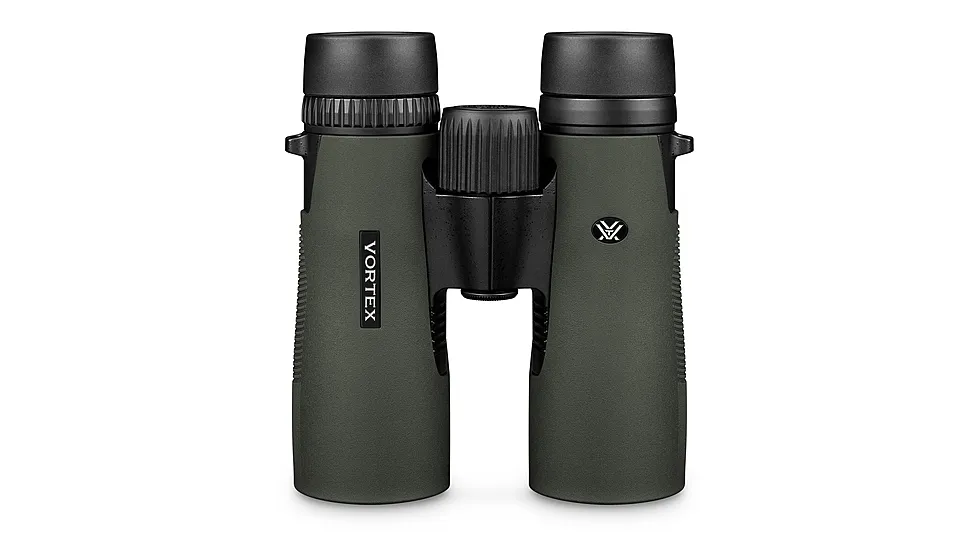
Best binoculars overall: Vortex Diamondback HD 10x42
Roof prism · 10x42 · HD glass · phase-corrected + dielectric · 21.3 oz
around $220exact price on OpticsPlanet
This is the binocular we would point most people to first. Against the Diamondback HD 8x42 below, which shares its HD optical system, prism coatings and 5 ft close focus, it gives up some field of view and some brightness at dawn and dusk for 10x reach across open country, and it carries the deeper owner record on OpticsPlanet. The retailer lists 10x magnification on a 42 mm objective, a 330 ft field of view at 1000 yards and a 5 ft close focus at 21.3 oz, and its feature list adds Vortex's HD optical system, dielectric prism coatings, phase correction and argon purging. That combination lets one pair glass a field edge across open ground and then watch a feeder a few steps away: one owner uses theirs primarily for watching their bird feeder, while the most helpful positive review on the listing was written by a hunter who says they perform even on foggy mornings. One owner who compared it with their Nikon ProStaff 3s and 7s found it much smaller than the 7s with a slightly brighter picture, and said that if going hunting they would most likely carry the Diamondbacks because of the smaller size. The one number to check is eye relief: at 15 mm it is tighter than the 17 mm of the Triumph HD and the Diamondback HD 8x42 below, so thick-lensed glasses wearers should start with those.
Pros
- HD optical system with dielectric prism coatings and phase correction on the roof prisms, at 21.3 oz
- A 5 ft close focus, so the same pair works for near wildlife and feeder birds as well as long glassing
- An owner comparing it with their Nikon ProStaff 7s found it slightly brighter in a much smaller body
- Vortex VIP warranty: unconditional, lifetime and transferable, including accidental damage
Cons
- 15 mm eye relief is tighter than the Triumph HD and the Diamondback HD 8x42 (17 mm each), the one specification to check if you wear thick glasses
- Stiff rubber on the eyecups, raised by an owner who found their Nikon eyecups more comfortable
- One owner calls the included harness "pretty much useless", while rating the neck strap and the case fine
- At 10x the view is narrower than at 8x: 330 ft at 1000 yards against the Diamondback HD 8x42's 393 ft
Best for: most buyers who want one full-size binocular for hunting, hiking, wildlife and the backyard. Wear thick glasses? Look at the Triumph HD or the 8x42 below for 17 mm of eye relief.
Key specifications
| Magnification | 10x |
|---|---|
| Objective lens | 42 mm |
| Prism | Roof, BAK4, phase-corrected + dielectric |
| Glass | HD optical system, fully multi-coated |
| Eye relief | 15 mm |
| Exit pupil | 4.2 mm (42 divided by 10, matches the retailer figure) |
| Field of view | 330 ft at 1000 yds (6.3 degrees) |
| Close focus | 5 ft |
| Twilight factor | 20.5 |
| Diopter | -4 to +4 dpt |
| Interpupillary distance | 55 to 73 mm |
| Weight | 21.3 oz |
| Length | 5.7 in |
| Sealing | Argon gas purged; waterproof, fogproof, shockproof |
| Warranty | Vortex VIP: unconditional, lifetime, transferable |
| MPN carded | DB-215 (green) |
“The Vortex Diamondbacks impressed me because they are much smaller than my 7s, slightly smaller than my 3s, but have a slightly brighter picture than my Prostaff 7s.”
Jon, verified owner (AR) via OpticsPlanet, comparing it with their Nikon ProStaff 3s and 7s
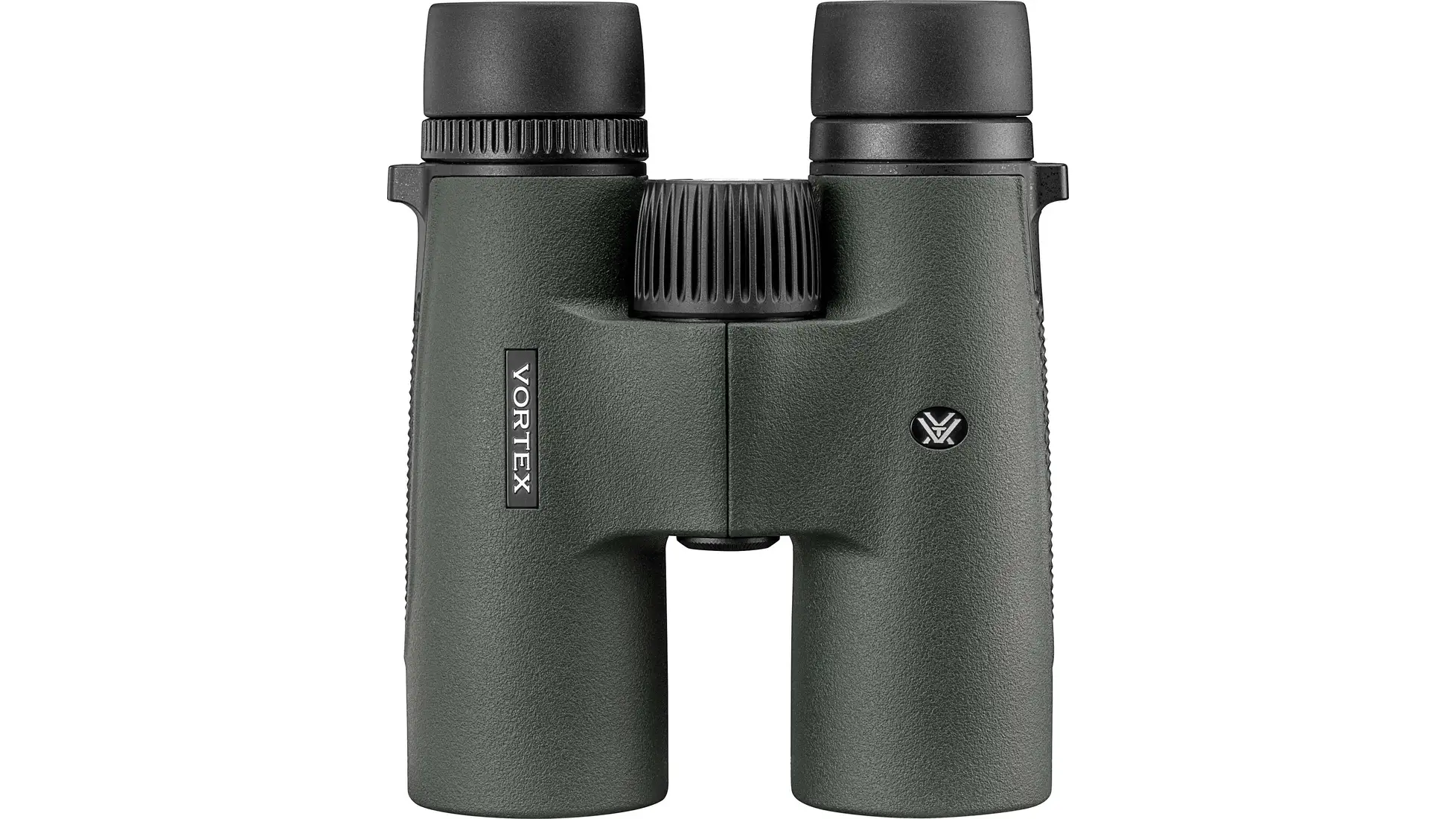
Best budget binoculars: Vortex Triumph HD 10x42
Roof prism · 10x42 · HD glass · phase-corrected + dielectric · 22.9 oz
around $100exact price on OpticsPlanet
This is the budget pick, and its feature list reads like a dearer binocular's: an HD optical system, dielectric prism coatings and phase correction on the roof prisms, ArmorTek on the exterior lenses, argon purging and O-ring seals. The box holds a GlassPak harness and case, a neck strap, tethered objective covers, eyepiece covers and a lens cloth, so there is nothing else to buy. Its 17 mm of eye relief is 2 mm more than the Diamondback HD 10x42 gives you, and the Vortex VIP warranty is the same unconditional, lifetime one. One owner titled their review "The budget diamondback hd" and reports that their brother, who has the Diamondback HD, picked the Triumph up and said "I wish these were out when I bought mine, I see no major difference." What you give up is close focus: at 15.3 ft it is about three times the Diamondback HD's 5 ft, so this is a binocular for looking across a field, not at a feeder.
Pros
- HD optical system with dielectric prism coatings and phase correction, the same coating pair as the Diamondback HD
- 17 mm eye relief, 2 mm more than the Diamondback HD 10x42
- GlassPak harness and case, neck strap, tethered objective covers and lens cloth in the box
- Vortex VIP warranty: unconditional, lifetime, fully transferable, no registration or receipt
Cons
- The objective lens covers work loose: two owners report it, and one lost a cover while walking
- A 15.3 ft close focus is poor for feeder birds, butterflies or anything close in
- The most helpful critical review found the holes on a 100-yard target very difficult to see handheld and says it needs a tripod for better stability
- At 22.9 oz it is 1.6 oz heavier than the Diamondback HD 10x42
Best for: a first serious binocular, a truck or pack pair, or anyone on a tight budget. Step up to the Diamondback HD for a much closer focus and a lighter body.
Key specifications
| Magnification | 10x |
|---|---|
| Objective lens | 42 mm |
| Prism | Roof, BAK-4, phase-corrected + dielectric |
| Glass | HD optical system, fully multi-coated, ArmorTek exterior lens coating |
| Eye relief | 17 mm |
| Exit pupil | 4.2 mm |
| Field of view | 334 ft at 1000 yds |
| Close focus | 15.3 ft |
| Diopter | -5 to +5 dpt |
| Interpupillary distance | 55 to 75 mm |
| Weight | 22.9 oz |
| Length | 6.1 in |
| Sealing | Argon gas purged, O-ring sealed; waterproof, fogproof, shockproof |
| In the box | GlassPak harness + case, neck strap, objective and eyepiece covers, lens cloth |
| Warranty | Vortex VIP: unconditional, lifetime, transferable |
| MPN carded | TRI-1042 |
“I always hesitate purchasing binoculars at low prices... but these work like high price binos, very surprised and impressed.”
Raymond Washburn, verified owner (CA) via OpticsPlanet
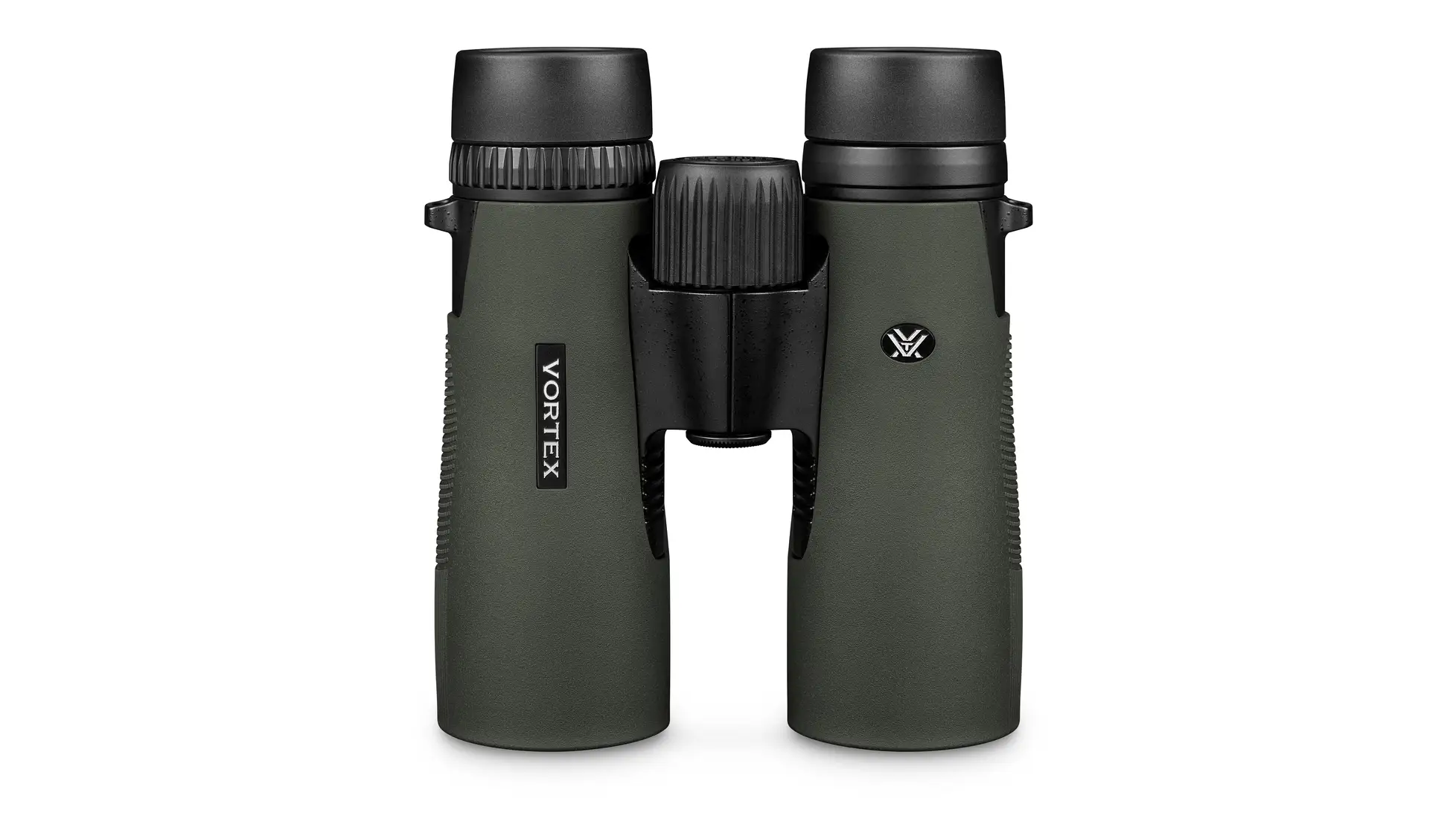
Best for birding and dusk: Vortex Diamondback HD 8x42
Roof prism · 8x42 · HD glass · 393 ft field of view · 21.8 oz
around $200exact price on OpticsPlanet
Choose 8x over 10x and you trade a little reach for a wider, steadier and, at the edges of the day, brighter view, and this is the 8x42 we would buy. The retailer lists a 393 ft field of view at 1000 yards against 330 ft on the Diamondback HD 10x42, which makes a moving bird easier to find and follow, with the same 5 ft close focus and 17 mm of eye relief. Its exit pupil is 5.25 mm (42 divided by 8) against 4.2 mm on any 10x42, so at true dawn and dusk, when your own pupil opens wide, it delivers the brighter image. Owners bought it for exactly this: one bought a pair so their wife has her own for birding, and the most helpful positive review chose the 8x42 because it would be handheld and found far less shaking than with higher-magnification binoculars. The box carries a GlassPak case and harness, a neck strap, tethered objective covers and a rainguard, under the same Vortex VIP warranty.
Pros
- 393 ft field of view at 1000 yards, against 330 ft on the Diamondback HD 10x42
- 5.25 mm exit pupil (42 divided by 8), so a brighter image than any 10x42 at dawn and dusk
- 5 ft close focus and 17 mm eye relief
- GlassPak case and harness, neck strap, tethered objective covers and rainguard in the box, plus the Vortex VIP warranty
Cons
- Less reach than a 10x: distant detail is smaller in the view, which matters across open country
- One owner wished the neck strap unhooked so they could switch to a shoulder strap
- At 21.8 oz it is half an ounce heavier than the Diamondback HD 10x42
Best for: birding, wildlife watching at dawn and dusk, safari and anyone who wants the steadiest wide view in the hand. Choose the 10x42 above if you mostly glass across open ground.
Key specifications
| Magnification | 8x |
|---|---|
| Objective lens | 42 mm |
| Prism | Roof, BAK4, phase-corrected + dielectric |
| Glass | HD optical system, fully multi-coated, ArmorTek exterior lens coating |
| Eye relief | 17 mm |
| Exit pupil | 5.25 mm (42 divided by 8; the retailer lists 5.2 mm) |
| Field of view | 393 ft at 1000 yds (7.5 degrees) |
| Close focus | 5 ft |
| Twilight factor | 18.3 |
| Interpupillary distance | 55 to 73 mm |
| Weight | 21.8 oz |
| Sealing | Argon gas purged, O-ring sealed; waterproof, fogproof, shockproof |
| In the box | GlassPak case + harness, comfort neck strap, tethered objective covers, rainguard, lens cloth |
| Warranty | Vortex VIP: unlimited lifetime, fully transferable, no receipt needed |
“Was debating the 8 and 10 power, don't regret the 8 at all!”
Matt, verified owner (CA) via OpticsPlanet
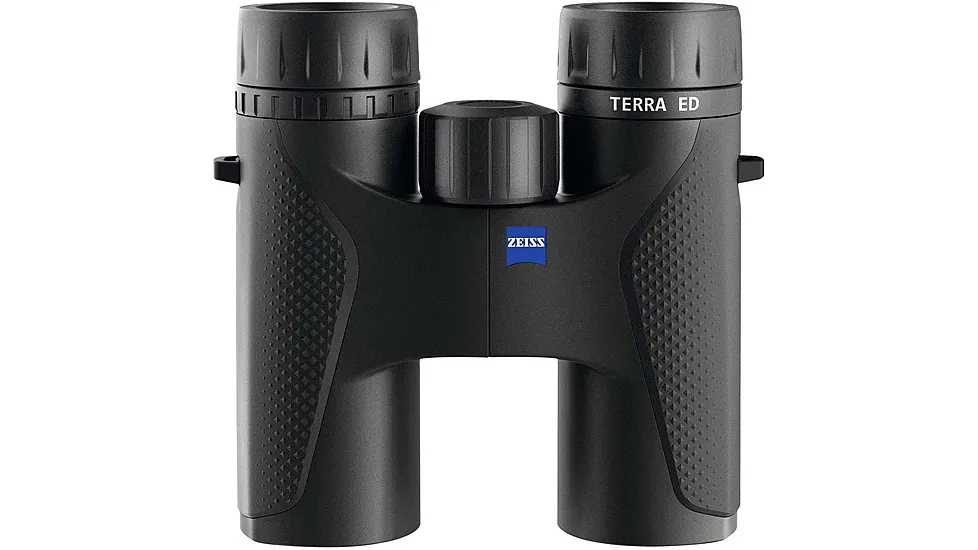
Best compact: Zeiss Terra ED Pocket 8x25
Schmidt-Pechan roof · 8x25 · ED glass · 88% transmission (Zeiss) · 10.9 oz
around $400exact price on OpticsPlanet
If the binocular has to live in a jacket pocket, this is the one. Zeiss's own product page lists ED objective glass, 88 percent light transmission, hydrophobic ZEISS MC coatings, waterproofing to 100 mbar and nitrogen filling, and its figures match the retailer's: 10.9 oz, a 357 ft field of view at 1000 yards and 16 mm of eye relief, with a 6.2 ft close focus on the retailer's table. The best evidence that it is more than a toy is an owner test: one owner put a standard eye chart at 50 yards and read down to the same 10/40 line through this 8x25 as through a Nikon Monarch 7 8x42, finding it slightly easier with the Zeiss; on trees 50 to 200 yards away they found not much difference, with the edge going to the 8x42 and its wider view. The price of the small size is light: a 3.1 mm exit pupil (25 divided by 8) cannot match a 42 mm binocular at dusk.
Pros
- ED objective glass and 88 percent light transmission, as Zeiss publishes it
- 10.9 oz with a 357 ft field of view at 1000 yards
- 16 mm eye relief, and one owner reports seeing most of the field of view with glasses on
- 6.2 ft close focus, short enough for near birds and insects
- Waterproof to 100 mbar and nitrogen-filled, under a Zeiss transferable limited lifetime warranty
Cons
- The diopter wheel has no witness marks, so a bumped setting has to be found again
- A 3.1 mm exit pupil: dimmer than any 42 mm binocular here at dawn and dusk
- Owners split on depth of field: one found it smaller than expected, another calls it comfortable
Best for: travel, hiking and daytime wildlife when the binocular has to go everywhere. Skip it for dusk hunting or astronomy, where a 25 mm objective cannot gather enough light.
Key specifications
| Magnification | 8x |
|---|---|
| Objective lens | 25 mm |
| Prism | Schmidt-Pechan roof |
| Glass | ED (extra-low dispersion) objectives, hydrophobic ZEISS MC coating |
| Light transmission | 88% (manufacturer figure) |
| Eye relief | 16 mm |
| Exit pupil | 3.1 mm |
| Field of view | 357 ft at 1000 yds |
| Close focus | 6.2 ft |
| Weight | 10.9 oz |
| Length | 4.4 in |
| Body | Fiberglass-reinforced casing (Zeiss) |
| Sealing | Waterproof to 100 mbar, nitrogen-filled |
| Operating range | +5 to +140 F (Zeiss) |
| Warranty | Zeiss transferable limited lifetime warranty |
“As it turns out, I like the Terra better than all the others except the Ultravids. However, the Terra Ed are less than 1/2 the cost.”
Ike (MN) via OpticsPlanet, after comparing pocket Swarovski, Zeiss Victory, Leica Trinovid and Leica Ultravid models
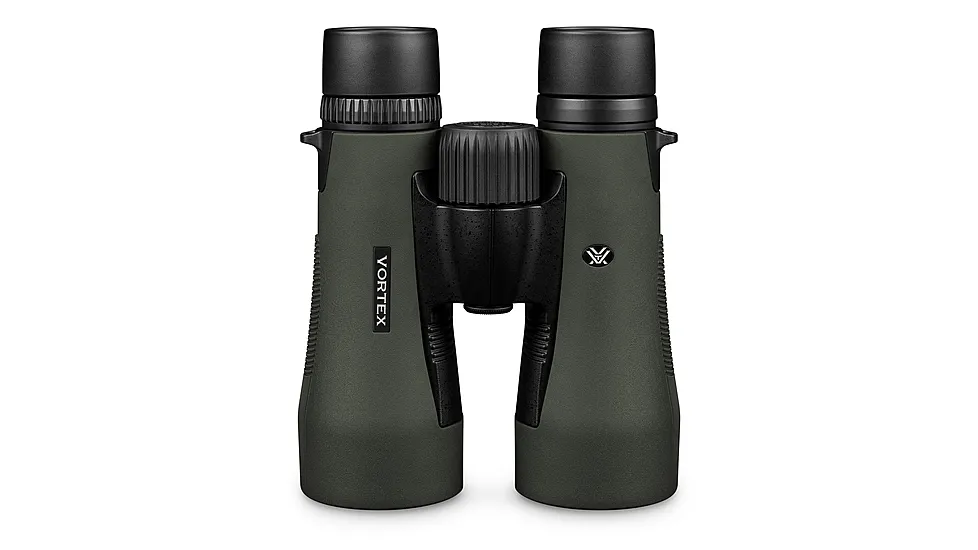
Best for long distance: Vortex Diamondback HD 12x50
Roof prism · 12x50 · HD glass · phase-corrected + dielectric · 28.9 oz
around $280exact price on OpticsPlanet
When the job is reading detail far away, from a field edge, a stand or a ridge, more magnification earns its weight, and this is the 12x we would start with. It keeps the Diamondback HD recipe, an HD optical system with dielectric prism coatings and phase correction, argon purged and O-ring sealed, and puts 12x magnification on a 50 mm objective. One owner who hunts deer over fields where you can easily see 1000 yards says it makes the big ones easy to pick out even that far away. Two things to know before you buy. The bigger objective feeds a bigger magnification, so the exit pupil is 4.2 mm (50 divided by 12), the same as a 10x42: it shows more detail, not a brighter image at dusk. And 12x magnifies hand shake as faithfully as the view, so it is at its best braced or on a tripod, which the retailer lists it as adaptable to.
Pros
- 12x magnification, the most reach of these picks
- HD optical system with dielectric prism coatings and phase correction, argon purged and O-ring sealed
- Tripod adaptable for steady high-power glassing
- GlassPak case and harness, neck strap, tethered objective covers and rainguard in the box, plus the Vortex VIP warranty
Cons
- Heavy at 28.9 oz, 7.6 oz more than the Diamondback HD 10x42
- 12x amplifies hand shake, so it wants a brace or a tripod for steady viewing
- A 271 ft field of view at 1000 yards, so close or fast subjects are harder to find than with a 10x or 8x
- 14 mm eye relief, marginal for eyeglass wearers
- Not brighter at dusk than a 10x42: the exit pupil is the same 4.2 mm
Best for: open country, stands and vantage points, and glassing from a tripod. Choose the 10x42 above if you carry the binocular in your hands all day.
Key specifications
| Magnification | 12x |
|---|---|
| Objective lens | 50 mm |
| Prism | Roof, BAK-4, phase-corrected + dielectric |
| Glass | HD optical system, fully multi-coated, ArmorTek exterior lens coating |
| Eye relief | 14 mm |
| Exit pupil | 4.2 mm (50 divided by 12 is 4.17) |
| Field of view | 271 ft at 1000 yds (5.2 degrees) |
| Close focus | 6 ft |
| Interpupillary distance | 60 to 75 mm |
| Weight | 28.9 oz |
| Length | 6.4 in |
| Body | Magnesium alloy, rubber, aluminum (retailer) |
| Sealing | Argon gas purged, O-ring sealed; waterproof, fogproof, shockproof |
| In the box | GlassPak case + harness, comfort neck strap, tethered objective covers, rainguard, lens cloth |
| Warranty | Vortex VIP: unlimited, unconditional, lifetime |
“We have a few stands set up on fields that you can easily see 1000 yards. These binoculars make it easy to pick out the big guys even that far away.”
Darin (MI) via OpticsPlanet, who uses them mostly for deer hunting
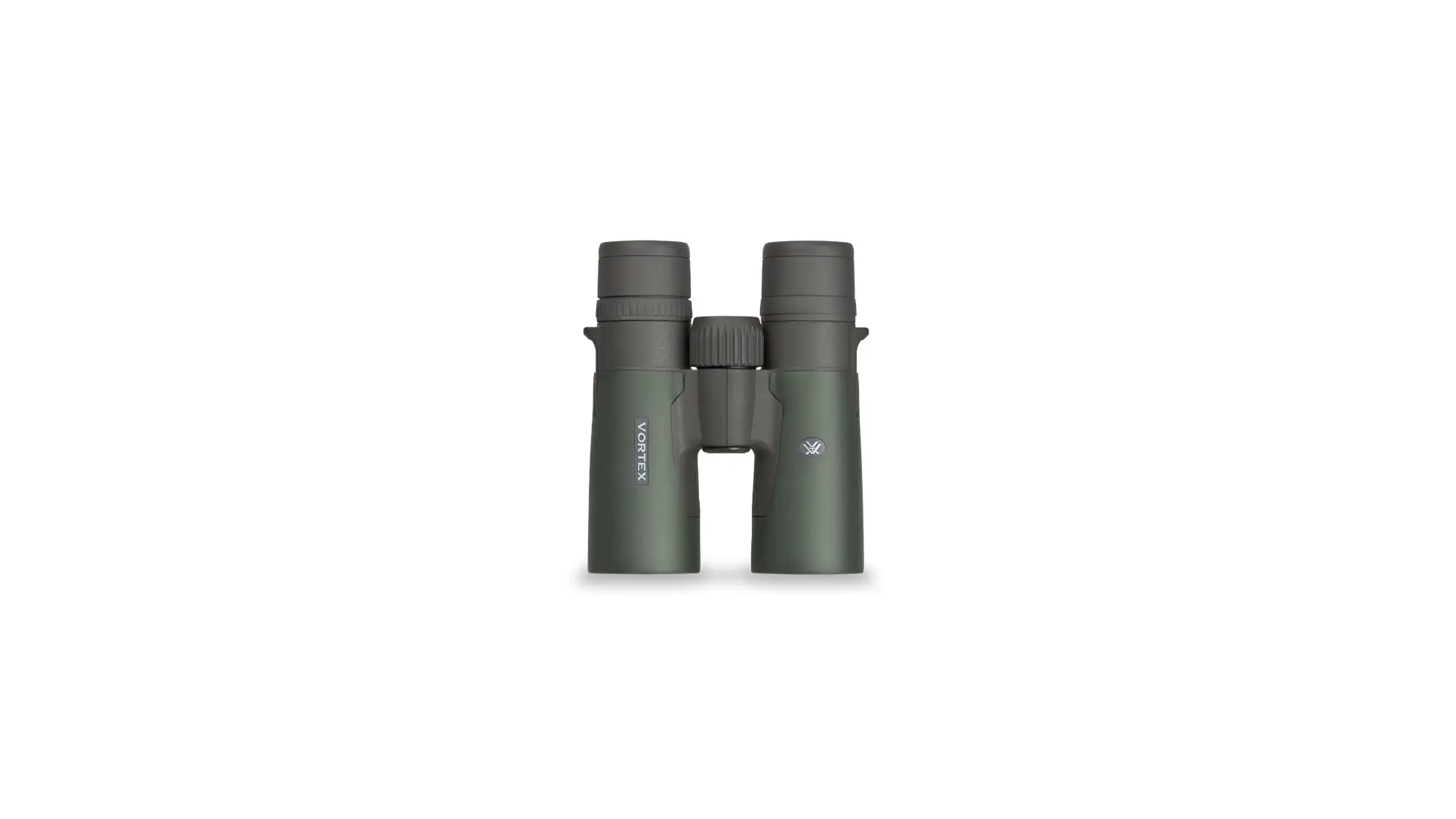
Best premium: Vortex Razor HD 10x42
Roof prism · 10x42 · HD glass · XR Plus coatings · magnesium chassis · 24.8 oz
around $1,000exact price on OpticsPlanet
This is where owner testimony stops being about value for money and starts being about comparisons with alpha glass. One owner ran it beside a Leica Trinovid 8x42 for three days with four other people, in daylight and late twilight, and the group's final vote was that the two were equal on brightness and resolution. Other owners put it beside Swarovski, Zeiss Conquest HD and Meopta HD glass. On paper it adds XR Plus fully multi-coated lenses on dielectric, phase-corrected BAK4 roof prisms, a 362 ft field of view at 1000 yards and 16.5 mm of eye relief, on a magnesium chassis at 24.8 oz. The honest counterweight is low light: two owners, years apart, found its light gathering at dusk below what they expected, one of them against a Leupold Porro binocular their father had given them 22 years earlier. That is consistent with the arithmetic, because a 10x42's 4.2 mm exit pupil is narrower than a dark-adapted pupil, so read it as superb daylight and twilight glass rather than a low-light specialist; for dusk, an 8x42 delivers the brighter image.
Pros
- A three-day, five-person comparison against a Leica Trinovid 8x42 ended in a tie on brightness and resolution
- XR Plus fully multi-coated lenses on dielectric, phase-corrected BAK4 roof prisms
- A 362 ft field of view at 1000 yards and 16.5 mm eye relief, both more than the Diamondback HD 10x42
- One owner reports Vortex repaired a second-hand pair they had abused on a Dall sheep hunt, "no questions asked"
Cons
- Owners split on low light, and two rated it below older or cheaper binoculars at dusk; a 10x42's 4.2 mm exit pupil is one reason any 10x42 trails an 8x42 then
- Two owners list price as their con and a third calls it not worth the money
- At 24.8 oz it is 3.5 oz heavier than the Diamondback HD 10x42
- One owner reports the objective covers leave little dimples in the rubber armor
Best for: buyers who want alpha-adjacent glass in daylight and twilight without paying alpha prices. Choose the Diamondback HD 8x42 instead if most of your viewing happens at dawn and dusk.
Key specifications
| Magnification | 10x |
|---|---|
| Objective lens | 42 mm |
| Prism | Roof, BAK4, dielectric + phase-corrected |
| Glass | HD (extra-low dispersion), XR Plus fully multi-coated |
| Eye relief | 16.5 mm |
| Exit pupil | 4.2 mm (42 divided by 10) |
| Field of view | 362 ft at 1000 yds (6.9 degrees) |
| Close focus | 6 ft |
| Twilight factor | 20.5 |
| Diopter | -3 to +3 dpt |
| Weight | 24.8 oz |
| Chassis | Magnesium, rubber armour, matte finish |
| Sealing | Nitrogen-purged; waterproof, fogproof, shockproof |
| Tripod adaptable | Yes |
| Interpupillary distance | 55 to 75 mm |
| MPN carded | RZB-2102 (green). This is the Razor HD line, not the dearer Razor UHD |
| Warranty | Vortex VIP: unlimited, unconditional, lifetime |
“I compared the Leica Trinovid 8x42 and the Razor 10x42. Three days with 4 other people looking with me. Daylight... and late twilight. All of us agreed both glasses were very bright and with tremendous resolution.”
bladepeek (MI) via OpticsPlanet
Best binoculars by use
The picks above cover the common needs. For a specific job, each of these guides ranks its own picks with the trade-offs that matter for that use.
| Use | Guide | What it answers |
|---|---|---|
| Hunting | Best binoculars for hunting | Picks by terrain and budget, from all-day carry to open-country glassing. |
| Birding | Best binoculars for birding | Wide field of view, close focus and a steady 8x for small, fast birds. |
| Safari and travel | Best binoculars for safari | Why 8x42 suits game drives, with a lighter travel option. |
| Astronomy | Best binoculars for astronomy | Aperture and exit pupil for the night sky, on a power ladder. |
| Long distance | Best binoculars for long distance | High-magnification picks and what it takes to hold them steady. |
| On a budget | Best budget binoculars | What you can genuinely buy under $100 and what the next step adds. |
| Compact and pocket | Best compact binoculars | Pocketable binoculars ranked by weight, reach and eye relief. |
| 8x42 format | Best 8x42 binoculars | The do-everything format, compared across budgets. |
| 10x42 format | Best 10x42 binoculars | The reach format, compared from budget to premium. |
| 12x50 format | Best 12x50 binoculars | More reach for glassing from a steady position. |
| Image-stabilized | Best image stabilized binoculars | Stabilized binoculars that make high magnification usable in the hand. |
| Rangefinding | Best rangefinding binoculars | Binoculars with a laser rangefinder built in, to glass and range in one motion. |
| Monocular instead | Best monocular | Daytime monoculars, when you would rather carry one barrel than two. |
| Carrying | Best binocular harness | Chest harnesses that take the weight off your neck. |
| Night vision | Best night vision binoculars | Digital and image-tube night vision binoculars, from a budget digital pair up to Gen 3. |
| Thermal | Best thermal binoculars | Thermal imaging binoculars that see heat in the dark, compared by sensor, reach and rangefinder. |
Best binocular brands
We do not rank brands, because each maker sells lines at very different levels: the useful question is which line fits your use and budget. These are the brands we cover with a hub or a full review, and where each line sits on our pages.
- Bushnell. In Bushnell's range the optical break comes at the R5: BaK-4 prism glass with a PC3 phase coating and a dielectric prism coating, which the PowerView models below it do not list. Bushnell binoculars decoded · Fusion X review
- Leica. Leica lists both the Noctivid 8x42 and 10x42 at 19 mm of eye relief, and the Geovid R puts a laser rangefinder inside the binocular. Noctivid review · Geovid R review
- Leupold. The BX-1 Rogue 8x25 is an inverted Porro compact at 12.7 oz, and the BX-5 Santiam HD 8x42 runs Leupold's Twilight Max HD system with 18.5 mm of eye relief. Leupold binoculars, line by line · BX-1 Rogue 8x25 review · BX-5 Santiam HD on our 8x42 page
- Nikon. Nikon's range is a coating ladder from ProStaff to Monarch. The Monarch M5 8x42 lists 19.5 mm of eye relief, and the Monarch HG has a magnesium alloy body where the M7 uses fibreglass-reinforced polycarbonate; Nikon's releases say the Monarch HG is made in Japan. Nikon binoculars decoded · Monarch HG review · Monarch M5 review · Monarch M7 review
- Steiner. The Commander 7x50 has a 7.1 mm exit pupil, and Steiner rates it water pressure proof up to 10 m; the 7x50c version adds a compass. Commander 7x50 review
- Vortex. Vortex sells binocular lines at several levels, and our picks run from the Triumph HD at the budget end to the Razor HD at the top. Vortex says its VIP warranty covers its binoculars whatever the cause of the damage, whose fault it was or where you bought them, and that it does not cover loss, theft, deliberate damage or cosmetic damage that does not hinder the performance of the product. Vortex binoculars, line by line · Razor HD vs UHD · Diamondback HD vs Viper HD
- Zeiss. Zeiss publishes light transmission on its own pages: 88 percent for the Terra ED Pocket, our compact pick, and 92 percent for the 42 mm Victory SF, which Zeiss makes in Germany. Victory SF review · Conquest HDX review · SFL review
How to choose binoculars
A few figures on the spec sheet, and the prism type, decide most of what you will see:
- Magnification against steadiness. More magnification brings detail closer but also magnifies hand shake and narrows the view: the Diamondback HD shows 393 ft at 1000 yards at 8x, 330 ft at 10x and 271 ft at 12x. For handheld use, 8x or 10x; at 12x, brace it or use a tripod.
- Objective and exit pupil. Divide the objective by the magnification to get the exit pupil: 42 divided by 8 is 5.25 mm, 42 divided by 10 is 4.2 mm, 50 divided by 12 is also about 4.2 mm, and 25 divided by 8 is 3.1 mm. A larger exit pupil gives a brighter image at dawn and dusk, which is why a 12x50 is not brighter than a 10x42 and why a pocket 8x25 is dimmest of all in failing light.
- Eye relief if you wear glasses. Look for at least 16 to 17 mm. Among these picks the range runs from 14 mm (Vortex Diamondback HD 12x50) to 17 mm (Vortex Triumph HD 10x42 and Vortex Diamondback HD 8x42).
- Close focus. A 5 ft close focus lets a binocular double for feeder birds and insects; the Triumph HD's 15.3 ft does not.
- Roof or Porro prisms. Every full-size pick here is a roof prism, slim and straight-barreled; the Leupold BX-1 Rogue 8x25 compact uses an inverted Porro. Our roof prism vs Porro prism guide explains the trade.
- Waterproofing, as the makers state it. Read the maker's own wording: Zeiss rates the Terra ED Pocket waterproof to 100 mbar and nitrogen-filled, while the Vortex listings here describe gas purging (argon on most, nitrogen on the Razor HD), most of them with O-ring seals.
For the full walk-through read how to choose binoculars and what binocular numbers mean, or compare the two most common formats in 8x42 vs 10x42.
Which binoculars should you buy?
- One binocular for everything: the Vortex Diamondback HD 10x42.
- The least money for real HD glass: the Vortex Triumph HD 10x42, if you can live with a long close focus.
- Birding, or most viewing at dawn and dusk: the Vortex Diamondback HD 8x42.
- It must fit in a pocket: the Zeiss Terra ED Pocket 8x25.
- Distance from a stand, a ridge or a tripod: the Vortex Diamondback HD 12x50.
- Full-size glass owners compare with alpha brands: the Vortex Razor HD 10x42.
- A specific use we did not cover here: start from the guides by use above.
FAQ
What are the best binoculars?
For most people, in our editorial judgement, the Vortex Diamondback HD 10x42: HD glass with dielectric and phase-corrected roof prisms at 21.3 oz, 10x reach for open country with a 5 ft close focus that lets it double for near wildlife, and the Vortex VIP lifetime warranty. If birding or dawn and dusk viewing matter more to you than reach, the Vortex Diamondback HD 8x42 is the better choice. On a tight budget, the Vortex Triumph HD 10x42 keeps the same prism coatings and gives 17 mm of eye relief, 2 mm more than the Vortex Diamondback HD 10x42. For premium full-size glass, the Vortex Razor HD 10x42, which one owner's group test tied with a Leica Trinovid 8x42 and other owners set against Swarovski.
What is the best binocular brand?
There is no single best brand, only the best line for your use and budget, because one maker sells binoculars at very different levels. Vortex makes our overall, budget and premium picks here (Vortex Diamondback HD 10x42, Vortex Triumph HD 10x42, Vortex Razor HD 10x42) and backs them with an unconditional lifetime warranty; Zeiss makes our compact pick, the Zeiss Terra ED Pocket 8x25. Bushnell, Leica, Leupold, Nikon and Steiner are covered in our brand section.
What magnification is best for binoculars?
For handheld use, 8x or 10x. An 8x shows a wider, steadier view and is easier for birds and moving wildlife; a 10x brings distant detail closer and suits open country. Above 10x, such as 12x, hand shake grows with the magnification, so the binocular works best braced or on a tripod.
What do the numbers on binoculars mean?
In 10x42, the 10 is the magnification and the 42 is the diameter of each objective lens in millimeters. Divide the second number by the first to get the exit pupil, the width of the beam of light reaching your eye: 42 divided by 10 is 4.2 mm, and 42 divided by 8 is 5.25 mm.
Which binoculars are brightest in low light?
The ones with the largest exit pupil, the objective divided by the magnification. An 8x42 gives 5.25 mm and a 10x42 gives 4.2 mm, so the Vortex Diamondback HD 8x42 delivers the brighter image at dawn and dusk. A 12x50 is not brighter than a 10x42: 50 divided by 12 is also about 4.2 mm, so it adds detail, not brightness.
What binoculars are best if you wear glasses?
Look for at least 16 to 17 mm of eye relief, so you can see the full view with the eyecups twisted down. The Vortex Triumph HD 10x42 and the Vortex Diamondback HD 8x42 give 17 mm and the Vortex Razor HD 10x42 16.5 mm, while the Vortex Diamondback HD 10x42 gives 15 mm and the Vortex Diamondback HD 12x50 14 mm.
Are compact binoculars as good as full-size binoculars?
In daylight they can come close: one owner of the Zeiss Terra ED Pocket 8x25 read the same line of an eye chart at 50 yards through it as through a full-size 8x42. At dawn and dusk they cannot, because a 25 mm objective at 8x gives a 3.1 mm exit pupil against 5.25 mm on an 8x42.
Head-to-head: Diamondback HD vs Viper HD · Diamondback HD 10x42 vs 12x50. Reviews: Diamondback HD 10x42 · Triumph HD 10x42 · Diamondback HD 8x42 · Diamondback HD 12x50.