The best thermal binoculars in 2026
Our verdict for 2026: the ATN Binox 6 Dual 256 (around $1,500) is the best thermal binocular overall, a 4-in-1 multispectral device with a rangefinder for the lowest full-featured price. The AGM ObservIR 256 (around $1,500) is the best value, and the ATN Binox 4T 640 (around $4,400) is the max-range pick, with the biggest 50mm lens and 16-hour runtime. The sharpest image here belongs to the ATN Binox 6 Dual 640 (around $2,900), but at roughly double the price of the 256 picks it is a benchmark here rather than a ranked pick.
Between them these four binoculars carry 27 owner reviews on OpticsPlanet. Prices verified September 30, 2026; confirm the current price on the retailer page.
Thermal binoculars let you scan the dark with both eyes, find an animal by its heat, and increasingly identify and range it without ever picking up your rifle. The trick to buying one is separating two numbers the marketing blurs together: the lens size sets how far it reaches, and the thermal sensor resolution sets how much detail you see. Everything below is sold by OpticsPlanet and built for real night hunting, from a value pick at around $1,500 to a 640-sensor optic that reads fine detail far downrange.
How these picks were made: a research-based roundup comparing published specifications, thermal sensor resolution and sensitivity, lens size and field of view, built-in rangefinders, owner reviews and pricing on OpticsPlanet. Scores are our editorial opinion, not a hands-on test of every model, and owner ratings are shown attributed to their source. Confirm current price on the retailer page. See how we evaluate.
Quick comparison
| Category | Pick | Spec | Price | |
|---|---|---|---|---|
| Best overall | ATN Binox 6 Dual 256 6-48x25mm | 256x192 · 25mm · LRF | around $1,500 | Check price |
| Best value | AGM ObservIR 256 5.5-22x25mm | 256x192 · 25mm · LRF | around $1,500 | Check price |
| Best for maximum range | ATN Binox 4T 640 2.5-25x50 | 640x480 · 50mm · LRF | around $4,400 | Check price |
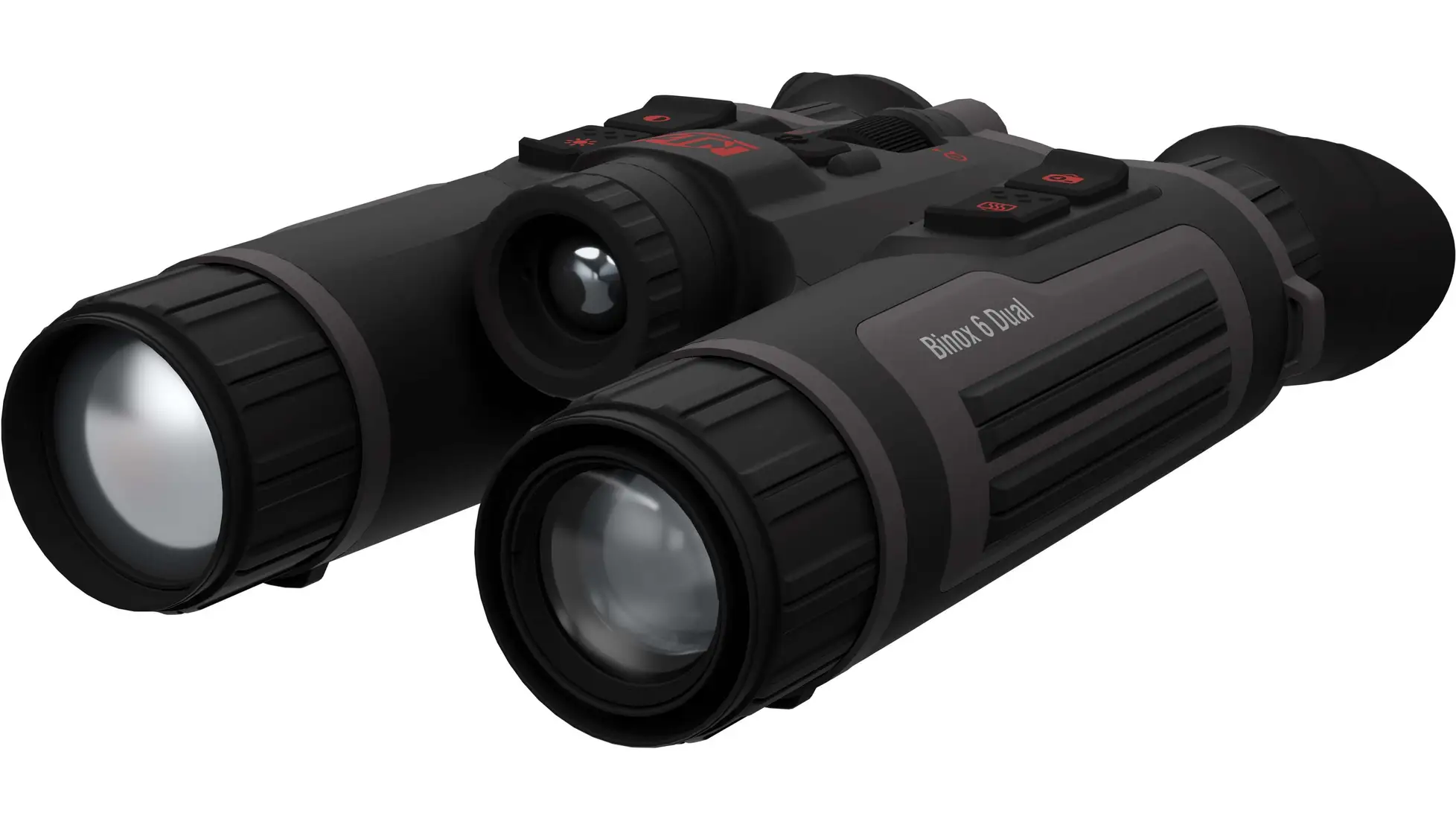
Best overall: ATN Binox 6 Dual 256 6-48x25mm
6-48x · 25mm germanium lens · 256x192 sensor · sub-20 mK NETD · 50 Hz · 4-in-1 thermal/4K day/IR night/twilight · 1,000-yd LRF · 64 GB · dual 18650, 8 hr
around $1,500exact price on OpticsPlanet
This is the thermal binocular most buyers should start with, because it does four jobs in one body for the lowest price of any full-featured pick here. It is a true multispectral device: a thermal channel, a 4K CMOS daytime channel, IR-assisted digital night vision and a twilight mode, so you can detect a heat signature in the dark, toggle to the 4K channel to identify the animal, and range it with the built-in 1,000-yard laser rangefinder without dropping the binocular from your eyes. Its standout is a sub-20 mK NETD sensitivity, unusual on a 256x192 sensor, which lets it cut through fog and humidity that wash out lesser thermals. It stores video to 64 GB of internal memory (no SD card to lose), runs on swappable dual 18650 batteries, and carries a magnesium IP67 body and a 5-year warranty. Two eyes steady the image and cut fatigue on long scans, an advantage owners call out over a monocular.
Pros
- True 4-in-1 multispectral: thermal, 4K daytime, IR night vision and twilight in one device, so you detect then identify without switching optics
- Sub-20 mK NETD sensitivity punches above its 256x192 class, cutting through fog and humidity that blind lesser sensors
- Built-in 1,000-yard laser rangefinder, 64 GB internal storage and a Wi-Fi app, so no separate rangefinder or SD card
- Swappable dual 18650 batteries, a magnesium IP67 body and a 5-year warranty; bi-ocular viewing is steadier and less tiring than a monocular
Cons
- The 256x192 sensor realistically identifies targets within about 150 to 250 yards; the 1,500 m figure is detection of a heat blob, not identification
- A narrow roughly 7-degree thermal field of view (6x base) is restrictive up close and in dense timber
- The 6-48x range is mostly digital zoom; past about 12x the 256 image pixelates badly, so the top of the range is a marketing number
- Owners report early Gen 6 firmware quirks, including a compass that drifts and a GPS with no menu toggle
Best for: predator and hog hunters, and anyone doing game recovery, who want all four vision modes plus a rangefinder in one binocular for the lowest entry price. Step up to the 640-sensor model for a sharper image, or save with the AGM ObservIR.
Key specifications
| Manufacturer | ATN |
|---|---|
| Sensor resolution | 256x192 pixels |
| Objective | 25 mm germanium |
| Magnification | 6-48x (6x base, digital zoom) |
| NETD | Sub-20 mK |
| Refresh rate | 50 Hz |
| Rangefinder | Built-in 1,000 yd |
| Detection range | Up to 1,500 m (ATN rated) |
| Storage | 64 GB internal |
| Battery | Dual 18650 rechargeable, 8 hr |
| Sealing | IP67, magnesium alloy |
| Weight | 1.56 lb |
| Warranty | ATN 5-year |
“This is one of the few units I have used that genuinely combines multiple vision modes in a single binocular. Daytime 4K, IR-assisted night vision, thermal imaging and twilight mode without needing to switch devices. Highly recommend!”
Jessica via OpticsPlanet
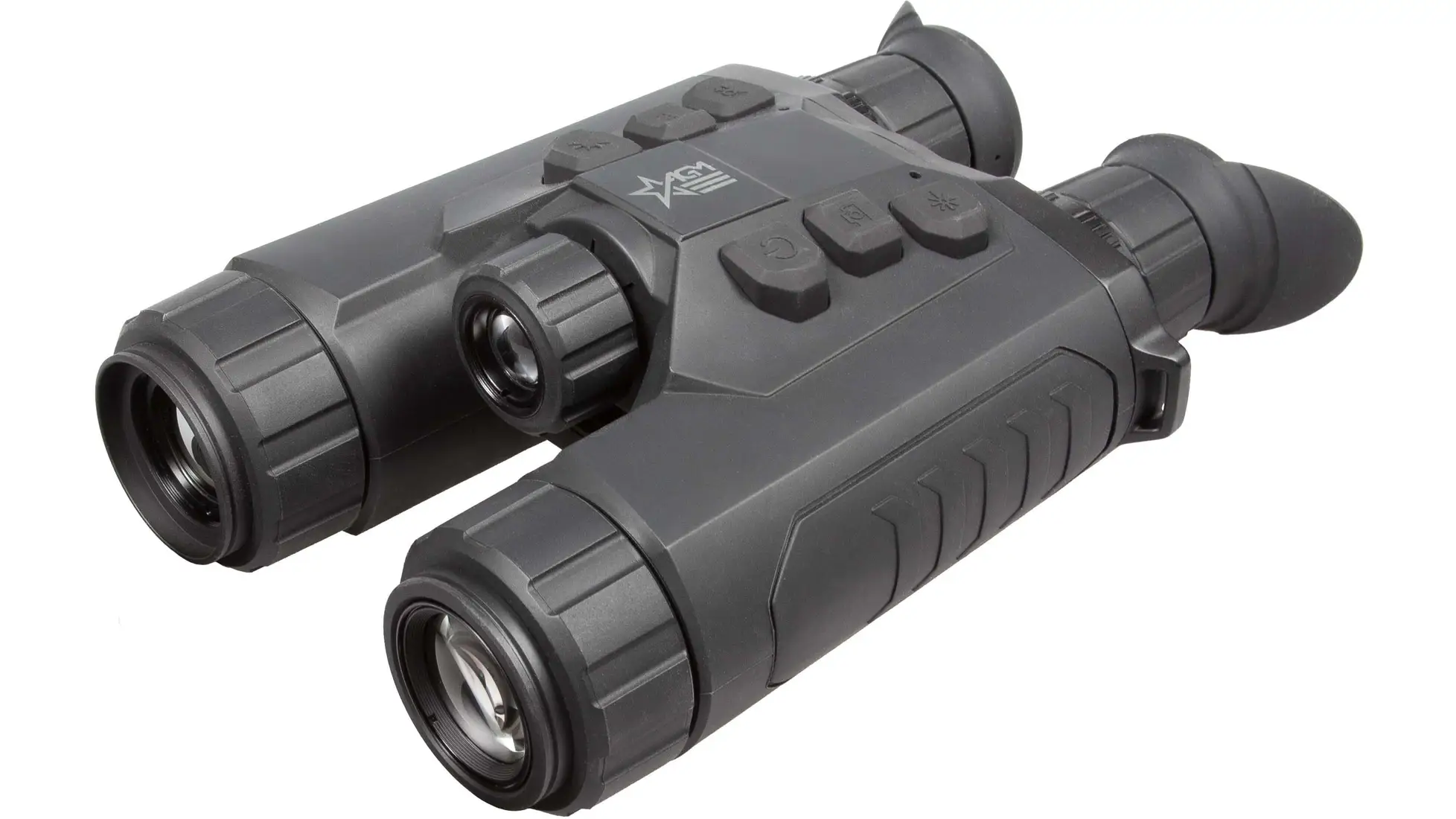
Best value: AGM ObservIR 256 5.5-22x25mm
5.5-22x · 25mm germanium lens · 256x192 sensor · 35 mK NETD · 50 Hz · dual-spectrum thermal + day/night · 1,000-m LRF · GPS · 64 GB · four 18650, 8 hr
around $1,500exact price on OpticsPlanet
This is the lowest-cost way into a do-it-all thermal binocular, and it undercuts the ATN Binox 6 by a couple hundred dollars while keeping the features that matter. Like the ATN, it is a dual-spectrum device pairing a 256x192 thermal channel with an ultra-low-light day/night CMOS channel, and it carries the same built-in 1,000-meter laser rangefinder, a GPS module, 64 GB of internal storage and Wi-Fi. It ships with four 18650 batteries rather than the usual two, so a long night in the field is covered without a mid-hunt charge. The honest trade for the price is sensitivity: its 35 mK NETD is less sensitive than the ATN Binox 6's sub-20 mK, so it washes out sooner in heavy fog and humidity. For coyote and hog scanning where you want a rangefinder and a day channel without crossing $1,500, it is the value pick.
Pros
- The lowest price here for a full dual-spectrum thermal plus day/night binocular with a built-in 1,000-meter laser rangefinder
- Ships with four 18650 batteries, double the usual two, so field runtime is covered without a mid-hunt charge
- 64 GB internal storage, a GPS module and Wi-Fi, in a rugged rubber-overmolded IP-rated housing
- One owner runs it for coyote hunting to scan fields without lifting the rifle, doing the same job as a thermal scope
Cons
- A 35 mK NETD is less sensitive than the ATN Binox 6's sub-20 mK, so it washes out sooner in heavy fog and humidity
- The same 256x192 sensor limit: identification within a few hundred yards, not the 1,200 m detection figure
- Only two owner reviews so far, a thin track record
- Heavier at 1.96 lb than the ATN Binox 6 (1.56 lb)
Best for: the lowest-cost entry into a thermal-plus-day/night binocular with a rangefinder, for coyote and hog scanning. Step up to the ATN Binox 6 for a sharper sub-20 mK sensor, or the 640 model for real detail.
Key specifications
| Manufacturer | AGM Global Vision |
|---|---|
| Sensor resolution | 256x192 pixels |
| Objective | 25 mm germanium |
| Magnification | 5.5-22x (5.5x base, digital zoom) |
| NETD | 35 mK |
| Refresh rate | 50 Hz |
| Rangefinder | Built-in 1,000 m |
| Detection range | Up to 1,200 m (AGM rated) |
| Storage | 64 GB internal |
| Battery | Four 18650 rechargeable, 8 hr |
| Sealing | IP-rated, dustproof |
| Weight | 1.96 lb |
| Warranty | AGM manufacturer warranty |
“I put the varmint LRF on my 223 and now I purchased the AGM observIR LRF binos for my coyote hunting. They work as well as the scope and I don't have to pick my rifle up to scan the fields. Easy to adjust.”
oneshot, verified owner (VA) via OpticsPlanet
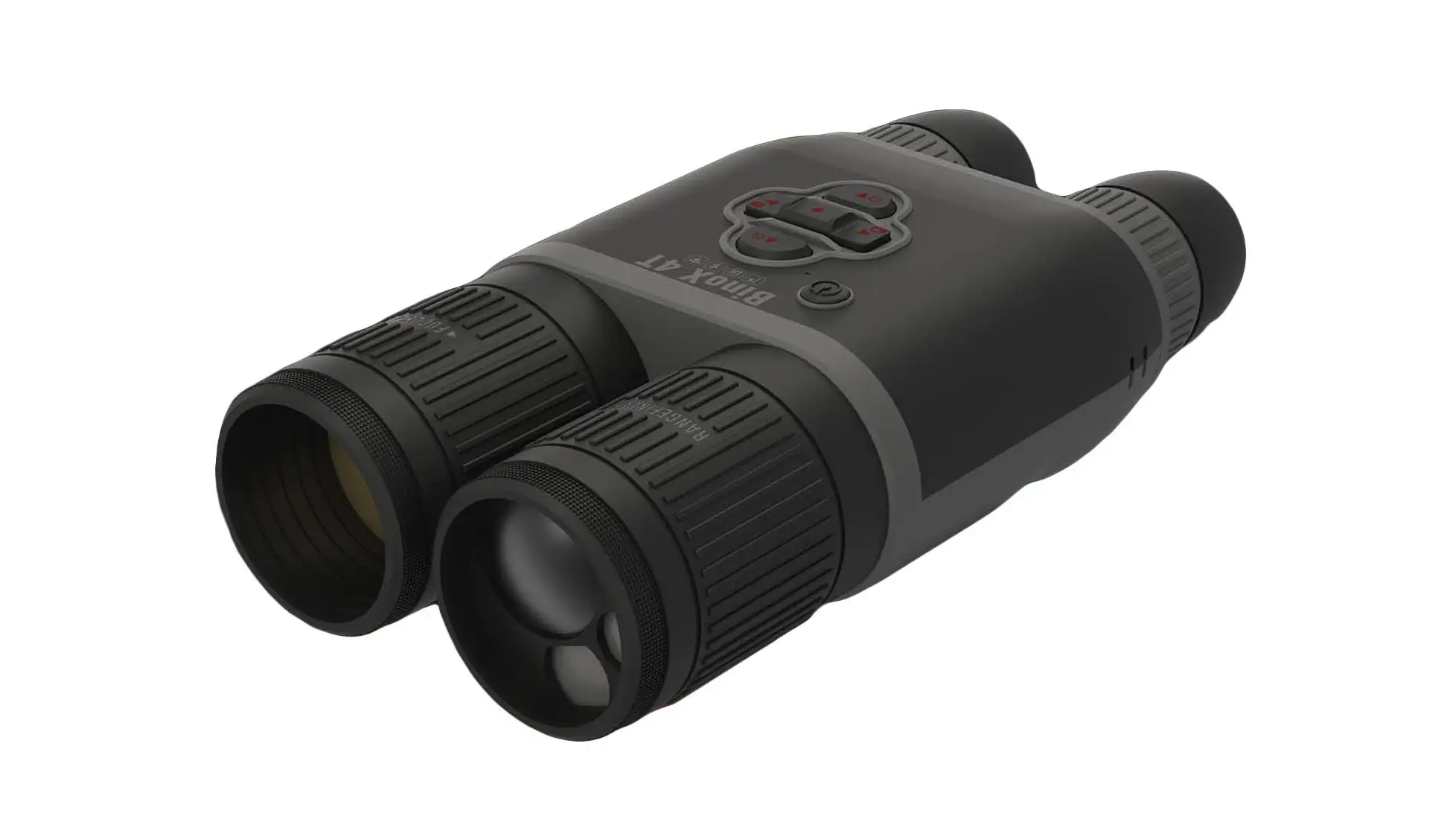
Best for maximum range: ATN Binox 4T 640 2.5-25x50
2.5-25x · 50mm lens · 640x480 sensor · biggest objective here · 1,000-yd LRF + IR · BIX ballistic link · dual Wi-Fi · SD recording · 16+ hr battery
around $4,400exact price on OpticsPlanet
This is the reach-and-runtime pick, and the most proven binocular here. Its 50mm objective is the biggest of any pick, feeding a 640x480 sensor for the longest usable range, while a low 2.5x base keeps a wide field for scanning. It carries the longest battery life here at 16-plus hours, a built-in 1,000-yard laser rangefinder with an IR illuminator, dual Wi-Fi streaming, onboard SD-card recording, and ATN's Ballistic Information Exchange (BIX), which sends range data straight to a paired ATN smart scope. With 13 owner reviews it also has the deepest track record of any pick, and owners hunt hogs with it out past 500 yards. Be clear-eyed about what it is, though: this is the previous Gen 4 platform. The newer Gen 6 Binox 6 Dual 256 above has a more sensitive sensor and a 5-year warranty for a good deal less money, so you choose the 4T specifically for the 50mm reach, the 16-hour runtime and the ATN BIX ecosystem.
Pros
- The biggest 50mm objective here feeds a 640x480 sensor for the longest reach, with a low 2.5x base for a wide scanning field
- The longest battery life here at 16-plus hours, and the deepest owner track record (13 reviews); owners identify hogs past 500 yards
- Built-in 1,000-yard rangefinder with IR illuminator, plus BIX to send range data straight to a paired ATN smart scope
- Dual Wi-Fi streaming and onboard SD-card recording
Cons
- It is the previous Gen 4 platform; the newer Gen 6 Binox 6 Dual 640 above has a more sensitive 15 mK sensor for less money
- The priciest pick here, whether you take the new unit or the used dealer-demo row of the same listing, and the heaviest at 2.5 lb
- A 3-year warranty, shorter than the Gen 6 models' 5-year
- The BIX ballistic link is most useful only if you also run ATN smart optics
Best for: hunters who want the biggest 50mm lens for maximum range, the longest 16-hour runtime and the BIX link to an ATN smart scope, and who value a deep, proven track record over the newest sensor generation. For a sharper sensor at a lower price, the Gen 6 Binox 6 Dual 640 wins.
Key specifications
| Manufacturer | ATN |
|---|---|
| Sensor resolution | 640x480 pixels |
| Objective | 50 mm (biggest here) |
| Magnification | 2.5-25x (2.5x base, digital zoom) |
| Rangefinder | Built-in 1,000 yd, with IR illuminator |
| Ballistics | BIX link to ATN smart scopes |
| Recording | Onboard SD card, dual Wi-Fi streaming |
| Eye relief | 10-30 mm |
| Battery | Internal lithium, 16+ hr |
| Weight | 2.5 lb |
| Generation | ATN Gen 4 |
| Warranty | ATN 3-year |
“These ATN thermal imaging binox are really incredible. I can't get over how well they perform. I just used them on a hog hunting trip and they are so much better for identifying game than NV. They feel very well made. The zoom is great. I could see hogs that were in some brush at just over 500 yds.”
Collin, owner (IL) via OpticsPlanet
Sharpest image, at roughly double the price: ATN Binox 6 Dual 640 3-24x35mm
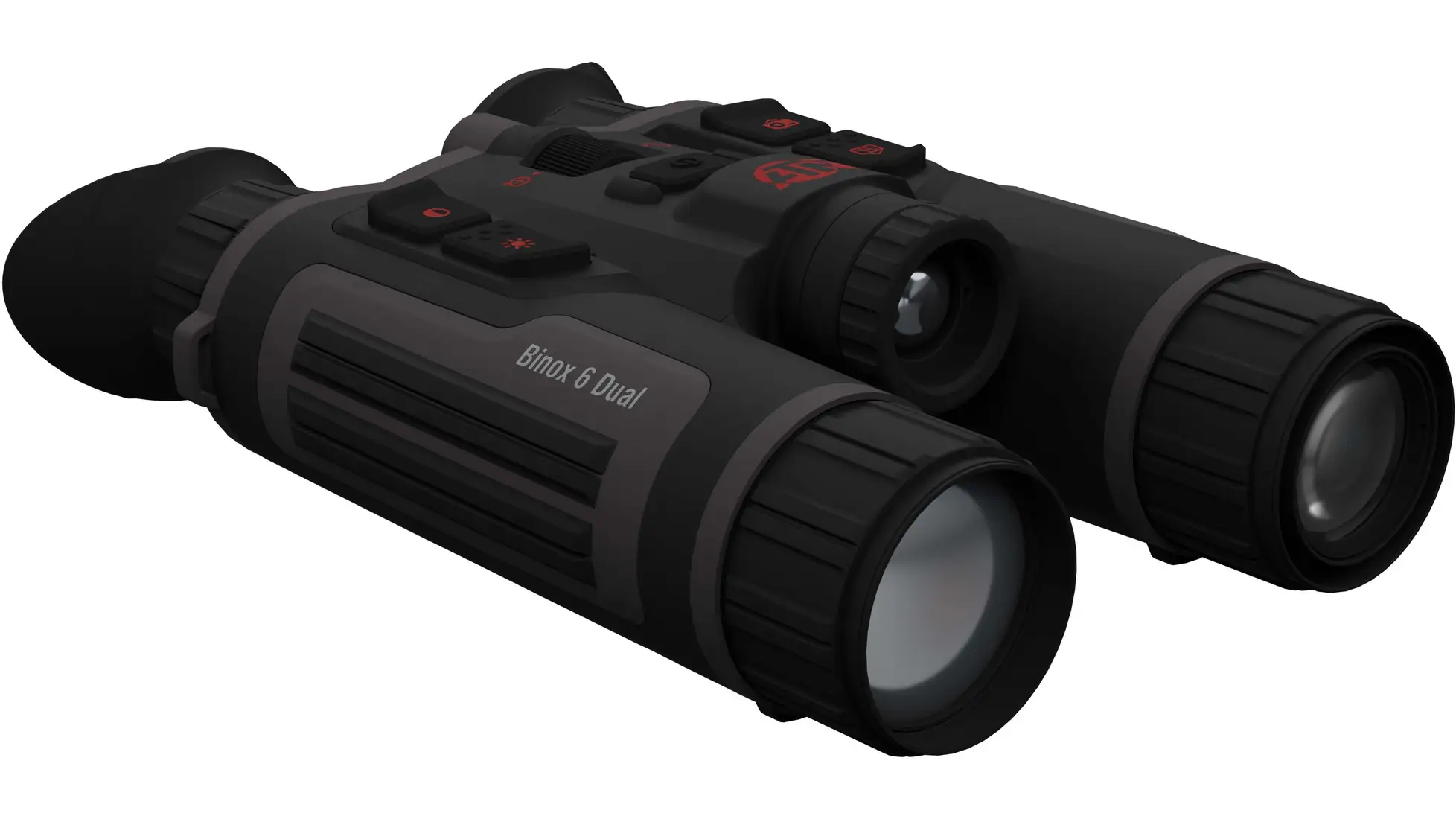
around $2,900 4.8/5, 6 reviews on OpticsPlanet
On image quality nothing else here comes close. It takes the same Gen 6 multispectral platform as our top pick and steps it up to a 640x512 sensor with a 15 mK NETD, which reads fine detail the 256 models cannot resolve, and it does it while keeping the widest field of view on this page: a 3x base magnification on a 35mm lens gives about 12.5 degrees, unusual for a 640 and much easier to scan and follow a moving animal with than a 6x-base 256. Everything else carries over, including the 4-in-1 thermal, 4K day, IR night and twilight modes, the built-in 1,000-yard laser rangefinder, 64 GB of storage and Wi-Fi, on dual 18650 cells for about 8 hours. One verified owner compared its thermal channel directly against Bering and Pulsar 640 binoculars and rated the image superior to both, while noting firmware bugs that still need fixing.
It sits in its own section rather than the numbered picks because at roughly double the price of the 256 picks it is not competing with them: it is the answer for the narrower group who want the sharpest thermal image and will pay for it. The other trade-offs are real too: the same early Gen 6 firmware quirks owners report on the 256, and a daytime micro-OLED view that takes adjustment after looking through analog glass.
The best thermal binoculars for hunting, by what you hunt
Every pick above is a hunting optic, but they are not interchangeable in the field. What you hunt, and the country you hunt it in, decides which one is right:
- Hogs and coyotes at normal calling distance. The ATN Binox 6 Dual 256 (around $1,500) or the AGM ObservIR (around $1,500). A 256x192 sensor identifies game inside roughly a few hundred yards, which covers most night hunting, and both include a rangefinder so you get a real distance before the shot. One ObservIR owner scans fields for coyotes with it instead of lifting his rifle.
- Dense timber and close brush. The ATN Binox 6 Dual 640 (around $2,900). Its 3x base gives the widest field here at about 12.5 degrees, so you find and follow a moving animal instead of hunting through a narrow straw. The 256 picks are noticeably tighter at 6x base.
- Open country and long identification. The ATN Binox 4T 640 (around $4,400) for the biggest 50mm lens and the longest reach, or the Binox 6 Dual 640 if you want the sharpest image. An owner identified hogs in brush at just over 500 yards with the 4T.
- Fog, humidity and damp mornings. Sensitivity decides this, not resolution. The sub-20 mK Binox 6 Dual 256 and the 15 mK Binox 6 Dual 640 hold an image where the 35 mK ObservIR washes out sooner.
- All-night sits and game recovery. The Binox 4T 640 runs 16-plus hours, the longest here; the Gen 6 picks run about 8 hours on swappable 18650s you can carry spares of. Any of them will find downed game by its heat signature.
One honest limit worth repeating: thermal binoculars are a scanning and spotting tool, not a weapon sight. You still need a rifle optic, so pair them with a thermal scope or a night vision scope. Confirm your state's night-hunting and thermal-optic rules for the species you are after before you go.
How to choose thermal binoculars
Two specs decide most of it, and buyers constantly conflate them:
- Lens size sets range; sensor resolution sets detail. A big lens on a small sensor still out-reaches a small lens on a big sensor, but it will not show more detail. Read both numbers, never just the "detection range."
- 256x192 vs 640x512. A 256 sensor identifies game inside a few hundred yards and keeps the price under $1,800; a 640 resolves far finer detail farther out, at roughly double the cost.
- Sensitivity (NETD). A lower mK number cuts through fog and humidity. Sub-20 mK and 15 mK (our ATN picks) hold an image where a 35 mK sensor washes out.
- Digital zoom is not reach. The headline "48x" is mostly digital crop; past about 12x a 256 sensor pixelates. Base magnification and lens size are the honest numbers.
- A built-in rangefinder earns its keep. Thermal flattens depth, so a laser rangefinder gives you a real distance. Every binocular here includes one.
Want a weapon-mounted optic instead of a handheld scanner? See our best thermal scopes and best thermal monoculars. Deciding between the technologies? Read thermal vs night vision. Hunting a specific way? See best thermal scope for coyote hunting.
FAQ
Are thermal binoculars better than a thermal monocular?
For scanning, usually yes. Using both eyes steadies the image and dramatically reduces the eye fatigue, headaches and one-eye night blindness that come from staring through a single-tube monocular for hours, which is why owners prefer binoculars for long observation. A monocular is lighter, cheaper and easier to carry or helmet-mount. If you scan for long stretches, choose binoculars; if you want the lightest, cheapest scanner, a monocular wins.
How far can thermal binoculars see?
It depends on whether you mean detection or identification, and on the lens and sensor separately. The lens size sets range and the sensor resolution sets detail, so a 256x192 model may detect a heat blob at over 1,000 meters but only let you truly identify an animal within about 150 to 250 yards. A 640-sensor model with a bigger lens, like the Binox 6 Dual 640 or the 4T, identifies game meaningfully farther out. Treat the headline detection number as a best case, not an identification range.
What thermal sensor resolution do you need for hunting?
A 256x192 sensor, as in the ATN Binox 6 Dual 256 and the AGM ObservIR, is enough to scan for and identify hogs and coyotes inside a few hundred yards, which covers most night hunting, and it keeps the price under $1,800. A 640x512 sensor, as in the Binox 6 Dual 640, resolves far finer detail and identifies game farther out, at roughly double the cost. A lower NETD number (sensitivity) also matters: the sub-20 mK and 15 mK picks cut through fog and humidity better than a 35 mK sensor.
Do thermal binoculars need a laser rangefinder?
A rangefinder is genuinely useful on thermal, because thermal imaging flattens depth perception: on a plain heat screen a 50-yard animal can look much like a 150-yard one. A built-in laser rangefinder removes that ambiguity and gives you a real distance for the shot, which is why every binocular on this page includes one. If you plan to shoot at what you scan, a rangefinder-equipped binocular saves carrying a separate unit.
Can you hunt with thermal binoculars?
Yes, and scanning for game is exactly what owners use them for. Owners report using these to find and identify hogs and coyotes in total darkness and to recover downed game by its heat signature, with the 640 and 50mm models reaching farther. Thermal binoculars are a scanning and spotting tool, not a weapon sight, so you pair them with a separate rifle optic. Always confirm night-hunting and thermal-optic regulations for your state and species before you hunt.
Related: best thermal scopes · best thermal monoculars · best binoculars for hunting.