Best rifle scopes 2026, ranked by use case and budget
Our verdict for 2026: the Vortex OPMOD Diamondback Tactical 6-24x50 FFP (around $290) is the best value in a long-range rifle scope. The Vortex Crossfire II 3-9x40 (around $120) is the best budget pick for general hunting, the Leupold VX-Freedom 3-9x40 (around $300) is the premium hunting choice, and the Vortex Strike Eagle 5-25x56 FFP (around $800) is the step-up for dedicated long-range shooting.
Between them, our four picks carry more than 650 owner reviews on OpticsPlanet. Prices verified September 30, 2026; confirm the current price on the retailer page.
The right scope depends on your rifle, your range and your budget. Below are our picks across four common needs, with honest pros and cons and what to check before you buy.
How these picks were made: a research-based roundup comparing published specifications, warranty terms, owner reviews and pricing across reputable retailers. Scores are our editorial opinion, not a hands-on test of every model. Confirm current price on the retailer page. See how we evaluate.
Quick comparison
| Category | Pick | Spec | Price | |
|---|---|---|---|---|
| Best value for long range | Vortex OPMOD Diamondback Tactical 6-24x50 FFP | 6-24x50 FFP | around $290 | Check price |
| Best on a budget | Vortex Crossfire II 3-9x40 | 3-9x40 SFP | around $120 | Check price |
| Best premium pick | Leupold VX-Freedom 3-9x40 | 3-9x40 SFP | around $300 | Check price |
| Best for long range | Vortex Strike Eagle 5-25x56 FFP | 5-25x56 FFP | around $800 | Check price |
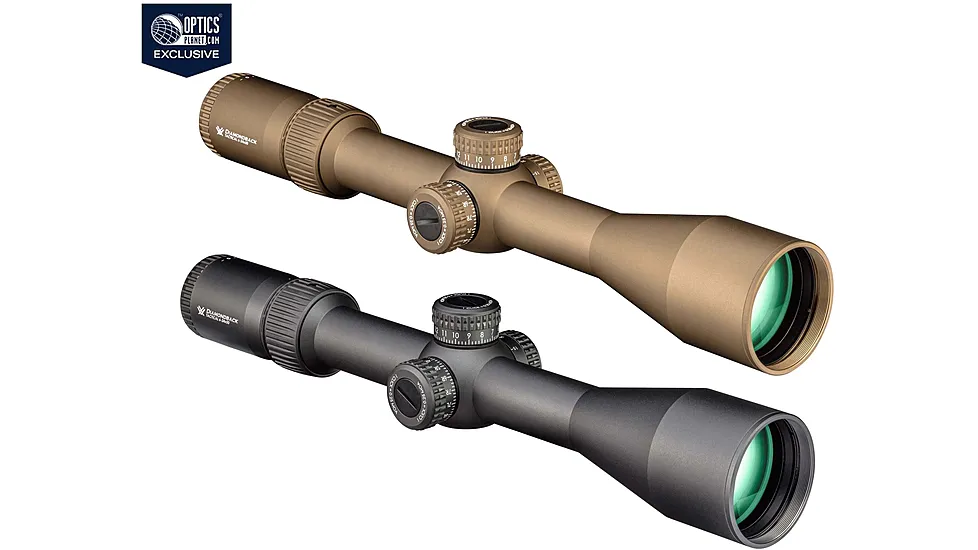
Best value for long range: Vortex OPMOD Diamondback Tactical 6-24x50 FFP
First focal plane · 6-24x50 · 30mm tube · EBR-2C MOA reticle
around $290exact price on OpticsPlanet
🏆 Named Best Optic Under £1,000 at the Great British Shooting Awards (source: Gun Trade News)
This OpticsPlanet-exclusive OPMOD version (in FDE or Wolf Gray) puts true first-focal-plane precision within reach: reliable tracking, the EBR-2C holdover reticle, and a rare 10-yard side parallax. Testers pass box drills with it, owners ring steel out to 1,000 yards, and everything is backed by Vortex’s unconditional lifetime VIP warranty. For learning long-range or running precision rimfire on a budget, little else comes close at the price.
Pros
- Reliable tracking and return-to-zero, with crisp, audible turret clicks (no budget-scope mushiness)
- FFP EBR-2C reticle stays accurate at any zoom, with a fine Christmas-tree grid for wind and elevation holds
- Rare 10-yard side parallax: a real edge for precision rimfire (NRL22) and close-to-far practice
- Lightest in its class at 24.6 oz
- Unlimited, unconditional lifetime Vortex VIP warranty (covers accidental damage, whoever was at fault)
Cons
- No zero stop, so when you dial past one full turn you must track your turret revolutions carefully
- No illuminated reticle: the fine FFP crosshair can wash out in low light or dark timber
- Glass is excellent to about 18x but softens toward 24x (edge blur, slight color fringing), so treat it as a 6-18x scope
- Tight eye box at maximum magnification demands a consistent cheek weld
Best for: entry-level long-range and PRS, precision rimfire (NRL22), and benchrest or varmint shooting on a budget. Skip it if you mainly hunt in low light or dense timber (no illumination), or need a hard zero stop for heavy dialing.
Key specifications
| Magnification | 6-24x |
|---|---|
| Objective lens | 50 mm |
| Reticle | EBR-2C MOA |
| Focal plane | First focal plane (FFP) |
| Tube diameter | 30 mm |
| Field of view | 18 - 4.5 ft at 100 yds |
| Eye relief | 3.9 in |
| Adjustment click | 1/4 MOA |
| Parallax | 10 yds to infinity |
| Sealing | Waterproof, fogproof, shockproof |
| Finish carded | Tan (DBK-10028-OP); the Wolf Gray version is the same scope for a little more |
“You can’t go wrong with Vortex glass for the price. They are clear and crisp, much better than other brands in the same price point.”
B.P, verified owner (KS) via OpticsPlanet
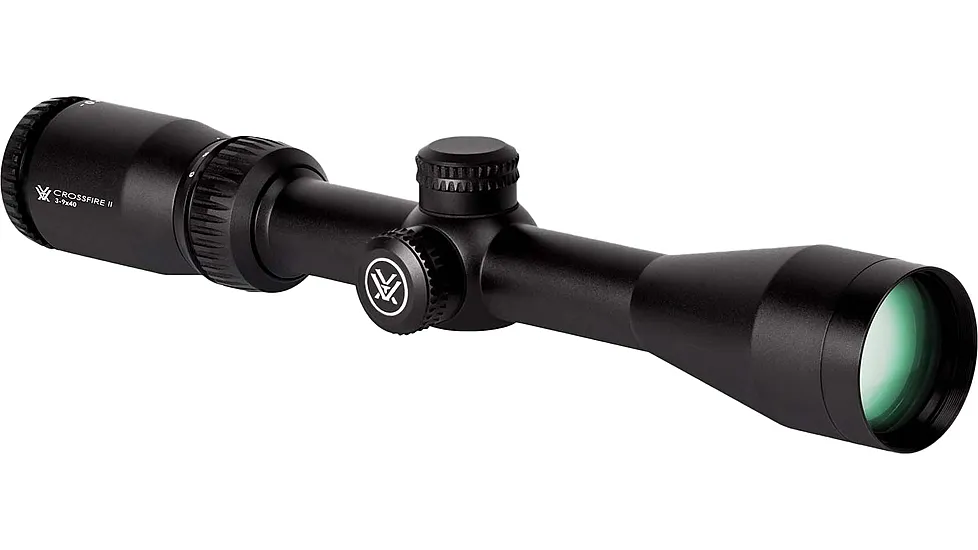
Best on a budget: Vortex Crossfire II 3-9x40
Second focal plane · 3-9x40 · 1-inch tube · Dead-Hold BDC or V-Plex reticle
around $120exact price on OpticsPlanet
At its price, the Crossfire II 3-9x40 takes most of the risk out of buying budget glass. You get bright, usable images from 3x to about 6x, a genuinely forgiving eye box that finds your target fast, and a single-piece aluminum tube that holds zero through real recoil (owners run it on .308 and .30-06 without drama). Backing all of it is Vortex’s unlimited, unconditional VIP warranty: repair or replace at no charge, no matter how it happened, whose fault it was, or where you purchased it. It is a regular on under-$200 scope roundups (American Hunter among them) for exactly that reason: it does the core job of a hunting scope reliably, and if it ever fails, Vortex simply replaces it.
Pros
- Bright, clear glass from 3x to about 6x that punches well above its price (owners rank it near scopes costing far more)
- Forgiving eye relief (3.8 to 4.4 in) and a large low-power eye box for fast, comfortable target acquisition
- Single-piece aircraft-grade aluminum tube holds zero under heavy recoil; nitrogen-purged, waterproof and fogproof
- Unlimited, unconditional Vortex VIP lifetime warranty (covers accidental damage, whoever was at fault)
- Light and simple to run, with a fast-focus eyepiece and capped set-and-forget turrets
Cons
- Glass softens at the edges toward maximum 9x, with some color fringing in high-contrast light (typical budget-glass limits)
- Fixed 100-yard parallax: fine for centerfire hunting, but not ideal for precision rimfire at 25 to 50 yards
- Capped, soft-clicking turrets are made to set and forget, not to dial in the field; the SFP holdovers only track true at 9x
- Non-illuminated, and the 1-inch tube with 60 MOA of travel limits serious long-range dialing
Best for: general hunting and first-time buyers shooting inside about 300 yards, brush and lever guns (.30-30, .45-70), and casual plinking. Skip it for precision rimfire target work up close, dialing for long range, or hunting in very low light where a bigger objective and premium glass pull ahead.
Key specifications
| Magnification | 3-9x |
|---|---|
| Objective lens | 40 mm |
| Reticle | Dead-Hold BDC or V-Plex (non-illuminated) |
| Focal plane | Second focal plane (SFP) |
| Tube diameter | 1 in |
| Field of view | 34.1 - 12.6 ft at 100 yds |
| Eye relief | 3.8 - 4.4 in |
| Adjustment click | 1/4 MOA (capped, resettable) |
| Parallax | Fixed at 100 yds |
| Elevation/windage travel | 60 MOA |
| Weight | 14.8 oz |
| Sealing | Waterproof, fogproof, shockproof |
| Warranty | Vortex VIP: unlimited, unconditional, lifetime |
“Great scope, regardless of the price, but very good value. Clarity and eye relief are fantastic.”
jpfadden, verified owner (NH) via OpticsPlanet
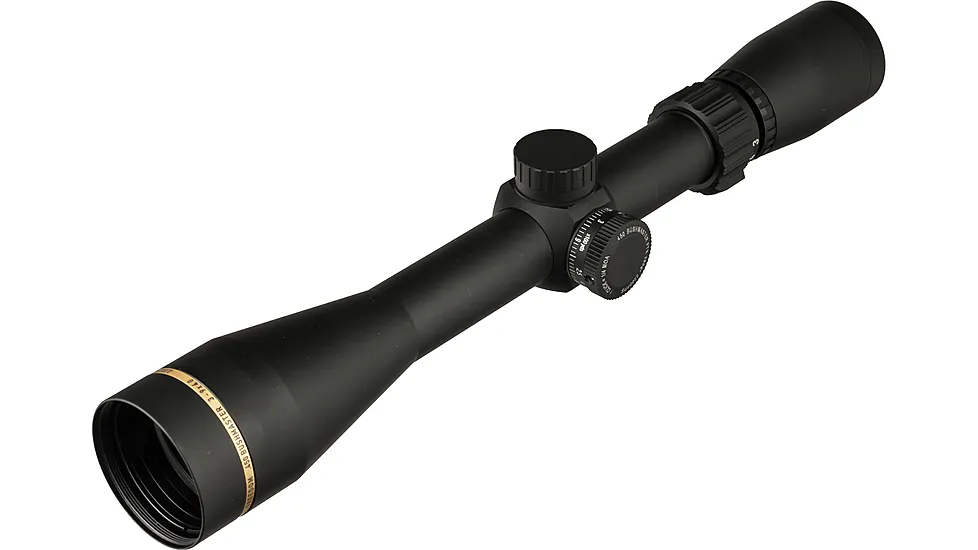
Best premium pick: Leupold VX-Freedom 3-9x40
Second focal plane · 3-9x40 · 1-inch tube · Duplex, Hunt-Plex, CDS and specialty reticles
around $300exact price on OpticsPlanet
🏆 Named an American Rifleman Editors’ Pick (2018) for its Twilight Light Management System (source: American Rifleman)
This is the scope that replaced Leupold’s legendary VX-1 and VX-2 lines, and it earns the premium slot on three things rivals at this price cannot match: it is designed, machined and assembled in Beaverton, Oregon; its Twilight Light Management System coatings genuinely stretch usable light at dawn and dusk, when deer actually move; and at 12.2 ounces it is the lightest scope in its class by a wide margin. It also survives the same factory recoil-torture protocol as Leupold’s high-end tactical scopes, and CDS variants include one free custom laser-etched elevation dial matched to your load. You pay a few hundred dollars more than our budget pick for better glass and less weight, not for extra features, and that is exactly the right way to spend it on a hunting rifle.
Pros
- Class-leading low-light performance: Twilight Light Management coatings buy real extra minutes of legal shooting light and control glare
- Lightest in its class at 12.2 oz (a Crossfire II weighs 15 oz), ideal for mountain and backcountry rifles
- Long 4.2 to 3.7 in eye relief with a forgiving eye box: no scope bite on magnums, fast target acquisition in awkward positions
- Made in the USA (Beaverton, Oregon) and recoil-tested on the same factory protocol as Leupold’s high-end tactical scopes
- Unconditional, fully transferable Leupold lifetime guarantee: no receipt, no registration, any owner
Cons
- Capped turrets have a soft, muted click feel and there is no zero stop: this is a zero-and-forget hunting scope, not one to dial in the field
- Fixed parallax (no side focus), so precision rimfire at mixed close distances is not its game
- Non-illuminated, and its field of view is narrower than the Vortex Diamondback at the same price
- About three times the price of a Crossfire II: the money goes to glass, weight and US manufacture, not to extra features
Best for: traditional whitetail and big-game hunters inside about 400 yards, magnum and heavy-recoil rifles, and backcountry hunters counting ounces. Skip it if you dial turrets for long range, shoot precision rimfire at varied close distances, or want an illuminated reticle.
Key specifications
| Magnification | 3-9x |
|---|---|
| Objective lens | 40 mm |
| Reticle | Duplex, Hunt-Plex, Tri-MOA (CDS), UltimateSlam or Rimfire MOA (non-illuminated) |
| Focal plane | Second focal plane (SFP) |
| Tube diameter | 1 in |
| Field of view | 33.1 - 13.6 ft at 100 yds |
| Eye relief | 4.2 - 3.7 in |
| Adjustment click | 1/4 MOA (capped, finger click) |
| Parallax | Fixed (no adjustment) |
| Elevation/windage travel | 60 MOA |
| Weight | 12.2 oz |
| Made in | USA (Beaverton, Oregon) |
| Sealing | Waterproof, fogproof, shockproof |
| Warranty | Leupold full lifetime, transferable |
“I put the VX-Freedom 3-9×40 scope on my new Savage Axis2 22-250. I don’t have the best eyes, but while zeroing the rifle in, I was able to see the holes at 100 yrds. The VX is much clearer and sharper than any of the scopes I own.”
gdb, verified owner (TX) via OpticsPlanet
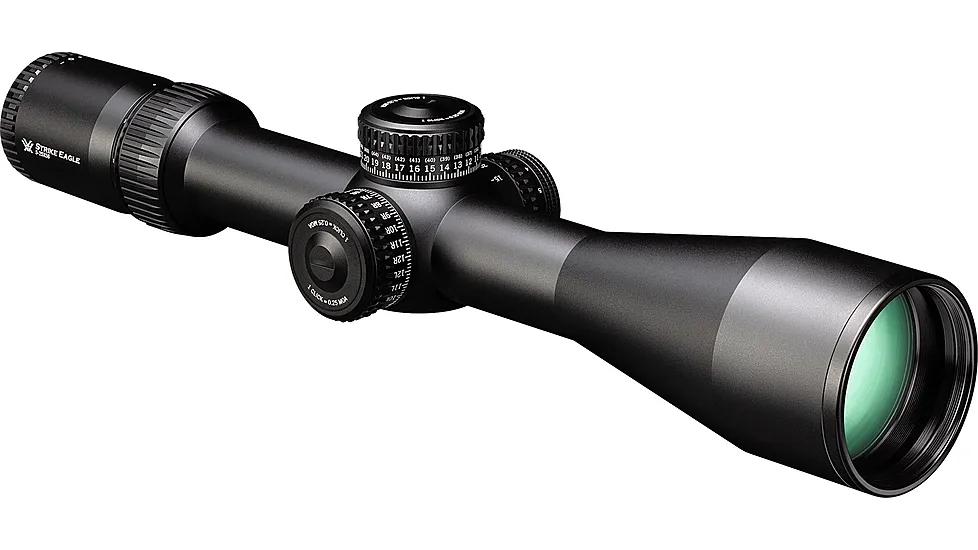
Best for long range: Vortex Strike Eagle 5-25x56 FFP
First focal plane · 5-25x56 · 34mm tube · illuminated EBR-7C reticle (MOA or MRAD, same price)
around $800exact price on OpticsPlanet
When Vortex launched this scope in 2020, a 34mm tube with 110 MOA of elevation, an illuminated first-focal-plane Christmas-tree reticle and a toolless zero stop was a spec sheet from the $1,200-plus tier. It is still the disruption in this roundup. What the price does not compromise is the part that matters most at distance: independent tall-target tests measure tracking deviation around 1 percent, and owners report dialing repeatable hits from 500 out to 1,760 yards. The Strike Eagle line is a fixture in under-$1,000 long-range roundups (Outdoor Life among them), it ships complete with throw lever, sunshade and zero-stop ring, and Vortex’s unconditional VIP lifetime warranty backs all of it. For a first serious long-range or PRS scope, this is where the value curve peaks.
Pros
- Tracks like scopes twice its price: about 1 percent deviation in independent tall-target tests, with owners dialing verified hits to 1,000+ yards
- 34mm tube with 110 MOA (31 MRAD) of elevation travel: real dialing headroom for true long range
- Illuminated, glass-etched FFP EBR-7C reticle keeps holdovers accurate at every magnification (11 brightness settings)
- Side parallax focuses down to 15 yards, a rarity that makes it a genuine rimfire-trainer and NRL22 crossover
- Complete out of the box: throw lever, sunshade, RevStop zero ring, lens covers and turret tool included, plus the unconditional Vortex VIP lifetime warranty
Cons
- Heavy at 30.4 oz bare (over 2 lb mounted with 34mm rings): the wrong scope for a mountain or carry rifle
- Glass is excellent from 5x to about 15x, but color fringing and edge softening appear past 20x, and the eye box tightens noticeably at 25x
- Turret clicks are on the soft, muted side compared to crisper rivals, even though the actual tracking stays accurate
- Installing the RevStop zero ring cuts usable elevation from 31 to about 18 MRAD, so extreme-long-range shooters past 1,200 yards may run without it
Best for: entry-to-mid-level PRS shooters, ringing steel from 300 to 1,000+ yards with a 6.5 Creedmoor or .308, and rimfire trainer builds thanks to the 15-yard parallax. Skip it for backcountry hunting rifles, or if you want flawless glass at full magnification, where the premium tiers pull away.
Key specifications
| Magnification | 5-25x |
|---|---|
| Objective lens | 56 mm |
| Reticle | EBR-7C (MOA or MRAD), glass-etched, illuminated (11 settings) |
| Focal plane | First focal plane (FFP) |
| Tube diameter | 34 mm |
| Field of view | 24 - 5.2 ft at 100 yds |
| Eye relief | 3.7 in |
| Adjustment click | 1/4 MOA (0.1 MRAD on the MRAD version) |
| Elevation/windage travel | 110 / 78 MOA |
| Parallax | 15 yds to infinity (side focus) |
| Weight | 30.4 oz |
| Length | 14.6 in |
| In the box | Throw lever, sunshade, RevStop zero ring, lens covers, turret tool, CR2032 |
| Sealing | Waterproof, fogproof, shockproof (ArmorTek coating) |
| Warranty | Vortex VIP: unlimited, unconditional, lifetime |
“This optic is well built, priced decently, and offers features you find on more pricey scopes in its class. For a new long-range shooter or a more budget-friendly, but higher-end option this is a good buy.”
The Marksman, verified owner (MI) via OpticsPlanet, after a year on a .300 Win Mag
How to choose a rifle scope
A few decisions matter more than any single spec on the box:
- Use case first. A deer rifle, a .22 plinker and a long-range target rig all want different magnification and reticles.
- FFP vs SFP. First focal plane keeps holdovers true at any magnification; second focal plane is simpler and usually cheaper. Full explainer: FFP vs SFP.
- Glass and warranty over big numbers. A clear, well-supported scope beats a dim one with a longer spec sheet.
- Match magnification to range. 3-9x covers most hunting; 5-25x suits real distance.
FAQ
What magnification do I need on a rifle scope?
For most hunting inside 300 yards, a 3-9x variable scope covers everything: our budget pick, the Vortex Crossfire II 3-9x40, and our premium pick, the Leupold VX-Freedom 3-9x40, both use it. Step up to a 5-25x or 6-24x optic such as the Vortex Strike Eagle or Diamondback Tactical only if you regularly shoot past a few hundred yards.
Should I choose FFP or SFP?
Choose first focal plane (FFP) if you hold over with the reticle at different zoom levels, because the reticle measurements stay true at any magnification. Our FFP picks are the Vortex Diamondback Tactical 6-24x50 and Strike Eagle 5-25x56. Second focal plane (SFP) is simpler and cheaper and works fine for fixed-distance hunting, which is why both of our 3-9x40 hunting picks are SFP.
Is a budget rifle scope good enough for hunting?
Yes, within typical hunting ranges. The Vortex Crossfire II 3-9x40, the cheapest pick in this guide, holds zero under heavy recoil and carries a 4.7/5 rating across 236 owner reviews on OpticsPlanet. Spend more when you need better low-light glass, higher magnification for long range, or turrets built for repeated dialing in the field.
What matters more: glass quality or magnification?
Glass quality and warranty, for most shooters. A clear, well-supported 3-9x scope beats a dim 6-24x with a longer spec sheet, because you can only use magnification you can see through. That is why we weight optical clarity, tracking reliability and warranty terms above headline magnification numbers in our rankings. See our methodology page for the full criteria.
Shopping by budget and use case
- Best budget rifle scope - two picks under $300, for hunting and for long range.
- Best rifle scope under $500 - three picks by use case, all under the ceiling.
- Best long range rifle scope - our two FFP picks, compared in depth for the distance game.
- Best LPVO - low power variable optics for an AR-15, red-dot speed at 1x plus reach, from $100.
- Best rimfire scope - .22 LR to .17 HMR picks with a 50-yard parallax, plus the best scope for a Ruger 10/22.
By cartridge and game
- Best scope for deer hunting - low-light glass and light weight for dawn-and-dusk whitetail, from $120.
- Best scope for a 6.5 Creedmoor - FFP tracking picks for the entry long-range cartridge, from $280.
- Best scope for a .300 Win Mag - magnum-safe eye relief for hunting and 110 MOA for long range.
- Best scope for a .308 - three picks by use case for the do-everything cartridge, from $120.
- Best scope for an AR-15 - LPVO and precision picks for a carbine or an SPR build, from $100.
- Best shotgun scope - low-power, recoil-proven picks for a slug gun by range, from $120.
- Best laser bore sighter - get a new scope on paper before you sight in, from $35.
Head-to-head comparisons
- Vortex Crossfire II vs Leupold VX-Freedom - budget vs premium 3-9x40 for hunting.
- Vortex Diamondback Tactical vs Strike Eagle - value FFP vs the long-range step-up.
- Vortex Crossfire II vs Diamondback - the classic Vortex budget upgrade question.
More in-depth scope reviews
- Vortex Viper HD 3-15x44 review - the features-first SFP hunter: illuminated Dead-Hold BDC and a locking elevation turret.
- Leupold VX-3HD 3.5-10x40 review - the US-made 12.6 oz low-light hunting benchmark with the CDS dial, around $500.
- Vortex Venom 5-25x56 review - the budget long-range FFP value play: 85 MOA of travel and measured tracking past 1,000 yards, around $500.
- Vortex Venom 1-6x24 review - the best-value carbine LPVO: true 1x, illuminated AR-BDC3 and included accessories, around $300.
Buying inside one premium brand? Our Nightforce NX8 decoder walks the F1 versus F2 choice with prices for every variant. Learn the basics: FFP vs SFP · MOA vs MRAD · parallax · how to adjust a scope · how to mount · how to sight in a rifle scope.
Want a faster close-range optic instead of magnification? See our best red dot sights.