Vortex Diamondback Tactical vs Strike Eagle: how much long-range scope do you need?
Our verdict: both are first-focal-plane scopes, so this is a question of how far you are taking your shooting. Buy the Vortex OPMOD Diamondback Tactical 6-24x50 (around $290) to learn long range, run precision rimfire, or shoot mid-range on a budget: true FFP precision at a remarkable price. Step up to the Vortex Strike Eagle 5-25x56 (around $800) when you want to dial seriously: a 34mm tube with 110 MOA of elevation, a RevStop zero stop, an illuminated reticle and a full accessory kit.
And the option most of these comparisons leave out: the Vortex Venom 5-25x56 (around $500) sits between them with the same 34mm tube, the same EBR-7C reticle and the same RevStop zero stop as the Strike Eagle, for around $300 less. You give up illumination, 25 MOA of elevation and five ounces.
Both hold a 4.8/5 average across a combined 355 owner reviews on OpticsPlanet. Prices verified September 30, 2026; confirm the current price on the retailer page. Both are picks in our best rifle scopes guide.
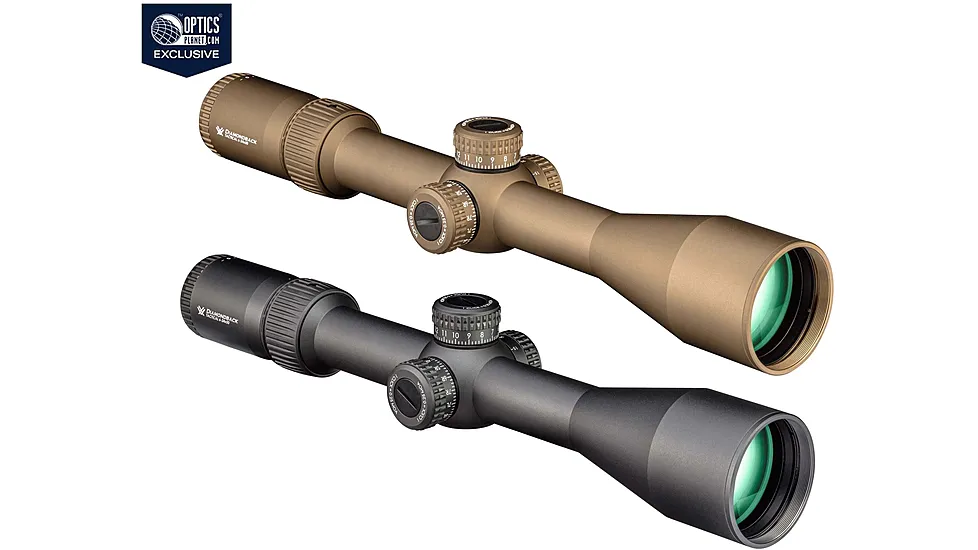
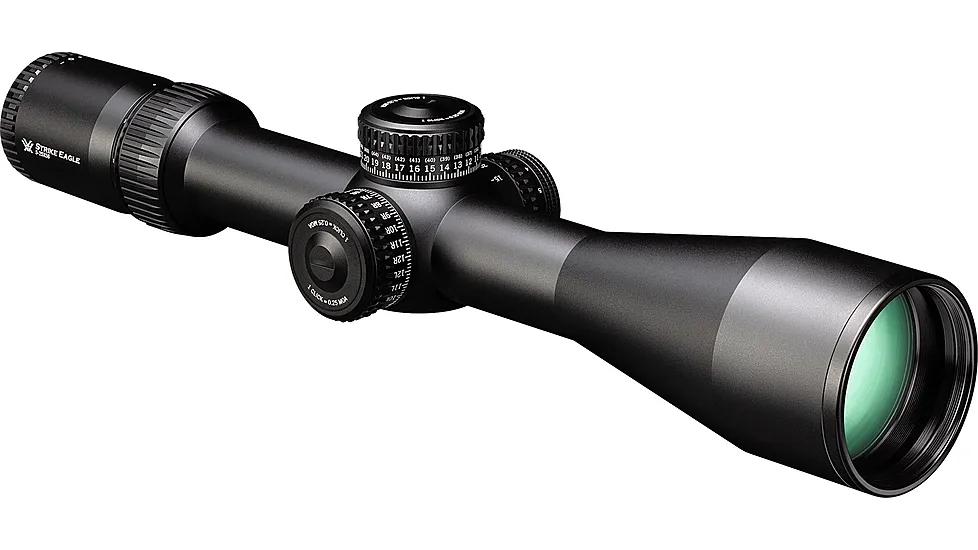
How this comparison was made: a research-based, spec-by-spec comparison from retailer specifications, expert reviews and owner feedback. We have not bench-tested these two side by side; scores and verdicts are our editorial opinion. See how we evaluate.
First, which Diamondback and which Strike Eagle?
Vortex puts both names on more than one scope, so "Diamondback vs Strike Eagle" is really several different questions. Sort out which pair you mean before you compare anything, because the answer changes completely:
- Diamondback covers the Diamondback Tactical first-focal-plane precision scopes (the 6-24x50 on this page and the 4-16x44), the Diamondback Tactical 4-12x40, which is second focal plane despite the same name, the standard Diamondback hunting scopes such as the 3-9x40, and the Diamondback Rimfire 2-7x35. The name also runs across Vortex binoculars and spotting scopes, which is why a plain search for it pulls in optics that are not rifle scopes at all.
- Strike Eagle is now five scopes doing three jobs: the 5-25x56 FFP compared here, the 3-18x44 FFP, and three low-power variables, the 1-10x24 FFP, the 1-8x24 FFP and the 1-8x24 that is second focal plane. That last pair is the trap: two scopes with the same 1-8x24 name and different focal planes, roughly $140 apart at list. The older 1-6x24 is no longer in Vortex's current Strike Eagle line-up, so if you are reading a comparison built around it, you are reading about a discontinued model.
That focal-plane split is worth pausing on, because the most-read forum thread on this comparison is arguing about a Diamondback Tactical FFP against a Strike Eagle SFP, which is a different question from the one on this page. On an FFP scope the reticle grows and shrinks with the zoom, so your holdovers are true at any magnification; on SFP they are only true at one power, usually maximum. If you dial and hold at mixed magnifications, that difference outranks brand and price.
This page compares the two first-focal-plane precision scopes: the Diamondback Tactical 6-24x50 against the Strike Eagle 5-25x56. That is the pairing worth agonising over, because they genuinely overlap: same focal plane, same job, one costs close to three times the other. If you actually meant a different pair, these are faster routes:
- Standard Diamondback against a budget hunting scope: Crossfire II vs Diamondback.
- The Strike Eagle LPVOs: Strike Eagle vs Sig Tango MSR, or the full best LPVO guide.
- Just deciding how much scope you need: our best rifle scopes guide ranks both of these alongside the rest.
Side-by-side specifications
| Diamondback Tactical 6-24x50 | Strike Eagle 5-25x56 | |
|---|---|---|
| Street price | around $290 | around $800 |
| Owner rating | 4.8/5, 257 reviews on OpticsPlanet | 4.8/5, 108 reviews on OpticsPlanet |
| Magnification | 6-24x | 5-25x |
| Objective | 50 mm | 56 mm |
| Tube | 30 mm | 34 mm |
| Focal plane | First focal plane (FFP) | First focal plane (FFP) |
| Reticle | EBR-2C MOA | EBR-7C (MOA or MRAD) |
| Illumination | None | Yes, 11 settings |
| Zero stop | No | Yes (RevStop) |
| Max elevation | 65 MOA | 110 MOA (31 MRAD) |
| Travel per rotation | 15 MOA | 25 MOA |
| Field of view at 100 yds | 18.0' at 6x to 4.5' at 24x | 24.0' at 5x to 5.2' at 25x |
| Eye relief | 3.9 in | 3.8 in |
| Parallax | Side focus, 10 yds to infinity | Side focus, 15 yds to infinity |
| Length / weight | 14.3 in / 24.6 oz | 14.6 in / 30.4 oz |
| In the box | Scope, covers | Throw lever, sunshade, RevStop ring, covers, tool |
| Warranty | Vortex VIP: unlimited, unconditional, lifetime | Vortex VIP: unlimited, unconditional, lifetime |
| Check Diamondback price | Check Strike Eagle price |
Price and positioning
At around $290, the Diamondback Tactical is arguably the best value in a first-focal-plane scope, full stop: it puts reliable tracking and a true FFP holdover reticle on a rifle for well under $300. The Strike Eagle costs around $800 and does not just add polish, it adds capability: more elevation, a real zero stop, illumination and a heavier, tougher chassis. Neither is overpriced for what it is. The honest question is whether you need the Strike Eagle's extra dialing capability yet.
Long-range capability and dialing
This is where the Strike Eagle earns its price, and Vortex's own numbers put a size on it. The Strike Eagle's 34mm tube holds 110 MOA of elevation and moves 25 MOA per turret rotation; the Diamondback Tactical's 30mm tube holds 65 MOA and moves 15 MOA per rotation. So the Strike Eagle gives you about 70 percent more total elevation, and it gets there in fewer turns. Add the RevStop zero stop and you can spin back to a verified zero in the dark without counting anything. Independent tall-target tests put its tracking deviation around 1 percent.
The Diamondback tracks well and passes box drills, but it has no zero stop and only 15 MOA to a turn, so any come-up past 15 MOA puts you into a second revolution with nothing mechanical to stop you returning to the wrong one. That is a discipline problem rather than a defect, and plenty of shooters live with it happily. It is also the single clearest reason to spend more.
The third scope this comparison usually ignores: the Venom 5-25x56
If the Diamondback's missing zero stop is what bothers you but the Strike Eagle's price is what stops you, Vortex sells the answer in between and almost nobody puts it in this comparison. The Venom 5-25x56 FFP is around $500: the same 34mm tube, the same EBR-7C reticle family and the same RevStop zero stop as the Strike Eagle, at around $300 less. What you give up is specific: 85 MOA of elevation instead of 110, no illumination, and it is the heaviest of the three at 35.0 oz. Owners rate it 4.8/5 across 176 reviews, more than the Strike Eagle has.
So the ladder is really three rungs: zero stop or not (Diamondback to Venom), then illumination and another 25 MOA of elevation (Venom to Strike Eagle). Read the full Venom 5-25x56 review for the honest trade-offs, including non-locking turrets.
Which exact model are you buying?
Both listings sell more than one thing, and one of them affects what turns up at your door. The Diamondback Tactical is a retailer-exclusive OPMOD build: the Gray scope is the price quoted here, and bundles that add an OPMOD cantilever mount, in Gray and in Tan, cost more. The Strike Eagle comes in two reticles at the same price, EBR-7C MOA and EBR-7C MRAD. On a scope bought for dialing, that is not a detail: pick your unit of measurement first, and make sure the listing you order is the reticle you meant to buy.
Reticle and illumination
Both use first-focal-plane Christmas-tree reticles that keep holdovers true at any magnification, but only the Strike Eagle's EBR-7C is illuminated (11 brightness settings), which helps against dark targets and in low light. The Diamondback's EBR-2C is a fine daylight reticle but non-illuminated, and its fine crosshair can wash out in dim conditions. If you often shoot at last light or against shadowed steel, illumination is a real advantage.
Glass
Both punch above their price in the low-to-mid magnification range, and both share the same honest budget-FFP limit: image quality softens toward the top of the zoom range, with some edge blur and color fringing (treat the Diamondback as a 6-18x in practice, and expect the Strike Eagle to soften past about 20x). Neither will match a $2,000 optic at maximum magnification, but for their tiers both are strong.
Weight and handling
The Diamondback Tactical is noticeably lighter at 24.6 oz; the Strike Eagle is a hefty 30.4 oz bare, and with 34mm rings it adds over two pounds to a rifle. On a bench or prone precision rig that weight is a non-issue and even helps stability. On anything you carry, the Diamondback is far friendlier. The Strike Eagle also ships complete: throw lever, sunshade, RevStop ring, lens covers and turret tool in the box, where the Diamondback keeps it basic.
Which one should you buy?
- Learning long range or on a budget: Diamondback Tactical. True FFP precision for under $300.
- Serious PRS or reaching past 1,000 yards: Strike Eagle, for the 110 MOA and zero stop.
- Low light or dark targets: Strike Eagle, for the illuminated reticle.
- Precision rimfire / NRL22: both work (close side parallax on each); Diamondback if weight and price matter, Strike Eagle if you want illumination and a zero stop.
- A scope you carry: Diamondback Tactical, at 24.6 oz. The Venom is the heaviest of the three at 35.0 oz, the Strike Eagle sits between at 30.4 oz.
- You want a zero stop but not the Strike Eagle's price: the Venom 5-25x56 (around $500), same 34mm tube and RevStop, no illumination.
- You think in mils: Strike Eagle, and order the EBR-7C MRAD reticle. The Diamondback Tactical's EBR-2C is MOA only.
- General hunting inside 300 yards: neither; see our 3-9x40 picks, the Crossfire II and VX-Freedom.
FAQ
Is the Strike Eagle worth close to three times the price of the Diamondback Tactical?
If you are serious about dialing for distance, yes. The Vortex Strike Eagle 5-25x56 adds a 34mm tube with 110 MOA of elevation, a proper RevStop zero stop, an illuminated EBR-7C reticle and a complete accessory kit. If you are learning long range or shooting precision rimfire on a budget, the Diamondback Tactical 6-24x50 delivers true first-focal-plane precision for far less, which is why it is our value pick.
Which is the better first long-range or PRS scope?
Both are legitimate entry points and both are first focal plane. The Diamondback Tactical is the lowest-risk way to learn holdovers and dialing without a big spend. The Strike Eagle is the better long-term platform: its zero stop, extra elevation and illuminated reticle mean you will not outgrow it as fast. Budget usually decides it.
Which is better for precision rimfire (NRL22)?
Both shine here because both have close-focusing side parallax (the Diamondback down to 10 yards, the Strike Eagle to 15 yards) and FFP reticles. For a rimfire trainer on a budget, the Diamondback Tactical is lighter and much cheaper. If you want an illuminated reticle and a zero stop on the same rifle, the Strike Eagle is the richer tool.
Is the Vortex Strike Eagle any good?
On the evidence, yes, within its tier. The 5-25x56 holds 4.8/5 across 108 owner reviews at OpticsPlanet and 4.9/5 across 634 on Vortex's own site, it carries the mechanical features that matter for dialing (110 MOA of elevation, 25 MOA per rotation, a RevStop zero stop, an illuminated EBR-7C reticle), and it is backed by the unconditional VIP lifetime warranty. It is not a match optic: it is a mid-tier scope selling well below its Vortex list price, and its glass softens toward the top of the zoom range the way scopes at this price do. Judge it against the Venom and the Diamondback Tactical, not against a Razor.
Is the Vortex Diamondback Tactical any good?
For the money it is one of the strongest arguments in the category: a true first-focal-plane scope with an EBR-2C holdover reticle, 65 MOA of elevation and repeatable tracking, at well under $300. Owners rate it 4.8/5 across 257 reviews. The honest limits are that it has no zero stop, only 15 MOA per turret rotation, no illumination, and image quality that is best treated as a 6-18x rather than a full 24x. As a first FFP scope, a rimfire trainer or a mid-range precision optic, it is hard to beat at the price.
What is the highest quality Vortex rifle scope?
Vortex's own riflescope menu lists its families in this order, dearest first: AMG, Razor, Golden Eagle, Viper, Strike Eagle, Venom, Diamondback, Crossfire and Triumph. So neither scope on this page is near the top: the Razor and AMG families are where Vortex puts its best glass and mechanics, at several times these prices. What the Diamondback Tactical and Strike Eagle are for is getting genuine first-focal-plane capability without paying that.
Can either scope reach 1,000 yards?
The Strike Eagle is built for it: 110 MOA (31 MRAD) of elevation in a 34mm tube lets you dial well past 1,000 yards, and owners report verified hits out beyond that. The Diamondback Tactical can stretch out with holdovers, but its 30mm tube offers less elevation and it has no zero stop, so it is happier as a learning and mid-range precision scope than a dedicated extreme-long-range optic.
See both scopes in context in our best rifle scopes 2026 guide, or read how to sight in a rifle scope.