The best crossbow scopes for 2026, by budget and use
Our verdict for 2026: the Vortex Crossfire II 2-7x32 kit (around $200) is the best crossbow scope for most people, because its speed-calibrated XBR-2 reticle is dead-on out to 80 yards, it ships with rings and a wrench, and Vortex calls its VIP warranty unlimited and unconditional. Read one thing before you sight it in: Vortex designed this reticle around a 40-yard zero, not the 20-yard zero almost every other crossbow scope uses. The Hawke XB1 1.5-5x32 (around $160) has the highest owner rating here and publishes the bolt-speed window it covers; the UTG True Hunter 4x32 (around $160) is the best-built fixed 4x, with locking turrets and quick-detach rings; and the TruGlo 4x32 with rings (around $95) is the cheapest way onto paper. If you would rather have no magnification at all, the TruGlo 30mm three-dot red dot (around $80) is the crossbow sight to buy, and the Burris Oracle X (around $1,050) is the only one here that measures the range for you.
Editorial scores are our opinion; owner ratings are shown attributed to their source. Prices verified September 30, 2026; confirm the current price and availability on the retailer page.
A crossbow scope is not a rifle scope with a different label. A bolt flies far slower than a bullet and drops fast, so a crossbow scope is built around bolt drop, with stacked aiming points you calibrate to your bolt speed, a shorter parallax and internals braced for a crossbow's sharp forward jolt. Below are six picks across three product classes, four magnified scopes from budget to best overall, a 1x red dot for hunters who want no magnification, and one scope with a laser rangefinder inside it, plus how the reticle actually works and how to choose between them.
How these picks were made: a research-based roundup built from the OpticsPlanet product specifications and owner feedback for each optic, then checked against each manufacturer's own published specifications and warranty terms. That check is what corrected the zero distance, the adjustment range and the warranty wording on our own top pick this round. Scores are our editorial opinion, not a hands-on test of every model, and owner ratings are shown attributed. Prices were verified on the retailer pages on September 30, 2026. See how we evaluate.
- Vortex Crossfire II 2-7x32 SFP XBR-2 MOA Crossbow Kit - Best overall
- Hawke XB1 1.5-5x32 Crossbow Scope - Best glass and illumination
- UTG True Hunter 4x32 Crossbow Scope - Best built fixed 4x
- TruGlo 4x32 Crossbow Scope with Rings - Best budget
- TruGlo Crossbow Red-Dot Sight, 30mm 3 Dot - Best crossbow sight without magnification
- Burris Oracle X Rangefinding Bow Sight - Best rangefinding crossbow scope
- How a crossbow reticle works
- The zero distance most roundups get wrong
- How to choose a crossbow scope
- FAQ
Quick comparison
| Category | Pick | Spec | Price | |
|---|---|---|---|---|
| Best overall | Vortex Crossfire II 2-7x32 SFP XBR-2 MOA Crossbow Kit | 2-7x32 · speed reticle · rings incl. | around $200 | Check price |
| Best glass and illumination | Hawke XB1 1.5-5x32 Crossbow Scope | 1.5-5x32 · SR reticle · red/green | around $160 | Check price |
| Best built fixed 4x | UTG True Hunter 4x32 Crossbow Scope | Fixed 4x32 · locking turrets · QD rings | around $160 | Check price |
| Best budget | TruGlo 4x32 Crossbow Scope with Rings | Fixed 4x32 · range reticle · rings incl. | around $95 | Check price |
| Best crossbow sight without magnification | TruGlo Crossbow Red-Dot Sight, 30mm 3 Dot | 1x · 3 dots · 30 mm window | around $80 | Check price |
| Best rangefinding crossbow scope | Burris Oracle X Rangefinding Bow Sight | 2-7x32 · built-in rangefinder | around $1,050 | Check price |
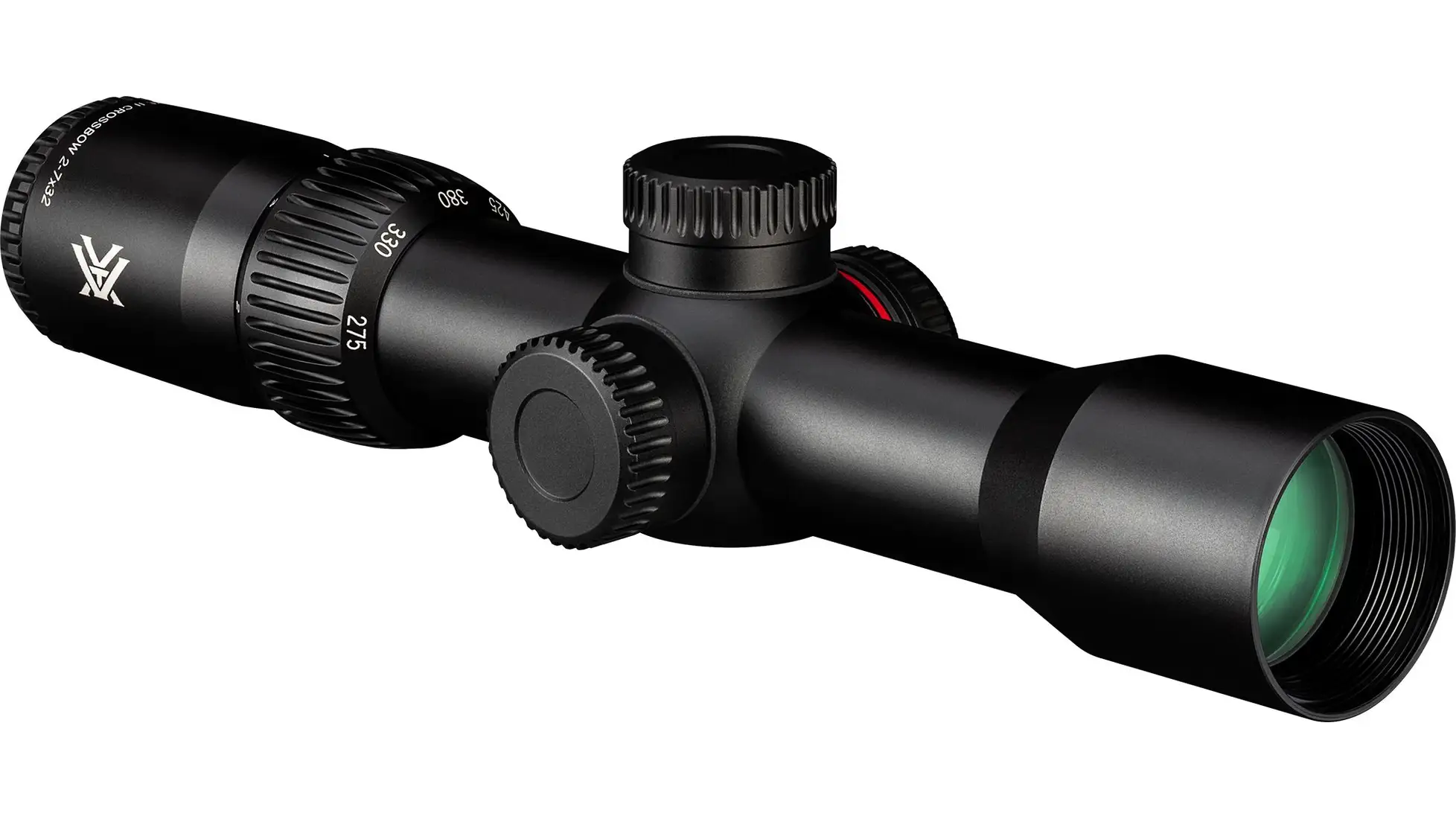
Best overall: Vortex Crossfire II 2-7x32 SFP XBR-2 MOA Crossbow Kit
2-7x32 · XBR-2 speed reticle (red/green) · 30 mm tube · 40 yd zero · 75 yd parallax · rings included
around $200exact price on OpticsPlanet
For most crossbow hunters the right scope is the one that mounts fast, holds zero under the sharp forward jolt of a limb release, and puts an aiming point on the target at every ethical range. The Crossfire II kit does all three and throws the rings in. Its XBR-2 reticle is speed-calibrated, and Vortex prints the fps scale on the magnification ring itself, so you set the ring to your measured bolt velocity and the stacked marks then fall where they say they do, which owners repeatedly confirm out to 80 yards. One thing to know before you buy, because most roundups get it wrong: Vortex designed this reticle around a 40-yard zero on the main crosshair, with holdovers running from 20 to 100 yards, not the 20-yard center zero most crossbow scopes use. The 75-yard parallax is set for crossbow distances, the glass is genuinely better than the scope your bow shipped with, and the VIP warranty is the least conditional in this group.
Pros
- Speed-calibrated XBR-2 reticle with the fps scale printed on the magnification ring, and owners confirm the marks dead-on to 80 yards once matched to bolt velocity
- Vortex publishes 160 MOA of maximum elevation and windage adjustment, room the steep arc of a bolt genuinely uses, on a 30 mm tube
- Dual red and green illumination, and because the reticle is etched it stays a crisp black crosshair with the battery dead
- Ships as a complete kit: two 30 mm rings 1.1 in high, flip caps, a neoprene cover, a lens cloth, a CR2032 and a Torx T-15 wrench, so nothing else is needed to shoot
- The deepest owner track record of our picks (4.8/5, 44 reviews) and a Best Rated Product badge on OpticsPlanet
- Vortex calls the VIP warranty unlimited, unconditional and lifetime, and states it does not matter how it happened, whose fault it was, or where you bought it
Cons
- The 40-yard center zero is the real trade-off: every hunter trained on a 20-yard crosshair has to retrain, and a close shot taken on reflex is the shot that punishes it
- The magnification ring IS the speed ring, so you cannot choose your zoom freely; a fast bow pushes you toward the top of the range and a slow one toward the bottom
- That speed setting does not lock, so a ring brushed against a stand rail or heavy sleeve can quietly change your calibration (owner-noted)
- Vortex names four exclusions on the VIP warranty: loss, theft, deliberate damage, and cosmetic damage that does not hinder performance
- Made in China (owner-noted), if country of origin matters to you
Best for: almost any crossbow hunter who wants one do-it-all scope that mounts and shoots the day it lands, and who is willing to learn a 40-yard zero. Take the Hawke if you want the highest owner rating and a more conventional zero, the UTG if you would rather have a fixed 4x with locking turrets, or the TruGlo to spend the least.
Key specifications
| Magnification | 2-7x |
|---|---|
| Objective | 32 mm |
| Tube | 30 mm |
| Focal plane | Second focal plane |
| Reticle | XBR-2 (MOA, speed-calibrated, red/green illuminated) |
| Zero distance | 40 yd on the main crosshair, holdovers 20 to 100 yd (Vortex) |
| Parallax | 75 yd (fixed) |
| Max elevation / windage | 160 MOA each (Vortex) |
| Travel per rotation | 30 MOA |
| Adjustment graduation | 1/2 MOA |
| Eye relief | 2.7 in |
| Field of view | 57.5 to 16.4 ft at 100 yd |
| Weight | 14 oz |
| Length | 9.5 in |
| Battery | CR2032 |
| Included | Two 30 mm rings (1.1 in), flip caps, neoprene cover, lens cloth, battery, Torx T-15 wrench |
| Warranty | Vortex VIP, unlimited and unconditional lifetime |
| MPN | CF2-CB1 |
“For the money can't be beat. Clear glass tightened my groups w/425 fps cb... The reticle colors are bright enough for daytime use.”
Mark, verified owner via OpticsPlanet (MI)
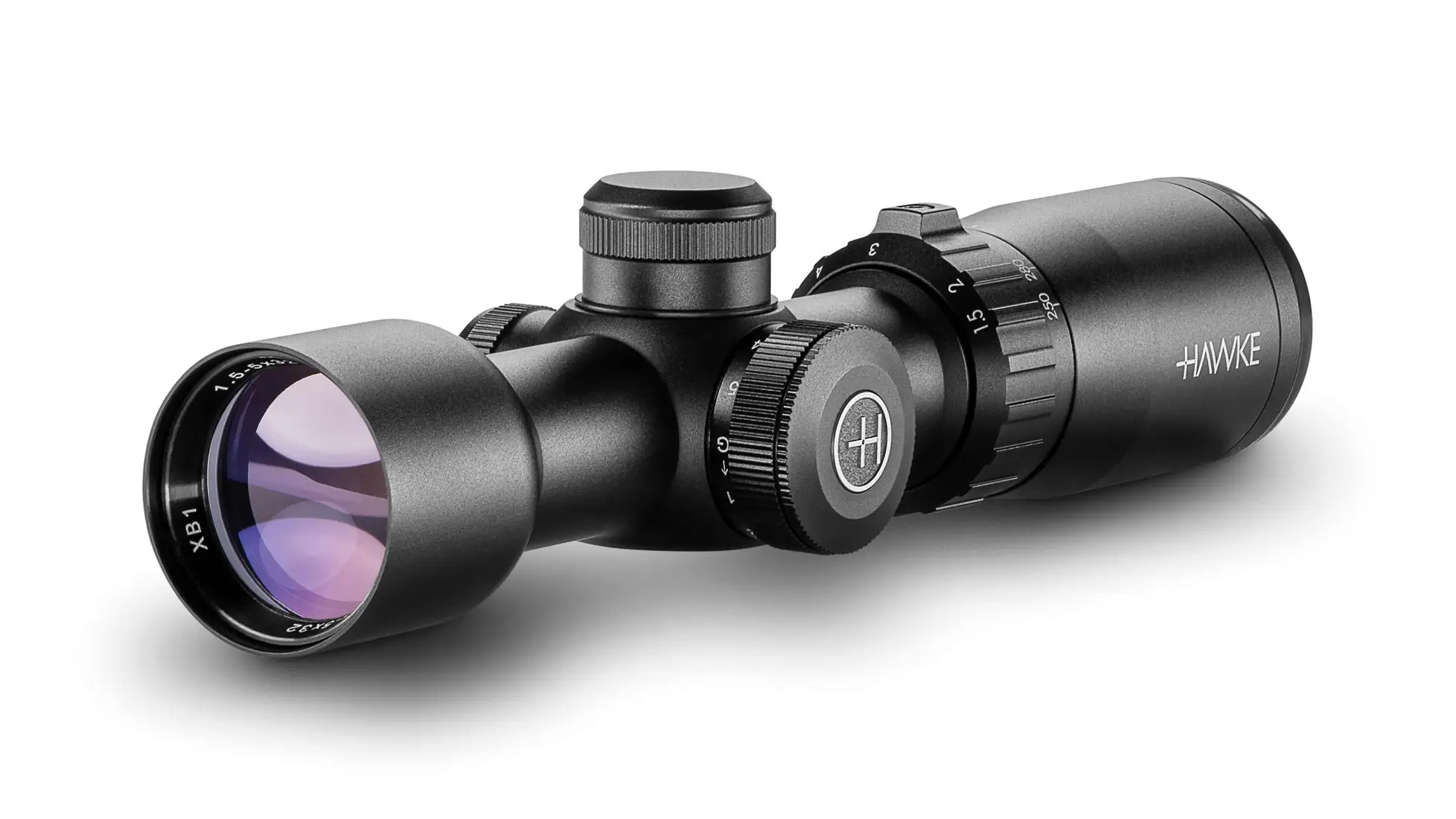
Best glass and illumination: Hawke XB1 1.5-5x32 Crossbow Scope
1.5-5x32 · SR speed reticle · 1 in tube · red/green, 5 levels · 250 to 425 fps
around $160exact price on OpticsPlanet
Hawke is an optics house that specialises in crossbow glass, and it shows: the XB1 carries the highest owner rating here and the reason owners keep repeating is that it zeros in a handful of shots and then stays put. Its SR reticle works the way the Vortex does, you match a speed setting to your bolt velocity so the holdover marks line up down-range, and Hawke publishes the window it covers, 250 to 425 fps, which is a useful thing to check against your own bow before you order rather than after. The red and green illumination runs through five brightness levels, which matters more than the colour count in a ground blind where a bright reticle washes out the animal. On a 1-inch tube it drops into standard rings. The honest catch is the same one the Vortex has: the zoom doubles as the speed ring, so you only reach the top 5x with a fast crossbow.
Pros
- Highest owner rating of our picks (4.9/5, 23 reviews), with owners praising a fast zero that then holds under the shot
- Hawke publishes the speed window the reticle covers, 250 to 425 fps, so you can check your bow against it before buying
- Red and green illumination with five brightness levels, for the first and last legal light a crossbow hunter lives in
- Standard 1-inch tube drops into common rings, and it undercuts the Vortex kit while beating it on owner rating
Cons
- The magnification is tied to the speed-calibration ring, so you only reach the top 5x with a fast bow (a 305 to 340 fps crossbow lands nearer 3x), owners report honestly
- That speed setting does not lock, so a bumped zoom ring can shift your calibration (one owner marks it with paint)
- Hawke sets the parallax at 45 metres, roughly 49 yards, which is fine at hunting distance but means a hurried cheek weld can float the reticle on a close shot
- Rings are not included, unlike the Vortex, UTG and TruGlo picks
- The retailer page has shown a sibling model’s spec table, so confirm you are ordering MPN 12221 before you buy
- Fewer reviews than the Vortex (23 vs 44), a shallower track record
Best for: the hunter who wants the highest-rated glass here and five-level red/green illumination, and who is fine matching magnification to bolt speed. Choose the Vortex for the included rings and deepest track record, or the TruGlo to spend the least.
Key specifications
| Magnification | 1.5-5x |
|---|---|
| Objective | 32 mm |
| Tube | 1 in (mono-tube) |
| Focal plane | SFP |
| Reticle | SR (Speed Reticle), illuminated |
| Illumination | Red and green, 5 levels |
| Suitable bolt speeds | 250 to 425 fps (Hawke) |
| Parallax | Fixed at 45 m (about 49 yd) |
| MPN | 12221 (new) |
| Note | Confirm MPN 12221; the retailer page has shown a sibling spec table |
“It took exactly 4 shots to zero it in... The lighted reticles are great in low light conditions and don't distort like some others I've seen, and stay clear and bright even without the light feature.”
MnGriz, verified owner via OpticsPlanet (MN)
Best built fixed 4x: UTG True Hunter 4x32 Crossbow Scope
Fixed 4x32 · Pro 5-Step reticle (red/green) · 1 in tube · 50 yd parallax · QD lever-lock rings included
around $160exact price on OpticsPlanet
This is what you buy when a fixed 4x is enough optic but the cheapest fixed 4x is not enough hardware. It brings the things budget crossbow scopes leave out: zero-lockable and zero-resettable target turrets, an integral sun shade, quick-detach lever-lock rings in the box, and Leapers’ rain-proof, fog-proof True Strength housing. There is one thing you have to know before it fits your bow, and it comes from Leapers rather than the retailer: the reticle carries five horizontal lines that the maker states are "Calibrated for 300fps Crossbows", for 10, 20, 30, 40 and 50 yards. Plenty of 2026 hunting crossbows shoot well past 300 fps. That does not make the lines useless, they still land somewhere repeatable, but on a fast bow you find each line’s real distance on the range instead of taking it out of the box, which is precisely what one owner describes doing.
Pros
- Zero-lockable and zero-resettable target turrets, an integral sun shade and a rain-proof, fog-proof housing, hardware the cheap fixed 4x scopes do not have
- Quick-detach lever-lock rings, flip caps, a cleaning cloth, install tools and a battery all in the box
- Red and green illumination on a side wheel, which owners single out for first and last light, and it dials low enough not to overpower the target
- Owners consistently report a fast zero (about four shots) that then holds, with one reporting it true from 20 to 60 yards after a 10-yard zero
- Leapers backs it with a lifetime warranty against defects in material and workmanship
Cons
- Leapers states the reticle lines are calibrated for 300 fps crossbows, so on a faster modern bow you have to find what each line is really worth at the range
- The quick-detach rings did not fit every rail: three separate owners, all on Barnett bows, had to use different rings or an adapter, so measure your rail
- The owner record is old, the newest of the listed reviews is January 2022, so it is a long track record rather than a current one
- One owner reports lens condensation after rain, directly against the fog-proof claim, while another says it never fogs; both are on the record
- One owner reports the illumination is intermittent and switches off at the lightest bump of the dial
- Leapers’ lifetime warranty covers defects, and explicitly does not extend to accidental damage, misuse or negligence, so it is not the Vortex VIP
Best for: the hunter who wants a simple fixed 4x but wants it built properly, with locking turrets and rings included, and whose bow is nearer 300 fps than 450. Take the Vortex or Hawke if you want zoom and a speed-adjustable reticle, or the TruGlo if the budget is the point.
Key specifications
| Magnification | 4x (fixed) |
|---|---|
| Objective | 32 mm |
| Tube | 1 in |
| Reticle | Pro 5-Step, red/green illuminated, lines for 10/20/30/40/50 yd calibrated for 300 fps (Leapers) |
| Parallax | Pre-set at 50 yd (from the maker feature list, not the retailer spec table) |
| Clicks | 0.25 MOA |
| Eye relief | 3.8 in |
| Field of view | 27.2 ft at 100 yd |
| Exit pupil | 8 mm |
| Weight | 12.3 oz |
| Length | 8.19 in |
| Battery | CR1620 |
| Included | Two quick-detach lever-lock rings, flip caps, cleaning cloth, install tools, battery |
| Warranty | Leapers lifetime against defects (excludes accidental damage) |
| MPN | SCP-M4CR5WQ |
| Note | The retailer titles this "UTG Pro 4x32mm Crossbow Scope"; Leapers sells UTG PRO as a separate line and calls this one True Hunter, so "Pro" is the reticle’s name. Same MPN in both. |
“Zeroed in in about 4 shots, multiple reticle just like the factory scope. Takes a little work to figure the range mark values after your 20 yard zero, as they are dependant on your bows speed.”
Jon via OpticsPlanet (IL)
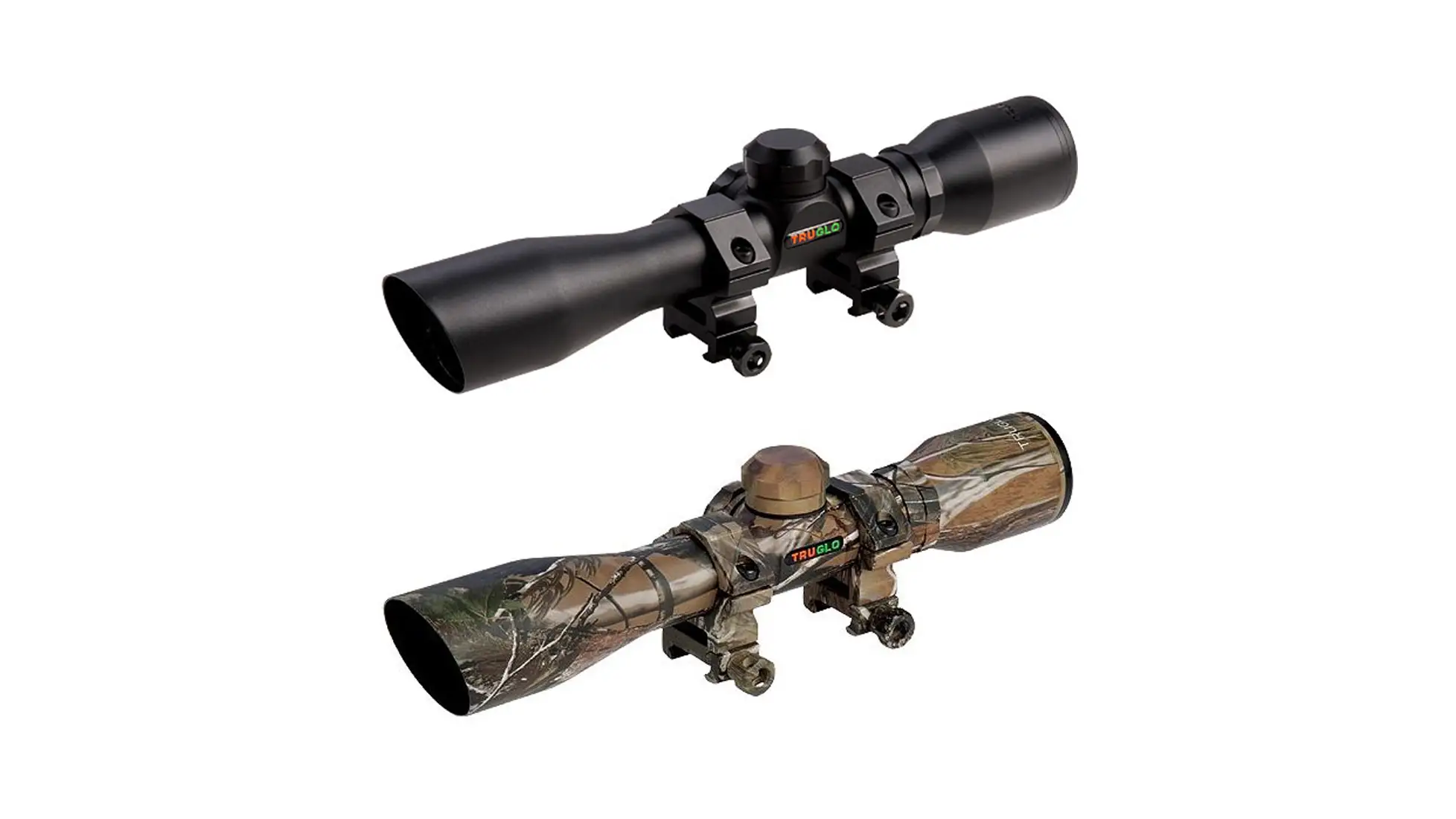
Best budget: TruGlo 4x32 Crossbow Scope with Rings
Fixed 4x32 · trajectory-compensating range reticle · 1 in tube · rings included
around $95exact price on OpticsPlanet
If the job is simply to get a crossbow on paper for the least money, the TruGlo does it and includes the rings to boot. It is a fixed 4x, which sounds limiting but is plenty for the sub-50-yard ranges most crossbow hunters actually shoot, and a fixed magnification means one less thing to bump. Its multi-line reticle gives trajectory-compensating aiming points at roughly 20, 30, 40 and 50 yards, and the wider bars double as a rough range estimator by bracketing a deer. With Weaver-style rings in the box, it is the cheapest complete path to a zeroed crossbow here. The honest trade is durability in extreme cold: several owners in hard-freeze states report internal fogging, so it is best matched to milder-weather hunting.
Pros
- Cheapest magnified pick here, and it includes Weaver-style rings, so it is the lowest total cost to a zeroed crossbow
- Fixed 4x is simple, has nothing to bump, and is enough magnification for typical crossbow ranges under 50 yards
- Multi-line trajectory-compensating reticle with 20/30/40/50-yard aiming points that owners zero in about three shots
- Camo/Realtree or black finish options, and owners repeatedly call it strong value for the price
Cons
- Repeated owner reports of internal fogging in hard freezing cold (several Michigan owners), so it suits milder-weather hunting
- Fixed 4x means no zoom-down for a very close timber shot or zoom-up to confirm a distant animal
- No illumination, so the reticle is a black crosshair in exactly the light a crossbow season is hunted in
- The included rings did not fit every crossbow rail for one owner, who bought different rings
- The shallowest and lowest owner rating of our magnified picks (4.3/5, 12 reviews)
Best for: the budget buyer or the second crossbow who wants a simple, rings-included scope for ranges under 50 yards in moderate weather. Step up to the UTG for locking turrets and illumination, or to the Vortex and Hawke for zoom and a speed-adjustable reticle.
Key specifications
| Magnification | 4x (fixed) |
|---|---|
| Objective | 32 mm |
| Tube | 1 in |
| Reticle | Range-finding / trajectory-compensating |
| Clicks | 0.25 MOA |
| Eye relief | 4 in |
| Field of view | 24 ft at 100 yd |
| Weight | 11.4 oz |
| Length | 8 in |
| Included | Weaver-style rings |
| Finish | Realtree / black |
| MPN | TG-TG8504C3 |
“Mounted it on a Centerpoint 370, first shot was an inch low at 20 yards. Well constructed and very clear focus, especially fond of the built-in range reticle for judging distance on deer.”
Ramster, verified owner via OpticsPlanet (TX)
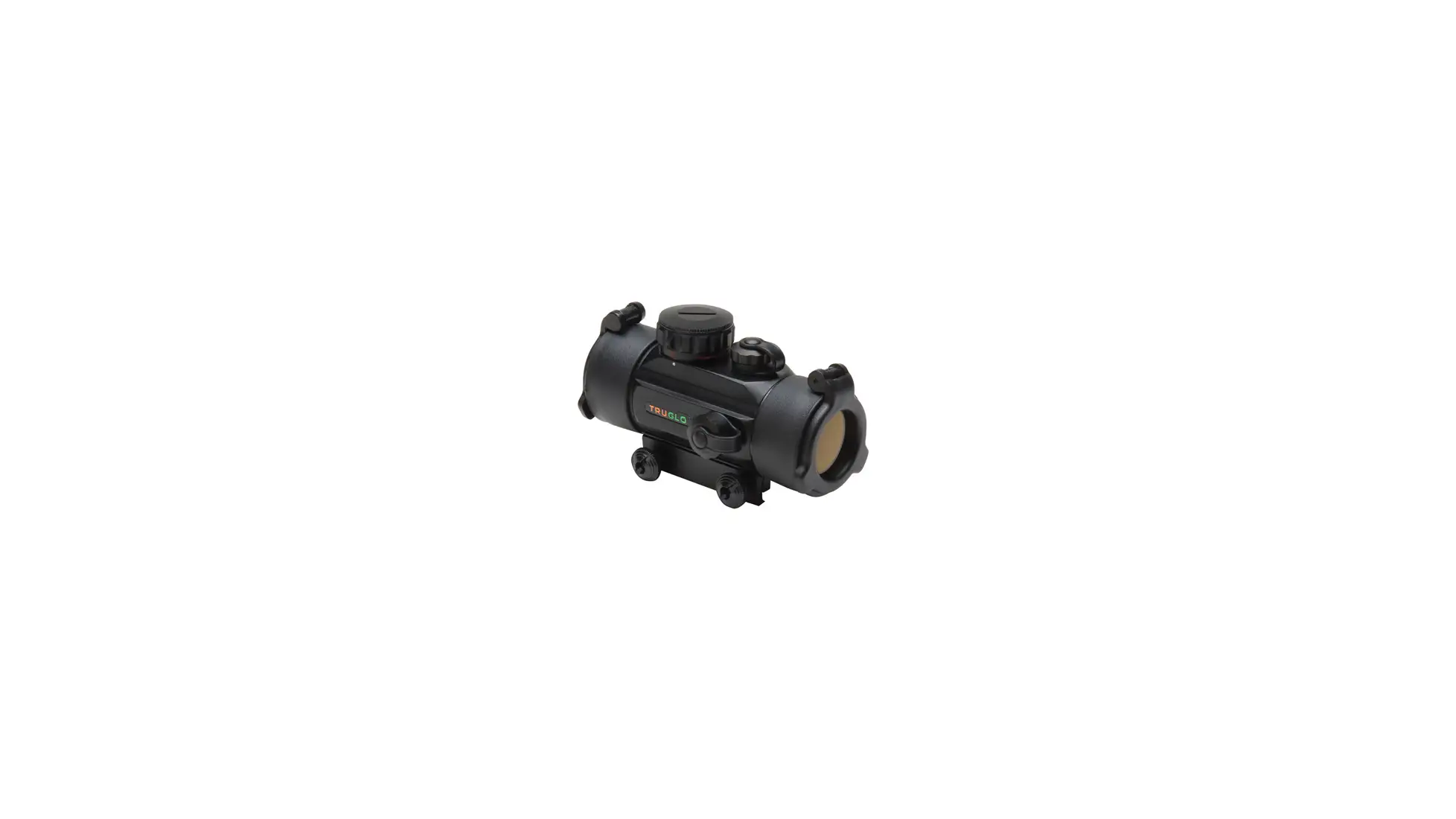
Best crossbow sight without magnification: TruGlo Crossbow Red-Dot Sight, 30mm 3 Dot
1x · three descending-diameter red dots · 30 mm window · enclosed emitter · 11 brightness levels · integrated Weaver mount
around $80exact price on OpticsPlanet
Some crossbow hunters do not want a scope at all, and this is the sight for them. At true 1x it has unlimited eye relief, which is the single biggest ergonomic difference on a crossbow: there is no eye box to find and no penalty for a hurried cheek weld under the forward jolt of the shot. TruGlo positions it as an alternative to magnified glass rather than a cheaper substitute, and the owners here agree in the bluntest possible way, two of them say plainly that they prefer it to a scope, and a third that it beats the sight his crossbow came with. Three dots of descending diameter give you rough holdovers instead of one aiming point, the emitter is enclosed rather than open, and the whole thing runs on a CR2032 you can buy anywhere. It is the fastest sight here inside 40 yards and the one least likely to fog, because it has the fewest surfaces to fog.
Pros
- True 1x with unlimited eye relief and a wide 30 mm window, so there is no eye box to find and no scope bite under a crossbow’s forward jolt
- Three descending-diameter dots give rough holdovers for stepped ranges, which a single-dot red dot cannot do
- Enclosed emitter, listed as such in the spec table rather than guessed from the model name, so the emitter window cannot silt up with rain or snow
- Eleven brightness levels, an integrated Weaver-style mount, flip-up lens caps in the box and a common CR2032 battery
- Owners report it arrives close to zeroed: one needed no windage adjustment at all, another was on target in four shots
Cons
- Only seven owner reviews, so the 4.9 rating is thin evidence next to the Vortex’s 44
- Neither TruGlo nor the retailer publishes what the three dots subtend in MOA, so what range each dot is worth has to be found on your own bow
- No magnification at all, so confirming an animal at distance or threading a gap in cover is on your eyes
- There is no on/off switch, you rotate the brightness dial to turn it on and off (one owner’s only complaint, and he called it nit picking)
- The retailer also lists an open-box copy of this sight at a lower price that carries no returns; the price here is the new one
Best for: the hunter shooting inside about 40 yards, anyone who finds a scope’s eye box unforgiving on a crossbow, and anyone whose hunt does not permit magnified optics. Take a magnified pick instead if you want calibrated holdovers past 50 yards.
Key specifications
| Magnification | 1x |
|---|---|
| Window | 30 mm |
| Tube | 30 mm |
| Reticle | Three red dots of descending diameter |
| Emitter | Enclosed |
| Brightness settings | 11 |
| Mount | Integrated Weaver-style, Picatinny compatible |
| Battery | CR2032 (included) |
| Finish | Matte |
| MPN | TG-TG8030B3 |
| Dot size | Not published by TruGlo or the retailer in MOA |
| Note | TruGlo’s own name for it is the 30mm Traditional Dot Sight |
“This Red Dot works much better than the scope that came on my crossbow. I feel much more confident with it now. Easy to mount. Clear sight picture. It just works.”
Bubba, verified owner via OpticsPlanet (IL)
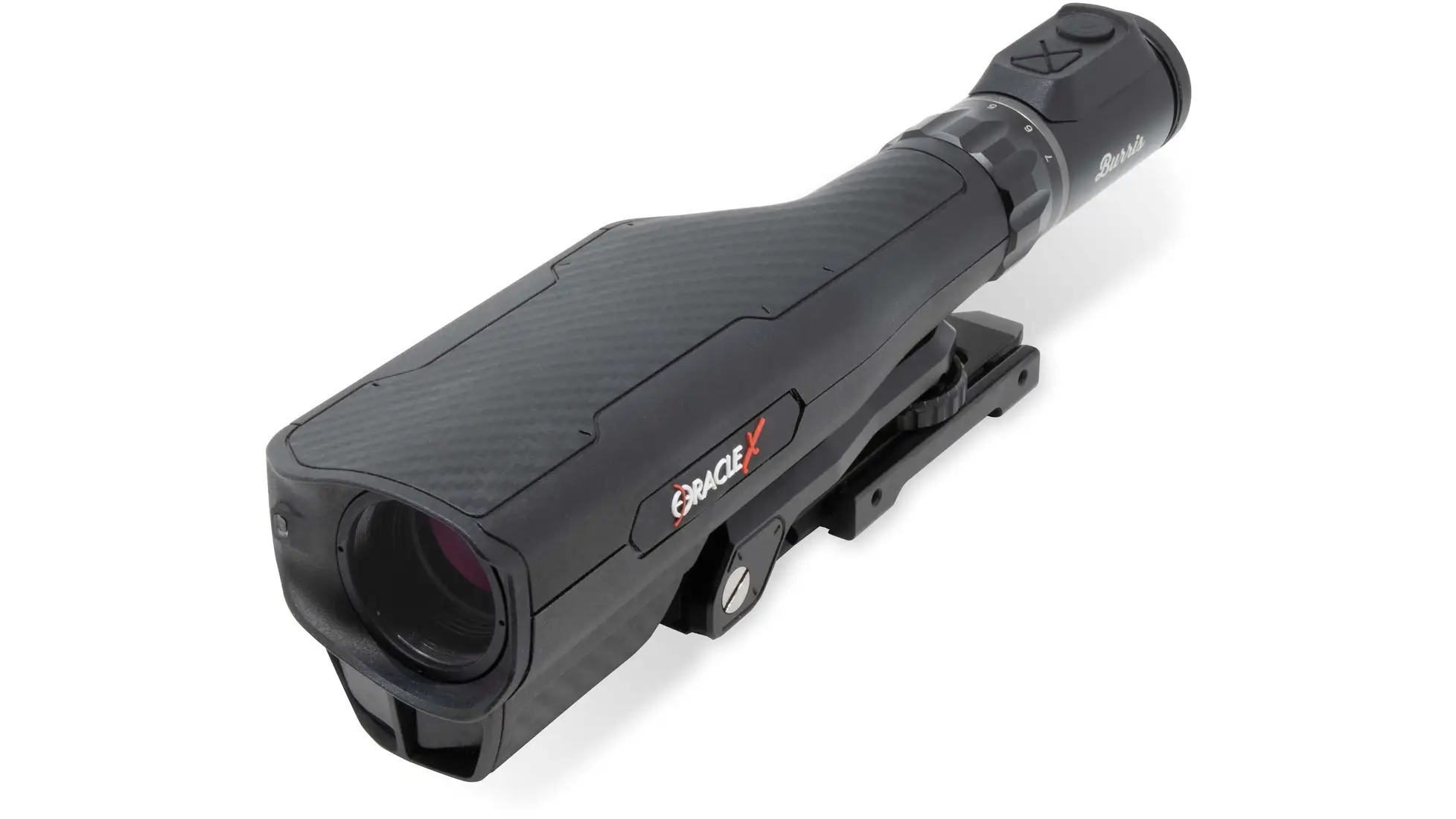
Best rangefinding crossbow scope: Burris Oracle X Rangefinding Bow Sight
2-7x32 · built-in laser rangefinder · magnification compensation · inclinometer and electronic level · wireless remote
around $1,050exact price on OpticsPlanet
This is the only pick here that removes the error the others cannot touch. Every scope on this page assumes you already know the distance; the Oracle X measures it, corrects it for the angle you are shooting down at from a stand, and lights the aiming point where the bolt will actually land. One owner describes it exactly: he read a shot as 20 to 25 yards, the scope said 31, he held the dot it gave him and the shot was perfect. It is a genuinely different tool, with a matching set of trade-offs. It costs more than the other five picks put together, it sits high enough that Burris’ own spec sheet puts the body at 3.28 inches (an owner measured 3.25 and was right), and the risk with it is not optical but electronic: in fifteen owner reports nobody complains about the glass, holding zero or the mount coming loose, and almost every complaint is about batteries, the battery cap or the wireless remote. Burris shipped free replacement parts quickly in every case on the record, which is the part a spec sheet will not tell you.
Pros
- A laser rangefinder inside the scope, so the distance error most missed crossbow shots come from simply goes away, plus an inclinometer for steep tree-stand angles and an electronic level for cant
- Magnification compensation across the 2-7x range keeps the aiming point valid as you zoom, unlike the speed-ring scopes here where zoom and calibration are the same control
- A wireless remote you can mount anywhere on the bow, so ranging costs no movement at the moment it matters most
- Owners report real confidence at distance: bullseyes at 100 yards on the range, and one who patterns at 60 yards and hunts it
- The Burris Signature Warranty covers the optic for its lifetime and transfers automatically to future owners
- Burris publishes the numbers most makers hide: a 5-yard minimum range, 3,000-plus activations per battery, and two separate ranging distances rather than one flattering one
Cons
- Burris rates the laser to 500 yards on a reflective target but only 200 yards on a deer; the hunting number is the smaller one, and by our arithmetic it is about 40 percent of the headline figure
- Batteries are the recurring theme in owner reports: a cap whose threads are hard to catch, batteries flat before they were used, and one dead in the box, though other owners get a full season on one
- Burris’ own technical note tells you to remove the battery after use to preserve it, which is the complaint owners make, written into the spec sheet
- The wireless remote is the part that fails: two owners had one die, one out of the box and one at the end of a second season
- It sits high, 3.28 in by Burris’ own measurement, enough that one owner cannot close a hard case without removing it and another had to lift off the cheek piece
- Sighting in is a hybrid job, mechanical at 20 yards then electronic beyond, and several owners recommend watching the maker’s video first
- The warranty covers the optic only, not accessories, and requires purchase from an authorised seller
Best for: the crossbow hunter who has already decided that unknown distance is the thing costing him animals, and who is happy to own a battery-powered device rather than a sealed optic. Everyone else is better served by a speed-calibrated scope and a handheld rangefinder.
Key specifications
| Magnification | 2-7x |
|---|---|
| Objective | 32 mm |
| Ranging, reflective target | 500 yd (Burris) |
| Ranging, deer | 200 yd (Burris) |
| Minimum range | 5 yd |
| Field of view | 47 ft (low) to 14 ft (high) at 100 yd |
| Weight | 30.8 oz |
| Length | 11.9 in |
| Height | 3.28 in |
| Battery | CR123, 3,000-plus activations |
| Extras | Wireless remote, inclinometer, electronic level |
| Warranty | Burris Signature Warranty (renamed from the Forever Warranty; optic only, authorised sellers) |
| MPN | 300410 |
| Note | Burris calls this the Oracle X Crossbow Rangefinding Scope; the retailer title says Bow Sight, and Burris sells a separate compound-bow Oracle |
“Took a shot that I estimated to be 20-25 yards. The scope said 31, so I put the little red dot where I wanted and the shot was PERFECT.”
Jim via OpticsPlanet (OH)
How a crossbow reticle works
Every magnified scope here uses a multi-point reticle instead of a single crosshair, because a crossbow bolt drops fast and predictably. The idea is simple: you sight one reference crosshair in at a set distance, and the marks around it become your aiming points for the other ranges.
- Zero the reference crosshair first. On most crossbow scopes that is the top crosshair at 20 yards (the TruGlo, the UTG, the Hawke). On the Vortex it is the main crosshair at 40 yards, which is the exception explained below.
- Calibrate to your bolt speed, if the scope lets you. On a speed-calibrated scope like the Vortex XBR-2 or the Hawke SR, you set a speed ring, or the magnification ring, to your measured bolt velocity so the other marks fall on where they should. Hawke states the XB1 covers 250 to 425 fps. Get your fps from the crossbow maker or, better, a chronograph.
- A fixed reticle is calibrated to one speed, chosen for you. Leapers states the UTG True Hunter reticle carries lines calibrated for 300 fps crossbows, at 10, 20, 30, 40 and 50 yards, and the TruGlo's lines are not speed-adjustable either. On a faster bow the marks still land somewhere repeatable, you simply establish each one on the range instead of reading it off the box.
- A red dot does none of this. The three dots on our 1x pick descend in diameter to give rough holdovers, but nobody publishes what they subtend, so their ranges are entirely yours to find.
- Practice each mark. A reticle mark is a starting point, not a guarantee; pattern your own bolts at every distance you might shoot before you hunt.
The zero distance most roundups get wrong
Twenty yards is the standard crossbow zero, and it is right for most scopes, including three of the four magnified picks here. Our top pick is not one of them. Vortex states that the XBR-2 reticle is "specifically designed for crossbows for a 40-yard zero and fast, accurate holdovers from 20-100 yards", which means the main crosshair is zeroed at 40 and the close-range aiming points sit above it rather than below.
That is not a detail, it is the step everything else depends on. Zero a Crossfire II at 20 yards on the main crosshair and every shot past 20 goes high, with the error growing at exactly the distances the reticle was built to serve. We had this wrong on this page and in our sight-in guide until we read Vortex's own specification, and it is worth checking the manual in your own box against whatever any roundup tells you, ours included. Our sight-in guide now carries the exception too.
How to choose a crossbow scope
A few decisions matter more than the spec sheet:
- Magnified scope or 1x sight. A magnified scope gives you calibrated holdovers past 50 yards; a red dot gives you unlimited eye relief, no eye box and the fastest target acquisition inside about 40. TruGlo positions its dot as an alternative to magnified glass rather than a cheaper version of it, and its owners agree. Optics rules for hunting vary and change, so check your own current regulations as part of this decision.
- Speed-calibrated or fixed reticle. A speed-calibrated reticle (Vortex XBR-2, Hawke SR) tunes the aiming points to your bolt velocity; a fixed reticle (UTG, TruGlo) is simpler and cheaper, but it is calibrated to one speed that may not be yours, so you confirm each mark yourself.
- Check the speed window against your bow. Hawke publishes 250 to 425 fps for the XB1 and Leapers publishes 300 fps for the UTG reticle. If your crossbow is a modern 450 fps machine, that is worth knowing before the box arrives, not after.
- Magnification, and what it is tied to. On both speed-ring scopes here the zoom IS the calibration control, so you do not get to choose your magnification freely. A fixed 4x sidesteps that entirely and is plenty for the sub-50-yard shots most crossbow hunters take.
- Illumination. Crossbow hunting lives in low light, so a red or green illuminated reticle earns its keep at dawn and dusk. The Vortex, Hawke and UTG all have it; the budget TruGlo does not. Confirm the reticle is still usable with the light off.
- Rings included, and whether they fit. The Vortex, UTG and TruGlo ship with rings, lowering the total cost to a zeroed setup. Included is not the same as fitting: three separate UTG owners, all on Barnett bows, had to swap rings or use an adapter, so measure your rail.
- Read the warranty, not the warranty word. All three of the makers here use the word lifetime and they do not mean the same thing. Vortex calls VIP unlimited and unconditional and excludes loss, theft, deliberate and cosmetic damage. Leapers covers defects in material and workmanship and explicitly does not extend to accidental damage, misuse or negligence. Burris covers the optic for its lifetime and transfers to future owners, but covers the optic only, not accessories, and requires an authorised seller.
- Durability and weather. Look for sealing rated for a crossbow's jolt, and note that both fixed 4x picks have at least one owner report of internal condensation, against one UTG owner who says it never fogs.
FAQ
What is the best crossbow scope?
For most hunters the best crossbow scope is the Vortex Crossfire II 2-7x32 SFP XBR-2 MOA Crossbow Kit, because it pairs a speed-calibrated reticle that owners confirm dead-on to 80 yards with included rings, a 75-yard parallax set for crossbow ranges and the least conditional warranty here. Know before you buy that Vortex designed the XBR-2 around a 40-yard zero, not the 20-yard zero most crossbow scopes use. The Hawke XB1 1.5-5x32 Crossbow Scope carries the highest owner rating here (4.9/5) and publishes the bolt-speed window its reticle covers, 250 to 425 fps. The UTG True Hunter 4x32 Crossbow Scope is the best-built fixed 4x, with locking turrets and quick-detach rings. The TruGlo 4x32 Crossbow Scope with Rings is the budget pick for ranges under 50 yards, the TruGlo Crossbow Red-Dot Sight, 30mm 3 Dot is the answer if you would rather have no magnification at all, and the Burris Oracle X Rangefinding Bow Sight is the one with a laser rangefinder built in. Prices verified September 30, 2026; confirm current price and availability on the retailer page.
Do you zero a crossbow scope at 20 yards or 40 yards?
Twenty yards is the standard crossbow zero and it is correct for most scopes, including the TruGlo, the UTG and the Hawke here: you zero the top crosshair at 20, then set the speed dial to your bolt velocity so the lower marks fall on at 30, 40 and 50 yards. There is a real exception on this page, and it is our top pick. Vortex states that the XBR-2 reticle in the Crossfire II crossbow scope is "specifically designed for crossbows for a 40-yard zero and fast, accurate holdovers from 20-100 yards", so the main crosshair is zeroed at 40 and the close-range marks sit above it. That is a genuine difference in how you sight the bow in, not a detail, and it is the kind of thing worth reading in the manual that came in the box rather than taking from any roundup, including ours. If you zero a Crossfire II at 20 yards on the main crosshair you will shoot high at every distance past it.
What is the best crossbow sight?
If you mean a sight rather than a magnified scope, our pick is the TruGlo Crossbow Red-Dot Sight, 30mm 3 Dot. At true 1x it has unlimited eye relief, which removes the eye box entirely, and that is the single most forgiving thing a crossbow optic can do given the sharp forward jolt of the shot. Its three dots descend in diameter so you get rough holdovers rather than one aiming point, the emitter is enclosed against rain and snow, and it runs on a common CR2032. Owners are unusually direct about it: two say they prefer it to a scope and a third says it beats the sight his crossbow came with. The honest limits are a thin owner record (seven reviews) and the fact that neither TruGlo nor the retailer publishes what the dots subtend in MOA, so what range each dot is worth is something you establish on your own bow. Optics rules for hunting vary from place to place and change, so check your own current regulations before choosing between a sight and a magnified scope.
What is the best crossbow scope under $150?
The TruGlo 4x32 Crossbow Scope with Rings, and if you do not need magnification the TruGlo Crossbow Red-Dot Sight, 30mm 3 Dot sits at the same money. Both are well under $100, so a $150 ceiling is comfortable rather than tight. We want to be blunt about the rest, because a lot of pages are not: our best-overall pick, the Vortex Crossfire II kit, along with the Hawke XB1 and the UTG True Hunter, all sell for more than $150, so none of them is a $150 scope no matter how the roundups phrase it. If $150 is a hard ceiling, the TruGlo 4x32 gets a crossbow zeroed with rings in the box and a trajectory-compensating reticle good for the sub-50-yard shots most crossbow hunters actually take; its honest limits are a fixed 4x, no illumination, the shallowest owner record of our magnified picks, and repeated reports of internal fogging in hard freezing cold. The black finish of that same scope is a separate listing and has been priced below the camo one we card, so check both colourways before you order.
Is there a crossbow scope with a built-in rangefinder?
Yes, and the one with a real owner record behind it is the Burris Oracle X Rangefinding Bow Sight. It ranges the target, corrects for the angle you are shooting down at from a stand, and illuminates the aiming point for that exact distance, with a wireless remote so you can trigger it without moving. Two things are worth knowing before you spend the money. First, Burris publishes two ranging distances and only one of them is about hunting: 500 yards to a reflective target, 200 yards to a deer, and by our arithmetic the hunting figure is about 40 percent of the headline one. Second, the risk profile changes: across fifteen owner reports nobody complains about the glass, the zero or the mount, and almost every complaint is about the battery, the battery cap or the remote, which is the trade you accept when the optic becomes a device. Burris replaced parts free and fast in every case on the record, but one owner reports being told a full repair runs five to six weeks, and by then the retailer 30-day return window has closed, so unbox it and test it the week it arrives.
How far can you shoot a deer with a 400 fps crossbow?
Two different questions live inside that one, and only the first has a spec-sheet answer. What the speed buys you is trajectory: a faster bolt drops less, so on a speed-calibrated scope you dial the reticle to your actual measured velocity and the stacked aiming points then fall where they say they do, which owners of our top pick confirm out to 80 yards, and the Vortex is parallax-set at 75 yards for exactly that reason. What the speed does not buy you is a longer ethical range. That is set by your own repeatable group size under hunting conditions, by wind and by how much a deer can move in the time the bolt is in flight, and none of those improve because the bolt left faster. Our view, and it is a view rather than a specification, is to let your practice groups decide the number and to treat the extra speed as insurance on a shot you had already earned, not as permission for a longer one. Whatever range you settle on, calibrate the reticle to your own chronographed bolt speed rather than the number printed on the crossbow.
How is a crossbow scope different from a rifle scope?
A crossbow scope is built around bolt drop, not bullet drop. A bolt leaves a crossbow far slower than a bullet (roughly 300 to 470 fps versus thousands), so it drops fast, which is why crossbow scopes use multi-line or speed-calibrated reticles with stacked aiming points for 20, 30, 40, 50-plus yards rather than a single crosshair. Many also set a shorter fixed parallax to match crossbow distances, 75 yards on the Vortex, 50 on the UTG and 45 metres on the Hawke, and their reticles are often tuned to your bolt velocity. They are also built for a different recoil: a crossbow delivers a sharp forward jolt at the shot rather than a rifle’s rearward blast, so the internals are braced for that specific shock.
What do the aiming points on a crossbow scope mean, and why do they depend on bolt speed?
The stacked lines or dots below the center crosshair are holdover points for longer ranges, so a hold that is dead-on at your zero distance keeps working further out. They depend on bolt speed because a faster bolt shoots flatter, so the same reticle marks land at different distances for a 470 fps crossbow than a 320 fps one. Makers solve that in two ways. A speed-calibrated scope like the Vortex XBR-2 or the Hawke SR lets you rotate a speed ring, or the magnification ring, to your measured bolt velocity so the aiming points match your setup, and Hawke states the XB1 covers 250 to 425 fps. A fixed reticle picks one speed and prints the lines for it: Leapers states the UTG True Hunter reticle is calibrated for 300 fps crossbows, which means a faster bow will land its marks somewhere other than the printed yardages, so you confirm each one at the range. Know your fps, from the manufacturer or a chronograph, before you calibrate.
Do you need an illuminated reticle on a crossbow scope?
It is not required, but it is genuinely useful, because crossbow seasons and legal shooting light concentrate the action at dawn and dusk. An illuminated reticle (red, or green, which many eyes pick up faster against foliage) keeps the aiming point visible against a dark deer or shadowed timber when a black reticle disappears. The Vortex Crossfire II, the Hawke XB1 and the UTG True Hunter all offer red and green illumination; the budget TruGlo 4x32 has none, which is the clearest thing you give up for its price. Just confirm the reticle is still usable with the illumination off, since a good etched one is, in case the battery dies.
How far can you shoot a crossbow with these scopes?
The optics here give you aiming points well past 50 yards (Vortex publishes holdovers to 100 and owners confirm the reticle dead-on to 80), but effective and ethical range is set by your crossbow, your bolts and your practice, not the scope. Most crossbow hunters keep hunting shots inside 30 to 50 yards, where a well-zeroed setup is very accurate, and treat the longer marks as range-practice or once-in-a-lifetime insurance. Always pattern your own bolts at each distance, check your own current regulations, and only take a shot you can place in the vitals every time.
More for the crossbow hunter: how to sight in a crossbow scope walks the zero and speed-dial setup step by step, and crossbow scope vs red dot covers when a 1x dot is the better call. Also useful: our best rangefinder for bow hunting guide if you would rather range with a handheld than pay for one built into the scope, and best binoculars for hunting to find game before the shot.