The best trail camera
Quick answer: the Browning Dark Ops DCL Nano (around $160) is our pick for best trail camera overall: Field & Stream's Best Overall conventional (non-cellular) camera, with separate day and low-light lenses and a 0.15 second trigger, per Browning. For value, the Spypoint Force-48 (around $70), Field & Stream's Best Value. For 4K video, the Bushnell Core DS-4K No Glow (around $160), Live Science's Best 4K. For day and night images on AA batteries, the Spypoint Force-Pro (around $100), Live Science's Best day and night. For solar power, the Spypoint Force-Pro-S 2.0 (around $130), Field & Stream's Best Solar. Our cellular pick here, a solar camera that sends photos to your phone, is the Spypoint FLEX-S-DARK (around $150), Digital Camera World's Best cellular; our full cellular ranking is in the best cellular trail camera roundup.
How we know: this is a research-based roundup, not our own field testing. Specs come from each maker's own page and manual, picks from published editors' guides named in the text, and owner opinions from OpticsPlanet reviews where they exist. When we checked in October 2026, only the Browning and the Force-48 had an owner review on OpticsPlanet, one each, so we quote them as single owners, not as a trend.
A trail camera (or game camera) sits on a tree and takes photos or video when something moves in front of it. The choice comes down to how you get the images back (pulling an SD card or receiving them over the cell network), trigger speed, night flash, video resolution and power. Where the retailer listing and the maker disagree on a figure, we print the maker's and name the other, and where a maker's figure differs from an independent measurement, we say whose number is whose.
Best non-cellular trail camera
Our pick for best non-cellular trail camera is the Browning Dark Ops DCL Nano. A non-cellular camera records to an SD card that you collect in person, so it suits spots with little or no cell service and buyers who do not want a data plan. Field & Stream's trail camera guide covers only these conventional, non-wireless cameras and sends readers who are done with SD cards and weekly visits to camera sites to its cellular test instead. Its picks on this page are the Browning (Best Overall), the Spypoint Force-48 (Best Value) and the Spypoint Force-Pro-S 2.0 (Best Solar).
Every camera here except the FLEX-S-DARK is non-cellular by its maker's own listing: Browning's comparison chart marks BTC-6DCLN as not cellular capable, Bushnell gives the Core DS-4K's connection type as non-cellular, and Spypoint files the Force-48, Force-Pro and Force-Pro-S 2.0 under non-cellular trail cameras. Spypoint files the FLEX-S-DARK under cellular trail cameras. Choose cellular if you want images on your phone between visits: Spypoint's free plan covers 100 photos a month per camera, and Digital Camera World notes that you need a subscription to transmit videos. Our best cellular trail camera roundup compares cellular cameras and their plans.
Trail cameras compared
| Camera | Best for | Connection | Photo | Video | Trigger speed | Detection range | Night flash | Power | Screen | Price |
|---|---|---|---|---|---|---|---|---|---|---|
| Browning Dark Ops DCL Nano (BTC-6DCLN) | Overall | SD card | 26 MP (product page) or 46MP (2026 run) | 4K with sound | 0.15 s (Trailcampro measured 0.24 s) | 100 ft (Browning manual; Trailcampro measured 60 ft) | Invisible IR, 100 ft flash range | 6 AA or 12 V jack | 1.5 in color | around $160 |
| Spypoint Force-48 (1857) | Value | SD card | 48MP | 720p | 0.5 s (retailer, Field & Stream; not published by Spypoint) | 80 ft (retailer, Field & Stream) | 48 low-glow LEDs, 80 ft | 8 AA or 12 V jack | Setup screen (Field & Stream); size not published | around $70 |
| Bushnell Core DS-4K No Glow (119987C) | 4K video | SD card | Up to 32MP | 4K | 0.15 s | Not published (Live Science: 120 ft) | No-glow, 120 ft night range | AA (six, per Live Science) | 1.5 in color | around $160 |
| Spypoint Force-Pro (1889) | Day and night | SD card | 30MP | 4K | 0.2 s | 110 ft | No glow, 90 ft (Spypoint manual) | 8 AA (Spypoint manual) or 12 V (Live Science) | 1.5 in black and white (Live Science); for configuration only (Spypoint manual) | around $100 |
| Spypoint Force-Pro-S 2.0 (1858) | Solar | SD card | 48 MP or 40MP (both on Spypoint's series page) | 4K with sound | Under a quarter second (series page: 0.2 s) | 110 ft | 54 LEDs, 90 ft (product page) or 110 ft (series table) | Solar and internal lithium battery, 8 AA backup | Full-color LCD | around $130 |
| Spypoint FLEX-S-DARK (1810) | Cellular pick (solar) | Cellular, dual SIM | 40MP | 1080P | 0.3 s | 100 ft | Low glow or no glow, 100 ft | Built-in solar panel and battery | None (Digital Camera World) | around $150 |
Figures are from each maker's own page or manual (Browning, Spypoint, Bushnell) unless the cell names another source. Makers publish different ranges: Browning a flash range and a detection range, Bushnell a night range, Spypoint illumination or detection depending on the model, so compare like with like. Prices are bands; confirm the current price and availability on the retailer page before you buy.
Our picks
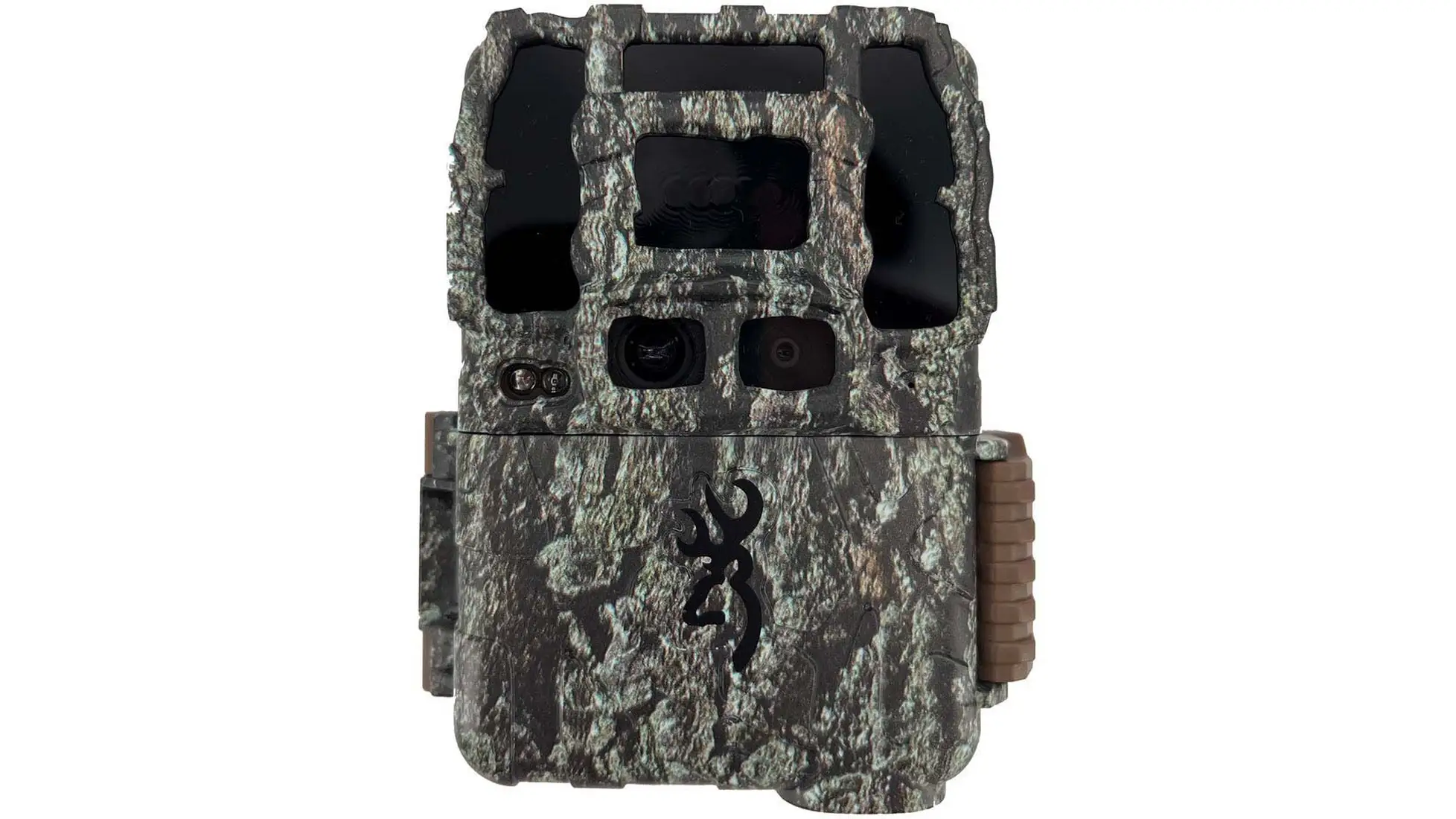
Best trail camera overall: Browning Dark Ops DCL Nano Trail Camera
Non-cellular (SD card) · separate day and low-light lenses · 4K video with sound · 0.15 s trigger (Browning) · card: BTC-6DCLN
around $160exact price on OpticsPlanet
Our pick for best trail camera overall, and Field & Stream's Best Overall conventional (non-cellular) camera. Browning lists the Dark Ops Pro DCL Nano (model BTC-6DCLN, the model on this card) with a dedicated daytime lens and a separate low-light lens, a 0.15 second trigger speed, 0.35 second picture recovery, invisible night IR with a 100 ft flash range, 4K video with sound, a 1.5 in color view screen and a 54-degree viewing angle. It runs on 6 AA batteries (not included) or a 12 volt external power jack and takes up to a 512GB SDXC card (not included). Photo resolution depends on the production run: Browning's live product page says 26 MP, its 2026 support page and revised manual list 46MP for the same model number, and a Browning firmware notice covers 2026 units with serial numbers ending in 266DCLN. The retailer listing does not say which run it sends. Browning's manual gives a 4208 x 2368 day sensor and a 1920 x 1080 night sensor, and Trailcampro calls the 26 MP photos interpolated. Scott Bestul named it Best Overall in Field & Stream's trail camera guide (page dated January 23, 2026) as the magazine's pick for the best overall conventional cam for 2024, and wrote that during the test it "performed as advertised with razor-sharp nighttime photos." F&S calls it the Dark Ops DCL Nano and prints no model number; Browning uses that name for BTC-6DCLN in its 2024 catalog. Because F&S picked it among 2024 cameras and Browning documented the 46MP run in 2026, F&S's unit was the earlier run (our inference from the dates). Trailcampro, which sells the camera, measured a 0.24 second trigger and 60 ft of detection range, against the 100 ft average IR detection in Browning's manual. Winterberry's Bob Zak, testing BTC-6DCLN, measured low power use, especially at night, and found very good, loud audio, but found image quality behind his benchmark cameras, especially at night. One OpticsPlanet owner (5.0 from 1 review) says the day and night videos are excellent quality.
Pros
- Field & Stream's Best Overall conventional camera: "razor-sharp nighttime photos" in its test
- Dedicated daytime lens and separate low-light lens, 4K video with sound (Browning)
- 0.15 second trigger and 0.35 second recovery by Browning's figures; Trailcampro measured a 0.24 second trigger
- Compact 4.25 x 3.5 x 2 in case with an all-steel adjustable tree bracket and a 1/4-20 tripod socket (Browning)
- Low power use, especially at night, in Winterberry's lab measurements
Cons
- Photo resolution is not one fixed figure: 26 MP on Browning's product page, 46MP on its 2026 support page, both above the sensor sizes in Browning's manual
- Trailcampro measured 0.24 seconds against Browning's 0.15, and 60 ft of detection against the 100 ft average IR detection in Browning's manual
- Winterberry found night images behind its benchmark cameras, a narrower night frame than day, and a small screen that is not ideal for reviewing photos in the field
- Field & Stream: the Python cable lock is not as secure as some other designs
- One-year warranty (Browning), against two years on the Spypoint cameras here; one OpticsPlanet owner wanted more than the 10 second countdown before it arms
Best for: a hunter who checks cameras in person and wants one compact SD card camera with strong night images. If you want photos sent to your phone, see the FLEX-S-DARK below or our best cellular trail camera roundup.
Key specifications
| Connection | Non-cellular, SD card (Browning chart: not cellular capable) |
|---|---|
| Lenses | Dedicated daytime lens plus a separate low-light lens (Browning) |
| Photo resolution | 26 MP (Browning product page); 46MP (Browning 2026 support page and revised manual, units with serials ending 266DCLN) |
| Sensor (manual) | Day 4208 x 2368, night 1920 x 1080 (Browning manual) |
| Video | 4K with sound, clips of 5 sec to 2 min (Browning); night videos limited to 20 seconds (Browning manual) |
| Trigger / recovery | 0.15 s / 0.35 s (Browning); 0.24 s trigger, 0.5 s photo recovery (Trailcampro measured) |
| Flash | Invisible night IR, 100 ft flash range (Browning) |
| Detection range | 100 ft average IR detection (Browning manual); 60 ft measured by Trailcampro |
| Viewing angle | 54 degrees (Browning product page; its manual says 55) |
| Power | 6 AA batteries (not included) or 12 V external jack (Browning) |
| Card | Up to 512GB SDXC, not included (Browning) |
| Screen | 1.5 in color (Browning) |
| Size | 4.25 x 3.5 x 2 in (Browning) |
| Weight | Not published by Browning; about 350 g with 6 lithium AAs (Winterberry) |
| In the box | Camera, 6 ft tree strap, instruction manual (Browning manual) |
| Warranty | One year from the date of purchase (Browning) |
| Model on this card | BTC-6DCLN, the only row on this retailer listing |
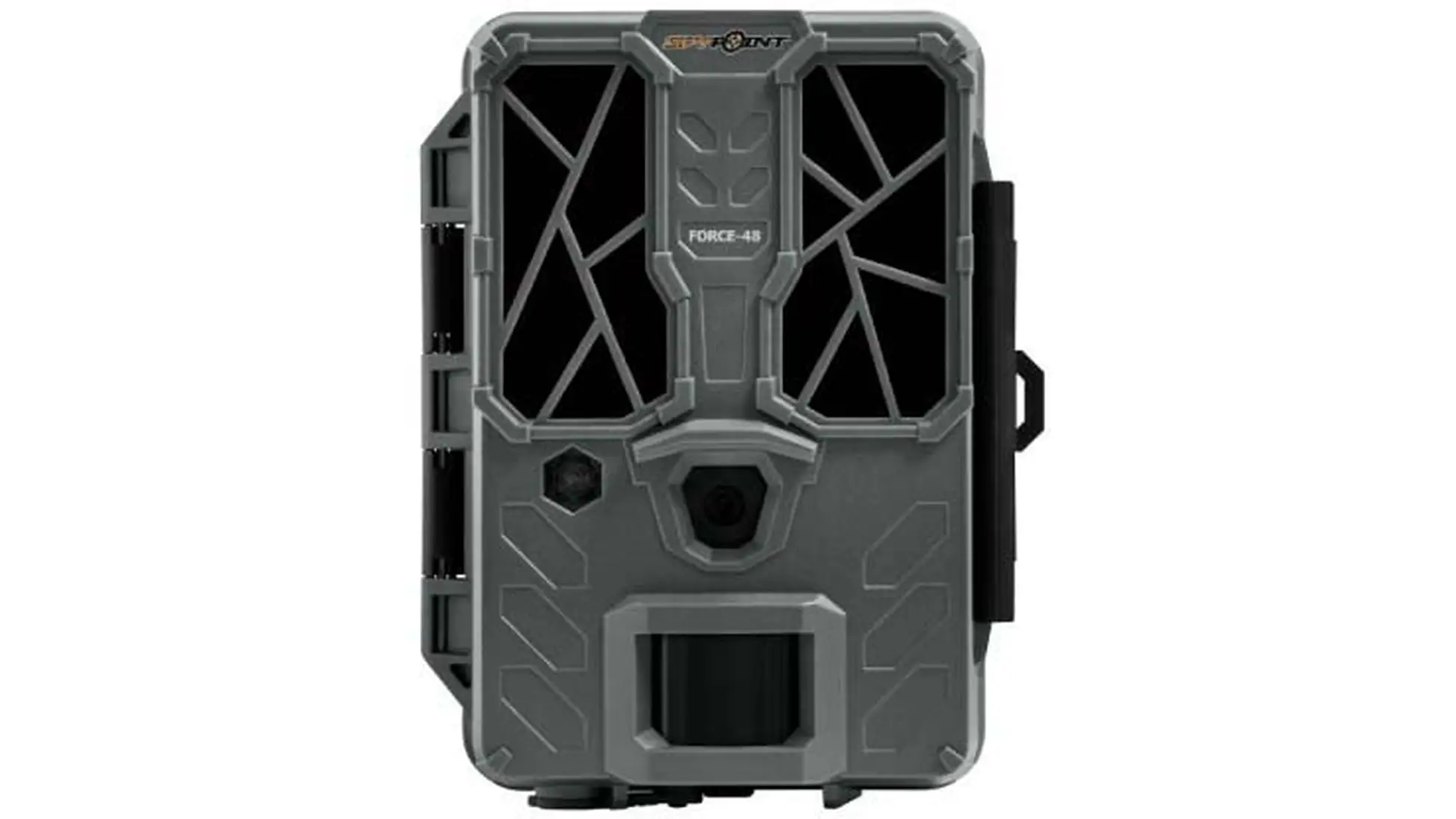
Best value trail camera: Spypoint Force-48 Trail Camera
Non-cellular (SD card) · 48MP photos · 720p video · 48 low-glow LEDs, 80 ft illumination (Spypoint) · card: 1857
around $70exact price on OpticsPlanet
The value pick, and the lowest-priced camera here. Spypoint files the Force-48 under non-cellular trail cameras and lists 48MP photos, 720p video, three capture modes (Photo, Video and Time Lapse), multi-shot of up to five photos per detection, infrared boost technology and 48 low-glow LED lights that provide 80 ft of illumination. Its quick start guide calls for 8 AA alkaline or lithium batteries, sold separately, warns against rechargeable AAs, adds a 12 V jack, and takes cards from 2 to 512 GB; night videos are limited to 20 seconds. Spypoint's product page does not publish a trigger speed or detection range; the retailer listing and Field & Stream both give 0.5 seconds and 80 ft. Scott Bestul named it Best Value in Field & Stream's trail camera guide, wrote that it "takes surprisingly good photos for the price", and listed a below-average trigger speed and the missing SD card as cons. In the F&S test it had trouble with a SanDisk Ultra 64-GB card and ran with zero issues after a switch to a Spypoint card. One OpticsPlanet owner (4.0 from 1 review) found setup easy and warns that, unlike earlier Spypoint models, it came without an SD card or batteries; the strap was included.
Pros
- Field & Stream's Best Value pick; it "takes surprisingly good photos for the price"
- The lowest-priced camera on this page
- Easy setup, per Field & Stream and one OpticsPlanet owner
- Multi-shot of up to five photos per detection; 2-year limited warranty (Spypoint)
Cons
- 720p video only, the lowest video resolution here
- 0.5 second trigger by the retailer listing and Field & Stream, which lists it as a below-average trigger speed; Spypoint does not publish one
- No SD card or batteries in the box: plan on 8 AA batteries and a card (Spypoint, Field & Stream, one owner)
- Field & Stream had trouble with a SanDisk Ultra 64-GB card until it switched to a Spypoint card
Best for: putting several cameras out on one property for little money. If you want 4K video or a faster trigger, the Bushnell Core DS-4K or the Spypoint Force-Pro costs more.
Key specifications
| Connection | Non-cellular, SD card (Spypoint category) |
|---|---|
| Photo resolution | 48MP, with smaller sizes selectable (Spypoint quick start guide) |
| Video | 720p (480P or 720P selectable), clips of 10 to 60 s; night videos limited to 20 s (Spypoint quick start guide) |
| Trigger speed | 0.5 s (retailer listing and Field & Stream); not published by Spypoint |
| Detection range | 80 ft (retailer listing and Field & Stream); Spypoint gives 80 ft as illumination |
| Flash | 48 low-glow LED lights, 80 ft of illumination (Spypoint product page; its quick start guide says no glow flash) |
| Power | 8 AA alkaline or lithium, sold separately; no rechargeable AAs; 12 V jack (Spypoint quick start guide) |
| Card | 2 to 512 GB, not included (Spypoint quick start guide; Field & Stream) |
| In the box | Strap listed in the box (Spypoint quick start guide) |
| Warranty | 2-year limited (Spypoint) |
| Model on this card | Spypoint 1857, the only row on this retailer listing |
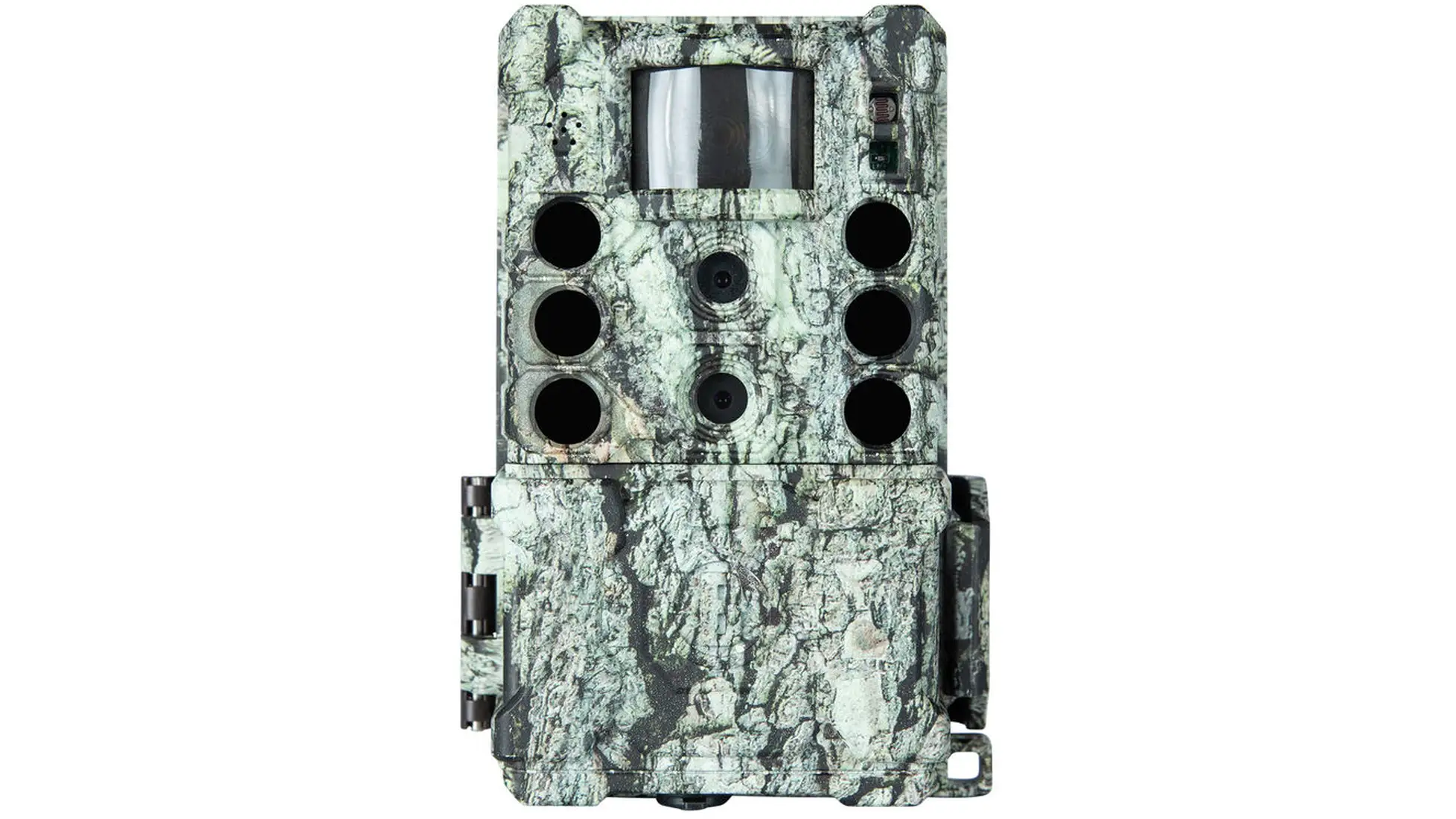
Best 4K trail camera: Bushnell Core DS-4K No Glow Trail Camera
Non-cellular (SD card) · dual sensors · up to 32MP · 4K video · 0.15 s trigger · no-glow 120 ft night range (Bushnell) · card: 119987C
around $160exact price on OpticsPlanet
The 4K pick. Bushnell lists the Core DS-4K No Glow (product ID BU-119987C, this card's 119987C) with dual sensors for day and night images, up to 32MP images, 4K video, a 0.15 second trigger speed, no-glow LEDs with a 120 ft night range, a 1.5 in color view screen, an in-camera color review LCD, and three preset menus plus an advanced mode. Bushnell calls both the 4K video and the trigger speed best in class; that is Bushnell's own marketing claim, not a test result. Its connection type is non-cellular, it runs on AA batteries (Live Science counts six), and Bushnell says it is for sale and use in the U.S. only. The retailer listing gives the video as 4K UHD 4096 x 2160 and lists up to 12 months of battery life and cards up to 512 GB (not included); Bushnell's product page does not repeat those figures. James Abbott named it Best 4K in Live Science's trail camera guide (published 16 July 2025), writing that it "has the best 4K video footage", and listed as reasons to avoid that set-up requires trial and error, it runs on battery power only and it has no GPS. OpticsPlanet has no customer reviews on it yet.
Pros
- Live Science's Best 4K pick: it "has the best 4K video footage"
- Dual sensors for day and night, up to 32MP images and 4K video (Bushnell)
- 0.15 second trigger, tied with the Browning for the fastest maker figure here (Bushnell)
- No-glow LEDs with a 120 ft night range (Bushnell)
Cons
- Live Science: set-up requires trial and error, battery power only, no GPS
- Bushnell publishes no separate detection range and leaves its field of view value blank
- Region locked: for sale and use in the U.S. only (Bushnell)
- No owner reviews on OpticsPlanet yet
Best for: a buyer who wants the sharpest video on an SD card camera and a no-glow flash. If you would rather not buy AA batteries, the solar Spypoint Force-Pro-S 2.0 is the alternative.
Key specifications
| Connection | Non-cellular (Bushnell) |
|---|---|
| Sensors | Dual sensors for day and night images (Bushnell) |
| Photo resolution | Up to 32MP (Bushnell) |
| Video | 4K (Bushnell); 4K UHD 4096 x 2160 (retailer listing) |
| Trigger speed | 0.15 s (Bushnell) |
| Flash | No-glow LED, 120 ft night range (Bushnell) |
| Detection range | Not published by Bushnell; Live Science lists 120 ft |
| Power | AA batteries (Bushnell); six, per Live Science; up to 12 months battery life (retailer listing) |
| Card | Up to 512 GB, not included (retailer listing) |
| Screen | 1.5 in color view screen (Bushnell) |
| Region | For sale and use in the U.S. only (Bushnell) |
| Model on this card | Bushnell 119987C (product ID BU-119987C), the only row on this retailer listing |
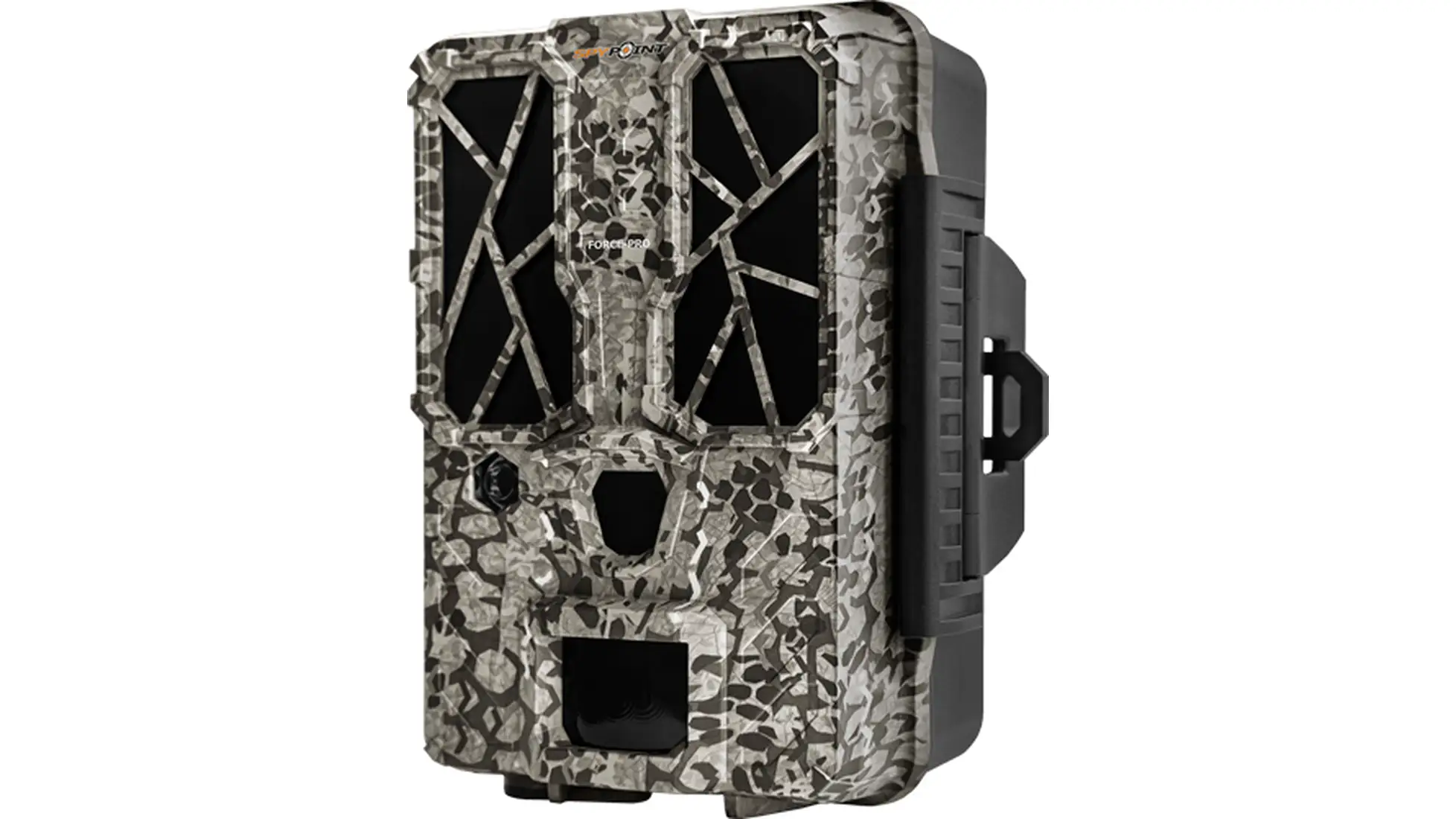
Best day and night trail camera: Spypoint Force-Pro Trail Camera
Non-cellular (SD card) · 30MP · 4K video · 0.2 s trigger · 110 ft detection (Spypoint) · card: 1889
around $100exact price on OpticsPlanet
The pick for day and night capture on plain AA power. Spypoint files the Force-Pro under non-cellular trail cameras and lists 30MP still images, a 4K video mode, a 0.2 second trigger speed and a 110 ft detection range. James Abbott named it Best day and night in Live Science's trail camera guide (published 16 July 2025): Live Science says it captures in color during the day and in black and white at night, records sound, shoots bursts of up to six photos, and runs on eight AA batteries or an external 12 V source, with an LED flash range of up to 90 ft, the same figure as the retailer listing. Its reasons to avoid there are no cellular connection, eight AA batteries and a black and white LCD screen, and it advises care with detection sensitivity so foliage movement does not set it off. Spypoint's FORCE-PRO manual lists a no glow flash with a night light range of up to 90 ft, 8 AA batteries (not included) and cards up to 128 GB, and calls the LCD for configuration only. OpticsPlanet has no customer reviews on it yet.
Pros
- Live Science's Best day and night pick, with color images by day and black and white at night
- 30MP stills and a 4K video mode (Spypoint); records sound (Live Science)
- 0.2 second trigger and 110 ft detection range (Spypoint)
- Runs on AA batteries or an external 12 V source (Live Science); 2-year warranty (Spypoint)
Cons
- Eight AA batteries and no solar panel (Live Science); the Force-Pro-S 2.0 adds solar
- The LCD is for configuration only (Spypoint manual) and black and white (Live Science)
- No owner reviews on OpticsPlanet yet
Best for: a buyer who wants 4K video, a fast trigger and long detection on ordinary AA batteries. If you want fewer battery changes, the solar Force-Pro-S 2.0 is the next step up.
Key specifications
| Connection | Non-cellular, SD card (Spypoint category) |
|---|---|
| Photo resolution | 30MP (Spypoint) |
| Video | 4K video mode (Spypoint); clips of 10, 20, 30 and 60 seconds with sound (Live Science) |
| Trigger speed | 0.2 s (Spypoint) |
| Detection range | 110 ft (Spypoint) |
| Flash | No glow, night light range up to 90 ft (Spypoint manual); 90 ft flash range (retailer listing and Live Science) |
| Power | 8 AA, not included (Spypoint manual), or external 12 V (Live Science) |
| Card | Up to 128 GB (Spypoint manual); the retailer listing says up to 32GB |
| Screen | 1.5 in black and white LCD (Live Science) |
| Warranty | 2 years (Spypoint) |
| Model on this card | Spypoint 1889, the only row on this retailer listing |
Best solar trail camera: Spypoint Force-Pro-S 2.0 Solar Trail Camera
Non-cellular (SD card) · solar panel and internal lithium battery, 8 AA backup · 4K video with sound (Spypoint) · card: 1858
around $130exact price on OpticsPlanet
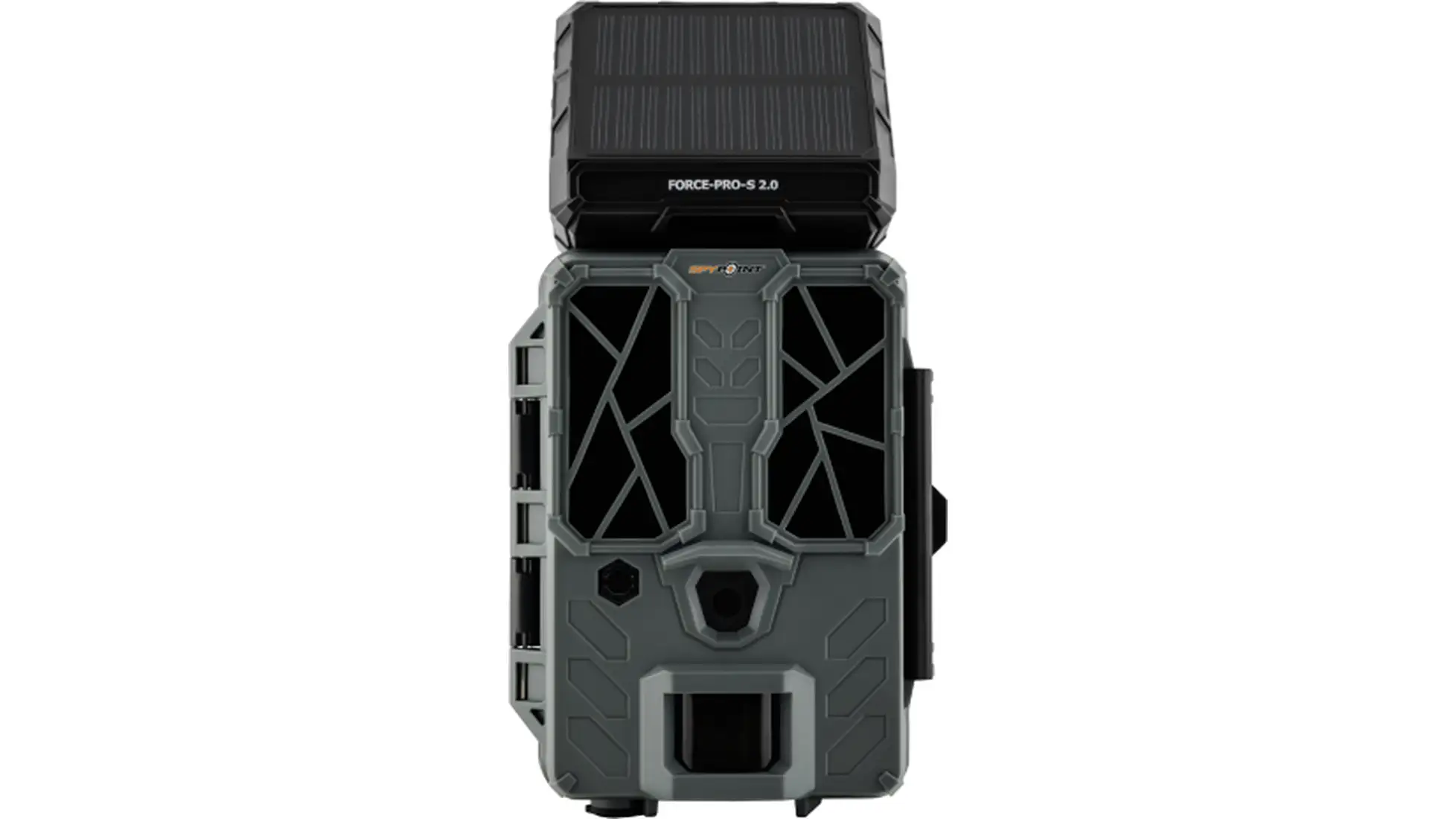
The solar pick. Spypoint files the Force-Pro-S 2.0 under non-cellular trail cameras and says a solar panel charges an internal lithium battery, and that you can install eight AA batteries to take over if the onboard battery runs down for lack of sunlight. It records up to 4K video with sound, offers Photo, Video, Time-Lapse and Time-Lapse+ modes, takes up to six photos per detection, and has a full-color LCD viewing screen and 54 LED lights that provide 90 ft of illumination. Spypoint describes "our fastest trigger speed at less than a quarter of a second", and its series page lists 0.2 s and a 110 ft detection range. Photo resolution is not settled at the maker: the same Spypoint series page shows 48 MP on the product card and 40MP in its comparison table, and the retailer listing says 48 MP. Scott Bestul named it Best Solar in Field & Stream's trail camera guide; in the F&S test it "shot some of the best day and night images of deer at our feeder", and F&S writes that it had the longest detection range in that test. The F&S con: the screen is impossible to use for angling the camera. OpticsPlanet has no customer reviews on it yet.
Pros
- Field & Stream's Best Solar pick, with some of the best day and night deer images in its test
- Solar panel charges an internal lithium battery, with eight AA batteries as backup (Spypoint)
- Full-color LCD screen and Time-Lapse+ mode (Spypoint)
- 110 ft detection range (Spypoint series page), the longest in the Field & Stream test
- 2-year warranty (Spypoint)
Cons
- Field & Stream: the screen is impossible to use for angling the camera
- Spypoint's own series page lists both 48 MP and 40MP, so the photo resolution is unconfirmed
- The panel needs sun: Spypoint fits AA backup for when the onboard battery runs down for lack of sunlight
- No owner reviews on OpticsPlanet yet
Best for: cameras on fields and sunny edges that you visit rarely. In deep shade, plan on the AA backup.
Key specifications
| Connection | Non-cellular, SD card (Spypoint category) |
|---|---|
| Power | Solar panel charging an internal lithium battery; eight AA batteries as backup (Spypoint) |
| Photo resolution | 48 MP (Spypoint series page card and retailer listing) or 40MP (Spypoint series comparison table) |
| Video | Up to 4K with sound (Spypoint) |
| Modes | Photo, Video, Time-Lapse, Time-Lapse+; multi-shot up to six photos per detection (Spypoint) |
| Trigger speed | Less than a quarter of a second (Spypoint product page); 0.2 s (Spypoint series page) |
| Detection range | 110 ft (Spypoint series page) |
| Flash | 54 LED lights, 90 ft of illumination (Spypoint product page); 110 ft flash range (Spypoint series table) |
| Screen | Full-color LCD (Spypoint) |
| Weight | 0.45 kg (retailer listing); not published by Spypoint |
| Warranty | 2 years (Spypoint) |
| Model on this card | Spypoint 1858, the only row on this retailer listing |
Cellular pick (solar): Spypoint FLEX-S-DARK Cellular Trail Camera
Cellular (dual SIM) · built-in solar panel and battery · 40MP · 1080P video · low glow and no glow LEDs (Spypoint) · card: 1810
around $150exact price on OpticsPlanet
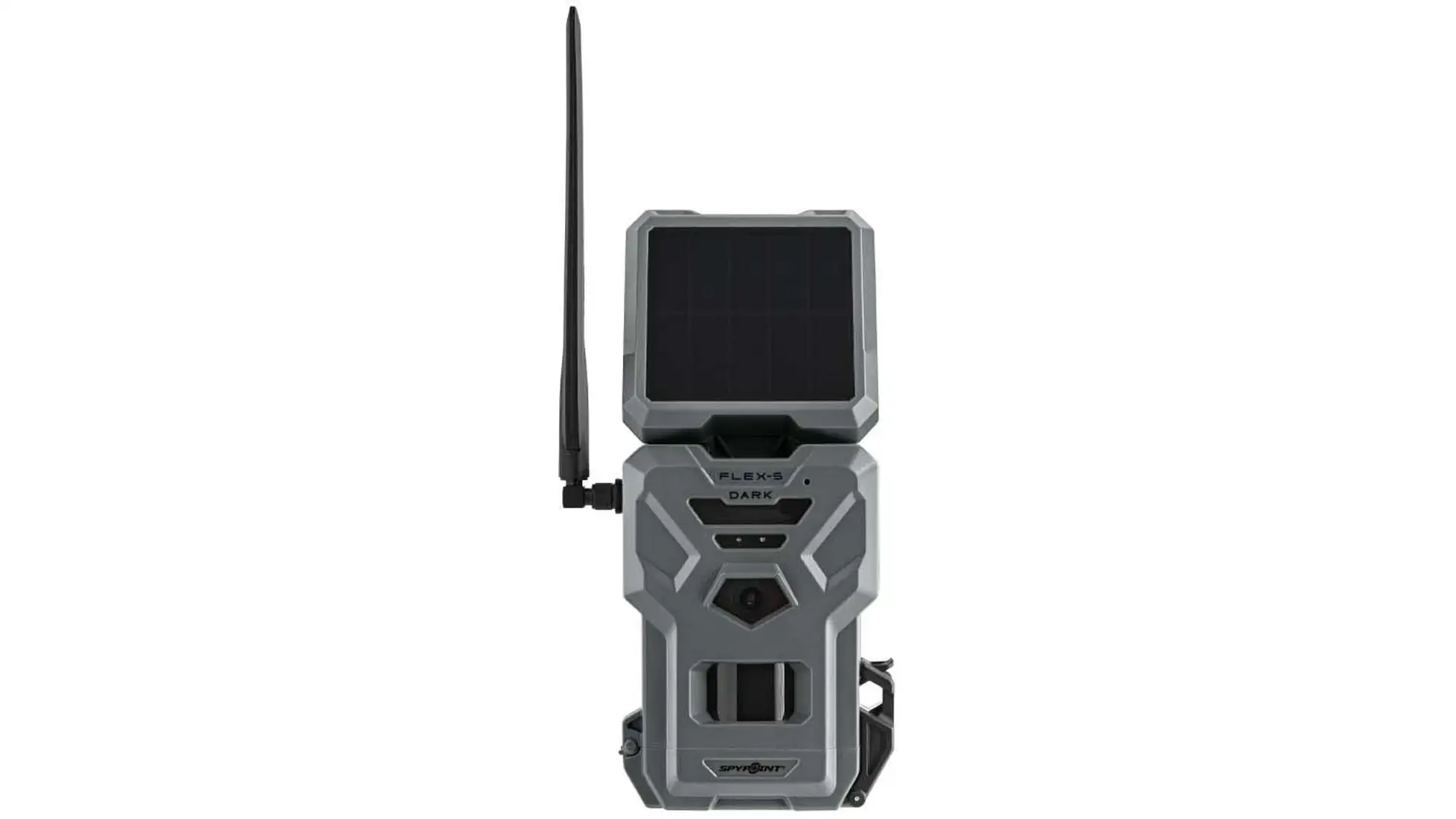
The one cellular camera on this page, and Digital Camera World's Best cellular; for our full cellular ranking, where the Reveal Pro 4.0 is the overall pick, see our best cellular trail camera roundup. Spypoint calls the FLEX-S-DARK a cellular trail camera that runs on the power of the sun, and says its built-in battery replaces up to 1,000 AA batteries. Dual-SIM technology connects to all major carriers and the strongest signal in the area (Spypoint names no carriers), and you can set the flash to low glow or no glow LEDs, which Spypoint says make no noticeable light or sound. Spypoint's comparison table lists 40MP photos, 1080P video, a 0.3 second trigger and 100 ft of flash and detection range. The transmission plan is free for 100 photos a month per camera, with paid tiers above that; Spypoint adds Buck Tracker AI filtering, a GPS locator on the in-app map, a microSD card slot and a two-year warranty. Lauren Scott named it Best cellular in Digital Camera World's trail camera guide (last updated 25 September 2026); in her field tests the dual-SIM setup latched onto the strongest local mobile network, but she notes there is no internal LCD screen, so framing means test shots through the app, that image processing and dynamic range are average, and that you need to subscribe to transmit videos. OpticsPlanet has no customer reviews on it yet.
Pros
- Digital Camera World's Best cellular pick; in its field tests the dual-SIM setup found the strongest local network
- Built-in solar panel and battery that Spypoint says replaces up to 1,000 AA batteries
- Free plan of 100 photos a month per camera (Spypoint)
- Switchable low glow and no glow LEDs; GPS locator in the app (Spypoint)
Cons
- Past 100 photos a month, and for video transmission, you need a paid plan (Spypoint, Digital Camera World)
- No internal LCD screen: framing takes test shots through the app (Digital Camera World)
- Digital Camera World rates its image processing and dynamic range as average; video is 1080P, not 4K (Spypoint)
- No owner reviews on OpticsPlanet yet
Best for: a camera you cannot visit often and want to check from your phone. For more cellular cameras and how their plans compare, see our best cellular trail camera roundup.
Key specifications
| Connection | Cellular, dual SIM, all major carriers; carrier names not published (Spypoint) |
|---|---|
| Power | Built-in solar panel and battery, replaces up to 1,000 AA batteries (Spypoint) |
| Photo resolution | 40MP (Spypoint comparison table) |
| Video | 1080P (Spypoint comparison table) |
| Trigger speed | 0.3 s (Spypoint comparison table) |
| Flash and detection range | 100 ft each (Spypoint comparison table) |
| Flash | Low glow and no glow LEDs (Spypoint) |
| Plan | 100 free photos a month per camera, paid tiers above (Spypoint) |
| Storage | microSD card (Spypoint) |
| Screen | No internal LCD (Digital Camera World) |
| Retailer specs | 1.77 lb, 45 degree field of view, -30 to 50 Celsius operating temperature (retailer listing); the retailer lists AA as the battery type, while Spypoint describes the built-in battery |
| Warranty | Two years (Spypoint) |
| Model on this card | Spypoint 1810, the only row on this retailer listing |
How to choose a trail camera
- SD card or cellular. A non-cellular camera stores images on a card you collect, with no data plan; a cellular camera sends them to your phone and needs a plan past any free tier. Spypoint's FLEX-S-DARK plan is free for 100 photos a month per camera, with paid tiers above that. See our best cellular trail camera roundup for cellular plans.
- Trigger speed. Field & Stream calls one-fourth of a second about as good as it gets and a half-second respectable for most camera setups. Maker figures are claims, not measurements: Trailcampro measured the Browning at 0.24 seconds against Browning's 0.15.
- Range. Browning lists a 100 ft flash range and a 100 ft average IR detection range, Bushnell a 120 ft no-glow night range, and Spypoint a 110 ft detection range for the Force-Pro and Force-Pro-S 2.0. Flash, night and detection ranges are not the same measurement, and a maker figure is not a measured one: Trailcampro measured the Browning's detection range at 60 ft.
- Megapixels. A photo figure can be larger than the sensor. Browning's manual lists a 4208 x 2368 day sensor and a 1920 x 1080 night sensor for the Dark Ops DCL Nano, which Browning sells as 26 MP and, in a 2026 run, 46MP (our arithmetic: the day sensor is about 10 MP); Trailcampro calls the photos interpolated.
- Night flash. Bushnell lists no-glow LEDs for the Core DS-4K, Browning invisible night IR for the Dark Ops DCL Nano, Spypoint's product page low-glow LEDs for the Force-48, and Spypoint's manual a no glow flash for the Force-Pro. The FLEX-S-DARK lets you switch between low glow and no glow LEDs; Digital Camera World describes that as a choice between range and stealth.
- Power. Browning lists 6 AA batteries, Spypoint 8 AA for the Force-48 and warns against rechargeable AAs for it, and Spypoint's manual and Live Science list 8 AA for the Force-Pro. The Force-Pro-S 2.0 and FLEX-S-DARK charge a built-in battery from a solar panel.
- What is in the box. Batteries and memory cards are often extra: Browning and Spypoint list them as not included for the Dark Ops DCL Nano and the Force-48.
How we chose these
This is a research-based roundup, not a hands-on test. We found each camera on OpticsPlanet and read the full model list on each listing to confirm the exact row each card links to. We checked specs against the maker's own pages and manuals for Browning, Bushnell and Spypoint, and where the retailer and the maker disagree we use the maker and say so. Editors' picks come from Field & Stream (Scott Bestul), Live Science (James Abbott) and Digital Camera World (Lauren Scott); we read each guide ourselves before naming a pick, print the date the publication shows, and say when the version an editor handled may differ from the card. Measurements come from Trailcampro and Winterberry for the Browning. Owner opinions come from OpticsPlanet reviews, quoted as single owners. We give no ratings of our own. See our methodology for how we work.
FAQ
What is the best trail camera?
For a camera you check in person, the Browning Dark Ops DCL Nano: separate day and low-light lenses, 4K video with sound and a 0.15 second trigger, per Browning, and Field & Stream's Best Overall conventional camera. On a budget, the Spypoint Force-48 (Field & Stream's Best Value); for 4K video, the Bushnell Core DS-4K No Glow (Live Science's Best 4K); for day and night images on AA power, the Spypoint Force-Pro (Live Science's Best day and night); for solar power, the Spypoint Force-Pro-S 2.0 (Field & Stream's Best Solar); and as a solar cellular camera that sends photos to your phone, the Spypoint FLEX-S-DARK (Digital Camera World's Best cellular). Our best cellular trail camera roundup ranks more cellular cameras.
What is the best non-cellular trail camera?
The Browning Dark Ops DCL Nano. Field & Stream, whose trail camera guide covers only conventional, non-wireless cameras, named it Best Overall and wrote that it performed as advertised with razor-sharp nighttime photos in its test. Browning's comparison chart marks this model (BTC-6DCLN) as not cellular capable, so it records to an SD card of up to 512GB, which is not included.
Should I buy a cellular or a non-cellular trail camera?
Buy non-cellular if your camera sits where there is little or no cell service, or if you do not mind walking in to pull the card: there is no data plan to run. Buy cellular if you want images on your phone between visits. Spypoint gives the FLEX-S-DARK 100 free photos a month per camera, and Digital Camera World notes that you need a subscription to transmit videos. Our best cellular trail camera roundup compares more cellular cameras and their plans.
Does the Browning Dark Ops DCL Nano take 26MP or 46MP photos?
It depends on the production run. Browning's live product page for BTC-6DCLN says 26 MP, while its 2026 support page and revised manual list 46MP for the same model number, and a Browning firmware notice refers to 2026 units with serial numbers ending in 266DCLN. The retailer listing does not say which run it sends. Both figures are larger than the sensors in Browning's manual (4208 x 2368 for day, 1920 x 1080 for night), and Trailcampro calls the 26 MP photos interpolated.
Do trail cameras come with batteries and an SD card?
Often not. Browning lists the Dark Ops DCL Nano's 6 AA batteries and SDXC card as not included, and its manual lists the box as the camera, a 6 foot tree strap and the instruction manual. Spypoint says the Force-48's batteries are sold separately, and Field & Stream and an OpticsPlanet owner both note that it comes without an SD card. The retailer lists the Bushnell Core DS-4K's card as not included.
What trigger speed should a trail camera have?
Field & Stream calls one-fourth of a second about as good as it gets and a half-second respectable for most camera setups. Maker figures here run from 0.15 seconds (Browning, Bushnell) to 0.3 seconds (Spypoint FLEX-S-DARK), with the Force-48 at 0.5 seconds by the retailer listing and Field & Stream. A maker figure is not a measurement: Trailcampro measured the Browning at 0.24 seconds against Browning's 0.15.
More trail cameras: best cellular trail camera · Tactacam Reveal guide · how we evaluate.