The best hearing protection for shooting
Quick answer: the Walker's Razor Slim Electronic Patriot Series (around $55) is the best hearing protection for shooting for most people. It is an electronic muff rated at a 23 dB NRR, with two microphones that let conversation through and compression that reacts in 0.02 seconds, and owners single out its low-profile cups for staying out of the way of a rifle stock. For the most rated protection in one muff, the Howard Leight Impact Pro carries a 30 dB NRR but its bulky cups fight a cheek weld. For Bluetooth, the PELTOR Sport Tactical 500. On a budget, the Caldwell E-Max Low Profile (around $40). And at an indoor range, wear passive plugs such as the SureFire EP4 under your muff: NIOSH recommends double protection for people who shoot for a living.
Shooting hearing protection has two jobs that pull against each other: cut the crack of a gunshot, and let you hear range commands and the people next to you. Electronic muffs and earbuds do the second job with microphones; passive muffs and plugs just block. The number on the box, the NRR, is only part of the story, and for gunfire the EPA's own label rule says so (see what NRR means). Every card below names the exact model we checked. Where we could read the maker's own page we used it; where a figure comes only from the retailer's listing, the card says so.
Shooting hearing protection compared
| Product | Best for | Type | NRR | Electronic | Power | Profile | Owner rating | Price |
|---|---|---|---|---|---|---|---|---|
| Walker's Razor Slim Patriot | Overall, rifle and pistol | Muff | 23 dB | Yes, mono per owners | 2x AAA | Slim | 4.6 (117) | around $55 |
| Howard Leight Impact Pro | Highest NRR | Muff | 30 dB | Yes | 2x AAA | Bulky per owners | 4.7 (43) | around $100 |
| PELTOR Sport Tactical 500 | Bluetooth | Muff | 25 dB (3M) | Yes, Bluetooth | AA or rechargeable | Long-gun cut-outs | 4.4 (23) | around $190 |
| Howard Leight Impact Sport | Slim, auto shut-off | Muff | 22 dB | Yes | 2x AAA | Slim | 4.6 (16) | around $85 |
| Caldwell E-Max Low Profile | Budget electronic | Muff | 23 dB | Yes, stereo | 2x AAA | Low profile | 4.5 (70, two models) | around $40 |
| SureFire EP4 | Doubling up, no batteries | Plugs | 24 dB, caps in | No, filtered | None | In-ear | 4.6 (75) | around $20 |
| ISOtunes Sport CALIBER BT | Earbud option | Earbuds | 25 dB | Yes, Bluetooth | Rechargeable | In-ear | 3.6 (25) | around $180 |
Walker's, SureFire and PELTOR (NRR and power) figures are from each maker's own product page; the other products' specifications come from the retailer's listing. Owner ratings are OpticsPlanet's, shown with the number of reviews. Prices are bands; confirm the current price and availability on the retailer page before you buy.
Our picks
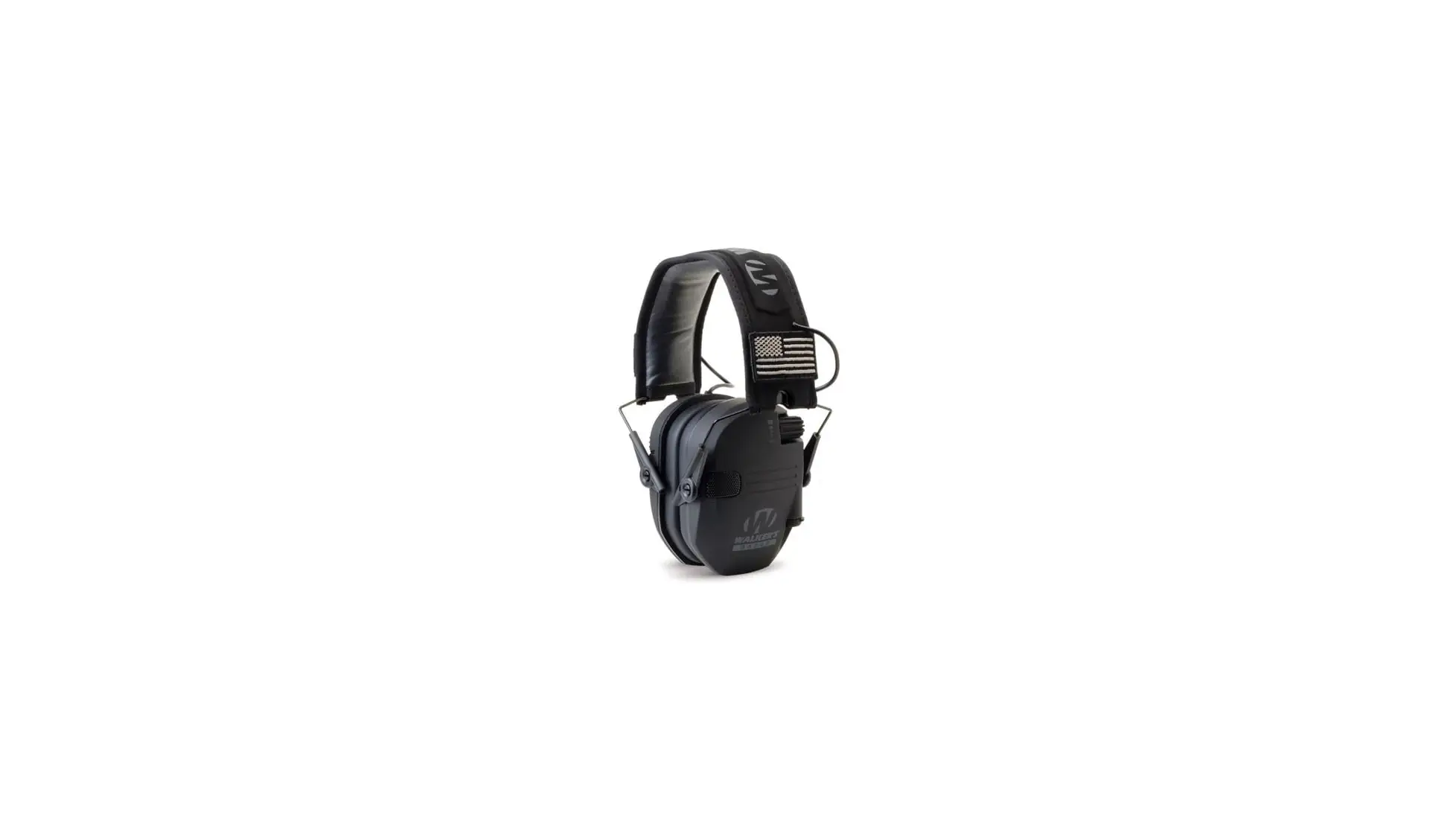
Best hearing protection for shooting overall: Walker's Razor Slim Electronic Patriot Series
Electronic ear muff · 23 dB NRR · two omnidirectional microphones · 0.02 s sound-activated compression · single recessed volume knob · folding · 2x AAA (Walker's) · card: Black, GWP-RSEMPAT
around $55exact price on OpticsPlanet
The muff to start with if you shoot rifles as well as handguns. Walker's builds the Razor Slim around ultra low-profile ear cups, and its Patriot Series adds two US flag patches to the same recipe: a 23 dB NRR, two hi-gain omnidirectional microphones, sound-activated compression with a 0.02 second reaction time, an audio input jack and two AAA batteries. Owners praise two things above all: that you can talk and shoot without touching the volume, and that the thin cups stay out of the way of a rifle stock. It is also the second least expensive muff on this page. The trade-offs are real, though. Its NRR sits in the middle of this list, owners report that the microphones feed both ears the same mono sound, and a small group report hiss or static.
Pros
- Ultra low-profile cups; owners repeatedly say they do not interfere with a cheek weld on a rifle stock
- Owners can hold a conversation and shoot without adjusting the volume
- Folding design, audio input jack and external battery door, per Walker's
- Deep owner record: 4.6/5 from 117 reviews on OpticsPlanet
Cons
- Owners report mono sound, so you cannot tell which side a voice comes from; Walker's lists one volume knob on the Patriot, while its standard Razor Slim lists independent volume controls
- 23 dB NRR is mid-pack here, and several owners add foam plugs for rifles or indoor ranges
- Hiss, static or buzzing is reported by a small group of owners, including a returned pair
- Walker's warranty is one year, shorter than you might expect for electronics
Best for: rifle, shotgun and pistol shooters who want a thin muff that talks through. If you need to hear which direction a voice is coming from, pick a stereo design such as the Caldwell E-Max.
Key specifications
| Manufacturer | Walker's (GSM Outdoors) |
|---|---|
| Type | Electronic ear muff, folding |
| NRR | 23 dB |
| Microphones | Two hi-gain omnidirectional |
| Compression | Sound-activated, 0.02 second reaction time |
| Controls | One recessed volume control knob |
| Power | 2x AAA, external battery door |
| Inputs | Audio input jack |
| Warranty | Walker's one-year limited warranty |
| Spec source | Walker's own Razor Patriot Series page and warranty page |
| Model on this card | Retailer MPN GWP-RSEMPAT, Black (Walker's lists the Patriot Series as GWP-RSEMP) |
“The slim profile does not get in the way of your cheek on the stock.”
Jake, owner (KY) via OpticsPlanet
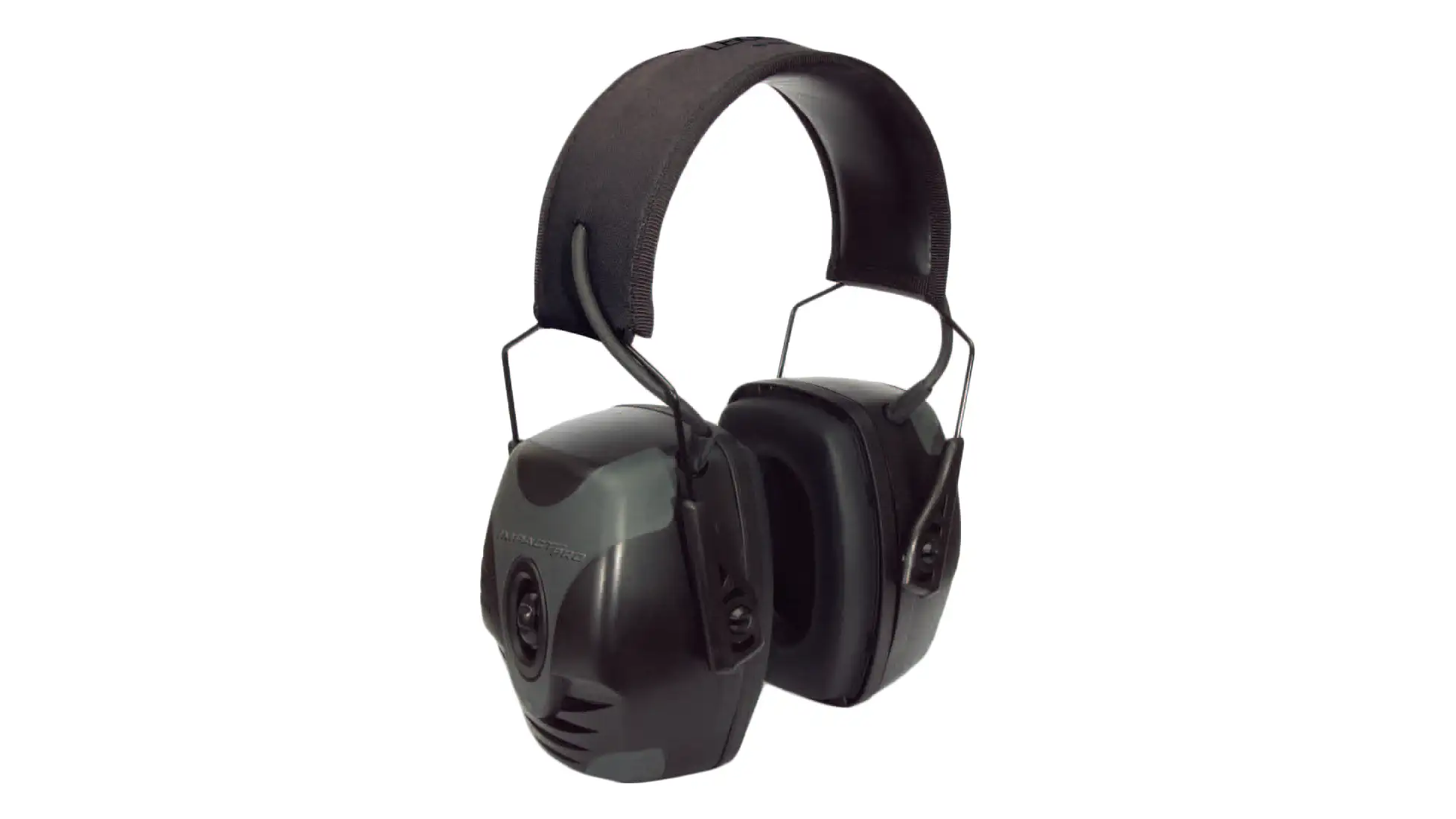
Highest NRR on this page: Howard Leight Impact Pro (NRR 30)
Electronic ear muff · 30 dB NRR · amplifies low-level sound up to 4x · auto shut-off · single volume knob · 2x AAA included (retailer listing) · card: Black, R-01902
around $100exact price on OpticsPlanet
If protection comes first, this is the muff with the highest rating here. The retailer lists the Impact Pro at a 30 dB NRR, with amplification of low-level sound and conversation up to four times, Air Flow Control, an auto shut-off, a single on/off and volume knob, an external battery compartment with two AAA batteries included, and an audio jack with its cord. Owners, several of them hard of hearing, praise how clearly they hear range commands, and some say the rating lets them skip foam plugs. The cost of that rating is size: the most repeated owner complaint is that the cups are too big for a proper cheek weld on a rifle. It also has the highest owner rating on this page, though most of those reviews date from 2013 to 2018.
Pros
- 30 dB NRR, the highest of any product on this page
- Owners, including some with hearing loss, describe range commands as easy to hear
- Auto shut-off and an external battery compartment, per the retailer listing
- Highest owner rating on this page: 4.7/5 from 43 reviews on OpticsPlanet
Cons
- Bulky cups: the most repeated owner complaint is interference with a rifle cheek weld
- Some owners find the amplification and audio input only average
- Does not fold, per owners, so it takes more room in a range bag
- An older review pool, mostly 2013 to 2018
Best for: handgun and shotgun shooters, indoor ranges and anyone who wants the most rated protection in one muff. Rifle shooters who care about cheek weld should look at the Walker's or the PELTOR.
Key specifications
| Manufacturer | Howard Leight (Honeywell) |
|---|---|
| Type | Electronic ear muff, over the head |
| NRR | 30 dB |
| Amplification | Low-level sound up to 4x; cuts amplification at harmful levels |
| Controls | Single on/off and volume knob |
| Power | 2x AAA (included), external compartment, auto shut-off |
| Inputs | Audio jack with connection cord |
| Spec source | Retailer listing spec table, features and description |
| Model on this card | R-01902, Black |
“the dB reduction is adequate to allow for use without foams in your ear”
DC74, owner (CA) via OpticsPlanet
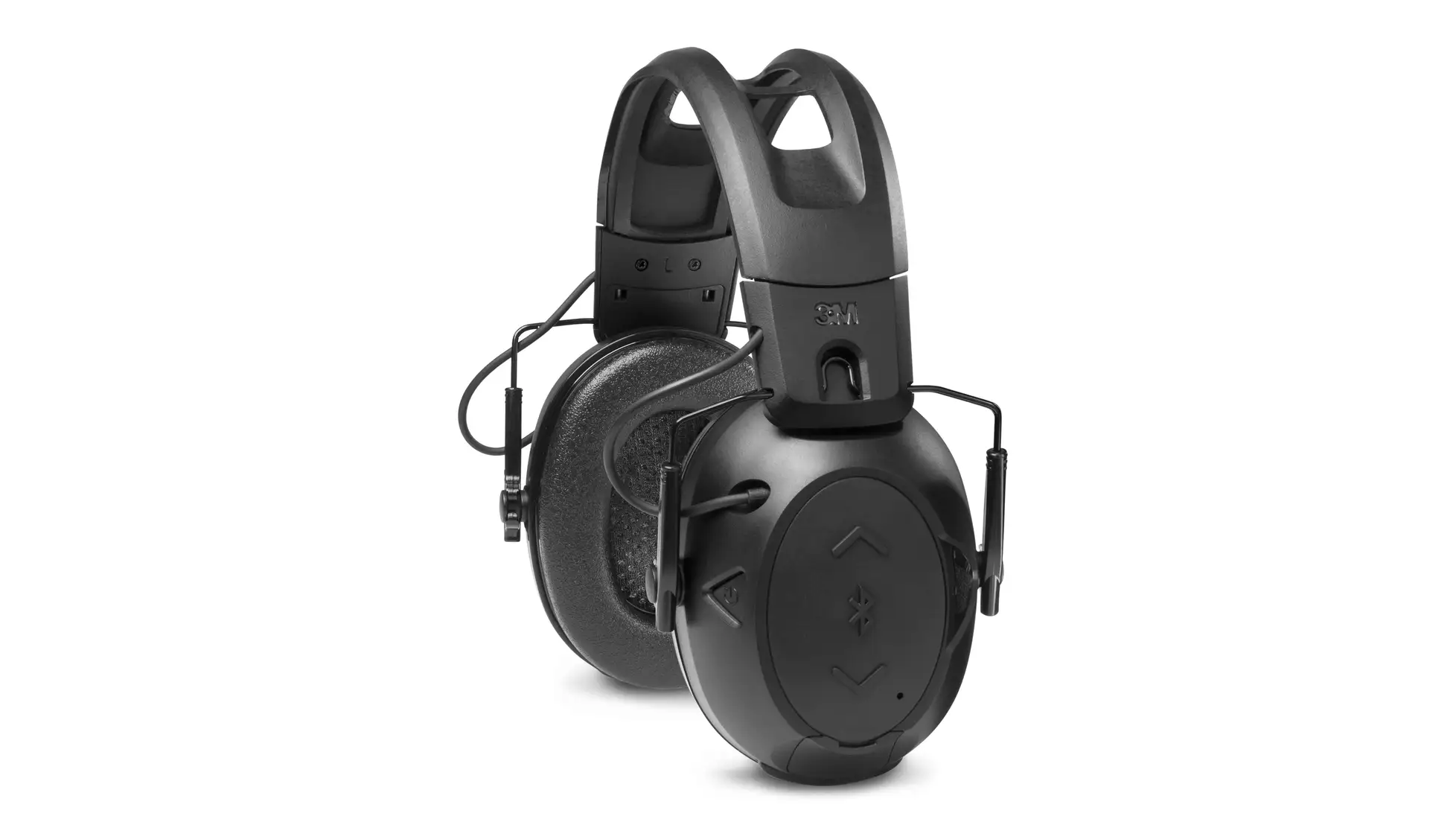
Premium pick with Bluetooth: PELTOR Sport Tactical 500
Electronic ear muff · 25 dB NRR per 3M (the retailer lists 26) · Bluetooth · Dynamic Suppression Time · Clear Voice Tracking · AA or optional rechargeable pack (3M) · low-profile cups with long-gun cut-outs (retailer listing) · card: Black, TAC500-NS-8
around $190exact price on OpticsPlanet
The one to buy if you want your phone in your ear pro. 3M gives the Sport Tactical 500 a 25 dB NRR (the retailer listing says 26) and says it runs on AA batteries, not included, or an Alpha 1100 lithium-ion rechargeable pack sold separately. The retailer lists Bluetooth, 3M SMART technologies including Dynamic Suppression Time (which adapts to the firearm and environment) and Clear Voice Tracking (which seeks out speech in noise), voice guidance, auto shut-off, a vented headband that works with hats, and low-profile cups cut out for long guns. Owners like the Bluetooth for calls and music, and one who replaced an Impact Sport writes that these clear the stock where the old pair hit it. It is by far the most expensive product on this page, and its critics aim at the headband and the Bluetooth volume.
Pros
- Bluetooth for calls and music, the only muff here with it
- Low-profile cups with cut-outs for long guns, per the retailer listing
- Suppression that adapts to the firearm and environment, plus voice tracking, per the retailer listing
- Vented headband that works over a hat
Cons
- The most expensive product on this page
- Two owners call the headband hard and uncomfortable
- One owner reports very low Bluetooth volume, another a crackle when pressing phone buttons
- Batteries are not in the box: 3M says it runs on AA cells (not included) or a rechargeable pack sold separately
Best for: rifle shooters and hunters who want Bluetooth and a cup shaped for a stock, and do not mind the price.
Key specifications
| Manufacturer | PELTOR (3M) |
|---|---|
| Type | Electronic ear muff, foldable |
| NRR | 25 dB per 3M (the retailer listing says 26 dB) |
| Electronics | Dynamic Suppression Time, Clear Voice Tracking, voice guidance |
| Wireless | Bluetooth |
| Power | AA batteries (not included) or Alpha 1100 lithium-ion rechargeable pack (sold separately), per 3M |
| Auto shut-off | Yes |
| Spec source | 3M product page for NRR and power (same UPC as the card); retailer listing for the rest |
| Model on this card | TAC500-NS-8, Black (3M catalog number TAC500-OTH, UPC 076308913373) |
“These fit well, just barely clear the stock and give better noise reduction.”
Heywood, owner (CO) via OpticsPlanet
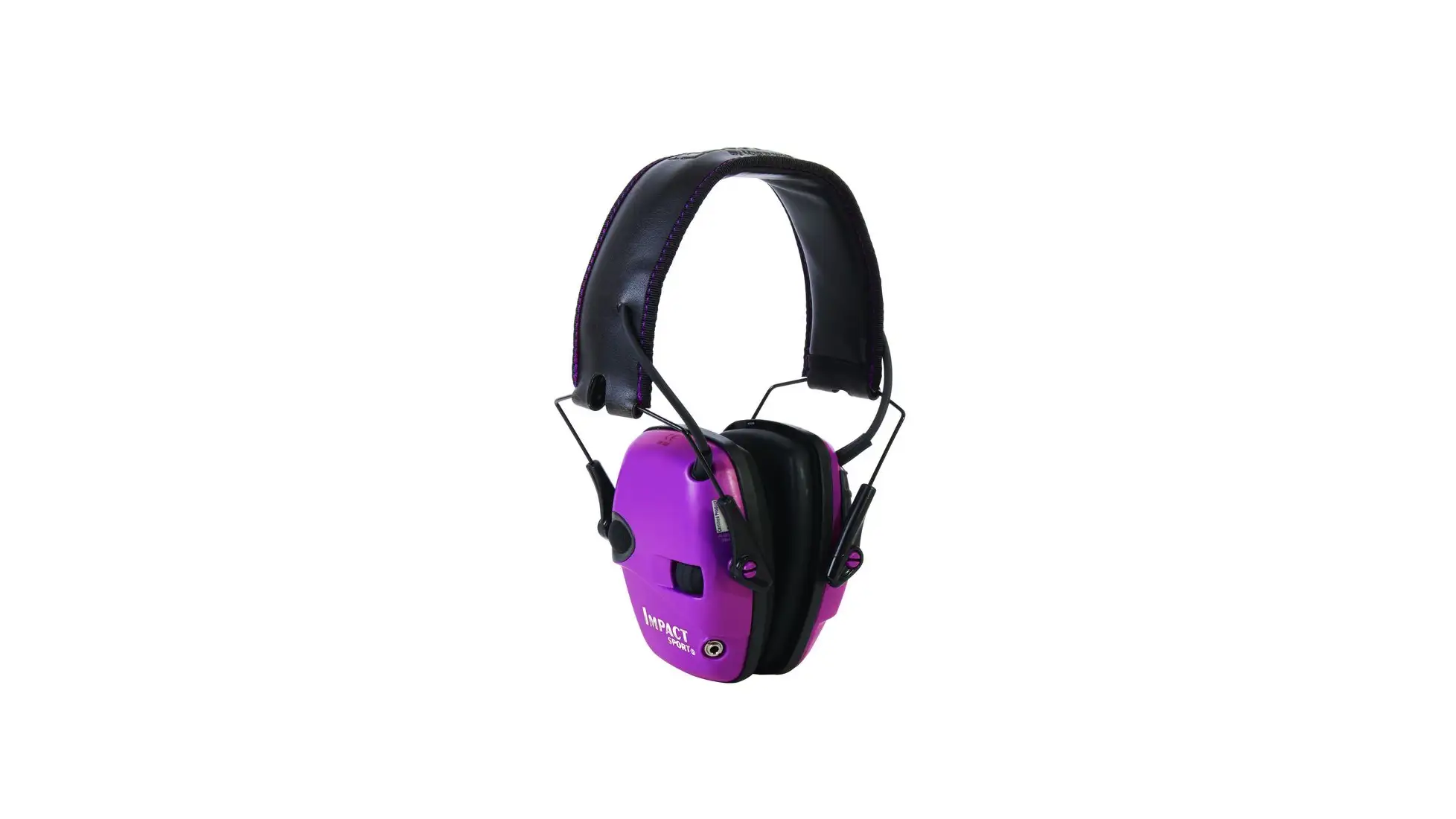
Slim folding muff with a 4-hour auto shut-off: Howard Leight Impact Sport
Electronic ear muff · 22 dB NRR · amplifies low-level sound up to 4x · 4-hour auto shut-off · folding · AUX input · 0.95 lb (retailer listing) · card: Black, R-02524
around $85exact price on OpticsPlanet
A thin, simple muff that switches itself off. The retailer lists the Impact Sport at a 22 dB NRR with directional microphones, amplification of low-level sound up to four times, a 4-hour automatic shut-off, an AUX input, a folding frame, a weight of 0.95 lb and ultraslim, contoured cups meant to clear a firearm stock. A law enforcement firearms instructor who spends whole days at the range calls it good and perfect for a shouldered rifle, and another owner likes that it turns itself off. The catch is its rating: 22 dB is the lowest NRR on this page, and its most helpful critical review found it short of expectations at an indoor pistol range. It also costs more than the Walker's on this listing.
Pros
- Four-hour automatic shut-off saves batteries if you forget, per the retailer listing
- Thin, folding cups; an instructor calls them "perfect for aiming with a shouldered rifle"
- AUX input and a single power/volume knob
- Listed weight 0.95 lb
Cons
- 22 dB NRR, the lowest on this page; its most helpful critical review found it short at an indoor pistol range
- An owner of the PELTOR reports that his previous Impact Sport hit the rifle stock
- Small owner record: 16 reviews, shared across the listing's color versions
- Owners report weak volume through the AUX input
Best for: outdoor rifle and shotgun shooting where a thin cup matters more than maximum rating; pair it with plugs indoors.
Key specifications
| Manufacturer | Howard Leight (Honeywell) |
|---|---|
| Type | Electronic ear muff, folding |
| NRR | 22 dB |
| Amplification | Low-level sound up to 4x, directional microphones |
| Power | 2x AAA (included), 4-hour auto shut-off |
| Inputs | AUX input |
| Weight | 0.95 lb |
| Spec source | Retailer listing spec table, features and description |
| Model on this card | R-02524, Black, new (the listing also sells other colors and an open-box unit) |
“They are perfect for aiming with a shouldered rifle.”
Idilio, law enforcement firearms instructor, via OpticsPlanet
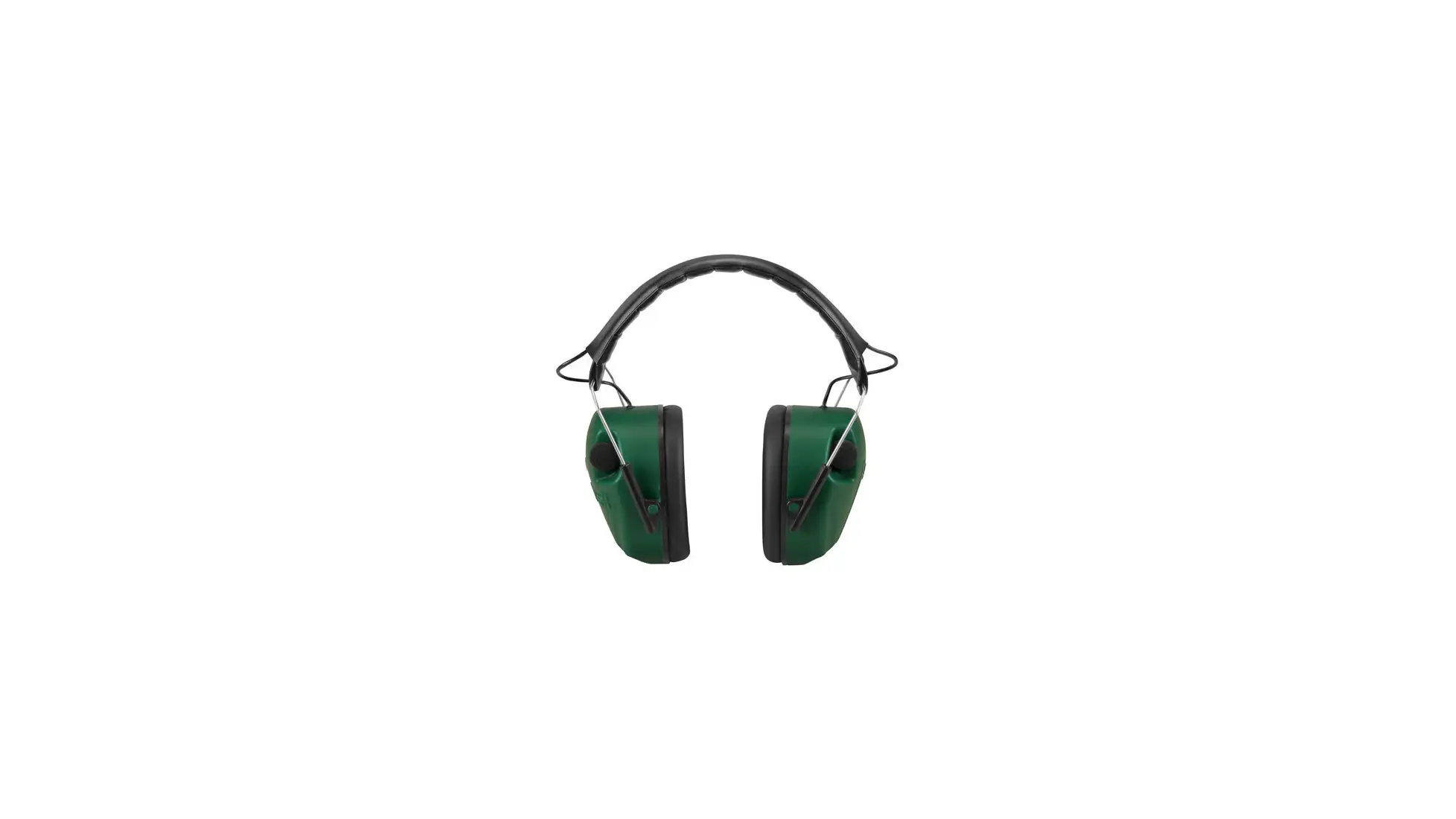
Best budget electronic muff: Caldwell E-Max Low Profile
Electronic ear muff · 23 dB NRR (this row) · one microphone per cup, stereo · amplifies below 85 dB, cuts off above · 2x AAA (retailer listing) · card: Low Profile 487557
around $40exact price on OpticsPlanet
The least expensive electronic muff on this page, and the only one whose listing promises stereo sound. The retailer describes the Low Profile version with one microphone in each cup for true stereo and directional hearing, amplification of sound below 85 dB and a split-second shut-off of the microphones above it, over-the-head wear and two AAA batteries. The 23 dB NRR comes from the row attribute of this Low Profile model; the listing's spec table has no NRR at all, and the standard E-Max on the same listing is a separate 25 dB model. Owners value it for the money and for hearing range commands. Read their record with care: the 70 reviews are shared by both models, and most were written between 2009 and 2015.
Pros
- The lowest price of any electronic muff here
- Stereo, with a microphone in each cup, per the retailer listing; owners confirm they can tell direction
- An owner reports a "great cheek weld on rifle with the low profile model"
- Owners use it to hear range commands; one outfitted a police academy class
Cons
- Owners report hiss, mostly faint, that rises with the volume or near indoor range fans
- Several owners add plugs indoors or with louder calibers
- Some owners call the build cheap or flimsy
- The 70 reviews cover two models and are mostly from 2009 to 2015
Best for: new shooters, classes and spare pairs, where cost and hearing commands matter more than build quality.
Key specifications
| Manufacturer | Caldwell |
|---|---|
| Type | Electronic ear muff, over the head |
| NRR | 23 dB (Low Profile row; the standard E-Max row is 25 dB) |
| Microphones | One per ear cup, stereo, per the description |
| Electronics | Amplifies below 85 dB; microphones shut off for a split second above 85 dB |
| Power | 2x AAA |
| Spec source | Retailer listing row attribute and description (the spec table lists no NRR) |
| Model on this card | 487557, E-Max Low Profile |
“great cheek weld on rifle with the low profile model”
Owner via OpticsPlanet (2012)
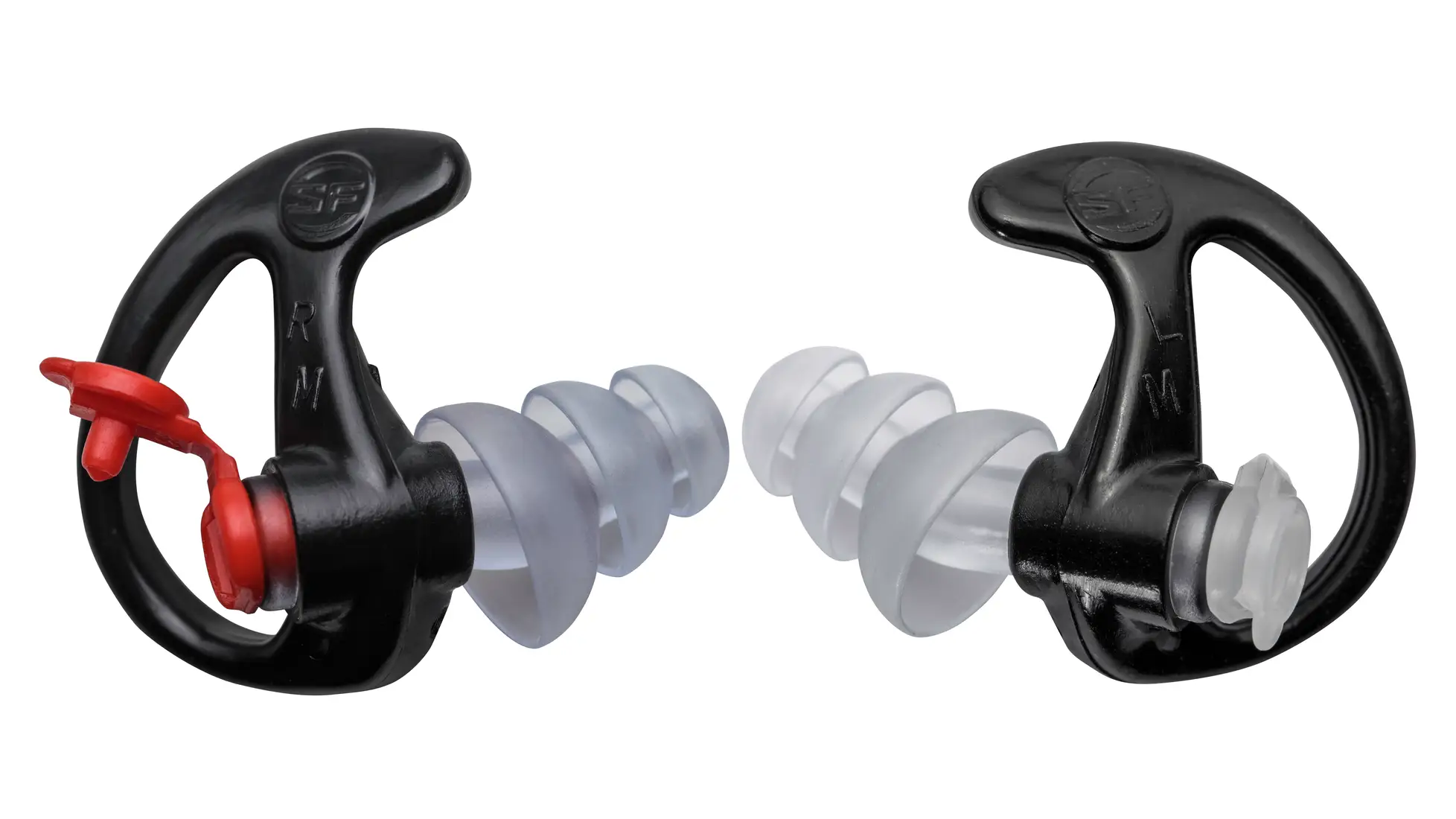
Best passive earplugs, and for doubling up: SureFire EP4 Sonic Defenders Plus
Passive filtered earplugs · 24 dB NRR with filter caps inserted · filter lowers noise above 85 dB · EarLock retention rings · hypoallergenic polymer · lanyard and case (SureFire) · card: Clear, Medium, 1 pair, EP4-MPR
around $20exact price on OpticsPlanet
No batteries, no charging and small enough to wear under any muff on this page. SureFire rates the EP4 at a 24 dB NRR with the filter caps inserted; with the caps open, a filter lowers noise above 85 dB while letting quieter sound and conversation through, and SureFire publishes no NRR for that open setting. EarLock retention rings hold them in place, and SureFire says they last up to 6+ months depending on use and care. Owners like the no-charging simplicity and wear them alone outdoors or under muffs. The recurring problem is fit: owners write more about getting the right size than about anything else, and some found them not enough on their own indoors.
Pros
- No batteries or charging
- Filter caps: open to hear conversation, closed for the full rated 24 dB, per SureFire
- Low profile under muffs, hats and helmets
- The lowest price on this page
Cons
- The 24 dB NRR applies only with the filter caps inserted; SureFire gives no rating for the open filter
- Sizing is the most repeated owner complaint; some needed a second size or pair
- Some owners found them not enough alone at an indoor range
- SureFire's own page calls the stem triple-flanged in one place and double-flanged in another
Best for: doubling up under an electronic muff at indoor ranges, and battery-free protection outdoors.
Key specifications
| Manufacturer | SureFire |
|---|---|
| Type | Passive, filtered, reusable earplugs |
| NRR | 24 dB with filter caps inserted (no rating published for the open filter) |
| Filter | Lowers noise above 85 dB |
| Retention | EarLock rings |
| Material | Hypoallergenic polymer |
| Service life | Up to 6+ months, depending on usage and care |
| Spec source | SureFire's EP4 product page; retailer listing for size and lanyard |
| Model on this card | EP4-MPR, Clear, Medium, 1 pair |
“I was looking for ear protection that I didn't have to worry about charging.”
Wayne, owner (VA) via OpticsPlanet
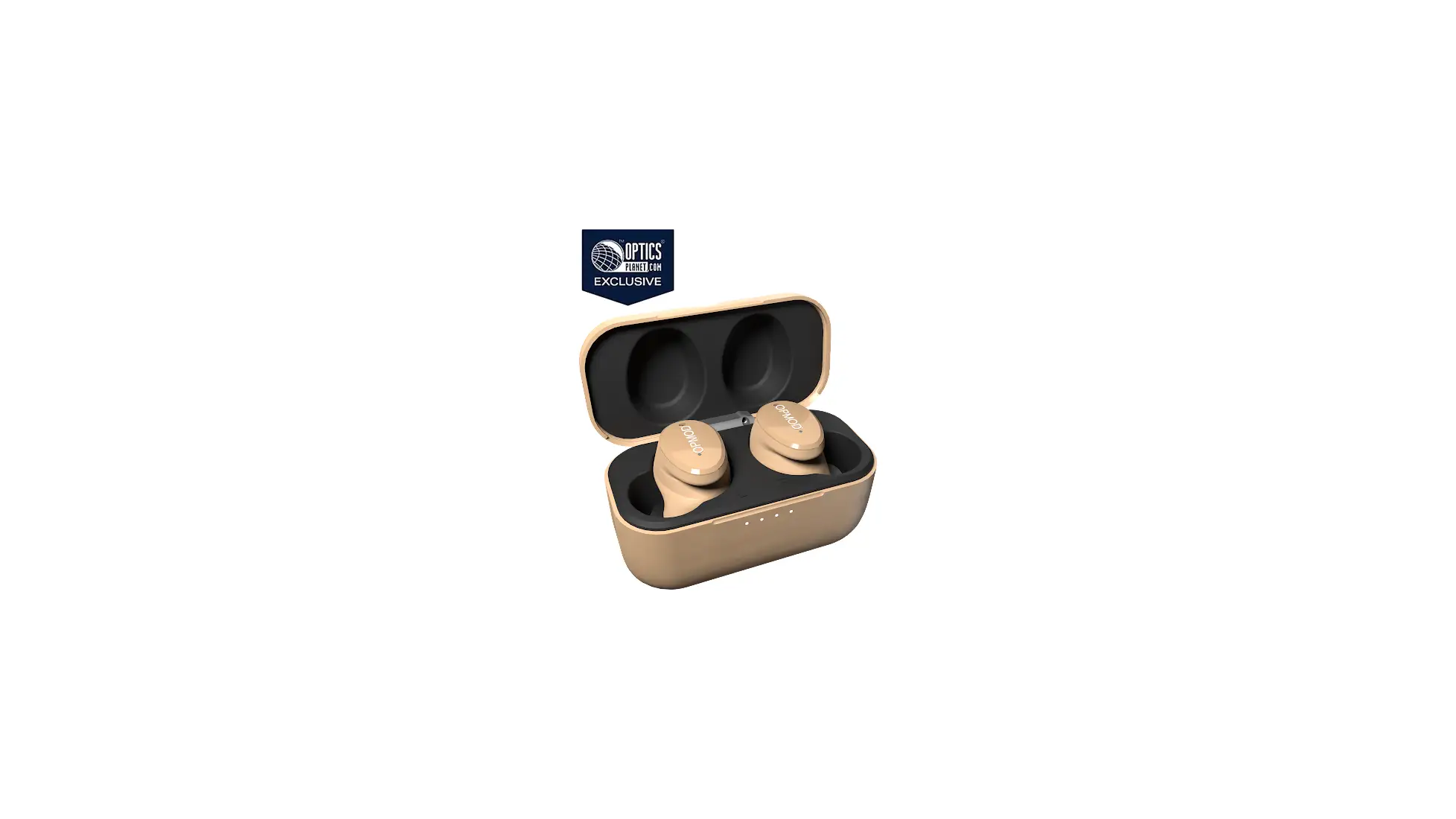
Earbud option: ISOtunes Sport CALIBER BT
Electronic true wireless earbuds · 25 dB NRR · Tactical Sound Control · Bluetooth · 2-hour auto power-off · IP67 (retailer listing) · card: OD Green, IT-17
around $180exact price on OpticsPlanet
The in-ear alternative to a muff, and the product on this page with the weakest owner record. The retailer lists the Sport CALIBER BT as true wireless earbuds with a 25 dB NRR, Tactical Sound Control (amplified natural sound with gunshot noise reduction), a background noise-reducing microphone, Bluetooth, a 2-hour auto power-off and an IP67 rating, with up to 13 hours of use per its description. The owners who like them are rifle and shotgun shooters: no cup to push against the stock, and one glasses wearer finds they seal better than muffs. But its rating is 3.6 out of 5, and the complaints repeat: an ambient microphone that is too sensitive, especially in wind, a short auto-off and battery life, and units that failed.
Pros
- No ear cup to hit a rifle or shotgun stock
- A glasses wearer reports a better seal than over-the-ear muffs
- Bluetooth for music and calls, and owners use them as everyday earbuds
- IP67 rating, per the retailer listing
Cons
- "the extra powerful setting for the external mic pickup seems to be on by default and unless you are alone in nature, it tends to be too much." (Matt S., owner, via OpticsPlanet)
- "Step outside and any moderate breeze sounds like you're in an all out gale." (drp, owner, via OpticsPlanet)
- "the ear plugs have a 2hr auto shutoff" (Matt S.); another owner: "Reality is that a full charge permits no more than 2 hours of use." (David, owner, via OpticsPlanet)
- "Unfortunately, I got a bad ear bud." (LV579, owner, via OpticsPlanet); another owner is on a third set, and one says the company would not allow a return
Best for: rifle and shotgun shooters who wear glasses or hate muffs against the stock, and who will set the microphone to its low setting. Everyone else is better served by a muff above.
Key specifications
| Manufacturer | ISOtunes Sport |
|---|---|
| Type | Electronic true wireless earbuds |
| NRR | 25 dB |
| Electronics | Tactical Sound Control, SafeMax, background noise-reducing microphone |
| Wireless | Bluetooth, true wireless |
| Power | Rechargeable; up to 13 hours per the description; 2-hour auto power-off |
| Durability | IP67 |
| Spec source | Retailer listing spec table, features and description |
| Model on this card | IT-17, OD Green |
“the large over-the-ear hearing protection types are always annoying when I place my chick on the stock because the stock moves them”
KP, owner (IL) via OpticsPlanet
What NRR means, and what it does not
NRR is a lab rating for steady noise, not a gunshot rating. The Noise Reduction Rating is the number the EPA requires on every hearing protector's label, under 40 CFR Part 211, Subpart B. It is measured by the ANSI S3.19-1974 real-ear method, and the label must state that the range for existing protectors is approximately 0 to 30, with higher numbers meaning more protection. The same rule requires this statement in the supporting information:
“Although hearing protectors can be recommended for protection against the harmful effects of impulsive noise, the Noise Reduction Rating (NRR) is based on the attenuation of continuous noise and may not be an accurate indicator of the protection attainable against impulsive noise such as gunfire.”
EPA, 40 CFR 211.204-4
- Gunfire is loud enough to matter. NIOSH reports that firearms discharged at an indoor range produce peak noise levels above the 140 dB SPL occupational health limit, and a later NIOSH bulletin describes firearm sound often reaching 160 to 170 dB peak.
- The label figure is not a field figure. OSHA's technical manual, when it estimates a worker's exposure from A-weighted sound level data, subtracts 7 dB from the NRR first.
- Use NRR to compare, not to promise. Between two products tested the same way, a higher NRR means more rated attenuation. It does not tell you how a muff seals over your glasses or how an earplug fits your ear, and owners on this page write about both.
Doubling up: plugs under muffs
NIOSH recommends double hearing protection, earplugs and earmuffs, for people who use a firing range as part of their job, such as law enforcement officers. Two protectors do not add up, though. OSHA's technical manual estimates dual protection by taking the NRR of the higher-rated protector and adding 5 dB for the second. In practice, owners of every muff on this page describe the same habit: foam or filtered plugs under the muff for rifles and indoor ranges. The SureFire EP4 is the plug on this page built for it: SureFire says it is low profile enough to wear with supplemental muffs, and it needs no batteries.
How to choose hearing protection for shooting
- Electronic or passive. Electronic muffs and earbuds use microphones to pass or amplify quiet sound and hold back loud impulses, so you can hear range commands without lifting a cup. Passive protection just blocks and needs no power.
- Muffs, plugs or earbuds. Muffs go on and off in a second and seal without fitting; plugs and earbuds depend on getting the size right, which is the most repeated complaint about the SureFire EP4. Earbuds leave nothing outside the ear to hit a stock.
- Cheek weld on a rifle. Thick cups push against the stock. Owners of the Walker's, the Caldwell Low Profile and the PELTOR say theirs clear it; owners of the Impact Pro say its cups do not.
- Stereo or mono. Owners of the Walker's report that both ears get the same sound, so direction is lost. The Caldwell's listing describes a microphone in each cup for stereo, and its owners confirm they can tell direction.
- Glasses. Muff seals break around the arms of shooting glasses; one ISOtunes owner who wears glasses says his earbuds protect better than muffs for that reason.
- Power. Most electronic muffs here run on two AAA batteries; the Impact Sport's listing gives a four-hour auto shut-off, and the ISOtunes listing a two-hour auto power-off. Batteries are not included with the PELTOR, per 3M.
- Radio comms. None of the muffs here is a radio headset. If you need to talk on a radio or to your team through your ear pro, our PELTOR ComTac review explains which ComTac V, VI NIB and VIII rows come with a radio lead and which do not.
How we chose these
This is a research-based roundup, not a hands-on test, and nothing on this page is medical advice. We started from the retailer's ear muff and earplug categories sorted by most reviews, opened each listing's full model block (every orderable variant, with used and demo units set aside) to find the exact model each card links to, and read every owner review on each listing, including every low-star one. For the Walker's, our top pick, we checked the specifications and warranty against Walker's own pages, and for the SureFire EP4 we read SureFire's own product page; claims we found only in secondary research and could not confirm at the source were left out. What NRR means and how to double up comes from the EPA's labeling rule, OSHA's technical manual and NIOSH, named in the text. Our scores are our opinion; owner ratings are shown attributed to the retailer that collected them. See our methodology for how we work.
FAQ
What is the best hearing protection for shooting?
For most shooters, the Walker's Razor Slim Electronic Patriot Series. Walker's rates it at a 23 dB NRR with two omnidirectional microphones and 0.02 second sound-activated compression, and its low-profile cups are what owners praise most for keeping a rifle cheek weld. For the most rated protection in one muff, the Howard Leight Impact Pro is rated 30 dB. For indoor ranges and rifles, add passive plugs such as the SureFire EP4 under any muff.
Is a 23 or 25 dB NRR enough for shooting?
The NRR alone cannot tell you. The EPA rule that governs the label requires the maker to state that the NRR is based on the attenuation of continuous noise and may not be an accurate indicator of the protection attainable against impulsive noise such as gunfire. NIOSH reports that firearms at indoor ranges produce peak levels above the 140 dB SPL occupational limit and recommends double protection, earplugs and earmuffs, for people who shoot as part of their job.
Should you wear earplugs under ear muffs when shooting?
NIOSH recommends double hearing protection, earplugs plus earmuffs, for people who use a firing range as part of their occupation. Do not add the two ratings together: OSHA's technical manual estimates dual protection by taking the higher-rated protector and adding 5 dB for the second one.
Electronic or passive hearing protection for shooting?
Both reduce loud noise; electronic protection adds microphones that pass or amplify quieter sound, such as range commands, and hold back loud impulses. Passive muffs and plugs need no batteries. Every electronic pick on this page runs on batteries or a charge, and the passive SureFire EP4 needs neither.
Are shooting earbuds as good as ear muffs?
They can carry a comparable rating: the ISOtunes Sport CALIBER BT is listed at 25 dB NRR, against 22 to 30 dB for the muffs here. Their advantage is fit with a rifle stock and with glasses, per owners. Their drawback on this page is the owner record: the CALIBER BT is rated 3.6 out of 5 on OpticsPlanet, with repeated complaints about microphone sensitivity, battery life and failed units.
Heading to the range: how to sight in a rifle scope · how to sight in a red dot · how we evaluate. To carry muffs, eye protection, pistols and ammo in one trip, our best range bag guide compares range bags that carry them. Want electronic earplugs with nothing outside the ear? Our OTTO NoizeBarrier review covers the Micro earplugs and the over-ear Range SA and TAC headsets.