Kenetrek Mountain Extreme review: the stiff boot owners swear by
Our verdict: 4.5/5. The Kenetrek Mountain Extreme is a 10-inch leather mountain hunting boot built for steep ground and heavy packs, and all 20 owner reviews we could read on the two OpticsPlanet listings are five stars. Kenetrek builds it in Italy with 2.8mm premium leather uppers, a one piece vamp with no seams down the tongue, a 7mm nylon midsole for support under pack loads, a Windtex waterproof membrane and K-Talon outsoles. It comes in two versions that share that build: the Non-Insulated for active, warmer hunts and the 400 with 400 gram Thinsulate for cold weather. The trade-offs are clear: the sole is stiff, Kenetrek itself allows up to 50 miles to break the boots in, and it is a premium-priced boot. For the pack on top, see our Mystery Ranch Metcalf review, a framed hunting pack for carrying meat out.
OpticsPlanet shoppers rate the Non-Insulated listing 5.0/5 across 13 reviews and the 400 listing 5.0/5 across 7 reviews. The Non-Insulated row we card (KE-420-NI 10.5 Wide) sells for around $520, and the 400 row we card (KE-420-400 7.0 Medium) for around $540; each listing charges the same across standard sizes, and sizes 15 and 16 cost more. Check price and availability on OpticsPlanet.
How we reviewed it: a research-based review built from Kenetrek's own product, FAQ, warranty and repair pages, the two OpticsPlanet listings and all 20 owner reviews on them (13 on the Non-Insulated, 7 on the 400). We have not worn these boots ourselves; the score is our editorial opinion and owner ratings are shown attributed to their source. Claims we could not confirm on Kenetrek's site are left out. See how we evaluate.
What the Mountain Extreme is
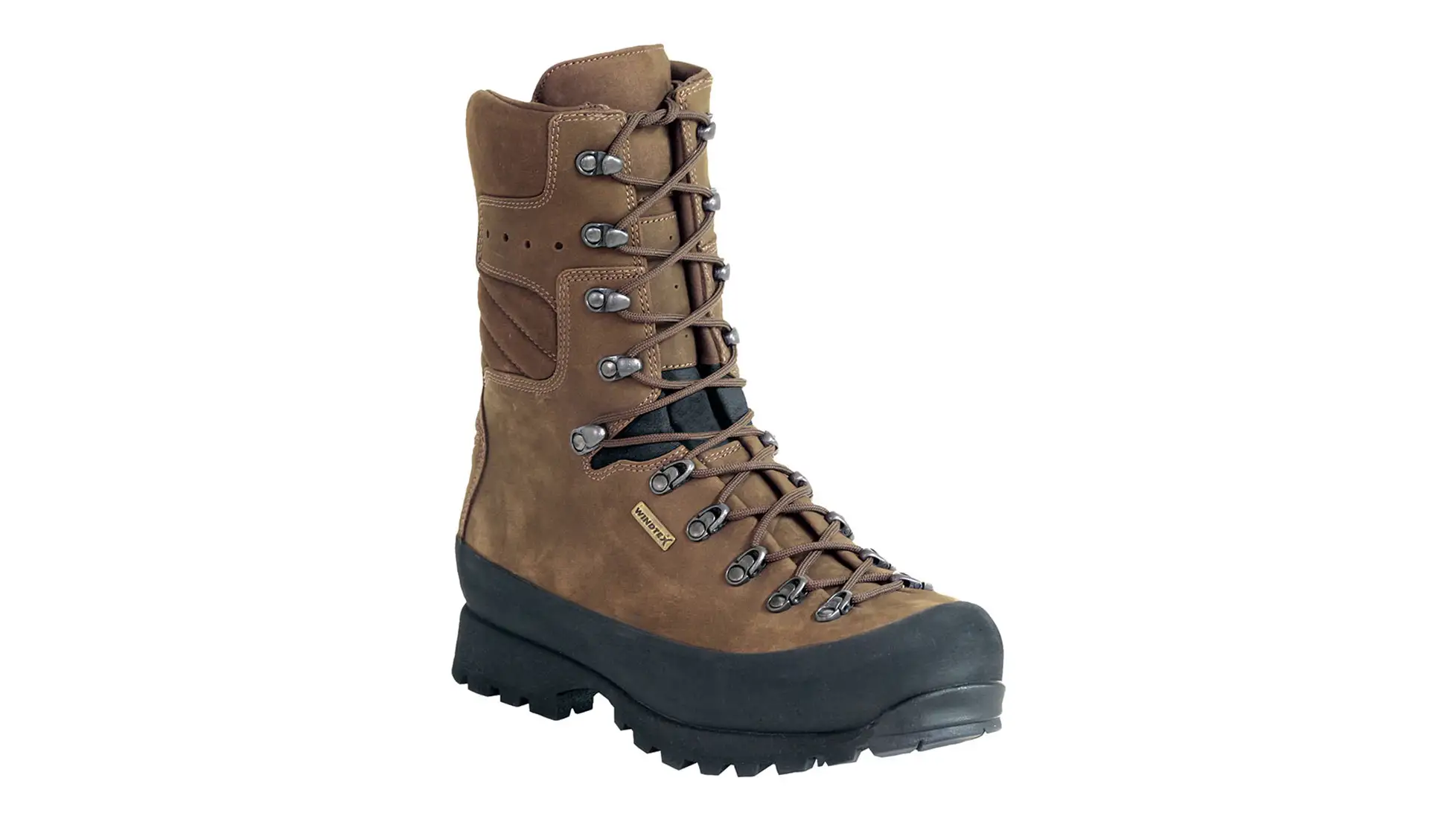
Kenetrek sells the Mountain Extreme in its Mountain Boots line. Its product pages describe 10-inch leather uppers made with 2.8mm premium leather in a one piece vamp construction with no seams down the tongue, reinforced double and triple stitching in high wear areas, 7mm nylon midsoles that "provide extra support with heavy pack loads", Kenetrek Supportive Footbeds, anti-corrosion boot hardware that swivels instead of breaking, a reinforced rubber sole guard, a Windtex waterproof, breathable, flexible membrane and lightweight K-Talon outsoles. Kenetrek lists the weight as 3.9 lbs for the Non-Insulated and 4.2 lbs for the 400, and both pages say Made in Italy.
Kenetrek pitches it at the hardest hunts. Its product copy sets the scene with hunting Dall sheep in the Mackenzie Mountains of the Northwest Territories, where you "may be surprised with six inches of snow in August." We found no temperature rating on either Kenetrek product page, so we print none.
One independent recognition we could confirm at the source: Field & Stream's guide to the best elk hunting boots, by Jace Bauserman, names the Mountain Extreme 400 its Best Overall pick. That award is for the 400, not the Non-Insulated version.
A Kenetrek video of its non-insulated brown leather mountain boot, with on-screen callouts for 10-inch height, 2.8 mm full-grain leather, a Windtex waterproof membrane, triple stitching, anti-corrosive hardware swivels and the K-Talon outsole. The model name does not appear on screen. "Full grain" is the video's own callout; Kenetrek's product pages say premium leather.
Why owners rate it: support and comfort under load
All 13 reviews on the Non-Insulated listing are five stars, and at least 10 of them mention comfort, which is notable for a boot this stiff. Reviewers describe hunting, hiking and carrying loads on steep ground: one moves stands in the hills of southern Indiana, another hunts rocky terrain in Idaho, a third bought them for mountain hunting in west Texas. Three of them say the stiff build pays off on steep terrain or for backpack hunting.
“They did awesome on hillsides carrying a load over wet ground.”
Bobby (IN), via OpticsPlanet
“The soles are pretty stiff, but the rocker and the little bit of flex that you gain after breaking them in makes them a very versatile boot that is great for any terrain.”
Dustin Bailey (FL), verified owner, via OpticsPlanet
Fit gets steady praise too. Four reviewers on the Non-Insulated listing say the boots run true to size, which matches Kenetrek's own FAQ line that its mountain boots "run very true to size with the Brannock device." One verified owner who bought a 10 Wide reports a generous toe box and found they could tune the fit for different sock combinations with the laces. Owners also cross over between the versions: the most helpful review comes from someone who liked the Non-Insulated enough to buy the 400 as well.
“I liked the non insulated so much, I bought the 400 gram insulated boot as well for winter months.”
Most helpful positive review, via OpticsPlanet
The honest catches
Stiffness and break-in. Four Non-Insulated reviewers call the sole or shank stiff, and one verified owner adds that it is slightly stiffer above the ankle than most of the typical boots found at Bass Pro or Cabela's, though not too rigid. Kenetrek is upfront about this: its FAQ says its mountain boots "can take up to 50 miles of normal walking before a comfort flex will form in the midsole," and its break-in advice is to wear them daily for at least a few hours, starting at least a couple of months before your hunt. Owner experience splits here. Five Non-Insulated reviewers found them comfortable out of the box or needing little break-in, while three of the seven 400 reviewers describe theirs as stiff and needing break-in, one of them reporting rubbed heels.
“They are a little tough to break in - tend to be stiff and rub your heels.”
stan (ID), verified owner, 400 listing, via OpticsPlanet
Traction in mud and on wet surfaces. Two Non-Insulated reviewers flag grip limits. One says the tread holds certain kinds of sticky mud, and another finds the soles a little slippery on wet surfaces, though neither treats it as a deal-breaker.
“My only complaint is the boot tread can hold certain types of sticky mud but otherwise provides great traction.”
Lost River (WV), verified owner, via OpticsPlanet
“The soles are a little slippery when walking on wet surfaces, but not a huge negative.”
Ditchpickle (CA), via OpticsPlanet
Not a work boot. One reviewer who wears them daily in construction writes that they do not hold up to work conditions as well as dedicated work boots, while still calling them the most comfortable boots they have owned.
Price, and an old review record. Price comes up on both listings: two Non-Insulated reviewers and four 400 reviewers mention the cost, all of them in five-star reviews. And the record is small and dated. On the Non-Insulated listing the twelve dated reviews run from 2017 to July 2024; on the 400 listing six of the seven reviews are dated 2016 to 2020, and the seventh, the most helpful review, has no date we could confirm. Read the perfect scores as a long-running pattern of happy owners, not as a fresh sample of current production.
Non-Insulated or 400: which Mountain Extreme?
Kenetrek lists the same upper, stitching, midsole, footbed, hardware, membrane and outsole on both versions. The differences are the insulation, the weight and the price. Kenetrek's own video labels the non-insulated style "for warmer weather", and in our view it is the one to take on active early and mid season hunts. The 400 adds 400 gram Thinsulate, which Kenetrek describes as "insulation for warmth without the bulk"; we would pick it for late season, snow and high country.
Key specifications
| Spec (Kenetrek) | Non-Insulated | 400 |
|---|---|---|
| Height | 10 in leather uppers | 10 in leather uppers |
| Upper | 2.8mm premium leather, one piece vamp with no seams down the tongue | Same |
| Stitching | Reinforced double and triple stitching in high wear areas | Same |
| Insulation | None (non-insulated) | 400 gram Thinsulate |
| Membrane | Windtex waterproof, breathable, flexible membrane | Same |
| Midsole | 7mm nylon | 7mm nylon |
| Footbed | Kenetrek Supportive Footbeds | Same |
| Hardware | Anti-corrosion boot hardware that swivels instead of breaking | Same |
| Sole guard | Reinforced rubber sole guard | Same |
| Outsole | K-Talon | K-Talon |
| Weight (Kenetrek) | 3.9 lbs | 4.2 lbs |
| Sizes (men's, whole and half) | Narrow 8-12, 13, 14, 15, 16 · Medium 7-12, 13, 14, 15, 16 · Wide 8-12, 13 | Same |
| Made in | Italy | Italy |
| Carded row | KE-420-NI 10.5 Wide | KE-420-400 7.0 Medium |
| OpticsPlanet rating | 5.0/5, 13 reviews | 5.0/5, 7 reviews |
| Price (standard sizes) | around $520 | around $540 |
Specifications are Kenetrek's, from its two product pages; the carded rows, ratings and prices are the retailer's. Each listing sells many size and width rows at one price for standard sizes; sizes 15 and 16 carry an oversize charge at Kenetrek and a higher price on OpticsPlanet. Not every size comes in every width, so confirm the row in your cart. Kenetrek also sells a Mountain Extreme 1000, which this page does not cover.
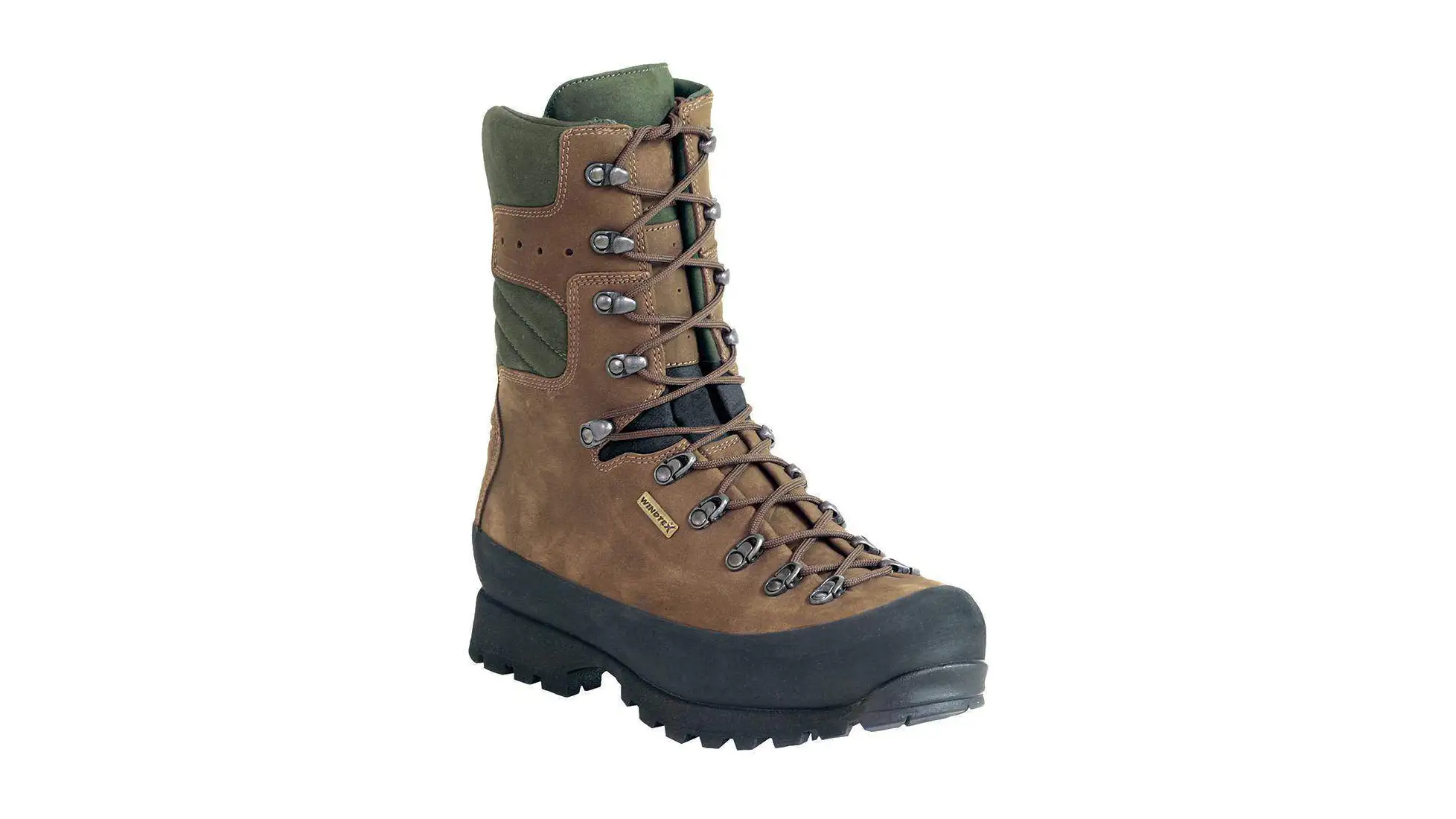
The seven 400 reviews are all five stars and echo the Non-Insulated record: comfort and build, with stiffness and price as the reservations. One owner who had put around 20 miles on theirs found the heel slip that, in their words, many people wrote about to be minimal and the insulation unobtrusive. Two others report the boots have stayed waterproof so far.
“The insulation is good in this boot and does not feel bulky in any way.”
Glenn (GA), 400 listing, via OpticsPlanet
A Kenetrek video of its 400-gram Thinsulate insulated brown-and-green leather mountain boot, with callouts for 10-inch height, 2.8 mm full-grain leather, a Windtex waterproof membrane, triple stitching, hardware swivels and the K-Talon outsole. The model name does not appear on screen.
Care, resoling and warranty
Kenetrek asks owners to condition the leather with Kenetrek Boot Wax, warning that other boot dressings "can contain heavy oils or animal fats that may delaminate the glue bond of the rubber rand." It also warns against drying boots with heat from campfires or wood stoves, which it says can damage internal materials, often beyond repair.
When the soles wear out, the boots can be rebuilt. Kenetrek's repair page offers a Mountain Boot Resole Package (it names the line, not individual models; the Mountain Extreme is listed in Kenetrek's Mountain Boots line), which includes new outsoles, any minor repairs needed, new performance insoles and new laces, with a 6 to 8 week turnaround, and its FAQ puts a rebuild at "around half of the cost of a new pair." The warranty covers failures from defective materials or poor workmanship within 12 months of purchase and before the soles are worn 75 percent; improper care, alterations, accidents and natural wear and tear are excluded.
Trade-offs, plainly
- A stiff sole and a long break-in: Kenetrek allows up to 50 miles, and four Non-Insulated and three 400 reviewers mention stiffness.
- Premium price, raised by reviewers on both listings, and the 400 costs a little more than the Non-Insulated.
- Tread can hold sticky mud and feel slippery on wet surfaces (one reviewer each).
- Not built for daily construction work, by one daily wearer's account.
- A small, old review record: 20 reviews in total; 18 of them are dated on the listings, the newest of those from July 2024.
- Care rules matter: Kenetrek warns that other brands' oily dressings and campfire heat can damage the boots.
Should you buy it, and what else to consider
- Buy the Non-Insulated if you hunt steep country early or mid season, carry real weight, and will put in the break-in miles before opening day.
- Buy the 400 if your hunts run late, cold or high, where 400 gram Thinsulate earns its place; it is also the version Field & Stream names Best Overall for elk.
- Skip both if you hunt mostly flat ground, want a soft boot you can wear hard on day one, or need a daily work boot.
What else to consider for the same hunt:
- The pack that loads these boots: our Mystery Ranch Metcalf review covers a framed, roll-top pack for multi-day hunts and for carrying meat out.
- Binoculars off your neck: our best binocular harness guide picks a chest pack that carries the weight off your neck.
FAQ
Is the Kenetrek Mountain Extreme worth it?
For carrying loads over steep, rough ground, owners say yes. Every one of the 20 reviews across the two OpticsPlanet listings is five stars, and comfort is the most repeated praise. The cost is real: it is a premium-priced boot, the sole is stiff, and Kenetrek itself says its mountain boots can take up to 50 miles of normal walking to break in. If you hunt flat country or want a soft boot on day one, it is more boot than you need.
Should I buy the non-insulated or the 400 gram Mountain Extreme?
Buy the non-insulated version if you hike hard in early and mid season or run warm; Kenetrek's own video tags it for warmer weather. Buy the 400 if you hunt late season, in snow or at high altitude; Kenetrek's video tags its 400 gram Thinsulate for warmth. Apart from the insulation, Kenetrek lists the same upper, midsole, membrane and outsole on both; the 400 weighs a little more (4.2 lbs against 3.9 lbs) and costs a little more.
How long does it take to break in Kenetrek Mountain Extreme boots?
Kenetrek says its mountain boots can take up to 50 miles of normal walking before a comfort flex forms in the midsole, and advises wearing them daily for a few hours, starting at least a couple of months before the hunt. Owner reports vary: on the non-insulated listing five reviewers describe the boots as comfortable from the box or needing little break-in, while on the 400 listing three reviewers describe them as stiff and needing break-in.
Do Kenetrek Mountain Extremes run true to size?
Kenetrek says its mountain boots run very true to size with the Brannock device, and advises checking for at least a finger's width behind your heel. Four reviewers on the non-insulated listing say true to size; one bought a half size larger for downhill room, and one 400 owner with large, narrow feet says large sizes feel about a half size large. Widths come in Narrow, Medium and Wide, but not every size in every width.
Can Kenetrek Mountain Extreme boots be resoled, and what is the warranty?
Yes. Kenetrek lists the Mountain Extreme in its Mountain Boots line and offers a paid Mountain Boot Resole Package that includes new outsoles, any minor repairs needed, new performance insoles and new laces, with a 6 to 8 week turnaround. Its FAQ puts a rebuild at around half the cost of a new pair. The warranty covers defective materials or poor workmanship within 12 months of purchase and before the soles are worn 75 percent; damage from improper care, alterations, accidents or natural wear is not covered.
Where are Kenetrek Mountain Extreme boots made?
In Italy. Both Kenetrek product pages read for this review say Made in Italy, and Kenetrek's FAQ says its Mountain Boots are made in Italy, while its Pac Boots are assembled in Thailand and its Light Hikers are made in Romania.
More gear for the hunt: Mystery Ranch Metcalf review · best binoculars for hunting · best binocular harness · best spotting scope for hunting · 5.11 Stryke pant.