The best rangefinders in 2026, for hunting, golf, bow and long range
Quick answer: the best rangefinder for most people is the Vortex Diamondback HD 2000 (around $250). It pairs 7x magnification with 2,000 yards of reach on reflective targets and 1,400 on game, a red OLED display, HCD angle compensation and Vortex's unlimited lifetime VIP warranty. What puts it ahead of the Leupold RX-1400i (around $200), in our editorial judgement, is more magnification, more reach on game and a warranty with no separate electronics term, plus a deeper owner record on OpticsPlanet: 47 reviews at 4.7/5, against 24 at 4.8/5. Choose the Leupold if you hunt with a bow and want arrow-arc data.
Golf: buy a golf unit with First Target Priority and, if you play tournaments, a slope mode you can switch off; ours is the Nikon Coolshot Pro III Stabilized. Hunting: buy a unit with a Last target mode and angle compensation, like the Diamondback.
Budget and long-range picks below. Prices verified October 14, 2026; confirm the current price and availability on the retailer page.
A rangefinder is only as good as its fit to the job: golf and hunting units use opposite targeting logic, and the yardage on the box is not the one you will get on an animal. Below are five picks, one per job, each with honest pros and cons, followed by the golf versus hunting difference, a route to every rangefinder roundup on the site, and how to read a rangefinder spec sheet.
How we reviewed them: a research-based roundup built from the makers' published specifications, the retailer listings and the owner-review record, with every owner quote taken word for word from the retailer's review pages. We have not used these rangefinders ourselves; scores are our editorial opinion, and owner ratings are shown attributed to their source. See how we evaluate.
Quick comparison
| Pick | Category | Magnification and weight | Range, and the target it is for | Min range | Price |
|---|---|---|---|---|---|
| Vortex Diamondback HD 2000 | Best rangefinder overall | 7x · 7.6 oz | 2,000 yds reflective / 1,400 yds on deer (Vortex) | 5 yds | around $250 |
| Nikon Coolshot Pro III Stabilized | Best for golf | 6x · 7.2 oz | 1,200 yds to a highly reflective target / about 490 yds (450 m) to a flagstick (Nikon) | 8 yds | around $530 |
| Leupold RX-1400i Gen 2 TBR/W | Best for bow hunting | 5x · 5.1 oz | 1,400 yds reflective / 900 yds on deer (Leupold) | 6 yds | around $200 |
| Vortex Crossfire HD 1400 | Best budget | 5x · 4.8 oz | 1,400 yds reflective / 750 yds on deer (Vortex) | 5 yds | around $180 |
| Vortex Razor HD 4000 GB | Best for long range | 7x · 10.1 oz | 4,000 yds reflective / 2,500 trees / 2,200 deer (Vortex) | 5 yds | around $800 |
Range figures are as each maker publishes them, with the target each figure is for. Editorial scores are our opinion.
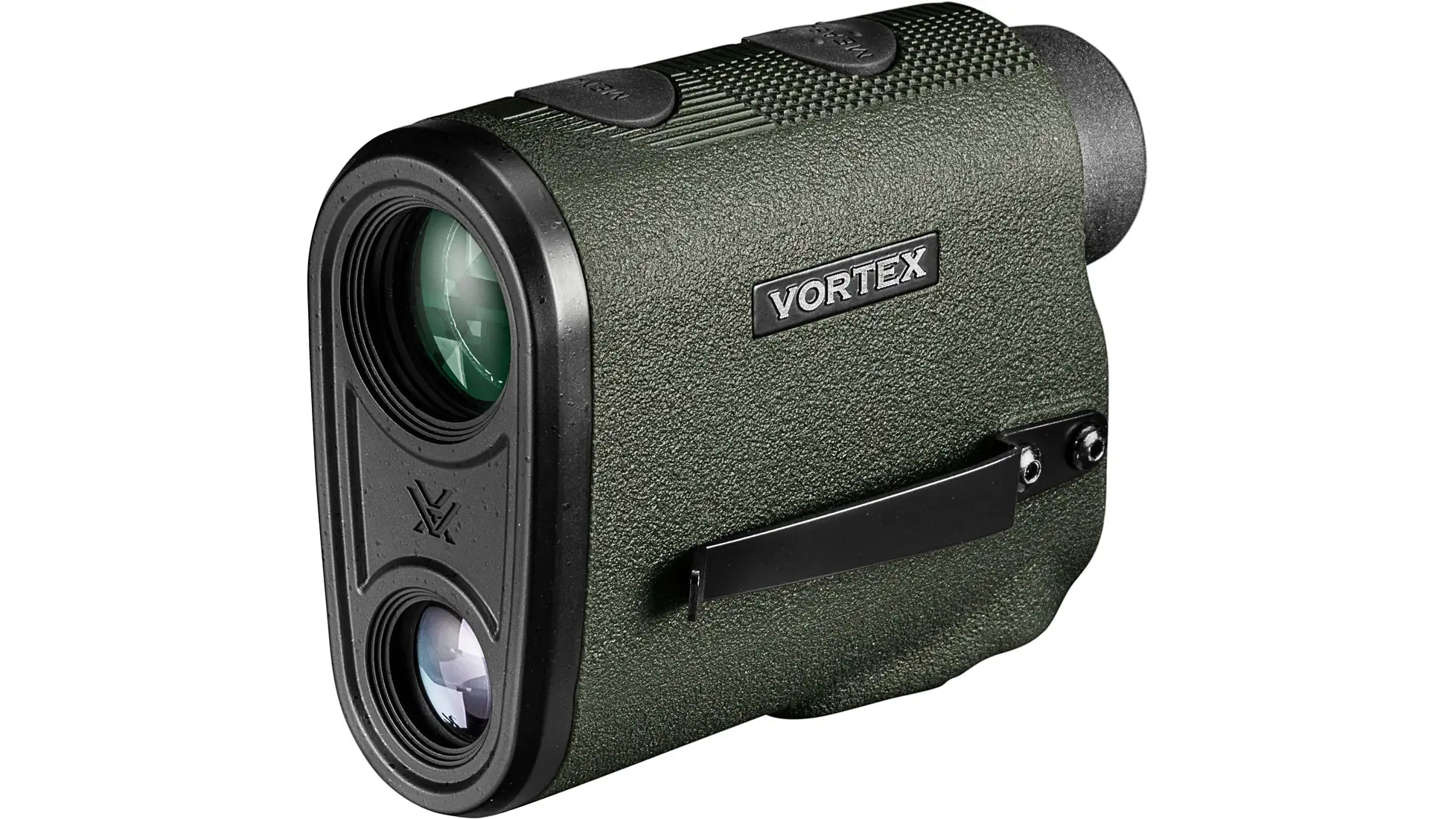
Best rangefinder overall: Vortex Diamondback HD 2000
Laser · 7x24 · red OLED · HCD/LOS · 2,000 yd reflective
around $250exact price on OpticsPlanet
This is the rangefinder we would point most people to first, in our editorial judgement, and the runner-up it beats is the Leupold RX-1400i below. Both are hunting lasers with angle-compensated ranging and a red display, so the choice comes down to magnification, reach and warranty against software and weight. The Vortex wins the first three: 7x magnification against the Leupold's 5x, and 2,000 yards on reflective targets with 1,400 on deer, where Leupold publishes 1,400 reflective and 900 on deer for the RX-1400i. It carries Vortex's VIP warranty, which Vortex describes as unlimited and lifetime, with exclusions for loss, theft, deliberate damage and cosmetic damage, and which the retailer listing adds is fully transferable; Leupold covers the RX-1400i's electronics for five years. What the Leupold does better is software and weight: TBR/W ballistic holdovers, a Bow Mode with Flightpath, and 5.1 oz against 7.6 oz. The retailer lists two target modes (Normal and Last), two ranging modes (HCD and LOS), a red OLED display that stays clear in low light, a 5-yard minimum and a tripod-adaptable body. One owner who replaced a Leupold with it gives the Leupold a slight edge on lens clarity and calls the transferable warranty the clincher.
Pros
- 7x magnification, and Vortex publishes 2,000 yards on reflective targets and 1,400 on deer
- HCD angle-compensated and LOS ranging modes, with Normal and Last target modes
- Red OLED display that the retailer says stays clear in low light
- Vortex VIP warranty: unlimited lifetime, with no separate term for the electronics
Cons
- No ballistic holdovers, Bow Mode or arrow-arc data: the Leupold RX-1400i below has them
- At 7.6 oz it is heavier than the two 5x picks here (4.8 oz and 5.1 oz)
- 16 mm eye relief, against 18.3 mm on the Leupold RX-1400i
- Owner reports on reflective targets vary: one maxed it out at 1861 yards on a building, another ranged a farmhouse at 2347
Best for: hunters and shooters who want one rangefinder with real reach, good glass and a warranty that covers the electronics. Archers who want arrow-arc data should start with the Leupold RX-1400i, and golfers with the Nikon below.
Key specifications
| Type | Laser rangefinder |
|---|---|
| Magnification | 7x |
| Objective | 24 mm |
| Range | 2,000 yds reflective / 1,400 yds on deer (Vortex) |
| Min range | 5 yds |
| Accuracy (Vortex) | +/- 1 yd at 100 yds |
| Ranging modes | HCD and LOS, plus Scan (Vortex) |
| Target modes (Vortex) | Normal and Last |
| Display | Red OLED |
| Eye relief | 16 mm |
| Field of view | 335 ft at 1000 yds |
| Weight | 7.6 oz |
| Battery | CR2 |
| Sealing | Waterproof, shockproof |
| Warranty | Vortex VIP: unlimited lifetime, no separate electronics term |
“I would give the lense clarity of the Leupold a slight edge. The lifetime transferable warranty was the clincher for me.”
Sandman, verified owner (MI) via OpticsPlanet, who replaced a Leupold rangefinder with it
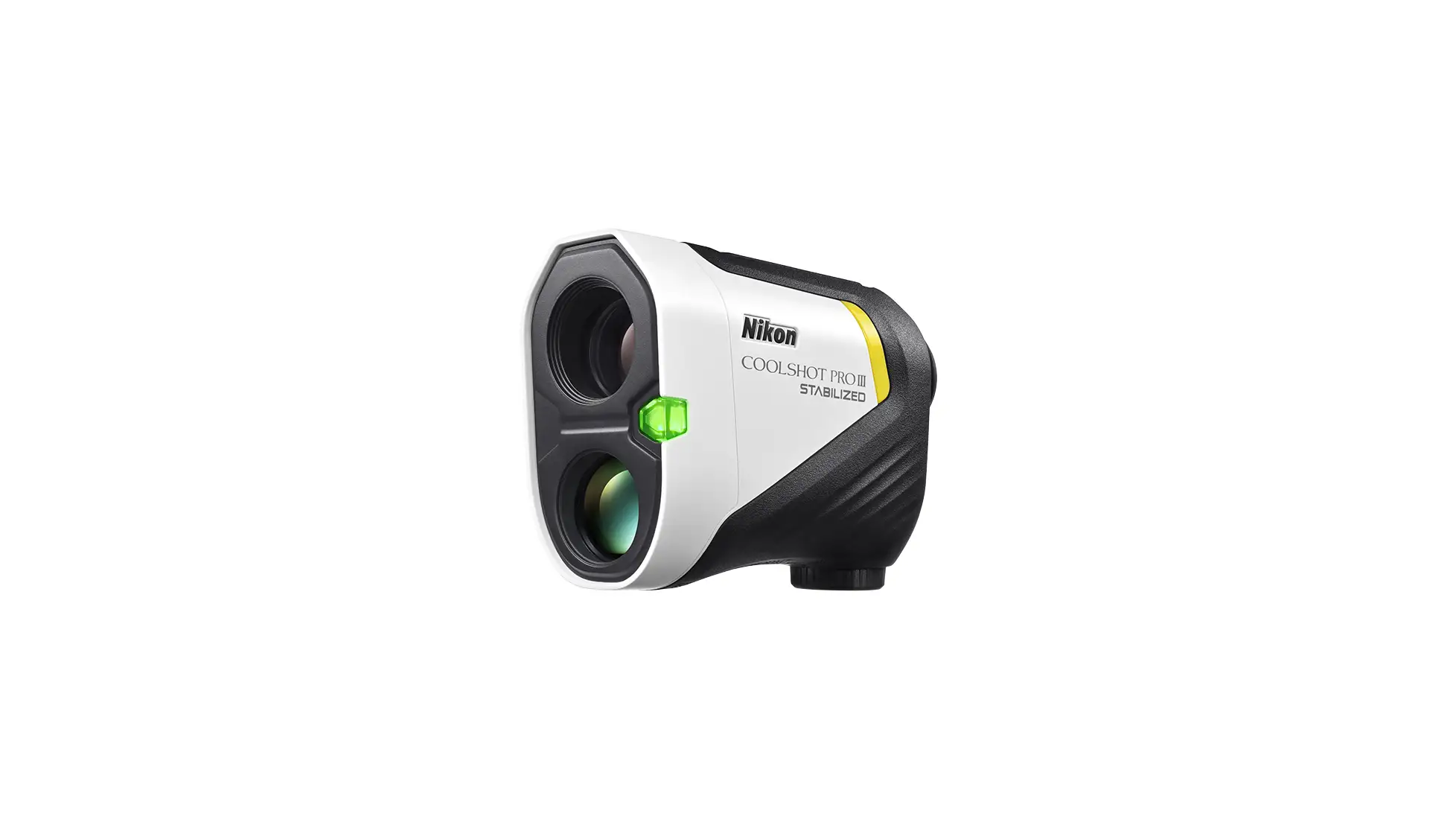
Best for golf: Nikon Coolshot Pro III Stabilized
Laser · 6x21 · image-stabilized · red OLED · switchable slope
around $530exact price on OpticsPlanet
If the rangefinder is for the golf course, buy a golf unit, and this is the one we would start with. Its headline is optical image stabilization, which Nikon says counteracts hand shake in both the monocular view and the ranging laser. First Target Priority makes it ignore background trees, shrubs and golf carts so the flagstick is what it locks, and Dual Locked On Quake confirms the lock with a visual cue plus a gentle vibration rather than a beep. Slope compensation is switchable: Nikon says it complies with USGA Local Rule 14-3 for tournament play when slope is turned off, and an external ADI LED lets other players and officials see that it is off. HYPER READ ranging takes 0.1 seconds, and an independent tester at Plugged In Golf found it never more than a yard different from other well-regarded lasers. It is laser only, with no GPS and no cart magnet.
Pros
- Optical image stabilization for both the view and the ranging laser
- First Target Priority locks the flagstick ahead of trees, shrubs and carts behind it
- Pin lock confirmed with a visual cue plus a gentle vibration (Dual Locked On Quake), not a beep
- Switchable slope with an external ADI LED that shows other players and officials it is off
- Nikon covers new units for 5 years
Cons
- No cart magnet, so riders keep it in the case, a pocket or a cup holder
- Heavier than the Pro II it replaces: 7.2 oz against 6.3 oz
- Laser only: no GPS hole maps
- A thin owner record: the rating we can cite comes from 7 reviews on Nikon's own store
- Built to lock the nearest object, the opposite of what a hunter needs to range an animal behind brush
Best for: golfers, especially anyone who ranges one-handed, plays in wind or has unsteady hands. Skip it for hunting, and skip it if you ride and need a cart magnet.
Key specifications
| Type | Laser rangefinder (no GPS) |
|---|---|
| Magnification | 6x |
| Objective | 21 mm |
| Display | Red OLED |
| Range | 1,200 yds to a highly reflective target / about 490 yds (450 m) to a flagstick (Nikon) |
| Min range | 8 yds |
| Ranging speed | 0.1 sec (HYPER READ) |
| Targeting | First Target Priority |
| Pin lock | Dual Locked On Quake (visual cue + vibration) |
| Slope | Switchable; external ADI LED signals slope off |
| Image stabilization | Yes |
| Eye relief | 18 mm |
| Field of view | 7.5 degrees (39.3 ft at 100 yds) |
| Weight | 7.2 oz |
| Sealing | Waterproof |
| Battery | CR2 |
| Cart magnet | No |
| Warranty | Nikon 5-year on new units |
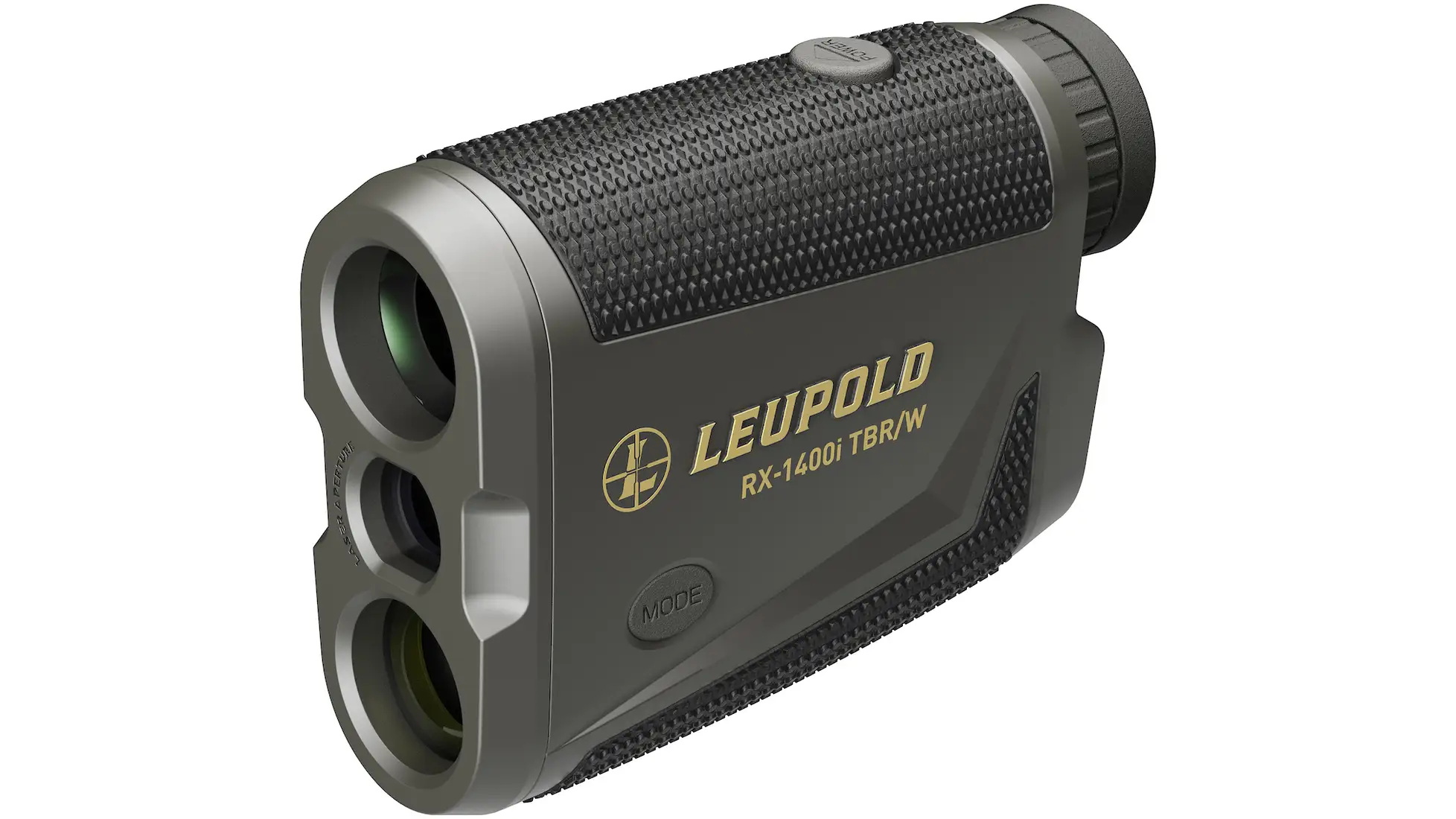
Best for bow hunting: Leupold RX-1400i Gen 2 TBR/W
Laser · 5x21 · TBR/W + Flightpath · red TOLED · 5.1 oz
around $200exact price on OpticsPlanet
🏆 Outdoor Life Great Buy award (2024) for the top price-to-value score (source: Outdoor Life)
For a bow, this is the one. Its Bow Mode gives the true horizontal distance for an angled shot out to 175 yards, and Flightpath shows the apex of the arrow's arc so you can see whether the shot clears a branch. Move to a rifle and TBR/W gives holdovers in MOA or MIL from 25 ballistic groups, plus a 10 mph wind hold. The retailer lists 5.1 oz, 18.3 mm of eye relief, a 6-yard minimum and a 0.3-second response, and Outdoor Life gave it a Great Buy award in 2024. Owners bought it for both jobs: one who replaced a 1000i that lasted ten years says the expanded archery function allows for more hunting and less thinking about distance and angle, and another finds the TBR function especially helpful for longer-range hog hunting. The trade-offs are reach and warranty: Leupold publishes 900 yards on deer, and it covers the RX-1400i's electronics for five years rather than for life. The retailer also lists 60 percent light transmission, which in our reading means a darker view than the naked eye at last light.
Pros
- Bow Mode true horizontal distance to 175 yards, with Flightpath showing the arrow-arc apex
- TBR/W rifle holdovers in MOA or MIL from 25 ballistic groups, plus a wind hold
- 5.1 oz, 18.3 mm eye relief and a 6-yard minimum, per the retailer listing
- An Outdoor Life Great Buy award (2024)
Cons
- The retailer lists 60 percent light transmission; in our reading, a darker view than the naked eye at last light
- 900 yards on deer against 1,400 reflective (Leupold): not a long-range tool
- Flightpath needs a manual calibration, shooting at 20 and 60 yards, rather than an app sync
- Leupold covers RX electronics for five years, where Vortex's VIP covers its rangefinders for life with no separate term
Best for: bowhunters, and crossover hunters who want arrow-arc and ballistic data in a 5.1 oz body. Step up to the Diamondback HD 2000 for more magnification, more reach and Vortex's warranty.
Key specifications
| Type | Laser rangefinder |
|---|---|
| Magnification | 5x |
| Objective | 21 mm |
| Range | 1,400 yds reflective / 900 yds on deer (Leupold) |
| Min range | 6 yds |
| Accuracy (Leupold) | 0.5 yd to 125 yds, 2 yds to 1,000 |
| Response time | 0.3 sec |
| Modes (retailer) | TBR, Bow with Flightpath, LOS, TRIG |
| Archery | Bow Mode to 175 yds + Flightpath |
| Display | Red TOLED |
| Light transmission | 60% (retailer) |
| Eye relief | 18.3 mm |
| Field of view | 368 ft at 1000 yds |
| Weight | 5.1 oz |
| Battery | CR2 |
| Warranty | Leupold five-year limited guarantee on the electronics (rangefinders are not on its lifetime list) |
“The archery expanded function is very nice as well, allows for more hunting less thinking about distance and angle.”
MG, verified owner (TX) via OpticsPlanet, who replaced a 1000i that lasted 10 years
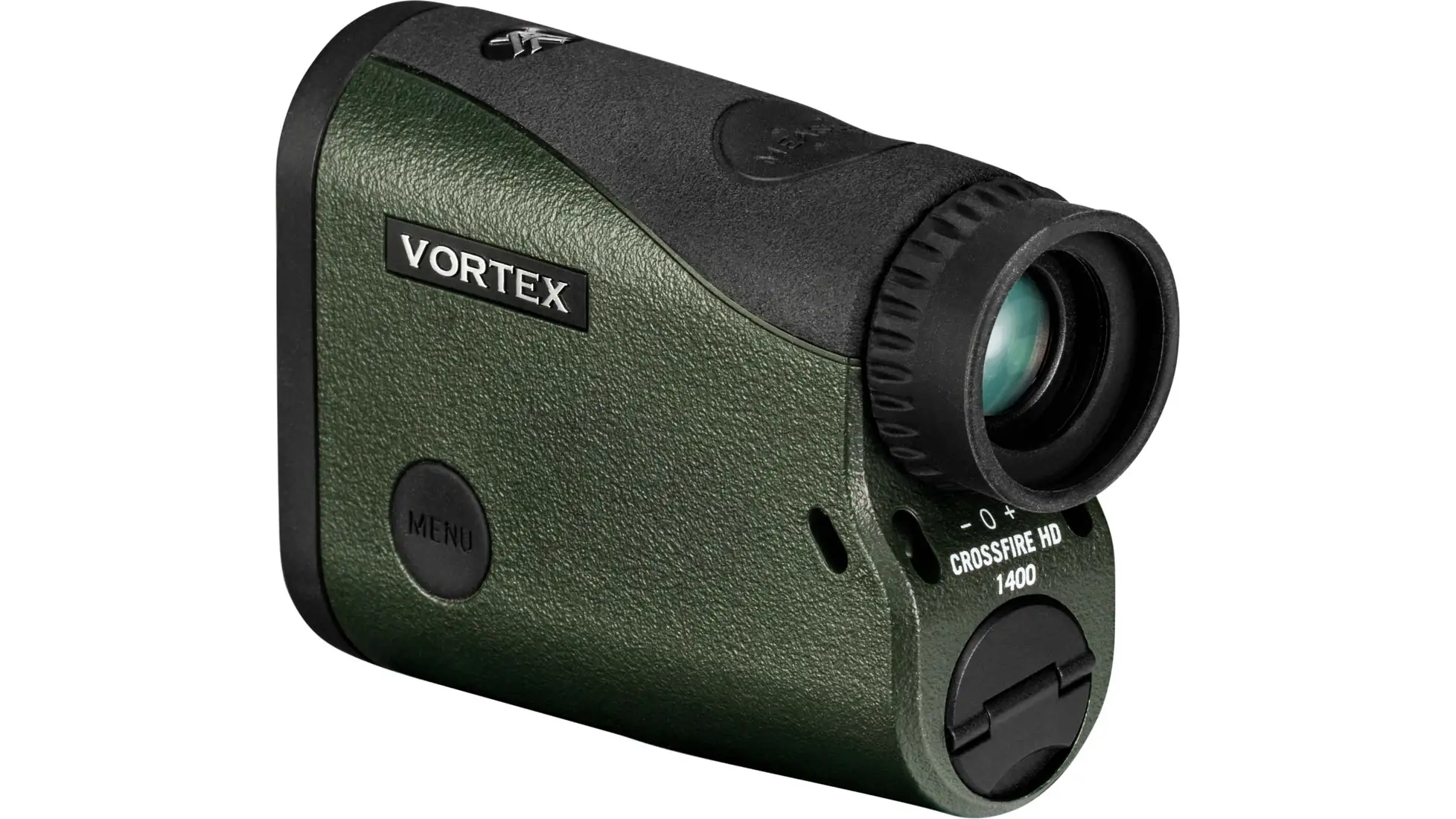
Best budget: Vortex Crossfire HD 1400
Laser · 5x21 · HD glass · 1,400 yd reflective · VIP lifetime
around $180exact price on OpticsPlanet
This is the least money we would spend on a rangefinder to trust on a hunt. It keeps the Vortex HD optical system, with XR Plus lens coatings and dielectric prism coatings, and the same VIP warranty as the Diamondback HD 2000, in a 4.8 oz body. Vortex publishes 1,400 yards on reflective targets, 950 on trees and 750 on deer, 1-yard accuracy at 100 yards and a 5-yard minimum, with HCD angle-compensated and LOS ranging modes, which suits a bow as well as a rifle. What you give up against the Diamondback is 7x magnification and reach on game: Vortex publishes 750 yards on deer for this one against 1,400 for the Diamondback. Owners praise it for the money, and one Florida hunter has already gotten theirs filthy, under water and muddy and says it still performs.
Pros
- Vortex HD optical system with XR Plus lens coatings and dielectric prism coatings
- 4.8 oz, with HCD angle compensation, 1-yard accuracy at 100 yards and a 5-yard minimum (Vortex)
- Waterproof, shockproof and tripod adaptable
- Vortex VIP warranty: unlimited lifetime, with no separate term for the electronics
Cons
- 5x magnification against 7x on the Diamondback HD 2000
- No ballistic holdovers or Bow Mode
- 750 yards on deer against 1,400 reflective (Vortex), about half the box figure by our arithmetic
- One owner finds it small in the hand and lists poor case design as a con
- Runs on a CR2 battery, which one owner lists as a con for being non-rechargeable
Best for: budget bow and rifle hunters who want Vortex glass and the lifetime warranty without the extras. Step up to the Diamondback HD 2000 for 7x and nearly double the deer range, or the Leupold RX-1400i for archery data.
Key specifications
| Type | Laser rangefinder |
|---|---|
| Magnification | 5x |
| Objective | 21 mm |
| Range | 1,400 yds reflective / 750 yds on deer (Vortex) |
| Min range | 5 yds |
| Accuracy (Vortex) | 1 yd at 100 yds |
| Eye relief | 16 mm |
| Ranging modes (Vortex) | HCD and LOS |
| Target modes (Vortex) | Normal, First and Last |
| Field of view | 367 ft at 1000 yds |
| Weight | 4.8 oz |
| Glass | HD optical system, XR Plus coatings, dielectric prism coatings, ArmorTek |
| Battery | CR2 |
| Sealing | Waterproof, shockproof |
| Warranty | Vortex VIP: unlimited lifetime, no separate electronics term |
“Pokes out much further than I ever will in the swamp, have already gotten it filthy, under water, muddy. Even with a dirty lens she will perform”
ED (FL) via OpticsPlanet, a Florida hunter
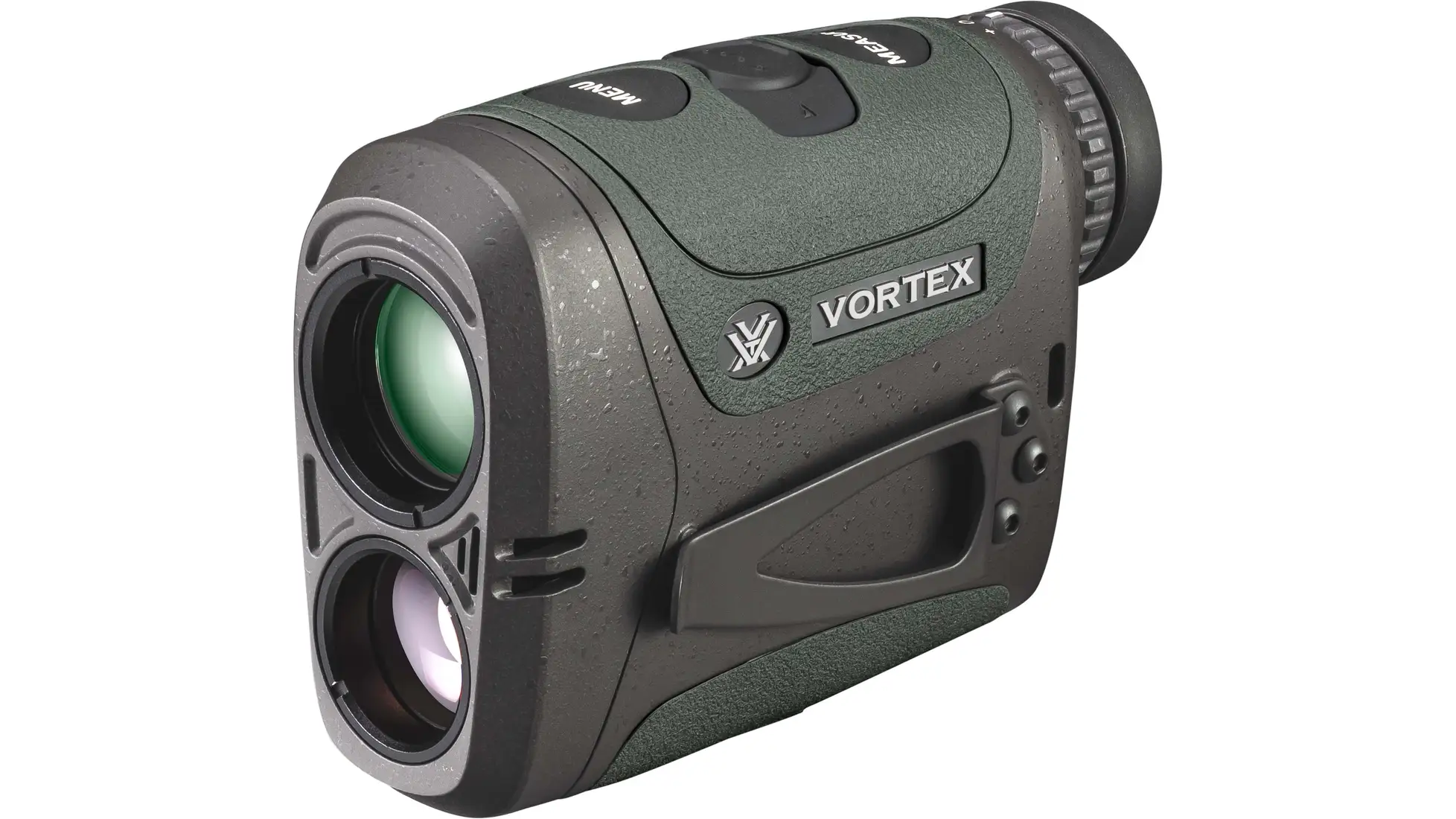
Best for long range: Vortex Razor HD 4000 GB
Laser · 7x25 · GeoBallistics solver · 4,000 yd reflective · magnesium
around $800exact price on OpticsPlanet
At long range the question is not only distance but the firing solution, and this unit gives you both in one hand. Vortex publishes 4,000 yards reflective, 2,500 on trees and 2,200 on deer. The GB adds the GeoBallistics solver with wind and drop solutions in the display, three preloaded profiles or custom ones built in the app, an onboard compass with humidity, barometric pressure and exposed temperature sensors, two wind modes, and pairing with Kestrel weather meters. One owner had the app set up with their rifles within an hour and easily hit ranges to 2200 yards. The trade-offs are weight and setup work: it is 10.1 oz, and another owner says you will need access to a chronograph to make the ballistic profile accurate. If all you need is distance, our long-range guide compares it with the plain Razor HD 4000 and the units around it.
Pros
- GeoBallistics solver puts wind and drop solutions in the display, with two wind modes
- Onboard compass, humidity, barometric pressure and temperature sensors
- Pairs with Kestrel weather meters
- Vortex VIP warranty, the same as the other Vortex picks here
Cons
- Heavy at 10.1 oz, and two owners call it heavy
- A real setup job: one owner says you will need access to a chronograph to accurize the ballistic profile
- One owner finds the wind adjustment buttons hard to press and awkwardly placed
- The 4,000 on the box is a reflective figure: Vortex publishes 2,200 yards on deer
Best for: precision shooters and long-range hunters who want the range, the solver and the sensors in one device and will do the profile work. Skip it if you only need a distance at hunting ranges, where the Diamondback HD 2000 is plenty.
Key specifications
| Type | Laser rangefinder with onboard ballistic solver |
|---|---|
| Magnification | 7x |
| Objective | 25 mm |
| Range | 4,000 yds reflective / 2,500 trees / 2,200 deer (Vortex) |
| Min range | 5 yds |
| Accuracy (retailer) | 0.5 to 2 yds |
| Response time | 0.25 sec |
| Eye relief | 17.5 mm |
| Field of view | 341 ft at 1000 yds |
| Solver | GeoBallistics, three preloaded profiles or custom via app |
| Sensors | Compass, humidity, barometric pressure, temperature |
| Wind modes | Full Cross Wind and Wind Bearing Capture |
| Weight | 10.1 oz |
| Finish | Magnesium |
| Battery | CR2 |
| Warranty | Vortex VIP, unlimited lifetime |
“I had the GB app set up with my rifles in the range finder within an hour. Easily hit ranges to 2200, but have not tried much further yet.”
Garrett, verified owner (ND) via OpticsPlanet
Golf vs hunting rangefinder: the real differences
The two look alike and use the same laser idea, but they answer opposite questions, which is why one rarely does the other's job well.
| Feature | Golf (example: Nikon Coolshot Pro III Stabilized) | Hunting (examples: Vortex Diamondback HD 2000, Leupold RX-1400i Gen 2 TBR/W) |
|---|---|---|
| Target priority | First Target Priority: ignores trees, shrubs and carts behind the pin and locks the flagstick | Last target mode on the Diamondback HD 2000 reads past brush to the animal behind it |
| Angle or slope | Slope adjusts the yardage for uphill and downhill shots, for club choice; switchable, with an external ADI LED that shows it is off | Angle compensation gives the horizontal shooting distance: HCD on the Vortex, TBR on the Leupold |
| Tournament use | Nikon says the Pro III complies with USGA Local Rule 14-3 for tournament play when slope is off | Not a consideration |
| Ballistics | Not a golf feature | TBR/W holdovers in MOA or MIL on the Leupold; a full GeoBallistics solver on the Vortex Razor HD 4000 GB |
| Archery | Not a golf feature | Bow Mode to 175 yards and Flightpath arrow-arc apex on the Leupold |
| Steadiness | Optical image stabilization on the Pro III | Tripod adaptable on the Diamondback HD 2000 and Crossfire HD 1400 |
The whole argument is laid out in hunting vs golf rangefinder. For the golf side, read what slope on a golf rangefinder is and whether you need a laser at all in golf GPS vs laser rangefinder. For the bow, how to use a rangefinder for bow hunting covers Bow Mode and pre-ranging your lanes.
Best rangefinder by use
The picks above cover the common jobs. For a specific one, each of these guides ranks its own picks with the trade-offs that matter for that use.
| Use | Guide | What it answers |
|---|---|---|
| Golf | Best golf rangefinder | Stabilized, slope and value picks for the course, with an option for Garmin watch owners. |
| Hunting | Best hunting rangefinder | Bow-to-rifle picks by budget, with angle compensation and target modes compared. |
| Bow hunting | Best rangefinder for bow hunting | Archery picks ranked for the bow, and the specs archery actually needs. |
| Long range and ballistics | Best long range rangefinder | Ballistic solvers and long reach, and what the yardage on the box buys you on game. |
| Rangefinding binoculars | Best rangefinding binoculars | Binoculars with a laser rangefinder built in, to glass and range in one motion. |
| Crossbow | Best rangefinding crossbow scope | Crossbow scopes with a laser rangefinder built in, compared on the makers' own figures. |
How to read a rangefinder spec
Four lines on the spec sheet decide most of what you will get, and the first is the one most often misread.
- Range, and which target it is for. The headline figure is usually for a reflective target, and the figure for game is shorter. Always ask which target a number is for. Vortex splits the Diamondback HD 2000 into 2,000 yards reflective, 1,800 on trees and 1,400 on deer.
- Accuracy, and at what distance. Read the tolerance with its distance: Vortex states the Diamondback HD 2000 and the Crossfire HD 1400 at 1 yd at 100 yards; Leupold states the RX-1400i at 0.5 yd to 125 yards and 2 yd to 1,000; the retailer lists the Razor HD 4000 GB at 0.5 to 2 yds, and Vortex states 0.5 yd at 100 yards. Nikon publishes the Pro III's tolerance in steps that widen with distance: +/- 0.75 yd under 700 yards, 1.25 yd from 700 to 999 and 1.75 yd beyond.
- Magnification. The picks here run from 5x (Crossfire HD 1400, Leupold RX-1400i) through 6x (Nikon Pro III) to 7x (Diamondback HD 2000, Razor HD 4000 GB). More magnification shows more detail and also more hand shake, which is the problem the Pro III's stabilization answers.
- Display. The Diamondback HD 2000 and the Pro III use red OLED displays. The Leupold uses a red TOLED display, and the retailer lists its light transmission at 60 percent, which in our reading means a darker view than the naked eye at last light.
| Rangefinder | Figure on the box | Figure for game or deer | Game as share of box (our arithmetic) | Source |
|---|---|---|---|---|
| Vortex Diamondback HD 2000 | 2,000 yds | 1,400 yds (deer) | 70% | Vortex |
| Nikon Coolshot Pro III Stabilized | 1,200 yds | no game figure; about 490 yds (450 m) to a flagstick | - | Nikon |
| Leupold RX-1400i Gen 2 TBR/W | 1,400 yds | 900 yds (deer) | 64% | Leupold |
| Vortex Crossfire HD 1400 | 1,400 yds | 750 yds (deer) | 54% | Vortex |
| Vortex Razor HD 4000 GB | 4,000 yds | 2,200 yds (deer) | 55% | Vortex |
The share column is the game figure divided by the box figure, computed by us from the published numbers; it runs from 54% to 70% on the picks whose source publishes both. Our long-range guide runs the same comparison across more units.
Which rangefinder should you buy?
- One rangefinder for hunting and shooting: the Vortex Diamondback HD 2000.
- The golf course: the Nikon Coolshot Pro III Stabilized, or see the golf guide for value picks.
- A bow, with arrow-arc data: the Leupold RX-1400i Gen 2 TBR/W.
- The least money for Vortex glass and warranty: the Vortex Crossfire HD 1400.
- Long range with a ballistic solver: the Vortex Razor HD 4000 GB.
- A rangefinder built into a binocular or a crossbow scope: start from the guides by use above.
FAQ
What is the best rangefinder?
For most people, in our editorial judgement, the Vortex Diamondback HD 2000: 7x magnification, 2,000 yards on reflective targets and 1,400 on game, Normal and Last target modes, HCD angle compensation and the Vortex VIP lifetime warranty. For golf, buy a golf unit instead: the Nikon Coolshot Pro III Stabilized adds image stabilization, First Target Priority and a switchable slope mode. For a bow, the Leupold RX-1400i Gen 2 TBR/W; on a budget, the Vortex Crossfire HD 1400; and for long range with a ballistic solver, the Vortex Razor HD 4000 GB.
Is a golf rangefinder good for hunting?
Not as a first choice. A golf rangefinder such as the Nikon Coolshot Pro III Stabilized uses First Target Priority to lock the nearest object, the flagstick ahead of the trees, while a hunting unit such as the Vortex Diamondback HD 2000 adds a Last target mode to read past brush to the animal behind it. Hunting units also give angle-compensated shooting distances and, on some models, ballistic holdovers, which a golf slope mode is not built to provide.
Is a hunting rangefinder good for golf?
Not as a first choice. Some hunting units have a first-target mode, but a golf unit such as the Nikon Coolshot Pro III Stabilized is built around the flagstick: First Target Priority that ignores the trees and carts behind the pin, a lock confirmation, and a slope mode you can switch off with a visible indicator for tournament play. Buy a dedicated golf rangefinder for golf.
What is a good budget rangefinder?
The Vortex Crossfire HD 1400: Vortex HD glass with XR Plus coatings, 1,400 yards on reflective targets and 750 on deer per Vortex, HCD angle compensation, 1-yard accuracy at 100 yards, a 5-yard minimum, 4.8 oz and the same Vortex VIP lifetime warranty as the Vortex Diamondback HD 2000. If you hunt with a bow, the Leupold RX-1400i Gen 2 TBR/W adds Bow Mode, Flightpath and rifle holdovers, but Leupold covers its electronics for five years rather than for life.
How far can a rangefinder really range?
Less than the box says on an animal. The headline figure is usually for a reflective target, and makers publish a shorter one for game: Vortex publishes 2,000 yards reflective and 1,400 on deer for the Vortex Diamondback HD 2000, 1,400 reflective and 750 on deer for the Vortex Crossfire HD 1400, and 4,000 yards reflective and 2,200 on deer for the Vortex Razor HD 4000 GB. When you compare rangefinders, compare the game or deer figure.
Do I need angle compensation on a rangefinder?
For hunting from a tree stand or across steep ground, yes. Angle compensation reads the incline and shows the horizontal shooting distance, which is what your bullet or arrow drop depends on; Vortex calls it HCD and Leupold TBR. For golf, the equivalent is slope, which adjusts the yardage for uphill and downhill shots and has to be switched off in tournament play.
What magnification is best for a rangefinder?
The picks here run from 5x to 7x. A 7x unit such as the Diamondback HD 2000 shows more detail for picking out game at distance, while a 5x unit is smaller and lighter: the Crossfire HD 1400 weighs 4.8 oz against the Diamondback's 7.6 oz. Golf units such as the Nikon Coolshot Pro III use 6x.