The best rangefinding crossbow scopes for 2026
Our verdict for 2026: for most hunters who want the rangefinder inside the scope, the Burris Oracle X (around $1,050) is the pick: 2-7x zoom, an inclinometer for stand angles, a wireless remote, a published ranging tolerance and 15 owner reviews on OpticsPlanet. The Garmin Xero X1i (around $1,400) is the premium pick: zero it at 20 yards, enter your bow speed and it builds aim points out to 80 yards, but it is a fixed 3.5x with a one-year Garmin warranty and three owner reviews. The BUK OPS X-Factor (around $700) is the value pick, with a speed-dial reticle instead of a computed aim point and a 100-yard target range by its maker. The deciding trade-off is the other route: a conventional crossbow scope plus a handheld rangefinder keeps the optic lighter and its aiming point usable without a battery (the etched reticle of the Vortex Crossfire II on our main roundup stays a black crosshair with its illumination battery dead); a built-in unit spares you the movement of ranging at the shot but adds weight, batteries and electronics. Both Garmin and Burris print hunting cautions: Garmin warns that "Some jurisdictions regulate or prohibit the use of electronic crossbow scopes for hunting." Burris's user guide says "The Oracle X crossbow sight is not legal to hunt big game in some states."
Editorial scores are our opinion; owner ratings are shown attributed to their source. Confirm the current price and availability on the retailer page.
A rangefinding crossbow scope puts a laser rangefinder inside the optic, so the distance you aim for is measured rather than guessed. Below are 4 OpticsPlanet listings, compared on the figures their makers publish, with every gap marked as a gap, plus what each one actually does with the range, the hunting cautions Garmin and Burris print, and when a regular scope and a handheld rangefinder is the better buy.
How we picked: a research-based roundup built from each model's OpticsPlanet listing and owner reviews, then checked against the maker's own product pages, support articles, manuals and warranty terms. Where a maker's pages disagree with each other or with the retailer, we say which figure came from where. Owner samples here are tiny (15, 3, 2 and 0 reviews), so we lean on published specifications more than on ratings. Scores are our editorial opinion, not a hands-on test, and we print no award claims. See how we evaluate.
- Comparison table
- Burris Oracle X Rangefinding Bow Sight - Best overall
- Garmin Xero X1i Crossbow Scope - Best premium pick
- BUK OPS X-Factor Rangefinding Crossbow Scope - Best value
- Maxview Certis LRF Scope - Also consider
- What a rangefinding crossbow scope does
- Hunting legality
- The alternative: a regular scope and a handheld rangefinder
- What owners say
- FAQ
Comparison table
| Spec | Burris Oracle X Rangefinding Bow Sight | Garmin Xero X1i Crossbow Scope | BUK OPS X-Factor Rangefinding Crossbow Scope | Maxview Certis LRF Scope |
|---|---|---|---|---|
| Magnification | 2-7x, magnification compensation | 3.5x fixed | 1.5-6x (retailer feature list) | Not published |
| Objective | 32 mm (retailer; Burris prints none) | Not published by Garmin | Not published | Not published |
| Ranging distance (target type) | 200 yd deer, 500 yd reflective (Burris) | 250 yd non-reflective, 500 yd reflective (Garmin support page) | 100 yd target, up to 1,200 yd reflective (BUK OPS); retailer says 250 yd max | 999 yd, target type not stated |
| Aim-point method | Illuminated aim point for the ranged, angle-corrected distance; 20 yd mechanical zero, then electronic truing | AutoCal: 20 yd zero plus bow speed builds digital aim points to 80 yd | Speed Dial fps reticle with 20-100 yd marks | Calculated aim point and arrow drop to 100 yd (crossbow mode) |
| Speed range / calibration limit | Not published; above 400 FPS Burris suggests truing at 40/60/80/100 yd | Up to 650 FPS; Garmin warns 400 FPS-plus bows can run out of adjustment | Dial range not published | Not published (uses chronographed velocity) |
| Battery + runtime | CR123; 3,000-plus activations (web), 2,000-plus (user guide); remote CR2032 | 2 AAA lithium, included; up to 1,200 ranges | CR2 + CR1632, not included; runtime not published | CR2, CR2032 (retailer); runtime not published, auto-off after 1 hour |
| Weight | 30.8 oz (product page); 20 oz (2026 catalog) | 1.9 lb (862 g) | Not published | Not published |
| Water rating | No IP rating; water-resistant (Burris catalog) | IPX7 | Not published | Not published |
| Remote trigger | Wireless remote | Wired trigger plus a button on top | Not published | Bluetooth wireless remote |
| Owner reviews (OpticsPlanet) | 4.2/5 from 15 | 3.7/5 from 3 | 4.0/5 from 2 | None yet |
| Price | around $1,050 | around $1,400 | around $700 | around $840 |
Figures are each maker's own unless the cell names another source. Garmin's support page gives 250 and 500 yards, and its spec tab prints 250 and 500 with no unit; the overview text on Garmin's product page prints different metric figures that match neither, so we do not use it.
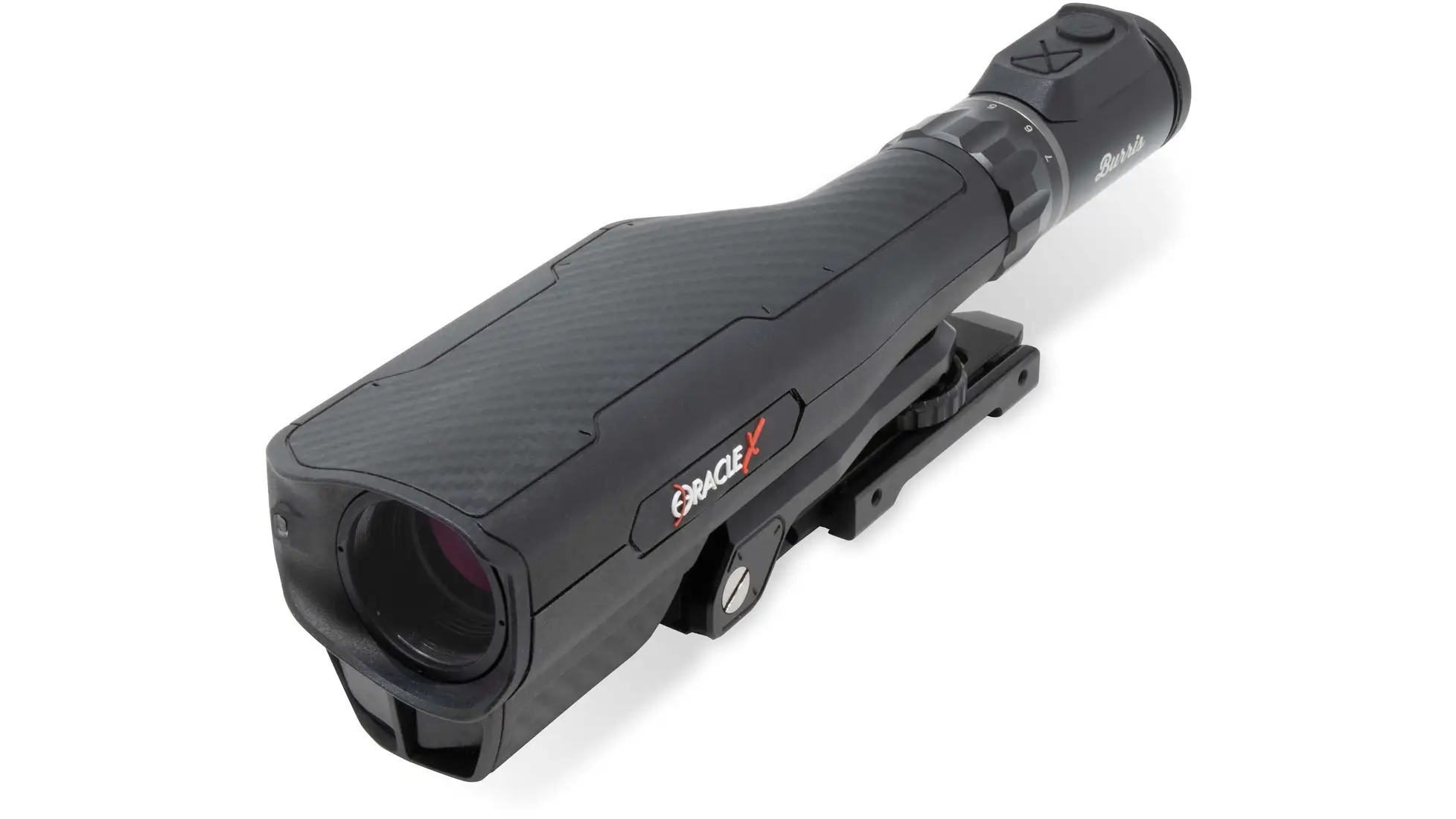
Best overall: Burris Oracle X Rangefinding Bow Sight
2-7x · built-in laser rangefinder · magnification compensation · inclinometer and electronic level · wireless remote
around $1,050exact price on OpticsPlanet
For most hunters who want the rangefinder inside the scope, this is the one to buy. It ranges the target, corrects the distance for the angle you are shooting down at from a stand with its inclinometer, and lights the aiming point for that distance, while 2-7x zoom with magnification compensation keeps the aiming point valid as you zoom. Burris also publishes a number Garmin does not: a ranging tolerance of plus or minus 1 yard under 100 yards and plus or minus 2 yards from 100 to 200, alongside 200 yards to a deer, 500 to a reflective target and a 5-yard minimum. The owner record on OpticsPlanet points mainly at the electronics: the battery and its hard-to-thread cap are the most repeated complaint, and one owner’s remote did not work out of the box. Single owners also report low-light clarity that is not the best, a unit that would not hold its sight-in, and a scope that kept shooting left, for which Burris was sending a new base. Owners who contacted Burris report replacements sent or on the way (a remote, a battery and cap, a base, in one case a whole scope), though one was told the wait for repairs was five to six weeks and another was refused the refund they asked for.
Pros
- Zoom from 2x to 7x with magnification compensation, so the aiming point stays valid as you zoom
- An inclinometer for steep tree-stand angles and an electronic level for cant
- A wireless remote you can mount anywhere on the bow, so ranging takes less movement at the moment it matters most
- Burris publishes a ranging tolerance, plus or minus 1 yard under 100 yards and plus or minus 2 yards from 100 to 200, and a 5-yard minimum range
- Owners report real confidence at distance: a bullseye at 100 yards, and one who patterns at 60 yards and says they feel 100% confident at that range on a whitetail
- The Burris Signature Warranty covers the optic for its lifetime and transfers automatically to future owners
Cons
- Burris rates the laser to 200 yards on a deer and 500 yards on a reflective target; the hunting number is the smaller one
- Batteries are the recurring theme in owner reports: a cap whose threads are hard to catch, a replacement battery that went dead before the bow was ever shot, and one dead in the box, though one owner gets a full season from each battery and another reports no issues with battery life
- Burris’ own technical note tells you to remove the battery after use to preserve it, a maintenance step that matches the battery drain owners report, written into Burris’ own product page
- Burris prints 3,000-plus activations per battery on its web page and 2,000-plus in its user guide, so the lower one is the safer planning figure
- The wireless remote runs on its own CR2032, a second battery to keep fresh alongside the scope’s CR123
- It is tall, 3.28 in overall by Burris’ own measurement (2.0 in from center to base), enough that one owner cannot close a hard case without removing it and another could not see the target without raising their face off the cheek piece
- Sighting in is a hybrid job, mechanical at 20 yards then electronic beyond, and owners found sight-in videos helpful, one recommending Burris’ own
- The warranty covers the optic only, not accessories, and requires purchase from an authorised seller
Best for: the crossbow hunter who wants a built-in rangefinder with zoom, a published accuracy figure and a real owner record, and who accepts a battery-powered device. Take the Garmin if you want the scope to calibrate itself from your bow speed, or the BUK OPS to spend less.
Key specifications
| Magnification | 2-7x |
|---|---|
| Objective | 32 mm (retailer and reviewer figure; Burris prints none) |
| Ranging, reflective target | 500 yd (Burris) |
| Ranging, deer | 200 yd (Burris) |
| Minimum range | 5 yd |
| Ranging accuracy | +/-1 yd under 100 yd, +/-2 yd from 100 to 200 yd (Burris) |
| Field of view | 47 ft (low) to 14 ft (high) at 100 yd |
| Weight | 30.8 oz (Burris product page; its 2026 catalog lists 20 oz) |
| Length | 11.9 in |
| Height | 3.28 in overall, 2.0 in center to base |
| Battery | CR123; 3,000-plus activations (Burris web page), 2,000-plus (Burris user guide) |
| Remote battery | CR2032 (Burris) |
| Fast crossbows | Above 400 FPS Burris recommends truing points at 40, 60, 80 and 100 yards |
| Water rating | No IP rating published; Burris’ 2026 catalog calls it water-resistant |
| Extras | Wireless remote, inclinometer, electronic level |
| Warranty | Burris Signature Warranty (renamed from the Forever Warranty; optic only, authorised sellers) |
| MPN | 300410 |
| Note | Burris calls this the Oracle X Crossbow Rangefinding Scope; the retailer title says Bow Sight. Burris’ bow (not crossbow) rangefinding sights are separate Oracle models |
“The Oracle X Xbow scope is a game changer with the ability to range your target on the fly.”
Tony via OpticsPlanet (MI)
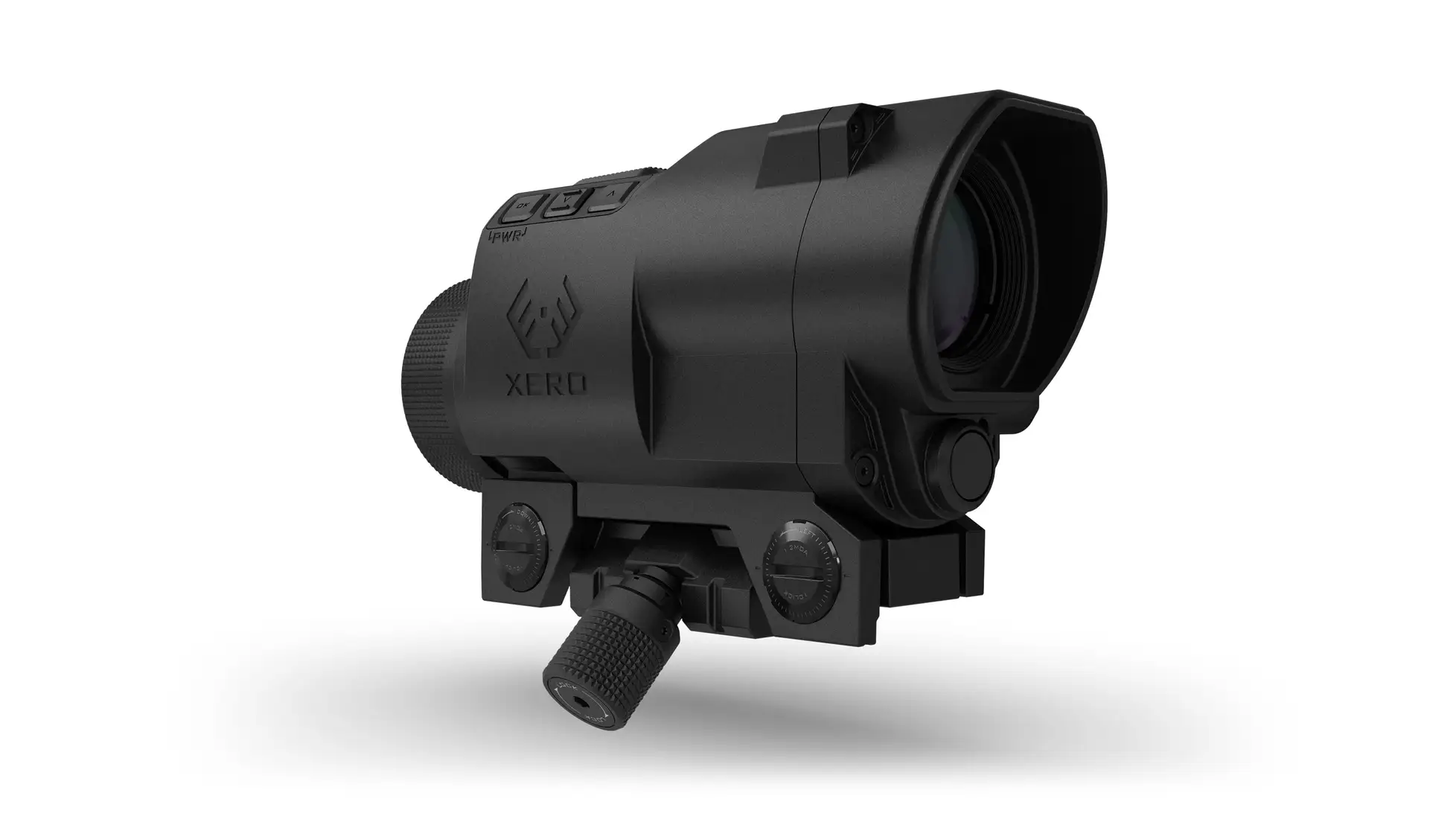
Best premium pick: Garmin Xero X1i Crossbow Scope
3.5x · built-in laser rangefinder · AutoCal aim points to 80 yd · IPX7 · wired trigger plus top button · Laser Locate
around $1,400exact price on OpticsPlanet
The X1i turns sighting in into data entry. You zero it at 20 yards, then, in Garmin’s words, "the scope prompts you to enter your bow's speed to generate a stack of fixed aim points out to 80 yards." From then on it ranges the target, works out the horizontal distance from the shot angle and shows the aim point for that range on a multi-colour display. Garmin lists bow speeds up to 650 FPS for that calibration, tells you a chronograph reading gives more accurate aim points than the advertised speed, and stores up to 10 bolt profiles. The hardware choices suit a hunter: a wired trigger you mount at the grip plus a button on top of the scope, so there is no remote battery to die, an IPX7 water rating, and two AAA lithium cells good for up to 1,200 ranges at a 20-second display timeout. What you give up is zoom (it is a fixed 3.5x), warranty length (Garmin warrants it for one year from purchase) and owner evidence: three reviews on OpticsPlanet across four years.
Pros
- Calibrates from your bow speed: zero at 20 yards, enter the speed, and AutoCal builds aim points out to 80 yards, for bow speeds up to 650 FPS by Garmin’s spec
- Garmin’s support notes add that ranges past 80 yards can be added after calibration by editing bolt profiles, and it stores up to 10 profiles
- Angle-compensated horizontal distance, a Target Lock indicator when readings repeat, and selectable ranging modes for leaves or other interference
- A wired trigger on about 17 in of cable for silent ranging from the grip, plus a button on top, and the cable unplugs so you can cock the crossbow
- IPX7: Garmin says it withstands incidental exposure to water up to 1 m for up to 30 minutes, and it is rated to operate from -4 to 140 F
- Two AAA lithium cells, up to 1,200 ranges at a 20-second display timeout and up to a year in standby, and stored data survives a battery change
- GPS and compass with Laser Locate, which records the heading and distance of each ranged target and sends it to a compatible Garmin watch or handheld
Cons
- Fixed 3.5x, so there is no zooming down for a close timber shot or up to confirm an animal
- Garmin warrants it for one year from the date of purchase, a far shorter term than the lifetime optic warranty Burris offers
- Garmin’s support notes say faster crossbows, 400 FPS or higher, can run out of adjustment range, and suggest mounting the scope further back on the rail
- Lithium AAA only: Garmin says alkaline cells are not supported, and below freezing the display timeout is capped at 30 seconds
- Garmin says its Xero crossbow scopes are not designed to range through glass, water or other clear objects, so a closed blind window gets in the way
- Garmin publishes no objective-lens diameter and no ranging tolerance, only that ranges display to a tenth of a yard
- A thin owner record: three reviews on OpticsPlanet, written in 2021, 2023 and 2025
Best for: the hunter who wants the scope to do the arithmetic, from bow speed to aim point, with a wired trigger and a published water rating, and who accepts a fixed 3.5x and a one-year warranty. Take the Burris for zoom and a longer warranty.
Key specifications
| Magnification | 3.5x (fixed) |
|---|---|
| Objective | Not published by Garmin |
| Field of view | 5 degrees |
| Eye relief | 2.4 in (62 mm) |
| Focus adjustment | +/-2 diopters |
| Ranging, non-reflective target | 250 yd / 229 m (Garmin support page) |
| Ranging, reflective target | 500 yd / 460 m (Garmin support page) |
| Range display | To 0.1 yd; no tolerance published |
| AutoCal | Bow speeds up to 650 FPS, out to 80 yd (73 m) (Garmin) |
| Aiming accuracy | 1/2 MOA (1/2 in at 100 yd) (Garmin) |
| Mount | Integrated, fits a Picatinny or Weaver rail, 1/2 MOA per click; Garmin does not recommend thread-locker on the mount screws |
| Weight | 1.9 lb (862 g) |
| Size | 6.2 x 2.6 x 3.7 in |
| Battery | 2 AAA lithium (included); up to 1,200 ranges at a 20 s display timeout, up to 1 year standby |
| Water rating | IPX7 |
| Operating temperature | -4 to 140 F |
| Laser | Class 1 |
| Connectivity | ANT (Laser Locate to compatible Garmin devices) |
| In the box | Scope, wired rangefinder trigger, lens covers, microUSB cable, 2 AAA lithium batteries, wrench, tape, documentation |
| Warranty | Garmin, one year from the date of purchase |
| MPN | 010-02212-00 |
| Note | Garmin’s support page gives 250 yd non-reflective and 500 yd reflective, and its spec tab prints 250 and 500 with no unit; the overview text on Garmin’s product page prints metric figures that match neither, so we use the support page. The retailer titles this the Garmin Xero X1i Crossbow Auto-Ranging Digital Sight, and a Ravin-branded edition is a separate product. |
“It is fast and precisely accurate. it takes all the guesswork out of ranging your target and enables you to make longer confident shots.”
DEDBUCK via OpticsPlanet (PA)
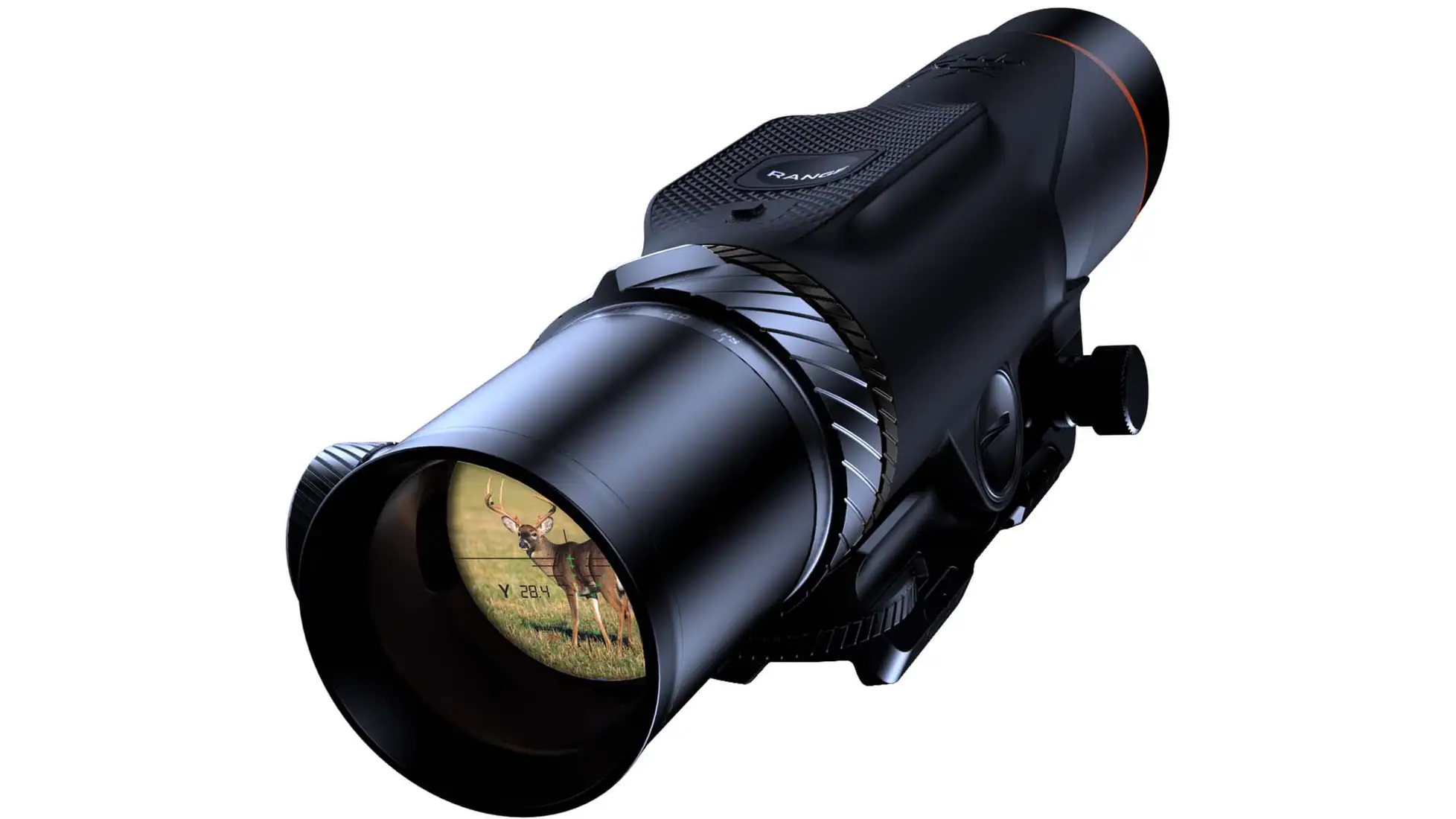
Best value: BUK OPS X-Factor Rangefinding Crossbow Scope
1.5-6x · built-in angle-compensating rangefinder · Speed Dial fps reticle, 20-100 yd marks · red/green illumination
around $700exact price on OpticsPlanet
The X-Factor takes a simpler route to the same problem. It has a built-in angle-compensating laser rangefinder fired with one press of a button, and an Active Scan Mode that BUK OPS says follows moving targets while you hold the button. The aiming side is mechanical rather than computed: BUK OPS describes a Speed Dial fps reticle you turn to match your crossbow’s arrow speed, with reticle marks from 20 to 100 yards and red or green illumination, so, as we read that description, the scope gives you the distance and you hold the matching mark. Two cautions come straight from the sources. BUK OPS rates it to a 100-yard target range (and up to 1,200 yards on a reflective target), while the retailer’s feature list says 250 yards maximum, and neither BUK OPS’s page, its product manual nor the retailer’s spec table publishes its weight or water rating. The manual gives the warranty: in BUK OPS’s words, its products "are warrantied from manufacturing defects for one year from date of purchase." The batteries, a CR2 and a CR1632, are not included.
Pros
- 1.5-6x zoom with magnification compensation, per the retailer feature list (BUK OPS’s own page does not state the magnification)
- Angle-compensating rangefinder plus an Active Scan Mode for moving targets, by BUK OPS’s description
- A Speed Dial fps reticle you set to your crossbow’s arrow speed, with 20 to 100 yard marks and adjustable red or green illumination
- One verified owner reports a 2-inch group at 50 yards after zeroing on a Ravin R10X
Cons
- BUK OPS rates the target range at 100 yards, half the Burris deer figure; the 1,200-yard number is for reflective targets
- The retailer’s feature list says 250 yards maximum, a figure BUK OPS’s own page does not give, so the published ranges disagree
- The aim point is a reticle mark you pick for the ranged distance, not one computed and lit for you, as we read BUK OPS’s description
- Weight and water rating are not published on BUK OPS’s page, in its product manual or in the retailer spec table, and a shopper’s question about weight on the retailer page is unanswered
- BUK OPS’s manual warrants it against manufacturing defects for one year from date of purchase, against the lifetime optic warranty Burris offers
- Batteries (one CR2 and one CR1632) are not included
- Only two owner reviews on OpticsPlanet
Best for: the hunter who wants a range readout with zoom for less money and is comfortable setting a speed dial and holding a yardage mark. Take the Burris or the Garmin if you want the scope to light the aim point for you.
Key specifications
| Magnification | 1.5-6x (retailer feature list; not stated by BUK OPS) |
|---|---|
| Objective | Not published |
| Ranging, target | 100 yd (BUK OPS) |
| Ranging, reflective | Up to 1,200 yd (BUK OPS) |
| Ranging, retailer feature list | 5 yd minimum, 250 yd maximum |
| Reticle | Speed Dial fps reticle, 20-100 yd marks, adjustable red/green illumination |
| Angle compensation | Automatic (BUK OPS) |
| Battery | 1 CR2 + 1 CR1632, not included (BUK OPS) |
| Weight | Not published |
| Water rating | Not published |
| Warranty | One year from date of purchase, manufacturing defects (BUK OPS product manual) |
| MPN | BUK40006 |
“after zeroing and sighting shooting at 50 yards i can hit a 2inch circle the same holds true to 10yards have not shot out more than 50 yards.”
lack, verified owner via OpticsPlanet (MA)
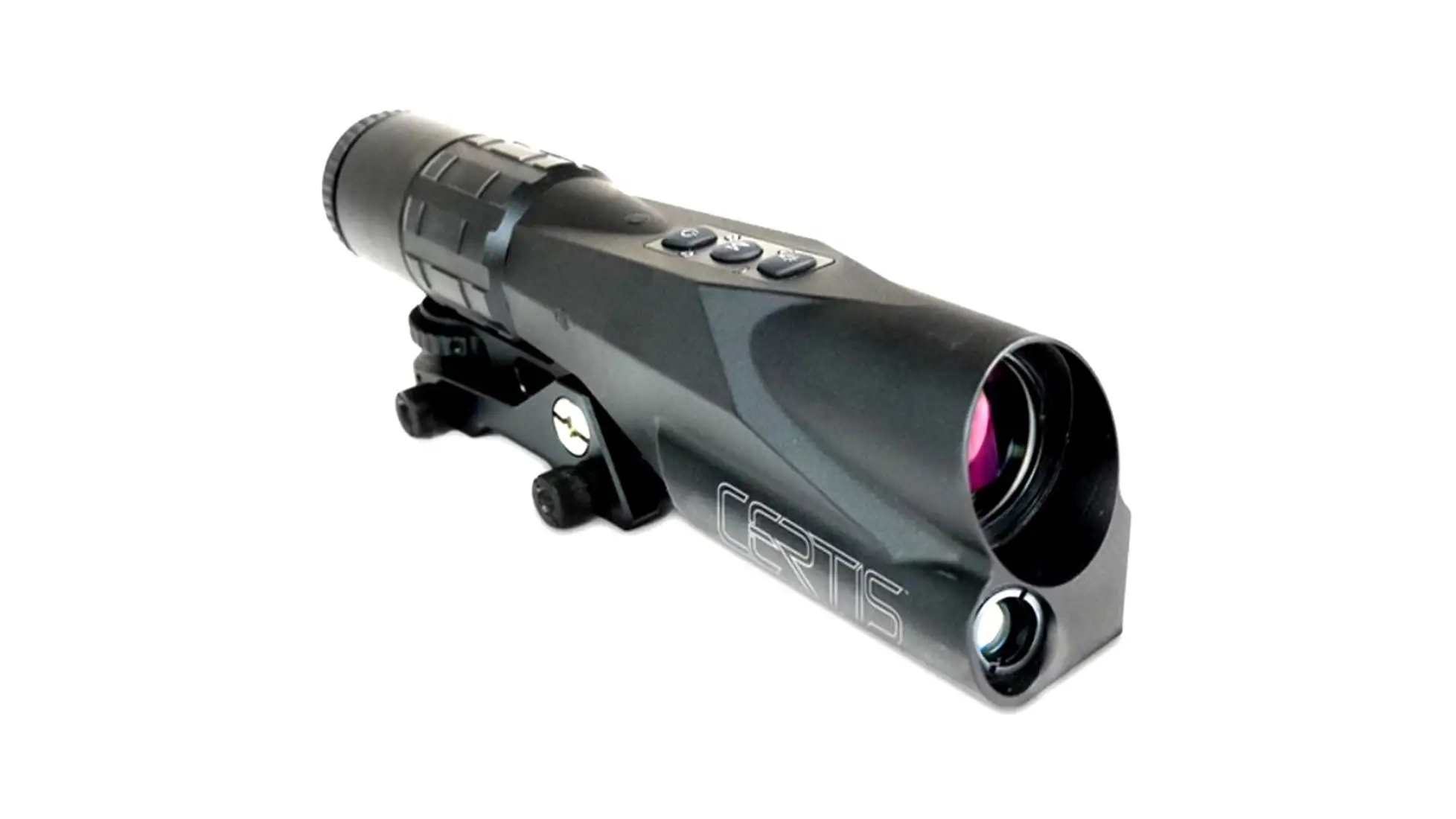
Also consider: Maxview Certis LRF Scope
Built-in laser rangefinder · calculated aim point and arrow drop to 100 yd (crossbow mode) · Bluetooth wireless remote · OLED display
around $840exact price on OpticsPlanet
The Certis does the same job as the Garmin on paper, calculating the aim point for the ranged distance, and adds a wireless remote. Its maker-side listing (Maxview Optics SKU 1024, on Killer Instinct Crossbows’ own store) tells you to "obtain your actual arrow velocity using a chronograph, zero your crossbow at 20 yards and you are set", with "Aiming point and arrow drop calculated out to 100 yards (Crossbow Mode Only)", and the display shows the actual arrow drop in inches from the 20-yard zero. We cannot place it higher, because too much is missing: neither that page nor the retailer publishes its magnification, objective, weight, water rating or warranty, the 999-yard ranging figure names no target type, and nobody has reviewed it on OpticsPlanet. Read the listing closely before you buy.
Pros
- A calculated aiming point and arrow drop out to 100 yards in crossbow mode, built from your chronographed arrow velocity and a 20-yard zero (maker-side listing)
- The display shows the actual arrow drop in inches from the 20-yard zero
- A Bluetooth wireless remote for ranging without moving
- A micro-LED aiming point with multiple brightness settings, and a fixed reticle the maker-side listing says is available regardless of conditions
- Hibernates between uses and shuts off automatically after an hour
Cons
- Magnification, objective size, weight, water rating and warranty are not published by the maker-side listing or the retailer, and a retailer question asking for the weight is unanswered
- The 999-yard ranging figure names no target type, so it says nothing about range to a deer
- No owner reviews on OpticsPlanet or on Killer Instinct Crossbows’ store; MaxView’s own store shows a single five-star review, written about rifle use
- The battery type is listed only by the retailer (CR2 and CR2032), and no battery life figure is published
- The retailer listing names it Maxview while its web address says Killer Instinct, so match Maxview Optics SKU 1024 before ordering
Best for: the shopper who wants a calculated aim point and a wireless remote and is willing to buy on the maker’s feature list alone. Everyone else is better served by a pick with published specs and an owner record.
Key specifications
| Magnification | Not published |
|---|---|
| Objective | Not published |
| Ranging | 999 yd, target type not stated (maker-side listing) |
| Aim point | Calculated, with arrow drop, out to 100 yd in crossbow mode |
| Calibration | Chronographed arrow velocity and a 20 yd zero |
| Display | OLED, micro-LED aim point with multiple brightness settings |
| Remote | Bluetooth wireless |
| Battery | CR2, CR2032 (retailer spec table) |
| Auto shutoff | After 1 hour |
| Weight | Not published |
| Water rating | Not published |
| Warranty | Not published |
| MPN | 1024 |
| Note | Maxview Optics SKU 1024; the retailer web address and image names say Killer Instinct |
What a rangefinding crossbow scope does
Three jobs, and the picks here do not all do all three in the same way.
- It measures the distance. A laser inside the scope ranges the animal. Each maker publishes a hunting figure and a larger reflective-target figure: Burris 200 yards to a deer, Garmin 250 yards to a non-reflective target, BUK OPS a 100-yard target range. The Certis listing gives 999 yards without saying to what.
- It corrects for the angle. From a tree stand the line-of-sight distance is longer than the horizontal distance the bolt drops over. Garmin says the X1i displays the horizontal distance calculated from the angle of measurement, Burris builds in an inclinometer for steep stand angles, and BUK OPS describes automatic angle compensation.
- It gives you an aim point for that distance. This is where they differ. The Burris lights an aiming point for the ranged distance after you zero at 20 yards and true it electronically; the Garmin builds a stack of digital aim points out to 80 yards from your 20-yard zero and bow speed; the Certis calculates the aim point and arrow drop to 100 yards from your chronographed velocity; the BUK OPS gives you a speed-dial reticle with 20 to 100 yard marks to hold.
All of them depend on knowing your real bolt speed. Garmin states that "Speed readings from a chronograph should be used to get the most accurate calibrated aim points", and the Certis listing asks for a chronographed velocity outright.
Hunting legality
Rules on electronic sights are set where you hunt, and we do not interpret them. Garmin's own warning for the Xero X1i reads:
"Some jurisdictions regulate or prohibit the use of electronic crossbow scopes for hunting. Always know and obey all state hunting regulations before using this device."
Burris's user guide for the Oracle X carries this notice:
"The Oracle X crossbow sight is not legal to hunt big game in some states. Please check your local hunting regulations."
Check your own state's current regulations for electronic crossbow sights before you buy any of these scopes, not only the Garmin and the Burris.
The alternative: a regular scope and a handheld rangefinder
A built-in rangefinder is not the only way to stop guessing distance. A speed-calibrated crossbow scope and a separate handheld rangefinder do the same jobs in two pieces. You lose the ability to range without moving your hands from the crossbow, but the aiming point no longer depends on a battery (the Vortex Crossfire II's reticle is illuminated by a CR2032, and because it is etched it stays a black crosshair with that battery dead), and the scope is far lighter: the Burris weighs 30.8 ounces on its product page (20 ounces in Burris’ 2026 catalog) and the Garmin 1.9 pounds by their makers, against 14 ounces for the Vortex Crossfire II on our main crossbow scope roundup. One Burris owner put the other side of it plainly: "The Oracle X makes my hand held rangefinder obsolete."
If the two-piece route suits you, start with our best crossbow scopes, ranked by budget and use, and pair one with a model from our best hunting rangefinder guide.
What owners say
The samples are tiny, so read these as individual reports rather than patterns. On OpticsPlanet the Burris has 15 reviews (4.2/5), the Garmin 3 (3.7/5), the BUK OPS 2 (4.0/5) and the Certis none.
- Burris Oracle X. The one real record in the class. Owners describe accurate shooting at distance; one wrote "I pattern arrows at 60 yards all the time and feel 100% confident at that range". The most repeated complaints are the battery and the battery cap; single owners also report a remote that did not work out of the box, low-light clarity that is not the best and a unit that would not hold its sight-in, and it sits high on the crossbow.
- Garmin Xero X1i. An owner with five years on a Scorpyd crossbow says it "takes all the guesswork out of ranging your target", and notes "It does add a little more weight to your bow than a normal scope, but it is well worth it." Another took a 10-point buck at 46 yards on a Ravin R20. The one negative review, from 2023, is about the two trigger cable clips missing from the box; Garmin's manual says the device includes them, so check for them when you unpack.
- BUK OPS X-Factor. A verified owner reports a 2-inch group at 50 yards on a Ravin R10X and has not shot further. The other owner reports that "The speed selector locking ring was frozen upon arrival" and planned a warranty return; one unit, not a pattern.
- Maxview Certis LRF. No owner reviews on OpticsPlanet or on Killer Instinct Crossbows' store. MaxView's own store shows one five-star review, and it is about rifles, not crossbows: "Will buy one for every rifle I own."
FAQ
Which crossbow scopes have a built-in rangefinder?
Four we can point you to on OpticsPlanet: the Burris Oracle X Rangefinding Bow Sight, the Garmin Xero X1i Crossbow Scope, the BUK OPS X-Factor Rangefinding Crossbow Scope and the Maxview Certis LRF Scope. They do not all work the same way. The Burris and the Garmin range the target, correct for the shot angle and light the aim point for that distance, the Certis calculates the aim point and arrow drop out to 100 yards in its crossbow mode, and the BUK OPS pairs an angle-compensating rangefinder with a speed-dial reticle carrying 20 to 100 yard marks. For most hunters our pick is the Burris, for its zoom, its published ranging tolerance and the deepest owner record of the group.
How far can a rangefinding crossbow scope range a deer?
Less than the headline number on the box, because each maker publishes a separate figure for reflective targets. Burris rates the Oracle X to 200 yards on a deer and 500 yards on a reflective target. Garmin's support page gives the Xero X1i 250 yards on a non-reflective target, which Garmin defines as something like an animal or a tree, and up to 500 yards on a reflective one. BUK OPS rates the X-Factor to a 100-yard target range and up to 1,200 yards on a reflective target, while the retailer lists 250 yards maximum. The Certis maker-side listing gives 999 yards with no target type at all. For hunting, read the deer or non-reflective figure and ignore the reflective one.
Do rangefinding crossbow scopes work with very fast crossbows?
Mostly, with conditions the makers state themselves. Garmin lists AutoCal for bow speeds up to 650 FPS out to 80 yards, but its support notes say crossbows of 400 FPS or higher can run out of adjustment range on the X1i, and suggest mounting the scope further back on the rail. Burris recommends truing points at 40, 60, 80 and 100 yards for crossbows above 400 FPS. BUK OPS does not publish the range of its speed dial, and the Certis calibrates from your chronographed arrow velocity without a published limit. Whatever you buy, use a chronograph reading rather than the speed printed on the crossbow, which Garmin also recommends.
Are rangefinding crossbow scopes legal for hunting?
We do not interpret hunting law, and the rules are set where you hunt. Garmin's own warning for the Xero X1i reads: "Some jurisdictions regulate or prohibit the use of electronic crossbow scopes for hunting. Always know and obey all state hunting regulations before using this device." The Burris user guide for the Oracle X carries this notice: "The Oracle X crossbow sight is not legal to hunt big game in some states. Please check your local hunting regulations." Check your own state's current regulations for electronic sights on a crossbow before you buy any of these scopes.
Is a rangefinding scope better than a regular crossbow scope and a handheld rangefinder?
It is a trade, not an upgrade. A scope with the rangefinder inside lets you range and aim without moving your hands from the crossbow, which matters most in a stand when a deer is already close. In exchange it is heavier, the Burris at 30.8 ounces on its product page (Burris’ 2026 catalog lists 20 ounces) and the Garmin at 1.9 pounds by their makers against 14 ounces for the Vortex Crossfire II on our main crossbow scope page, and it turns the optic into a battery-powered device: the most repeated complaint in the Burris owner record is the battery and its cap. A conventional speed-calibrated scope with a handheld rangefinder keeps the optic simple and the rangefinder usable for everything else you hunt.
What batteries do rangefinding crossbow scopes use?
Each one is different. The Garmin Xero X1i uses two AAA lithium cells, included, and Garmin says alkaline AAA cells are not supported. The Burris Oracle X uses a CR123 in the scope and a CR2032 in its wireless remote, and Burris recommends removing the battery after use. The BUK OPS X-Factor needs a CR2 and a CR1632, neither included. The retailer lists CR2 and CR2032 for the Maxview Certis, whose maker-side listing does not state a battery type.
Can the Garmin Xero X1i range through a ground blind window?
Garmin says no. Its support article states that Xero bow sights and crossbow scopes are not designed to provide ranges through water, glass or other clear objects, so range with the window open or from outside the glass.