Vortex Diamondback HD 2000 review: the value hunting rangefinder
Our verdict: 4.6/5. The Diamondback HD 2000 is our best overall hunting rangefinder, and the reason is restraint: instead of spending the budget on Bluetooth and sensors, Vortex put it into the glass and the laser. You get a 7x HD optical system, 2,000 yards of reflective reach, a vivid red OLED display that holds contrast at dusk, and an unconditional lifetime VIP warranty, all at a street price of around $250, well under Vortex's own list price. For most bow and rifle hunters it is the most rangefinder for the money, though it is no longer the bargain it was a month ago and the cheaper Crossfire HD 1400 in the same family is now a real question rather than a formality.
Rated 4.7 stars across 47 owner reviews on OpticsPlanet, and 4.9 across 317 on Vortex's own site. Price verified October 14, 2026; confirm the current price on the retailer page.
How we reviewed it: a research-based review built from manufacturer specifications, independent hands-on tests, editorial coverage and 46 owner reviews on OpticsPlanet (4.7 stars, attributed to the retailer, not our own rating). We have not bench-tested this unit ourselves; the score is our editorial opinion. See how we evaluate.
What it is
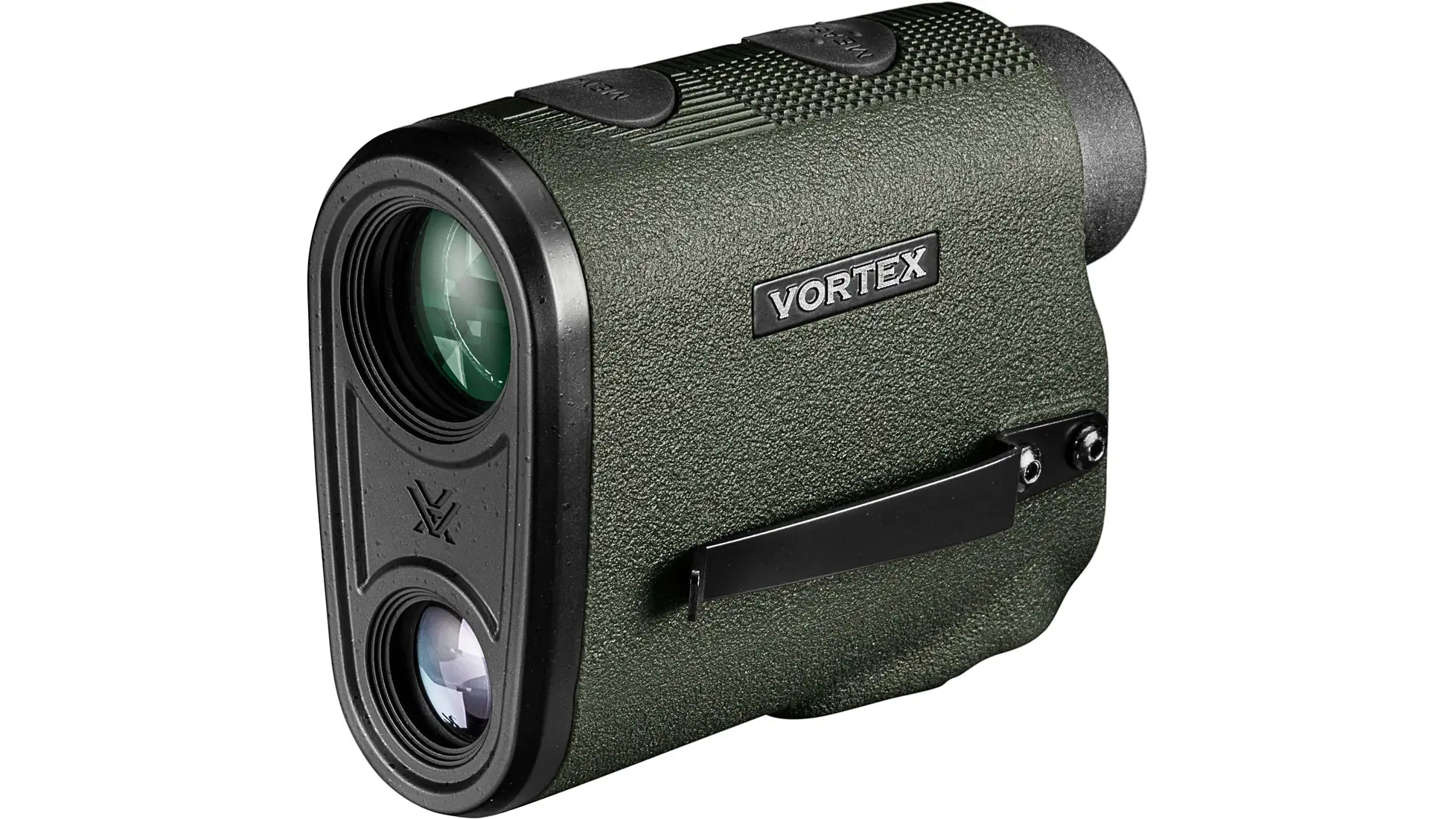
The Diamondback HD 2000 is Vortex's mid-tier handheld hunting laser rangefinder. It is a pure laser unit with no GPS or Bluetooth, built around a 7x monocular with an HD optical system, a 24mm objective and a red OLED display. The design philosophy is the opposite of the gadget-heavy competition: it pours the budget into optical clarity and raw ranging power rather than smartphone connectivity, and backs it with the unlimited, unconditional lifetime Vortex VIP warranty.
Glass and display: where the money went
The 7x HD glass is the headline. Independent reviewers repeatedly note that it stays sharp edge to edge with no color fringing, letting a hunter pick out antler tines on a mule deer at 400 yards in the first minutes of legal light. The red OLED display is the other standout: unlike the black LCD reticles on cheaper units that vanish against a shadowed shoulder or dark timber, the self-illuminating red readout stays crisp in low light, with five brightness levels to dim for night vision or fight midday glare. Ranging is near instant, about a quarter to four-tenths of a second whether the target is 20 or 2,000 yards out.
Angle compensation: HCD and LOS
On any steep shot from a tree stand or across a canyon, line-of-sight distance will make you aim high, because gravity only acts over the horizontal run. The Diamondback's default HCD mode reads the slope angle with an internal inclinometer (to about plus or minus 60 degrees) and instantly shows the true horizontal "shoot-to" number. Independent testing from a 22-foot tree stand matched an external ballistic calculator within half a yard. Switch to LOS mode and it shows the raw distance plus the exact angle for shooters who run their own ballistic solver. Two target modes back this up: Normal reads the strongest return for open country, and Last ignores foreground brush and rain to reach the animal behind cover, with a Scan mode for panning a hillside.
Recognition and pedigree
It has not won a formal industry award such as an NRA Golden Bullseye, and we will not claim one it did not earn. What it has is consistent editorial recognition: Field & Stream named it Best For Crossbow in The Best Rangefinders for Bowhunting of 2024 (source: Field & Stream), Crossbow Magazine called it the best hunting rangefinder for magnification (source: Crossbow Magazine), and OpticsPlanet lists it among its top-rated laser rangefinders. Those are editorial endorsements, not standardized awards, but they line up with what owners report in the field.
What owners and testers say
There are two owner records worth reading and they do not have the same weight. OpticsPlanet shows 4.7 stars from 47 reviews, which is the sample the quotes below come from. Vortex's own product page shows 4.9 from 317, a far bigger pool, and we checked that the figure belongs to this model rather than the whole Diamondback line: the sibling rangefinders on the same site report their own separate counts. The caveat is where those reviews come from. Many of them carry an "Originally posted on ExpertVoice.com" attribution, and ExpertVoice is an industry pro-deal platform, so those reviewers generally bought at a discount. That does not make them dishonest, but it is not the same population as a retail buyer, and a 4.9 collected that way should not be read as a stronger version of the 4.7.
“This is so much better then the $400 range finder I replaced. Optics are clear, read outs are almost instant, love the multiple range modes. Measured the next farmhouse from mine at 2347yds.”
Todd I, verified owner (AR) via OpticsPlanet
“This is accurate within inches and is great for an outdoor range. A great bang for the buck!”
rlad, verified owner (NJ) via OpticsPlanet
Trade-offs, plainly
- In HCD mode the screen shows only the compensated distance, not the line-of-sight range and slope angle at the same time; archers who want all three must toggle to LOS.
- No Bluetooth, environmental sensors or onboard ballistics: it is a pure distance tool, so tech-heavy long-range shooters will want a unit like the SIG KILO3K.
- 7x is shaky handheld at extreme range; getting a return on small non-reflective targets past about 1,000 yards usually means using the tripod socket.
- 16mm eye relief is a little tight for hunters wearing thick prescription glasses.
- Runs on a disposable CR2 battery rather than an internal USB-C rechargeable pack.
Price, and an honest correction
The street price is around $250, well under Vortex's own list price. This section used to say something different and we would rather explain that than quietly edit it: it called that same figure the street price while describing a $240 to $259 band as a frequent sale. That was wrong in both directions. When we first published this review the retailer price actually was in that lower band, so the "sale" we described was simply the price, and we had inferred "frequently" from a single observation. Since then the price has risen to the figure above, which is now the real number. We have removed the sale claim rather than restate it, because we have no record of this unit's discounting pattern, only two data points a month apart.
What that change does to the argument matters more than the number. At its old price this was an easy recommendation against 1,200-yard entry units. At around $250 it sits directly above Vortex's own Crossfire HD 1400, which we card at around $180. The extra money buys 7x magnification on a 24 mm objective rather than 5x on 21 mm, 2,000 yards of reflective reach rather than 1,400, and the red display and HCD modes. That is a real upgrade and this is still our overall pick, but at a hundred dollars it is now a decision rather than a default, and the Crossfire is the lighter unit at 4.8 oz against 7.6. Prices move, so confirm the current number on the retailer page, and see both side by side in our best hunting rangefinder guide.
Key specifications
| Type | Laser rangefinder (no GPS or Bluetooth) |
|---|---|
| Magnification | 7x |
| Objective | 24 mm |
| Display | Red OLED, 5 brightness levels |
| Max range | 2,000 yds reflective / 1,800 yds trees / 1,400 yds on deer |
| Min range | 5 yds |
| Accuracy | +/- 1 yd at 100 yds (Vortex) |
| Increments | 0.1 yd out to 999.9 yds |
| Field of view | 6.4 degrees, 335 ft at 1,000 yds |
| Dimensions | 4.1 x 3.1 x 1.8 in |
| Ranging speed | about 0.25 to 0.4 sec |
| Angle compensation | HCD (to about +/- 60 deg) and LOS modes |
| Target modes | Normal, Last and Scan |
| Eye relief | 16 mm (diopter +5 / -5) |
| Weight | 7.6 oz |
| Battery | CR2 (about 2,000 actuations) |
| Sealing | Waterproof and shockproof, ArmorTek lens coatings |
| Tripod | 1/4"-20 socket |
| Warranty | Vortex VIP: unlimited, unconditional, lifetime |
| In the box | Soft carry case, wrist lanyard, bungee lanyard, lens cloth, utility clip, 2.5 mm hex wrench, harness attachment, CR2 battery |
Should you buy it, and what else to consider
- Buy it if you want one rangefinder for both archery and rifle seasons with the best glass in its price class: our best hunting rangefinder overall.
- Want the lowest price with a Flightpath arrow-arc display? The Leupold RX-1400i Gen 2 TBR/W (around $200) is the budget and archery-ballistics pick.
- Is the cheaper Vortex enough? The Crossfire HD 1400 (around $180) is the same warranty and HD glass in a lighter 5x body with 1,400 yards of reach. It is the honest alternative if you range inside normal hunting distances, and it is the comparison shooters argue about most.
- Need 3,000-plus yards for Western or ELR use? Step up to the Vortex Razor HD 4000, our premium long-reach pick on the hub.
- New to rangefinders? Read how to use a rangefinder for bow hunting and hunting vs golf rangefinders.
FAQ
Is the Vortex Diamondback HD 2000 good for bow hunting?
Yes, it is one of the better crossover picks for archery. It ranges down to a 5-yard minimum for game passing right under a tree stand, reads in 0.1-yard increments for the exacting trajectory of an arrow, and its Last target mode pushes the laser past intervening brush to the animal behind it. HCD angle compensation gives you the true horizontal "shoot-to" number on steep tree-stand angles. OpticsPlanet even lists it under Archery Equipment, and Field & Stream named it Best For Crossbow in its 2024 bowhunting test.
What is the real maximum range on game?
Vortex rates it at 2,000 yards to a reflective target and 1,400 yards on non-reflective game such as deer, and it publishes a third figure people miss: up to 1,800 yards into trees. Independent field tests broadly confirm the range claims. Owners have ranged buildings past 1,861 yards. The catch is stability: 7x magnification shakes when handheld at extreme distance, so small non-reflective targets past about 1,000 yards usually need the 1/4"-20 tripod socket.
What is the difference between HCD and LOS mode?
HCD (Horizontal Component Distance) is the default and the one most hunters should use: an internal inclinometer measures the slope angle to about plus or minus 60 degrees and displays the angle-compensated horizontal distance you actually hold for, because gravity acts over the horizontal run. LOS (Line of Sight) shows the raw straight-line distance alongside the slope angle, which is for advanced shooters feeding numbers into an external ballistic app.
Can I use the Diamondback HD 2000 for golf?
No, and you should not buy it for that. It uses hunting target logic (Normal and Last modes) with no first-target pin-lock and no physical slope-disable switch, so it is awkward for locking a flagstick and is not tournament-legal. If golf is the goal, buy a dedicated golf rangefinder instead.
More: best hunting rangefinders · Leupold RX-1400i review · hunting vs golf rangefinders.