The best rangefinding binoculars in 2026
Our verdict for 2026: the Revic Acura BR10 (around $2,900) is the best rangefinding binocular for a long-range shooter, because it carries a full onboard ballistic solver that prints a true MOA or MIL holdover into the display. The GPO RangeGuide 10x40 (around $1,100) is the best value and by far the lightest, a Popular Mechanics award winner with excellent glass, for the hunter who is happy to read the range and dial their own turret. The whole decision is one question: do you want the optic to solve the shot for you?
This is a small, premium field. Prices verified September 30, 2026; confirm current price and availability on the retailer page.
A rangefinding binocular puts a laser inside your glass, so you find an animal and range it in one motion instead of trading a binocular for a handheld rangefinder. The category splits cleanly in two, and that split matters more than any spec: some models just give you an angle-corrected distance, while others carry a full ballistic computer that tells you exactly where to hold. Our two picks are the clearest example of each, and the field on OpticsPlanet is small and premium, so this is a focused two-pick guide.
How these picks were made: a research-based roundup comparing published specifications, glass quality, laser range and speed, the ballistic-solver capability, warranty, owner reviews and pricing on OpticsPlanet, plus a deep-research pass on each. Scores are our editorial opinion, not a hands-on test, and owner ratings and awards are shown attributed to their source. See how we evaluate.
Quick comparison
| Category | Pick | Spec | Price | |
|---|---|---|---|---|
| Best for long-range shooters | Revic Acura BR10 10x42 | 10x42 · solver · 8,000 yd | around $2,900 | Check price |
| Best value and lightest | GPO RangeGuide 10x40 | 10x40 · no solver · 26 oz | around $1,100 | Check price |
| Best reach for open country | Leupold BX-4 Range HD Gen 2 TBR/W 12x50 | 12x50 · 1,500 yd on deer · 37 oz | around $1,700 | Check price |
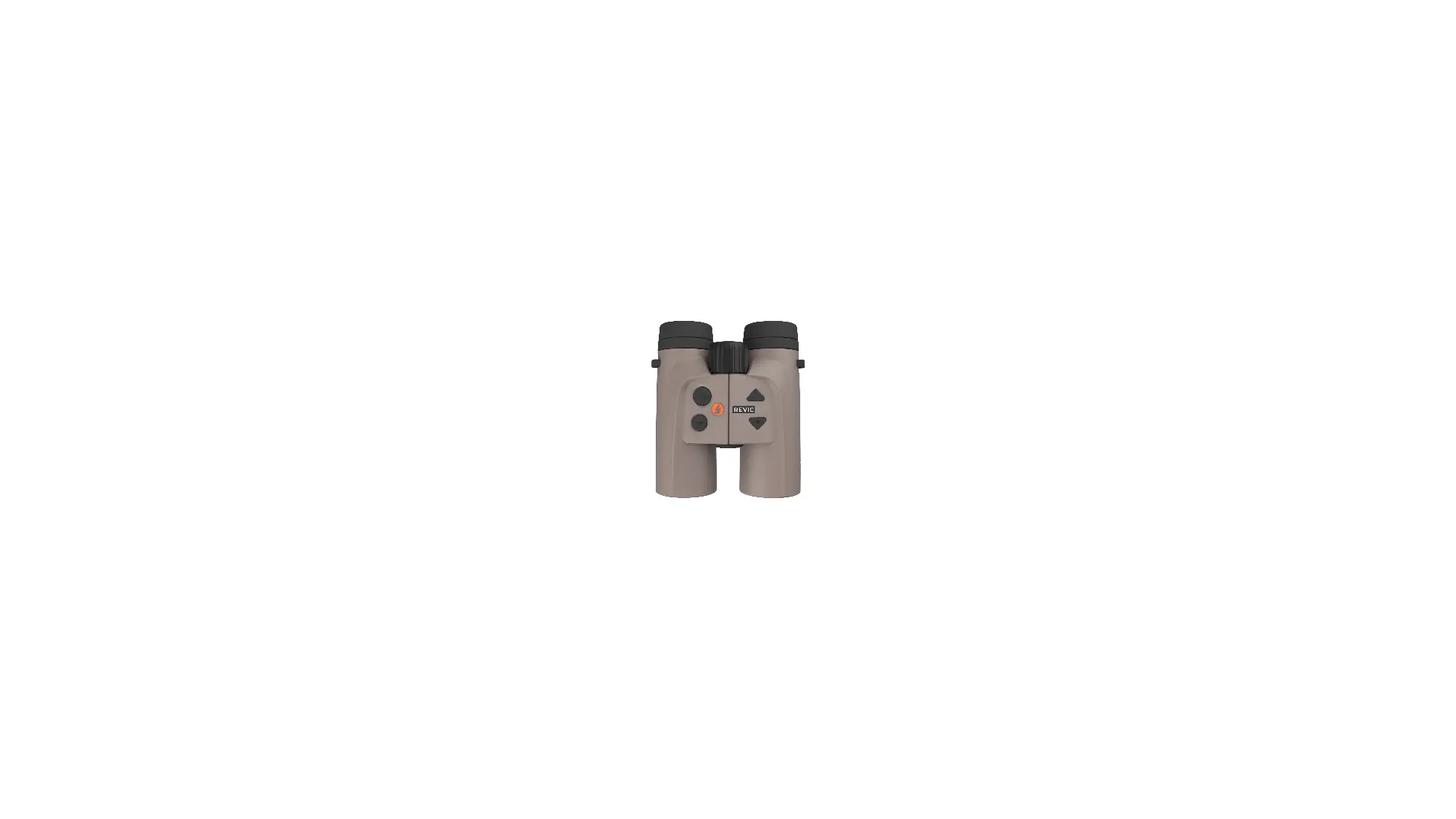
Best for long-range shooters: Revic Acura BR10 10x42
10x42 · ED glass, fully multi-coated · 8,000 yd reflective / 2,200 yd on game · onboard Revic ballistic solver (true MOA/MIL/inch holdover) · Gen 2 HUD · Revic Ops app + Raypoint GPS · CR2 · IP67 · 31.7 oz
around $2,900exact price on OpticsPlanet
This is the pick if you range to shoot at distance, because it is not really a binocular with a rangefinder bolted on, it is a fire-control system you glass through. Made by Gunwerks' optics arm, it pairs a genuinely good 10x42 ED-glass binocular with an 8,000-yard laser (2,200 yards on game) and, critically, its own onboard ballistic engine: range an animal and it prints a true holdover in MOA, MIL or inches straight into the display, corrected for angle, pressure, temperature and even Coriolis. Its standout trick is updating the wind after you have ranged, no re-lasing, and its Raypoint feature drops a GPS waypoint on whatever you ranged into the Revic Ops app. Independent testers call the laser among the fastest they have used and the app the most stable in the class. Be clear on who it is not for: the 16mm eye relief is tight for eyeglass wearers, the 10-meter close focus rules out archery and timber, and the warranty is weak for the price (5 years on the glass, just 2 on the electronics).
Pros
- A full onboard ballistic solver: range a target and it displays a true MOA/MIL/inch holdover, corrected for angle, pressure, temperature, even Coriolis, no phone needed for the shot
- An 8,000-yard laser (2,200 on game) that independent testers rate among the fastest available, punching through fog and low light on non-reflective targets past a mile
- Update the wind after ranging without re-lasing, and drop a GPS waypoint on the ranged target into the Revic Ops app (Raypoint); reviewers praise the app as the most stable in the class
- A genuinely good 10x42 ED-glass binocular, lighter (31.7 oz) than a Swarovski EL Range, IP67 sealed, with a hidden 1/4-20 tripod thread
Cons
- A weak warranty at this price: 5 years on the glass and mechanics, and only 2 years on the electronics, where Vortex covers its electronics for life
- 16mm of eye relief is tight for eyeglass wearers, who may not see the full field without removing the eyecups (and risking scratched lenses)
- A 10-meter (about 33 ft) close focus rules it out for archery, dense timber and any birding or close observation
- The HUD projects into the right barrel only (awkward for left-eye-dominant shooters), and the deep feature set has a real learning curve
Best for: the long-range Western big-game hunter or PRS/NRL competitor who wants to glass, range and get a corrected firing solution in one motion, and will use the solver. Skip it for archery, timber, birding, or if you just want a simple range readout.
Key specifications
| Type | Rangefinding binocular with full ballistic solver |
|---|---|
| Magnification / objective | 10x42 |
| Glass | ED, fully multi-coated, Schmidt-Pechan roof prism |
| Exit pupil | 4.2 mm |
| Field of view | 320 ft at 1,000 yd |
| Range (reflective / game) | 8,000 yd / 2,200 yd |
| Ranging accuracy | plus or minus 0.5% past 1,000 yd |
| Ballistics | Onboard Revic engine, MOA/MIL/inch, wind, angle, Coriolis |
| Sensors | Pressure, temperature, incline, compass |
| App / extras | Revic Ops (Bluetooth), Raypoint GPS waypoint |
| Battery | One CR2, about 4,000 range cycles |
| Weight / sealing | 31.7 oz, IP67 |
| Warranty | 5 yr optics/mechanical, 2 yr electronics |
“The Revic Acura BR10 is an amazing combo. Glass is crystal clear with vibrant color. The built in rangefinder is the best on the market... I just upgraded from Swarovski EL 10x42 and the original Gunwerks range finder... after receiving my Revic BR10s and looking through them I am so happy I made the switch.”
Jake Sol, verified owner (MT) via OpticsPlanet
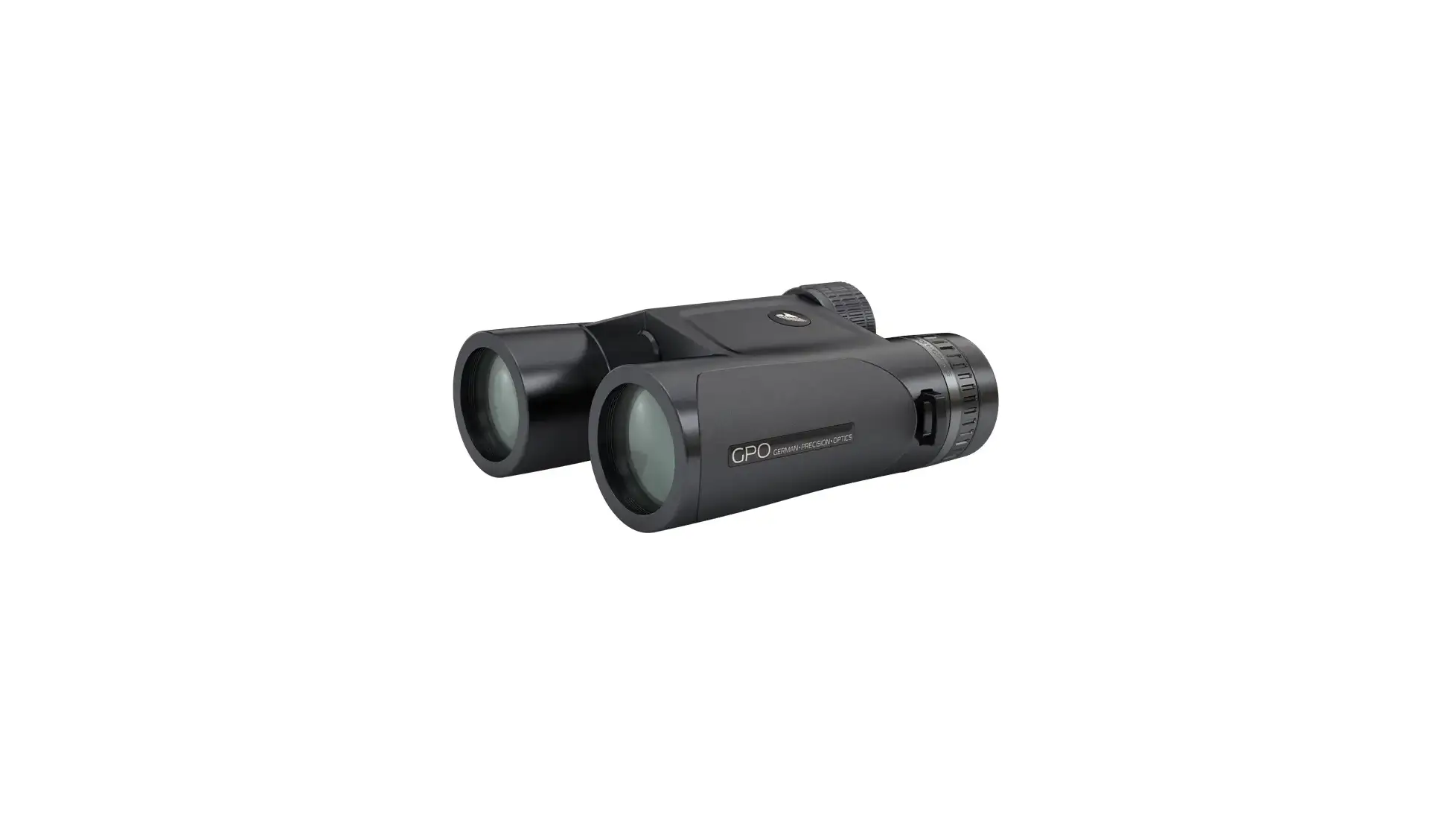
Best value and lightest: GPO RangeGuide 10x40
10x40 · Double HD glass, 87% transmission · 3,500 yd reflective / ~766 yd on game · angle-corrected range + temp/humidity/pressure (NO ballistic solver) · OLED, 9 brightness + auto · CR2 · 26 oz · transferable lifetime warranty
around $1,100exact price on OpticsPlanet
This is the rangefinding binocular for the hunter who wants alpha-feeling glass and an instant range in the lightest possible package, and does not need an onboard ballistic computer. At 26 ounces it is the lightest full-size rangefinding binocular here by a wide margin, the reason Popular Mechanics named it "Best for Hunting Binocular" in both 2023 and 2024 and the RangeGuide series took Gray's Best in 2021. Its Double HD glass runs 87% light transmission, and owners say the image and edge-to-edge sharpness punch well above the price. The laser ranges to 3,500 yards, fires in a quarter second, and has a scan mode for moving game. The honest, deliberate trade is that it stops at angle-corrected true-horizontal distance plus temperature, humidity and pressure readouts: it does NOT compute a MOA/MIL holdover and has no Bluetooth or app. You read the range and the conditions, then dial your own turret or a phone solver. For a traditional hunter that is a feature, not a flaw, and its transferable lifetime warranty beats the Revic's.
Pros
- The lightest full-size rangefinding binocular here at 26 oz, so it carries like a plain binocular; Popular Mechanics "Best for Hunting Binocular" 2023 and 2024, and Gray's Best 2021 for the series
- Double HD glass at 87% light transmission, with owners reporting a sharp image across 90-95% of the field, comparing it to European glass costing twice as much
- A 3,500-yard laser with a 0.25-second response and a scan mode, plus true-range angle compensation and temperature, humidity and barometric readouts
- GPO's transferable Spectacular Lifetime Warranty (lifetime on optics and body, 5 years on electronics), with no card or receipt required, is stronger than the Revic's
Cons
- No onboard ballistic solver: it gives an angle-corrected distance and the conditions, but no MOA/MIL holdover, and there is no Bluetooth or app, so long-range shooters must dial their own solution
- A 40mm objective caps the exit pupil at 4 mm, so in deep twilight the image goes darker sooner than a heavier 10x50 or 8x56
- A faint blue tint from the display beam-splitter, most visible against snow (common to all rangefinding binoculars)
- No OpticsPlanet owner reviews yet, so there is no owner record to check the long-term claims against
Best for: the backcountry or big-game hunter who wants top-tier glass, an instant range and the lightest possible rig, and is happy to read conditions and dial their own turret. Step up to the Revic if you want the optic itself to compute the firing solution.
Key specifications
| Type | Rangefinding binocular (angle-corrected range, no solver) |
|---|---|
| Magnification / objective | 10x40 |
| Glass | Double HD, 87% transmission, Schmidt-Pechan roof prism |
| Exit pupil | 4 mm |
| Eye relief | 16 mm |
| Field of view | 330 ft at 1,000 yd |
| Close focus | 16 ft |
| Range (reflective / game) | 3,500 yd / about 766 yd |
| Response / scan | 0.25 s, scan mode |
| Ballistics | Angle-corrected true-horizontal range only (no MOA/MIL, no app) |
| Sensors | Temperature, humidity, barometric pressure |
| Display | Red OLED, 9 brightness levels plus auto |
| Battery | One CR2, about 4,000 range cycles |
| Weight / sealing | 26 oz, waterproof and fogproof |
| Warranty | GPO Spectacular Lifetime (transferable), electronics 5 yr |
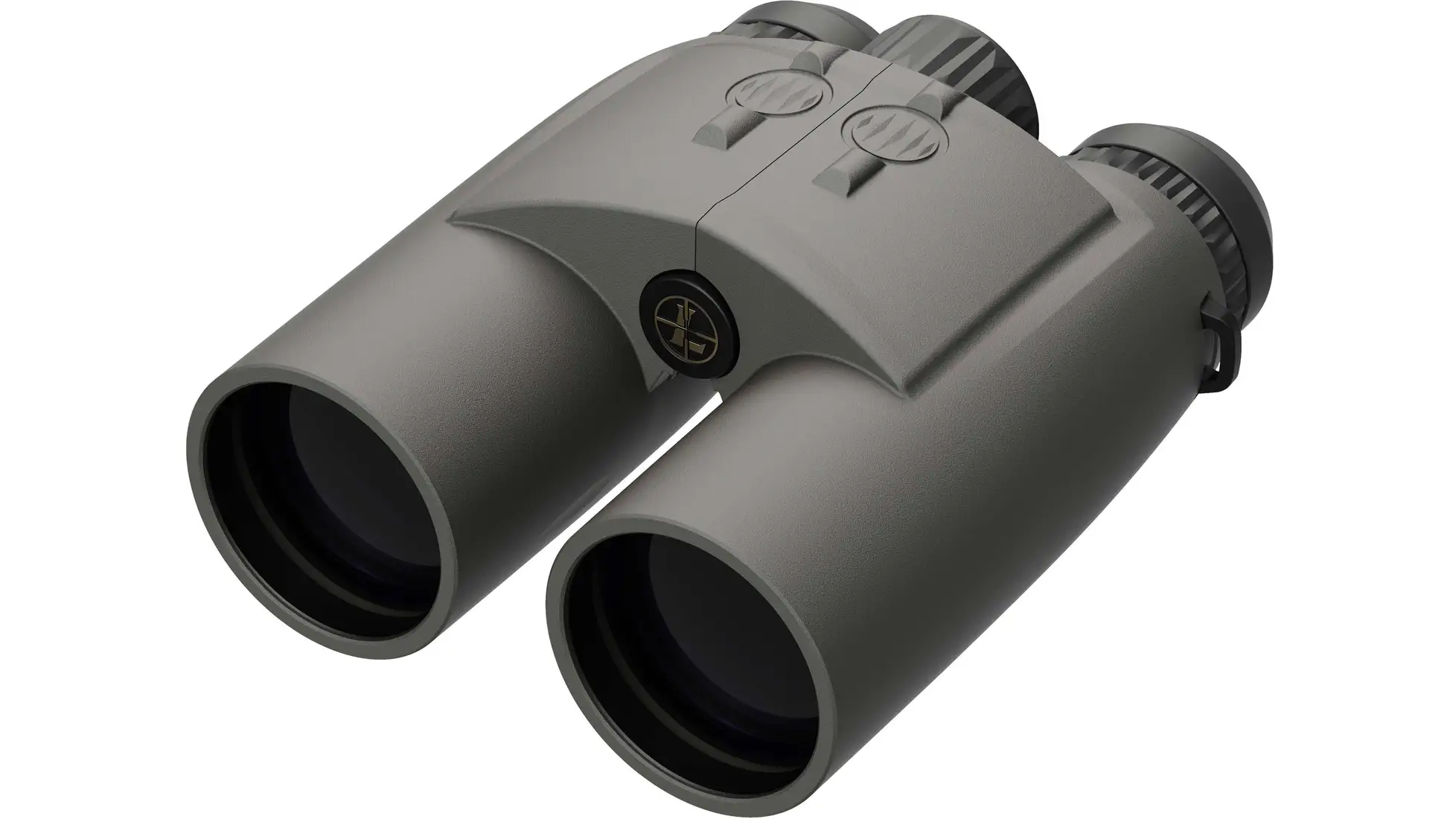
Best reach for open country: Leupold BX-4 Range HD Gen 2 TBR/W 12x50
12x50 · Elite Optical System, roof prism · 4,000 yd reflective / 2,200 yd on trees / 1,500 yd on deer · TBR/W ballistic range plus a 10 mph wind hold to 800 yd · red OLED · CR2, 3,000 actuations · 37 oz
around $1,700exact price on OpticsPlanet
This is the pick for glassing open country, and it earns that on two numbers the other two cannot match. It is the only 12x here, which is the difference between identifying an animal and merely finding it when you are picking apart a far hillside, and it ranges deer-sized game to 1,500 yards against roughly 766 on the GPO. Its TBR/W sits deliberately between the other two: it is not the full fire-control solver the Revic carries, but unlike the GPO it does hand you a ballistically corrected range and a hold for a 10 mph crosswind out to 800 yards, which covers most of what a hunter actually shoots. It is also the only one here you can use in timber, since it focuses down to 13 feet where the Revic stops at 10 metres. The costs are physical and they are real: it is the heaviest at 37 oz, it shows the narrowest field at 279 feet, and its 14 mm of eye relief is tighter still than the Revic’s 16 mm that we already flag as awkward for eyeglass wearers.
Pros
- The only 12x on this page, which is what you want when you are picking apart open country rather than scanning close timber
- Ranges deer-sized game to 1,500 yd and reflective targets to 4,000 yd, well past the GPO’s roughly 766 yd on game
- TBR/W gives a ballistically corrected range plus a hold for a 10 mph 90-degree wind out to 800 yd, which the GPO does not do at all
- Focuses to 13 ft, so unlike the Revic (10 m) it still works in timber and at close range
- Interchangeable form-fit eyecups in three shapes, programmable left or right power buttons, and a 1/4-20 tripod thread
Cons
- The heaviest here at 37 oz, against 31.7 on the Revic and 26 on the GPO, which you feel on a long carry
- The narrowest field of view at 279 ft against 320 and 330, which is the price of the extra magnification
- The tightest eye relief on this page at 14 mm, so eyeglass wearers should treat it more cautiously than the Revic we already flag at 16 mm
- No owner reviews on OpticsPlanet at all, so there is no independent record of how it holds up, only its published specification
- Leupold publishes a lifetime guarantee on the optical system but does not state an electronics term in its own specification table, so budget for that uncertainty the way you would on any laser
Best for: the open-country hunter who glasses far, wants a corrected range and a usable wind hold without paying for a full solver, and will carry the extra weight for the extra magnification. Skip it if you hunt close timber where the field of view matters more than reach, if you wear glasses, or if you want the Revic’s true holdover solution.
Key specifications
| Type | Rangefinding binocular (TBR/W ballistic range and wind hold, not a full solver) |
|---|---|
| Magnification / objective | 12x50 |
| Glass | Leupold Elite Optical System, roof prism |
| Exit pupil | 4.2 mm |
| Eye relief | 14 mm |
| Field of view | 279 ft at 1,000 yd (5.2 degrees) |
| Close focus | 13 ft |
| Range (reflective / trees / deer) | 4,000 yd / 2,200 yd / 1,500 yd |
| Ranging accuracy | 0.7 to 125 yd, 1 to 1,000 yd, 0.2 percent beyond |
| Display | Red OLED |
| Battery | CR2, 3,000 actuations |
| Interpupillary distance | 59 to 76 mm |
| Weight | 37 oz |
| Length | 6.25 in |
| Tripod | Yes, 1/4-20 |
| Warranty | Leupold lifetime guarantee on the optical system; no electronics term published in the maker’s specification table |
How to choose rangefinding binoculars
Four decisions separate these optics; the first is the big one:
- Solver or no solver. A ballistic-solver model (Revic) computes a true MOA/MIL holdover corrected for angle, atmosphere and more; an angle-compensating model (GPO) only gives a corrected distance. If you shoot at distance and want the optic to tell you where to hold, buy a solver; if you dial your own turret, you can save money and weight without one.
- Weight. Rangefinding binoculars are heavy because they pack two instruments, so weight is a real difference on a long day. The GPO is 26 oz; solver models like the Revic run past 31 oz. Mountain hunters feel every ounce.
- Range you will actually use. The headline range is for reflective targets; the game number is far shorter. Match it to how far you really range animals, not the biggest number on the box.
- Glass and warranty. These are premium optics, so the glass should be good, and it usually is. Check the warranty on the electronics specifically: it varies from GPO's lifetime coverage to the Revic's two years, which is a real consideration on a multi-thousand-dollar device.
Want a plain hunting binocular without the laser? See our best binoculars for hunting. Prefer a handheld rangefinder and a separate binocular? See our best hunting rangefinders. New to the numbers on a binocular? Read what binocular numbers mean.
FAQ
Are rangefinding binoculars worth it?
If you range often, yes. A rangefinding binocular replaces a binocular plus a handheld rangefinder with one optic, so you glass, find an animal and range it without dropping one tool to pick up another, which saves critical seconds and cuts the weight on your chest. The catch is cost: a good one starts north of $1,000 and the ballistic-solver models run near $3,000. If you rarely range, or only need a distance now and then, a separate binocular and a pocket rangefinder is cheaper.
What is the difference between the Revic BR10 and the GPO RangeGuide?
It comes down to one thing: a ballistic solver. The Revic Acura BR10, the dearest pick here, has a full onboard ballistic engine, so it computes and displays a true holdover in MOA, MIL or inches, corrected for angle, pressure, temperature and more, and pairs with an app. The far cheaper GPO RangeGuide does not: it gives you an angle-corrected true-horizontal distance plus temperature, humidity and pressure readings, but no firing solution and no app. The Revic also ranges far farther (8,000 vs 3,500 yards). The GPO is lighter (26 vs 31.7 oz), has better glass-for-the-money and a stronger warranty. Buy the Revic if you want the optic to solve the shot; buy the GPO if you dial your own turret.
Do rangefinding binoculars give you a shooting solution?
Only some of them. Two types exist. Angle-compensating models, like the GPO RangeGuide, correct the distance for uphill or downhill shots (true-horizontal range) and may show conditions, but stop there. Ballistic-solver models, like the Revic BR10 and the Sig KILO and Vortex Fury lines, go further and output an actual holdover in MOA, MIL or inches from a rifle profile you load in. If you want the binocular itself to tell you where to hold, you need a solver model; otherwise you read the range and dial your own.
How far can rangefinding binoculars range?
Farther on reflective targets than on animals, and the headline number is the reflective one. The GPO RangeGuide is rated to 3,500 yards reflective but about 766 on game; the Revic BR10 is rated to 8,000 reflective, 2,800 on non-reflective terrain and 2,200 on game. For hunting, the game number is what matters, and even that is a best case in clear conditions. Fog, rain and low contrast all shorten real-world range, though a more powerful laser like the Revic's holds up better in poor conditions.
How much do good rangefinding binoculars cost?
More than you might expect, because you are buying two instruments in one. Value models with good glass and angle compensation, like the GPO RangeGuide, start under $1,200. Full ballistic-solver models with long-range lasers, like the Revic BR10 or the Sig KILO series, run above $2,500. European alpha-glass options such as Leica and Swarovski sit at the top. There is no true budget rangefinding binocular with alpha glass; the technology carries a premium.
Related: best binoculars for hunting · best hunting rangefinders · Vortex Razor binoculars compared · Vortex Ranger HD 3000 review (not a pick on this page) · Leica Geovid R review (not a pick on this page) · what binocular numbers mean.