Nikon binoculars decoded: ProStaff, Monarch, and which rung to buy
Our verdict for 2026: two coatings divide this range, not price. The ProStaff P7 10x30 (around $190) is the cheapest Nikon that has both a phase-correction and a dielectric prism coating, which makes it the value pick. The ProStaff P3 8x42 (around $140) has neither, but it has the most generous eye relief on this page, so it is the one to buy if you wear glasses. The Monarch HG 10x42 (around $1,000) is the only one with independent lab measurements behind it.
Searching for a ProStaff 3S or 7S? Both are discontinued. Here is what replaced them. Prices and MPNs verified September 30, 2026; confirm the current price on the retailer page.
Nikon sells binoculars under two family names and has renamed the cheaper family twice, which is why so many buyers arrive looking for a model that no longer exists. The useful question is not which Nikon is best but where the real dividing lines sit, because they are not where the price breaks are. Below is the succession map, the coating ladder in Nikon's own words, what an independent laboratory measured, and the three models worth your money.
How these picks were made: a research-based roundup built from Nikon's own published specifications and press releases, independent laboratory measurements, owner reviews, and live pricing read from the OpticsPlanet product pages. This range has an unusually thin owner-review record, so the evidence here leans on the manufacturer's specification record and measured lab data rather than owner consensus, and we say so wherever it matters. Scores are our editorial opinion, not a hands-on test of every model. See how we evaluate.
- What replaced the ProStaff 3S, 7S, 5 and 7
- The coating ladder: what each step actually buys
- Nikon ProStaff P7 10x30mm Roof Prism Binocular - Best value in the Nikon line
- Nikon ProStaff P3 8x42mm Roof Prism Binocular - Best for glasses wearers on a budget
- Nikon Monarch HG 10x42mm Roof Prism Binoculars - Best Nikon binocular, measured
- The 92% question, answered with lab data
- Every current Nikon binocular, priced
- Where they are made
- FAQ
What replaced the ProStaff 3S, 7S, 5 and 7
If you are searching for a ProStaff 3S, a 7S, a ProStaff 5 or a ProStaff 7, you are searching for a discontinued product. On June 9, 2022 Nikon replaced the entry-level range with two models. Its press release is unambiguous: the new ProStaff P3 binoculars are described as the successors of the popular ProStaff 3S series, and the P7 as improving upon the previous ProStaff 7S models.
| Discontinued model | Current equivalent | What changed |
|---|---|---|
| ProStaff 3S | ProStaff P3 | Direct successor, named as such by Nikon |
| ProStaff 7S | ProStaff P7 | Direct successor, with redesigned exterior construction |
| ProStaff 5 | No direct successor | Slot absorbed by the P3 and P7 when the range was simplified |
| ProStaff 7 | No direct successor | Introduced 2011, superseded by the 7S in 2014, then absorbed by the P7 |
The practical consequence: a used 3S or 7S is not a bargain version of a current model, it is a three-generation-old design with no warranty path. The P3 and P7 are the models to compare against, and the P7 in particular is not a like-for-like reissue of the 7S but a differently specified instrument.
The coating ladder: what each step actually buys
Nikon's range looks like a price ladder and behaves like a coating ladder. Two treatments decide how much detail a roof-prism binocular can actually resolve, and they arrive at specific rungs.
Phase-correction coating is the one that matters most and the one buyers have never heard of. Any roof prism splits the light passing through it into two polarised components. Those components fall out of step, and when they recombine they interfere destructively, which smears fine detail and flattens contrast. A phase-correction coating puts them back in step. Its absence does not merely dim the image, it costs resolution.
A dielectric prism coating is the second. Where a roof prism cannot reflect light purely by total internal reflection, the face has to be mirrored. A silver-alloy mirror returns most of the light; a dielectric stack of alternating high and low refractive index layers returns more of it.
Here is where each treatment appears, in Nikon's own specification wording rather than ours.
| Rung | Prism mirror | Phase correction | ED glass | Extra |
|---|---|---|---|---|
| ProStaff P3 | Silver-alloy | Not listed | No | Friction diopter |
| ProStaff P7 | Dielectric | Yes | No | Locking diopter, oil and water repellent lens coating |
| Monarch M5 | Dielectric | Yes | Yes | Fully multicoated lenses and prisms |
| Monarch M7 | Dielectric | Yes | Yes | Wider-field eyepieces, oil and water repellent lens coating |
| Monarch HG | Dielectric | Yes | Yes | Field Flattener Lens System, magnesium alloy body |
Read that table once and the range stops being confusing. The P3 to P7 step buys corrected optics. The P7 to Monarch step buys ED glass. The M5 to M7 step buys field of view and a repellent lens coating, not better glass, since both use the same coatings and the same ED elements. The HG step buys flat-field geometry, and it is the only step whose benefit has been independently measured.
Quick comparison
| Category | Pick | Spec | Price | |
|---|---|---|---|---|
| Best value in the Nikon line | Nikon ProStaff P7 10x30mm Roof Prism Binocular | 10x30 · phase-corrected | around $190 | Check price |
| Best for glasses wearers on a budget | Nikon ProStaff P3 8x42mm Roof Prism Binocular | 8x42 · 20.2 mm eye relief | around $140 | Check price |
| Best Nikon binocular, measured | Nikon Monarch HG 10x42mm Roof Prism Binoculars | 10x42 · 88.3% measured | around $1,000 | Check price |
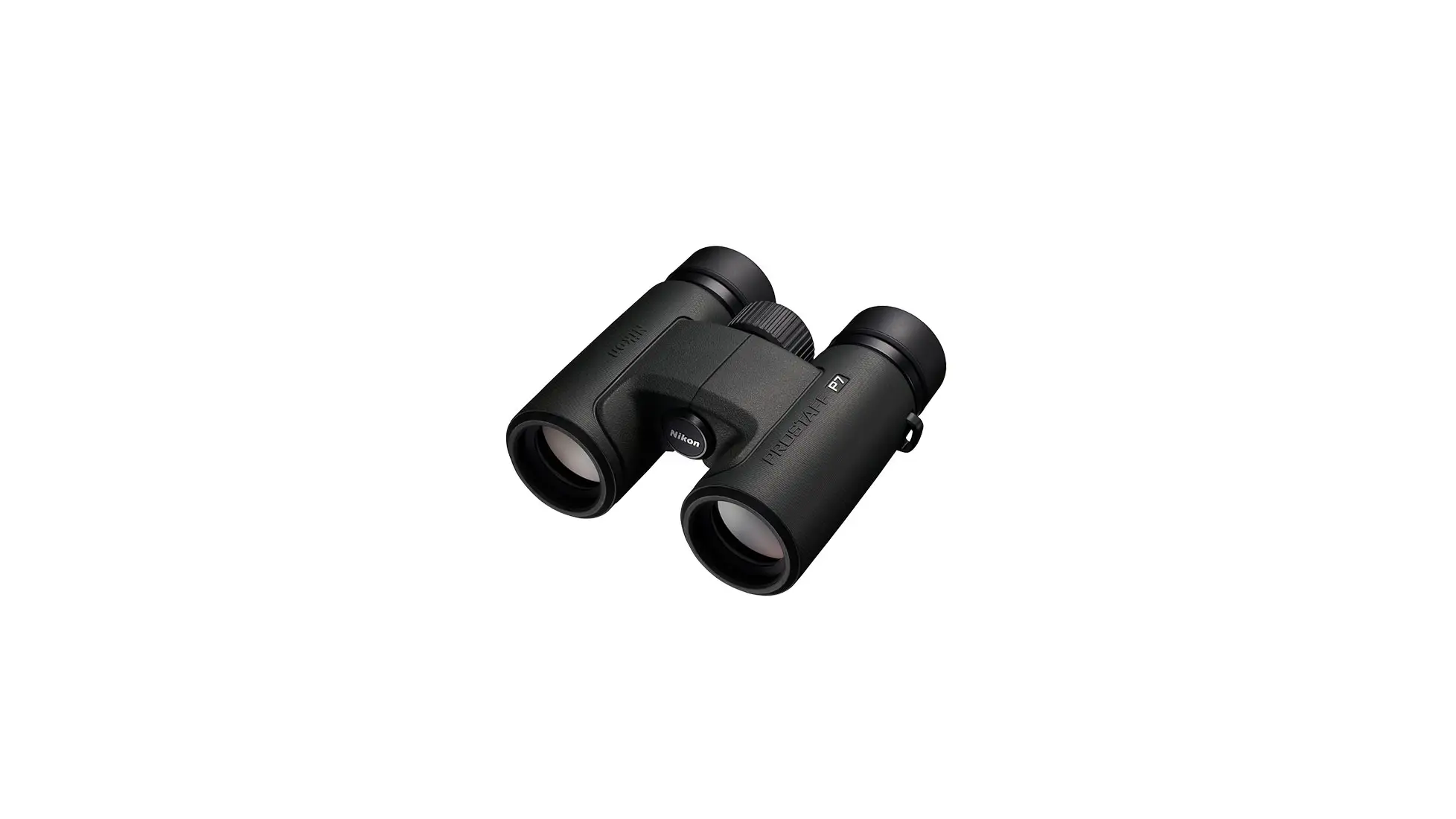
Best value in the Nikon line: Nikon ProStaff P7 10x30mm Roof Prism Binocular
10x · 30mm · roof prism · dielectric high-reflective prism coating · phase-correction coating · locking diopter · oil and water repellent lens coating · 470 g · waterproof to 1 m for 10 minutes
around $190exact price on OpticsPlanet
This is the cheapest Nikon binocular that is optically complete, and that sentence is doing real work. Two coatings separate a binocular that merely passes light from one that resolves detail properly, and the P7 is the first rung that has both. Nikon's own press release lists a dielectric high-reflective prism coating and a phase-correction coating for the P7; for the P3 it lists a silver-alloy mirror coating and no phase correction at all. Phase correction is not a marketing layer. A roof prism splits light into two polarised components that fall out of step and interfere destructively when they recombine, smearing fine detail and flattening contrast; the coating puts them back in step. Everything above this rung has it, nothing below it does. You also get the mechanical upgrades that separate a field instrument from a starter pair: a locking diopter ring that will not drift when you pull the binocular out of a pack, and an oil and water repellent coating on both lens surfaces so you can wipe a smeared objective without grinding grit into the anti-reflective layers. The trade-off is aperture, and it is a real one. This is a 30mm objective, so at 10x the exit pupil is 3.0 mm, narrower than a dilated eye at dusk. Buy it knowing that.
Pros
- The cheapest rung with both coatings that matter: Nikon lists a dielectric prism coating and a phase-correction coating here, and lists neither for the ProStaff P3 below it
- A locking diopter ring rather than the P3's friction ring, which means your focus setting survives being pulled in and out of a pack or harness
- Oil and water repellent coating on the objective and eyepiece lenses, so wiping a wet or smudged lens does not risk the coatings under it
- Light for what it is at 470 g, and the one verified owner reports it holds its own against his own 10x42 at dusk, reading street sign letters clearly at about 150 yards
Cons
- The 30mm objective is the real compromise: at 10x the exit pupil is 3.0 mm against 4.2 mm for a 10x42, and a dilated eye at dusk opens well past that, so it cannot fill your pupil in the last minutes of light
- Its sole owner review names "not the best sight picture" as his own con, which is consistent with a small objective at 10x rather than a defect
- Eye relief drops to 15.4 mm, the shortest of any model on this page and noticeably less forgiving than the 20.2 mm on the cheaper P3, which matters if you wear glasses
- The owner record is one review deep, so the 5.0 rating is a data point rather than a consensus, and there is no independent laboratory measurement published for any ProStaff model
Best for: the hiker, traveller or general daylight glasser who wants genuinely corrected optics in a small package and does not need the last twenty minutes of light. If you wear glasses or glass at dawn and dusk, the 42mm ProStaff P3 below is the more comfortable instrument despite being optically simpler.
Key specifications
| Manufacturer | Nikon |
|---|---|
| Magnification | 10x |
| Objective lens | 30 mm |
| Prism | Roof |
| Prism coatings | Dielectric high-reflective multilayer + phase-correction |
| Eye relief | 15.4 mm (Nikon) |
| Exit pupil | 3.0 mm |
| Close focus | 2.5 m (Nikon) |
| Field of view | 346 ft at 1000 yds |
| Weight | 470 g (Nikon), 16.6 oz |
| Diopter | Locking |
| Sealing | Waterproof to 1 m for 10 minutes, nitrogen purged |
| Body | Fibreglass-reinforced polycarbonate resin |
| MPN carded | 16771 (single offer, no demo variant) |
“I compared them at dusk with my 10 x 42 binoculars and there was not much difference at all in what I could see. I focused in on the street sign and the letters were just as clear at about 150 yards away. I wasn't looking to spend $300-$400 and I am very satisfied with this purchase.”
Toolman, verified owner (WI) via OpticsPlanet, the listing's only review
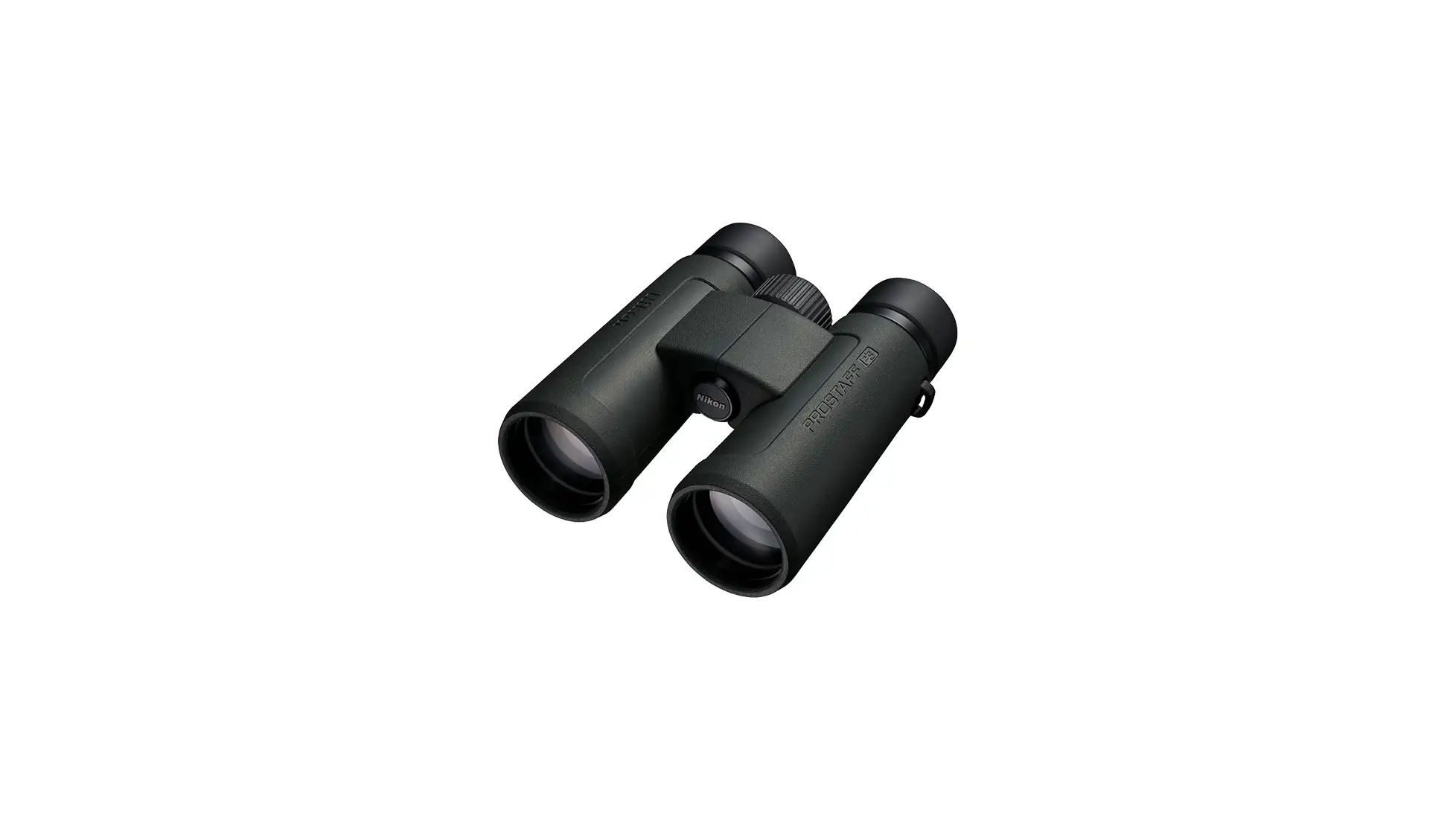
Best for glasses wearers on a budget: Nikon ProStaff P3 8x42mm Roof Prism Binocular
8x · 42mm · roof prism · multilayer-coated lenses · silver-alloy mirror prism coating · no phase-correction coating · 590 g · waterproof and fogproof
around $140exact price on OpticsPlanet
This is the direct replacement for the ProStaff 3S, the model most people are actually searching for, and Nikon says so in as many words: its 2022 press release calls the P3 "the successors of the popular PROSTAFF 3S series". What it is good at is comfort. The 20.2 mm of eye relief Nikon publishes for it is the most generous figure on this page, more than the flagship Monarch HG offers, and with a 5.3 mm exit pupil and turn-and-slide eyecups it is the easiest model here to use with thick spectacles or sunglasses. What it gives up is the coating layer above it. Nikon lists a silver-alloy mirror coating on the prism faces and no phase-correction coating at all, and that is not a small omission: without phase correction the two polarised halves of the light path recombine out of step, which measurably reduces resolution and micro-contrast rather than just dimming the view. So this is a comfortable, honest daylight binocular, not a low-light or astronomy instrument. One practical caution before you order: its published weight is contested. Nikon says 590 g while OpticsPlanet's spec field says 16.8 oz, which is about 114 g lighter. We use Nikon's number.
Pros
- The most forgiving eye box on this page: Nikon publishes 20.2 mm of eye relief with a 5.3 mm exit pupil, which beats every Monarch here including the flagship, so glasses wearers see the full field
- It is the documented successor to the ProStaff 3S, which means the model most buyers are still searching for has a current, in-catalogue equivalent rather than a used-market gamble
- A 42mm objective at only 8x is the most light-efficient combination on this page, so within its coating class it makes the best use of what it gathers
- Genuinely cheap for a full-size waterproof 42mm from a major optical manufacturer, at a price where most competitors are house brands
Cons
- No phase-correction coating, which is the single biggest optical compromise on this page. Nikon lists the coating for the P7 and every Monarch, and does not list it here, and its absence costs resolution and contrast rather than only brightness
- The prism faces use a silver-alloy mirror coating rather than the dielectric coating used from the P7 upward, so it reflects less of the light that reaches the prism
- The diopter ring is friction-based with no lock, so it can drift out of adjustment when the binocular is pulled in and out of a pack
- The published weight is contested: Nikon says 590 g, the retailer's spec field says 16.8 oz. We have not been able to reconcile them, so treat the retailer figure with caution
- Zero owner reviews on the retailer listing, so there is no owner record to check our reading against
Best for: the beginner, backyard birder, hiker or spectacle wearer who glasses in daylight and wants the most comfortable view for the money. Skip it for astronomy or serious dusk hunting, where the missing phase-correction coating and the silver-alloy prism will show, and step to the P7 or a Monarch instead.
Key specifications
| Manufacturer | Nikon |
|---|---|
| Magnification | 8x |
| Objective lens | 42 mm |
| Prism | Roof |
| Prism coatings | Silver-alloy mirror. No phase-correction coating listed |
| Lens coatings | Multilayer-coated (Nikon does not use the term "fully multicoated" here) |
| Eye relief | 20.2 mm (Nikon) |
| Exit pupil | 5.3 mm |
| Close focus | 3.0 m (Nikon) |
| Field of view | 456 ft at 1000 yds |
| Weight | 590 g (Nikon). The retailer lists 16.8 oz, which conflicts |
| Diopter | Friction, non-locking |
| Replaces | ProStaff 3S (Nikon press release, June 9 2022) |
| MPN carded | 16776 (single offer, no demo variant) |
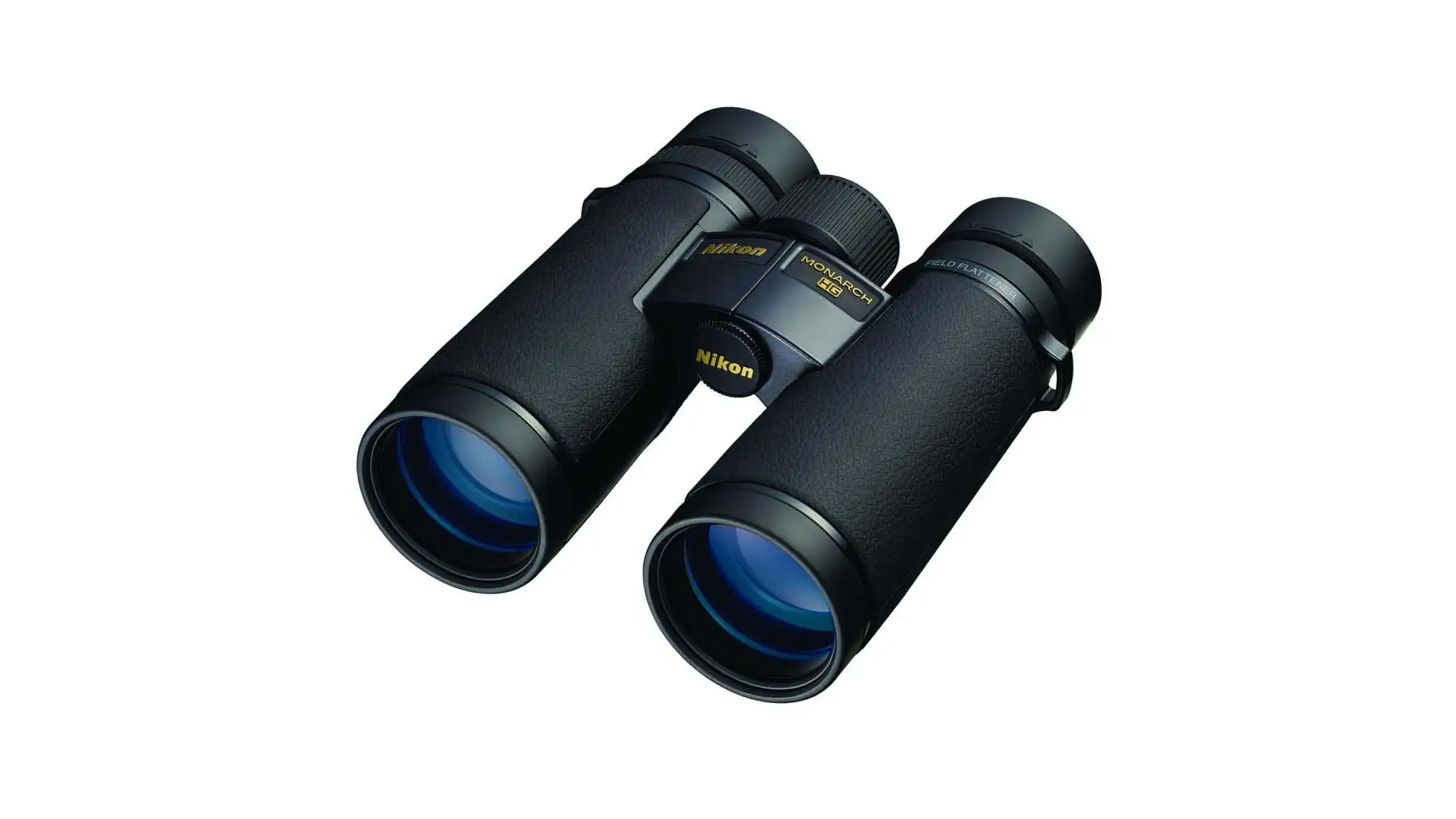
Best Nikon binocular, measured: Nikon Monarch HG 10x42mm Roof Prism Binoculars
10x · 42mm · BAK-4 roof prism · ED glass · Field Flattener Lens System · dielectric and phase-correction prism coatings · magnesium alloy body · 24 oz · waterproof to 16.4 ft for 10 minutes
around $1,000exact price on OpticsPlanet
This is the top of the ladder and the only Nikon binocular on this page whose optics have been measured by an independent laboratory rather than described by its manufacturer. AllBinos put it on a spectrophotometer and recorded 88.3 percent light transmission, then scored its distortion at a perfect 10 out of 10 with the first curved line pushed out to 92 percent of the field radius, and found edge blur only setting in at 84.5 percent of the way to the edge. Those two numbers are the Field Flattener Lens System doing exactly what Nikon claims for it, which is the rare case of a proprietary-sounding feature showing up in measured data. The same lab noted the binoculars are manufactured in Japan. Everything else on the ladder is here too: ED glass, fully multicoated optics, dielectric and phase-correction prism coatings, and a magnesium alloy body that keeps a 42mm at 24 oz. The one owner review is thin but unusually useful because he tests rather than admires, reading newspaper text at 50 yards for resolution and looking at a white fence in sun for chromatic aberration, and comparing against a Minox HG he has owned for twenty years. He rates the Nikon a touch brighter and then adds his own caveat, which we keep: perhaps there is better out there, but for the price he is satisfied. Two honest limits. The lab measured chromatic aberration at only 6.1 out of 10, medium to high at the extreme edge, despite the ED glass. And its transmission does not reach Nikon's advertised figure, which we cover in detail below.
Pros
- The only Nikon here with independent laboratory measurements behind it: 88.3 percent ± 1 percent light transmission on a spectrophotometer, not a manufacturer estimate
- Measured optical geometry is exceptional: distortion scored a perfect 10 out of 10 with the first curved line at 92 percent of the field radius, and edge blur only begins at 84.5 percent, which is the Field Flattener Lens System showing up in data
- Confirmed by the same laboratory as manufactured in Japan, the only rung on this ladder with a credible published assembly origin
- A magnesium alloy body keeps a full-size 42mm to 24 oz with a 6.6 ft close focus, the closest on this page, and it seals to 16.4 ft for 10 minutes
Cons
- It does not hit Nikon's advertised transmission. The manufacturer markets "up to 92 percent or higher"; the lab measured 88.3 percent on this model and 90.1 percent on the 8x30, and said in as many words that the promised 92 percent is not reached
- Chromatic aberration scored only 6.1 out of 10, slight in the centre but medium to high at the extreme edge, which is a modest result for a binocular built around ED glass
- At roughly seven times the price of the ProStaff P3, the measured gain over well-corrected mid-tier glass is real but incremental, and its own owner concedes there may be better out there
- The owner record is a single review, so there is almost no social proof to check our reading against
Best for: the serious birder, hunter or long-session observer who wants edge-to-edge sharpness and is buying once. If the seven-times price step is the question rather than the glass, a Monarch M5 or M7 carries the same ED glass and the same phase and dielectric coatings for a third to a half of the money.
Key specifications
| Manufacturer | Nikon |
|---|---|
| Magnification | 10x |
| Objective lens | 42 mm |
| Prism | BAK-4 roof |
| Prism coatings | Dielectric high-reflective multilayer + phase-correction |
| Lens material | ED glass with Field Flattener Lens System |
| Measured transmission | 88.3% ± 1% (independent lab) |
| Eye relief | 17 mm |
| Exit pupil | 4.2 mm |
| Field of view | 362 ft at 1000 yds |
| Close focus | 6.6 ft |
| Weight | 24 oz |
| Body | Magnesium alloy |
| Sealing | Waterproof to 16.4 ft for 10 min, nitrogen filled |
| Made in | Japan (independent lab observation) |
| MPN carded | 16028 (single offer, no demo variant) |
“My tests are to read the newspaper at 50 yards (resolution) and look at a white fence on a sunny day (chromatic aberration). I compare the Nikon HG to a pair of Minox HG 10x43 BR that I purchased 20 years ago, pretty close in performance, with the Nikon being just a tad brighter... Perhaps there is better out there but, for the price I am satisfied.”
snaffle, verified owner (CT) via OpticsPlanet
The 92% question, answered with lab data
Nikon markets the Monarch HG's dielectric coating as achieving up to 92 percent or higher light transmittance. That is the kind of number worth checking, because a manufacturer's transmission claim is a marketing statement until somebody puts the binocular on a spectrophotometer.
The independent optics laboratory AllBinos has done exactly that on two Monarch HG models. Its measured results:
| Model | Measured transmission | Nikon's claim |
|---|---|---|
| Monarch HG 10x42 | 88.3% ± 1% | "up to 92% or higher" |
| Monarch HG 8x30 | 90.1% ± 1% | "up to 92% or higher" |
The laboratory addressed the gap itself rather than leaving it to be inferred. Its verdict was that the binoculars do not reach the promised 92 percent, that at 600 nm you get a result near 91 percent, and that within the margin of error this is in accordance with the declared value. In other words the HG touches 91 percent at one specific orange-red wavelength while its transmission across the visible spectrum sits in the high eighties.
That is genuinely good glass and the claim is defensible at a single wavelength, but it is not 92 percent across the spectrum, and a buyer choosing between an HG and a European alpha binocular on that number deserves the measured figure rather than the advertised one. Note also what has not been measured: we found no published independent laboratory transmission data for any ProStaff model or for the Monarch M5 or M7, so nobody can tell you what those pass. Anyone who does is estimating.
The same laboratory's other measurements on the 10x42 are worth having, because they cut both ways: a perfect 10 out of 10 for distortion and edge blur held off until 84.5 percent of the field radius, which validates the Field Flattener Lens System, but only 6.1 out of 10 for chromatic aberration, medium to high at the extreme edge, in a binocular built around ED glass.
Every current Nikon binocular, priced
The three models above are the ones we card, but the ladder is wider than that. Where a rung is carded on this site, its price is re-read against the retailer on our normal schedule and shown as a band. Where it is not, we give a ceiling instead of a figure, because a price nothing on our side ever re-reads is a price that quietly goes stale. Every figure here was taken from the full offer list on the retailer's product page rather than the headline figure, which matters more than it sounds: on one of these listings the cheapest offer is a factory demo unit rather than the new model.
| Model | Price | Coatings | Notes |
|---|---|---|---|
| ProStaff P3 8x42 | around $140 | Silver-alloy, no phase correction | Replaces the 3S |
| ProStaff P7 10x30 | around $190 | Dielectric + phase correction | Replaces the 7S |
| Monarch M5 10x42 | under $400 | Dielectric + phase correction + ED | |
| Monarch M5 12x42 | under $400 | Dielectric + phase correction + ED | |
| Monarch M7 8x42 | around $490 | Dielectric + phase correction + ED | Read our M7 8x42 review |
| Monarch M7 10x30 | under $600 | Dielectric + phase correction + ED | |
| Monarch HG 10x42 | around $1,000 | + Field Flattener, magnesium body |
The Monarch M5 8x42 sits between these rungs and has its own full review, which carries its price on the same schedule as the carded figures above. We keep that figure in one place rather than repeating it here, because a number written twice is a number that can rot in one place and stay right in the other.
Where they are made
This question comes up in every Nikon binocular discussion and usually gets answered with more confidence than the evidence supports. Only two rungs can be answered credibly.
The Monarch HG is made in Japan. The independent laboratory that measured its transmission also physically inspected the unit and recorded that the Monarch HG series, like its predecessors, is manufactured in Japan. The ProStaff P3 is made in China, listed as the country of origin by multiple major retailers and printed on the packaging.
For the ProStaff P7, the Monarch M5 and the Monarch M7 we are not going to tell you, because we could not find a source worth quoting. Marketplace listings do claim origins for these lines, including one that describes a P7 as made in Japan, but a single third-party listing is not evidence, and a Japanese-built binocular at this price would be an anomaly. Older Monarch generations were built in China and in the Philippines, but we found no documentation for the current M5 and M7. If assembly country matters to your purchase, buy the rung where it is documented.
How to choose
- Buy the coating step, not the price step. The single biggest optical jump in this range is P3 to P7, a $60 difference, because that is where phase correction arrives. Nothing above it delivers as much improvement per dollar.
- Check eye relief before magnification if you wear glasses. The cheapest binocular here has the longest eye relief at 20.2 mm and the most expensive has 17 mm. Price does not track comfort in this range.
- Do not buy a 30mm for dawn and dusk. Exit pupil is objective divided by magnification: 3.0 mm on a 10x30 against 4.2 mm on a 10x42, both narrower than a dilated eye. The small objective gives up its ground exactly at the hours hunters care about.
- M5 to M7 is not a glass upgrade. Both use ED glass with the same prism coatings. You are paying for field of view and a repellent lens coating, which is worth it for birding and close to irrelevant for static glassing.
- Treat retailer spec fields as a lead, not a fact. The P3's weight is listed as 16.8 oz by the retailer and 590 g by Nikon, a difference of about 114 g. When the two disagree, the manufacturer wins.
Comparing across brands instead of within Nikon? Our best 8x42 binoculars and best binoculars for hunting rank the whole field, and Vortex Razor binoculars is the same kind of line decoder for Vortex's flagship range. Birding specifically? See best binoculars for birding. Carrying them all day calls for a binocular harness.
FAQ
What replaced the Nikon ProStaff 3S and ProStaff 7S?
The ProStaff P3 replaced the 3S and the ProStaff P7 replaced the 7S, both announced on June 9, 2022. Nikon states it directly, describing the P3 binoculars as the successors of the popular ProStaff 3S series and the P7 as improving upon the previous ProStaff 7S models. The older ProStaff 5 and ProStaff 7 binoculars have no direct numbered successor; the P3 and P7 between them absorbed those slots when Nikon simplified the range. So if you are searching for a 3S or a 7S, you are searching for a discontinued product, and the current equivalent is the P3 or the P7 respectively.
What is the difference between Nikon ProStaff and Monarch binoculars?
Two things, and only one of them is glass. First, coatings: the ProStaff P3 has neither a phase-correction coating nor a dielectric prism coating, the ProStaff P7 adds both, and every Monarch has both. Second, glass: every Monarch from the M5 upward uses ED (extra-low dispersion) glass to suppress colour fringing, and no ProStaff does. That is the actual dividing line. In practice the jump from P3 to P7 buys you corrected optics, and the jump from P7 to Monarch buys you ED glass on top. The Monarch HG then adds a Field Flattener Lens System, which independent laboratory measurement confirms is real: it scored a perfect 10 out of 10 for distortion with edge blur held off until 84.5 percent of the way to the field edge.
Do Nikon Monarch HG binoculars really reach 92% light transmission?
No, and the measurement is public. Nikon markets the Monarch HG dielectric coating as achieving up to 92 percent or higher light transmittance. The independent optics laboratory AllBinos measured the Monarch HG 10x42 at 88.3 percent ± 1 percent and the Monarch HG 8x30 at 90.1 percent ± 1 percent on a spectrophotometer. The lab addressed the claim directly, writing that the binoculars do not reach the promised 92 percent, that at 600 nm you get a result near 91 percent, and that within the margin of error this is in accordance with the declared value. So the honest reading is that the HG brushes 91 percent at a specific orange-red wavelength while its overall transmission sits in the high eighties. That is very good glass. It is not 92 percent across the spectrum.
Is the Nikon ProStaff P3 good enough, or should I buy the P7?
It depends on which compromise hurts you less, because the two models trade in opposite directions. The P3 is optically simpler but physically more comfortable: no phase-correction coating and a silver-alloy prism mirror, but 20.2 mm of eye relief, a 5.3 mm exit pupil and a 42mm objective. The P7 is optically complete but physically tighter: dielectric and phase-correction coatings plus a locking diopter, but a 30mm objective, a 3.0 mm exit pupil and only 15.4 mm of eye relief. If you wear glasses or glass in poor light, the P3 will please you more despite being the cheaper instrument. If you want the sharpest, highest-contrast image and you use it in reasonable light, buy the P7.
Is a 10x30 binocular bright enough compared with a 10x42?
In daylight the difference is hard to see; in the last twenty minutes of light it is obvious. Exit pupil is the objective divided by the magnification, so a 10x30 delivers a 3.0 mm column of light and a 10x42 delivers 4.2 mm. A healthy eye dilates past 5 mm in twilight, so both are already narrower than your pupil, but the 30mm falls short by more and the gap shows exactly when you need it. What is worth knowing is how small the practical penalty can be earlier in the day. The one verified owner of the ProStaff P7 10x30 compared it at dusk against his own 10x42 and reported not much difference at all in what he could see, reading street sign letters at about 150 yards. That is one owner rather than a controlled test, but it matches the physics: the 30mm gives up its ground at the very fringes of the day, not through it.
Where are Nikon binoculars made?
It depends on the line, and only two rungs can be answered credibly. The Monarch HG is made in Japan, confirmed by the independent laboratory that physically inspected a test unit. The ProStaff P3 is made in China, listed as the country of origin by multiple major retailers and shown on the packaging. For the ProStaff P7, the Monarch M5 and the Monarch M7, we found no credible manufacturer statement, industry report or laboratory observation, so we are not going to tell you. Single retailer listings and forum posts do claim origins for these lines, but a marketplace listing is not a source we will publish a fact from.
Which Nikon binocular should I buy for birding?
Work down from the field of view and eye relief rather than up from the price. Among the models here the ProStaff P3 8x42 has both the widest field of view at 456 ft and the longest eye relief at 20.2 mm, which is why it suits beginners and spectacle wearers finding small moving birds in foliage, and 8x is easier to hold steady on a warbler than 10x. If you want the same forgiving format with ED glass and corrected prisms, the Monarch M5 8x42 is the natural step up, and the Monarch M7 8x42 above it widens the view further. The Monarch HG 10x42 is the sharpest instrument on this page but 10x and a narrower field make it better suited to open country, shorebirds and raptors than to dense cover.
Related: Nikon Monarch M5 8x42 review · Nikon Monarch M7 8x42 review · best 8x42 binoculars · Vortex Razor binoculars decoded.