Leica Geovid R review: Leica glass with a simple laser, and no solver
Our verdict: 4.3/5. The Leica Geovid R is a roof-prism binocular with a laser rangefinder inside, and the 10x42 is the model we review here. Leica's own data sheet rates the laser from 10 up to approx. 1,800 m (Leica's US site says up to 2,000 yds), with EHR, an angle-corrected distance, up to approx. 1,100 m and a 0.3 second measuring time. It is deliberately simple: Leica lists two measuring modes, scanning and single, and "Ballistic function: no". Buy it if you want Leica optics and a fast, plain distance in one device. Skip it if you want the binocular to give you a hold. The catches are weight (approx. 33.7 oz for the 10x42 per Leica), a small owner record, and one reviewer whose rangefinder went dead after a few uses. The 15x56 is the 15x model in the same line. Compare it with the Vortex Ranger HD 3000 and the picks in our best rangefinding binoculars guide.
OpticsPlanet shoppers rate the 10x42 4.0/5 from 4 reviews and the 15x56 5.0/5 from 2. The 10x42 (MPN 40812) sells for around $1,750 and the 15x56 (MPN 40814) for around $2,000. Check price and availability on OpticsPlanet; confirm the current price on the retailer page.
How we reviewed it: a research-based review built from Leica's own technical data sheet for the Geovid R (version date September 2022), Leica's US product pages for the 10x42 and 15x56, Leica Camera USA's sport optics warranty page, the two OpticsPlanet listings and every review they show (4 for the 10x42, 2 for the 15x56). Where the retailer's spec table and Leica disagree, we print Leica's figure and say so. Research leads we could not confirm on a primary source, including an award, a launch date and failure reports from forums, were left out. We have not used this binocular ourselves; the score is our editorial opinion and owner ratings are shown attributed to their source. See how we evaluate.
What the Geovid R is, and what it is not
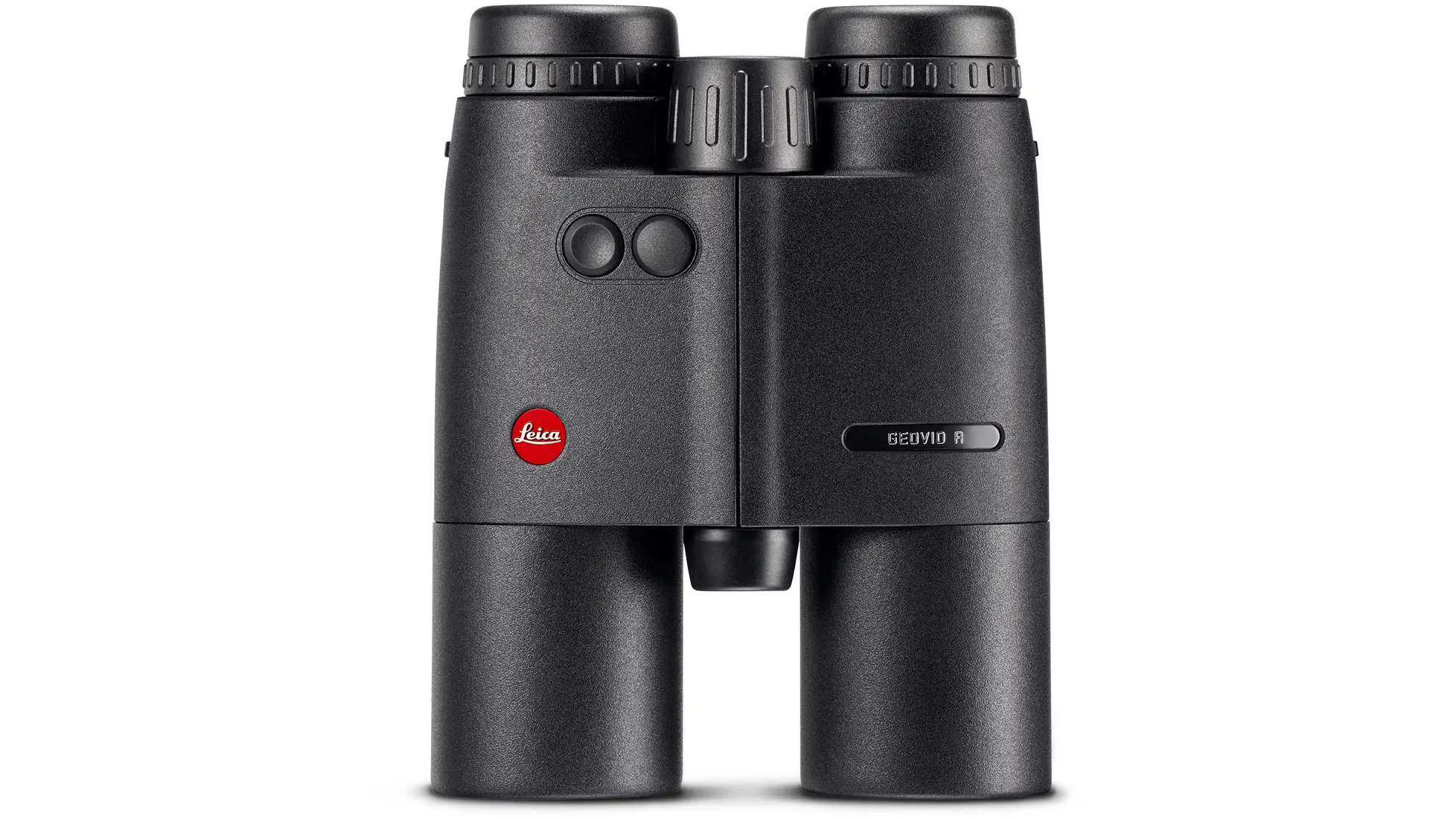
The Geovid R puts a laser rangefinder inside a roof-prism binocular. Leica's data sheet names the prism as a Modified Uppendahl system with HDC multilayer coating, internal focusing via a central drive, and a nitrogen-filled aluminum housing that is waterproof to 16.5 ft (5 m). The distance shows on an LED display with 4 digits, which Leica calls "easily legible in any light"; the OpticsPlanet listing adds that its brightness adjusts automatically to ambient light. You can switch between meters and yards, per Leica.
Leica's US site describes the line as "the new generation of Geovid R rangefinder binoculars", and its data sheet covers four sizes: 8x42, 10x42, 8x56 and 15x56. OpticsPlanet lists all four; this page reviews the 10x42 and the 15x56, the two with owner reviews. OpticsPlanet's search also returns other Geovid listings (HD-R, HD-B, Pro, and Geovid R listings with "w-ehr" in the web address). We did not review those, and none of their figures appear here, so check the part number, 40812 or 40814, before you buy.
The rangefinder: range, EHR and what it does not do
Leica's data sheet gives the same rangefinder figures for the 10x42 and the 15x56:
- Range: 10 up to approx. 1,800 m. Leica's US product pages for both sizes put it as "up to 2,000 yds (1,800 m)".
- EHR: 10 up to approx. 1,100 m, which is about 1,200 yards (our arithmetic). EHR is equivalent horizontal range, a distance corrected for the angle of the shot.
- Accuracy: plus or minus 1 yd to 383 yds, plus or minus 2 yds to 765 yds, and plus or minus 0.5 % above 765 yds (plus or minus 1 m to 350 m, 2 m to 700 m, 0.5 % above 700 m).
- Measuring time: 0.3 sec. Modes: scanning mode and single measurement.
- Laser: eye-safe invisible laser according to EN and FDA class 1.
What it does not do matters as much. Leica's sheet says "Ballistic function: no", so the Geovid R gives you a distance, and in EHR an angle-corrected one, but never a holdover in MOA, MIL or inches. Leica does not say what kind of target the 1,800 m figure applies to in the documents we read, and gives no separate figure for game. The OpticsPlanet spec table lists "2000 yds"; we use Leica's wording.
If you want the binocular to tell you where to hold, our best rangefinding binoculars guide explains the difference between a solver model and an angle-compensating one like this. Bowhunters can read how to use a rangefinder for bow hunting for why the angle-corrected number is the one to use on steep shots.
What 10x42 owners say
The 10x42 listing shows 4 reviews: three five-star and one one-star, for a 4.0 average. Two carry a Verified Owner tag. The other two appear only in OpticsPlanet's "Most Helpful" boxes with no date or tag shown, so we call them reviewers. Four reviews is too few to call anything a pattern, and it means the single one-star review moves the average a long way. Two of the three five-star reviews are about the glass and how easy the ranging is:
“The optical quality is crystal clear and consistent with what i would expect from Leica. The range finding feature works flawlessly.”
Jacques (WY), reviewer, via OpticsPlanet
“Excellent optics,easy range finding function.”
William Robinson (MS), verified owner, via OpticsPlanet
The same reviewer from Wyoming adds that "The rangefinder is very easy to understand and use." William Robinson lists "great warranty from a great company" among the pros and "None" as the con. The fourth review, a verified owner from Louisiana, is about the purchase rather than the binocular: "Item came as described."
Weight comes up twice, from two angles. Jacques writes that "The only drawback is the weight", while William Robinson calls it "Average weight for binos this size". Leica lists the 10x42 at approx. 33.7 oz (955 g) without battery. For comparison, our Vortex Ranger HD 3000 review covers a 10x42 rangefinding binocular that Vortex lists at 32.4 oz.
The one-star review, and what Leica's warranty page says
OpticsPlanet shows this as the "Most Helpful Negative" review on the 10x42, and 14 of 14 readers found it helpful. The reviewer, Bill from Nebraska, writes that the binocular was defective new:
“The rangefinder on this binocular worked a few times and then completely went dead.”
Bill (NE), reviewer, via OpticsPlanet
Bill also writes that a Leica representative "absolutely refused to cover the shipping cost to have this repaired", and that they were sending the binocular back for a refund. That is one reviewer's account; we do not know Leica's side of it, and it is the only fault report across the six reviews on the two listings.
Leica Camera USA's sport optics warranty page describes a 10-year Passport Protection Plan plus a 30-year manufacturer's warranty for Leica sport optics shipped to authorized USA or Canadian dealers since January 1, 2021. For the 10-year plan, the page says Leica "will repair or replace your Leica Sport Optic product purchased from an Authorized USA and Canadian dealer in the event it becomes damaged or defective, at no charge to you." The 30-year term is described as a "30-year warranty on the optical system", and the page states that non-optical products, such as accessories, are covered for two years. It does not name the Geovid R, does not single out rangefinder electronics, and does not say who pays to ship a product in for service, the point Bill disputes. Confirm with Leica how a laser fault and the shipping would be handled, and that your purchase qualifies, before you buy.
The honest catches
No solver, by design. Leica lists no ballistic function. If you shoot long range off a ballistic app, you read the EHR distance and enter it yourself.
Weight. Approx. 33.7 oz for the 10x42 and more for the 15x56, both without battery, per Leica. Two of the six reviewers on the two listings name weight as a drawback.
One reported laser failure, a small record. Six reviews across two listings, one of them a rangefinder that died early. Not a pattern, but there is not enough data to rule one out either.
Retailer and maker figures differ. The OpticsPlanet spec table lists eye relief of 15.6 mm on the 10x42 and 16.6 mm on the 15x56; Leica lists 14.5 mm and 15 mm. Leica also gives eye relief and a separate field of view for spectacle wearers. If you hunt in glasses, use Leica's numbers.
Trade-offs, plainly
- Distance only, angle-corrected in EHR: Leica lists "Ballistic function: no".
- Approx. 33.7 oz for the 10x42 per Leica; one reviewer calls the weight the only drawback.
- One reviewer reports a rangefinder that went dead after a few uses and a shipping dispute with Leica.
- Only 6 owner reviews across the two listings.
- Leica's 1,800 m range is not split by target type in the documents we read.
Which Geovid R: 10x42 or 15x56
Both share the rangefinder, battery, housing and prism. The optics and the size are what change:
Key specifications
| Spec (Leica data sheet) | Geovid R 10x42 | Geovid R 15x56 |
|---|---|---|
| Order no. (Leica) / OpticsPlanet MPN | 40812 | 40814 |
| Magnification x objective | 10x42 | 15x56 |
| Exit pupil | 4.2 mm (42 / 10) | 3.7 mm (56 / 15 = 3.73) |
| Twilight factor | 20.5 | 28.2 |
| Field of view at 1,000 yds | 330 ft (110 m at 1,000 m) | 225 ft (75 m at 1,000 m) |
| Field of view for spectacle wearers | 315 ft (105 m) | 194.4 ft (64.8 m) |
| Eye relief | 14.5 mm | 15 mm |
| Close focus | approx. 18.4 ft (5.6 m) | approx. 19.4 ft (5.9 m) |
| Diopter compensation | plus or minus 4 dpt | plus or minus 4 dpt |
| Prism system | Modified Uppendahl system | Modified Uppendahl system |
| Lens coating | HDC multilayer coating | HDC multilayer coating |
| Range | 10 up to approx. 1,800 m | 10 up to approx. 1,800 m |
| EHR (equivalent horizontal range) | 10 up to approx. 1,100 m | 10 up to approx. 1,100 m |
| Measuring time | 0.3 sec. | 0.3 sec. |
| Measuring modes | Scanning mode, single measurement | Scanning mode, single measurement |
| Ballistic function | no | no |
| Display | LED, 4 digits | LED, 4 digits |
| Laser | Eye-safe invisible, EN and FDA class 1 | Eye-safe invisible, EN and FDA class 1 |
| Battery | 1 x 3 V lithium CR2, approx. 2,000 measurements at 68 F | 1 x 3 V lithium CR2, approx. 2,000 measurements at 68 F |
| Watertightness | waterproof to 16.5 ft (5 m) | waterproof to 16.5 ft (5 m) |
| Housing | Aluminum, nitrogen-filled | Aluminum, nitrogen-filled |
| Dimensions (W x H x D) | 4.9 x 6.6 x 2.8 in | 5.3 x 8.3 x 2.8 in |
| Weight (without battery) | approx. 33.7 oz (955 g) | approx. 45.9 oz / 1,260 g as printed (see note) |
| OpticsPlanet rating | 4.0/5 from 4 reviews | 5.0/5 from 2 reviews |
| Price (OpticsPlanet) | around $1,750 | around $2,000 |
Figures are from Leica's Geovid R technical data sheet (version date September 2022), except the exit pupil arithmetic and the ratings and prices, which are OpticsPlanet's. Weight note: Leica's sheet prints the 15x56 as approx. 45.9 oz / 1,260 g without battery, but 1,260 g works out to about 44.4 oz (our arithmetic), so the two printed figures do not match each other; the OpticsPlanet spec table lists 45.9 oz. Leica lists the same tripod adapter, 42 220, as an accessory for both sizes.
The 10x42 is the one to carry. It has the wider view, 330 ft at 1,000 yds against 225 ft, the closer focus and the lower weight. The 15x56 trades that for 15x magnification and a twilight factor of 28.2 against 20.5, with a smaller 3.7 mm exit pupil. At 15x and Leica's printed weight, plan on a tripod; the tripod adapter is an accessory, not part of the scope of delivery Leica lists.
Leica's data sheet lists the same scope of delivery for both: contoured neoprene carrying strap, front lens cover, eyepiece caps, cordura case and battery. It does not list a harness. The OpticsPlanet package contents name only the binocular, so confirm what is in the box with the retailer.
Geovid R 15x56
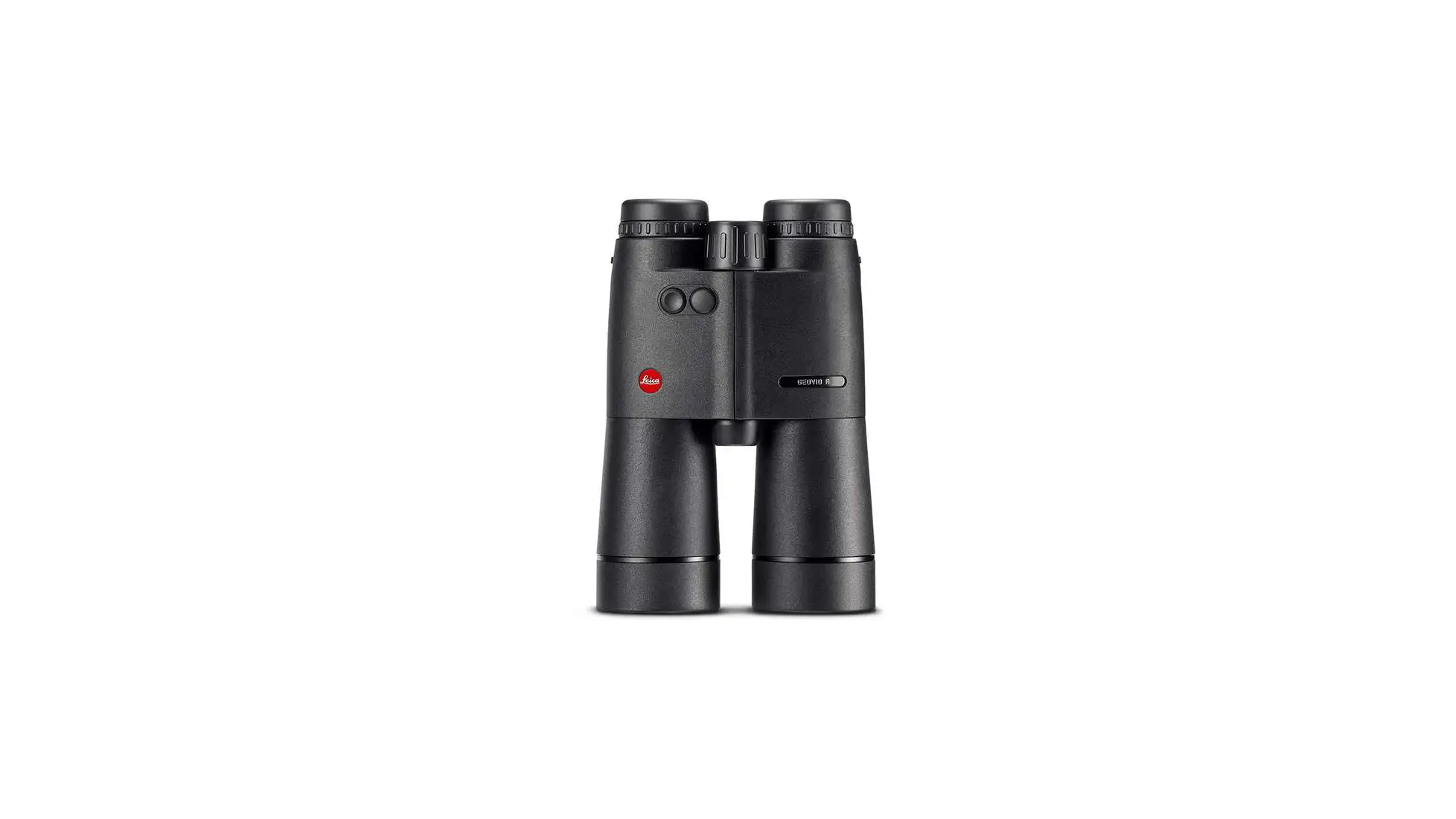
The 15x56 listing (MPN 40814) shows 2 reviews, both five-star, neither with a Verified Owner tag. One reviewer from Indiana writes:
“Excellent glass and easy to use. A joy to own. It has everything I need and no extra frills that one rarely uses anyway.”
luckySarge (IN), reviewer, via OpticsPlanet
The other, from Arizona, rates it five stars, lists "little heavy" as the con, and has two wishes about the accessories:
“My only concern is that a better harness should have been provided. Wider back support. Also a better carry case.”
nick (AZ), reviewer, via OpticsPlanet
If you plan to carry the 15x56 on your chest, our best binocular harness guide covers the options. Two reviews are a start, not a verdict.
Should you buy it, and what else to consider
- Buy the Geovid R 10x42 if you want Leica optics with a fast, simple distance and an angle-corrected EHR reading, and you do not need a solver.
- Buy the 15x56 if you glass from a tripod at long distance and want more magnification in the same rangefinder line.
- Look at a solver model if you want the hold in the display: our best rangefinding binoculars guide covers them.
- Pair a plain binocular with a handheld rangefinder if you want less weight on your chest: see our best binoculars for hunting and best hunting rangefinder guides. New to the numbers? Read what binocular numbers mean.
FAQ
Is the Leica Geovid R a ballistic rangefinding binocular?
No. Leica's technical data sheet for the Geovid R lists "Ballistic function: no". What it does have is EHR, equivalent horizontal range, which Leica rates from 10 up to approx. 1,100 m. You get a distance corrected for the angle, not a holdover. Leica's site also lists Geovid Pro and Geovid Max models; this page covers only the Geovid R 10x42 (40812) and 15x56 (40814).
How far does the Leica Geovid R range?
Leica's US product pages for the 10x42 and the 15x56 both say "up to 2,000 yds (1,800 m)", and Leica's data sheet gives the range as 10 up to approx. 1,800 m for both. Leica does not say what kind of target that maximum applies to in the documents we read. The OpticsPlanet spec table lists 2000 yds.
Which should I buy, the Geovid R 10x42 or the 15x56?
The 10x42 for carrying and glassing by hand: Leica lists it at approx. 33.7 oz (955 g) without battery with a 330 ft field of view at 1,000 yds. The 15x56 if you glass from a tripod at long distance: more magnification and a twilight factor of 28.2 against 20.5, but a 225 ft field of view and a weight Leica gives as 1,260 g. Leica lists a tripod adapter (42 220) as an accessory for both.
What battery does the Leica Geovid R use, and how long does it last?
One 3 V lithium CR2. Leica rates it for approx. 2,000 measurements at 68 F (20 C), and the battery is in Leica's scope of delivery. The OpticsPlanet spec table says "2000 hours"; Leica's unit is measurements, and we follow Leica.
Is the Leica Geovid R waterproof?
Leica's data sheet lists it as waterproof to 16.5 ft (5 m), with a nitrogen-filled aluminum housing, for both the 10x42 and the 15x56.
What do OpticsPlanet reviewers say about the Geovid R?
The record is small. The 10x42 is rated 4.0 out of 5 from 4 reviews: two of the three five-star reviews praise the optics and the easy ranging, and one one-star reviewer writes that the rangefinder worked a few times and then went dead, and describes a dispute with Leica over shipping for the repair. The 15x56 is rated 5.0 from 2 reviews; one of those reviewers lists "little heavy" as the con and wanted a better harness and carry case.