The best long range and ballistic rangefinders for 2026
Our verdict for 2026: the Vortex Razor HD 4000 GB (around $800) is the best long-range rangefinder for most shooters, because it puts a 4,000-yard laser, a GeoBallistics solver, environmental sensors and Kestrel pairing in one hand, and because Vortex is the only brand here that does not shorten its warranty for electronics. Want the same laser without the solver? The Razor HD 4000 (around $460) is the same magnesium body and the same published ranging distances. Want the best value? The Viper HD 3000 (around $400) is lighter than the Razor and still rated to 2,000 yards on deer.
Before you buy on the yardage: the number on the box is a reflective-target figure. Every manufacturer here publishes a much shorter one for game, and the gap gets wider as the headline gets bigger.
Prices verified October 14, 2026; confirm the current price and availability on the retailer page. Ratings are OpticsPlanet customer ratings, attributed to OpticsPlanet, never our own.
Quick comparison
| Rangefinder | Role | Key spec | Price |
|---|---|---|---|
| Vortex Razor HD 4000 GB | Best overall | 7x · 4,000 yd · onboard solver | around $800 |
| Vortex Viper HD 3000 | Best value | 7x · 3,000 yd · lightest Vortex here | around $400 |
| SIG SAUER KILO5K | Best for a BDX rifle scope | 7x · 5,000 yd reflective · 7.5 oz | around $700 |
| Revic BR4 | Best dedicated ballistic computer | 10x · 4,000 yd · 10 profiles | around $1,300 |
| Vortex Razor HD 4000 | Best without a solver | 7x · 4,000 yd · no solver | around $460 |
| Vortex Diamondback HD 2000 | Best entry point | 7x · 2,000 yd · 7.6 oz | around $250 |
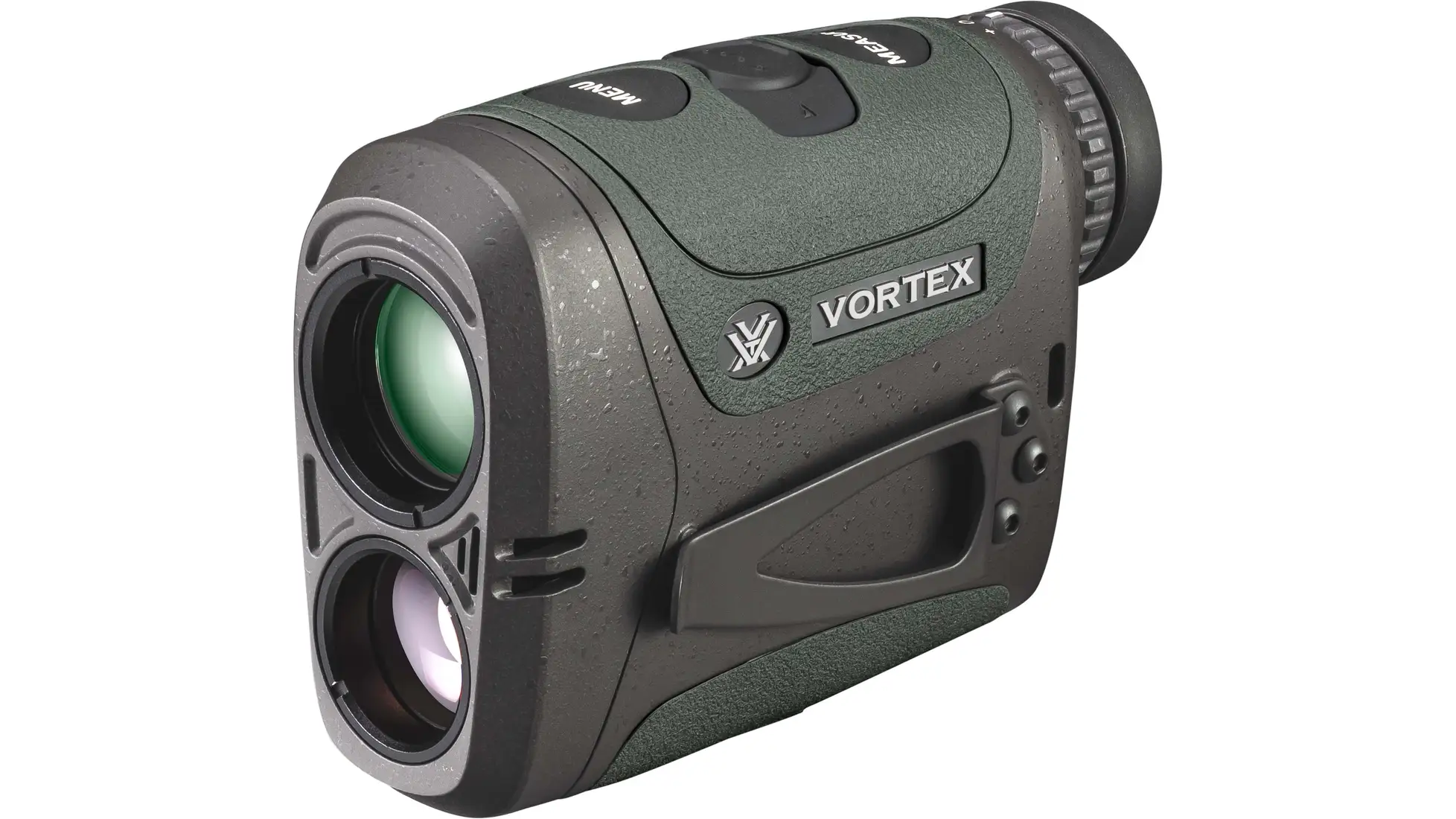
Best overall: Vortex Razor HD 4000 GB
Laser · 7x25 · GeoBallistics solver · 4,000 yd reflective · magnesium
around $800exact price on OpticsPlanet
This is the one to buy if you want the range and the firing solution in the same hand. The GB adds the GeoBallistics solver, a compass, humidity, barometric pressure and an exposed temperature sensor to the Razor chassis, then prints wind and drop straight into the display, with two wind modes including a patented wind-bearing capture. Vortex publishes 4,000 yards reflective, 2,500 on trees and 2,200 on deer, and the accuracy figure is a half-yard at 100. It also pairs with a Kestrel, which is the feature owners mention most often and the one that decides the buy for anyone already carrying a weather meter. Unlike every other brand here, the Vortex warranty has no electronics carve-out, which matters more on a computer than on a piece of glass.
Pros
- Onboard GeoBallistics solver with wind and drop in the display, plus two wind modes
- Compass, humidity, pressure and temperature sensors on board, so the solution updates with conditions
- Pairs with Kestrel weather meters, the upgrade path most owners cite
- Vortex VIP warranty is unlimited, lifetime and names rangefinders, with no separate electronics term
- The app tier that matters is free with the unit: GeoBallistics PRO comes with any enabled product
Cons
- The heaviest handheld here at 10.1 oz, and two owners say so unprompted
- It takes real setup work: one owner notes you need chronograph access to make the ballistic profile honest
- Owners report the wind-adjustment buttons are stiff and awkwardly placed, and the abbreviated menu wording is hard to read
- Vortex publishes 2,200 yards on deer against the 4,000 on the box, and the best owner-reported read we found is 2,200
Best for: precision shooters and long-range hunters who want the solver, the sensors and the Kestrel link in one device, and who will actually do the profile work. Skip it if you only need distance, where the plain Razor HD 4000 is the same laser for less.
Key specifications
| Type | Laser rangefinder with onboard ballistic solver |
|---|---|
| Magnification | 7x |
| Objective | 25 mm |
| Range (Vortex) | 4,000 yds reflective / 2,500 trees / 2,200 deer |
| Min range | 5 yds |
| Accuracy (Vortex) | 0.5 yd at 100 yds |
| Solver | GeoBallistics, three preloaded profiles or custom via app |
| Sensors | Compass, humidity, barometric pressure, temperature |
| Max angle | +/- 89 degrees |
| Weight | 10.1 oz |
| Chassis | Magnesium |
| Battery | CR2 |
| Warranty | Vortex VIP, unlimited lifetime, no electronics carve-out |
“I had the GB app set up with my rifles in the range finder within an hour. Easily hit ranges to 2200, but have not tried much further yet.”
Garrett, verified owner (ND) via OpticsPlanet
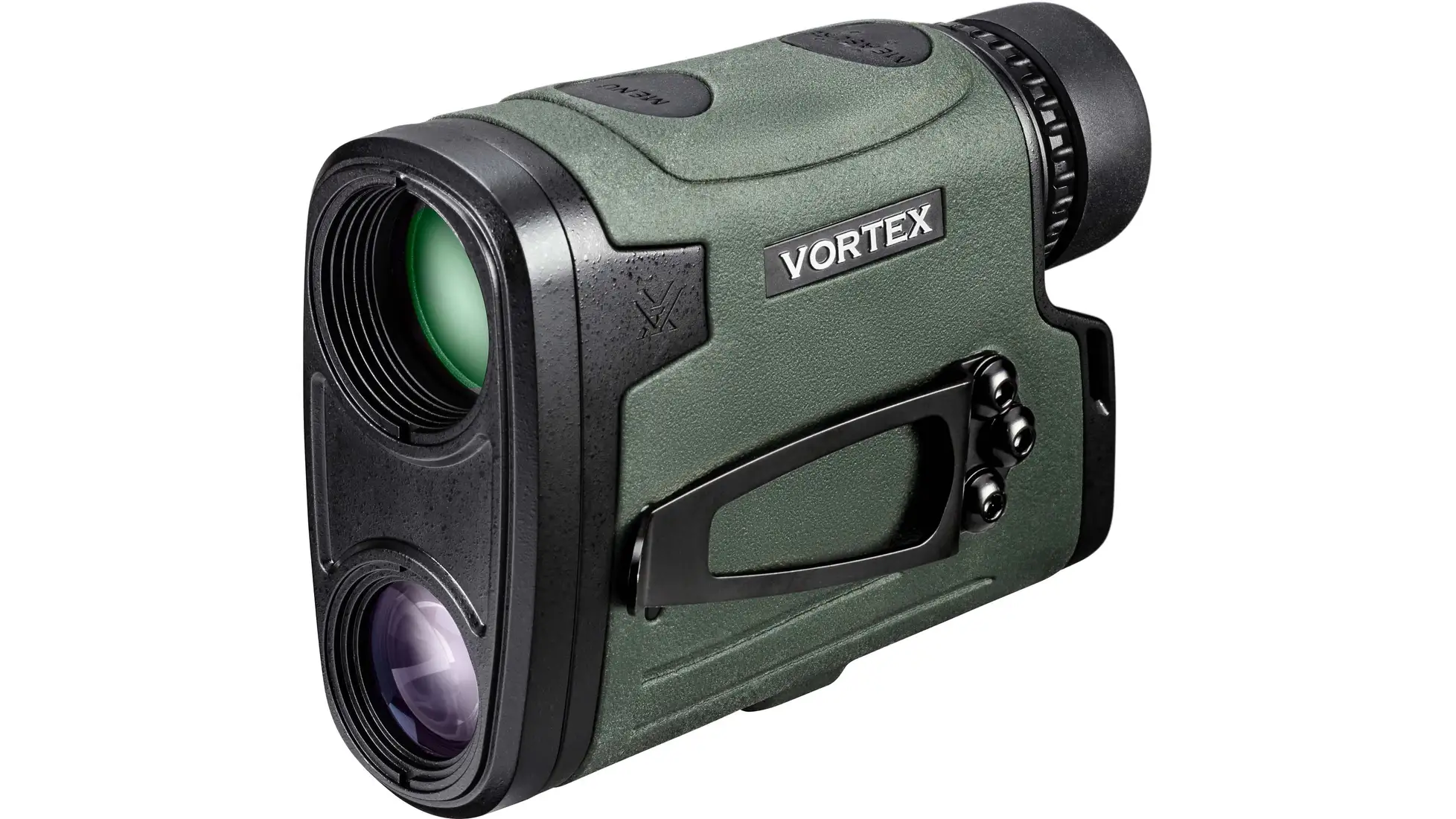
Best value: Vortex Viper HD 3000
Laser · 7x25 · 3,000 yd reflective · four target modes · 9.1 oz
around $400exact price on OpticsPlanet
The value pick, and the one that quietly beats its own big brother on two numbers. Vortex publishes the Viper HD 3000 at 9.1 oz against the Razor HD 4000's 9.9 oz, so the cheaper unit is the lighter one, and its published accuracy is 1 yard at 100 against the Razor's half-yard, which is a difference nobody feels in the field. What you give up is a thousand yards of reflective reach you were never going to use on game and the solver. What you keep is the same 7x HD glass, four target modes including an extended-range mode, both LOS and HCD ranging, and the same warranty. Vortex still publishes 2,000 yards on deer, which is more animal range than the Diamondback's headline number.
Pros
- Lighter than the more expensive Razor HD 4000, at 9.1 oz against 9.9 oz, both figures published by Vortex
- Four target modes (Normal, First, Last, ELR) plus LOS and HCD ranging
- 2,000 yards published on deer, which equals the KILO5K's deer figure at a much lower price
- Same Vortex VIP unlimited lifetime warranty, electronics included
Cons
- No ballistic solver, no sensors and no Bluetooth: this ranges, it does not compute
- Two owners independently call the mode wording on the display hard to decipher, and one reports missing illuminated segments
- One owner reports the battery compartment cap threads poorly and does not sit flush
- Runs on a CR123 rather than the CR2 the rest of the Vortex line here uses, so it is a different spare in your pack
Best for: the shooter who wants long-range glass and reach without the solver, and who would rather put the difference into ammunition. Step up to the GB only if you genuinely want the firing solution in the display.
Key specifications
| Type | Laser rangefinder (no solver, no Bluetooth) |
|---|---|
| Magnification | 7x |
| Objective | 25 mm |
| Range (Vortex) | 3,000 yds reflective / 2,300 trees / 2,000 deer |
| Min range | 6 yds |
| Accuracy (Vortex) | 1 yd at 100 yds |
| Target modes | Normal, First, Last, ELR |
| Ranging modes | LOS and HCD |
| Max angle | +/- 89 degrees |
| Weight | 9.1 oz |
| Battery | CR123 |
| Warranty | Vortex VIP, unlimited lifetime, no electronics carve-out |
“Paying often twice the amount more will only grab you a smattering of benefits. My 49-year-old eyes can't see the increased clarity from going one step up.”
B-Mac, verified owner (VA) via OpticsPlanet
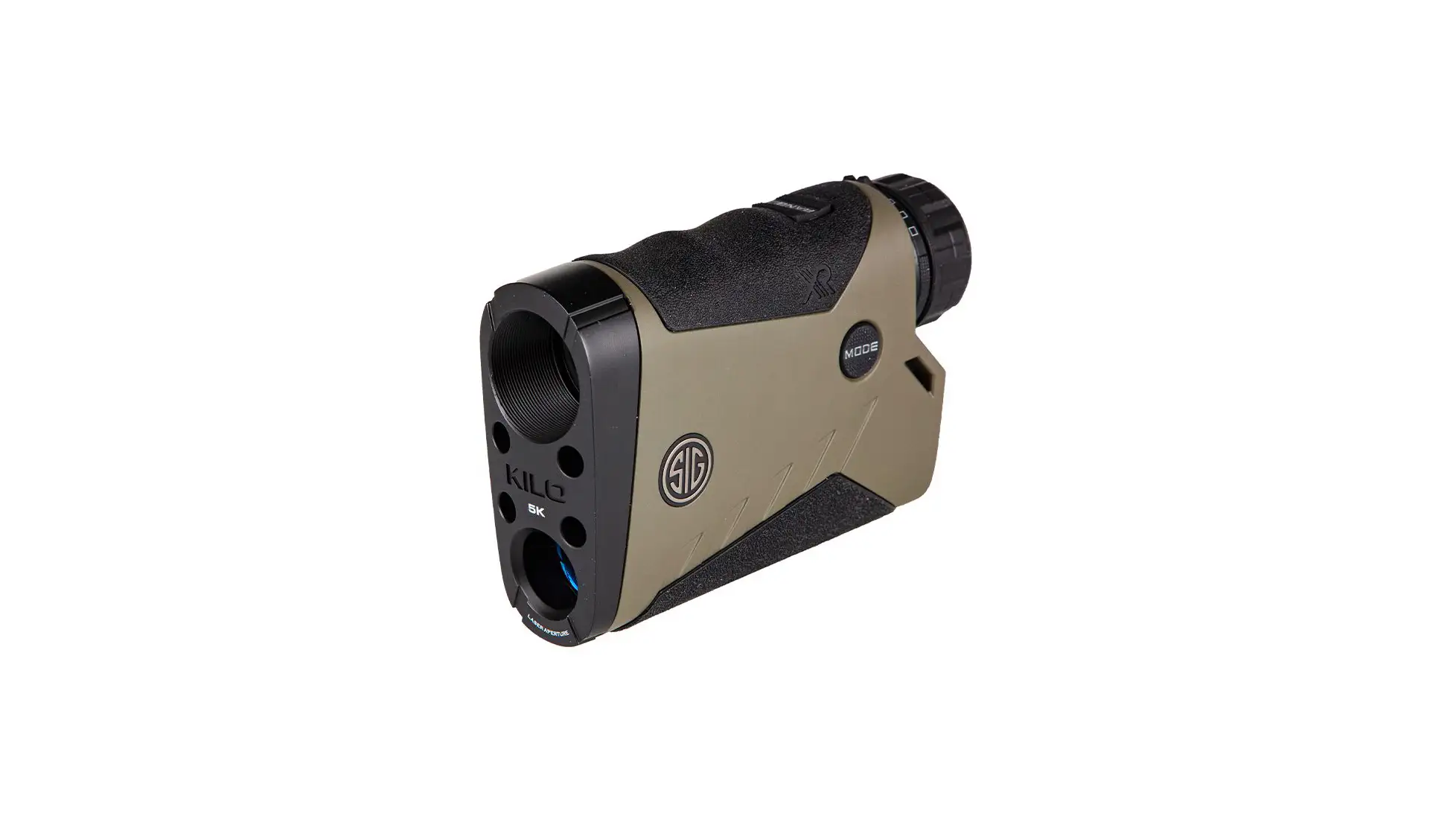
Best for a BDX rifle scope: SIG SAUER KILO5K
Laser · 7x25 · Applied Ballistics Ultralite · BDX 2.0 · 7.5 oz
around $700exact price on OpticsPlanet
The lightest unit on this page by a clear margin at 7.5 oz, and the one to buy if you already run a BDX-enabled SIG scope, because the rangefinder pushes the hold straight to the optic instead of asking you to read and dial. It carries Applied Ballistics Ultralite on board with up to 25 custom bullet profiles, environmental sensors, an OLED display and BDX-X for pairing to a Kestrel or Garmin. Three of its four owner reviews single out the Bluetooth link as the thing that works. Read the solver limit below before you buy it as a first-round-hit tool at distance, because it is the sharpest caveat on this page and SIG publishes it themselves.
Pros
- Lightest here at 7.5 oz, over 2.5 oz under the Razor GB
- Applied Ballistics Ultralite on board with up to 25 custom bullet profiles
- BDX 2.0 pushes the firing solution to a paired SIG scope, and BDX-X pairs to a Kestrel or Garmin
- SIG publishes ranging accuracy of +/- 1 yard to 500 and +/- 2 yards from 500 to 3,000
Cons
- The onboard solver stops at 800: SIG's own manual says 800 meters, SIG's own product page says 800 yards, and past that you need an external Applied Ballistics Elite device
- IPX-4 is the weakest sealing here, splash-rated rather than the waterproof rating the Vortex units carry
- SIG's Infinite Guarantee explicitly excludes electronic components; a rangefinder's electronics get a separate five-year limited warranty
- Four owner reviews is too thin an owner record to weigh against the Vortex units, and its 5.0 rating should be read that way
- Most of its advantage is locked to the SIG ecosystem: without a BDX scope you are paying for a link you will not use
Best for: the shooter already inside SIG's BDX ecosystem, or anyone who wants the lightest capable unit and will pair a Kestrel for shots past the Ultralite limit. Not the pick if you want one self-contained device that solves at distance.
Key specifications
| Type | Laser rangefinder with Applied Ballistics Ultralite |
|---|---|
| Magnification | 7x |
| Objective | 25 mm |
| Range (SIG manual) | 5,000 yds reflective / 2,500 trees / 2,000 deer |
| Accuracy (SIG manual) | +/- 1 yd to 500 yds, +/- 2 yds from 500 to 3,000 yds |
| Solver limit (SIG) | 800 (manual says meters, product page says yards) |
| Connectivity | BDX 2.0 Bluetooth, BDX-X to Kestrel or Garmin |
| Display | Segmented OLED |
| Weight | 7.5 oz |
| Sealing | IPX-4 |
| Battery | CR2 |
| Warranty | Infinite Guarantee excludes electronics; electronics five-year limited |
“Amazing product. Stable readings. Was only able to test out to 2800 yds. My only critique is with the software which restricts you to 800 yds.”
JohnB, verified owner (CA) via OpticsPlanet
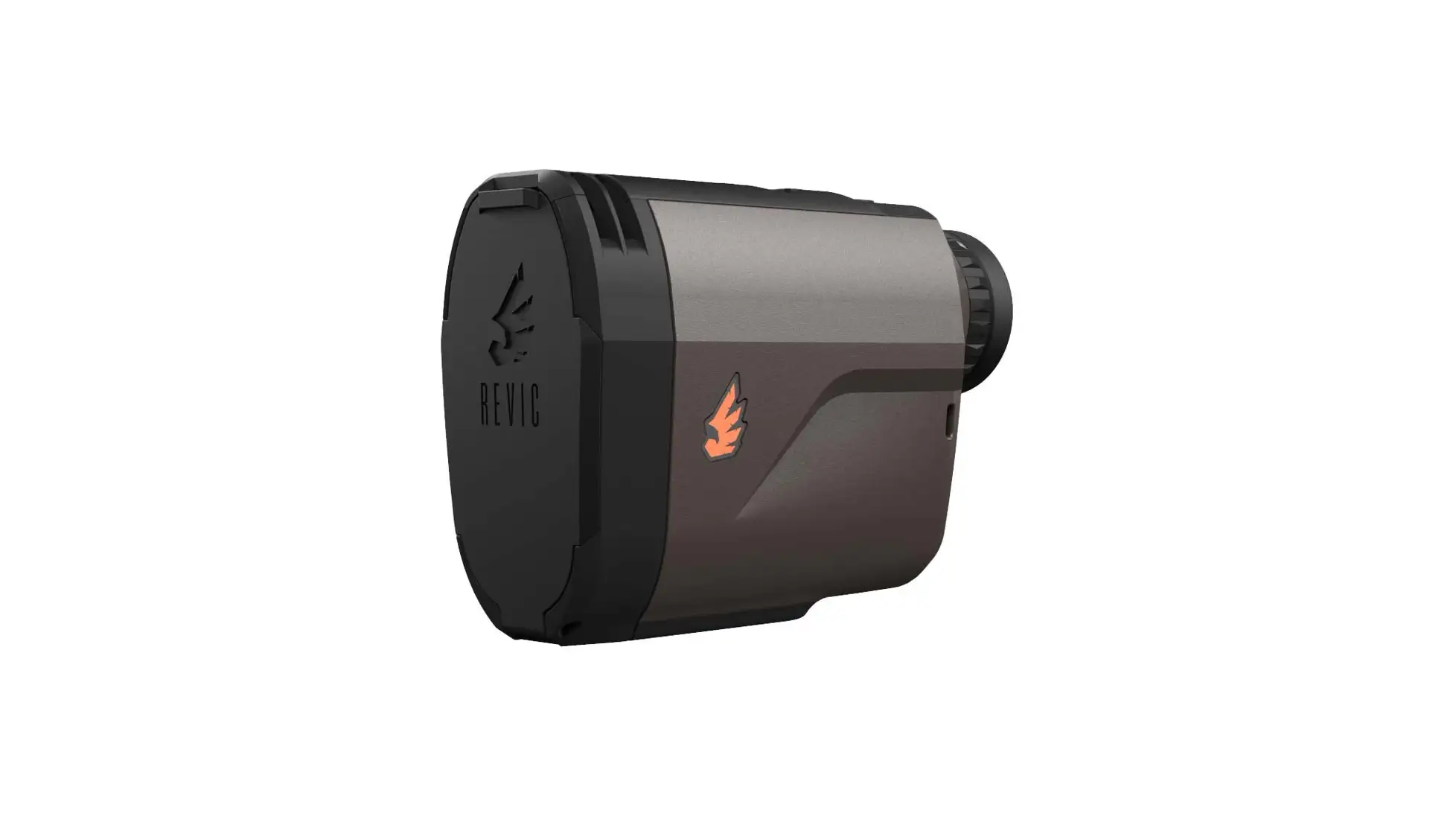
Best dedicated ballistic computer: Revic BR4
Laser · 10x25 · full onboard solver · 10 profiles · IP67
around $1,300exact price on OpticsPlanet
The only 10x unit here, and the one built as a ballistic computer that happens to range rather than a rangefinder that happens to compute. Revic (a Gunwerks brand) puts a full onboard solution behind ten rifle profiles, with temperature, station pressure, compass and inclinometer sensors, Bluetooth to an iOS or Android app and over-the-air firmware updates. The extra magnification is the practical difference owners describe: 10x picks up smaller targets a couple of hundred yards out that a 7x unit struggles to hold. It is also the most expensive pick here and carries the shortest electronics warranty on the page, and both of those belong in the decision.
Pros
- 10x magnification, the highest here, which owners say resolves small targets a 7x unit misses
- Full onboard ballistic solution with ten rifle profiles, no phone needed at the shot
- Temperature, station pressure, compass and inclinometer sensors on board
- Over-the-air firmware updates, so the solver improves after you buy it
- IP67 sealing, matching the toughest units here
Cons
- Revic warrants the electronics for only two years, the shortest term on this page, on the most expensive unit on this page
- The most expensive pick here by a wide margin
- Owners report the setup is genuinely complicated and one says the ballistic drop compensation ships without instructions
- Six owner reviews is a thin record for a four-figure device
- Revic does not publish a reflective-versus-game range breakdown we could find, so its 4,000-yard figure cannot be compared like-for-like with the Vortex and SIG numbers below
Best for: the shooter who wants a purpose-built ballistic computer with real magnification and will accept a two-year electronics warranty to get it. If the warranty is what you are buying, the Razor HD 4000 GB is the opposite answer.
Key specifications
| Type | Ballistic rangefinder with full onboard solver |
|---|---|
| Magnification | 10x |
| Objective | 25 mm |
| Max range (retailer spec) | 4,000 yds |
| Accuracy (retailer spec) | +/- 3 yds |
| Solver | Onboard, 10 rifle profiles |
| Sensors | Temperature, station pressure, compass, inclinometer |
| Connectivity | Bluetooth to iOS/Android app, over-the-air updates |
| Display | Red |
| Weight | 10 oz |
| Sealing | IP67 |
| Battery | CR2 |
| Warranty | Five years mechanical and optical, two years electronics |
“The clarity on the rangefinder is really good, much better than others i have tried. Also, having 10x vs the 7x makes a big difference when reaching out for smaller targets a couple hundred yards out.”
Verified owner via OpticsPlanet
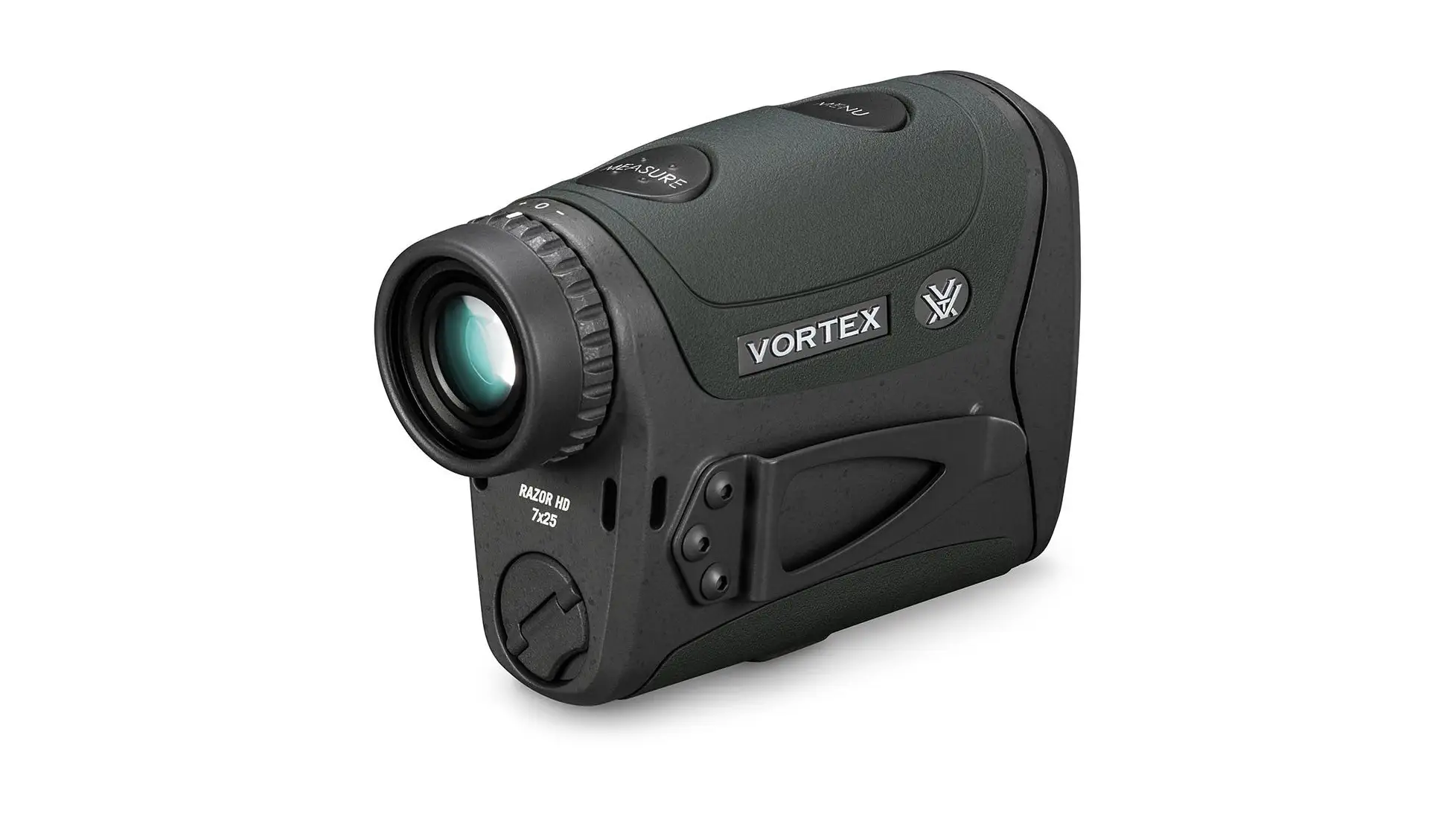
Best without a solver: Vortex Razor HD 4000
Laser · 7x25 · 4,000 yd reflective · magnesium · IP67
around $460exact price on OpticsPlanet
The same laser, the same magnesium chassis and the same published ranging distances as our top pick, minus the solver and the sensors, for a few hundred dollars less. It is also the deepest owner record on this page by a wide margin, which is worth something on its own. Buy this one if the honest answer to "will I build ballistic profiles and true my muzzle velocity" is no, because the GB's entire premium is that work. Vortex publishes the same 4,000 reflective, 2,500 trees and 2,200 deer for both units, and this one is two tenths of an ounce lighter.
Pros
- Identical published ranging distances to the GB: 4,000 reflective, 2,500 trees, 2,200 deer
- The deepest owner record here, 37 reviews against 17 for the GB and 6 for the Revic
- Magnesium chassis with IP67 sealing and All Weather Capable ranging
- Vortex VIP unlimited lifetime warranty with no electronics carve-out
- Slightly lighter than the GB at 9.9 oz, and Vortex publishes the same half-yard accuracy at 100
Cons
- No ballistic solver, no environmental sensors and no Kestrel pairing: it gives you a distance, nothing more
- Still heavy at 9.9 oz next to the 7.5 oz KILO5K
- The 7x25 configuration is a small exit pupil, so it trails larger-objective units in poor light
- Freehand 7x shakes at its longest reads, which realistically need the tripod socket
Best for: the long-range shooter who dials from a card or an app and just wants a fast, tough, accurate distance. It is also the safest pick on the page if you want the largest number of owners behind your purchase.
Key specifications
| Type | Laser rangefinder (no solver) |
|---|---|
| Magnification | 7x |
| Objective | 25 mm |
| Range (Vortex) | 4,000 yds reflective / 2,500 trees / 2,200 deer |
| Min range | 5 yds |
| Accuracy (Vortex) | 0.5 yd at 100 yds |
| Ranging speed | 0.25 sec |
| Max angle | +/- 89 degrees |
| Weight | 9.9 oz |
| Chassis | Magnesium |
| Sealing | IP67, ArmorTek |
| Battery | CR2 |
| Warranty | Vortex VIP, unlimited lifetime, no electronics carve-out |
“The picture is sharp and the ranging results are quick. I can range a deer out to 1800 yds. Further than I can ethically shoot. On top of that, the warranty is exceptional.”
Shady Trail Ranch, verified owner (ID) via OpticsPlanet
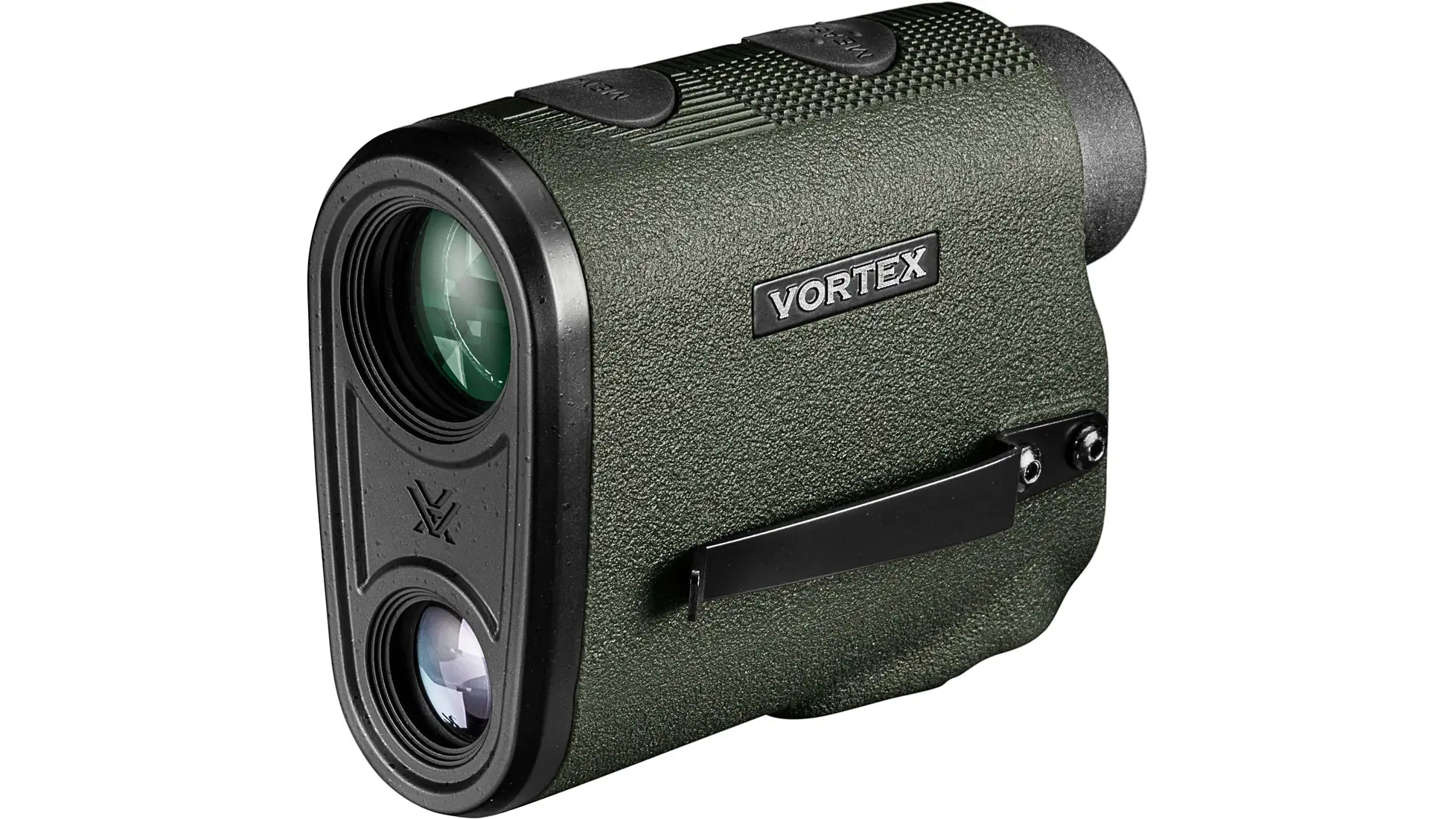
Best entry point: Vortex Diamondback HD 2000
Laser · 7x24 · 2,000 yd reflective · red OLED · 7.6 oz
around $250exact price on OpticsPlanet
The cheapest way onto this page, and the unit that makes the whole argument below concrete. Vortex publishes 2,000 yards reflective and 1,400 on deer, and that 1,400 is more animal range than most shooters will ever use, on the lightest Vortex here at 7.6 oz with a red OLED display that holds contrast at dusk. It is here as the honest floor: if your real question is "how far can I range a deer", this answers it for a third of the price of our top pick, and the gap between it and the Razor is smaller on game than the box numbers suggest.
Pros
- Lightest Vortex on the page at 7.6 oz and the cheapest pick by a clear margin
- Red OLED display that stays legible in low light where a black LCD washes out
- 1,400 yards published on deer, which is past any ethical shot for most shooters
- Same Vortex VIP unlimited lifetime warranty, electronics included
Cons
- The shortest reach here, and the only pick under 2,000 yards reflective
- No solver, no sensors and no Bluetooth
- Vortex publishes 1 yard at 100 for accuracy against the Razor line's half-yard
- Its 60-degree maximum angle reading is narrower than the 89 degrees the other Vortex units read
Best for: anyone who wants to stop paying for range they will not use. If you never shoot past 800 yards and do not want a solver, the argument for spending more is weak and this is the pick.
Key specifications
| Type | Laser rangefinder (no solver) |
|---|---|
| Magnification | 7x |
| Objective | 24 mm |
| Range (Vortex) | 2,000 yds reflective / 1,800 trees / 1,400 deer |
| Min range | 5 yds |
| Accuracy (Vortex) | 1 yd at 100 yds |
| Display | Red OLED |
| Max angle | +/- 60 degrees |
| Weight | 7.6 oz |
| Battery | CR2 |
| Warranty | Vortex VIP, unlimited lifetime, no electronics carve-out |
“This is so much better then the $400 range finder I replaced. Optics are clear, read outs are almost instant. Measured the next farmhouse from mine at 2347yds.”
Todd I, verified owner (AR) via OpticsPlanet
What the yardage number actually buys you
A rangefinder advertised at 5,000 yards will not range a deer at 5,000 yards, and the manufacturer already knows that. The headline figure is measured against a reflective target: something hard, flat and laser-friendly, at the far end of ideal conditions. For an animal, which is soft, angled and the wrong colour, every manufacturer here publishes a second, much shorter number, and it is rarely the one on the box.
Here is what the makers themselves publish, side by side. The reflective and deer figures are theirs; the percentage in the last column is our own arithmetic on those two numbers.
| Rangefinder | Headline (reflective) | Published on deer | Deer as a share of the headline |
|---|---|---|---|
| SIG SAUER KILO5K | 5,000 yds | 2,000 yds | 40% |
| Vortex Razor HD 4000 and 4000 GB | 4,000 yds | 2,200 yds | 55% |
| Vortex Viper HD 3000 | 3,000 yds | 2,000 yds | 67% |
| Vortex Diamondback HD 2000 | 2,000 yds | 1,400 yds | 70% |
Read the last column downwards and the useful part appears: the bigger the number on the box, the smaller the fraction of it you get on game. The 2,000-yard Diamondback delivers 70 percent of its headline on deer. The 5,000-yard KILO5K delivers 40 percent. Between them the KILO5K's advertised figure is two and a half times the Diamondback's, while its published deer figure is under one and a half times.
Owner reports point the same way. The best long read we found for the Razor HD 4000 GB from an owner is 2,200 yards, which is exactly the deer figure Vortex publishes. On the KILO5K an owner reports testing to 2,800 yards, well under the 5,000 on the box. And on the Viper HD 3000 an owner puts it plainly, saying he gets confident ranging out to about half the advertised model number, and that most people do not realise they have to buy over kill based on the model number to get accuracy. That last one is a single owner's view rather than a measurement, but it points where the manufacturers' own tables already point.
The practical consequence: choose by the published game figure, not the model name. If your honest maximum is 800 yards on an animal, every rangefinder on this page clears it with room to spare, and the reasons to spend more are the solver, the glass and the warranty, not the reach.
Revic does not appear in the table because we could not find a published reflective-versus-game split for the BR4. Rather than borrow another brand's ratio, we have left the row out.
The warranty nobody reads, on a device that is mostly electronics
A rangefinder is a small computer with a laser in it. That makes the electronics clause the clause that matters, and it is the one most often buried under a headline word like lifetime or infinite. We read all four brands' own warranty documents for this page, and they do not say what the headlines imply.
- Vortex names rangefinders in the VIP warranty, calls it unlimited and lifetime, and applies no separate term to electronics. Its stated exclusions are loss, theft, deliberate damage and cosmetic damage that does not hinder performance.
- SIG SAUER publishes an Infinite Guarantee with no time limit, described on SIG's page as fully transferable, requiring no warranty card and no receipt. It also states that the guarantee excludes electronic components. Those get a separate five-year limited warranty.
- Leupold does not list rangefinders among the products covered by its lifetime guarantee, which names riflescopes, mounts, red dots, binoculars and spotting scopes. RX rangefinder electronics are covered by a separate five-year guarantee.
- Revic, on the most expensive unit on this page, warrants mechanical and optical parts for five years and electronics for two, with a further discretionary goodwill period that the manual says carries no legal entitlement.
So on the part of a rangefinder most likely to fail, the terms run: Vortex unlimited, SIG five years, Leupold five years, Revic two. That is a real reason to weigh the Razor HD 4000 GB against the Revic BR4 beyond the spec sheet, and it is the sort of thing you only find by opening the manual.
One deliberate omission: Vortex's own VIP warranty page does not use the word transferable, so we do not claim it does. SIG's page does, and it is quoted as SIG's.
How to choose a long range rangefinder
Decide whether you want a solver at all
This is the only question that changes the price bracket. A plain rangefinder gives you a distance and you do the rest from a card or a phone. A ballistic rangefinder reads temperature, pressure and angle, applies a bullet profile you built, and shows a drop and a wind hold. The solver is worth paying for if you will actually true your muzzle velocity and keep profiles current, and one Razor GB owner is blunt that doing it properly needs chronograph access. For what a modern chronograph setup involves, see our Garmin Xero C2 review. If you will not do that work, the solver is a menu you will not use, and the Razor HD 4000 or Viper HD 3000 is the better buy.
Check where the solver stops
An onboard solver has its own working range, and it is shorter than the laser's. SIG states the KILO5K's Applied Ballistics Ultralite solves out to 800, past which you pair an external Applied Ballistics Elite device. If your shooting lives past that, the pairing path matters more than the ranging headline, which is why Kestrel compatibility appears in the pros of both the KILO5K and the Razor HD 4000 GB. For what the Kestrel side of that pairing does, and how the 5700 Elite differs from the cheaper 5700 Ballistics, see our Kestrel 5700 review.
Weigh the ecosystem, not just the unit
The KILO5K's strongest feature is pushing a firing solution to a BDX-enabled SIG scope, and three of its four owner reviews single out that link. If you do not own a BDX scope, you are paying for a connection you will not use. The Vortex equivalent is GeoBallistics, whose PRO tier comes free with any enabled product including the Razor HD 4000 GB.
Then read the electronics clause
See the section above. On a four-figure device, a two-year electronics term is a material part of the price.
Related reading
- Best hunting rangefinder, if your question is which rangefinder for hunting rather than how far it reaches
- Best rangefinder for bow hunting, where minimum range and arrow arc matter more than maximum reach
- Best rangefinding binoculars, if you would rather glass and range in one motion
- Free ballistic calculator, to see what a solver is actually computing before you pay for one
- Mil dot ranging calculator, for ranging a known-size target through the reticle
- Burris Eliminator 6 review, if you would rather have the rangefinder inside the scope
FAQ
What is the best long range rangefinder in 2026?
The Vortex Razor HD 4000 GB is our overall pick, because it combines a 4,000-yard reflective laser with an onboard GeoBallistics solver, environmental sensors and Kestrel pairing, and because Vortex is the only brand here whose warranty has no separate electronics term. The Vortex Viper HD 3000 is the value pick, the SIG SAUER KILO5K is the choice if you already run a BDX scope, the Revic BR4 is the dedicated ballistic computer, and the Vortex Diamondback HD 2000 is the entry point for anyone who does not need a solver.
Does a 4,000-yard rangefinder really range 4,000 yards?
Not on an animal. The number on the box is the reflective range, measured against a hard, flat, laser-friendly target. Manufacturers publish a separate and much shorter figure for game: Vortex rates the Razor HD 4000 at 4,000 yards reflective but 2,200 on deer, and SIG rates the KILO5K at 5,000 yards reflective but 2,000 on deer. Comparing our own arithmetic across those published figures, the deer number lands between 40 and 70 percent of the headline, and the ratio gets worse as the headline number gets bigger.
What is a ballistic rangefinder and do I need one?
A ballistic rangefinder measures the distance and then solves the shot, using onboard sensors for temperature, pressure and angle plus a bullet profile you enter, and displays a drop and wind hold instead of a raw number. You need one if you shoot past the distance where your zero stops being close enough and you do not want to read a card or a phone at the shot. You do not need one if you dial from a card you already trust, in which case a Vortex Razor HD 4000 or Viper HD 3000 gives you the same laser for less.
How far does the SIG KILO5K ballistic solver actually work?
SIG states the onboard Applied Ballistics Ultralite solver provides a firing solution out to 800, and past that you need BDX-X with an external Applied Ballistics Elite device such as a compatible Kestrel or Garmin. Note the unit, because SIG publishes it two ways: the KILO5K operator's manual says 800 meters in seven separate places, while the footnote on SIG's own product page says 800 yards. Applied Ballistics itself publishes no figure for Ultralite, so there is no third source to break the tie.
Which long range rangefinder has the best warranty?
Vortex, and it is not close on a device that is mostly electronics. The Vortex VIP warranty names rangefinders, is unlimited and lifetime, and applies no separate term to electronic components. SIG's Infinite Guarantee has no time limit but explicitly excludes electronic components, which get a separate five-year limited warranty. Leupold does not list rangefinders under its lifetime guarantee at all and covers RX rangefinder electronics for five years. Revic warrants the BR4 for five years on mechanical and optical parts but only two years on electronics.
Is the GeoBallistics app free?
The GeoBallistics app is free, and the PRO tier is free as well if you own a GeoBallistics-enabled product such as the Razor HD 4000 GB. Vortex charges a one-time fee under $20 for PRO only for people who do not own an enabled device. PRO adds online rifle and range-card backup, unlimited rifle profiles, weather-device compatibility, chart exporting and shooting-range downloads.