Nikon Coolshot Pro III Stabilized review: the quiet lock-on
Our verdict: 4.5/5. The Coolshot Pro III is our best overall golf rangefinder, and the reason is still stabilization: it steadies the ranging laser as well as the view, so a thin flagstick settles into the crosshair instead of bouncing past it. What the Pro III adds is the fix owners of the previous model kept asking for. It confirms a pin lock with a gentle vibration instead of a beep the rest of your group can hear, and it reads out in 0.1 seconds rather than 0.3. Buy it for steady, quick, quiet ranging; skip it if you ride and refuse to live without a cart magnet.
No award of its own: what it has is an editorial test result, MyGolfSpy placing it tied fourth overall in its 2026 rangefinder testing and picking it for shaky hands (source: MyGolfSpy), and a "Best for Shaky Hands" nod from Breaking Eighty. Price verified October 14, 2026; confirm the current price and availability on the retailer page.
How we reviewed it: a research-based review built from Nikon's own published specifications, an independent long-term hands-on test, and the owner feedback that exists. We have not bench-tested this unit ourselves; the score is our editorial opinion. Be aware the evidence base here is thinner than usual: this model has no owner reviews at all on the retailer we link to, and the owner voices below come from Nikon's own store and from the comments on a published review, both of which we name. See how we evaluate.
What it is
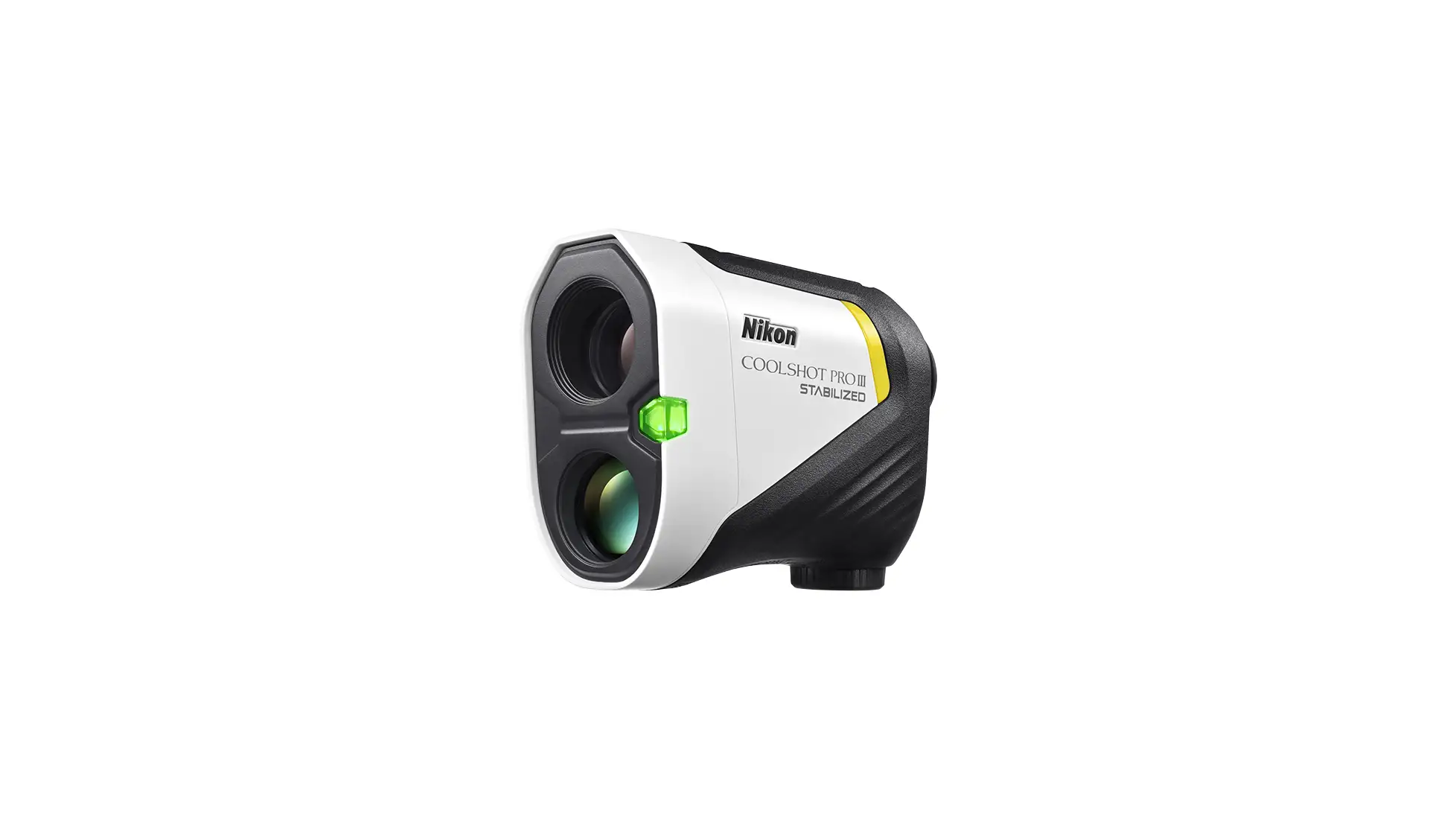
The Coolshot Pro III Stabilized is Nikon's current flagship handheld golf laser. It is a pure laser unit with no GPS and no hole mapping, built around a 6x monocular with a red OLED display and optical image stabilization. Nikon rates it from 8 to 1200 yards, and it weighs 7.2 oz, which is about an ounce more than the Pro II it replaces. The design goal is unchanged from that model, a pocketable device that makes a distant flagstick easy to lock, and the changes this generation are concentrated in how fast it reads and how it tells you it has locked.
Stabilization: still the reason to buy it
The optical stabilization counteracts hand shake in the monocular view and in the ranging laser at the same time, which is the part that matters. Plenty of devices can steady a picture; steadying the beam is what turns a wobbling attempt to hit a flagstick into a casual one-handed measurement. It is the feature that makes this line the standing recommendation for golfers with unsteady hands, and it is why both MyGolfSpy and Breaking Eighty single the Pro III out for exactly that audience.
What actually changed from the Pro II
Two changes, and one of them is more interesting than the spec sheet makes it look. The ranging speed went from 0.3 seconds to 0.1. In an independent hands-on test, Matt Meeker wrote that the speed was what jumped out at him, calling it "clearly faster than the prior model" and as fast as any rangefinder he had tested (source: Plugged In Golf). The same review found the yardages never more than a yard different from other well-regarded lasers, and noted that the readout carries a decimal place.
The second change is the pin-lock confirmation. The Pro II beeped; the Pro III adds a gentle vibration alongside the visual cue, which Nikon calls Dual Locked On Quake, and that review confirms the vibration is new to this generation. That sounds like a detail until you hear why owners care about it.
"I like the quiet vibration of the lock on feature over the audible Beeps. Which can be distracting to other people in your group... The big feature was the 0.1 lock on response time."
Jericho, a three-time Coolshot Pro II owner, commenting on the Plugged In Golf review (September 20, 2025)That is the clearest argument for the upgrade we found, and it comes from someone who owned the previous model three times over and tried the new one on a playing partner's unit. A beep is a small thing until you are the person setting it off on every hole.
| Spec | Coolshot Pro II | Coolshot Pro III |
|---|---|---|
| Ranging speed | 0.3 sec | 0.1 sec |
| Pin-lock confirmation | Green ring + audible beep | Visual cue + vibration |
| Weight | 6.3 oz | 7.2 oz |
| Image stabilization | Yes | Yes |
| Display | Red OLED | Red OLED |
| Maximum range | 1200 yds | 1200 yds |
| Tournament ADI LED | Yes | Yes |
| Cart magnet | No | No |
| Status at Nikon | Archived, sold refurbished only | Current model |
Tournament use
Slope is illegal in competition, so what matters is not whether a rangefinder has it but whether it can prove it is switched off. The Pro III does this with an external Actual Distance Indicator LED on the front of the body, visible to playing partners and officials without anyone having to take your word for it. Nikon states the device complies with the USGA local rule for tournament play when slope is off. If you want the reasoning behind the rule, we explain what slope is and why it is banned separately.
Trade-offs worth knowing
- No cart magnet and no mounting provision. This is the objection that comes up most, and it is a real one. A commenter on the same long-term review said that despite wanting the stabilization for his own shaky hands, the lack of a magnet on any rangefinder was simply a dealbreaker for him. If you ride and want the device on the cart bar, buy something else or plan on an aftermarket sleeve.
- Heavier than the model it replaces, at 7.2 oz against 6.3 oz. It is still pocketable, and it is far lighter than some ruggedised rivals, but if you walk and count ounces the older model was lighter.
- Deeper settings are buried. Changing display brightness or switching between yards and metres means pressing and holding the mode button rather than reaching a dedicated control.
- Laser only. There is no GPS, no hole flyover and no wind data. Some rivals at similar money include a mapping display; this device spends its budget on optics and stabilization instead.
- Very little owner feedback so far. It is a recent model and the evidence base is genuinely thin, which is a reason for caution rather than a mark against the device.
What owners and testers say
On Nikon's own store the Pro III holds 5.0 out of 5 across 7 reviews, all of them five-star. That is worth reading for what it is: a small sample on the manufacturer's own storefront, which is the weakest tier of social proof there is, and not a substitute for the hundreds of reviews an established model accumulates at a retailer. The retailer we link to has none for it yet. The most substantial account of using the device remains the independent long-term test quoted above.
Price
The retailer price we last verified is around $530, and Nikon's own store lists it at the same figure, so treat the higher manufacturer list price you may see quoted elsewhere as a list price rather than what this thing sells for. The comparison worth making is with its own predecessor: the Coolshot Pro II (around $280) has the same stabilization and display for less, and it is the model to buy if the vibration lock and the faster read are not worth the gap to you. Prices move, so confirm the current number on the retailer page.
Key specifications
| Type | Laser rangefinder (no GPS) |
|---|---|
| Magnification | 6x |
| Objective | 21 mm |
| Display | Red OLED, automatic or manual brightness |
| Eye relief | 18 mm |
| Field of view | 7.5 degrees (39.3 ft at 100 yds) |
| Range | 8 to 1200 yds (flagstick guide figure 450 m, about 490 yds) |
| Accuracy | +/- 0.75 yd under 700 yds, +/- 1.25 yd to 999, +/- 1.75 yd at 1000 and over |
| Ranging speed | 0.1 sec (HYPER READ) |
| Slope | ID incline/decline; external ADI LED shows slope off |
| Pin lock | First Target Priority + Dual Locked On Quake (visual cue + vibration) |
| Image stabilization | Yes |
| Weight | 7.2 oz |
| Cart magnet | No |
| Sealing | Waterproof |
| Battery | CR2, about 2,700 measurements |
| Warranty | Nikon 5-year on new units (90 days on refurbished) |
Should you buy it, and what else to consider
- Buy it if you range one-handed, play in wind, or have unsteady hands, and you want the quietest pin confirmation available: our best golf rangefinder overall.
- Want the same stabilization for less? The Coolshot Pro II is the value buy while retailers still hold new stock.
- Need a cart magnet and a lifetime warranty? The Vortex 6x Blade Slope has both, without stabilization.
- New to rangefinders? Learn what slope is and GPS vs laser.
FAQ
Is the Nikon Coolshot Pro III worth it?
If you range one-handed, play in wind, or have unsteady hands, yes. Optical image stabilization steadies both the view and the ranging laser, so a thin flagstick stops bouncing across the crosshair, and that single feature changes how the device feels to use more than any spec on the sheet. The Pro III adds two things over the model it replaces: it ranges in 0.1 seconds instead of 0.3, and it confirms a pin lock with a gentle vibration rather than an audible beep. If your hands are steady and you only need a yardage to the middle of the green, a much cheaper laser will do the job.
What is the difference between the Coolshot Pro II and the Pro III?
Three things. The Pro III ranges in 0.1 seconds where the Pro II takes 0.3. The Pro III confirms a flagstick lock with a visual cue plus a gentle vibration, which Nikon calls Dual Locked On Quake, while the Pro II uses a green ring and an audible beep. And the Pro III is heavier, at 7.2 oz against 6.3 oz. Stabilization, the 6x optics, the red OLED display, the 1200-yard maximum range and the tournament-legal ADI LED are shared. Nikon has since archived the Pro II, so its own store sells that model only as a refurbished unit on a 90-day warranty, while a new unit of either model carries the full 5-year warranty.
Does the Coolshot Pro III have a cart magnet?
No. It has no cart magnet and no mounting provision, and neither did the Pro II before it. If you ride, you keep it in its case, a pocket or a cup holder, or you buy an aftermarket magnetic sleeve. This is a real objection rather than a nitpick: a commenter on a long-term hands-on review said the lack of a magnet was a dealbreaker for him despite otherwise wanting the stabilization. If a cart magnet is non-negotiable, buy a rangefinder that has one.
Is the slope feature legal for tournaments?
Slope-adjusted "plays like" yardages are not legal during official competition under the Rules of Golf. The Pro III handles this in the open: when you switch slope off, an external Actual Distance Indicator LED on the front of the device shows playing partners and officials that the incline and decline mode is not in use. Nikon states the device complies with the USGA local rule for tournament play when slope is turned off.
How far will the Coolshot Pro III actually range a flagstick?
The headline number and the useful number are different, and it is worth separating them. The 1200-yard maximum applies to a large, highly reflective target. Nikon publishes a separate guide figure for a flagstick, which is 450 metres, or roughly 490 yards. Since that is far beyond any yardage you will play, the practical limit is not range but whether the device locks the pin cleanly, which is what the stabilization and the First Target Priority mode are for. Stated accuracy is within about 0.75 yard under 700 yards, widening at longer distances.
More: best golf rangefinders · Nikon Coolshot Pro II review · Vortex 6x Blade Slope review.