Vortex Crossfire II vs Leupold VX-Freedom: which 3-9x40 should you buy?
Our verdict: buy the Vortex Crossfire II 3-9x40 (around $120) if you want the most hunting scope for the least money: bright glass in daylight, proven zero retention and the unconditional VIP warranty. Pay the extra $180 for the Leupold VX-Freedom 3-9x40 (around $300) only if you hunt at dawn and dusk (its Twilight Light Management glass is the real difference), carry your rifle far (12.2 oz vs 14.8 oz), or want a US-made scope.
Both average 4.7/5 across a combined 327 owner reviews on OpticsPlanet. The configurations were read from Vortex, Leupold and the retailer for this update; prices verified September 30, 2026; confirm the current price on the retailer page. Both are full picks in our best rifle scopes guide.
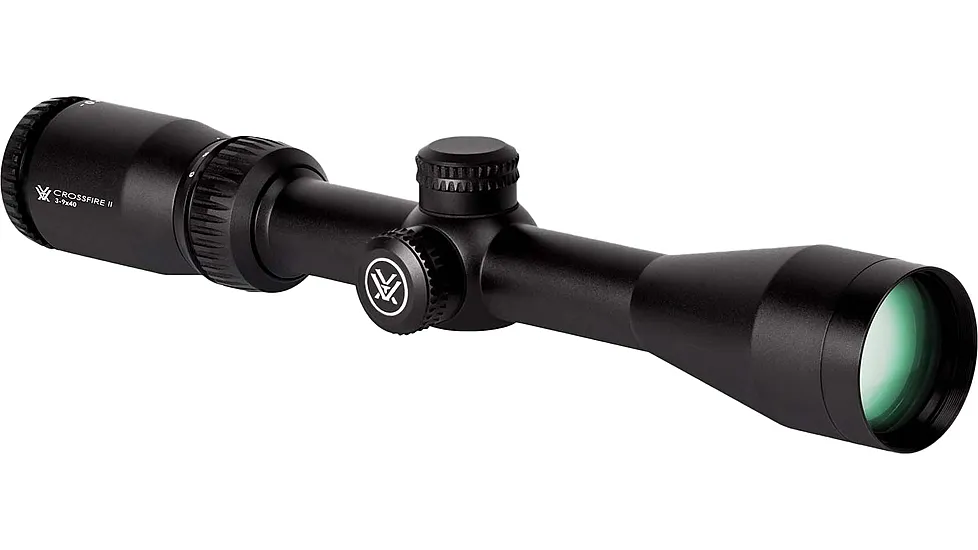
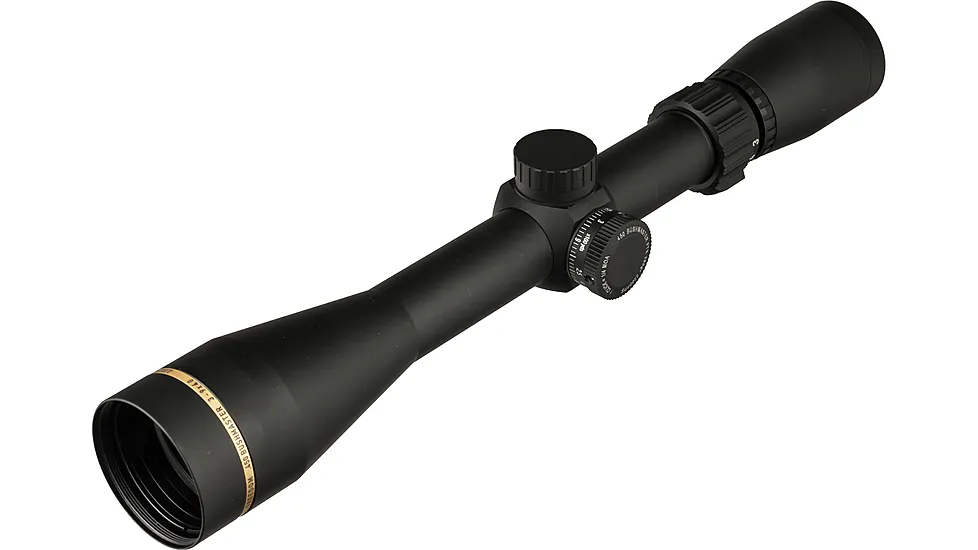
How this comparison was made: a research-based, spec-by-spec comparison built from retailer specifications, expert reviews and owner feedback for both scopes. We have not bench-tested these two side by side. Scores and verdicts are our editorial opinion. See how we evaluate.
Side-by-side specifications
| Vortex Crossfire II 3-9x40 | Leupold VX-Freedom 3-9x40 | |
|---|---|---|
| Street price | around $120 | around $300 |
| Maker list price | Above the street price (Vortex) | The same as the street price (Leupold) |
| Owner rating | 4.7/5, 234 reviews on OpticsPlanet | 4.7/5, 93 reviews on OpticsPlanet |
| Focal plane | Second focal plane (SFP) | Second focal plane (SFP) |
| Tube | 1 inch | 1 inch, 6061-T6 aluminum |
| Field of view | 34.1 - 12.6 ft at 100 yds | 33.1 - 13.6 ft at 100 yds |
| Eye relief | 3.8 in (Vortex spec) | 4.2 in at 3x, 3.7 in at 9x |
| Adjustment travel | 60 MOA elevation and windage | 60 MOA elevation and windage |
| Travel per rotation | 15 MOA | 15 MOA |
| Click value | 1/4 MOA, capped turrets | 1/4 MOA finger clicks, capped |
| Parallax | Fixed at 100 yds | Fixed (no adjustment) |
| Weight | 14.8 oz | 12.2 oz |
| Length | 12.2 in | 12.49 in |
| Configurations sold | Two: V-Plex, Dead-Hold BDC | Seven |
| Illumination | None available | None available |
| Optics | Fully multi-coated, SD optical system | Twilight Light Management System |
| Made in | Overseas | USA (Beaverton, Oregon) |
| Warranty | Vortex VIP: unlimited, unconditional, lifetime | Leupold lifetime, unconditional, transferable |
| Check Crossfire II price | Check VX-Freedom price |
Price and value: the gap is smaller than it looks, and it is not where you think
This is a scope at around $120 against one at around $300, and that $180 gap frames everything. The Crossfire II is the benchmark budget 3-9x40: at that price you get glass and reliability that owners routinely compare to far pricier scopes, which is why it carries a 4.7/5 average over 234 reviews. The VX-Freedom's extra money does not buy extra features. It buys better raw materials: superior lens coatings, a lighter tube and American manufacture.
What almost nobody says out loud is that the two scopes are not being sold the same way, and it changes what the gap means. Vortex publishes a list price for the Crossfire II 3-9x40 and the retailer sells it for around $120, comfortably underneath. Leupold publishes a list price for the live 3-9x40 configurations and the retailer sells them at around $300, which is that list price exactly. So maker to maker these scopes are about $210 apart, and the $180 you actually pay is that difference plus a Vortex discount. Two practical consequences. First, the Leupold has no discount to wait for at this retailer, while the Vortex is already sitting on one. Second, if you ever see the two compared at their list prices, the Leupold will look like a much smaller step up than the checkout page suggests, and neither number is wrong.
Glass and low light: the VX-Freedom's real advantage
In good daylight, both scopes are bright and crisp at typical hunting magnifications, and most shooters would struggle to justify the price gap. The separation happens at the edges of the day. Leupold's Twilight Light Management System uses coatings tuned to the blue-violet light that dominates dawn and dusk, and independent reviewers consistently report it resolves detail in deep shadow when same-class rivals wash out, with up to about ten extra minutes of usable shooting light. Since deer move at exactly those hours, low-light hunters get real value here. The Crossfire II's honest limits: its glass softens at the edges toward 9x with some color fringing in high-contrast light, typical of its class.
Weight and build
The VX-Freedom is one of the lightest scopes in its class at 12.2 oz; the Crossfire II runs 14.8 oz. On a mountain or backcountry rifle, saving about 2.6 oz on the optic is meaningful; on a blind or truck rifle, it is irrelevant. Durability is a tie in practice: the Crossfire II's single-piece aluminum tube has a strong owner track record of holding zero under .308 and .30-06 recoil, while the VX-Freedom passes the same factory recoil-torture protocol Leupold uses for its high-end tactical scopes. Both are waterproof, fogproof and shockproof.
Eye relief and handling
Both scopes are unusually forgiving for their price, and the published figures are closer than the price gap suggests. Leupold quotes 4.2 inches at 3x falling to 3.7 inches at 9x; Vortex quotes a single 3.8 inches for the Crossfire II. Either way you have most of four inches and a generous eye box at low magnification, so neither will bite your brow on a hard-recoiling rifle. Experts single out the VX-Freedom's eye box under magnum recoil, and its wide magnification band makes fast, off-angle shots in timber easy. The Crossfire II gives up little here; this category should not decide the purchase.
Reticles and configurations: you are not choosing between two scopes
This is the part the comparison usually skips, and it is where the decision actually gets made. The Crossfire II 3-9x40 is sold in two configurations and the VX-Freedom 3-9x40 in seven, so "which scope" is really "which of nine SKUs", and they are not all the same buy.
On the Vortex side both configurations cost the same around $120: the V-Plex fine crosshair (CF2-31005) and the Dead-Hold BDC holdover reticle (CF2-31007). The price is identical either way, so there is nothing to trade off: pick the reticle you want to shoot behind. Vortex lists a third reticle for this scope, the illuminated V-Brite, as unavailable on its own site, and the retailer carries no illuminated Crossfire II 3-9x40 at all. Treat this scope as a daylight, non-illuminated optic; that is what is actually buyable.
The Leupold side is the opposite problem, abundance rather than scarcity. Six configurations sit at around $300: Hunt-Plex, a Duplex with the Custom Dial System, Rimfire MOA, the UltimateSlam muzzleloader reticle, and Duplex versions built for .350 Legend and .450 Bushmaster rifles. A seventh, the CDS Tri-MOA, costs more than any of them. CDS models include one free laser-etched elevation dial matched to your load, which is a real extra if you shoot one cartridge. Two cautions worth having before you click. Leupold has discontinued the plain Duplex 3-9x40, the simplest and historically cheapest configuration, so the versions that remain are the specialised ones, which is a large part of why this scope now starts where it does. And Leupold has also discontinued the CDS Tri-MOA, the most expensive of the seven, so buying it means buying a configuration the maker has stopped making. The lifetime guarantee still covers it, but there is no reason to pay more for a discontinued version of a scope whose live configurations cost less.
Neither scope is built for dialing: both use capped turrets, 1/4 MOA clicks, no zero stop and fixed parallax, and both makers publish the same adjustment envelope, 60 MOA of elevation and windage with 15 MOA per rotation. Zero them, cap them, hunt.
Warranty
A practical tie at the top of the industry. Vortex VIP is unlimited and unconditional and explicitly covers damage no matter how it happened, whose fault it was, or where you purchased it. Leupold's lifetime guarantee is also unconditional and transferable, honored for any owner with no warranty card. With either scope, a failure years from now is the manufacturer's problem, not yours.
VX-Freedom vs Crossfire II: the same question from the Leupold side
Most people arrive here already leaning one way, and the two directions are not the same question. Coming from the Vortex side you are asking should I spend more; coming from the Leupold side you are asking can I spend less without regretting it. The honest answer to the second one: yes, in daylight. If you hunt open country in good light inside 300 yards, the Crossfire II gives up very little you would notice, and the $180 you save buys a rangefinder or a season of ammunition. Where the VX-Freedom keeps earning its money is the first and last twenty minutes of legal light, and on a rifle you carry all day. Wanting a Leupold for the brand or the Oregon build is a legitimate reason too, but it is a different reason, and it is worth being clear with yourself which one you are acting on before you spend.
Which one should you buy?
- First scope or strict budget: Crossfire II. It is the value benchmark of this class for a reason.
- Dawn and dusk hunter: VX-Freedom. The low-light glass is the single biggest real difference between these two.
- Mountain or backcountry rifle: VX-Freedom, for the 12.2 oz weight.
- Magnum or heavy recoil: either works; the VX-Freedom's eye box gets the expert nod.
- Buy-it-once, US-made preference: VX-Freedom, made in Beaverton, Oregon.
- You specifically want a holdover reticle: the Crossfire II's Dead-Hold BDC (CF2-31007) costs exactly what the plain V-Plex costs, so it is a straight reticle choice with no price penalty.
- You want illumination: neither, in this size. Vortex shows the illuminated V-Brite version of this scope as unavailable and the retailer stocks no illuminated 3-9x40 in either line.
- Want to dial for long range: neither; see the Vortex Strike Eagle 5-25x56 FFP in our main guide.
FAQ
Is the Leupold VX-Freedom worth about $180 more than the Crossfire II?
Only if its three real advantages matter to you: noticeably better low-light glass (the Twilight Light Management System), a 12.2 oz weight that is about 2.6 oz lighter, and US manufacture. For general daylight hunting inside 300 yards, the Vortex Crossfire II 3-9x40 does the same core job, which is why it is our budget pick. Worth knowing before you judge the gap: at list price it is much smaller. Vortex lists this scope well above what the retailer charges for it, while Leupold lists the live 3-9x40 configurations at exactly what the retailer charges. Most of what you feel as the Leupold premium is really the Vortex discount.
Who has better glass, Leupold or Vortex?
At this price point, Leupold, and the reason is narrow enough to be useful: the VX-Freedom uses the Twilight Light Management System, a coating package tuned for the low-light end of the day, and reviewers consistently report it holding detail in deep shadow when same-class rivals wash out. That is a statement about these two scopes, not about the two brands. Vortex builds glass that beats Leupold higher up the range, and Leupold builds scopes cheaper than this one that we would not put against a Crossfire II. Compare models, not badges: the honest version of this question is "which of these two scopes has better glass", and the answer is the VX-Freedom, in low light specifically, in daylight barely at all.
How many reticles does each scope come in?
Two on the Vortex side, seven on the Leupold side. OpticsPlanet lists two Crossfire II 3-9x40 models at the same price: the V-Plex (CF2-31005) and the Dead-Hold BDC (CF2-31007). Vortex shows a third reticle for this scope, the illuminated V-Brite, as unavailable, and there is no illuminated Crossfire II 3-9x40 at the retailer at all. The VX-Freedom is sold in seven configurations, six at one price and the CDS Tri-MOA above them.
Do the Crossfire II and VX-Freedom have the same warranty?
They are very close. Both come with unconditional lifetime warranties; Leupold states that its guarantee is transferable and needs no receipt or registration. The difference in wording: Vortex VIP explicitly covers accidental damage no matter how it happened, while Leupold promises free repair or replacement for any owner. In practice, both are considered gold-standard warranties in the industry.
Which is better for deer hunting?
Both are purpose-built for exactly this. If your hunts start at first light or run to last light, the Leupold VX-Freedom 3-9x40 earns its price with low-light clarity that experts consistently rate above same-class rivals. If you hunt mostly in daylight and want maximum value, the cheaper Crossfire II 3-9x40 covers deer inside 300 yards without drama.
Can I dial turrets for long range with either scope?
No, and neither pretends to. Both use capped, set-and-forget turrets with soft clicks, no zero stop, and fixed parallax. They are zero-and-hunt scopes. If you want to dial elevation for real long-range work, step up to something like the Vortex Strike Eagle 5-25x56 FFP from our best rifle scopes guide.
See both scopes in context in our best rifle scopes 2026 guide, or read how to sight in a rifle scope.