The best long range rifle scopes in 2026
Our verdict for 2026: the Vortex OPMOD Diamondback Tactical 6-24x50 FFP (around $290) is the best value long range rifle scope: true FFP with tracking that passes box drills at the lowest price of these four picks. It gives up illumination, a zero stop and travel (65 MOA). The Vortex Strike Eagle 5-25x56 FFP (around $800) is the best overall: an illuminated reticle, a 34mm tube with 110 MOA of travel and a RevStop zero stop (fitting it reduces usable elevation), the complete package under $900. If you dial in mils and want the most total elevation travel here, the Leupold Mark 4HD 4.5-18x52 FFP (around $1,500) lists 36 MIL on locking ZeroLock dials at 27.5 oz. If you shoot known distance from a bench or bipod and want magnification, the Nightforce NX8 4-32x50 F1 (around $2,500) is the only pick here that reaches 32x, with 90 MOA of elevation travel and a 1.6mm exit pupil at the top of its range. Our Nightforce NX8 guide compares it with the rest of that line.
Between them, the four picks carry 395 owner reviews and ratings on OpticsPlanet. Prices verified October 14, 2026; confirm the current price on the retailer page.
Long range is the discipline where scope marketing meets physics: the reticle must measure true, the turrets must track exactly what they claim, and the glass must stay honest at working magnification. All four picks below are first focal plane scopes with dialing travel, at four very different prices.
How these picks were made: a research-based roundup comparing published specifications, warranty terms, owner reviews and pricing across reputable retailers. Scores are our editorial opinion, not a hands-on test of every model, and owner ratings are shown attributed to their source. Confirm current price on the retailer page. See how we evaluate.
- Vortex OPMOD Diamondback Tactical 6-24x50 FFP - Best value for long range
- Vortex Strike Eagle 5-25x56 FFP - Best long range scope overall
- Leupold Mark 4HD 4.5-18x52 FFP - Most total elevation travel
- Nightforce NX8 4-32x50mm F1 Rifle Scope - Best for maximum magnification
- What makes a scope long-range capable
- FAQ
Quick comparison
| Category | Pick | Spec | Price |
|---|---|---|---|
| Best value for long range | Vortex OPMOD Diamondback Tactical 6-24x50 FFP | 6-24x50 FFP | around $290 |
| Best long range scope overall | Vortex Strike Eagle 5-25x56 FFP | 5-25x56 FFP | around $800 |
| Most total elevation travel | Leupold Mark 4HD 4.5-18x52 FFP | 4.5-18x52 FFP | around $1,500 |
| Best for maximum magnification | Nightforce NX8 4-32x50mm F1 Rifle Scope | 4-32x50 FFP | around $2,500 |
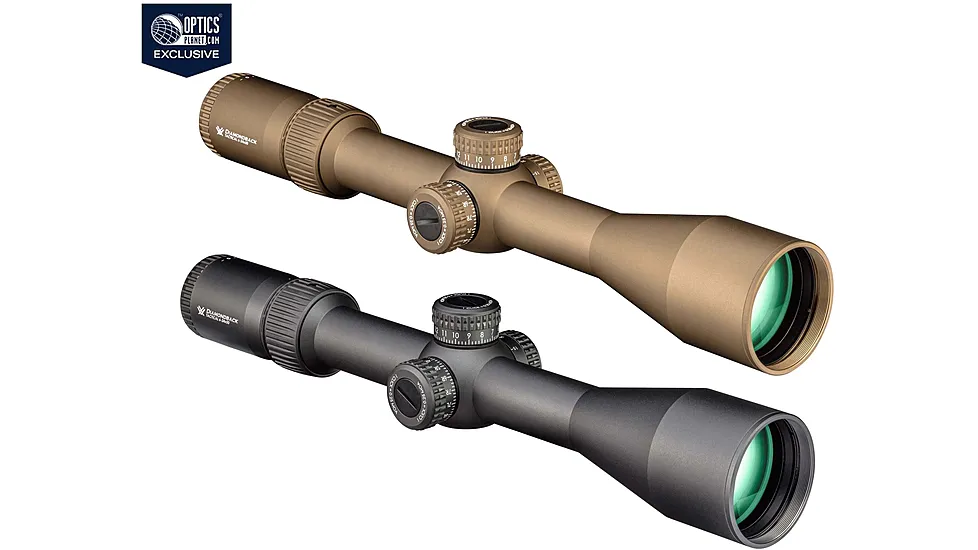
Best value for long range: Vortex OPMOD Diamondback Tactical 6-24x50 FFP
First focal plane · 6-24x50 · 30mm tube · EBR-2C MOA reticle
around $290exact price on OpticsPlanet
🏆 Named Best Optic Under £1,000 at the Great British Shooting Awards (source: Gun Trade News)
This is the cheapest of these four picks, and it does real long-range work without a real long-range asterisk. It is a true first focal plane optic, so the EBR-2C Christmas-tree reticle measures correctly at every magnification, and the part budget scopes usually fake is the part this one gets right: tracking. Testers pass box drills with it and turret clicks are crisp and audible. The 10-yard side parallax is a bonus that makes it a superb precision-rimfire (NRL22) trainer too. The unconditional Vortex VIP warranty removes the remaining risk. For a first dialing scope, the value curve peaks here.
Pros
- Reliable tracking and return-to-zero, with crisp, audible turret clicks (no budget-scope mushiness)
- FFP EBR-2C reticle stays accurate at any zoom, with a fine Christmas-tree grid for wind and elevation holds
- Rare 10-yard side parallax: a real edge for precision rimfire (NRL22) and close-to-far practice
- Unlimited, unconditional lifetime Vortex VIP warranty (covers accidental damage, whoever was at fault)
Cons
- No zero stop, so when you dial past one full turn you must track your turret revolutions carefully
- No illuminated reticle: the fine FFP crosshair can wash out in low light or dark timber
- Glass is excellent to about 18x but softens toward 24x (edge blur, slight color fringing), so treat it as a 6-18x scope
- Tight eye box at maximum magnification demands a consistent cheek weld
Best for: entry-level long-range and PRS on a budget, precision rimfire (NRL22), and learning to dial. Step up to the Strike Eagle when you want illumination, a zero stop and more elevation travel.
Key specifications
| Magnification | 6-24x |
|---|---|
| Objective lens | 50 mm |
| Reticle | EBR-2C MOA |
| Focal plane | First focal plane (FFP) |
| Tube diameter | 30 mm |
| Field of view | 18 - 4.5 ft at 100 yds |
| Eye relief | 3.9 in |
| Adjustment click | 1/4 MOA |
| Parallax | 10 yds to infinity |
| Weight | 24.6 oz |
| Sealing | Waterproof, fogproof, shockproof |
| Warranty | Vortex VIP: unlimited, unconditional, lifetime |
| Finish carded | Gray (DBK-10028-OP-GRY) |
“You can’t go wrong with Vortex glass for the price. They are clear and crisp, much better than other brands in the same price point.”
B.P, verified owner (KS) via OpticsPlanet
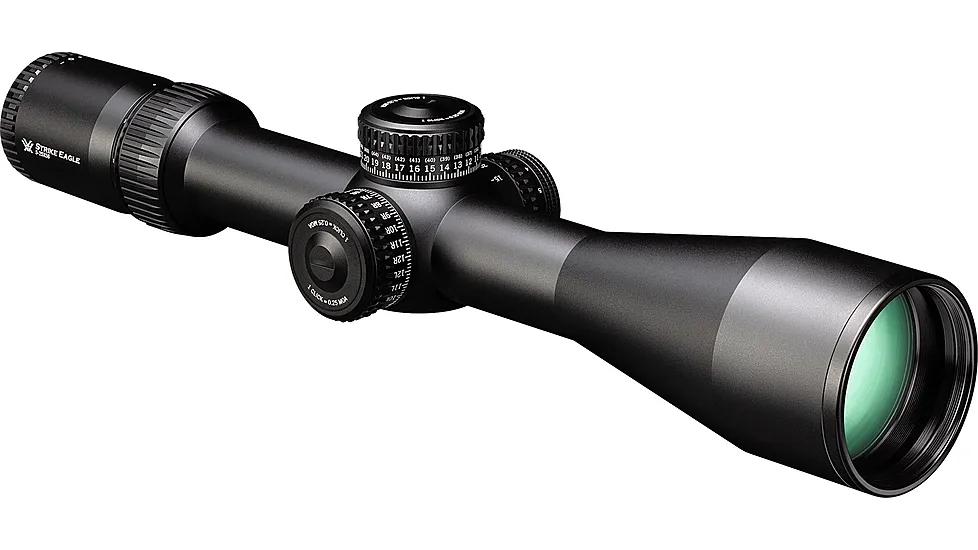
Best long range scope overall: Vortex Strike Eagle 5-25x56 FFP
First focal plane · 5-25x56 · 34mm tube · illuminated EBR-7C reticle (MOA or MRAD)
around $800exact price on OpticsPlanet
This is the complete long-range package under $900, with the spec sheet of the $1,200-plus tier: a 34mm tube with 110 MOA of elevation, an illuminated glass-etched FFP Christmas-tree reticle, a toolless RevStop zero stop (fitting it reduces the usable elevation), and side parallax down to 15 yards. What matters most at distance is what it does best: independent tall-target tests measure tracking deviation around 1 percent, and owners report dialing repeatable hits from 500 out to 1,760 yards. It ships complete with throw lever, sunshade and zero-stop ring, the Strike Eagle line is a fixture in under-$1,000 long-range roundups (Outdoor Life among them), and the unconditional Vortex VIP lifetime warranty backs all of it.
Pros
- Tracks like scopes twice its price: about 1 percent deviation in independent tall-target tests, with owners dialing verified hits to 1,000+ yards
- 34mm tube with 110 MOA (31 MRAD) of elevation travel: real dialing headroom for true long range
- Illuminated, glass-etched FFP EBR-7C reticle keeps holdovers accurate at every magnification (11 brightness settings)
- Side parallax focuses down to 15 yards, a rarity that makes it a genuine rimfire-trainer and NRL22 crossover
- Complete out of the box: throw lever, sunshade, RevStop zero ring, lens covers and turret tool included, plus the unconditional Vortex VIP lifetime warranty
Cons
- Heavy at 30.4 oz bare (over 2 lb mounted with 34mm rings): the wrong scope for a mountain or carry rifle
- Glass is excellent from 5x to about 15x, but color fringing and edge softening appear past 20x, and the eye box tightens noticeably at 25x
- Turret clicks are on the soft, muted side compared to crisper rivals, even though the actual tracking stays accurate
- Installing the RevStop zero ring cuts usable elevation from 31 to about 18 MRAD, so extreme-long-range shooters past 1,200 yards may run without it
Best for: entry-to-mid-level PRS shooters, ringing steel from 300 to 1,000+ yards with a 6.5 Creedmoor or .308, and rimfire trainer builds thanks to the 15-yard parallax. Skip it for backcountry hunting rifles, or if you want flawless glass at full magnification, where the premium tiers pull away.
Key specifications
| Magnification | 5-25x |
|---|---|
| Objective lens | 56 mm |
| Reticle | EBR-7C (MOA or MRAD), glass-etched, illuminated (11 settings) |
| Focal plane | First focal plane (FFP) |
| Tube diameter | 34 mm |
| Field of view | 24 - 5.2 ft at 100 yds |
| Eye relief | 3.7 in |
| Adjustment click | 1/4 MOA (0.1 MRAD on the MRAD version) |
| Elevation/windage travel | 110 / 78 MOA |
| Parallax | 15 yds to infinity (side focus) |
| Weight | 30.4 oz |
| Length | 14.6 in |
| In the box | Throw lever, sunshade, RevStop zero ring, lens covers, turret tool, CR2032 |
| Sealing | Waterproof, fogproof, shockproof (ArmorTek coating) |
| Warranty | Vortex VIP: unlimited, unconditional, lifetime |
“This optic is well built, priced decently, and offers features you find on more pricey scopes in its class. For a new long-range shooter or a more budget-friendly, but higher-end option this is a good buy.”
The Marksman, verified owner (MI) via OpticsPlanet, after a year on a .300 Win Mag
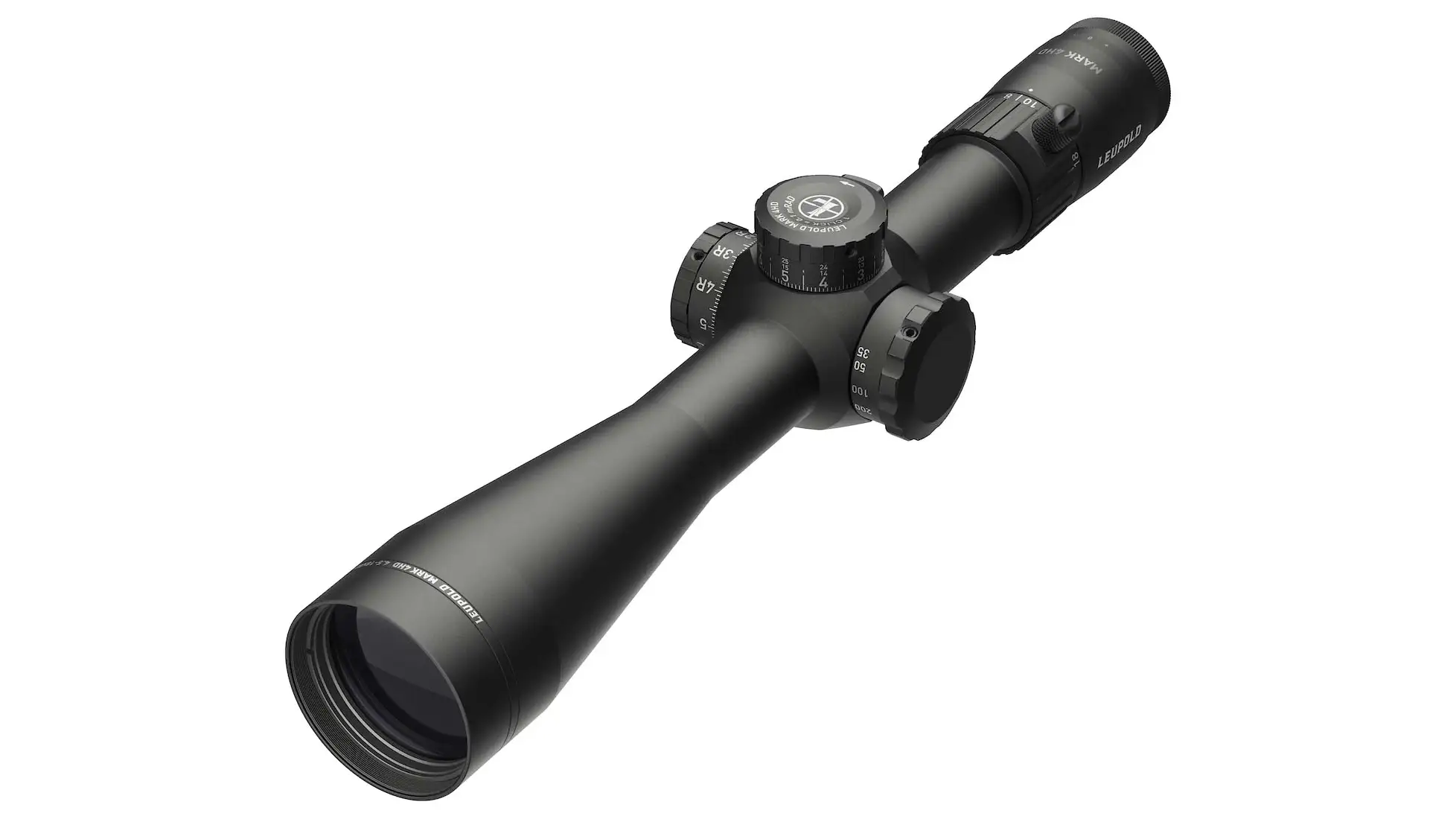
Most total elevation travel: Leupold Mark 4HD 4.5-18x52 FFP
First focal plane · 4.5-18x52 · 34mm tube · PR2-MIL reticle, non-illuminated · M5C3 ZeroLock elevation dial
around $1,500exact price on OpticsPlanet
This is the pick for the most total elevation travel on this page. Leupold's spec table lists 36 MIL for the PR2-MIL row, about 124 MOA against the Strike Eagle's 110 MOA, though Leupold also describes the M5C3 dial as giving up to 30 MIL in three revolutions (about 103 MOA). Clicks are 0.1 MIL at 10 MIL per revolution on that M5C3 ZeroLock dial, which has a revolution indicator; Leupold says ZeroLock prevents inadvertent adjustments and ensures accurate return to zero. The first focal plane PR2-MIL reticle works in the same mils as the dial, so holds and dialed corrections use one unit, and side focus runs from 25 yards to infinity. At 27.5 oz on Leupold's figures it is lighter than the Strike Eagle and the NX8 4-32x50. Three of six reviewers praise the clarity or the glass, and one calls the adjustments accurate. The catches: this row is not illuminated, it tops out at 18x, and the owner record is only six reviews.
Pros
- Leupold lists 36 MIL of elevation travel and 18 MIL of windage, in 0.1 MIL clicks with 10 MIL per revolution
- M5C3 ZeroLock elevation dial with a revolution indicator; Leupold says ZeroLock prevents inadvertent adjustments and ensures accurate return to zero
- First focal plane PR2-MIL reticle paired with a mil dial, so the reticle and the dial both work in mils
- Side focus from 25 yards to infinity, so you can clear parallax on close targets as well as at distance
- Backed by the Leupold Lifetime Guarantee
Cons
- The PR2-MIL row is non-illuminated; illuminated rows on the same listing cost more
- 27.5 oz on a 34mm tube, so 34mm rings are needed
- One of six reviewers finds the turrets not as clicky as they like
- Only six owner reviews, none tied to a reticle version
Best for: dialing in mils at distance with one scope for hunting and range days, when you want the most total elevation travel of these picks and locking ZeroLock dials. Skip this row if you want an illuminated reticle or more than 18x.
Key specifications
| Part number | 183626 (PR2-MIL, black) |
|---|---|
| Magnification | 4.5-18x (4:1 zoom ratio) |
| Objective lens | 52 mm |
| Tube diameter | 34 mm |
| Focal plane | First focal plane (FFP) |
| Reticle | PR2-MIL, non-illuminated |
| Elevation dial | M5C3 ZeroLock, locking, with revolution indicator (Leupold) |
| Click value | 0.1 MIL, 10 MIL per revolution (Leupold) |
| Elevation travel | 36 MIL total (Leupold spec table); Leupold describes the M5C3 dial as up to 30 MIL in three revolutions |
| Windage travel | 18 MIL (Leupold) |
| Parallax | Side focus, 25 yds to infinity |
| Field of view | 23.1 to 5.2 ft at 100 yds |
| Eye relief | 3.6 to 3.9 in |
| Length | 14.6 in (Leupold) |
| Weight | 27.5 oz (Leupold) |
| Warranty | Leupold Lifetime Guarantee |
“light enough for my hunting rifle with all the zoomeies for long range steel plinking”
Verified Owner (CA), via OpticsPlanet
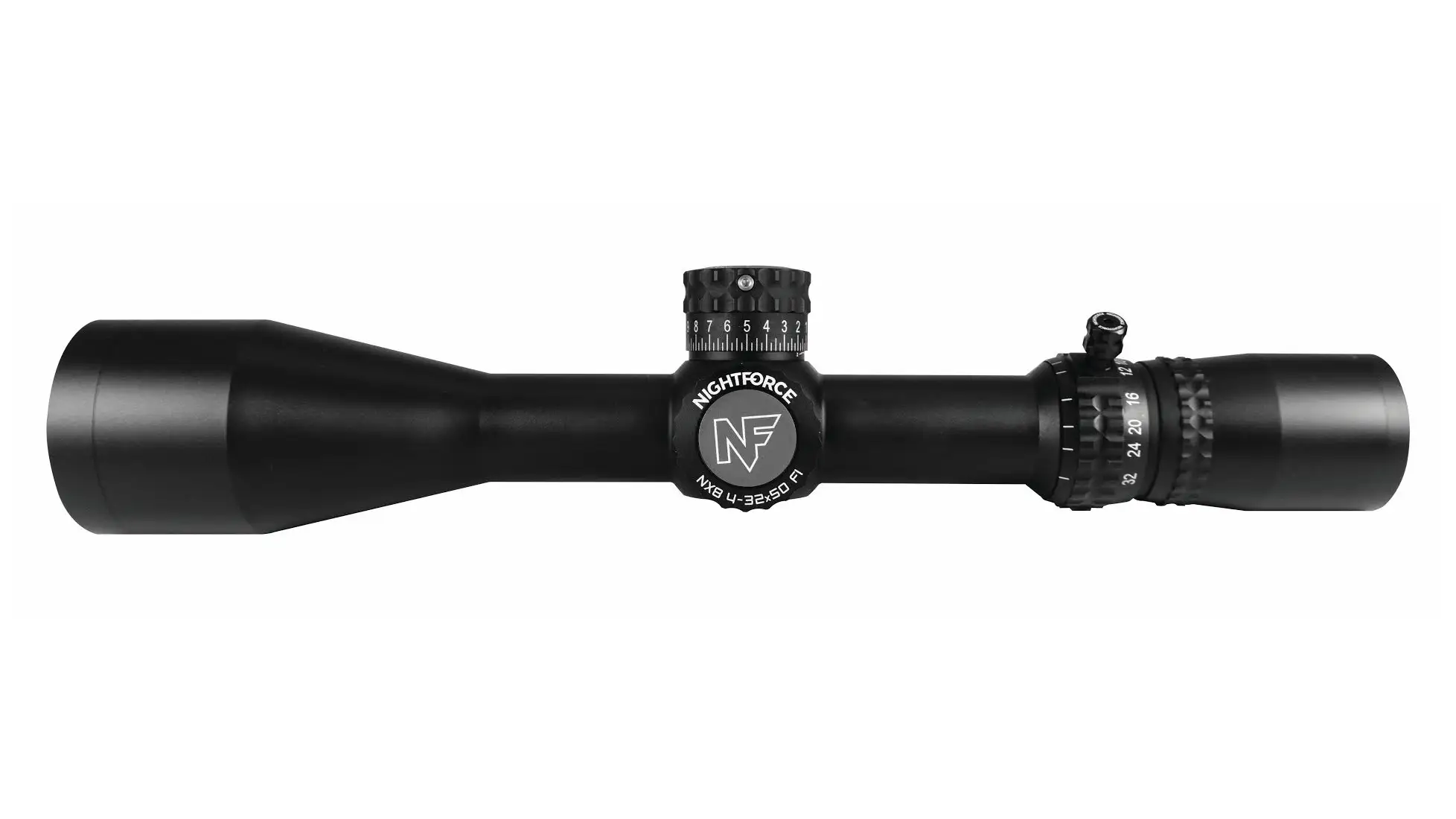
Best for maximum magnification: Nightforce NX8 4-32x50mm F1 Rifle Scope
4-32x · 50mm · 30mm tube · first focal plane · Mil-XT reticle · DigIllum · ZeroStop · 70 to 90 MOA of travel · 28.6 oz
around $2,500exact price on OpticsPlanet
This is the pick for maximum magnification: of these four scopes it is the only one that reaches 32x, with an illuminated first focal plane Mil-XT reticle, a ZeroStop and parallax down to 11 yards. Its owner record is 22 written reviews spanning 2020 to 2026, and the tone is consistent: tracking perfect, turrets tactile, glass clear. Go in knowing what the top end costs. It lists 90 MOA of elevation travel, less than the Strike Eagle's 110 MOA and the Mark 4HD's 36 MIL, and at 32x the exit pupil falls to 1.6mm, so the highest magnification is also the dimmest and the least forgiving of head position. That makes it a scope for a stable position rather than a do-everything rifle.
Pros
- The deepest owner record in the family by a wide margin, 22 written reviews across six years, and the tone is consistent: tracking perfect, turrets tactile, glass clear at all magnifications
- The only NX8 that reaches 32x, which is real capability for known-distance and varmint work, and one owner reports distinguishing an eight point from a ten point in that role
- A major outdoor publication called the 2.5-20x50 sibling of this scope possibly the ultimate precision riflescope and placed it second in its 2020 precision optics test, which is the company this line keeps
Cons
- Less adjustment than the rest of the family: 90 MOA of elevation and 70 of windage against 110 and 80 on the 2.5-20x50. An owner on their seventh Nightforce makes the same point comparing it to the 34mm ATACR
- The exit pupil falls to 1.6mm at 32x, narrower than a dark-adapted eye, so the top of the magnification range is dim and unforgiving of head position. More magnification is not more capability here
- Weight is the one con an owner lists outright at 28.6 oz, and the body is 13.4 inches long, which is a lot of scope for a light rifle
Best for: known-distance, bench or bipod shooting from a stable position when you want 32x. If you dial far, the Mark 4HD and the Strike Eagle list more elevation travel; if the rifle also has to work at close range, our Nightforce NX8 page points to the 2.5-20x50 instead.
Key specifications
| Manufacturer | Nightforce |
|---|---|
| Magnification | 4-32x |
| Objective lens | 50 mm |
| Tube diameter | 30 mm |
| Reticle focal plane | First focal plane (F1) |
| Reticle carded | Mil-XT, illuminated |
| Illumination | DigIllum, red |
| Exit pupil | 1.6 to 7.3 mm |
| Field of view | 26.1 ft at 100 yds |
| Elevation and windage travel | 70 to 90 MOA |
| Eye relief | 87.6 mm |
| Parallax | 11 yds to infinity |
| Weight | 28.6 oz |
| Length | 13.4 in |
| Model carded | C634 (of six orderable variants; one factory demo unit excluded) |
“I like it a lot more than my vortex razor gen 2. It's like half the weight and all the little things like click sounds and feel, built in knob, parallax adjustment, eye relief, and reticle adjustment... the razor gen 2 is better at low light usability due to the 56mm lens.”
ty, verified owner (FL) via OpticsPlanet
What makes a scope long-range capable
Four things separate a real long-range optic from a high-magnification hunting scope:
- Tracking you can trust. When you dial 6.5 MOA, the bullet must move exactly 6.5 MOA, shot after shot. This is the spec budget scopes most often fail. The evidence differs by pick: box drills for the Diamondback Tactical, independent tall-target tests for the Strike Eagle, an owner record of 22 written reviews describing the NX8 4-32x50's tracking as perfect, and for the Mark 4HD six reviews, one of which calls the adjustments accurate.
- A first focal plane reticle. FFP keeps holdover and wind marks true at every magnification. If you are new to the distinction, read FFP vs SFP.
- Elevation travel and a zero stop. Distance costs elevation, and a zero stop brings you home after big dials. Of these picks the Mark 4HD lists the most total travel at 36 MIL on a 34mm tube (about 124 MOA, on Leupold's spec table; Leupold also describes its M5C3 dial as up to 30 MIL in three revolutions, about 103 MOA), then the Strike Eagle at 110 MOA on a 34mm tube (less once its RevStop ring is fitted), then the NX8 4-32x50 at 90 MOA on a 30mm tube with a ZeroStop. The Diamondback Tactical has 65 MOA and no zero stop to hit its price, which is its honest trade-off.
- Usable glass at working power. Most dialing happens at 12-18x. The Diamondback Tactical and the Strike Eagle are sharp there and soften near maximum power, which we flag in their cons rather than hide. The NX8 4-32x50's exit pupil falls to 1.6mm at 32x, so its top power is its dimmest; the Mark 4HD stops at 18x, where its exit pupil works out to about 2.9 mm (52 mm divided by 18).
Deciding between the Diamondback Tactical and the Strike Eagle? We compare them head-to-head in Diamondback Tactical vs Strike Eagle. Dialing is a skill of its own: see how to adjust a rifle scope and MOA vs MRAD. If budget is not the limit, our Vortex Razor HD Gen III review covers Vortex's 34mm first focal plane 6-36x56 at several times the Strike Eagle's price. Prefer second focal plane and MOA for a hunting rifle you dial? Our Zeiss Conquest V4 review covers the 6-24x50 with a zero stop and the 4-16x44 with a capped turret. Want a 34mm dialing scope built for the longest shots? Our Nightforce ATACR review compares the 7-35x56, both 5-25x56 versions, the 4-16x42 and the 1-8x24 on Nightforce's own specs. Looking at Nightforce's newer NX6 line? Our Nightforce NX6 review compares eight NX6 models, including the 34mm 5-30x56 and 6-36x56, on Nightforce's own specs. Shooting F-Class or benchrest from a bench rather than dialing in the field? Our Nightforce Competition 15-55x52 review covers Nightforce's 27.9 oz second focal plane target scope with 1/8 MOA turrets and ZeroStop. Want a 34mm first focal plane long-range scope made in the U.S.A. with locking turrets? Our Steiner T6Xi review covers the 5-30x56 and compares the 3-18x56, 2.5-15x50 and 1-6x24 on Steiner's own specs. Looking at a 34mm first focal plane scope from Zeiss? Our Zeiss LRP S3 review covers the 6-36x56 and the 4-25x50 on Zeiss's own technical data. Hunting at unknown distances rather than dialing? Our Burris Eliminator 6 review covers a 4-20x52 hunting scope with a built-in laser rangefinder and ballistic holdover display, and its trade-offs. Want first focal plane with a clickless PĒK elevation knob and a ballistic heads-up display? Our Burris XTR PS review covers the 5.5-30x56 and the 3.3-18x50 on Burris's own specs, and its trade-offs. Dialed elevation only pays off from a steady rest; our best rifle bipod guide compares rifle bipods for prone and bench shooting.
FAQ
What magnification do I need for 1,000 yards?
The 5-25x and 6-24x classes are the long-range standard, and two of our four picks sit in them; the other two bracket them, the Leupold Mark 4HD at 4.5-18x and the Nightforce NX8 at 4-32x. In practice most shooters dial and spot impacts between 12x and 18x, where mirage and hand tremor are manageable, so honest glass in the middle of the range matters more than the number printed at the top. All four picks cover that working band.
Do I need a first focal plane (FFP) scope for long range?
For serious long-range work, yes. In an FFP scope the reticle scales with magnification, so holdover and wind marks read true at any zoom, which is essential when you hold or dial at varied power. All four of our picks are FFP: the Diamondback Tactical 6-24x50, the Strike Eagle 5-25x56, the Leupold Mark 4HD 4.5-18x52 and the Nightforce NX8 4-32x50 F1. A second focal plane scope only reads true at one magnification, which is workable but slower and error-prone at distance.
How much do I need to spend on a long range scope?
A genuinely capable entry point is under $300: the Vortex OPMOD Diamondback Tactical 6-24x50 FFP tracks reliably, which is the one thing a long-range scope cannot fake. For under $900, the Strike Eagle 5-25x56 adds an illuminated reticle, a 34mm tube with 110 MOA of travel, a zero stop (which reduces that travel once fitted) and a complete accessory kit. Above that, our two premium picks buy different things: the Leupold Mark 4HD 4.5-18x52 lists the most total elevation travel on this page, 36 MIL on Leupold's spec table, on locking ZeroLock dials, and the Nightforce NX8 4-32x50 F1 reaches 32x with an illuminated Mil-XT reticle and a ZeroStop.
Should I choose MOA or MRAD for long range?
Either system works at any distance; what matters is consistency between your reticle, your turrets and whoever you shoot with. MOA is more common among US hunters, and the Diamondback Tactical and Strike Eagle we list here are the MOA versions, while the Mark 4HD (PR2-MIL) and NX8 (Mil-XT) we list work in mils; MRAD dominates in PRS squads (the Strike Eagle also comes in an MRAD version, which costs a little less). Pick the system your range partners use and learn it well. Full explainer: MOA vs MRAD.
Shopping one brand rather than the field? Our Nightforce NX8 decoder shows why the higher-magnification model in that line has LESS elevation travel than the mid one, which is the opposite of what buyers expect. More picks: best rifle scopes overall · best budget rifle scope · best rifle scope under $500.