Vortex Strike Eagle 5-25x56 review: the long-range value play
Our verdict: 4.5/5. When this scope launched in 2020, its spec sheet (34mm tube, 110 MOA of elevation, illuminated first-focal-plane EBR-7C, toolless zero stop) belonged to the $1,200-plus tier. At around $800 it is still where the long-range value curve peaks, and the part that matters most is the part that measures best: independent tall-target tests put tracking deviation around 1 percent, and owners dial verified hits past 1,000 yards. It is our best-for-long-range pick.
Owners rate it 4.8/5 across 108 reviews on OpticsPlanet. The EBR-7C MOA version (SE-52503) is around $800, and the MRAD version (SE-52504) costs a little less. Prices verified October 14, 2026; confirm the current price and availability on the retailer page.
How we reviewed it: a research-based review built from retailer specifications, independent tracking tests, expert coverage and the owner-review record. We have not bench-tested this unit ourselves; the score is our editorial opinion. See how we evaluate.
What it is
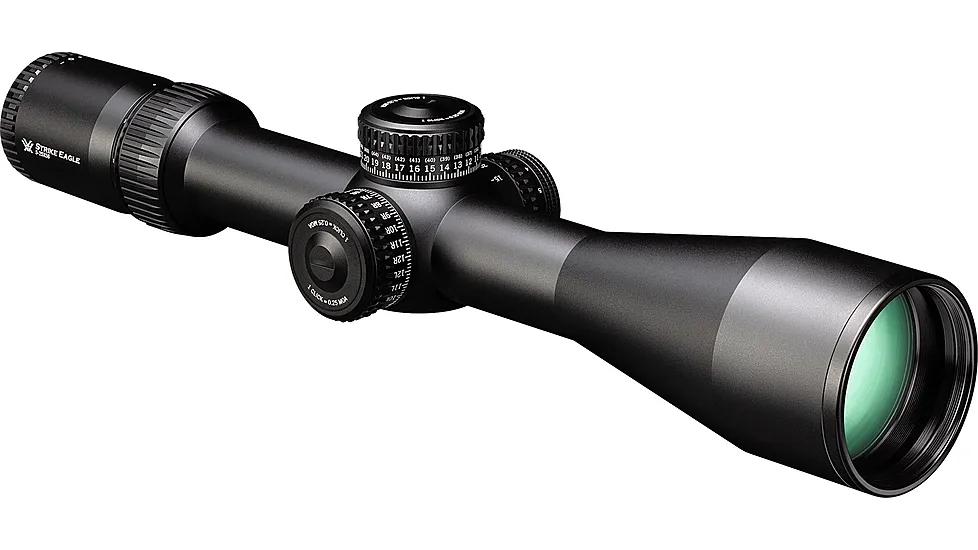
The Strike Eagle 5-25x56 sits between Vortex's Diamondback Tactical and Viper PST Gen II, and it was built to disrupt: give competitive and aspiring long-range shooters the mechanical feature set of premium optics at a fraction of the cost. First focal plane, 34mm tube, exposed locking turrets with a zero stop, illumination, and a box that includes what rivals sell separately: throw lever, sunshade, RevStop ring, covers and tools.
The Strike Eagle line, and where the 5-25x56 fits
Vortex builds the Strike Eagle as a two-family line. The low-power side (the 1-6x24 and the first-focal-plane 1-8x24) is made for close, fast AR-15 work, while the high-power side (3-18x44, 4-24x50 and this 5-25x56) is made for FFP long-range shooting. The 5-25x56 sits at the top: the biggest objective, the most magnification and the most elevation travel, which is why it is the one long-range shooters reach for. If you want a do-it-all AR optic instead, the 1-8x24 is the Strike Eagle to look at. This review covers the 5-25x56 FFP.
Tracking: the headline feature
A long-range scope lives or dies by whether the turrets move the bullet exactly as dialed, and this is where the Strike Eagle over-delivers for its price. Independent tall-target testing measured roughly 1 percent tracking deviation; box tests return to zero repeatably. The owner record is emphatic: the most-helpful verified review (115 of 118 found it useful) documents dialing between 200, 400 and 500 yards "spot on each time" and hits on half-MOA steel from 100 to 600 yards; another owner reports dialed hits at 500, 1,000, 1,500 and 1,760 yards on a 7 PRC.
Reticle and illumination
The glass-etched EBR-7C is a proper Christmas-tree reticle in the first focal plane, so wind and elevation holds stay true at every magnification (new to FFP? see our explainer). Eleven illumination settings keep it visible against dark steel and in low light, something our value pick, the Diamondback Tactical, lacks. Choose MOA or MRAD to match your system (MOA vs MRAD explained), and order by part number, SE-52503 for MOA and SE-52504 for MRAD, because the two are otherwise the same scope.
Elevation, the RevStop and the honest catch
The 34mm tube yields 110 MOA (31 MRAD) of elevation, true extended-range headroom. The included RevStop ring gives a hard return-to-zero stop with 5 clicks of under-travel. The trade-off we want you to know before buying: with the RevStop installed, usable elevation drops to about 18 MRAD (47 MOA). That is still plenty past 1,000 yards for most cartridges, but true ELR shooters often leave the ring out and keep the full travel.
Glass and handling: strong to 15x, honest past 20x
The XD-glass image is impressively sharp and bright through the low and mid magnifications where most shooting happens. Push past about 20x and budget physics reappear: some color fringing on high-contrast targets, edge softening at 25x, and an eye box that tightens enough to punish sloppy head position in positional shooting. At 30.4 oz bare it is also unapologetically heavy; on a bench or prone rig that stabilizes, on a mountain rifle it disqualifies.
What owners say (108 reviews, 4.8/5 on OpticsPlanet)
“The Vortex tracked perfectly today putting me on 1/2 moa steel from 100 to 600 yd steel and 1 moa steel at 750 and 880… My favorite budget scope so far (less than $1000).”
Rick S, verified owner (NV), most-helpful review
“This optic is well built, priced decently, and offers features you find on more pricey scopes in its class. For a new long-range shooter… this is a good buy.”
The Marksman, verified owner (MI), after a year on a .300 Win Mag
“I mounted it on my suppressed CZ 457 and was impressed. This is an awesome scope that reliably returns to zero every time.”
JR, verified owner (ID), rimfire crossover use
Price history: today is the standard price, not a sale
Vortex lists this scope above $1,000, and the minimum advertised price across major retailers has been around $800, which is exactly where both reticle versions sit today. Seasonal promotions have historically dipped below $700, with factory refurbs lower again, so this scope does go on sale and a patient buyer has somewhere to wait for. What it means right now is simpler: there is no discount on the table and no cheaper variant hiding behind the other reticle, so buy it when you need it rather than because the number looks like a deal.
Trade-offs, plainly
- Heavy: 30.4 oz bare, over 2 lb mounted. Not a carry scope.
- Optics soften past ~20x with color fringing on high-contrast targets; the eye box tightens at 25x.
- Turret clicks are softer than the crispest rivals, even though tracking accuracy itself measures excellent.
- RevStop installation cuts elevation to ~18 MRAD (disclosed above).
Key specifications
| Magnification | 5-25x |
|---|---|
| Objective lens | 56 mm |
| Tube | 34 mm, single-piece aircraft-grade aluminum |
| Focal plane | First focal plane (FFP) |
| Reticle | EBR-7C (MOA or MRAD), glass-etched, illuminated (11 settings) |
| Elevation / windage travel | 110 / 78 MOA (31 / 23 MRAD) |
| Zero stop | RevStop ring (included) |
| Parallax | Side focus, 15 yds to infinity |
| Eye relief | 3.7 in |
| Field of view | 24 - 5.2 ft at 100 yds |
| Weight / length | 30.4 oz / 14.6 in |
| In the box | Throw lever, sunshade, RevStop ring, lens covers, turret tool, CR2032 |
| Warranty | Vortex VIP: unlimited, unconditional, lifetime |
Should you buy it, and what else to consider
- Buy it as a first serious PRS/long-range scope, for 300 to 1,000+ yard steel, or as a do-it-all precision optic that even covers NRL22 rimfire (15-yard parallax).
- Save money with the Diamondback Tactical 6-24x50 if you are learning and can live without illumination and a zero stop.
- Skip it for hunting rifles you carry, or if you demand flawless 25x glass, where the premium tiers pull away.
FAQ
Is the Vortex Strike Eagle a good scope?
Yes, and it punches above its price bracket. The Strike Eagle line is known for first-focal-plane reticles, illumination and real tracking at prices well under premium glass; this 5-25x56 rates 4.8/5 across 108 reviews on OpticsPlanet and reaches 1,000 yards and beyond. Pick the low-power 1-6x24 or 1-8x24 models for close, fast AR-15 work, or this 5-25x56 for dedicated long range.
Can the Vortex Strike Eagle 5-25x56 really reach 1,000 yards?
Yes, with room to spare. Its 34mm tube holds 110 MOA (31 MRAD) of elevation travel, and owners report dialed, repeatable hits at 1,000, 1,500 and even 1,760 yards with appropriate cartridges. Independent tall-target tests measure its tracking deviation around 1 percent, which ballistic apps correct for easily.
Should I buy the MOA or MRAD version?
On the merits, match whichever system you and your shooting partners already use; neither is more accurate (see our MOA vs MRAD guide), and price barely separates them: the MRAD version costs a little less. The reticle is the same illuminated EBR-7C Christmas tree in both, so the only real question is the language you already think in: if your dope, your ballistic app and the people you shoot with are in mils, take the MRAD, and if they are in minutes, take the MOA. Switching systems mid-season costs more than most people expect. Order by manufacturer part number, SE-52503 for MOA and SE-52504 for MRAD, because the two are otherwise the same scope.
Is the Strike Eagle good for rimfire (NRL22)?
Genuinely yes, which is rare for a high-magnification centerfire scope. Its side parallax focuses down to 15 yards, so tiny close targets stay sharp and parallax-free, and the FFP reticle holds true at any zoom. One verified owner runs it on a suppressed CZ 457 for subsonic work out to 300 yards and bought a second for his .308.
What is the RevStop zero stop, and what is the catch?
RevStop is a ring you install under the elevation turret after zeroing; it gives a hard stop so you can spin back to zero without looking, with 5 clicks of travel below zero. The catch: installing it limits usable elevation from 31 MRAD to about 18 MRAD (47 MOA). Shooters chasing extreme range past roughly 1,200 yards often run without the ring to keep the full travel.
Want the close-quarters Strike Eagle instead of this long-range model? The 1-8x FFP anchors our best LPVO roundup.
The four rifle scopes we reviewed
Each pick is the best at one job. Here is where the one you just read fits, and the others worth comparing.
Best on a budget
Vortex Crossfire II 3-9x40
3-9x40 SFP
The bright, forgiving budget benchmark for daylight hunting.
Read the full review →Best value for long range
Vortex Diamondback Tactical 6-24x50
6-24x50 FFP
True FFP tracking and a 10-yard parallax for under $300.
Read the full review →Best premium hunting
Leupold VX-Freedom 3-9x40
3-9x40 SFP
US-made, class-leading low-light glass, lightest at 12.2 oz.
Read the full review →Best for long range
Vortex Strike Eagle 5-25x56
5-25x56 FFP
Illuminated FFP with 110 MOA and measured ~1% tracking.