The best rimfire scopes for 2026, for .22 LR to .17 HMR
Our verdict for 2026: the Vortex Diamondback Rimfire 2-7x35 is the best rimfire scope for most shooters, with centerfire-grade glass and build on a .22. The Barska 3-9x32 Plinker-22 (around $85, rings included) is the best budget pick. For .17 HMR, the BSA Sweet .17 SP 3-12x40 has an elevation turret calibrated for 17- and 20-grain loads. For precision target work with dialable parallax, the Hawke Vantage 4-16x50 AO is a step up outside the ranked picks, with one thing to know first: the version we link carries a Mil-Dot reticle, not Hawke's .17 HMR drop reticle.
Editorial scores are our opinion; owner ratings are shown attributed to their source. Prices verified September 30, 2026; confirm the current price and availability on the retailer page.
A rimfire scope earns its place with a close parallax setting, a forgiving eye box and clear glass at .22 prices. Below are our ranked picks across overall value, budget and glass value, plus the .17 HMR option, with honest pros and cons and how to choose.
How these picks were made: a research-based roundup comparing published specifications, independent hands-on reviews and owner feedback on OpticsPlanet. Scores are our editorial opinion, not a hands-on test of every model, and owner ratings are shown attributed to the retailer. Confirm current price on the retailer page. See how we evaluate.
Quick comparison
| Category | Pick | Spec | Price | |
|---|---|---|---|---|
| Best overall | Vortex Diamondback Rimfire 2-7x35 | 2-7x · 50 yd parallax · XD glass | around $240 | Check price |
| Best budget | Barska 3-9x32 Plinker-22 | 3-9x · rings included · 11.5 oz | around $85 | Check price |
| Best glass value | Sightron SI 3-9x32 Rimfire | 3-9x · 3.6-4 in eye relief · 11.6 oz | around $190 | Check price |
| Best first upgrade | Vortex Crossfire II 2-7x32 Rimfire | 2-7x · 50 yd parallax · 13.9 oz | around $120 | Check price |
| Best for .17 HMR | BSA Sweet .17 SP 3-12x40 | 3-12x · .17 HMR turret · side parallax | around $170 | Check price |
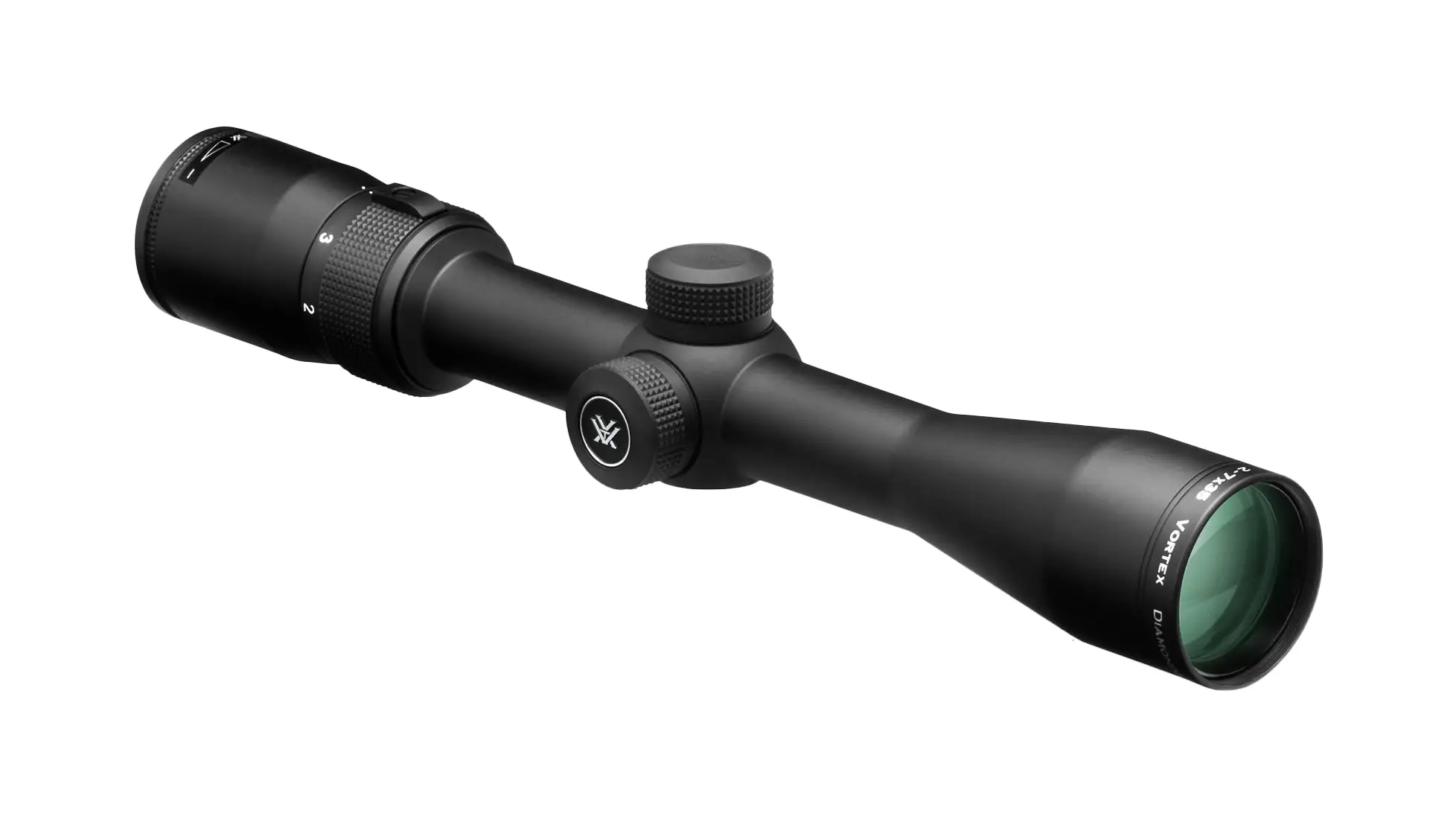
Best overall: Vortex Diamondback Rimfire 2-7x35
Rimfire · 2-7x35 · V-Plex · 50 yd parallax · SFP
around $240exact price on OpticsPlanet
This is the rimfire scope to beat, because it puts centerfire-grade hardware on a .22. Vortex built it around a solid aircraft-grade aluminum chassis and a magnum-rated erector that shrugs off recoil, added XD (extra-low dispersion) glass that owners say rivals scopes twice the price, and tuned the parallax to a fixed 50 yards for rimfire ranges. The field of view is huge (64.3 feet at 2x) for tracking small game in brush, and the whole thing carries the unconditional Vortex VIP lifetime warranty. It is the default answer for a serious .22 LR or 10/22.
Pros
- XD glass with fully multi-coated lenses, noticeably clearer than budget rimfire scopes in its price range
- Huge 64.3-foot field of view at 2x (versus about 42 ft on the Crossfire II) for fast small-game tracking
- 50-yard fixed parallax tuned to rimfire distances, so close shots stay optically flat
- Argon-purged build the retailer describes as highly resistant to magnum-force recoil, and owners report it holding zero
- Unlimited, unconditional Vortex VIP lifetime warranty
Cons
- Short 3.1-inch eye relief: fine for rimfire, but do not move it to a hard-recoiling centerfire or shotgun
- Oversized ocular bell often forces medium or high rings, which can raise your cheek weld
- The eye box tightens at 7x, so head position gets fussy at full magnification
Best for: the all-round .22 LR, .22 WMR or 10/22 shooter who wants the best glass and warranty in the class. Skip it if you need long eye relief for a centerfire, or a turret calibrated for .17 HMR and more magnification for longer shots (see the BSA Sweet .17).
Key specifications
| Type | Rimfire riflescope (SFP) |
|---|---|
| Magnification | 2-7x |
| Objective | 35 mm |
| Reticle | V-Plex (non-illuminated) |
| Parallax | Fixed 50 yds |
| Field of view | 64.3 to 19.3 ft at 100 yds |
| Eye relief | 3.1 in |
| Turrets | 1/4 MOA capped |
| Adjustment range | 100 MOA |
| Glass | XD, fully multi-coated |
| Gas | Argon |
| Weight | 13.7 oz |
| Warranty | Vortex VIP unlimited lifetime |
“Love this scope on my 10/22. Really clear glass at the price point, and the Vortex warranty is great peace of mind. Also able to mount very low profile on the 10/22.”
Drew, owner (IL) via OpticsPlanet
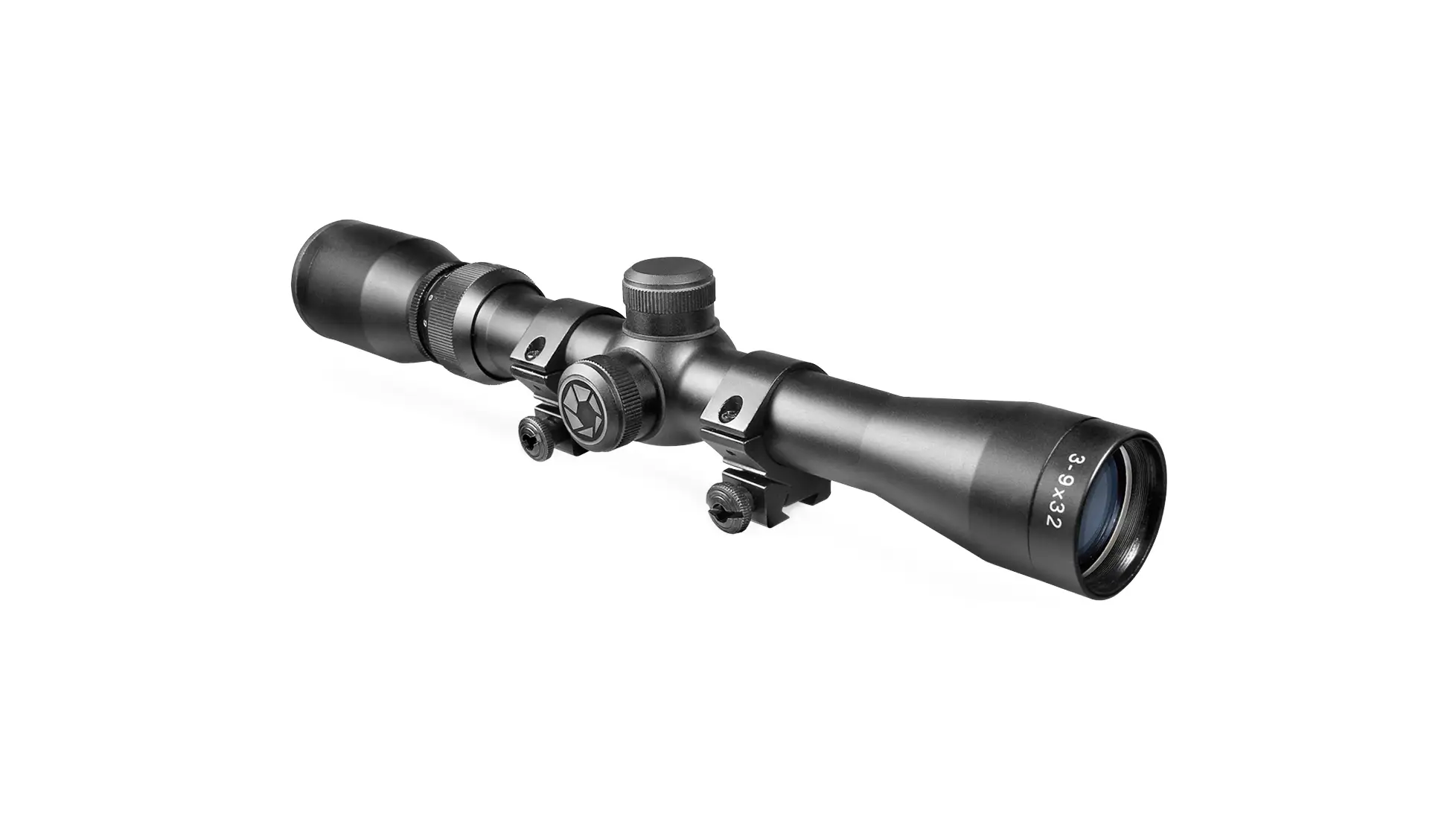
Best budget: Barska 3-9x32 Plinker-22
Rimfire · 3-9x32 · 30/30 · 50 yd parallax · rings included
around $85exact price on OpticsPlanet
If you just want to put decent glass on a plinking .22 without spending much, the Barska Plinker-22 is the honest budget pick. It is purpose-built for .22 rifles and rimfires, parallax-free at 50 yards, waterproof and fogproof, and it ships with 3/8-inch dovetail rings and scope caps in the box, so there is nothing else to buy. The 3-9x range gives a bit more reach than most starter scopes. It is not premium glass, but for a starter rifle, a youth .22, or a knock-around plinker, owners consistently say it does the job for the price.
Pros
- Very low price, and it includes 3/8-inch dovetail rings and scope caps in the box
- Purpose-built for rimfire with a 50-yard parallax and 3.5-inch eye relief
- Waterproof, fogproof and shockproof, with a lifetime warranty
- The 3-9x range adds a little reach over typical 4x starter scopes
Cons
- Entry-tier glass: fully coated (not fully multi-coated), so clarity and low-light trail the Vortex clearly
- Basic 30/30 reticle and capped turrets with a smaller 60 MOA adjustment range
- The 3/8-inch dovetail mount fits rimfire grooved receivers but limits ring options versus a Weaver base
Best for: budget and beginning shooters, youth .22 rifles and knock-around plinkers who want a complete, mounted setup cheaply. Step up to the Diamondback Rimfire for glass, field of view and the Vortex warranty.
Key specifications
| Type | Rimfire riflescope (SFP) |
|---|---|
| Magnification | 3-9x |
| Objective | 32 mm |
| Reticle | 30/30 |
| Parallax | Fixed 50 yds |
| Field of view | 39 to 13 ft at 100 yds |
| Eye relief | 3.5 in |
| Turrets | 1/4 MOA capped |
| Adjustment range | 60 MOA |
| Glass | Fully coated |
| Mount | 3/8 in dovetail rings included |
| Weight | 11.46 oz |
| Warranty | Barska limited lifetime |
“This scope is just what I wanted for my semi-auto 22lr. I sighted my rifle in at about 10 to 12 yards, and the first group of ten shots could be covered with a nickel.”
bearsherk, owner (PA) via OpticsPlanet
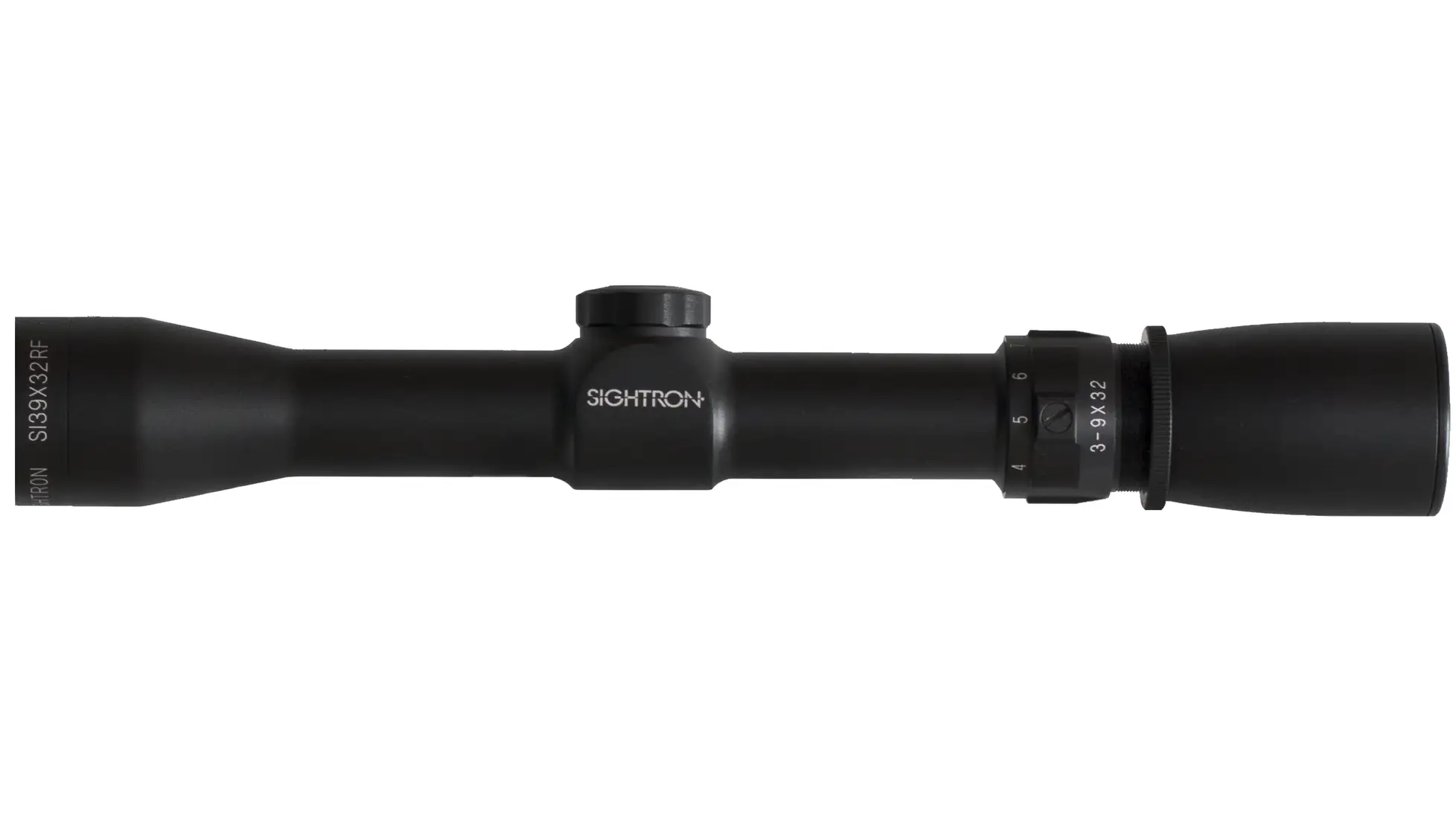
Best glass value: Sightron SI 3-9x32 Rimfire
Rimfire · 3-9x32 · Duplex · 50 yd parallax · SFP
around $190exact price on OpticsPlanet
If your priority is clean glass and comfortable handling on a .22 without going to the Vortex, the Sightron SI is the pick. It is a purpose-built rimfire scope (50-yard parallax, fully multi-coated glass) from a brand with a strong optical reputation, and owners repeatedly say it is in "an entirely different league" from old Tasco and Bushnell budget scopes. It also fixes the Diamondback's one ergonomic flaw with a forgiving 3.6 to 4-inch eye relief, and at 11.6 ounces it sits low and light on a slim .22. One owner even shoots it in IR 50/50 benchrest matches. The trade-off is a small review sample and a simple crosshair with no holdover marks.
Pros
- Fully multi-coated glass owners rank well above budget names like Tasco and Bushnell
- Forgiving 3.6 to 4-inch eye relief, more comfortable than the Diamondback Rimfire
- Light (11.6 oz) and low-profile, a natural fit on slim .22 sporters
- 50-yard parallax and a lifetime warranty, and it is proven in rimfire benchrest
Cons
- Small review sample so far (8), versus dozens on the Vortex and Barska
- Simple fine crosshair with capped hunting turrets: no BDC holdovers or field dialing
- No rings included, and the 32mm objective is modest for the lowest light
Best for: shooters who want nicer-than-budget glass and comfortable eye relief on a purpose-built .22 scope. Skip it if you want a turret calibrated for .17 HMR (the BSA), an illuminated reticle (the Hawke) or the widest field of view (the Vortex).
Key specifications
| Type | Rimfire riflescope (SFP) |
|---|---|
| Magnification | 3-9x |
| Objective | 32 mm |
| Reticle | Fine Duplex crosshair |
| Parallax | Fixed 50 yds |
| Field of view | 33.1 to 12.2 ft at 100 yds |
| Eye relief | 3.6 to 4 in |
| Turrets | 1/4 MOA capped |
| Adjustment range | 70 MOA |
| Glass | Fully multi-coated |
| Weight | 11.6 oz |
| Warranty | Sightron lifetime |
“The glass is crystal clear, and the quality of construction is exactly what I expected. I grew up with 4x32 and 3-9x32 Tasco and Bushnell scopes, and these Sightron scopes are in an entirely different league.”
SDG (NC) via OpticsPlanet
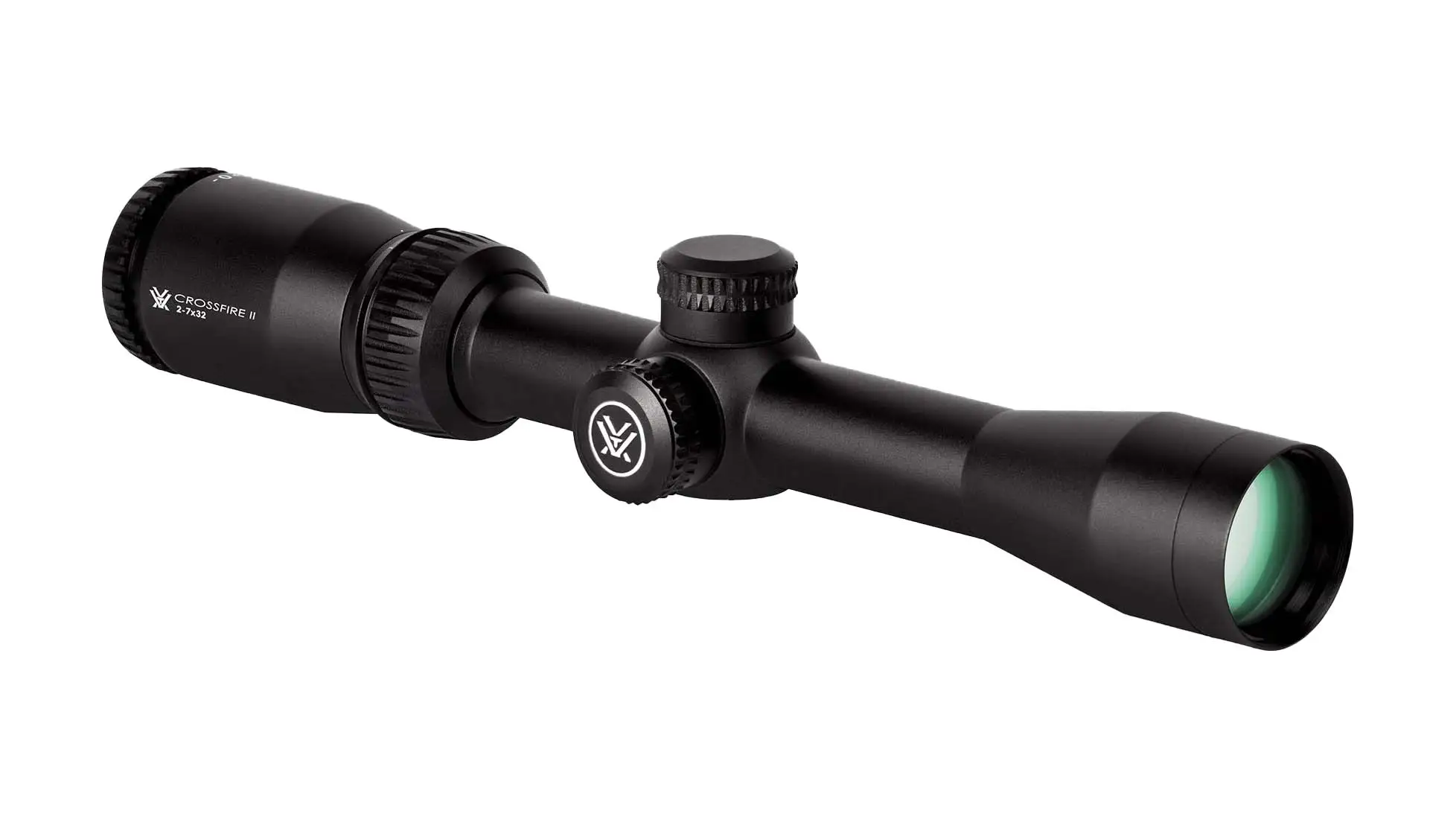
Best first upgrade: Vortex Crossfire II 2-7x32 Rimfire
Rimfire · 2-7x32 · V-Plex · 50 yd parallax · SFP
around $120exact price on OpticsPlanet
This is the rung most people actually start on, and it is the same idea as our top pick built to a lower price. It carries the rimfire specification that matters, a parallax fixed at 50 yards, so targets at .22 distances stay optically flat instead of shimmering the way a 100-yard centerfire scope makes them. It carries the same unlimited, unconditional Vortex VIP lifetime warranty as the Diamondback above it, on a nitrogen-purged, o-ring-sealed one-piece aluminum tube with capped resettable MOA turrets. What it gives up is glass and view. Vortex publishes 42.0 feet of field at 2x against 64.3 on the Diamondback, and there is no XD extra-low-dispersion element, so this is the scope that gets a bundled rimfire shooting properly rather than the one that ends the search. Buy it if the gap to the Diamondback is the difference between buying and not buying, and read the MPN rather than the page when you get there, because the retailer sells this rimfire model and a centerfire Dead-Hold BDC model under one listing.
Pros
- Fixed 50-yard parallax, the specification that makes a scope a rimfire scope rather than a centerfire scope sold to rimfire shooters
- The same unlimited, unconditional Vortex VIP lifetime warranty our overall pick carries, on a scope at roughly half the price
- Capped, resettable 1/4 MOA turrets with 60 MOA of travel in both axes, so a zero survives being carried and knocked
- Nitrogen-purged, o-ring-sealed one-piece aircraft-grade aluminum tube, fully multi-coated, waterproof and fogproof
- At 13.9 oz it is lighter than our top pick, which matters on a light .22 where a heavy scope changes how the rifle hangs
Cons
- The view is much narrower than the top pick: Vortex publishes 42.0 feet at 2x against 64.3 on the Diamondback Rimfire, which is the single biggest reason it is not our overall choice
- No extra-low-dispersion glass, so colour fringing on high-contrast edges is visible where the Diamondback is clean
- The owner record’s one real technical theme is the turrets: one owner measured half an inch per click against the stated quarter MOA, and another found the L-R and U-D markings on the wrong turrets
- The 4.8 from 258 ratings belongs to the retailer listing, which sells this scope and a centerfire Dead-Hold BDC model under one page, so it is not this variant’s own record and we do not present it as one
- The retailer’s own specification table on that shared listing prints a 100-yard parallax, which is the centerfire model’s figure; Vortex publishes 50 yards for this one, so compare on the maker’s numbers
Best for: the shooter putting a first real optic on a 10/22 or a bolt .22 who wants the Vortex warranty and the correct rimfire parallax without spending Diamondback money. Skip it if you shoot small game in brush, where the wider Diamondback view earns its price, or if you want lit reticles and reach for .17 HMR.
Key specifications
| Type | Rimfire riflescope (SFP) |
|---|---|
| Magnification | 2-7x |
| Objective | 32 mm |
| Reticle | V-Plex (non-illuminated) |
| Parallax | Fixed 50 yds |
| Field of view | 42.0 to 12.6 ft at 100 yds |
| Eye relief | 3.9 in |
| Turrets | 1/4 MOA capped, resettable |
| Travel per rotation | 15 MOA |
| Adjustment range | 60 MOA windage and elevation |
| Tube | 1 in |
| Length | 11.5 in |
| Weight | 13.9 oz |
| Warranty | Vortex VIP unlimited lifetime |
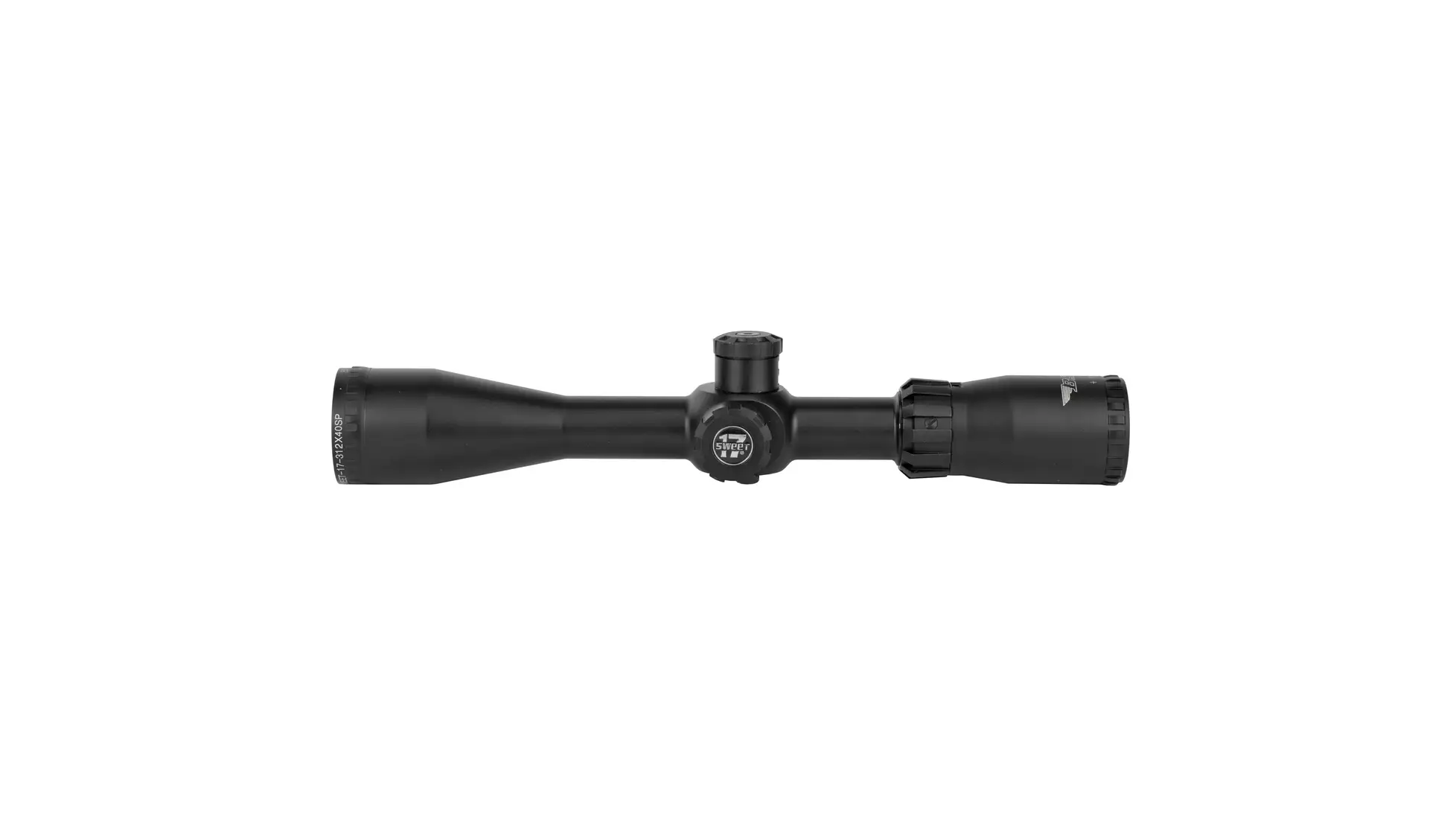
Best for .17 HMR: BSA Sweet .17 SP 3-12x40
Rimfire · 3-12x40 · 30/30 · .17 HMR elevation turret · side parallax
around $170exact price on OpticsPlanet
This is the scope in the guide that is built around the .17 HMR. BSA calibrates its elevation turret for 17-grain and 20-grain .17 HMR loads, so you zero the rifle, then turn the dial to the yardage you read off a rangefinder instead of holding over. The reticle itself is a plain 30/30; the calibration lives in the turret, not in the crosshair. Parallax is set with a side knob from 10 yards to infinity, which you can reach from behind the rifle on a rest, and 3-12x gives the reach a flat-shooting .17 HMR can use. What you give up is warranty and polish: BSA covers it for one year, the owner record is mostly several years old, and the turret marks are only right beyond your zero.
Pros
- Elevation turret calibrated by BSA for 17-grain and 20-grain .17 HMR loads, so you dial the distance rather than guess the holdover
- Side parallax from 10 yards to infinity, adjusted from the shooting position instead of reaching to the front of the scope
- 3-12x magnification and fully multi-coated lenses, with owners describing clear glass for the money
- Owners describe the turret marks as accurate, including one who had fitted five of these scopes in three months
Cons
- BSA’s own warranty is limited to one year, against the lifetime cover on the Vortex and Barska picks above
- The turret marks are for distances beyond your zero: one owner zeroed at 100 yards and measured about an inch off at 75 yards and more than 4 inches at 25 and 50, so learn your clicks for close shots
- A long scope with 4 inches of eye relief and no rings in the box: owners mention needing medium to extra-high rings, and one could not place the rings on a rail
- The owner record is old, with the newest review from 2021, and the listing mixes in reviews of the illuminated version, so treat the rating as a guide to the line rather than this exact model
Best for: .17 HMR owners who want a turret made for their cartridge at a modest price and will shoot mostly past 100 yards. Skip it if you want a lifetime warranty or a scope for a .22 LR, where the 50-yard parallax picks above are the better fit.
Key specifications
| Type | Rimfire riflescope for .17 HMR |
|---|---|
| Magnification | 3-12x |
| Objective | 40 mm |
| Reticle | 30/30 (non-illuminated) |
| Elevation turret | Calibrated for 17 gr and 20 gr .17 HMR |
| Parallax | Side focus, 10 yds to infinity |
| Field of view | 33 to 8.3 ft at 100 yds |
| Eye relief | 4 in |
| Click value | 1/4 MOA |
| Tube | 1 in |
| Glass | Fully multi-coated |
| Rings | Not included |
| Warranty | BSA limited one year |
“These scopes are clear and consistent. The adjustment is positive and very accurate. The ballistic turrets are dead on every time. The side focus is a real plus when the rifle is on a rest.”
Tcf, reviewer (CA) via OpticsPlanet
A precision step-up, and a note for .17 HMR shooters
If you want to dial parallax for target work, the Hawke Vantage 4-16x50 AO is the step up from the ranked picks: an adjustable objective that focuses from 15 yards to infinity, an illuminated reticle with red and green at five brightness levels, and 4-16x of magnification to see your own holes in paper. Read the model number before you buy, because the retailer listing we link sells Hawke's model 14260, and Hawke's own model table lists 14260 as the Mil-Dot version of this scope. The version with Hawke's .17 HMR drop reticle is a different model, 14261. A Mil-Dot works on any cartridge if you learn your holds; it is not calibrated to .17 HMR.
It also sits outside the ranked list because of the job it is built for. At 21.9 ounces and 15.3 inches it dwarfs a small rimfire rifle, and its 50mm objective needs high rings, so it is a varmint and target optic rather than the scope you leave on a 10/22 for an afternoon of plinking. If a .17 HMR is your rifle and you want a scope calibrated to the cartridge, that is the BSA Sweet .17 SP in the ranked picks above: its calibration sits in the elevation turret rather than the reticle, and it focuses parallax with a side knob instead of an adjustable objective.
One warning if you go looking for a substitute in the same family. The retailer's category grid lists a Vantage 6-24x50 AO and a Vantage 4-16x44 SF with prices next to them, which makes them look available. They are not: open either product page and there is nothing orderable on it. The figure in the grid is a list price on a page that cannot sell you anything, which is a trap worth knowing about generally, not just here.
How to choose a rimfire scope
A few things matter more than the spec sheet on a .22:
- Parallax setting. A rimfire scope is set parallax-free at 50 yards, right where you shoot a .22; a 100-yard centerfire scope shows reticle drift up close. This is the single biggest reason to buy rimfire-specific glass.
- Magnification. 2-7x is ideal for plinking and small game inside 100 yards; 4-16x with an adjustable objective suits .17 HMR and target shooting at distance.
- Eye relief and eye box. Rimfire recoil is negligible, so short eye relief is safe, but a forgiving eye box makes fast shots easier. Do not repurpose a short-eye-relief rimfire scope onto a hard-kicking centerfire.
- Mount type. Many .22 rifles use a 3/8-inch dovetail (grooved receiver); some use a Weaver or Picatinny base. Check what your rifle and rings need, or buy a scope that includes rings like the Barska.
- Glass and warranty. Fully multi-coated XD-type glass (the Vortex) clearly beats fully coated budget glass in low light, and the Vortex VIP lifetime warranty is a long-term value on a scope that may outlast the rifle.
One thing the scope cannot do for you: the distance you zero at. Fifty yards is the answer for a .22 LR, and it is not the same 50 as the parallax setting above. Zero at 100 the way you would a centerfire and published CCI trajectory data puts the bullet about 3 inches high at 50 yards, which is where you will take nearly every shot.
Thinking about the Vortex Crossfire II 2-7x32 Rimfire?
It is one of the most-searched rimfire scopes, and it is a fair one, so we card it above as our first-upgrade pick rather than talking about it and leaving you nowhere. The short version: it is the same idea as our overall pick built to a lower price. The reason we still card the Diamondback Rimfire 2-7x35 above it comes down to glass and field of view. Vortex publishes 64.3 feet of view at 2x on the Diamondback against 42.0 feet on the Crossfire II, and only the Diamondback has XD extra-low-dispersion glass, which is what you are paying the difference for when you track small game in brush. Both carry the same unconditional VIP lifetime warranty and both are built on the 50-yard parallax that makes a scope a rimfire scope, so you are choosing tier, not brand.
One thing to get right before you compare it anywhere else. The retailer sells this scope and a centerfire Dead-Hold BDC model under a single listing whose title just says Rifle Scope, and the specification table on that page belongs to the listing rather than to either model. It prints a 100-yard parallax. Vortex publishes 50 yards for the rimfire, and a 50-yard parallax is the entire reason this version exists. The listing understates the length and overstates the weight in the same way. Every figure on our card is Vortex's own, which is also why our numbers will not match the retailer's line for line.
FAQ
What is the best rimfire scope in 2026?
For most shooters the Vortex Diamondback Rimfire 2-7x35 is the best overall: XD glass, a magnum-rated build, a huge field of view and a 50-yard parallax tuned for .22 LR, all under a lifetime warranty. The Barska 3-9x32 Plinker-22 (under $100, with dovetail rings included) is the best budget pick. For .17 HMR, the BSA Sweet .17 SP 3-12x40 has an elevation turret calibrated for 17- and 20-grain loads. For precision target work with dialable parallax, the Hawke Vantage 4-16x50 AO is the step up, but the version we link has a Mil-Dot reticle rather than Hawke's .17 HMR drop reticle.
What is the best scope for a .17 HMR?
Our .17 HMR pick is the BSA Sweet .17 SP 3-12x40. BSA calibrates its elevation turret for 17-grain and 20-grain .17 HMR loads, so once the rifle is zeroed you dial the distance instead of holding over, and it adjusts parallax with a side knob from 10 yards to infinity. The trade-offs are a one-year BSA warranty and turret marks that only apply beyond your zero, so close shots still need counted clicks. A .22 LR scope with a fixed 50-yard parallax will work on a .17 HMR, but it is not calibrated to the cartridge.
What is the best budget rimfire scope?
The Barska 3-9x32 Plinker-22 at under $100 is our budget pick, and it includes 3/8-inch dovetail rings and scope caps in the box, so it is a complete setup with nothing else to buy. It is purpose-built for rimfire with a 50-yard parallax. The glass is entry-level, so if you can stretch the budget the Vortex Diamondback Rimfire is a large step up in clarity and warranty.
Do I really need a rimfire-specific scope?
It helps a lot at close range. A rimfire scope is set parallax-free at 50 yards, matching the distances a .22 is shot at, while a standard centerfire scope is set at 100 yards and shows parallax error (the reticle drifting off target as your head moves) up close. A centerfire scope will work, but a 50-yard rimfire scope like these gives more consistent aim at 25 to 75 yards.
What is the best scope for a Ruger 10/22?
The Vortex Diamondback Rimfire 2-7x35 is our top Ruger 10/22 pick: owners mount it low and clean on the receiver, and its 50-yard parallax plus wide field of view suit the 10/22 perfectly. On a tight budget the Barska Plinker-22 is a solid starter with rings included. See our dedicated best scope for a Ruger 10/22 guide for the full rundown.
Is the Vortex Crossfire II 2-7x32 Rimfire a good .22 scope?
It is a solid budget-to-midrange choice and a common first upgrade, but within the same brand the Diamondback Rimfire is the better buy for a little more money. The Crossfire II 2-7x32 Rimfire is purpose-built for .22 with a 50-yard parallax and the same lifetime VIP warranty, and its V-Plex reticle and capped turrets do the job. Where it trails the Diamondback is glass and field of view: the Diamondback uses XD extra-low-dispersion glass and shows a much wider view (about 64 feet at 2x against roughly 42 feet on the Crossfire II), which is why we card the Diamondback as our overall pick. If your budget is tight the Crossfire II is a reasonable option; if you can stretch, the Diamondback is the clearer, wider glass.
Related: best scope for a Ruger 10/22 · what distance to zero a .22 · rimfire vs centerfire scopes · best rifle scopes overall.