Garmin Xero A1i Pro review: the bow sight with a rangefinder inside
Our verdict: 4.3/5. The Garmin Xero A1i Pro is a bow sight with a laser rangefinder built in. You press a silent trigger taped to your grip, at rest or at full draw, and it ranges the animal and lights an LED pin for that distance, angle-compensated, so you never lower the bow to use a handheld unit. Garmin lists 100 yards to game and 300 to reflective targets. Garmin's model line says the Pro adds micro-adjustable rails and quick detach over the A1i. The sight also builds a pin stack from a 20-yard pin and your arrow speed, which you then validate. Buy it if ranging at full draw is the problem you want gone. The catches are a high price, 18.0 oz on the front of your bow, lithium batteries only for ranging, and state rules: Garmin itself warns that some jurisdictions regulate or prohibit the use of electronic bow sights for hunting. If you would rather keep your sight and add a handheld, see our best rangefinder for bow hunting guide.
OpticsPlanet shoppers rate it 5.0/5 from 1 review. We card the left-hand row (MPN 010-01781-51) at around $1,300; the right-hand row is the same price. Check price and availability on OpticsPlanet.
How we reviewed it: a research-based review built from Garmin's own sources: the specifications, box contents and model comparison on Garmin's product page, Garmin's August 2021 launch release for the A1i Pro, and the Xero A1i Pro owner's manual and its device specifications page. We add the OpticsPlanet listing and its single review. With one review there is no pattern to report, so the weight of this page is Garmin's published detail. We have not used this sight ourselves; the score is our editorial opinion and the owner rating is shown attributed to its source. Claims from outside research that we could not confirm on a Garmin page, such as awards, are left out. See how we evaluate.
What the Xero A1i Pro does
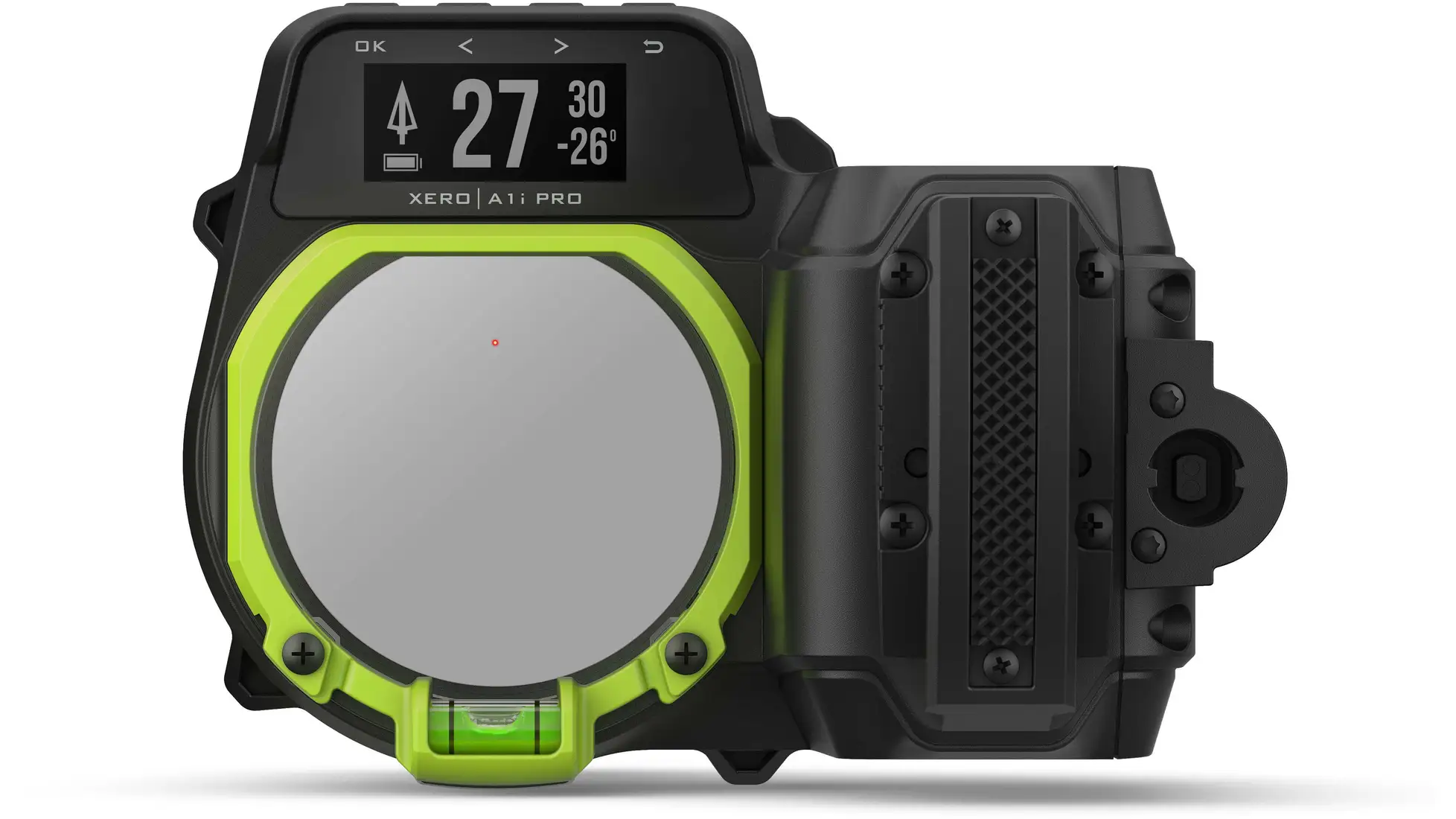
A conventional bow sight gives you fixed pins for set distances, and you find the distance with a separate rangefinder. The Xero puts both jobs in one housing. Per the owner's manual, you hold the rangefinder trigger, put the primary pin on the ranging reticle and the target, then release the trigger; the sight shows the measured range and projects a new pin, and you aim with that pin and shoot. The manual's tip is that you can range with the bow drawn or at rest.
The display shows three measurements: the line-of-sight distance, the upward or downward angle, and the adjusted distance, which the manual describes as the horizontal distance calculated using that angle. That is the number that matters from a tree stand. Garmin lists two pin colors, red and green, with brightness set by an ambient light sensor or by hand, and says no visible light is ever projected toward the target. The trigger is a wired button: the manual has you lock its cable into the sight and secure the button to your bow grip with the included tape, where you can activate it at full draw.
Garmin's model line lists Laser Locate for both the A1i and the A1i Pro. Garmin describes it as a waypoint projection feature that pairs with a compatible Garmin GPS device, sold separately, to show the target's location. Neither a GPS handheld nor a watch comes in the box.
What the Pro adds over the A1i
The Xero A1i without "Pro" is a separate product on a separate OpticsPlanet listing. Garmin's own model line separates them in one phrase. The A1i "Adds advanced features, such as dual-color LED pins, multiple arrow profiles and Laser Locate functionality". The A1i PRO lists the same and then "plus adds micro-adjustable rails and quick detach for travel". Garmin's August 2021 launch release for the A1i Pro describes these features (only the rails and quick detach are named as Pro additions in Garmin's model line):
- Micro adjustable rails. Per the release, archers "can now make quick, precise (.35 MOA) changes to elevation, windage, pitch and yaw".
- Quick detach. The release describes "a removable dovetail with two position options" and says that to remove the sight, you remove a single screw from the bow riser and unplug the new quick release trigger cable from the sight housing.
- Autocalibration. "After mechanically setting a 20-yard pin, archers can enter or estimate their bow's chronograph speed, and the sight will autogenerate a pin stack." You then validate it by shooting a few arrows at 40 yards or more. The owner's manual bases the prediction on draw length and chronograph speed, asks for arrow diameter, and accepts optional sight height and grip-to-sight measurements.
- Dynamic level. The release calls it "the A1i Pro's new dynamic level feature": indicators within the sight window show if the bow is not sufficiently level for an accurate shot. The manual adds that the level's sensitivity increases at longer ranges.
- Flight Apex. Per the release, if you hunt in heavier cover with potential obstructions such as branches, a flashing dot indicates the arrow's highest point during flight.
- XD Mode. The release calls it "the new Xtra Distance (XD) Mode"; the manual describes it as a secondary position, called the extended position, on the elevation rail. Garmin's release says most archers will get an extra 10-15 yards on the sight's max shooting range in this mode.
If you already know you want a rangefinding bow sight and you travel with the bow, the rails and quick detach are the practical reasons to pay for the Pro: per Garmin's release, the sight comes off with one screw and one cable.
Setup: one pin and your arrow speed
The owner's manual walks through auto-calibration in four steps: enter your arrow's chronograph speed when the arrow profile asks for it, choose to auto-calibrate, select your arrow diameter, and follow the on-screen steps to validate the stack. The device asks you to validate at 40 yards or farther, and the manual suggests a longer distance if you shoot long. You can also calibrate by hand: Garmin recommends a calibrated range every 10 yards for manual calibration.
The sight saves several arrow profiles, so a practice setup and a hunting setup can sit side by side; the manual advises a separate profile for each arrow type. It also builds fixed pins in 10-yard steps for auto-calibrated profiles, so it can work like a conventional fixed-pin sight, and the manual notes fixed pins draw less power than the rangefinder. One limit is worth knowing before you plan a long shot: the manual says the bow sight will not provide pins beyond the farthest calibrated range.
The only OpticsPlanet review describes the adjustment period:
“It took me a week of shooting to get used to it”
AN (CA), five-star review from April 2022, via OpticsPlanet
The same reviewer lists "Fast Yard Reading" as the pro, recommends the sight, and names hunting as its best use. That is one person's experience, not a pattern.
The honest catches
Price. This is an expensive sight, and what you pay for is the built-in rangefinder and the electronics. The one OpticsPlanet reviewer's single listed con is "Expensive".
Legality. Garmin's product page carries this warning: "Some jurisdictions regulate or prohibit the use of electronic bow sights for hunting. Always know and obey all state hunting regulations before using this device." The OpticsPlanet reviewer says the same in their own words:
“Not legal for hunting in every state so check your local laws.”
AN (CA), five-star review from April 2022, via OpticsPlanet
We do not interpret any state's rules. Check your state's archery regulations before you buy.
Lithium batteries only, for ranging. The owner's manual is blunt: lithium batteries are required, alkaline and NiMH batteries do not meet the power requirements for ranging, and with them the sight may be reduced to standard fixed pin aiming only. Garmin includes two AAA lithium cells and rates them for up to 1 year in standby mode or up to 25,000 laser ranges.
Weight. Garmin lists 18.0 oz (510.3 g) for the device and mount together. Compare that with your current sight before you buy, because it all sits out on the riser.
XD Mode has rules. The manual warns that you need clearance between the arrow vanes and the sight housing, and that you can only range at rest while using the extended position.
Ranging tops out at 100 yards on game, per Garmin, with 300 yards on reflective targets. That covers bow distances, but it is not a substitute for a long-range handheld.
Trade-offs, plainly
- Expensive; the one OpticsPlanet reviewer lists "Expensive" as the con.
- Garmin warns that some jurisdictions regulate or prohibit electronic bow sights for hunting.
- Ranging needs lithium AAA batteries; with alkaline or NiMH the sight may fall back to fixed pins only (Garmin manual).
- 18.0 oz with the mount (Garmin), all of it on the front of the bow.
- No pins beyond your farthest calibrated range, and in XD Mode you range at rest only (Garmin manual).
- One OpticsPlanet review in total, so there is no owner track record on this listing to lean on.
Left or right hand: which row to buy
The OpticsPlanet listing has two new rows that differ only by hand: Left, MPN 010-01781-51, the row the listing shows first and the one we card, and Right, MPN 010-01781-50, at the same price. Garmin's box contents describe the sight as right- or left-handed depending on the version selected, so order the hand that matches your bow. Garmin also sells an A1i PRO Hoyt version that includes a picatinny mount; the OpticsPlanet listing does not carry it. The single review on the listing does not say which row it was written about.
Left hand, MPN 010-01781-51: around $1,300. Right hand, MPN 010-01781-50: the same price on the same listing.
Key specifications
| Spec | Garmin Xero A1i Pro |
|---|---|
| Type (Garmin) | Auto-ranging digital bow sight with a built-in laser rangefinder and LED pins |
| Ranging distance (Garmin) | 100 yards to game; 300 yards to reflective targets |
| Laser classification (Garmin) | Class 1 |
| Distance shown (Garmin manual) | Line-of-sight distance, angle of measurement, and the adjusted (horizontal) distance calculated from that angle |
| Pins (Garmin) | 2 colors (red and green); pin diameter .007 in and larger for red, .009 in and larger for green |
| Pin brightness (Garmin) | Ambient light sensor controlled or manual |
| Light toward the target (Garmin) | No visible light is ever projected toward the target |
| Display (Garmin) | Sunlight-visible, transflective memory-in-pixel (MIP); 160 x 68 pixels |
| Adjustments (Garmin release) | Micro adjustable rails, .35 MOA changes to elevation, windage, pitch and yaw |
| Mount (Garmin) | Removable dovetail with two position options (Garmin release); quick-detach feature; the Hoyt version includes a picatinny mount |
| Battery (Garmin) | 2 lithium AAA, included; up to 1 year in standby mode or up to 25,000 laser ranges |
| Operating temperature (Garmin) | -4 to 140 F (-20 to 60 C) with two AAA lithium batteries |
| Water rating (Garmin) | IPX7: withstands incidental exposure to water of up to 1 m for up to 30 min |
| Wireless (Garmin manual) | ANT 2.4 GHz; per Garmin, Laser Locate pairs with a compatible Garmin GPS device, sold separately |
| Size (Garmin) | 9.2 x 5.0 x 3.7 in, device and mount |
| Weight (Garmin) | 18.0 oz (510.3 g), device and mount |
| In the box (Garmin) | Sight, mount, protective bag, 2 AAA lithium batteries, 3 Allen hex keys, 2 screws, grip tape, microUSB cable, documentation |
| OpticsPlanet rows | Left hand, MPN 010-01781-51 (carded); Right hand, MPN 010-01781-50 (same price) |
| Price (OpticsPlanet, left hand) | around $1,300 |
Specifications are Garmin's, from its product page Specs tab, its August 2021 launch release and the Xero A1i Pro owner's manual. OpticsPlanet's own spec table agrees on weight (18 oz), water rating (IPX-7), size and the two AAA lithium batteries. No editorial award is claimed.
Should you buy it?
- Buy it if you hunt where electronic bow sights are allowed, you lose shots to the time it takes to range with a handheld, and you want the distance and the pin in one motion at full draw.
- Pick the Pro over the A1i if you travel with your bow or want fine adjustment: the micro-adjustable rails and quick detach are what Garmin lists as the Pro's additions.
- Skip it if your state's rules do not allow it, if you will not run lithium batteries, or if 18.0 oz on the riser is more than your setup wants.
What else to consider:
- Keep your sight and add a handheld: the Leupold RX-1400i Gen 2 TBR/W is that guide's pick for bow hunting, and its Flightpath shows the apex of your arrow's arc on the display.
- For one rangefinder across bow and rifle seasons, the same guide's Vortex Diamondback HD 2000 has a 5-yard minimum and HCD angle compensation for tree-stand shots.
- Shooting a crossbow instead? Garmin sells the Xero A1i Pro as a bow sight that mounts to the bow riser; our best crossbow scope guide covers optics built for crossbow rails and bolt drop.
FAQ
Is the Garmin Xero A1i Pro worth it?
It is worth it if ranging at full draw is the problem you want solved. Garmin builds the laser rangefinder into the sight: you press a trigger taped to your grip, it measures the distance and lights a pin for that distance, so there is no handheld rangefinder to raise and put away. It is an expensive sight, it weighs 18.0 oz with its mount per Garmin, it needs lithium batteries to range, and Garmin warns that some jurisdictions regulate or prohibit electronic bow sights for hunting. In our opinion, if you only shoot known distances, a conventional fixed-pin sight, with a handheld rangefinder when you need one, is the simpler route.
What is the difference between the Garmin Xero A1i and the A1i Pro?
In Garmin's own model line, the A1i 'Adds advanced features, such as dual-color LED pins, multiple arrow profiles and Laser Locate functionality', and the A1i PRO adds the same 'plus adds micro-adjustable rails and quick detach for travel'. Garmin's 5 August 2021 launch release for the A1i Pro also describes 'the A1i Pro's new dynamic level feature', 'the new Xtra Distance (XD) Mode', the 'new Xero A1i Pro autocalibration feature' and Flight Apex. The A1i without Pro is a separate listing and a separate product; nothing on this page describes it.
How far does the Garmin Xero A1i Pro range?
Garmin lists the ranging distance as 100 yards to game and 300 yards to reflective targets. How far it can show a pin is a different number: it depends on your bow and arrow, and the owner's manual says the sight will not provide pins beyond the farthest calibrated range. Garmin's XD Mode moves the sight to a second position on the elevation rail, and Garmin's release says most archers will get an extra 10-15 yards on the sight's max shooting range in that mode, with vane clearance under the housing required.
What batteries does the Garmin Xero A1i Pro use?
Two AAA lithium batteries, which Garmin includes. Garmin rates them for up to 1 year in standby mode or up to 25,000 laser ranges. The owner's manual says lithium batteries are required: alkaline and NiMH batteries do not meet the power requirements for ranging, and with them the sight may be reduced to standard fixed pin aiming only.
Is the Garmin Xero A1i Pro legal for hunting?
That depends on where you hunt, and we do not give legal advice. Garmin's own warning reads: 'Some jurisdictions regulate or prohibit the use of electronic bow sights for hunting. Always know and obey all state hunting regulations before using this device.' The one OpticsPlanet reviewer makes the same point. Check your state's archery regulations before you buy.
Does the Garmin Xero A1i Pro come in a left-hand version?
Yes. The OpticsPlanet listing sells a left-hand row (MPN 010-01781-51) and a right-hand row (MPN 010-01781-50) at the same price, and Garmin's box contents describe the sight as right- or left-handed depending on the version selected. Garmin also sells a Hoyt version with a picatinny mount; the OpticsPlanet listing does not include that version.