The best scope for a 6.5 Creedmoor
Quick answer: the Vortex Strike Eagle 5-25x56 FFP (around $800) is the best scope for a 6.5 Creedmoor of our four picks: it has the most elevation travel here, 110 MOA, and an illuminated first focal plane reticle. It also ships with a RevStop zero-stop ring, but fitting it cuts usable elevation to about 18 MRAD (about 62 MOA), less than the Diamondback Tactical’s 65, so shooters who dial far may run without it. On a budget, the Vortex OPMOD Diamondback Tactical 6-24x50 FFP (around $290) costs a little over a third as much as the Strike Eagle and keeps a first focal plane reticle and tracking that passes box drills, with 65 MOA and no zero stop. The Vortex Venom 5-25x56 FFP (around $500) sits between them: 85 MOA on a 34mm tube and a RevStop ring in the box, but at 35 oz it is the heaviest pick. For a rifle you carry far, the Vortex Razor HD LHT 4.5-22x50 FFP (around $1,500) is the lightest at 21.7 oz, with an illuminated reticle, but Vortex lists only 27 MOA of total elevation with its RevStop installed. The Strike Eagle and Diamondback Tactical are also covered in our best long range rifle scope guide.
The 6.5 Creedmoor is the cartridge that made long range approachable: a flat trajectory, mild recoil and efficient match bullets that stay supersonic well past 1,000 yards. That combination shapes the scope you want. Because you dial and hold a lot at distance, a first focal plane reticle and honest tracking outrank everything else, and because recoil is gentle, you do not pay the magnum tax for a heavy, scope-bite-proof build.
How we reviewed them: a research-based roundup built from Vortex’s published specifications, the retailer listings and the OpticsPlanet owner-review record. We have not used these scopes ourselves; scores are our editorial opinion, and owner ratings are shown attributed to their source. See how we evaluate.
The four 6.5 Creedmoor picks side by side
| Pick | Magnification | Focal plane | Tube | Elevation travel | Zero stop | Parallax | Illuminated reticle | Eye relief | Weight | Owner rating (OpticsPlanet) | Price |
|---|---|---|---|---|---|---|---|---|---|---|---|
| Vortex Strike Eagle 5-25x56 FFP | 5-25x, 56 mm | First focal plane (FFP) | 34 mm | 110 MOA | Yes (RevStop ring included; fitting it reduces usable elevation) | 15 yds to infinity (side focus) | Yes, 11 settings | 3.7 in | 30.4 oz | 4.8/5 from 108 | around $800 |
| Vortex OPMOD Diamondback Tactical 6-24x50 FFP | 6-24x, 50 mm | First focal plane (FFP) | 30 mm | 65 MOA | No | 10 yds to infinity | No | 3.9 in | 24.6 oz | 4.8/5 from 257 | around $290 |
| Vortex Venom 5-25x56 FFP | 5-25x, 56 mm | First focal plane (FFP) | 34 mm | 85 MOA | Yes (RevStop ring included) | Side focus, 15 yds to infinity | No | 3.6 in | 35 oz | 4.8/5 from 176 | around $500 |
| Vortex Razor HD LHT 4.5-22x50 FFP | 4.5-22x, 50 mm | First focal plane (FFP) | 30 mm | 75 MOA maximum; 27 MOA total with RevStop installed | Yes (RevStop zero system) | 25 yds to infinity | Yes, push button | 4.0 in | 21.7 oz | 4.8/5 from 45 | around $1,500 |
Specifications are Vortex’s as published on the retailer listings and our full reviews. Prices verified October 14, 2026; confirm the current price and availability on the retailer page before you buy.
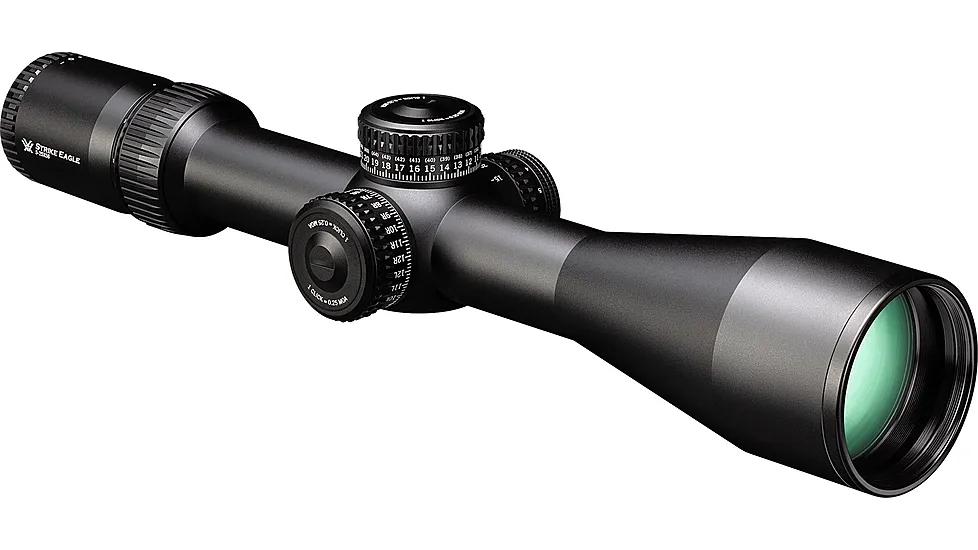
Best overall: Vortex Strike Eagle 5-25x56 FFP
First focal plane · 5-25x56 · 34mm tube · illuminated EBR-7C reticle (MOA or MRAD)
around $800exact price on OpticsPlanet
This is the complete long-range package for a 6.5 Creedmoor under $900. The 34mm tube carries 110 MOA of elevation travel, a RevStop zero-stop ring is in the box (fitting it reduces the usable elevation), and the illuminated, glass-etched FFP EBR-7C reticle keeps holds true at every magnification. Independent tall-target tests measure its tracking deviation around 1 percent. At 30.4 oz it is heavier than the Diamondback Tactical and the Razor HD LHT, a scope for a rifle you shoot from a bench, bag or barricade rather than carry far.
Pros
- Tracks like scopes twice its price: about 1 percent deviation in independent tall-target tests, with owners dialing verified hits to 1,000+ yards
- 34mm tube with 110 MOA (31 MRAD) of elevation travel: real dialing headroom for true long range
- Illuminated, glass-etched FFP EBR-7C reticle keeps holdovers accurate at every magnification (11 brightness settings)
- Side parallax focuses down to 15 yards, a rarity that makes it a genuine rimfire-trainer and NRL22 crossover
- Complete out of the box: throw lever, sunshade, RevStop zero ring, lens covers and turret tool included, plus the unconditional Vortex VIP lifetime warranty
Cons
- Heavy at 30.4 oz bare (over 2 lb mounted with 34mm rings): the wrong scope for a mountain or carry rifle
- Glass is excellent from 5x to about 15x, but color fringing and edge softening appear past 20x, and the eye box tightens noticeably at 25x
- Turret clicks are on the soft, muted side compared to crisper rivals, even though the actual tracking stays accurate
- Installing the RevStop zero ring cuts usable elevation from 31 to about 18 MRAD, so extreme-long-range shooters past 1,200 yards may run without it
Best for: a 6.5 Creedmoor built to dial toward the far end of its range, shot from a bench, bag or barricade. Skip it for a carry rifle: it weighs 30.4 oz bare.
Key specifications
| Magnification | 5-25x |
|---|---|
| Objective lens | 56 mm |
| Reticle | EBR-7C (MOA or MRAD), glass-etched, illuminated (11 settings) |
| Focal plane | First focal plane (FFP) |
| Tube diameter | 34 mm |
| Field of view | 24 - 5.2 ft at 100 yds |
| Eye relief | 3.7 in |
| Adjustment click | 1/4 MOA (0.1 MRAD on the MRAD version) |
| Elevation/windage travel | 110 / 78 MOA |
| Parallax | 15 yds to infinity (side focus) |
| Weight | 30.4 oz |
| Length | 14.6 in |
| In the box | Throw lever, sunshade, RevStop zero ring, lens covers, turret tool, CR2032 |
| Sealing | Waterproof, fogproof, shockproof (ArmorTek coating) |
| Warranty | Vortex VIP: unlimited, unconditional, lifetime |
“This optic is well built, priced decently, and offers features you find on more pricey scopes in its class. For a new long-range shooter or a more budget-friendly, but higher-end option this is a good buy.”
The Marksman, verified owner (MI) via OpticsPlanet, after a year on a .300 Win Mag
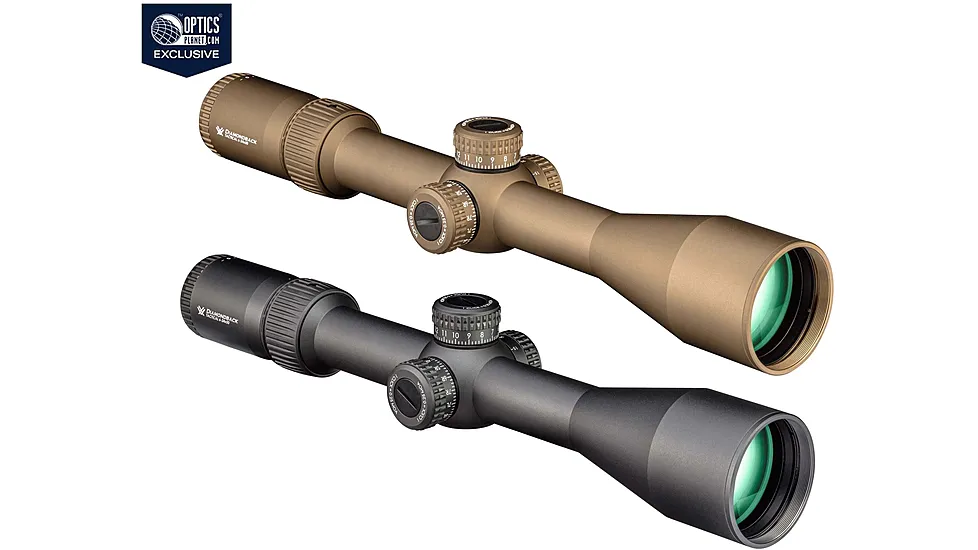
Best value: Vortex OPMOD Diamondback Tactical 6-24x50 FFP
First focal plane · 6-24x50 · 30mm tube · EBR-2C MOA reticle
around $290exact price on OpticsPlanet
🏆 Named Best Optic Under £1,000 at the Great British Shooting Awards (source: Gun Trade News)
If you are building a first 6.5 Creedmoor and want to spend on the rifle, this is the value pick at a little over a third of the Strike Eagle’s price. It is a true first focal plane optic, so the EBR-2C Christmas-tree reticle measures correctly at every zoom, and testers pass box drills with it: the tracking is the part it gets right. It is 5.8 oz lighter than the Strike Eagle and its side parallax focuses down to 10 yards, which also makes it a precision-rimfire trainer. What you give up: illumination, a zero stop (each turret revolution is 15 MOA, so you count turns on long dials) and elevation travel, 65 MOA in total against the Strike Eagle’s 110. The glass is at its best to about 18x, so treat it as a 6-18x scope.
Pros
- Reliable tracking and return-to-zero, with crisp, audible turret clicks (no budget-scope mushiness)
- FFP EBR-2C reticle stays accurate at any zoom, with a fine Christmas-tree grid for wind and elevation holds
- Rare 10-yard side parallax: a real edge for precision rimfire (NRL22) and close-to-far practice
- Unlimited, unconditional lifetime Vortex VIP warranty (covers accidental damage, whoever was at fault)
Cons
- No zero stop, so when you dial past one full turn you must track your turret revolutions carefully
- No illuminated reticle: the fine FFP crosshair can wash out in low light or dark timber
- Glass is excellent to about 18x but softens toward 24x (edge blur, slight color fringing), so treat it as a 6-18x scope
- Tight eye box at maximum magnification demands a consistent cheek weld
Best for: a first 6.5 Creedmoor build on a budget, learning to dial, and precision rimfire practice. Step up to the Strike Eagle when you want illumination, a zero stop and more elevation travel.
Key specifications
| Magnification | 6-24x |
|---|---|
| Objective lens | 50 mm |
| Reticle | EBR-2C MOA |
| Focal plane | First focal plane (FFP) |
| Tube diameter | 30 mm |
| Field of view | 18 - 4.5 ft at 100 yds |
| Eye relief | 3.9 in |
| Adjustment click | 1/4 MOA |
| Parallax | 10 yds to infinity |
| Weight | 24.6 oz |
| Sealing | Waterproof, fogproof, shockproof |
| Warranty | Vortex VIP: unlimited, unconditional, lifetime |
| Finish carded | Gray (DBK-10028-OP-GRY) |
“You can’t go wrong with Vortex glass for the price. They are clear and crisp, much better than other brands in the same price point.”
B.P, verified owner (KS) via OpticsPlanet
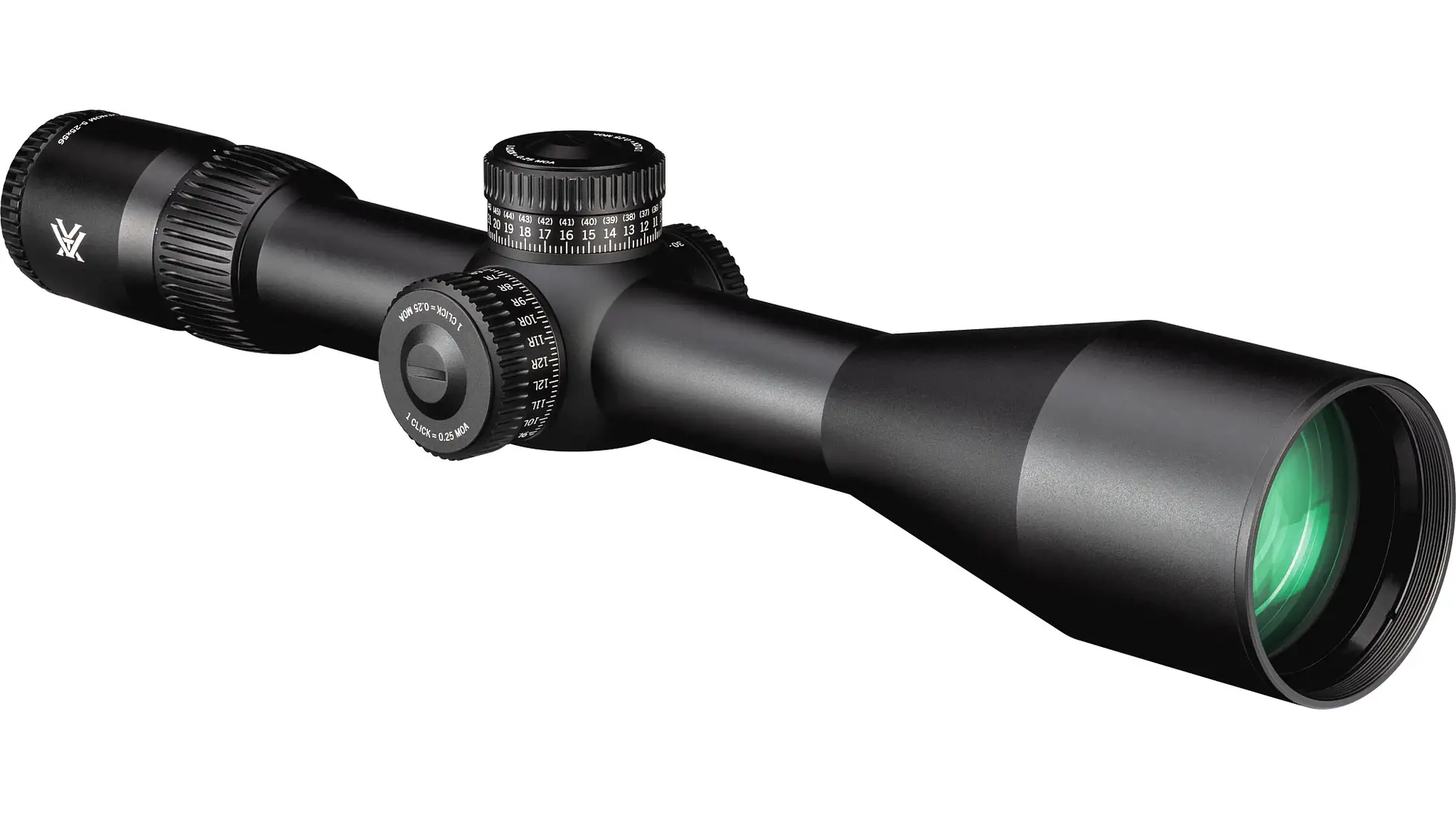
Best value with a zero stop: Vortex Venom 5-25x56 FFP
First focal plane · 5-25x56 · 34mm tube · EBR-7C MOA reticle, glass-etched, non-illuminated · RevStop Zero System
around $500exact price on OpticsPlanet
The Venom sits between the Diamondback Tactical and the Strike Eagle. It has a 34mm tube with 85 MOA (25 MRAD) of elevation travel, a glass-etched first focal plane EBR-7C reticle, and a RevStop zero-stop ring and throw lever in the box, which the Diamondback Tactical lacks, for less than the Strike Eagle. One owner reports walking a Ruger Precision Rifle in 6.5 Creedmoor out to 900 yards with it and says the scope tracked great, and owners consistently call the clicks crisp and audible. Against the Strike Eagle you give up illumination and 25 MOA of travel, and at 35 oz it is the heaviest of these four picks, a bench and prone scope rather than a carry scope. The turrets do not lock, the most common owner criticism.
Pros
- 34mm tube with 85 MOA (25 MRAD) of elevation travel and the RevStop Zero System for a repeatable return to zero
- Glass-etched first focal plane EBR-7C reticle, so wind and elevation holds stay true at every magnification
- Owners consistently call the clicks crisp and audible
- Throw lever, 3 in sunshade and RevStop ring included in the box
- Vortex VIP warranty: unlimited, unconditional, lifetime
Cons
- Turrets do not lock, the most common criticism for a dialing scope
- The RevStop zero-return can be fiddly to set up compared to a premium zero stop
- Heavy at 35 oz, and torque-sensitive at the rings (torque to spec)
- Non-illuminated and a busy target reticle, less suited to hunting use
Best for: a 6.5 Creedmoor shot from a bench or prone, when you want a zero stop and more elevation travel than the Diamondback Tactical without paying for the Strike Eagle. Step up to the Strike Eagle for an illuminated reticle and 110 MOA.
Key specifications
| Magnification | 5-25x |
|---|---|
| Objective lens | 56 mm |
| Tube diameter | 34 mm |
| Focal plane | First focal plane (FFP) |
| Reticle | EBR-7C MOA, glass-etched, non-illuminated |
| Turrets | 0.25 MOA clicks, 85 MOA / 25 MRAD travel, exposed (non-locking), RevStop Zero System |
| Parallax | Side focus, 15 yds to infinity |
| Eye relief | 3.6 in |
| Field of view | 4.71 - 21.21 ft at 100 yds |
| Exit pupil | 2.24 - 11.2 mm |
| Weight | 35 oz |
| Length | 15.3 in |
| In the box | Throw lever, 3 in sunshade, RevStop ring, rubber lens covers, turret tool, 2mm hex, lens cloth |
| Warranty | Vortex VIP: unlimited, unconditional, lifetime |
“I used this on a Ruger Precision Rifle in 6.5 Creedmoor… walked out to 900 yards… the scope tracked great, so much so I hit a clay bird sitting on a berm at 900 yards. If you're looking for a low-cost, high value optic you won't be disappointed.”
Dennis G., verified owner (FL), via OpticsPlanet
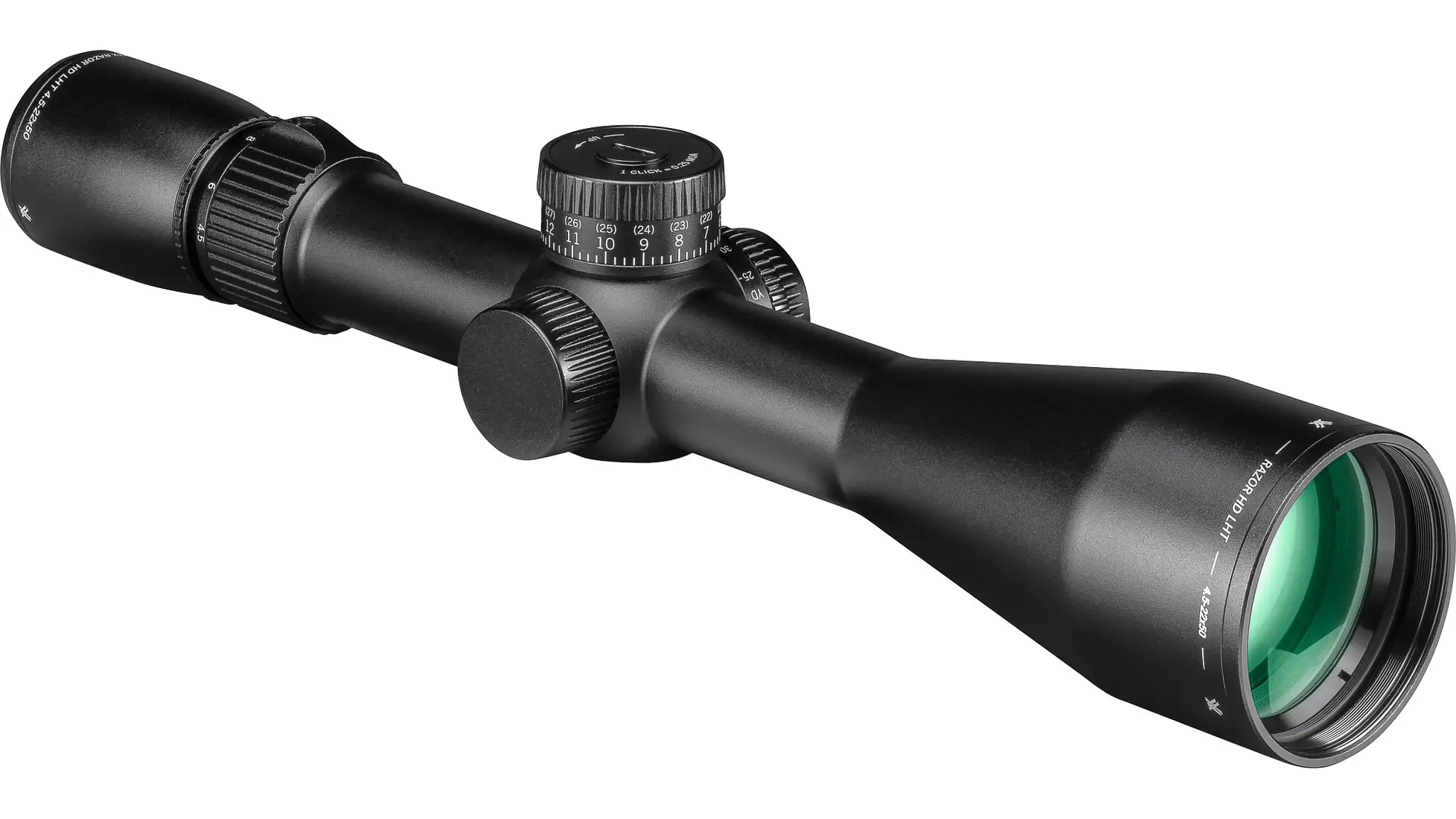
Best lightweight: Vortex Razor HD LHT 4.5-22x50 FFP
First focal plane · 4.5-22x50 · 30mm tube · illuminated XLR-2 MOA reticle · RevStop zero system
around $1,500exact price on OpticsPlanet
The Razor HD LHT is the light option. Vortex lists 21.7 oz, the lightest of these four picks and 8.7 oz less than the Strike Eagle, on a 30mm tube with an illuminated first focal plane XLR-2 MOA reticle, 4.0 in of eye relief and the RevStop zero system. Reviewers repeat two themes above all: how light it is and how clear the glass is. Know its dialing limit before you buy: Vortex lists a 75 MOA maximum elevation adjustment but only 27 MOA of total elevation with RevStop installed, so if you dial far past your zero, run your drop chart against that figure first. Illumination splits reviewers, and two think the glass does not justify the price.
Pros
- Light for a first focal plane 4.5-22x50: Vortex lists 21.7 oz on a 30mm tube
- Weight and glass clarity are the two themes reviewers repeat most
- Illuminated first focal plane XLR-2 reticle that keeps its values at every magnification
- 4.0 in of eye relief and parallax from 25 yards to infinity
- Vortex VIP warranty: unlimited, unconditional, lifetime
Cons
- With RevStop installed, Vortex lists 27 MOA of total elevation adjustment on the 4.5-22x50 MOA model, against a 75 MOA maximum
- Illumination splits reviewers: one calls it dim, the most helpful review says it is not daylight bright, and three dislike the push button
- The fine reticle can be hard to find against a dark background, per two reviewers
- Two reviewers think the glass does not justify the price, while most praise it
- A 2.3 mm exit pupil at 22x and eye relief that may need careful ring placement at high zoom
Best for: a rifle you carry far, when weight and a first focal plane reticle matter more than dialing range. Our full review points mountain and open-country hunters here; if you dial far past your zero or shoot timed matches, the Strike Eagle and the Venom list more elevation travel.
Key specifications
| Magnification | 4.5-22x |
|---|---|
| Objective lens | 50 mm |
| Tube diameter | 30 mm |
| Focal plane | First focal plane (FFP) |
| Reticle (this row) | XLR-2 MOA, red illumination |
| Illumination | Push button (Vortex); 10 brightness settings, one CR2032 battery (retailer) |
| Turrets | Exposed elevation, capped windage (Vortex) |
| Click value | 1/4 MOA (Vortex) |
| Max elevation / windage | 75 MOA / 45 MOA (Vortex) |
| Total elevation with RevStop installed | 27 MOA (Vortex) |
| Parallax | 25 yds to infinity |
| Field of view | 23.5 to 4.7 ft at 100 yds |
| Eye relief | 4.0 in |
| Length | 13.3 in |
| Weight | 21.7 oz |
| Warranty | Vortex VIP: unlimited, unconditional, lifetime (Vortex) |
“Wow! The clarity is amazing, and the weight (or lack there of) is incredible, I thought the box was empty!”
Jason Fairclough (UT), verified owner, via OpticsPlanet
What a 6.5 Creedmoor scope actually needs
The cartridge’s whole appeal is reaching distance predictably, so the scope has to support that:
- Tracking you can trust. When you dial 6.5 MOA, the bullet must move exactly 6.5 MOA, shot after shot. This is the spec budget scopes most often fail. The evidence differs by pick: independent tall-target tests for the Strike Eagle, box drills for the Diamondback Tactical, one owner’s report that the Venom tracked great walking a 6.5 Creedmoor out to 900 yards, and one owner’s report that the Razor HD LHT’s return to zero has always worked.
- A first focal plane reticle. The 6.5 Creedmoor rewards dialing and holding at mixed power, and FFP keeps those marks true at any magnification. New to the distinction? See FFP vs SFP.
- Elevation travel. Distance costs elevation. The Strike Eagle’s 34mm tube carries 110 MOA (less once its RevStop zero stop is fitted), the Venom’s 34mm tube 85 MOA, the Razor HD LHT a 75 MOA maximum but only 27 MOA of total elevation with RevStop installed, and the Diamondback Tactical’s 30mm tube 65 MOA. The Strike Eagle’s figure is the honest reason to step up if you shoot to the far edge of the cartridge’s range. Check any of these figures against your own load’s drop table.
- Not recoil toughness. Unlike a magnum, the 6.5 Creedmoor is mild, so eye relief and a scope-bite-proof build are not deciding factors. Spend the money on turrets and glass instead.
Choosing between the Diamondback Tactical and the Strike Eagle? We compare them head-to-head, with the Venom 5-25x56 in between, in Diamondback Tactical vs Strike Eagle. Dialing is a skill of its own: see how to adjust a rifle scope and MOA vs MRAD.
FAQ
What scope magnification do I need for a 6.5 Creedmoor?
For the distances a 6.5 Creedmoor is built for, a 5-25x or 6-24x scope is the standard; three of our four picks sit in that class, and the Razor HD LHT is a 4.5-22x. In practice most shooters dial and spot impacts between 12x and 18x, where mirage and hold are manageable, so honest glass in the middle of the range matters more than the top number. Save the extra magnification for reading conditions at distance.
Do I need a first focal plane scope for 6.5 Creedmoor?
For the long-range work the cartridge is made for, yes. The 6.5 Creedmoor rewards dialing and holding at varied magnification, and a first focal plane (FFP) reticle keeps holdover and wind marks true at any zoom. All four picks are FFP: the Strike Eagle 5-25x56, the Diamondback Tactical 6-24x50, the Venom 5-25x56 and the Razor HD LHT 4.5-22x50. If you only shoot fixed known distances, a good SFP scope also works.
What is the best budget scope for a 6.5 Creedmoor?
Of our four picks, the Vortex OPMOD Diamondback Tactical 6-24x50 FFP, under $300, is the budget answer. It is a true first focal plane optic that testers put through box drills, so the one thing a long-range scope cannot fake, reliable tracking, is the part it gets right. At that price you give up illumination, a zero stop and elevation travel: it has 65 MOA in total, against 110 MOA on the Strike Eagle (less once its RevStop zero stop is fitted). The Venom 5-25x56 is the step between them: a RevStop zero stop and 85 MOA of travel for less than the Strike Eagle.
Does a 6.5 Creedmoor kick hard enough to hurt a scope?
No. The 6.5 Creedmoor is a notably mild-recoiling cartridge, which is a big reason it is the entry point to long range. Recoil durability and eye relief are not the deciding factors here the way they are on a .300 Win Mag; tracking, elevation travel and glass at working power are. That lets you focus the budget on the turrets and reticle rather than a magnum-tough build.
More: best long range rifle scopes · best scope for a .300 Win Mag · best rifle scopes overall.