Nightforce NX8 decoded: F1 vs F2, and which model to buy
Our verdict for 2026: buy the NX8 2.5-20x50 F1 ($2,250). It has the most elevation travel in the family, the widest useful magnification spread, and the illuminated Mil-XT grid costs nothing over the plain reticles. Carbine or gas gun? The NX8 1-8x24 ($2,000) is the only model with daylight-bright illumination. Shooting known distance from a bipod? The NX8 4-32x50 F1 ($2,450) reaches 32x, but with less travel and a 1.6mm exit pupil at the top.
Searching for F1 or F2? That one choice matters more than the magnification. Prices and part numbers verified September 30, 2026 from each variant's own listing; confirm the current price on the retailer page.
The NX8 is three scopes and two focal planes sold under one name, which is why so many buyers arrive searching for "nx8 f1" or "nx8 f2" without being sure what they are choosing between. There is also a genuine oddity in this family that nobody explains: owners of one model praise the illumination in the same words that owners of the other two use to complain about it. Both groups are right, and the reason is below.
How these picks were made: a research-based roundup built from Nightforce's published specifications and reticle sheets, magazine test results read at source, 49 owner reviews across the three models, and live pricing read from each variant's own listing on OpticsPlanet. Scores are our editorial opinion, not a hands-on test of every model. Where a claim could not be verified at its source we say so on the page rather than repeating it. See how we evaluate.
- The whole NX8 line-up, priced
- F1 vs F2: the choice that actually matters
- Nightforce NX8 2.5-20x50mm F1 Rifle Scope - Best NX8 overall
- Nightforce NX8 1-8x24mm F1 Rifle Scope - Best NX8 for a carbine
- Nightforce NX8 4-32x50mm F1 Rifle Scope - Best NX8 for maximum magnification
- Why the illumination reviews contradict each other
- Reticles: what each one costs and does
- What the 30mm tube costs you
- FAQ
The whole NX8 line-up, priced
Three magnification ranges. The 2.5-20x50 and 4-32x50 each come in first and second focal plane versions; the 1-8x24 is first focal plane only. Every price below was read on July 26, 2026 from the individual variant listings rather than from the headline figure, which matters here for a reason covered further down.
| Model | Focal plane | From | Owner ratings | Travel |
|---|---|---|---|---|
| NX8 1-8x24 F1 | F1 only | $2,000 | 4.0 / 5 from 21 | 100 MOA |
| NX8 2.5-20x50 F1 | First (F1) | $2,250 | 4.9 / 5 from 9 | 80 to 110 MOA |
| NX8 2.5-20x50 F2 | Second (F2) | $2,200 | 5.0 / 5 from 6 | 80 to 110 MOA |
| NX8 4-32x50 F1 | First (F1) | $2,450 | 4.8 / 5 from 24 | 70 to 90 MOA |
| NX8 4-32x50 F2 | Second (F2) | $2,500 | 4.8 / 5 from 5 | 70 to 90 MOA |
A from-price belongs to one part number. Every one of these listings sells several variants under a single page, and the advertised starting figure is the cheapest of them, which is not always the reticle or the finish you came for. On the three models we card the advertised starting price was honest. The lesson is not that the retailer is misleading you, it is that a from-price on a multi-variant listing belongs to one specific part number, so check which one before you commit.
F1 vs F2: the choice that actually matters
Buyers agonise over 2.5-20x versus 4-32x and then pick the focal plane almost at random. It should be the other way round.
F1 puts the reticle in front of the magnification erector, so it grows and shrinks with the target image. The hash marks therefore mean the same thing at every power: one milliradian is one milliradian at 5x and at 20x. That is what you want if you range with the reticle, hold for wind and elevation instead of dialling, or shoot competition.
F2 puts the reticle behind the erector, so it stays the same apparent size no matter the magnification. It is bold and instantly findable at the bottom of the zoom range, but its hash marks are only mathematically correct at one stated power.
Here is the part that is specific to the NX8 rather than general theory. These are 8x zooms in a compact tube. An F1 reticle has to be etched fine enough not to bury a small target at 20x or 32x, which means at the bottom of the range it has been scaled down eight times. The owner who wrote the most useful review of the 2.5-20x50 F1 names exactly this as their main criticism: the reticle is very small at 2.5x, and finding centre quickly at low power takes longer. That is not a fault, it is geometry, and it is the single strongest argument for choosing F2 if your shooting is fast and close.
One practical warning. The F1 and F2 listings for the same magnification have almost identical names and their web addresses differ by a single letter. Verify the focal plane on the specification table or from the part number, never from the page address.
Quick comparison
| Category | Pick | Spec | Price | |
|---|---|---|---|---|
| Best NX8 overall | Nightforce NX8 2.5-20x50mm F1 Rifle Scope | 2.5-20x50 · FFP | around $2,300 | Check price |
| Best NX8 for a carbine | Nightforce NX8 1-8x24mm F1 Rifle Scope | 1-8x24 · daylight bright | around $2,000 | Check price |
| Best NX8 for maximum magnification | Nightforce NX8 4-32x50mm F1 Rifle Scope | 4-32x50 · deepest record | around $2,500 | Check price |
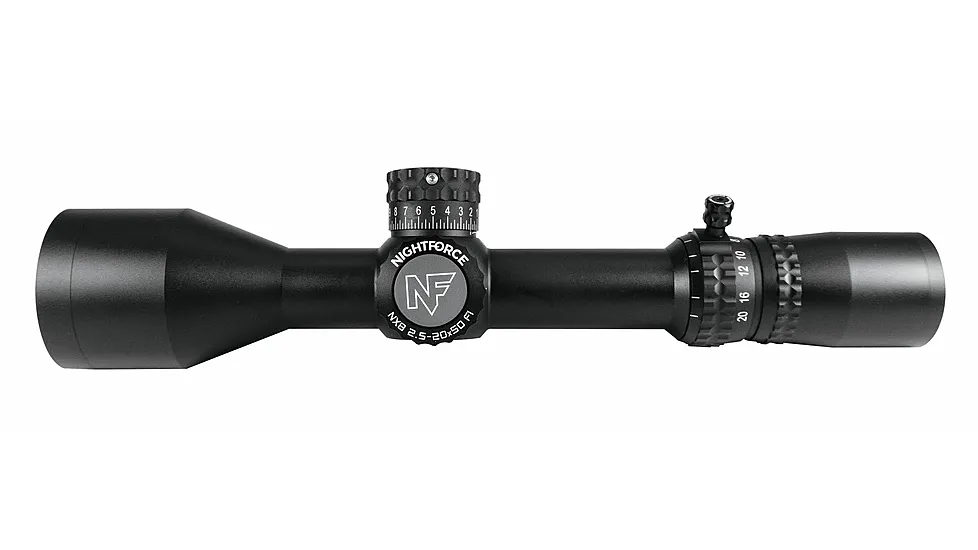
Best NX8 overall: Nightforce NX8 2.5-20x50mm F1 Rifle Scope
2.5-20x · 50mm · 30mm tube · first focal plane · Mil-XT reticle · DigIllum · ZeroStop · 80 to 110 MOA of travel · 28.3 oz
around $2,300exact price on OpticsPlanet
This is the NX8 to buy if you are buying one, and the reason is range of use rather than any single specification. An 8x erector in a 30mm tube gives you 2.5x for a close, moving target and 20x for reading a plate at distance, and it does it with 110 MOA of elevation travel, which is the most in the family. It is also the best value inside its own price bracket in a way worth spelling out: the Mil-XT variant we card, which adds an illuminated milliradian grid, costs exactly the same $2,250 as the plain Mil-C and the plain MOAR variants. Nothing is charged for the illuminated grid. Only the licensed TReMoR3 reticle and the Dark Earth finish cost more. What the owner record adds is texture rather than contradiction: eight written reviews, all recommending it, one shooter ringing steel at 800 yards on the first day, another putting their children on clay targets at 200 yards. The most useful review is also the most critical, and it is worth reading before you buy: the zero stop wants only 4 inch-pounds of torque and they damaged theirs by over-tightening, Nightforce repaired it free, and they note the reticle is very small at 2.5x. That last point is not a defect, it is what a first focal plane reticle does, and it is the single most important thing to understand before choosing F1 over F2.
Pros
- The most elevation travel in the family at 110 MOA, with 80 MOA of windage, from a 30mm tube, which is what makes it usable at distance despite the compact body
- The illuminated Mil-XT grid costs nothing extra: it is the same $2,250 as the plain Mil-C and MOAR variants
- The widest useful spread in the line, 2.5x for close and moving targets up to 20x for precision, in a 12 inch, 28.3 oz package
- Turret feel is the most consistently praised thing in the owner record, described as sharp, precise and easy to see, with return to zero straightforward
Cons
- The reticle is very small at 2.5x, which an owner names as their main criticism. This is inherent to a first focal plane reticle across an 8x zoom: sized to be precise at 20x, it scales down eight times at the bottom of the range
- The zero stop is torque-sensitive. An owner damaged theirs by over-tightening, learned it wants only 4 inch-pounds, and bought a torque driver after the fact. Nightforce repaired it at no charge
- The DigIllum illumination has a divided record, with four owners across the high-magnification models reporting distinct problems. See the illumination section below before you assume the illuminated reticle is a free upgrade
- Mounting is tight. A major outdoor publication called the package very tight with stingy mounting dimensions, and an owner independently reports mounting is tricky because of the short length of tube in front of the turrets
Best for: the shooter who wants one scope for a rifle that does more than one job: field positions and moving targets at the bottom of the range, precision and holdovers at the top. Choose the 4-32x50 instead if you are shooting known distance from a bench or bipod and want maximum magnification, or the 1-8x24 if the rifle is a carbine.
Key specifications
| Manufacturer | Nightforce |
|---|---|
| Magnification | 2.5-20x |
| Objective lens | 50 mm |
| Tube diameter | 30 mm |
| Reticle focal plane | First focal plane (F1) |
| Reticle carded | Mil-XT, illuminated |
| Illumination | DigIllum, red |
| Exit pupil | 2.5 to 7.1 mm |
| Field of view | 41.5 to 6.8 ft at 100 yds |
| Elevation and windage travel | 80 to 110 MOA |
| Eye relief | 87.5 mm |
| Parallax | 11 yds to infinity |
| Weight | 28.3 oz |
| Length | 12 in |
| Model carded | C632 (of six orderable variants; five factory demo units excluded) |
“Very clear glass. Adjustments are sharp, precise and easy to see. I had an issue with the zero stop; perhaps I over tightened. Sent to nightforce and they fixed it for free. They want 4 in-lbs to tighten which is very light... My only knock on the scope is that the reticle is very small at the 2.5x setting.”
RandyB, verified owner (WA) via OpticsPlanet, the listing's most helpful review
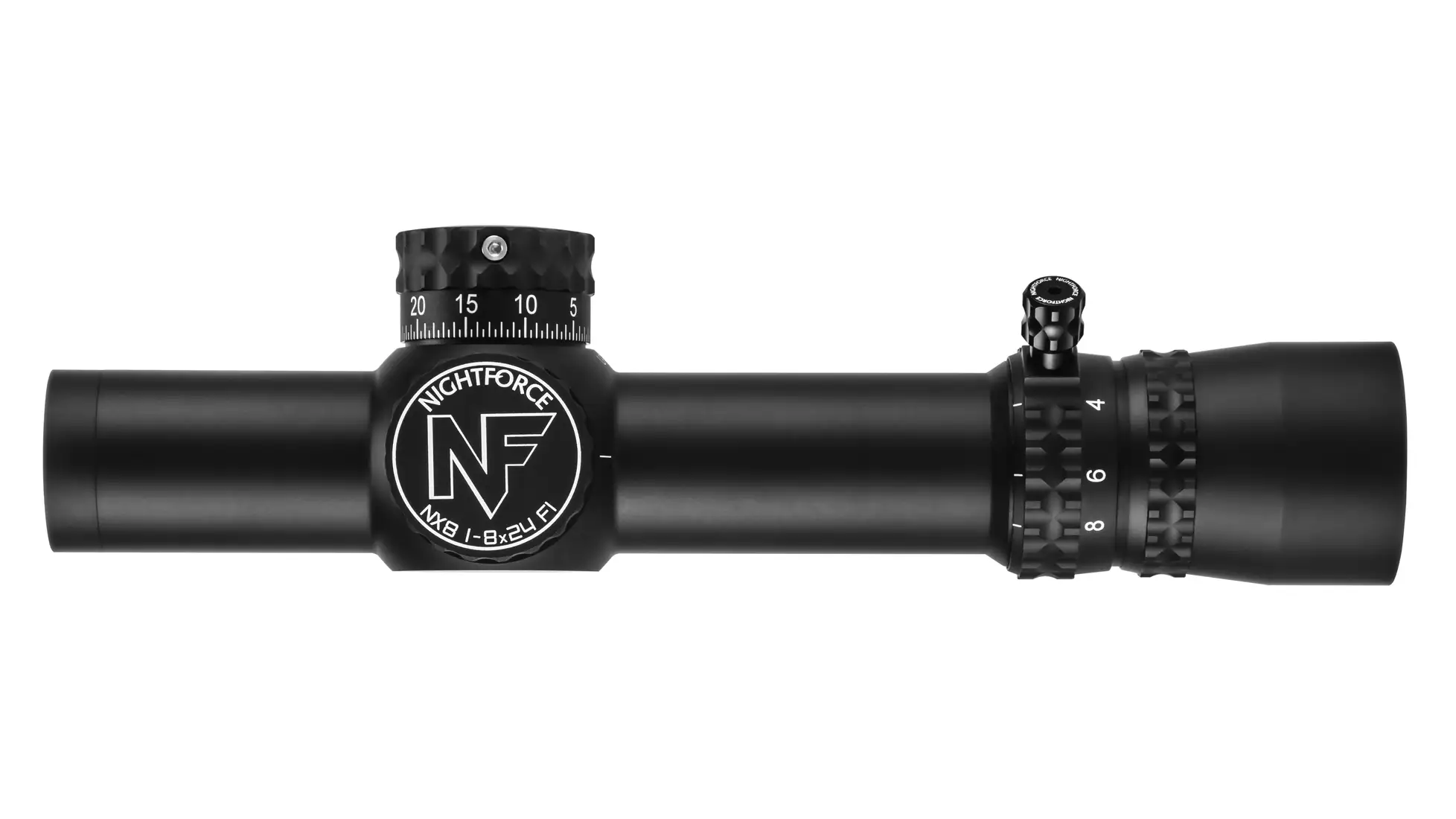
Best NX8 for a carbine: Nightforce NX8 1-8x24mm F1 Rifle Scope
1-8x · 24mm · 30mm tube · first focal plane · FC-Mil reticle · daylight-visible illumination with 10 brightness settings · capped or ZeroStop elevation · 17.3 to 17.6 oz
around $2,000exact price on OpticsPlanet
This is the cheapest NX8 and the only one whose illumination its owners consistently praise, which is not a coincidence: it is a different system from the DigIllum used further up the line. Nightforce publishes ten brightness settings and a 96 hour battery life for this model, and three separate owners describe the result in the same terms, one saying the true daylight visibility lets you run it like a red dot at 1x, another titling their review "red dot bright even at High Noon". At 17.3 to 17.6 oz by Nightforce's figures it is also genuinely light for the capability, which an owner puts in context by noting many 1-4x optics weigh 16 oz. Two things to settle before you buy. The eyebox is not generous, which the most thorough owner review concedes directly before explaining that a correct cheek weld and length of pull solve it for them. And the reticle deserves a decision rather than a default: the FC-Mil we card has a 0.35 MRAD centre dot and the FC-MOA alternative at the same price has a 1.25 MOA dot, which one owner calculated covers over five inches of target at 400 yards. Nightforce answered that criticism with the newer FC-DMx reticle, sold at the same $2,000 on a separate listing, and an owner here says outright that they prefer it.
Pros
- The illumination is the good kind on this model: Nightforce publishes ten brightness settings and a 96 hour battery life, and three owners independently describe it as daylight bright and usable like a red dot at 1x
- Light for the capability at 17.3 oz capped or 17.6 oz with ZeroStop in an 8.7 inch body (Nightforce's figures), which an owner frames against 1-4x optics that weigh 16 oz for a quarter of the zoom range
- The cheapest way into the line at $2,000, and the reticle choice between FC-Mil and FC-MOA costs nothing either way, with only the Dark Earth finish adding $100
- A major outdoor publication picked the FC-DMx version of this scope as best for competition in its LPVO test, praising the segmented centre circle at low power and the 1 MRAD aiming grid that appears at higher power
Cons
- The eyebox is not generous. The most detailed owner review says so plainly, then argues that correct rifle setup fixes it, which is honest but does mean this is not a forgiving optic to share between shooters
- The FC-MOA reticle's 1.25 MOA centre dot is coarse for distance work. An owner calculated it covers over 5 inches of target at 400 yards and over 10 inches at 800. The FC-Mil we card uses a 0.35 MRAD dot instead, and the newer FC-DMx was designed specifically to address this
- It carries the lowest owner rating in the family at 4.0, and reading the reviews the reason is largely that one reticle argument rather than the instrument
- It is a 1-8x24 at $2,000, which is alpha money for a carbine optic. An owner who compared it directly against a Vortex Razor HD Gen 2 1-6 and chose this one still says buyers should look at the current Vortex, which reaches 10x
Best for: the carbine, gas gun or 3-gun shooter who wants a true 1x red-dot experience with real magnification behind it, and who will set the rifle up around the optic. If you want the finer centre dot, buy the FC-DMx version on the separate listing at the same price; if you want to dial elevation rather than hold, note that Nightforce lists this part (C598) with a capped, finger adjustable or a ZeroStop elevation turret while the retailer describes ZeroStop elevation with capped windage, so confirm which turret your scope ships with.
Key specifications
| Manufacturer | Nightforce |
|---|---|
| Magnification | 1-8x |
| Objective lens | 24 mm |
| Tube diameter | 30 mm |
| Reticle focal plane | First focal plane (F1) |
| Reticle carded | FC-Mil, 0.35 MRAD centre dot |
| Illumination | Red, 10 brightness settings |
| Battery | CR2032, 96 hours rated |
| Exit pupil | 3 to 7.9 mm |
| Field of view | 13.2 to 106 ft at 100 yds |
| Eye relief | 3.75 in |
| Turrets | Capped, finger adjustable or ZeroStop elevation (Nightforce); retailer lists ZeroStop elevation, capped windage |
| Optical coating | Fully multi-coated |
| Weight | 17.3 oz capped, 17.6 oz ZeroStop (Nightforce) |
| Length | 8.7 in (Nightforce) |
| Model carded | C598 (of three orderable variants; two demo and one used unit excluded) |
“Granted, it isn't the most generous eyebox, however, when I get behind the rifle, I must have a natural cheek weld and alignment that doesn't cause any issues. I served in the Marine Corps... I think as long as your rifle is set up correctly, with the right eye relief and length of pull, you should be fine. Love this scope. 5 stars.”
Mike via OpticsPlanet, one of the listing's most helpful reviews
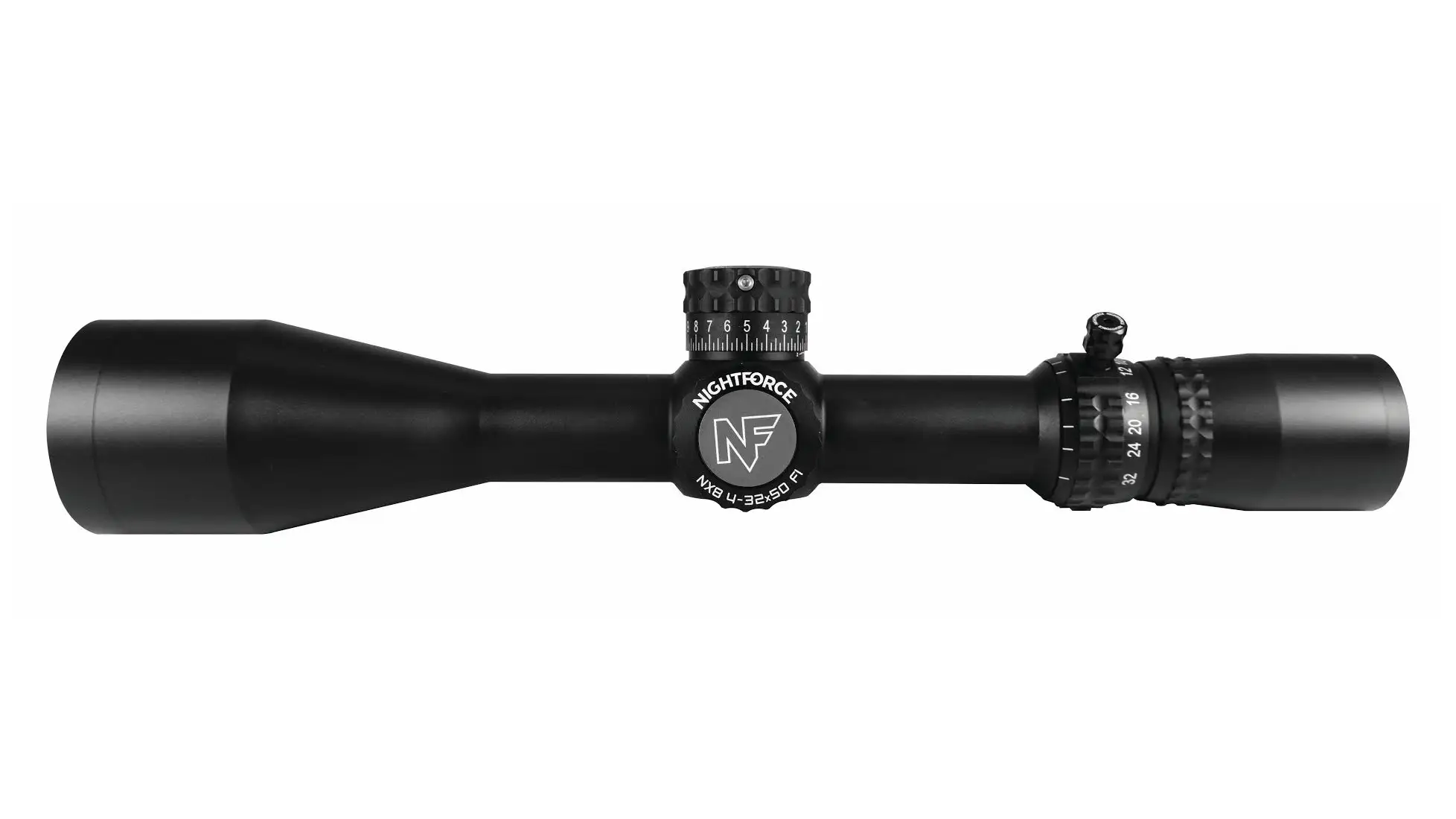
Best NX8 for maximum magnification: Nightforce NX8 4-32x50mm F1 Rifle Scope
4-32x · 50mm · 30mm tube · first focal plane · Mil-XT reticle · DigIllum · ZeroStop · 70 to 90 MOA of travel · 28.6 oz
around $2,500exact price on OpticsPlanet
Buy this one for the top end, and go in knowing what the top end costs you. It is the only NX8 that reaches 32x and it has by far the deepest owner record, 22 written reviews spanning 2020 to 2026, which is where its real value to a buyer lies. The record is also unusually informative because two owners position it against specific alternatives rather than praising it in the abstract: one prefers it to their Vortex Razor Gen 2 for weight and controls while conceding the Razor is better in low light thanks to its 56mm objective, and another, on their seventh Nightforce, says it lacks the adjustment range of the 34mm-tube ATACR but is just as clear. Both are fair, and the second is visible in the specifications: this model has 90 MOA of elevation travel against the 2.5-20x50's 110. The other number that matters is the exit pupil. At 32x it falls to 1.6mm, well under a dark-adapted pupil, so the highest magnification is also the dimmest and the least forgiving of head position. That is the trade you are making, and it is why the 2.5-20x50 above is the better choice for most rifles.
Pros
- The deepest owner record in the family by a wide margin, 22 written reviews across six years, and the tone is consistent: tracking perfect, turrets tactile, glass clear at all magnifications
- The only NX8 that reaches 32x, which is real capability for known-distance and varmint work, and one owner reports distinguishing an eight point from a ten point in that role
- The illuminated Mil-XT variant is the same $2,450 as the plain Mil-C and MOAR variants, so the grid and the illumination are not upcharges
- A major outdoor publication called the 2.5-20x50 sibling of this scope possibly the ultimate precision riflescope and placed it second in its 2020 precision optics test, which is the company this line keeps
Cons
- Less adjustment than the rest of the family: 90 MOA of elevation and 70 of windage against 110 and 80 on the 2.5-20x50. An owner on their seventh Nightforce makes the same point comparing it to the 34mm ATACR
- The exit pupil falls to 1.6mm at 32x, narrower than a dark-adapted eye, so the top of the magnification range is dim and unforgiving of head position. More magnification is not more capability here
- Weight is the one con an owner lists outright at 28.6 oz, and the body is 13.4 inches long, which is a lot of scope for a light rifle
Best for: the known-distance, bench, bipod or varmint shooter who wants the highest magnification in the line and shoots from a stable position. If your rifle needs to work at close range too, or if you want the most elevation travel, buy the 2.5-20x50 instead.
Key specifications
| Manufacturer | Nightforce |
|---|---|
| Magnification | 4-32x |
| Objective lens | 50 mm |
| Tube diameter | 30 mm |
| Reticle focal plane | First focal plane (F1) |
| Reticle carded | Mil-XT, illuminated |
| Illumination | DigIllum, red |
| Exit pupil | 1.6 to 7.3 mm |
| Field of view | 26.1 ft at 100 yds |
| Elevation and windage travel | 70 to 90 MOA |
| Eye relief | 87.6 mm |
| Parallax | 11 yds to infinity |
| Weight | 28.6 oz |
| Length | 13.4 in |
| Model carded | C634 (of six orderable variants; one factory demo unit excluded) |
“I like it a lot more than my vortex razor gen 2. It's like half the weight and all the little things like click sounds and feel, built in knob, parallax adjustment, eye relief, and reticle adjustment... the razor gen 2 is better at low light usability due to the 56mm lens.”
ty, verified owner (FL) via OpticsPlanet
Why the illumination reviews contradict each other
Read owner reviews across this family and you will find people describing the illumination in incompatible terms. On the 1-8x24: true daylight visibility, run it like a red dot at 1x, red dot bright even at high noon. On the 2.5-20x50 and 4-32x50: not visible in daylight, so much light at night that it washes out the target, lights up the tube no matter the colour or intensity.
They are describing two different systems. Nightforce publishes ten brightness settings and a rated 96 hour battery life for the 1-8x24. For the 2.5-20x50 and the 4-32x50 it publishes an illumination type, DigIllum, and no settings count at all. The manufacturer's own specification fields differ, and owner experience splits along precisely that line.
| Model | Published illumination | What owners report |
|---|---|---|
| NX8 1-8x24 | 10 brightness settings, 96 hr battery | Three owners: daylight bright, usable as a red dot at 1x |
| NX8 2.5-20x50 | DigIllum, no settings count published | Not daylight visible; washes out the target at night; one owner wishes only the centre cross were lit |
| NX8 4-32x50 | DigIllum, no settings count published | Lights the tube regardless of setting; one owner reports it switching on under recoil |
The complaints are not one unhappy buyer. They come from four separate owners, across three different NX8 models, between 2020 and 2024, and one of them says they contacted Nightforce about the tube glow and got no real answer. Against them, one owner of the 4-32x50 wrote twice that the red and green illumination dims down usefully and is superior at dusk, so this is a divided record rather than a settled fault.
What we could not establish. We could not verify from Nightforce's own documentation how DigIllum is controlled, how many intensity levels it has, or whether it illuminates the whole reticle or only part of it, so we are not going to tell you. On the recoil report specifically: one owner of the 4-32x50 says the illuminated reticle may turn on under recoil, that it happened to them, and that they found others online with the same experience. We found no acknowledgement, service bulletin or fix from Nightforce, and no independent test quantifying it.
The buying consequence is concrete. Inside each model the illuminated Mil-XT variant costs exactly the same as the non-illuminated Mil-C and MOAR variants, $2,250 on the 2.5-20x50 and $2,450 on the 4-32x50. On first look that makes the illuminated grid a free upgrade and an obvious choice. Given the divided record above, the honest version is narrower: the grid itself is worth having at no extra cost, but if you do not need illumination on a high-magnification scope, choosing the plain Mil-C at the same money is a legitimate decision rather than a saving forgone.
Reticles: what each one costs and does
Reticle choice inside a model is usually free and occasionally expensive. These are the figures Nightforce publishes.
| Reticle | Published detail | Price effect | Sold on |
|---|---|---|---|
| Mil-XT | Illuminated milliradian grid | No extra cost | 2.5-20x50, 4-32x50 |
| Mil-C | Milliradian, minimal, centre dot | Same price as Mil-XT | 2.5-20x50, 4-32x50 |
| MOAR / MOA-XT | MOA equivalents of the above | Same price | 2.5-20x50, 4-32x50 |
| TReMoR3 | Licensed grid with wind and mover holds | Plus $250 | 2.5-20x50 ($2,500), 4-32x50 ($2,700) |
| FC-Mil | 0.35 MRAD centre dot, segmented circle | No extra cost | 1-8x24 |
| FC-MOA | 1.25 MOA centre dot, segmented circle | Same price | 1-8x24 |
| FC-DMx | 4 MRAD segmented circle, 1 MRAD aiming grid | Same price, separate listing | 1-8x24 |
The one reticle argument worth knowing about is on the 1-8x24. An owner who has bought four Nightforce scopes rated this one below five stars for a single reason: the FC-MOA reticle's 1.25 MOA centre dot. Their arithmetic is checkable and correct. A 1.25 MOA dot covers roughly 5.25 inches of target at 400 yards and 10.5 inches at 800, which is enough to hide a vital zone behind your own aiming point. They argue it should have been half a minute.
Another owner rebuts them directly on the same listing: you are not meant to aim with the centre dot at that distance, the finer subtensions are what the reticle gives you for it. Both positions are reasonable, and the decision rule that falls out of them is simple. If you intend to use the centre dot as your aiming point past a few hundred yards, this reticle is not for you. If you use the illuminated dot and circle as a close-range red dot and the grid for distance, it is not a problem.
Nightforce's own answer to that criticism is the newer FC-DMx, which enlarges the segmented circle to 4 MRAD and adds a 1 MRAD aiming grid. It sells at the same $2,000 on a separate listing, an owner in our sample says outright that they prefer it, and it is the version Outdoor Life named best for competition in its LPVO test. We have not published a figure for its centre dot because Nightforce does not list one on its reticle page.
What the 30mm tube costs you
The NX8 exists to put an 8x zoom into a short, light 30mm body. That is the whole point of the line and it is also where every real trade-off comes from.
| Model | Elevation travel | Exit pupil | Weight | Length |
|---|---|---|---|---|
| NX8 2.5-20x50 | 110 MOA | 2.5 to 7.1 mm | 28.3 oz | 12 in |
| NX8 4-32x50 | 90 MOA | 1.6 to 7.3 mm | 28.6 oz | 13.4 in |
| NX8 1-8x24 | 100 MOA | 3 to 7.9 mm | 17.3 to 17.6 oz | 8.7 in |
More magnification buys you less, twice over. The 4-32x50 has 20 MOA less elevation travel than the 2.5-20x50 despite costing $200 more, and its exit pupil collapses to 1.6mm at the top of the range, which is far narrower than a dark-adapted eye. So the highest magnification in the family is also its dimmest and least forgiving setting. An owner on their seventh Nightforce makes the travel point from the other side, noting the NX8 lacks the adjustment range of the larger-tubed ATACR while being just as clear. Our Nightforce ATACR review lists the travel of each ATACR size from Nightforce's spec pages. Our Nightforce NX6 review covers Nightforce's 6x zoom line with the FieldSet turret, from the 1-6x24 to the 6-36x56.
Mounting is genuinely tight, and this one is double-sourced. Outdoor Life's precision riflescope test called the NX8 a very tight package with stingy mounting dimensions, and an owner of the 2.5-20x50 independently reports that mounting is tricky because of the shortened length of tube in front of the turrets. When a magazine test and an owner arrive at the same complaint separately, it is worth budgeting for: check your ring spacing before you buy, not after.
For balance, the things owners do not complain about are just as consistent. Turret feel and tracking draw praise in almost every review, one owner calls tracking perfect, another notes the clicks are pronounced enough for the shooter to hear but not enough to spook game, and a third had a zero stop repaired free of charge after damaging it himself.
How to choose
- Pick the focal plane before the magnification. Fast and close, or a rifle you shoot at low power, argues for F2. Ranging, holding and competition argue for F1. This decides more about how the scope feels to use than 20x versus 32x does.
- Do not buy magnification you cannot see through. A 1.6mm exit pupil at 32x is narrower than your dark-adapted pupil. If you shoot at dawn or dusk, the 2.5-20x50 gives you a brighter image and more elevation travel for less money.
- Take the grid, decide separately about the illumination. Mil-XT costs the same as the plain reticles, so there is no reason to pay for less reticle. Whether you want the illumination lit is a different question, and the divided owner record above is the input to it.
- Check which part number the from-price belongs to. On a multi-variant listing the advertised starting price is the cheapest variant on the page, which may not be the reticle or the finish you want.
- Budget for mounting. Both a magazine test and an owner flag the short tube in front of the turrets. Confirm your rings and rail will actually fit before ordering.
Comparing across brands rather than within Nightforce? Our best long range rifle scopes and best rifle scopes rank the whole field, and best LPVO covers the 1-8x24's category specifically. Shooting a 6.5 Creedmoor or a .308? See best scope for 6.5 Creedmoor and best scope for .308.
FAQ
What is the difference between Nightforce NX8 F1 and F2?
Where the reticle sits. In an F1 scope the reticle is in the first focal plane, ahead of the magnification erector, so it grows and shrinks with the image. That means the hash marks are mathematically correct at every magnification, which is why F1 is the choice for ranging, holdovers and precision competition. In an F2 scope the reticle sits behind the erector and stays a constant apparent size, so it is bold and easy to find at low power but its hash marks are only correct at one stated magnification. The practical consequence for the NX8 specifically: because these are 8x zooms, an F1 reticle sized to be precise at 20x or 32x becomes very small at the bottom of the range, and an owner of the 2.5-20x50 F1 names exactly that as their main criticism. If your shooting is fast and close, F2 is the better tool. If you hold rather than dial, F1 is.
Which NX8 models come in F2, and which are F1 only?
The 2.5-20x50 and the 4-32x50 are each sold in both F1 and F2 versions. The 1-8x24 is F1 only. Be careful when shopping, because the retailer URLs for the F1 and F2 versions differ by a single letter and the product names are otherwise nearly identical, so check the focal plane on the specification table or the part number rather than trusting the page address. As of July 26, 2026 the F2 versions were slightly cheaper than the F1s, the 2.5-20x50 F2 at $2,200 against $2,250 and the 4-32x50 F2 listing from $2,400.
Why do some Nightforce NX8 owners say the illumination is too dim and others say it is daylight bright?
Because they are describing two different systems in the same product family. Nightforce publishes ten brightness settings and a 96 hour battery life for the 1-8x24, and its owners consistently describe daylight-bright illumination that lets them run the scope like a red dot at 1x. For the 2.5-20x50 and the 4-32x50 the manufacturer publishes only an illumination type, DigIllum, and gives no settings count, and it is those two models that draw the complaints: not visible in daylight, too bright at night to the point of washing out the target, and lighting up the inside of the tube regardless of the setting. One owner of the 2.5-20x50 wished only the centre cross were illuminated rather than the whole reticle. So if daylight visibility is what you need, the 1-8x24 is the model built for it, and on the higher-magnification models you should treat the illumination as a low-light aid rather than a red dot.
Does the NX8 illuminated reticle really turn itself on under recoil?
One owner of the 4-32x50 reports exactly that, writing that the illuminated reticle may turn on with recoil, that it happened to them, and that they then found online that it happens to some other owners. We take that report seriously enough to publish it, and we also have to be straight about its limits: it is one owner's account plus their description of what they read, we found no acknowledgement, service bulletin or documented fix from Nightforce, and no independent test has quantified how often it happens. If you shoot a heavy-recoiling rifle and this worries you, the practical mitigation is the obvious one, which is to check the illumination state as part of your routine or leave the battery out when you do not need it.
Should I pay more for the TReMoR3 reticle in an NX8?
For most civilian shooting, no. Inside the same model the illuminated Mil-XT grid, the plain Mil-C and the MOAR all sell for the same price, so the useful grid costs nothing. TReMoR3 is the exception that does cost more: on the 4-32x50 it runs $2,700 against $2,450 for the Mil-XT, and on the 2.5-20x50 it is $2,500 against $2,250. That is a licensed reticle design with wind and mover holds built into the grid, which is genuine capability for someone trained to use it and clutter for someone who is not. Unless you already know you want time-of-flight wind holds, the Mil-XT gives you a full milliradian grid for $250 less.
How much elevation travel does the NX8 have?
It depends on the model, and the pattern is the opposite of what buyers usually assume. The 2.5-20x50 has the most at 110 MOA of elevation and 80 MOA of windage. The 4-32x50, despite reaching higher magnification, has less: 90 MOA of elevation and 70 of windage. That is a consequence of packing a bigger erector movement into the same 30mm tube. An owner on their seventh Nightforce notes the same limitation from the other direction, saying the NX8 does not have the adjustment range of the 34mm-tube ATACR while being just as clear. So if your ballistic profile needs every minute of elevation you can get, the 2.5-20x50 is the better NX8, not the 4-32x50.
Has the Nightforce NX8 won any awards?
No award from a recognised awards body, and we want to be precise about that because the internet is not. What is real is editorial recognition in magazine tests: Outdoor Life named the NX8 1-8x24 best for competition in its LPVO test, praising the segmented centre circle at low power and the 1 MRAD aiming grid at higher power, and in its 2020 precision riflescope test the NX8 2.5-20x50 finished second, with Editor's Choice going to the Leica PRS 5-30x56. Those are category picks by a publication, not institutional awards, and we present them as such. If you see a Golden Bullseye attached to the NX8, that is a mix-up: a rifle won that award with an NX8 mounted on it.
Related: best long range rifle scopes · best LPVO · best rifle scopes · Vortex Razor binoculars decoded.