Burris XTR PS review: the 5.5-30x56 and the 3.3-18x50 with the PĒK turret
Our verdict: 4.2/5. The Burris XTR PS is a first focal plane long-range scope whose elevation knob has no clicks. Burris's PĒK (Programmable Elevation Knob) is a clickless mechanical turret read by a digital position sensor, and a heads-up display at the top of the view shows your dialed distance or mil value, wind hold, rifle cant and a match timer, from a ballistic profile you build in the BurrisConnect phone app and store on the scope. We review the 5.5-30x56 (Burris item 201230): a 34 mm tube, 26 MIL of total elevation, side focus from 20 yards, 15.4 in and 37.5 oz on Burris's figures. Guns & Ammo named the XTR PS its 2025 Optic of the Year. It loses points for what to know first: the HUD, illumination and Bluetooth all run on one CR123A, full functionality needs the app, the holds are only as good as the data you enter, Burris's own documents disagree on several figures, and each listing has a single owner review. Pick the 5.5-30x56 for reach, or the 3.3-18x50 for more elevation travel (35 MIL) in a shorter, lighter scope. If you would rather dial a conventional clicked turret, see our Steiner T6Xi review or our best long range rifle scopes.
The 5.5-30x56 (item 201230) sells for around $2,300 and the 3.3-18x50 (item 201220) for around $2,100. OpticsPlanet shows 4.0/5 from 1 review on the 5.5-30x56 and 5.0/5 from 1 review on the 3.3-18x50. Check price and availability on OpticsPlanet; confirm the current price on the retailer page.
How we reviewed it: a research-based review built from the retailer's two XTR PS listings (one owner review on each), checked against Burris's product pages for both sizes, its SCR 2 XTR PS reticle page, its warranty page, its announcement of the Guns & Ammo award and the XTR PS user guide published on Burris's site. Independent tests are cited only where we read the article: Guns & Ammo on the 5.5-30x56 and RifleShooter on the 3.3-18x50, one hands-on test per size. Where the retailer and Burris disagree we print Burris; where Burris's own documents disagree we say so and use arithmetic or leave the figure out. Research leads we could not confirm on a primary source were left out. We have not tested this scope ourselves; the score is our editorial opinion and owner ratings are shown attributed to their source. See how we evaluate.
What the XTR PS is
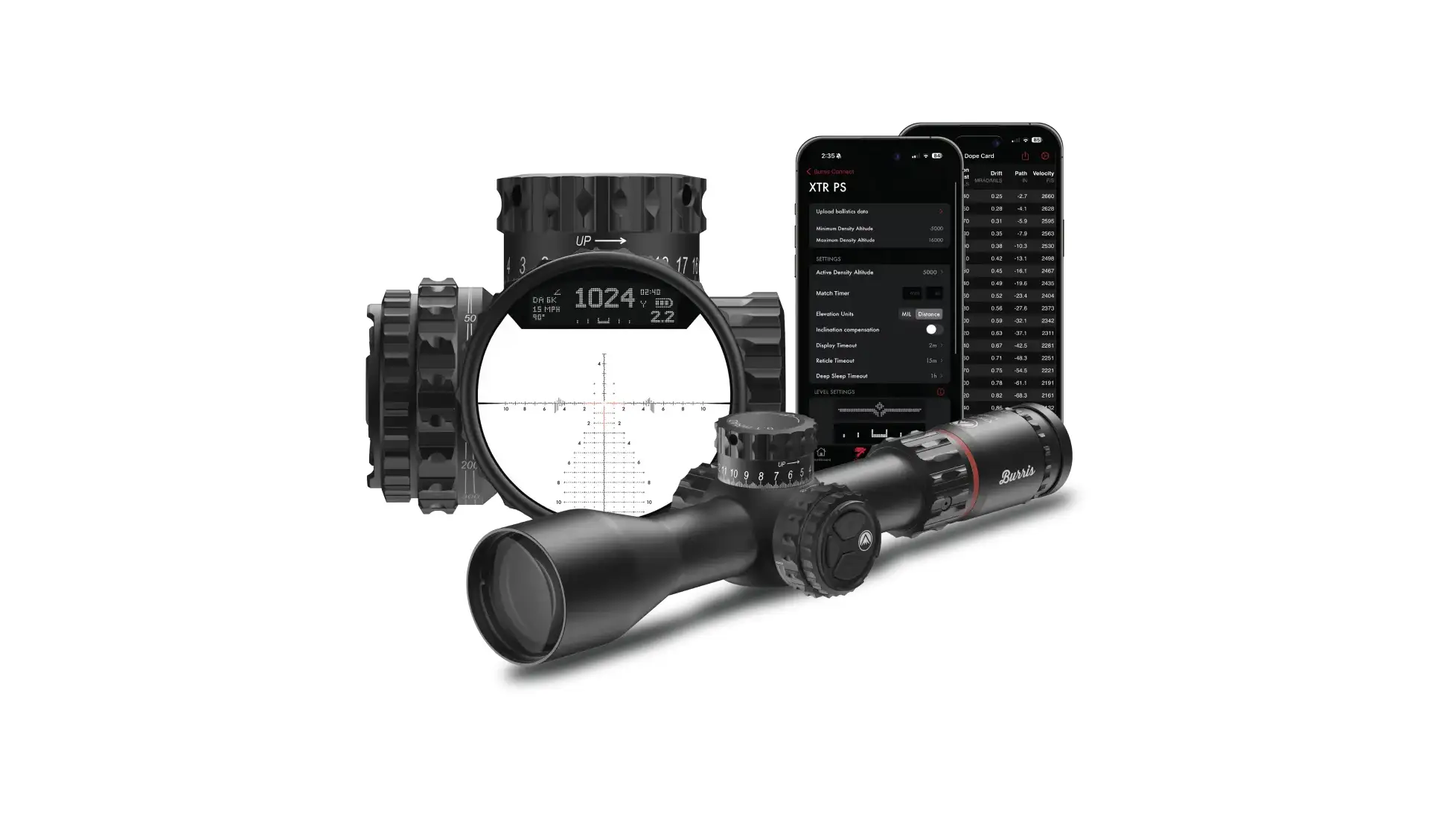
Burris lists the XTR PS in two configurations, the 5.5-30x56 (item 201230) and the 3.3-18x50 (item 201220), both in matte black with one reticle, the illuminated SCR 2 XTR PS. Burris's user guide says the scope builds on the proven XTR line and adds advanced ballistic capabilities, including these three:
- The PĒK elevation knob. A clickless mechanical turret whose position is read by a digital sensor and shown in the display.
- A heads-up display (HUD). Elevation in yards, meters or MIL, a bubble level, wind values, a density altitude table, a battery meter and a match timer, shown without shifting the eye from the field of view, per Burris.
- Bluetooth for the BurrisConnect app. You build ballistic profiles on a phone or tablet and upload them to the scope.
RifleShooter's Alfredo Rico writes that PĒK was initially developed for Burris's Veracity PH hunting scope; the XTR PS, they write, includes features that are useful for competitive shooters. Guns & Ammo published a full review of the 5.5-30x56 in October 2025.
Award: Guns & Ammo 2025 Optic of the Year (Guns & Ammo staff, November 12, 2025). The award article names both configurations, and Burris announced the award on its blog. It is a Guns & Ammo award for the XTR PS, separate from any award given to other Burris scopes.
The PĒK elevation knob: no clicks, a sensor instead
Burris's user guide explains the idea: traditional elevation turrets rely on a limited number of detents milled into the turret, while the XTR PS uses a digital sensor that tracks the turret to within 0.5 degrees, or approximately 1/30 MIL. The knob itself is mechanical and its lasered markings are 1/10 MIL; Burris says that by removing detents you can dial to the equivalent of 1/30 MIL. RifleShooter's Alfredo Rico confirms the turret physically moves the reticle like a regular turret and describes turning it as being “like turning the volume knob on a guitar”. Guns & Ammo's Zach Bowhay gives an example: a dial of 10.68 MRAD can be set exactly, without the limits of a click-based turret.
Total elevation is 26 MIL on the 5.5-30x56 and 35 MIL on the 3.3-18x50. Burris's product pages and its user guide word the adjustment in one rotation of the knob differently, so we give only the totals. The mechanical zero uses a zero-turn stop: you loosen three set screws with the supplied 2 mm hex wrench, turn the cap clockwise to zero and retighten them. The digital zero is a separate step, set in the scope's menu or with “Zero Elevation Knob” in the app. For elevation below zero, the guide says to loosen the zero-turn stop screw near the 15 MIL mark on the turret base.
The catch is that you read marks, not clicks. Rico found that the clickless turret took getting used to, and wrote that with their eyes “the markings are a little too close together”, while still landing within .05 mils or less of the value they wanted.
The heads-up display and the BurrisConnect app
Burris's product pages and its user guide count the display zones differently, so we list what the guide's diagram shows rather than a number. The main field shows the dialed elevation as a distance in yards or meters, or as a MIL value, set in the app. The others show the wind hold for the active ballistic table, a battery meter, the unit of measure, a level with selectable styles, wind direction and wind speed, the density altitude in use, angle compensation and a countdown match timer that can be set up to 99 minutes. Guns & Ammo's award article says the HUD sits at the top of the window. You can set the HUD characters from Level 1 to Level 5 and choose a red or green reticle illumination color in the scope's menu.
Burris's user guide says wind direction and wind speed are defined by the user in the ballistic profile in the BurrisConnect app, so they are values you enter. The built-in inclinometer corrects the displayed aiming distance for uphill and downhill shots, and Burris's guide warns that if your laser rangefinder already has angle compensation, you should turn it off in the XTR PS. Burris's product page says profiles can carry over 20 density altitude curves; the guide says the scope stores values from -5,000 ft to 16,000 ft in 1,000 ft steps, which is 22 values (our arithmetic), selectable from the scope's buttons.
The app is not optional for the full feature set. Burris's guide says full functionality requires the BurrisConnect mobile app and recommends downloading it at home, because installation requires a high-speed internet connection. Once paired, settings and ballistic data are stored on the scope, so it works without your phone, and any change to a profile has to be uploaded again. Guns & Ammo and Burris both call the app free. In the app you can also set the display timeout, the scope's auto-off and the reticle timeout.
The 5.5-30x56 (201230): the one we review
Burris lists the 5.5-30x56 with a 56 mm objective, 26 MIL of total elevation, 15 MIL of windage, side focus from 20 yards to infinity, a field of view of 21.5 ft at 5.5x to 4.2 ft at 30x at 100 yards, 15.4 in of length and 37.5 oz. Its eye relief runs from 85 mm at 5.5x to 95 mm at 30x (about 3.35 to 3.74 in, our arithmetic); on this size Burris lists more eye relief at the top of the zoom than at the bottom. Burris's product pages and its user guide give two different exit pupil figures, so we print only the arithmetic: 56 mm divided by 30 is about 1.9 mm at full power. The retailer's web address for this listing says 36mm; its own table and Burris say 34 mm.
Guns & Ammo's Zach Bowhay tested a 5.5-30x56 on a custom .260 Remington built on an XLR chassis, with a first session at 5,300 feet of elevation. They write that connecting the scope to the app took them longer than necessary because they do not read instructions as well as they should, and that following the instructions as written is simple. They stress that the data you enter decides the result: mounting height, zero range, muzzle velocity, bullet diameter and ballistic coefficient all need to be exact. Over several sessions, with what they describe as a mild recoil rifle, “the optic held zero”, and they wrote that the system “removes much of the guesswork” of long-range shooting. That is one tester's experience on one rifle.
The listing has one OpticsPlanet review, four stars, from a Verified Owner who wrote it in July 2025. It is one person's experience, not a pattern.
“Using for 22 NRL MATCHES. good glass, can see hits, misses out to 250 yards.”
BillDitt (CO), Verified Owner, four-star review, via OpticsPlanet
“HUD allows me to stay in scope, not hunt around turret for adjustments.”
BillDitt (CO), Verified Owner, four-star review, via OpticsPlanet
The same owner wrote that the “XMAS Tree reticle works well for no adjustment stages”, that the timer and level are in the HUD, and that the HUD offers both range and turret value options, which matches Burris's description of the main display field. On the ballistics, their words were: “Trued ballistics calculator and it agrees with Kestrel within 2 hundreds of a MIL.” That is the owner's comparison, not a test we ran.
The 3.3-18x50 (201220): more travel, shorter and lighter
The 3.3-18x50 shares the 34 mm tube, the PĒK turret, the HUD, the SCR 2 XTR PS reticle and 15 MIL of windage. On Burris's figures it differs in four ways: 35 MIL of total elevation against 26, side focus from 25 yards instead of 20, a field of view of 36 ft at 3.3x to 6.7 ft at 18x at 100 yards, and 13.3 in and 35.2 oz, which is 2.1 in shorter and 2.3 oz lighter (our arithmetic). Eye relief is 90 mm at 3.3x and 88 mm at 18x (about 3.54 and 3.46 in, our arithmetic); at 18x the 50 mm objective gives about a 2.8 mm exit pupil (our arithmetic). The retailer's photo for this listing is the same file as the 5.5-30x56's, so we show it only once.
Battery note: the retailer's specification table for this listing gives a CR2032. Burris's product page and user guide give one CR123A for this size too, the same as the 5.5-30x56, so that is what we print.
RifleShooter's Alfredo Rico reviewed this size and shot it at a local precision rifle match. They found the app setup intuitive, creating a profile and uploading it in a few minutes, and found having the wind hold in the display super useful because it updated itself at each distance. Their two setup cautions come from this size, but they concern the HUD and turret that both sizes share (our note): if your cheekpiece is too low you see only the mil value and not the bubble level or wind hold, so check your head position; and after zeroing, turn the dial to 10 mils and check that the HUD also reads 10, because on their first zero the dial was off from the HUD by .2 mils. Rico also describes the lit part of the reticle: the center dot, 2 mils on either side of the horizontal stadia and 3 mils of the lower stadia.
The listing has one OpticsPlanet review, five stars, from a Verified Owner who wrote in January 2026 that they had just got the scope and had not mounted it yet, so it is a first impression rather than performance evidence.
“Amazing Glass, excellent eye box. The heads up display is very useful.”
Chris (NY), Verified Owner, five-star review, via OpticsPlanet
The same review goes on: “Just got this scope and am going to mount it on my build soon.”
Battery and power: what runs on the CR123A
Burris's user guide says the HUD, reticle and Bluetooth features are powered by one CR123 battery, behind a screw-on battery cap. It does not recommend rechargeable CR123 batteries such as 16340 cells, because the circuitry is incompatible, and says using rechargeable batteries voids your warranty. For storage of over a month it advises removing the battery, and says doing so does not erase riflescope data.
Burris writes that the optic gets the job done with or without batteries. Our inference from Burris's wording, not a Burris statement: since the battery runs the HUD, the reticle illumination and Bluetooth, those go without power, while the elevation turret's 1/10 MIL lasered markings and the clicked windage dial remain for dialing by eye. The HUD's battery meter shows the charge.
Windage, zeroing and mounting
Windage is a conventional clicked dial: Burris lists 0.1 MIL graduations and 15 MIL of total windage on both sizes. The scope comes with a capped windage knob fitted, and an exposed, uncapped knob is in the box for shooters who prefer it. The knob is limited in rotation so you cannot lose track of windage zero: once set, it gives 4.6 MIL, or a half turn, in either direction from zero. If you run out of windage during sight-in, the guide has you loosen the set screws, move the dial and retighten them.
Mounting needs 34 mm rings. Burris's guide says it is critical to level the scope with less than 1/2 degree of cant, and Guns & Ammo's Bowhay took the same extra care. Our how to mount a rifle scope guide and scope rings guide cover the basics; check that the ring you pick is sold in a 34 mm size.
Glass, weatherproofing, warranty and what is in the box
Burris describes ED glass paired with index-matched, Hi-Lume multi-coated lenses; neither tester we read measured resolution or light transmission, so we have no independent figure. The user guide lists an IPX7 waterproof rating, an operating temperature of -20 to +140 F and a storage temperature of -40 to +160 F for both sizes. Those are Burris's ratings, not results of a test we ran.
Burris covers its non-thermal optics under the lifetime Burris Signature Warranty: lifetime coverage, fully transferable and no receipt required, per Burris's warranty page, which says the Forever Warranty was renamed and only the name has changed. The warranty covers the optic, not accessories, and applies to products bought from Burris or a Burris authorized seller in the United States; Burris gives a phone number to check whether a seller is authorized. We found no separate term for the electronics on Burris's warranty page or in the user guide.
Burris's user guide lists the box contents as the riflescope, the user guide, a hex wrench, a CR123 battery, a lens cloth, flip-up lens covers, a sun shade and the exposed windage knob. The retailer's Package Contents line names only the scope.
Trade-offs, plainly
- The HUD, illumination and Bluetooth all depend on one CR123A; rechargeable 16340 cells void the warranty, per Burris.
- Full functionality needs the BurrisConnect app, and the holds are only as good as the data you enter, as Guns & Ammo stresses.
- A clickless turret means reading marks rather than counting clicks; RifleShooter found the marks a little close together.
- Your cheek height decides how much of the HUD you see, and RifleShooter saw a .2 mil dial-to-HUD offset on the first zero.
- The 5.5-30x56 is 37.5 oz and 15.4 in, with 26 MIL of total elevation, less than the 3.3-18x50's 35 MIL.
- Burris's own documents disagree on exit pupil, ocular size, the elevation per turn and the number of HUD zones.
- One owner review per listing, and the 3.3-18x50's was written before the owner had mounted the scope.
- Some states restrict electronic or HUD-assisted optics for hunting, per Guns & Ammo.
Key specifications: the two XTR PS sizes
| Spec | 5.5-30x56 | 3.3-18x50 |
|---|---|---|
| Burris item number | 201230 | 201220 |
| Magnification / objective | 5.5-30x / 56 mm | 3.3-18x / 50 mm |
| Tube | 34 mm, one piece 6061-T6 aluminum | 34 mm, one piece 6061-T6 aluminum |
| Focal plane / reticle | Front (FFP), SCR 2 XTR PS, 0.2 mrad graduations | Front (FFP), SCR 2 XTR PS, 0.2 mrad graduations |
| Illumination | Red or green (menu selectable) | Red or green (menu selectable) |
| Elevation | PĒK, clickless; 1/10 MIL lasered markings; sensor approx. 1/30 MIL | PĒK, clickless; 1/10 MIL lasered markings; sensor approx. 1/30 MIL |
| Total elevation range | 26 MIL | 35 MIL |
| Windage | 0.1 MIL clicks, 15 MIL total, capped (exposed knob in the box) | 0.1 MIL clicks, 15 MIL total, capped (exposed knob in the box) |
| Parallax | Side focus, 20 yds to infinity | Side focus, 25 yds to infinity |
| Field of view (ft at 100 yd) | 21.5 (5.5x) to 4.2 (30x) | 36 (3.3x) to 6.7 (18x) |
| Eye relief | 85 mm (5.5x) to 95 mm (30x); about 3.35 to 3.74 in | 90 mm (3.3x) to 88 mm (18x); about 3.54 to 3.46 in |
| Exit pupil at top power (our arithmetic) | About 1.9 mm at 30x | About 2.8 mm at 18x |
| Battery | One CR123A (HUD, reticle, Bluetooth) | One CR123A (HUD, reticle, Bluetooth) |
| Waterproof rating | IPX7 | IPX7 |
| Operating / storage temperature | -20 to +140 F / -40 to +160 F | -20 to +140 F / -40 to +160 F |
| Length / weight | 15.4 in / 37.5 oz | 13.3 in / 35.2 oz |
Figures are from Burris's product pages and the XTR PS user guide, read 2026-10-11. Inch eye relief and exit pupil are our arithmetic (objective divided by the highest magnification); Burris's pages and guide give different exit pupil figures, so we print neither. Burris's product pages and user guide also word the elevation in one PĒK rotation differently, so the table gives only the totals. The retailer's tables are not used where they differ from Burris.
Should you buy one?
- Buy the 5.5-30x56 for competition and long-range steel where you want 30x at the top, side focus down to 20 yards and the dial-to-distance HUD, and you accept 37.5 oz.
- Buy the 3.3-18x50 if you want more elevation travel (35 MIL), a wider low end at 3.3x and a scope 2.1 in shorter and 2.3 oz lighter.
- Skip both if you do not want a battery and an app in your aiming system, or if your state restricts electronic or HUD-assisted optics for the hunting you do.
- What else to consider: the Steiner T6Xi, a 5-30x56 first focal plane scope with locking turrets and 0.1 mrad clicks that Steiner says is made in the U.S.A.; the Burris Eliminator 6 if you hunt at unknown distances and want a laser rangefinder built into the scope; or the Kestrel 5700 if you want a meter that measures wind speed and direction, which the XTR PS takes as values you enter.
FAQ
How does the PĒK turret on the Burris XTR PS work?
PĒK stands for Programmable Elevation Knob. Burris's user guide describes it as a clickless mechanical elevation turret combined with a digital position sensor: there are no milled detents, the sensor tracks the turret to within 0.5 degrees, or approximately 1/30 MIL, and the turret's lasered markings are 1/10 MIL. Total elevation is 26 MIL on the 5.5-30x56 and 35 MIL on the 3.3-18x50. The turret position is shown in the heads-up display in yards, meters or MIL.
What battery does the Burris XTR PS use, and what if it dies?
Both sizes use one CR123A: Burris's user guide says the HUD, reticle and Bluetooth features are powered by one CR123 battery. The retailer's table for the 3.3-18x50 lists a CR2032; Burris's product pages and user guide list CR123A, so we follow Burris. Burris does not recommend rechargeable 16340 cells, says the circuitry is incompatible and that using rechargeable batteries voids your warranty. Removing the battery does not erase riflescope data, per Burris, and the elevation turret still carries 1/10 MIL lasered markings you can read without power.
Do you need the BurrisConnect app to use the XTR PS?
For full functionality, yes. Burris's user guide says full functionality requires the BurrisConnect mobile app and recommends downloading it at home because installation needs a high-speed internet connection. Once paired, settings and ballistic data are stored on the scope, so it works without your phone; changes to a profile have to be uploaded again. Guns & Ammo and Burris both describe the app as free.
Should you buy the 5.5-30x56 or the 3.3-18x50?
On Burris's figures the 5.5-30x56 has more magnification, side focus down to 20 yards and 26 MIL of total elevation, at 15.4 in and 37.5 oz. The 3.3-18x50 has 35 MIL of total elevation, side focus from 25 yards and a wider low-power field of view (36 ft against 21.5 ft at 100 yards), at 13.3 in and 35.2 oz. Both have the same 34 mm tube, PĒK turret, HUD, SCR 2 XTR PS reticle and 15 MIL of windage. Pick the 5.5-30x56 for reach and the 3.3-18x50 for travel, a wider view and a shorter, lighter scope.
What rings does the Burris XTR PS need?
34 mm rings. Burris's user guide says the XTR PS requires 34 mm riflescope rings and lists a 34 mm tube for both sizes. The retailer's web address for the 5.5-30x56 says 36mm, but its own specification table and Burris both say 34 mm. Burris's guide also says it is critical to level the scope with less than 1/2 degree of cant.
Can you hunt with the Burris XTR PS?
Check the rules first. Guns & Ammo's review says some states restrict electronic or HUD-assisted optics and that it is critical to ensure legality before heading into the field. Check your state's regulations before you hunt with it.
More rifle scopes: best rifle scopes · best long range rifle scopes · Burris Eliminator 6 review · FFP vs SFP · MOA vs MRAD · parallax in a rifle scope · ballistic calculator.