The best night vision binoculars in 2026
Our verdict for 2026: the PARD Merlin (around $200) is the best night vision binocular for most buyers: a digital model with a 1920x1080 sensor, a built-in 850 nm illuminator, photo and video recording and an IP67 housing, for night walks, property checks and wildlife watching. The Barska NV-2 10x43 (around $140) is the best budget pick, with 10x magnification for scanning open ground, though it publishes less detail. To step up from a screen to a real image-intensifier tube, the AGM FoxBat-5 (around $1,900) gives a Gen 2+ green phosphor image for watching from a fixed spot, and the AGM FoxBat-8 3AW1 (around $5,900) is the premium Gen 3 white phosphor pick with 8x and a tripod in the box, for long-range observation.
None of the 4 picks has an owner review on OpticsPlanet yet. Confirm the current price and availability on the retailer page. More night vision picks are in our night vision guide.
Night vision binoculars are handheld devices you raise to both eyes to see in the dark. If you want your hands free, head-mounted tube goggles are a different product: see our best night vision goggles. If one eye is enough and you want something smaller, see our best night vision monoculars. If you need to find animals by their heat rather than see them by light, read thermal vs night vision. The 4 picks below run from digital models to Gen 3 tube bi-oculars, from around $140 to around $5,900.
How we reviewed these: a research-based roundup comparing the specifications PARD, Barska and AGM publish, the OpticsPlanet listings, and the type of device. None of these picks has an owner review on OpticsPlanet yet, so there are no owner ratings or quotes here, and the ranking rests on the makers' published specs and on what kind of device each one is. Where a listing and a maker disagree, we name the source of each figure or leave it out. This is not a hands-on test. Confirm current price on the retailer page. See how we evaluate.
- PARD Merlin ME-50/850 - Best overall
- Barska NV-2 10x43 - Best budget
- AGM FoxBat-5 Gen 2+ - Best tube step-up
- AGM FoxBat-8 3AW1 Gen 3 - Best premium (Gen 3)
- What "night vision binoculars" usually means
- Digital or image-intensifier tube?
- IR illuminators: 850 nm and 940 nm
- Spec comparison
- How to choose night vision binoculars
- FAQ
Quick comparison
| Category | Pick | Spec | Price |
|---|---|---|---|
| Best overall | PARD Merlin ME-50/850 | Digital · 850 nm IR · records | around $200 |
| Best budget | Barska NV-2 10x43 | Digital · 10x | around $140 |
| Best tube step-up | AGM FoxBat-5 Gen 2+ | Gen 2+ tube · bi-ocular | around $1,900 |
| Best premium (Gen 3) | AGM FoxBat-8 3AW1 Gen 3 | Gen 3 tube · 8x | around $5,900 |
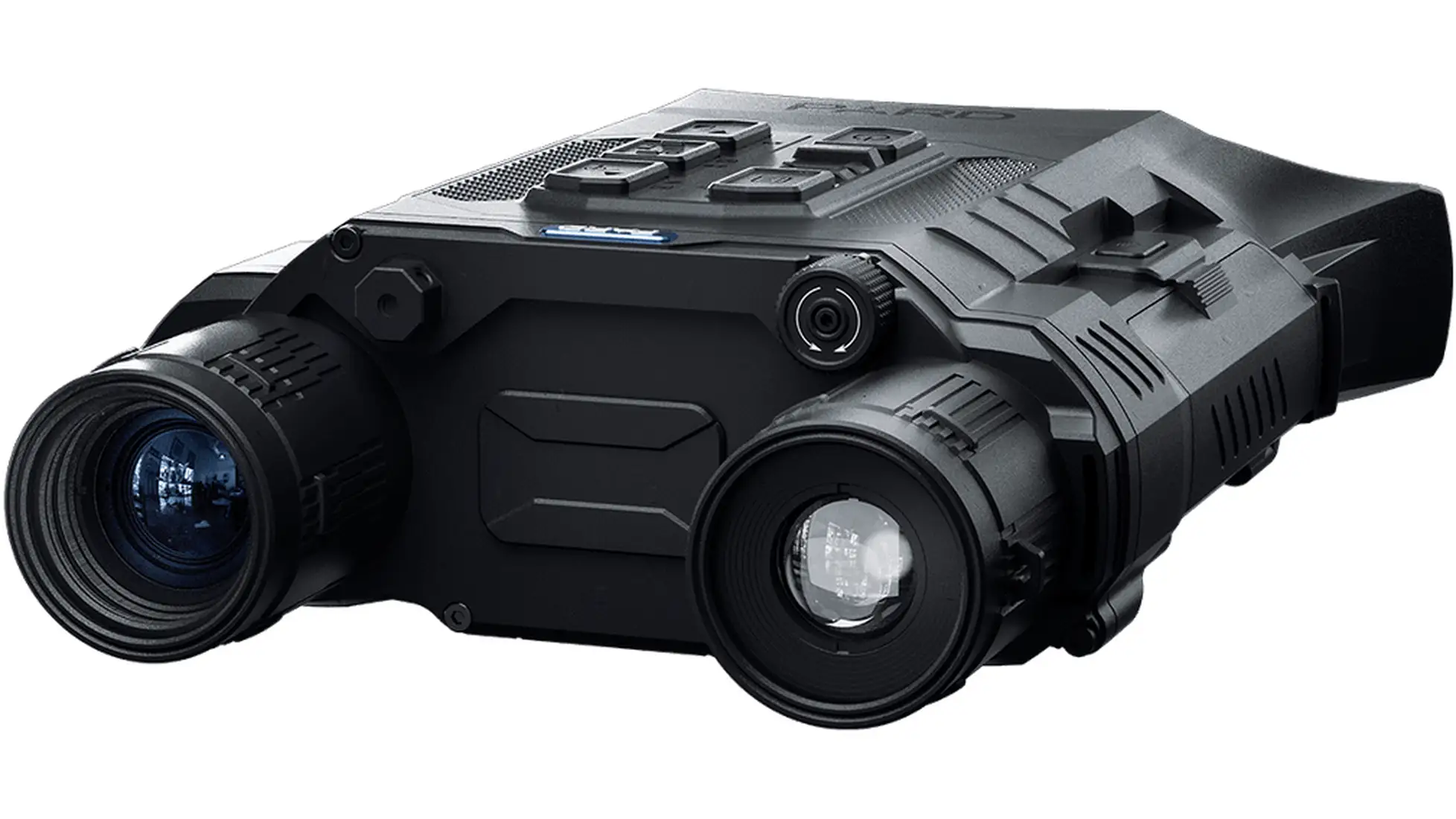
Best overall: PARD Merlin ME-50/850
Digital · 1920x1080 CMOS sensor · one 640x480 LED screen · 50 mm lens · built-in 850 nm IR · photo and video · Wi-Fi · IP67 · 21700 battery included
around $200exact price on OpticsPlanet
The Merlin is the best all-round night vision binocular here for most buyers, because it packs the most published capability into a light, simple digital device. PARD pairs a 1920x1080 CMOS sensor with one screen that both eyes look into, a built-in 850 nm illuminator (a 5 W VCSEL with three levels, which PARD rates to 350 m), and photo and video recording to a Micro SD card of up to 128 GB. Built-in Wi-Fi links it to PARD's PardVision2 phone app, which PARD says turns the phone into an external viewfinder and moves images across, and there is an HDMI output. It runs on one 21700 lithium-ion cell, which comes in the box, for up to 6 hours per PARD, and takes external power over USB-C. PARD rates the housing IP67 and the weight at 441.6 g. Two things need care. Magnification: PARD lists 3.2x and 4.6x versions, and OpticsPlanet lists this unit as 3.2-4.6x with a 50 mm lens, and PARD lists a 2x digital zoom. And the screen is 640x480 per PARD, so you see far fewer pixels than the sensor captures, and with one screen there is no depth perception.
Pros
- The fullest published spec sheet on this page: 1920x1080 CMOS sensor, 0.001 lux sensitivity per PARD, 60 Hz in color and 30 Hz in black and white
- Records photo and video with audio, auto and loop recording and a time stamp, to Micro SD up to 128 GB, with Wi-Fi to the PardVision2 app
- Built-in 850 nm VCSEL illuminator, 5 W with three levels, rated by PARD to 350 m
- One 21700 lithium-ion cell in the box, USB-C external power, and an IP67 housing rated for -30 to +55 C
Cons
- One screen for both eyes: comfortable two-eye viewing, but both eyes see the same flat image, so there is no depth perception
- The 640x480 screen shows far less detail than the 1920x1080 sensor records
- PARD's published specs list 3.2/4.6x and 35/50 mm without saying which pairs with which, and OpticsPlanet merges both into one 3.2-4.6x figure
- Up to 6 hours per charge per PARD, well short of the tube models below, and OpticsPlanet's package list names no Micro SD card
Best for: night walks, property checks and what PARD calls "wildlife observation, patrol, and night-time outdoor use", when you want to record what you see. Want a real image-intensifier tube instead of a screen? Step up to the AGM FoxBat-5.
Key specifications
| Model | ME-50/850 |
|---|---|
| Technology | Digital (CMOS sensor and screen) |
| Sensor | 1920x1080 CMOS, 2.9 µm pixels (PARD) |
| Display | One LED screen, 640x480 (PARD) |
| Magnification | OpticsPlanet lists 3.2-4.6x; PARD lists 3.2x and 4.6x versions and a 2x digital zoom |
| Objective | 50 mm |
| Field of view | OpticsPlanet lists 6.8-4.8 degrees; PARD lists 6.8 and 4.8 degrees horizontal for its two versions |
| IR illuminator | 850 nm VCSEL, 5 W, 3 levels, rated to 350 m (PARD) |
| Recording | Photo and video with audio, Micro SD up to 128 GB (OpticsPlanet's package list names no card) |
| Connections | USB Type-C, Wi-Fi (PardVision2 app), HDMI |
| Battery | One 21700 Li-ion (included), up to 6 hr (PARD) |
| Focus range | 3 m to infinity |
| Diopter | -5 to +3 |
| Water rating | IP67 (PARD) |
| Size | 220 x 137 x 58 mm |
| Weight | 442 g (OpticsPlanet); 441.6 g (PARD) |
| Warranty | PARD: 2 years for digital night vision devices |
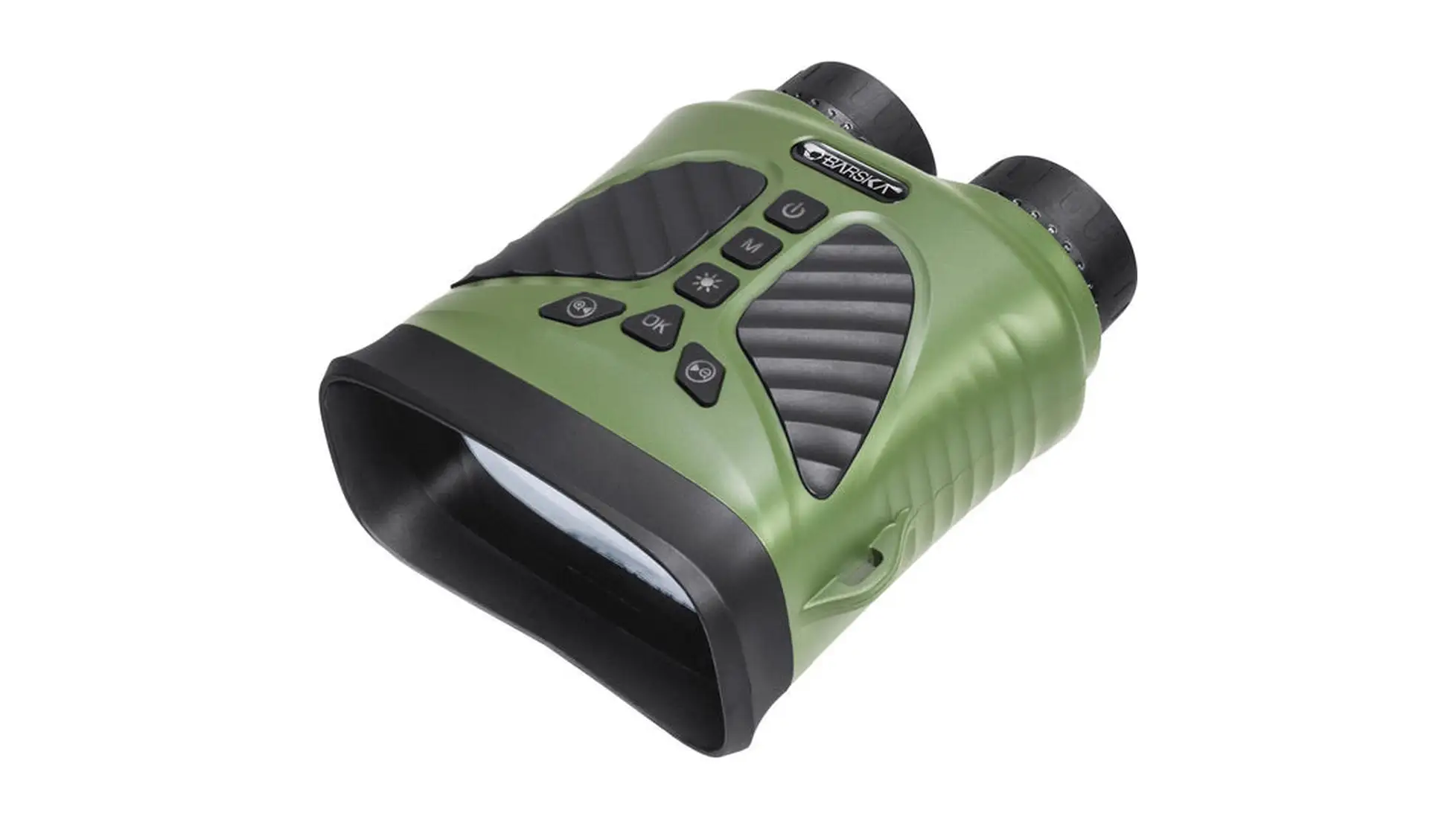
Best budget: Barska NV-2 10x43
Digital · 10x43 · 10 degree field of view · built-in IR illuminator · photo and video · backlit buttons · tripod adaptable · 0.73 lb
around $140exact price on OpticsPlanet
The NV-2 is the budget way into digital night vision, and it has the highest listed magnification on this page: OpticsPlanet lists it at 10x with a 43 mm objective and a 10 degree field of view, plus an 8x zoom range. It also has the lightest listed weight here, 0.73 lb. Barska lists a 1.3 MP 1/3-inch CMOS sensor and a 3-inch IPS screen at 640x360, so it publishes a smaller sensor than the Merlin. It records photo and video (Barska lists 2.5K video), OpticsPlanet lists daytime and nighttime modes, and it has backlit silicone buttons you can find in the dark and is tripod adaptable. The built-in IR illuminator has three brightness settings. The weak point is the paperwork: the sources disagree on how far the illuminator reaches and on whether a battery comes in the box, and neither OpticsPlanet nor Barska's product page lists a water rating or warranty term. Barska's own listing rates viewing to 200 to 300 m, while OpticsPlanet's description quotes a much longer figure.
Pros
- The highest listed magnification on this page, 10x with a 43 mm objective, plus an 8x zoom range per OpticsPlanet
- The lightest listed weight here, 0.73 lb, with a compact 5.51 x 4.88 x 2.36 in body
- Records photo and video, with day and night modes per OpticsPlanet and backlit silicone buttons for use in the dark
- Tripod adaptable, for long watches from one spot
Cons
- A smaller published sensor than the Merlin (1.3 MP against 1920x1080) and a 640x360 screen, per Barska
- IR range claims disagree by source: Barska rates viewing to 200 to 300 m, OpticsPlanet's description quotes much further
- The battery story conflicts: OpticsPlanet lists a battery in the package, while Barska says the 18650 cell it needs is not included
- No water rating, IR wavelength, runtime or warranty term listed on OpticsPlanet or Barska's product page
Best for: a first, low-cost digital night vision binocular with plenty of magnification for scanning fields and tree lines. If you want a fuller published spec sheet and an IP67 housing, the PARD Merlin is the step up.
Key specifications
| Model | BQ14072 |
|---|---|
| Technology | Digital |
| Sensor | 1.3 MP 1/3-inch CMOS (Barska) |
| Display | 3-inch IPS, 640x360 (Barska) |
| Magnification | 10x; 8x zoom range (OpticsPlanet) |
| Objective | 43 mm |
| Field of view | 10 degrees |
| IR illuminator | Built-in, 3 brightness settings; wavelength not listed; range figures differ by source |
| Recording | Photo and video (Barska lists 2.5K video) |
| Battery | Rechargeable lithium; sources disagree on whether the cell is included |
| Minimum focus | 3 m |
| Size | 5.51 x 4.88 x 2.36 in |
| Weight | 0.73 lb |
| Water rating | Not listed (OpticsPlanet, Barska product page) |
| Warranty | Not listed (OpticsPlanet, Barska product page) |
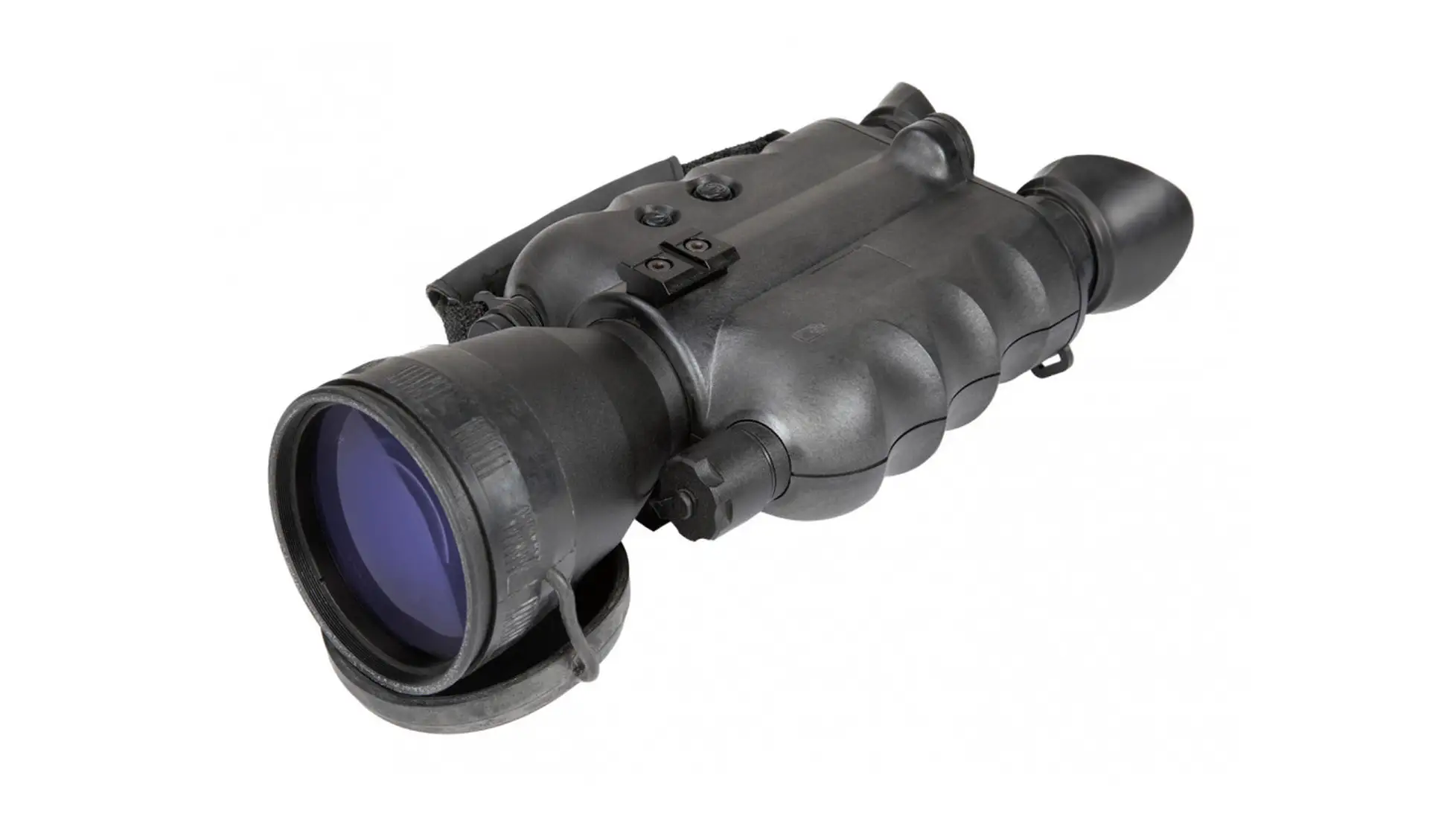
Best tube step-up: AGM FoxBat-5 Gen 2+
Gen 2+ green phosphor tube · bi-ocular, two eyepieces · detachable Sioux850 long-range IR illuminator included · waterproof · tripod adaptable
around $1,900exact price on OpticsPlanet
The FoxBat-5 is the step from a digital screen to a real image-intensifier tube: a Gen 2+ green phosphor tube in a bi-ocular body, so both eyes look through their own eyepiece at the one tube image, which the listing calls a dual eye viewing system for long viewing sessions. It comes with AGM's detachable Sioux850 long-range infrared illuminator and one CR123A battery, has fully multi-coated all-glass optics, and is tripod adaptable. OpticsPlanet lists it as waterproof and fog resistant, with a 108 mm objective, a 9.5 degree field of view, focus from 10 m to infinity, -5 to +5 diopter adjustment, a -40 to 122 F operating range, 2.9 lb, a 10.3 x 5.5 x 3.1 in body, 30 hours of battery life and a limited two-year warranty. One figure needs care: OpticsPlanet's spec table lists 4.5x magnification, while the model name on the same listing says 5x, so confirm the magnification on the retailer page. OpticsPlanet also lists no tube resolution for this unit.
Pros
- A real Gen 2+ green phosphor image-intensifier tube, not a screen image
- Two eyepieces for comfortable two-eye viewing over long sessions
- Detachable AGM Sioux850 long-range IR illuminator in the box
- Long battery life: 30 hours per OpticsPlanet, against up to 6 hours for the digital Merlin per PARD
Cons
- One tube feeds both eyes, so there is no true depth perception
- No recording listed, unlike the digital picks
- OpticsPlanet's listing gives two magnifications (4.5x in the spec table, 5x in the model name) and lists no tube resolution for this unit
- No manual gain control (OpticsPlanet), and 2.9 lb per OpticsPlanet, far heavier than the digital picks
Best for: watching from a fixed spot, such as a property line or a field edge, where you want a true tube image and long runtime and do not need to record. For a Gen 3 tube and 8x, see the FoxBat-8 3AW1.
Key specifications
| Model | 13FXB522103031 |
|---|---|
| Technology | Image-intensifier tube, bi-ocular |
| Tube | Gen 2+, green phosphor |
| Magnification | 4.5x (OpticsPlanet spec table); 5x (model name on the OpticsPlanet listing) |
| Objective | 108 mm (OpticsPlanet) |
| Field of view | 9.5 degrees (OpticsPlanet) |
| IR illuminator | Detachable AGM Sioux850 long-range illuminator, included; wavelength not listed |
| Recording | None listed |
| Battery | One CR123A in the box, 30 hr (OpticsPlanet) |
| Focus range | 10 m to infinity |
| Diopter | -5 to +5 |
| Operating temperature | -40 to 122 F |
| Size | 10.3 x 5.5 x 3.1 in (OpticsPlanet) |
| Weight | 2.9 lb (OpticsPlanet) |
| Water rating | Waterproof, fog resistant (OpticsPlanet) |
| Warranty | Limited two-year (OpticsPlanet) |
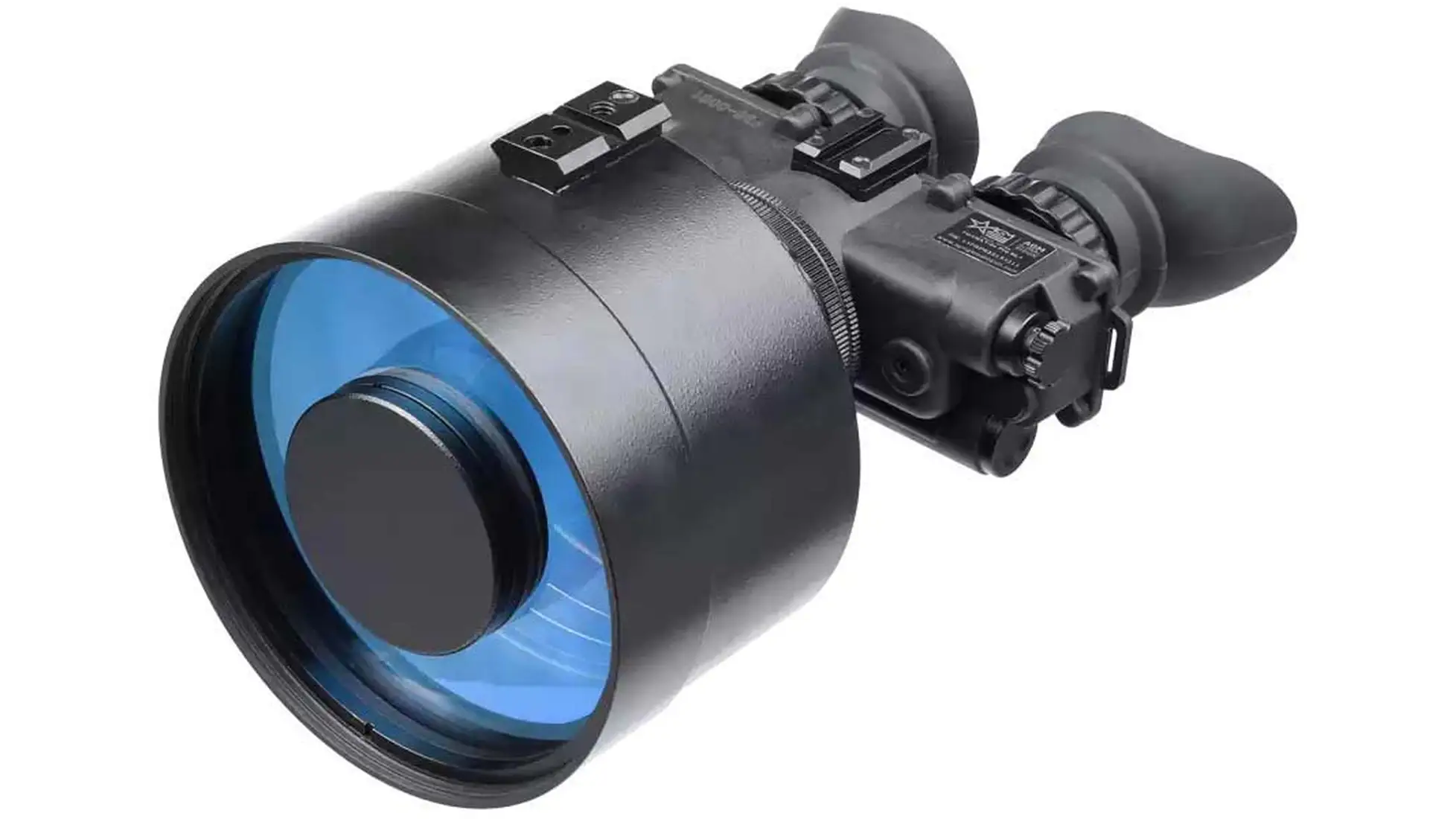
Best premium (Gen 3): AGM FoxBat-8 3AW1 Gen 3
Gen 3 auto-gated white phosphor tube · 8x · 216 mm f/1.8 lens · bi-ocular · detachable IR illuminator, tripod and hard case included · two AA, up to 40 hr
around $5,900exact price on OpticsPlanet
The FoxBat-8 3AW1 is the premium pick: AGM's SKU label for this model reads Gen 3 Auto-Gated White Phosphor "Level 1", and OpticsPlanet lists the generation as 3 with auto-gating and white phosphor. It is a long-range observation device rather than a walking-around binocular. AGM's FoxBat-8 datasheet gives 8x magnification through a 216 mm f/1.8 lens, a 4.5 degree field of view, 15 mm of eye relief, a 57 to 73 mm interpupillary range, bright-light cut-off and automatic brightness control, two AA batteries for up to 40 hours, and a -40 to +122 F operating range, at 3.9 lb. A tripod, a hard case and a detachable IR illuminator come in the box; neither OpticsPlanet nor the datasheet lists the illuminator's wavelength. OpticsPlanet lists a resolution of 64-72 lp/mm, a figure we did not find in AGM's own documents. AGM backs it with a three-year warranty. The datasheet covers the whole FoxBat-8 family, so its figures are not specific to the 3AW1 tube.
Pros
- A Gen 3 auto-gated white phosphor tube per AGM's SKU label, the highest tube grade on this page
- 8x through a 216 mm f/1.8 lens for observation at range, with 64-72 lp/mm resolution per OpticsPlanet
- Tripod, hard case and detachable IR illuminator in the box
- Up to 40 hours on two AA batteries per AGM's datasheet, and a three-year warranty from both AGM and the listing
Cons
- The most expensive pick here, and at 3.9 lb it is the heaviest; the included tripod is the practical way to use it
- The narrowest published field of view on this page, 4.5 degrees
- One tube feeds both eyes, so there is no true depth perception, and no recording is listed
- AGM's datasheet says the equipment is subject to US export regulations and may require a license prior to export
Best for: fixed-position observation at distance, such as ranch or perimeter watching from a tripod, by a buyer who wants the highest tube grade here. To spend far less on a tube, see the FoxBat-5; to record, choose a digital pick.
Key specifications
| Model | 13F8P82325401 |
|---|---|
| Technology | Image-intensifier tube, bi-ocular |
| Tube | Gen 3, auto-gated, white phosphor, "Level 1" (AGM SKU label) |
| Resolution | 64-72 lp/mm (OpticsPlanet) |
| Magnification | 8x |
| Lens system | 216 mm, f/1.8 (AGM FoxBat-8 datasheet) |
| Field of view | 4.5 degrees |
| Eye relief | 15 mm (AGM datasheet) |
| Interpupillary distance | 57 to 73 mm (AGM datasheet) |
| IR illuminator | Detachable, included; wavelength not listed |
| Recording | None listed |
| Battery | Two AA, up to 40 hr (AGM datasheet) |
| Operating temperature | -40 to +122 F (AGM datasheet) |
| Weight | 3.9 lb |
| Water rating | Water and fog resistant (OpticsPlanet) |
| Warranty | 3 years (AGM datasheet and OpticsPlanet) |
| In the box | Bi-ocular, detachable IR illuminator, tripod, lens cloth, hard case, user manual |
What "night vision binoculars" usually means
Many devices sold as night vision binoculars show one image to both eyes. PARD describes the Merlin as a night vision binocular "with one screen": one sensor feeds one screen that both eyes look into. The AGM FoxBats are bi-oculars, with one image-intensifier tube viewed through two eyepieces. Either way you get the comfort of looking with both eyes, but both eyes see the same flat image, so there is no true depth perception. Barska does not say how the NV-2 display is arranged. A true dual-tube binocular, with one tube per eye, is a different class of device; our night vision goggles guide covers one.
Digital or image-intensifier tube?
The digital picks put a camera sensor behind the lens and show its picture on a screen. That is why they can record photo and video and work by day as well as at night: PARD lists color and black-and-white modes for the Merlin, and OpticsPlanet lists daytime and nighttime modes for the Barska. In the dark they lean on their built-in infrared illuminators, which the Barska's OpticsPlanet listing pitches as what lets you see in complete darkness.
The AGM picks use an image-intensifier tube instead: the FoxBat-5 a Gen 2+ green phosphor tube, the FoxBat-8 3AW1 a Gen 3 auto-gated white phosphor tube. Their listings do not mention recording, they run far longer on a set of batteries (30 hours for the FoxBat-5 per OpticsPlanet, up to 40 hours for the FoxBat-8 per AGM's datasheet), and they are night devices: AGM's FoxBat manual says the protection system cuts off the image intensifier when the ambient light stays above 40 lux for 10 seconds or more. On resolution, OpticsPlanet lists 64-72 lp/mm for the FoxBat-8 3AW1 and no figure for the FoxBat-5, so they cannot be compared on that number here.
IR illuminators: 850 nm and 940 nm
Every pick here carries an infrared illuminator, built in on the digital models and detachable on the AGM bi-oculars. PARD sells the Merlin with a choice of wavelength and describes the two on its store page as "850 nm Higher visibility" and "940 nm Invisible illumination". The Merlin on this page, ME-50/850, is the 850 nm version, and PARD rates its 5 W illuminator to 350 m without stating the test conditions. The OpticsPlanet listings for the Barska and the AGM FoxBats list no wavelength, and the range figures quoted for the Barska differ from one source to the next.
Spec comparison
Figures are for the exact model we price. Where OpticsPlanet and the maker disagree, the cell names the source; a figure that neither the listing nor the maker documents we read give is marked "Not listed".
| Spec | PARD Merlin | Barska NV-2 | AGM FoxBat-5 | AGM FoxBat-8 3AW1 |
|---|---|---|---|---|
| Technology | Digital | Digital | Image-intensifier tube (bi-ocular) | Image-intensifier tube (bi-ocular) |
| Magnification | 3.2-4.6x as listed by OpticsPlanet (PARD lists 3.2x and 4.6x versions and a 2x digital zoom) | 10x; 8x zoom range | 4.5x (OpticsPlanet spec table); 5x (model name on the same listing) | 8x |
| Objective | 50 mm | 43 mm | 108 mm (OpticsPlanet) | 216 mm, f/1.8 (AGM datasheet) |
| Sensor or tube | 1920x1080 CMOS (PARD) | 1.3 MP 1/3-inch CMOS (Barska) | Gen 2+ tube, green phosphor | Gen 3 auto-gated tube, white phosphor |
| Display | One LED screen, 640x480 (PARD) | 3-inch IPS, 640x360 (Barska) | Tube image through two eyepieces | Tube image through two eyepieces |
| IR illuminator (wavelength) | Built-in, 850 nm; rated to 350 m by PARD | Built-in; wavelength not listed | Detachable Sioux850, included; wavelength not listed | Detachable, included; wavelength not listed |
| Recording | Photo and video, Micro SD up to 128 GB; Wi-Fi app | Photo and video | None listed | None listed |
| Battery and runtime | One 21700 Li-ion (included), up to 6 hr (PARD) | Rechargeable lithium; runtime not listed | One CR123A in the box, 30 hr (OpticsPlanet) | Two AA, up to 40 hr (AGM datasheet) |
| Weight | 442 g | 0.73 lb | 2.9 lb (OpticsPlanet) | 3.9 lb |
| Water rating | IP67 (PARD) | Not listed | Waterproof, fog resistant (OpticsPlanet) | Water and fog resistant (OpticsPlanet) |
| Warranty | 2 years (PARD) | Not listed | Limited two-year (OpticsPlanet) | 3 years |
| Price | around $200 | around $140 | around $1,900 | around $5,900 |
How to choose night vision binoculars
A few decisions matter more than the spec sheet:
- Digital or tube. Digital (Merlin, Barska) records, works by day and costs far less. A tube (FoxBat-5, FoxBat-8 3AW1) gives an intensified tube image and long battery life, with no recording listed.
- Magnification and field of view together. The Barska lists 10x with a 10 degree field; the FoxBat-8 3AW1 lists 8x with a 4.5 degree field, the narrowest here, which suits a tripod and a fixed watch rather than scanning on the move.
- Runtime and batteries. PARD lists up to 6 hours for the Merlin on one 21700 cell. OpticsPlanet lists 30 hours for the FoxBat-5 on one CR123A, and AGM's datasheet up to 40 hours for the FoxBat-8 3AW1 on two AA cells. Neither OpticsPlanet nor Barska's product page lists a runtime for the Barska.
- Recording and phone link. If you want to keep footage, the Merlin documents it best: Micro SD up to 128 GB (OpticsPlanet's package list names no card) and Wi-Fi to the PardVision2 app.
- Weight. The digital picks list 0.73 lb (Barska) and 442 g, about 0.97 lb (Merlin); the FoxBat-5 is 2.9 lb per OpticsPlanet and the FoxBat-8 3AW1 3.9 lb, with a tripod in the box.
- Read the source of each number. These listings carry no owner reviews yet, and several specs differ between retailer and maker. We name the source wherever they disagree; check the retailer page before you buy.
Want to aim a rifle in the dark instead? See our best night vision scopes. Prefer heat detection? Read thermal vs night vision.
FAQ
Are night vision binoculars true binoculars?
Often not. PARD describes the Merlin as a night vision binocular with one screen, so both eyes look at the same image, and the AGM FoxBats are bi-oculars: one image-intensifier tube viewed through two eyepieces. Both designs give comfortable two-eye viewing but no true depth perception, because both eyes see the same flat image. Barska does not say how the NV-2 display is arranged. A true dual-tube binocular uses one tube per eye; our night vision goggles guide covers one.
Should I buy digital or tube night vision binoculars?
Choose digital if you want to record, to use the same device by day and at night, and to spend less: the PARD Merlin and Barska NV-2 record photo and video. Choose an image-intensifier tube if you want a tube image and long battery life and do not need to record: OpticsPlanet lists 30 hours for the AGM FoxBat-5 and AGM's datasheet up to 40 hours for the FoxBat-8, against up to 6 hours for the Merlin per PARD. The tube picks are the most expensive on this page.
Can night vision binoculars record video?
The digital picks can. The PARD Merlin records photo and video with audio to a Micro SD card of up to 128 GB, which OpticsPlanet's package list does not name, and connects over Wi-Fi to the PardVision2 app. The Barska NV-2 records photo and video too. The AGM FoxBat listings do not mention recording.
What is the difference between 850 nm and 940 nm IR illuminators?
PARD sells the Merlin with either illuminator and describes them on its store page as "850 nm Higher visibility" and "940 nm Invisible illumination". The unit on this page, ME-50/850, is the 850 nm version. The OpticsPlanet listings for the Barska NV-2 and the AGM FoxBats do not list a wavelength for their illuminators.
Can you use night vision binoculars in daylight?
The digital picks are built for it: PARD lists color and black-and-white modes for the Merlin, and OpticsPlanet lists daytime and nighttime modes for the Barska NV-2. The AGM tube models are night devices; AGM's FoxBat manual says the protection system cuts off the image intensifier when the ambient light stays above 40 lux for 10 seconds or more.
Can I take night vision binoculars out of the US?
Do not assume so. PARD states that all of its night-vision and thermal imaging devices require a license for export outside the country, and AGM's FoxBat-8 datasheet says the equipment is subject to US export regulations and may require a license prior to export. Check the current rules before you travel with one or send one abroad.
Related: best night vision scopes · best night vision goggles · best night vision monoculars · thermal vs night vision.