DNT ThermNight review: the TNC635R, TNC335R and TNC225R, channel by channel
Our verdict: 4.0/5. The DNT ThermNight is a rifle scope with two imaging channels behind one eyepiece, a thermal sensor and a digital day/night camera, plus a laser rangefinder and a ballistic calculator. The three models differ mainly on the thermal side. The TNC635R we review has a 640x512 thermal sensor on a 35 mm focal length with a 1.5x base, which gives it the widest thermal view of the three at 12.52 degrees. The TNC335R puts a 384x288 thermal sensor behind the same focal length at 2.5x, and the TNC225R uses a 256x192 thermal sensor on a 25 mm lens at 3x in a shorter, lighter body. All three have a 1920x1080 day/night camera that zooms digitally from 5x to 20x. Pick the TNC635R for the most thermal detail and the widest scan, the TNC335R for the same display, eye relief and day/night camera at a lower price with a narrower thermal view, and the TNC225R to save weight and money if a 256x192 thermal sensor, a 1024x768 display and 45 mm of eye relief are enough. What to know first: you zero the thermal and day/night channels separately, the two views are switched or shown picture in picture rather than blended, some of DNT's own figures disagree with each other, and OpticsPlanet shows five reviews across the three listings from three reviewers. For other thermal scopes, see our best thermal scope guide, or our AGM Rattler V3 review for a 640 thermal scope with a built-in rangefinder and ballistic calculator.
The TNC635R sells for around $2,800, the TNC335R for around $2,000 and the TNC225R for around $1,200. OpticsPlanet shows 4.5/5 from 2 reviews on the TNC635R, 5.0/5 from 1 review on the TNC335R and 5.0/5 from 2 reviews on the TNC225R. Check price and availability on OpticsPlanet; confirm the current price on the retailer page.
How we reviewed it: a research-based review built from DNT's ThermNight series page, its TNC635R, TNC335R and TNC225R product pages, two DNT user manuals (one shared by the TNC635R and TNC335R, one for the TNC225R), DNT's warranty, registration and shipping pages, the three OpticsPlanet listings and their five reviews. Hands-on reviews from three outside publications are cited only as DNT reprints them on its own blog, and we say so each time; the reprints do not say how the testers got their units. Where the retailer's spec table and DNT disagree we print DNT's figure; where DNT's own documents disagree we print both, labelled. Every figure names its channel: thermal, day/night, rangefinder or display. We have not used these scopes ourselves; the score is our editorial opinion and OpticsPlanet ratings are shown attributed to their source. See how we evaluate.
Which ThermNight is which, and what the model names mean
DNT's ThermNight menu lists four models: TNC4K219R, TNC225R, TNC335R and TNC635R. This page covers the three that OpticsPlanet sells under these listings: the TNC635R (sold as the 1.5-6x), the TNC335R (2.5-10x) and the TNC225R (3-12x52mm). The TNC4K219R is a separate model and nothing on this page describes it.
The names mix two channels. In DNT's spec tables, the first two numbers are the thermal channel: its base magnification and its top digital zoom step (1.5x to 6x on the TNC635R, 2.5x to 10x on the TNC335R, 3x to 12x on the TNC225R). The "5-20x" in all three listing names is the day/night channel, which starts at 5x and zooms digitally to 20x.
Two retailer labels need care. OpticsPlanet's spec tables give "35 mm" (TNC635R) and "52 mm" (TNC225R) as an objective lens diameter; DNT's tables list them as focal lengths. The 35 mm is the thermal lens of the TNC635R and TNC335R, and the 52 mm is the TNC225R's day/night lens; the TNC225R's thermal lens is 25 mm. And the 1920x1080 in the TNC635R listing's sensor resolution field matches DNT's figure for the display and the day/night camera; DNT lists the TNC635R's thermal sensor at 640x512.
TNC635R: 640x512 thermal, the one we review
Thermal channel. DNT lists a 640x512 sensor with a 12 μm pixel pitch, a sensitivity (NETD) of ≤18 mK at 25°C and 50 FPS, and its series page says the TNC335R and TNC635R both use uncooled VOx microbolometers. The thermal lens has a 35 mm focal length; DNT publishes no aperture. The base is 1.5x and the digital zoom steps through 1.5x, 2.25x, 3x, 3.75x, 4.5x, 5.25x and 6x. The field of view is 12.52° x 10.02°, which is what 640 pixels of 12 μm behind 35 mm works out to (12.52° horizontal, our arithmetic). DNT's TNC635R page promises confident detection and engagement beyond 400 yards, without a target size.
The shared TNC635R/335R manual lists a Thermal Zoom Lock with Off, 1.5x and 1x settings on the TNC635R, and says the digital day/night magnification remains unaffected by it. The manual's palettes are White Hot, Black Hot, Red Hot and Iron Hot, with a hotspot tracking option.
Day/night, display and power are shared with the TNC335R and covered below. The one difference DNT's tables show there is battery life: 5.5 hours for the TNC635R against 6 hours for the TNC335R, both with the IR illuminator off.
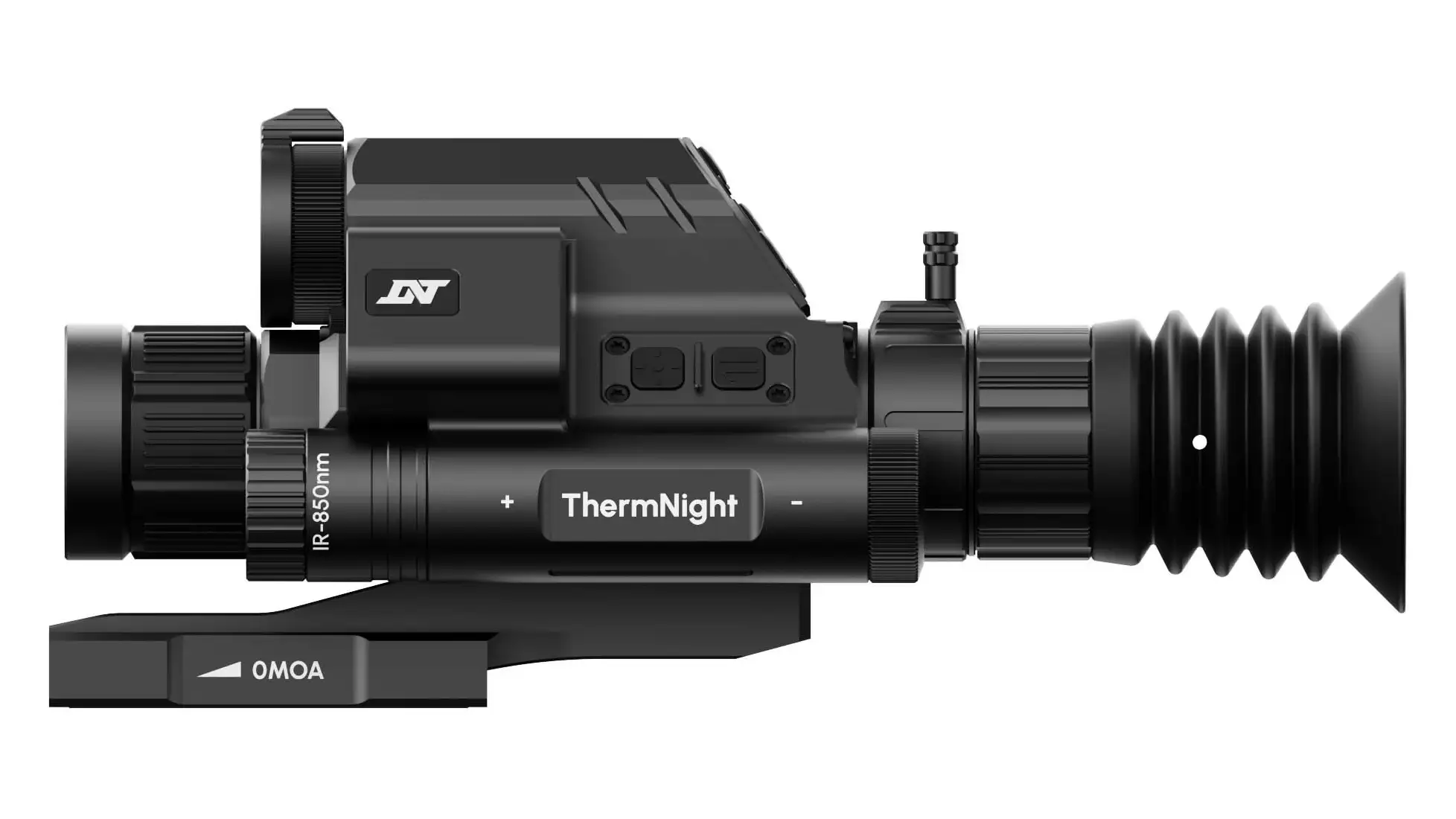
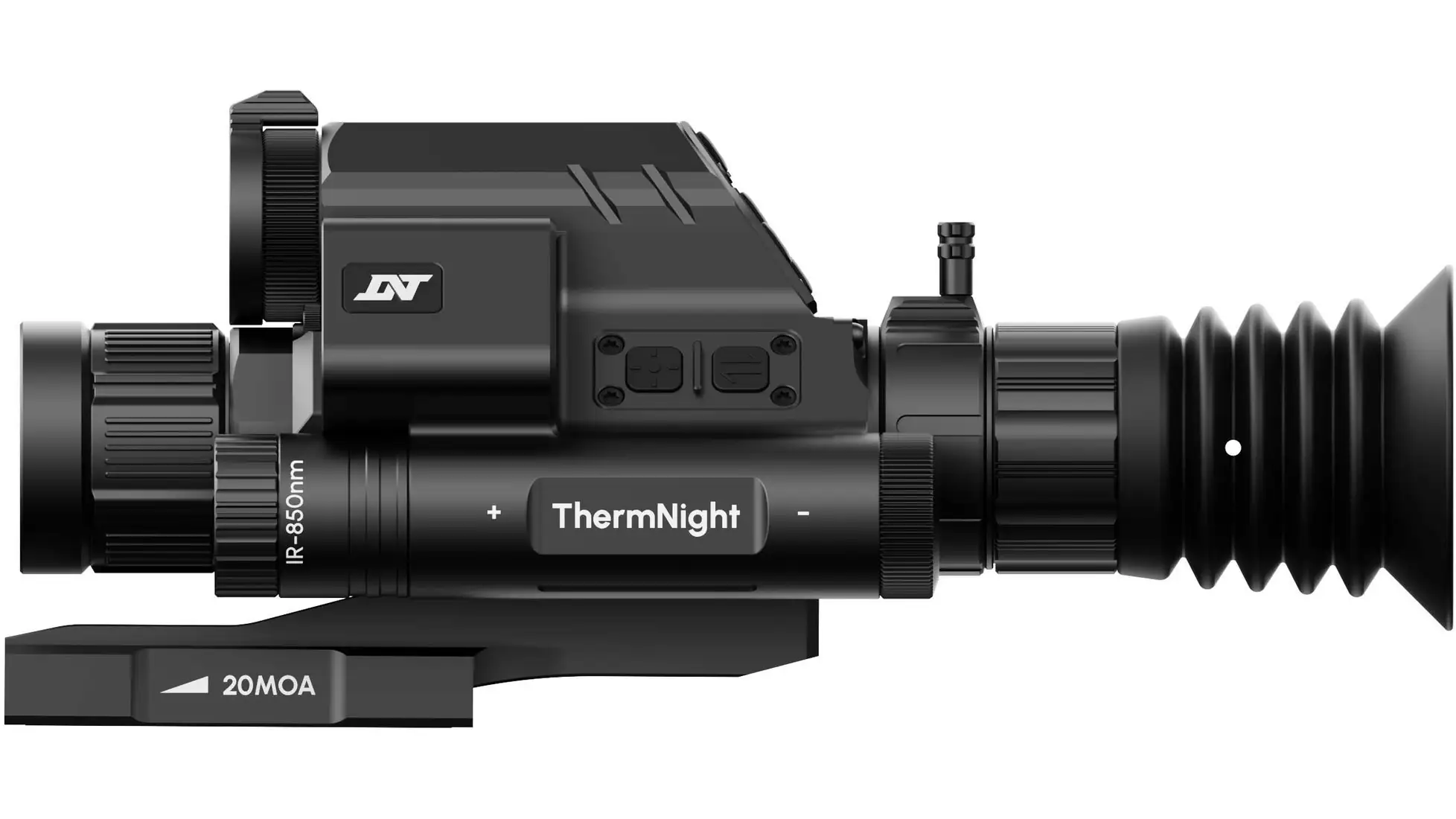
In the box, per DNT's TNC635R page: the scope, a PMS mount (Picatinny 0 MOA Short), a PM20L mount (Picatinny 20MOA L), an eye cup, a flip-up cover, two 21700 flat-top batteries, a charger, two USB cables, the user manual, a lens cleaning cloth and a scope sunshade. No case is listed.
A hands-on test, as reprinted by DNT. Mitchell Graf's TNC635R review, which DNT's blog reprints and credits to GunsAmerica, mounted the scope on a .223 Rem AR-15 using the 0 MOA base. Graf writes that start-up “averaged about 9.5 seconds during my testing”, that cattle could be seen nearly a mile away and that “identifying them beyond 700 yards wasn't difficult”. The downsides he lists: “the thermal focus ring is tucked farther back and can be awkward to reach”, and there are “just a few too many buttons, and most of them are fairly small”. He also notes that digital zoom “simply enlarges the existing image rather than adding detail”. His summary: “On paper, it's difficult to find another optic that offers this combination of features”. These are one tester's results on one unit, in a text DNT chose to republish; the reprint does not say how Graf got the unit.
OpticsPlanet reviews. The listing shows 4.5/5 from 2 reviews, both from reviewers tagged Verified Owner. The four-star reviewer had not mounted the scope yet, lists "I can see at night time" as a pro, and wrote:
“Seems to work pretty good.”
hogir (FL), Verified Owner, four-star review, via OpticsPlanet
The same reviewer adds that it is “taking me quite some time to learn how to use it” and that they will update the review once it is mounted. The other, a five-star review, is about the warranty:
“registering gets you a full 5yr warranty as well”
Shane Waters (TN), Verified Owner, five-star review, via OpticsPlanet
That matches DNT's warranty table for this model (see warranty). Two reviews are not a pattern; the weight of this section is on DNT's documents.
TNC335R: 384x288 thermal, same size and display
Thermal channel. DNT lists a 384x288 sensor with the same 12 μm pitch, ≤18 mK at 25°C and 50 FPS, behind the same 35 mm focal length as the TNC635R. The base is 2.5x and the digital zoom steps through 2.5x, 3.75x, 5x, 6.25x, 7.5x, 8.75x and 10x (DNT's product page runs "6.25x7.5x" together; its manual lists them separately). The field of view is 7.53° x 5.65°. With the same focal length and fewer pixels, the TNC335R sees a narrower thermal field than the TNC635R; its horizontal field is close to the TNC225R's 7.03°, and what separates those two on paper is resolution (384 against 256 pixels across) and sensitivity (≤18 against ≤25 mK). DNT's TNC335R page says it is optimized for reliable identification beyond 250 yards, without a target size. The Thermal Zoom Lock offers Off, 2.5x and 1x on this model.
Everything else in DNT's tables matches the TNC635R: the day/night camera, the display, the 65 mm eye relief, the rangefinder, 64 GB of storage, 724 g and 232 x 82 x 78 mm. Battery life is the one number in its favor: 6 hours with the IR illuminator off, the longest of the three on DNT's tables.
In the box, per DNT's TNC335R page: the same list as the TNC635R: the scope, a PMS mount (Picatinny 0 MOA Short), a PM20L mount (Picatinny 20MOA L), an eye cup, a flip-up cover, two 21700 flat-top batteries, a charger, two USB cables, the user manual, a lens cleaning cloth and a scope sunshade. OpticsPlanet shows the same photo for this listing as for the TNC635R, so we show none here.
OpticsPlanet review. The listing shows 5.0/5 from 1 review, by a reviewer tagged Verified Owner who came to it from the TNC225R. One voice is not a pattern.
“Bought TNC225R but decided to upgrade to the TNC335R”
Nengva Yang (MN), Verified Owner, five-star review, via OpticsPlanet
The same review adds: “The extra features and resolution definitely worth the price.”
What the TNC335R and TNC635R share
Day/night channel. DNT's series page names a Sony STARVIS 2 CMOS sensor; the tables list 1920x1080 at 60 Hz, a 5x base with digital zoom to 20x and a 5.31° x 2.99° field of view. DNT does not list a focal length for this lens on these two models. The shared manual describes a full-color night mode with Color and Black/White modes, and lists a day/night detection range of 400 m without a target size. The IR illuminator is detachable, DNT's tables rate it “Class 3R Eye Safe”, and the manual says it can be substituted with modules of 850 nm or 940 nm. To keep the illuminator from overheating, DNT's series page says brightness levels 4 and 5 drop to level 3 after 10 minutes, and every level turns off after 30 minutes of continuous use.
Display and eyepiece. A Micro-OLED display at 1920x1080 and 60 Hz, 65 mm of eye relief and ±3 diopters. DNT's series page says it moved the zoom control to a ring around the entire eyepiece, with a removable throw lever, and that the ring is easier to turn with gloves. The manual describes AutoWake: the scope enters sleep mode when the shooter's eye moves away and wakes automatically when the shooter is back in position.
Reticle. DNT's series page says a first focal plane MIL or MOA reticle, and its feature list gives 8 styles and 5 colors. The manual's settings menu lists the digital and thermal reticles separately, each with eight styles (two marked FFP, six marked SFP) and the colors red, green, yellow, black and white.
Recording and app. 64 GB of built-in memory and video recording at 1800x1080 (DNT's figure). The manual lists recoil-activated recording (auto, manual or off), audio recording and loop recording. Over Wi-Fi, the DNT app offers live streaming, ballistics and a video album, and DNT lists wireless updates.
Power and build. One 21700 flat-top battery runs the scope, and DNT lists two with each model. A 5V USB-C power bank can run it, but the manual says external power will not charge the battery inside. DNT's feature list says up to 5 hours of battery life, while its spec tables give 5.5 hours (TNC635R) and 6 hours (TNC335R) with the IR illuminator off; DNT gives no figure with the IR on. The body is IP67, rated for -20 to 50°C (-4 to 122°F) and 800 Gs, 232 x 82 x 78 mm and 724 g (25.6 oz). DNT's series page adds recoil resistance up to .50 BMG; that line appears on the series page, not on the two product pages.
Both videos come from the OpticsPlanet listings and cover the TNC335R and TNC635R together; neither is specific to one model, and the unboxing video says it uses the TNC635R as its example unit. Figures shown on screen are not quoted here; the specifications on this page come from DNT's tables and manuals.
TNC225R: 256x192 thermal, shorter and lighter
Thermal channel. DNT lists a 256x192 sensor with a 12 μm pitch, ≤25 mK at 25°C and 50 FPS, and describes it as an uncooled infrared image sensor. The thermal lens has a 25 mm focal length, the base is 3x and the digital zoom steps through 3x, 6x, 9x and 12x, with a 7.03° x 5.28° field of view.
Day/night channel. 1920x1080 at 60 FPS behind a 52 mm focal length, 5x to 20x digital, with a 6.13° x 3.45° field of view. DNT says you can switch between 850 nm and 940 nm illuminators and that the 940 nm module is sold separately. Video recording is 1024x768.
Display, controls and modes. A Micro-OLED display at 1024x768 and 50 FPS, 45 mm (1.8 in) of eye relief and ±5 diopters, with a digital zoom wheel. The TNC225R manual lists three imaging modes, Day/Night, Thermal and PIP, and a Screen Shifting setting for aligning the digital and thermal images.
Ballistics are app-led. In the manual's real-time mode, the DNT app calculates the drop; a Ballistic Table mode sends a table to the scope, which then works without needing the connection. DNT's product page mentions a preloaded bullet database. The TNC225R lists Bluetooth as well as Wi-Fi, and 32 GB of storage.
Power and build. One 18650 flat-top battery, 5 hours with the IR illuminator off, two in the box. DNT gives 645 g (22.8 oz) in the manual and 170 x 83 x 79 mm (6.7 x 3.3 x 3.1 in); the OpticsPlanet listing gives 646 g. IP67, -4 to 122°F, 800 Gs, and DNT's TNC225R page gives a recoil rating up to .50 BMG. DNT's mount page notes that earlier versions of the TNC225R have a square mounting base; check yours before buying a DNT mount.
In the box, per DNT's TNC225R page: the scope, a PMS mount (Picatinny 0 MOA Short), an eye cup, a flip-up cover, two 18650 flat-top batteries, a charger, two USB cables, the user manual and a lens cleaning cloth.
DNT's range claims. DNT's TNC225R page says the combined thermal and day/night image gives clear target identification at around 150 yards, and that night vision with the IR alone can extend visibility to approximately 450 yards. Neither figure comes with a target size.
Hands-on tests, as reprinted by DNT. American Rifleman's TNC225R review (published June 24, 2025, per DNT's reprint) found on a night hunt that a crescent moon gave enough ambient light to view objects approximately 75 yards out, that the IR illuminator extended this by several hundred yards, and that “Images were clear out to 400 yards”; it describes a mil-scale reticle with first focal plane functionality. Review This Thing's comparison of the TNC225R and TNC635R, also reprinted on DNT's blog, lists among the TNC225R's cons that its 256x192 resolution is noticeable past 200 yards, and that its night vision channel can be prone to IR washout in tall grass or reflective vegetation. Neither reprint says how the testers got their units.
OpticsPlanet reviews. The listing shows 5.0/5 from 2 reviews, but both are by the same reviewer, tagged Verified Owner, written on the same day, so we count them as one voice. One says:
“First time using ballistic calculator and it worked perfectly.”
Nengva Yang (MN), Verified Owner, five-star review, via OpticsPlanet
The other ends with the reviewer deciding to return the scope for the TNC335R, without giving a reason; a review under the same name on the TNC335R listing says they upgraded.
Thermal and day/night: switching, picture in picture and zero
None of DNT's documents we read describes blending the two images into one. You switch channels with a button, or turn on picture in picture: the TNC225R manual describes the main screen showing thermal while the PIP window shows night vision, with a button that flips the two, and the TNC635R/335R manual lets you set the window left, center or right, at a default of twice the main view's magnification.
Each channel has its own zero. DNT's TNC635R/335R manual says that point of aim and point of impact “will be different for day/night & thermal, so they each need to be zeroed separately”, and the TNC225R manual gives separate thermal and day/night zeroing steps. Both describe a one-shot zeroing aid: a short press of the power button freezes the image so you can move the reticle onto the point of impact. The TNC635R and TNC335R hold 10 zero profiles, the TNC225R up to 5 (A to E). DNT's TNC225R page adds that after one shot with the day/night channel you can switch to thermal and move that reticle to the same point of impact, so one shot can serve both, but each channel's reticle is still set on its own. Re-check both channels after any mount change.
Rangefinder and ballistic calculator
DNT lists the rangefinder on the TNC635R and TNC335R at 5 to 1,100 m, or 5 to 1,200 yd (1,100 m is about 1,203 yd, our arithmetic). The TNC225R is less clear: DNT's product page gives the same figure, while its TNC225R manual gives 5 to 1,000 m, or 5 to 1,100 yd. The TNC635R/335R manual lists continuous, single pulse and timed ranging (its settings menu gives the timed intervals as 3, 5 or 10 seconds, its instructions as 5, 10 or 15). DNT publishes no rangefinder accuracy, wavelength or laser class in the sources we read; the “Class 3R Eye Safe” line in its tables belongs to the IR illuminator.
All three show the ballistic solution as dial-in or holdover corrections and sense angle with a 3-axis gyroscope (DNT lists inclination and cant on the TNC225R). On the TNC635R and TNC335R the calculator is built into the scope: you enter data on the device or upload it from the DNT app over Wi-Fi, and DNT's series page says up to five ballistic profiles sync to the scope while the app stores as many as you want. On the TNC225R the live solution comes from the app, as described above.
Warranty and export
DNT's warranty table, on its product registration page, lists the TNC335R and TNC635R at 3 years, or 5 years with product registration, and the TNC225R at 2 years, or 3 years with registration. DNT's general warranty page still says all DNT night vision products are backed by a 2-year warranty; the registration table names the ThermNight models, so it is the figure we use. DNT's policy does not cover cosmetic damage, normal wear, intentional damage, theft, loss, acts of God or misuse, and on intentional abuse it says to “leave those torture tests to the YouTubers”. It excludes products obtained from unauthorized and non-official channels and asks for proof of purchase, so check the seller's status with DNT before you count on the extended term. For a claim, DNT asks you to send the optic only, and warns that it may be reset to factory settings, so back up your ballistic data first.
DNT's TNC635R, TNC335R and TNC225R pages carry this note: “This item may be subject to U.S. export restrictions.” DNT's own shipping policy says that due to ITAR restrictions it will not ship to any international addresses. Check your state and federal rules.
Trade-offs, plainly
- Two zeros to keep: DNT's manuals have you zero the thermal and day/night channels separately on all three models.
- No blended image: you switch channels or use picture in picture.
- DNT's own figures disagree in places: battery life (up to 5 hours in its feature list, 5.5 or 6 hours in its tables with the IR off) and the TNC225R rangefinder (1,200 yd on the product page, 1,100 yd in the manual).
- No published rangefinder accuracy, laser class or thermal aperture.
- Thin owner record: five OpticsPlanet reviews across the three listings, from three reviewers.
- The hands-on reviews we cite are DNT's reprints, chosen by DNT.
- The TNC335R and TNC635R weigh 724 g and measure 9.2 inches on DNT's first dimension, against 645 g and 6.7 inches for the TNC225R.
- The TNC225R's display is 1024x768 against 1920x1080 on the other two, and its eye relief is 45 mm against 65 mm.
Key specifications: three ThermNight models
| Spec | TNC635R | TNC335R | TNC225R |
|---|---|---|---|
| Version carded | TNC635R, Black (OpticsPlanet code 6P1-THR-ZULFC7-TNC635R) | TNC335R, Black (6P1-THR-ZULFC6-TNC335R) | TNC225R, Black (6P1-THR-ZULFC5-TNC225R) |
| Thermal: sensor | 640x512, 12 μm | 384x288, 12 μm | 256x192, 12 μm |
| Thermal: detector (DNT wording) | Uncooled VOx microbolometer (DNT series page) | Uncooled VOx microbolometer (DNT series page) | Uncooled infrared image sensor |
| Thermal: NETD | ≤18 mK at 25°C | ≤18 mK at 25°C | ≤25 mK at 25°C |
| Thermal: frame rate | 50 FPS | 50 FPS | 50 FPS |
| Thermal: lens focal length | 35 mm | 35 mm | 25 mm |
| Thermal: base and digital zoom steps | 1.5x; 1.5x, 2.25x, 3x, 3.75x, 4.5x, 5.25x, 6x | 2.5x; 2.5x, 3.75x, 5x, 6.25x, 7.5x, 8.75x, 10x | 3x; 3x, 6x, 9x, 12x |
| Thermal: field of view | 12.52° x 10.02° | 7.53° x 5.65° | 7.03° x 5.28° |
| Thermal: palettes | White Hot, Black Hot, Red Hot, Iron Hot | White Hot, Black Hot, Red Hot, Iron Hot | Not stated in the sources we read |
| Thermal: aperture (f-number) | Not stated | Not stated | Not stated |
| Day/night: camera | Sony STARVIS 2 CMOS, 1920x1080, 60 Hz | Sony STARVIS 2 CMOS, 1920x1080, 60 Hz | 1920x1080, 60 FPS |
| Day/night: lens focal length | Not stated | Not stated | 52 mm |
| Day/night: zoom | 5x base, digital to 20x | 5x base, digital to 20x | 5x base, digital to 20x |
| Day/night: field of view | 5.31° x 2.99° | 5.31° x 2.99° | 6.13° x 3.45° |
| Day/night: IR illuminator | Detachable; 850 nm or 940 nm modules; "Class 3R Eye Safe" | Detachable; 850 nm or 940 nm modules; "Class 3R Eye Safe" | Detachable; 850 nm or 940 nm, the 940 nm sold separately; "Class 3R Eye Safe" |
| Day/night: video recording | 1800x1080 | 1800x1080 | 1024x768 |
| Display | Micro-OLED, 1920x1080, 60 Hz | Micro-OLED, 1920x1080, 60 Hz | Micro-OLED, 1024x768, 50 FPS |
| Eye relief / diopter | 65 mm / ±3 | 65 mm / ±3 | 45 mm (1.8 in) / ±5 |
| LRF: range | 5 to 1,100 m / 5 to 1,200 yd | 5 to 1,100 m / 5 to 1,200 yd | Product page 5 to 1,100 m / 5 to 1,200 yd; manual 5 to 1,000 m / 5 to 1,100 yd |
| LRF: accuracy, wavelength, laser class | Not stated | Not stated | Not stated |
| Ballistics | On-board calculator, up to five profiles synced from the DNT app; dial-in or holdover | On-board calculator, up to five profiles synced from the DNT app; dial-in or holdover | Live solution from the DNT app, or a ballistic table sent to the scope; preloaded bullet database; dial-in or holdover |
| Angle sensing | 3-axis gyroscope | 3-axis gyroscope | 3-axis gyroscope |
| Zeroing | Each channel zeroed separately; 10 profiles | Each channel zeroed separately; 10 profiles | Separate thermal and day/night zeroing; 5 profiles (A to E) |
| Storage / connection | 64 GB / Wi-Fi | 64 GB / Wi-Fi | 32 GB / Wi-Fi and Bluetooth |
| Battery (one in use) | 21700 flat-top; 5.5 h with the IR off | 21700 flat-top; 6 h with the IR off | 18650 flat-top; 5 h with the IR off |
| External power | 5V USB-C; does not charge the battery | 5V USB-C; does not charge the battery | 5V USB-C; does not charge the battery |
| Sealing / temperature / shock | IP67; -20 to 50°C (-4 to 122°F); 800 Gs | IP67; -20 to 50°C (-4 to 122°F); 800 Gs | IP67; -4 to 122°F; 800 Gs |
| Weight | 724 g / 25.6 oz | 724 g / 25.6 oz | 645 g / 22.8 oz |
| Size (DNT, axes unlabelled) | 232 x 82 x 78 mm / 9.2 x 3.2 x 3.0 in | 232 x 82 x 78 mm / 9.2 x 3.2 x 3.0 in | 170 x 83 x 79 mm / 6.7 x 3.3 x 3.1 in |
| Mounts DNT lists with the scope | PMS (Picatinny 0 MOA Short) and PM20L (Picatinny 20MOA L) | PMS (Picatinny 0 MOA Short) and PM20L (Picatinny 20MOA L) | PMS (Picatinny 0 MOA Short) |
| Warranty (DNT table) | 3 years; 5 years with registration | 3 years; 5 years with registration | 2 years; 3 years with registration |
Specifications are DNT's: its three product pages, the TNC635R/335R user manual, the TNC225R user manual and its ThermNight series page. "Not stated" means no figure in the DNT sources we read. The "Version carded" row is the OpticsPlanet listings'. DNT gives the sizes as three numbers without naming the axes. No editorial award is claimed.
Should you buy one?
- Buy the TNC635R if you want the widest thermal view and the most thermal pixels in this line, with a full-HD day/night camera, rangefinder and on-board ballistic calculator in one scope, and you accept two zeros and 724 g.
- Buy the TNC335R if you want the same size, display and day/night camera for less, and a narrower 384x288 thermal view is enough for your distances.
- Buy the TNC225R if weight and price matter most and you are happy with a 256x192 thermal sensor, a smaller display and app-based live ballistics.
- Want a dedicated thermal scope with a rangefinder and ballistic calculator? Our AGM Rattler V3 review covers a 640 thermal scope with a built-in 1,000 m rangefinder and a ballistic calculator.
- Prefer a detailed image and daytime use over heat detection? See our best night vision scopes.
- Already run a good day scope? Our best thermal clip-on guide covers adding night capability without giving it up.
FAQ
What is the difference between the DNT ThermNight TNC225R, TNC335R and TNC635R?
Mostly the thermal channel. On DNT's figures the TNC635R has a 640x512 thermal sensor behind a 35 mm lens with a 1.5x base and a 12.52 x 10.02 degree field of view; the TNC335R has 384x288 behind the same 35 mm focal length with a 2.5x base and 7.53 x 5.65 degrees; the TNC225R has 256x192 behind a 25 mm lens with a 3x base and 7.03 x 5.28 degrees. The TNC335R and TNC635R share DNT's size and weight figures, a 1920x1080 Micro-OLED display, 65 mm of eye relief and a 21700 battery. The TNC225R is shorter and lighter, with a 1024x768 display, 45 mm of eye relief and an 18650 battery.
What is the thermal resolution of the DNT ThermNight?
DNT lists the thermal sensor at 640x512 on the TNC635R, 384x288 on the TNC335R and 256x192 on the TNC225R, all with a 12 micron pixel pitch. The 1920x1080 figure you will see on spec sheets belongs to the day/night camera on all three and to the display of the TNC335R and TNC635R; it is not the thermal sensor.
Do the thermal and day/night channels share one zero?
No. DNT's TNC635R/335R user manual says the point of aim and point of impact will be different for day/night and thermal, so each channel needs to be zeroed separately, and the TNC225R manual gives separate thermal and day/night zeroing steps. Both manuals describe a one-shot zeroing aid that freezes the image while you move the reticle to the point of impact.
How long does the ThermNight battery last?
DNT's spec tables give 6 hours for the TNC335R, 5.5 hours for the TNC635R and 5 hours for the TNC225R, and its manuals tie those figures to the IR illuminator being turned off. DNT's own feature lists also say up to 5 hours. Each scope runs on one flat-top cell (21700 on the TNC335R and TNC635R, 18650 on the TNC225R), and DNT lists two cells and a charger with each model. A USB-C power bank can run the scope but does not charge the battery inside it, according to DNT.
What warranty does DNT give the ThermNight?
DNT's warranty table lists 3 years for the TNC335R and TNC635R, or 5 years with product registration, and 2 years for the TNC225R, or 3 years with registration. DNT's warranty policy excludes products obtained from unauthorized and non-official channels and asks for proof of purchase, so confirm the seller's status with DNT before you count on the extended term.
How far can the ThermNight rangefinder measure?
DNT lists 5 to 1,100 m (5 to 1,200 yd) for the TNC335R and TNC635R. For the TNC225R, DNT's product page gives the same figure while its TNC225R manual gives 5 to 1,000 m (5 to 1,100 yd). DNT publishes no rangefinder accuracy or laser class in the sources we read; the Class 3R line in its tables belongs to the IR illuminator.
More thermal: best thermal scope · best budget thermal scope · best thermal scope for coyote hunting · thermal vs night vision.