The best clip-on thermal sights in 2026
Our verdict for 2026: the SIG SAUER ECHO CV25 (around $4,500) is the best clip-on thermal to buy: a 640x512 sensor in a 5-inch body that fits an AR, Outdoor Life's "Best for an AR" pick, backed by an unlimited lifetime warranty. On a real budget, the ATN TICO 6 (around $1,000) is the cheapest true clip-on worth buying, at the cost of a much coarser 256x192 image. Those are the two we would put money on today: the higher-resolution Guide USA TB1250 PRO has been discontinued by its manufacturer and is no longer sold, so it is out.
Clip-ons are a premium field: the flagship sits above $4,000 and the value entry costs about a quarter of that. Prices verified September 30, 2026; confirm current price and availability on the retailer page.
A thermal clip-on is the way to make one rifle a day gun and a night gun without choosing between them. Instead of replacing your scope, it mounts in front of it: you keep looking through your daytime optic and aim with its reticle, while the clip-on paints a 1x thermal image into the front of the glass, then comes off for daylight. The prize is that your day scope keeps its zero. The field is small and expensive, so this is a tight two-pick guide rather than a padded list: the proven SIG, and one genuine budget option at about a quarter of the price for buyers who cannot justify $4,000.
How these picks were made: a research-based roundup comparing published specifications, thermal sensor resolution and sensitivity, lens size, mounting and zero-retention design, owner reviews and pricing on OpticsPlanet, plus a deep-research pass on the anchor. Scores are our editorial opinion, not a hands-on test of every model, and owner ratings are shown attributed to their source. See how we evaluate.
Quick comparison
| Category | Pick | Spec | Price | |
|---|---|---|---|---|
| Best overall | SIG SAUER ECHO CV25 1x25mm | 640x512 · 25mm · no LRF | around $4,500 | Check price |
| Best value | ATN TICO 6 1x25mm | 256x192 · 25mm · no LRF | around $1,000 | Check price |
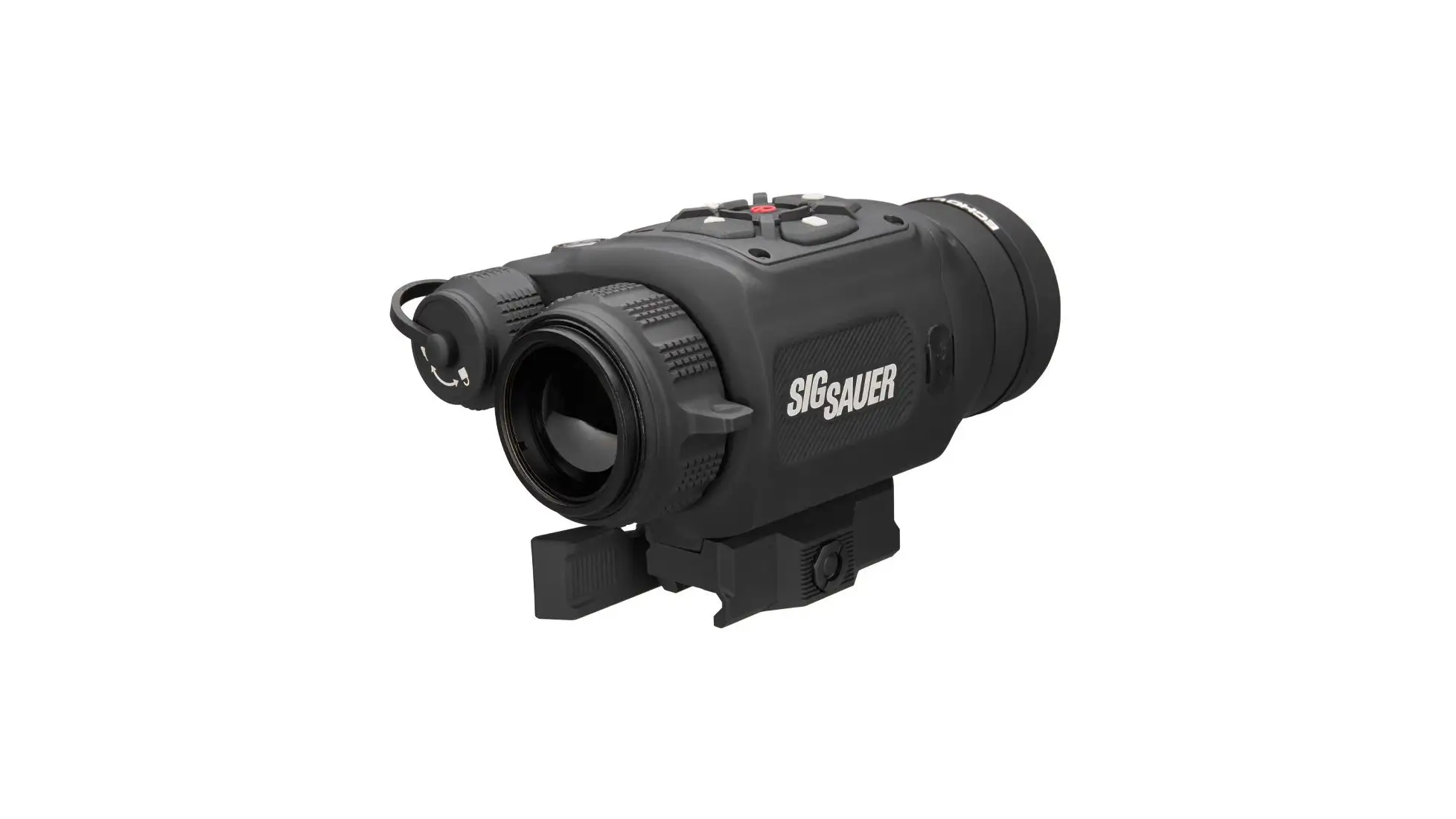
Best overall: SIG SAUER ECHO CV25 1x25mm
1x (unity) · 640x512 sensor · 25mm germanium lens · sub-20 mK NETD · 50 Hz · Bobro QD mount · BDX 2.0 digital collimation · 1024x768 AMOLED · dual 18650, 9 hr each · IP67 · 18.8 oz / 5 in
around $4,500exact price on OpticsPlanet
This is the thermal clip-on most AR shooters should buy, and it earned Outdoor Life's "Best for an AR" pick in their best-thermal-clip-ons field review. The reason is its 5-inch length: mount an LPVO and a thermal in tandem on an AR and rail space is tight, and the CV25 is short enough that both optics sit on the rigid upper receiver instead of bridging onto the handguard, where barrel flex would shift your point of impact. It pairs a 640x512 sensor, the top civilian class, with a sub-20 mK NETD sensitivity that cuts through the fog and humidity that wash out lesser thermals. Its Bobro quick-disconnect mount and the BDX 2.0 app's digital collimation let you clip it on and off in the dark and keep your day scope's zero. It runs on standard, cheap 18650 batteries (two included, about 18 hours total) rather than proprietary packs. But the real hook is the warranty: SIG's Infinite Guarantee is an unlimited, transferable lifetime warranty in a category where the norm is 3 to 5 years, and a $4,000 thermal is a fragile camera under recoil. Be clear on the trade: the 25mm lens caps identification at roughly 150 to 250 yards, and there is no laser rangefinder.
Pros
- A 640x512 sensor with sub-20 mK NETD sensitivity: the top civilian sensor class, and sensitive enough to hold an image in fog and humidity that blind lesser thermals
- Only 5 inches long, so an AR runs both an LPVO and the thermal on the rigid upper receiver without bridging the handguard; Outdoor Life named it "Best for an AR"
- Bobro QD mount plus BDX 2.0 app digital collimation, so you clip it on and off in the dark and keep the host scope's zero, no re-zeroing
- Standard 18650 batteries (two included, about 18 hr total) not proprietary packs, IP67 sealed, and the transferable Infinite Guarantee unlimited lifetime warranty; can also run as a standalone thermal sight
Cons
- The 25mm lens realistically identifies targets within about 150 to 250 yards; the "1,000 yard" figure is detection of a heat blob, not identification
- No integrated laser rangefinder, and thermal flattens depth perception, so ranging in the dark is guesswork (a real problem for subsonic loads)
- Dense at 18.8 oz, which adds noticeable front weight to an AR and dips the muzzle on long unsupported holds
- Collimation depends on the BDX phone app over Bluetooth, a failure point if the phone dies in the cold; one of three OP owners also reported a unit that shut off under 300 BLK recoil (a single-unit fault the lifetime warranty covers)
Best for: the AR-15 owner running a 1-4x, 1-6x or 1-8x LPVO or a red-dot magnifier who wants toolless day-to-night predator control (coyotes, hogs) inside about 200 yards, with a lifetime warranty. Skip it if you need to identify targets past 200 yards or shoot subsonic loads that demand an exact range.
Key specifications
| Configuration | Clip-on (1x unity), also runs standalone |
|---|---|
| Sensor resolution | 640x512 pixels, 12 micron |
| Objective | 25 mm germanium |
| NETD | Sub-20 mK |
| Refresh rate | 50 Hz |
| Field of view | 17 degrees |
| Display | 1024x768 AMOLED, 8 palettes |
| Rangefinder | None |
| Mount | Bobro QD, 1.535 in centerline, M1913 Picatinny |
| Storage | 32 GB internal, photo/video with audio |
| Battery | Dual 18650 rechargeable, 9 hr each |
| Sealing | IP67, aluminum |
| Weight | 18.8 oz |
| Warranty | SIG Infinite Guarantee (unlimited lifetime, transferable) |
“My prior experience with thermal clip-ons was with an AGM StingIR 640. This is a noticeable step up in almost every performance metric. Bigger screen, better thermal performance, more features, better build quality... My only real con is that the bikini caps Sig included are a joke.”
Michael Frazier (IN) via OpticsPlanet
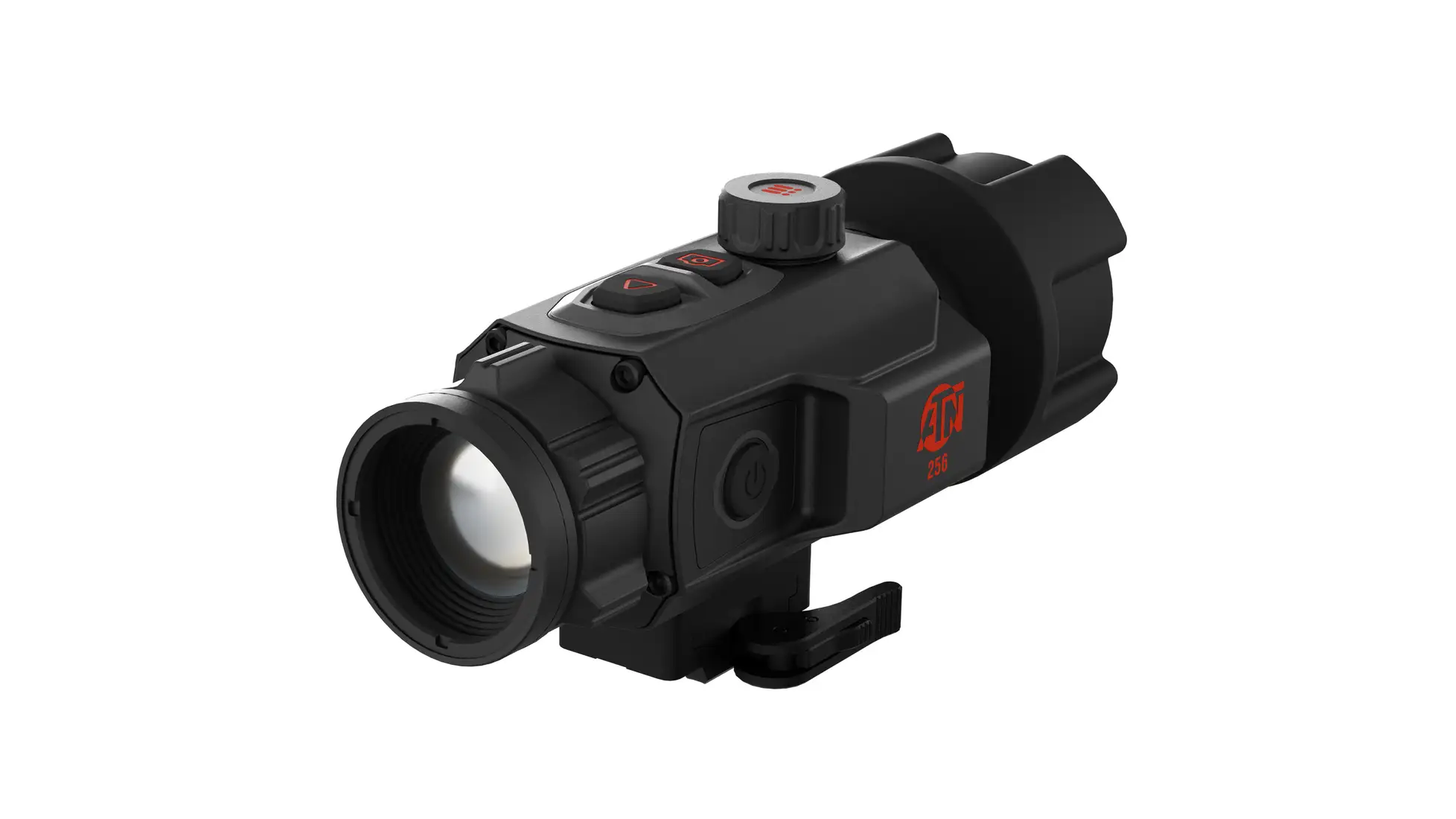
Best value: ATN TICO 6 1x25mm
1x · 256x192 sensor · 25mm germanium lens · 20 mK NETD · 50 Hz · 800x600 OLED · SharpIR image processing · Hot Point Tracking · QD mount · 2x 18650, about 8 hr total · IP67 · magnesium alloy · 17.9 oz
around $1,000exact price on OpticsPlanet
This is the clip-on for the hunter who wants thermal on the rifle they already own without spending four thousand dollars. It costs roughly a quarter of what the flagship above does, and it does the same core job: it clips in front of your day scope, so you keep your reticle and your zero, and it comes off for daylight. The trade is the sensor. Its 256x192 core is a quarter of the SIG's pixel count, so the image is coarser and usable identification distance is meaningfully shorter, which is exactly what the price difference buys. What you do get is a light, sealed and genuinely practical unit: 17.9 oz in a magnesium-alloy IP67 body, about 8 hours of runtime from two 18650 batteries (ATN rates 4 hours per battery), 20 mK sensitivity, ATN's SharpIR processing and Hot Point Tracking to flag the warmest object in frame. Four of the eight OpticsPlanet reviewers call it lightweight, two say it does not upset rifle balance, and one describes moving it between rifles in about 20 seconds. Read the owner record with your eyes open, though: it is early and thin, eight reviews, seven five-star and one four-star.
Pros
- By far the cheapest true clip-on here, roughly a quarter of the price of the premium pick, so thermal on your existing scope stops being a $4,000 decision
- Light and well sealed: 17.9 oz in a magnesium-alloy IP67 housing with a quick-detach mount; two reviewers say it does not upset rifle balance and one reports 20-second swaps between rifles
- About 8 hours of runtime from the two included 18650 batteries (4 hours each, ATN's rating), with a battery charger, carrying bag and remote control in the box per ATN's accessory list
- 20 mK NETD sensitivity with SharpIR image processing and Hot Point Tracking, which flags the warmest object in the frame
Cons
- The 256x192 sensor is the real compromise: a quarter of the SIG's pixels, so the image is coarser and usable identification range is markedly shorter
- The owner record is thin: eight reviews, the oldest from February 2026, seven five-star and one four-star whose writer's biggest complaint is the separately sold eyepiece, so there is no long-term durability track record yet
- The eyepiece needed to use it handheld is sold separately, an extra cost one reviewer calls out, and the same reviewer calls the manual "ok" and asks for a video walkthrough
- No laser rangefinder, the same gap as the SIG, and the 1x optic gives no magnification of its own: your day scope supplies all of it
Best for: the predator, hog or varmint hunter who wants real clip-on thermal on an existing day scope for close-to-moderate range work and cannot justify $4,000, and who accepts a coarser image for the saving. Step up to the SIG ECHO CV25 if you need a 640x512 image, a proven record and a lifetime warranty.
Key specifications
| Configuration | Clip-on, 1x (mounts ahead of your day optic) |
|---|---|
| Sensor resolution | 256x192 pixels |
| Objective | 25 mm germanium |
| NETD | 20 mK |
| Refresh rate | 50 Hz |
| Display | 800x600 OLED |
| Field of view | 7 to 5.3 degrees |
| Detection range | Up to 1,500 m (ATN rated; detection, not identification) |
| Rangefinder | None |
| Mount | Quick-detach |
| Battery | 18650 rechargeable x2, about 8 hr total (4 hr each, ATN) |
| Sealing | IP67, magnesium alloy |
| Weight / length | 17.9 oz / 6.25 in |
| In the box | Two 18650 batteries, battery charger, cable, portable bag, remote control, mount, rubber adapter, manual (ATN list, abridged) |
“The clip-on design makes it easy to pair with my existing optic without having to re-zero constantly ... I like how lightweight and compact it is ... For a budget-friendly thermal clip-on, it delivers reliable performance and good usability where it matters most.”
Daniel P. (TX) via OpticsPlanet
How to choose a thermal clip-on
A clip-on adds a few decisions a normal thermal scope does not:
- Lens size sets range; sensor resolution sets detail. A 25mm lens (SIG) keeps the unit short but caps identification range; a bigger 50mm lens reaches and resolves farther, at the cost of length and rail space. Read both numbers, and treat the "detection range" as a best case, not an identification range.
- Match it to your day scope's magnification. A clip-on projects pixels that your day scope then magnifies, so the image is cleanest at low host magnification, and the more you zoom in, the more visible the individual pixels become. Maker ratings differ: ATN lists 1-8x as the optimal day scope range for the 256 TICO 6, 1-12x for the 384 and 1-15x for the 640, so check your clip-on maker's figure against your scope.
- Zero retention is everything. The value of a clip-on is keeping your day zero, so a repeatable quick-disconnect mount and a way to fine-tune the optical alignment (the SIG's app-based digital collimation) matter more than a spec sheet. Always reconfirm zero after first mounting.
- Neither has a rangefinder. Thermal flattens depth, so plan to carry a handheld laser rangefinder if exact distance matters, especially for subsonic loads.
- Warranty is real money here. A $4,000 thermal is a fragile camera under recoil. SIG's unlimited lifetime Infinite Guarantee is a genuine advantage over the category's usual 3-to-5-year coverage.
Prefer a weapon-mounted optic with its own reticle instead of a clip-on? See our best thermal scopes and best thermal monoculars. Want a micro thermal sight on an RMR footprint? Read our InfiTac Fast Mini FMP13 review, or for the higher-resolution 384x288 version, our InfiTac FML19 review. Deciding between the technologies? Read thermal vs night vision. Hunting a specific way? See best thermal scope for coyote hunting. Weighing the three ATN TICO 6 sensors? Our ATN TICO 6 review compares the 256, 384 and 640 versions and the day scope ATN pairs each with.
FAQ
What is a thermal clip-on?
A thermal clip-on mounts in front of your existing daytime rifle scope or red dot, rather than replacing it. It has no reticle of its own: you keep looking through your day optic and aim with its reticle, while the clip-on projects a 1x thermal image into the front of that scope. The point is that you keep your normal cheek weld, your familiar reticle and, critically, your day scope's mechanical zero, then remove the clip-on for daytime use. A dedicated thermal scope, by contrast, replaces the day optic entirely and has its own reticle.
Does a thermal clip-on keep my rifle's zero?
That is the whole design goal, and it depends on the mount and on collimation. A quality quick-disconnect mount (the SIG ECHO CV25 uses a self-tensioning Bobro QD) returns to the same position every time so clipping on and off does not move your point of impact. Manufacturing tolerances between scope, rail and clip-on can still cause a small optical offset, which is why the CV25 lets you digitally shift the thermal image in the BDX app to line it up with your day reticle, no shims or turret changes. Always confirm zero at the range after first mounting.
How far can the SIG ECHO CV25 see?
Separate detection from identification. The CV25 can detect a heat signature, a hot blob on the screen, out toward its rated 1,000 yards, but its 25mm lens realistically lets you identify what the animal is only within about 150 to 250 yards. That makes it an excellent close-to-medium-range tool for coyotes and hogs, and the wrong choice if you need to positively identify targets at long range. A bigger 50mm lens identifies farther out, but no current clip-on we can recommend carries one.
What is the cheapest thermal clip-on worth buying?
The ATN TICO 6 is the cheapest true clip-on we would recommend, at roughly a quarter of the price of the flagship pick. It does the same core job, mounting ahead of your day scope so you keep your reticle and zero, in a light 17.9 oz IP67 body with about 8 hours of runtime from two 18650 batteries. The compromise is image quality: its 256x192 sensor is a quarter of the SIG ECHO CV25's pixel count, so the picture is coarser and you can identify what you are looking at over a markedly shorter distance. Be aware its owner record is still thin, eight OpticsPlanet reviews, all from 2026. Watch out for cheaper thermal units advertised as clip-ons that actually have their own reticle and mount like a red dot: those are standalone thermal sights, not clip-ons.
Do thermal clip-ons have a laser rangefinder?
Neither pick here does, and that is a real limitation. Thermal imaging flattens depth perception because it renders heat, not light and shadow, so a 50-yard animal can look much like a 150-yard one. Without a built-in rangefinder you are estimating distance in the dark, which matters most for subsonic loads where a 25-yard error is a miss. If exact range is critical to you, plan to carry a separate handheld rangefinder.
Is a thermal clip-on better than a dedicated thermal scope?
It depends on how you shoot. A clip-on lets one rifle stay a daytime precision rifle and become a thermal rig in seconds without giving up your day scope, its glass or its zero, which is ideal if you already run a good LPVO. A dedicated thermal scope is usually cheaper for the same sensor, is purpose-built with its own reticle and ballistic tools, and is simpler, but it lives on the rifle full time. If you want one rifle that does both day and night, choose a clip-on; if the rifle is a dedicated night gun, a thermal scope is the better value.
Related: best thermal scopes · best thermal binoculars · best thermal monoculars · thermal vs night vision.