The best budget thermal scope
Quick answer: the AGM RattlerV2 25-256 (around $800) is the budget thermal to buy. Against the cheaper 19-256 (around $700) it trades the wider view for reach: a 25mm lens at a 3.5x base and an AGM-rated detection range of 1250 yards against 950. Against the sharper 25-320 (around $1,000) it keeps an 11.5-hour battery rating against 6.5 hours, the quick-detach mount in the box, and 33 owner reviews against one. Pick the 19-256 if you mainly scan for heat at close range: its 49-foot view at 100 yards is the widest here and it is the lightest at 1.06 lb. Pick the 25-320 if image detail matters more than run time. Up to $2,000, the 35-384 (around $1,600) has the most pixels here at 384x288, and the ATN Thor LTV (around $1,750) is the one that mounts in standard 30mm rings, with a 60 Hz refresh. There is nothing worth buying under $500, and we explain why below.
Budget in thermal stretches from a retailer catalogue floor of more than $600 up to the $2,000 mark, and the answer changes at each step, so this guide is organised by ceiling. Pick your number and read that tier. Above $2,000, the 640 and 1280 resolution scopes with built-in rangefinders are ranked in our best thermal scope guide.
How we reviewed them: a research-based roundup built from the retailer's spec tables, the makers' published ratings and the owner-review record. We have not used these scopes ourselves. Prices verified October 14, 2026 on the OpticsPlanet product pages; confirm the current price and availability on the retailer page. Scores are our editorial opinion; owner ratings are shown attributed. See how we evaluate.
All 5 budget thermal scopes compared
| Pick | Price | Sensor | NETD | Lens, magnification | Refresh | Detection range | Battery | Recording | Weight |
|---|---|---|---|---|---|---|---|---|---|
| RattlerV2 25-256 | around $800 | 256x192 | 35 mK | 25 mm, 3.5-28x | 50 Hz | Up to 1250 yd (AGM rated) | 11.5 hr, 2 included | Video and audio, shot-activated | 1.08 lb |
| RattlerV2 19-256 | around $700 | 256x192 | 35 mK | 19 mm, 2.5-20x | 50 Hz | Up to 950 yd (AGM rated; retailer table: 950 m) | 11.5 hr, 2 included | Video and audio, shot-activated | 1.06 lb |
| RattlerV2 25-320 | around $1,000 | 320x256 (12-micron) | sub-20 mK (AGM rated) | 25 mm, 3.5-28x | 50 Hz | Not published | 6.5 hr, 2 included (AGM) | Video and audio, shot-activated | 1.08 lb |
| RattlerV2 35-384 | around $1,600 | 384x288 | 20 mK (sub-20) | 35 mm, 3-24x | 50 Hz | Up to 1800 yd (AGM rated) | 11 hr, 2 included | Video and audio, shot-activated | 1.13 lb |
| ATN Thor LTV 5-15x | around $1,750 | 320x240 | Not published | 35 mm, 5-15x | 60 Hz | Up to 1510 m (ATN rated) | 9 hr, 2 included | Video to microSD | 1.4 lb |
NETD is the sensitivity rating: the lower the number, the more cleanly a warm animal separates from a warm background. Detection ranges are the makers' own ratings and are not comparable to identification range. The retailer's spec tables print 1200 m of detection for the 25-256, 25-320 and 35-384 alike while AGM rates two of them at 1250 and 1800 yards, so we use AGM's figures and leave the 25-320 blank. For the 19-256 the retailer table prints 950 m where AGM says 950 yards. ATN does not publish an NETD figure for the Thor LTV in our source.
Best under $1,000
Both picks share a 256x192 sensor at 50 Hz, a 35 mK sensitivity rating, two rechargeable batteries rated for 11.5 hours and the ADM quick-detach mount. The choice between them is lens: 25mm at a 3.5x base for reach, or 19mm at a 2.5x base for the widest view.
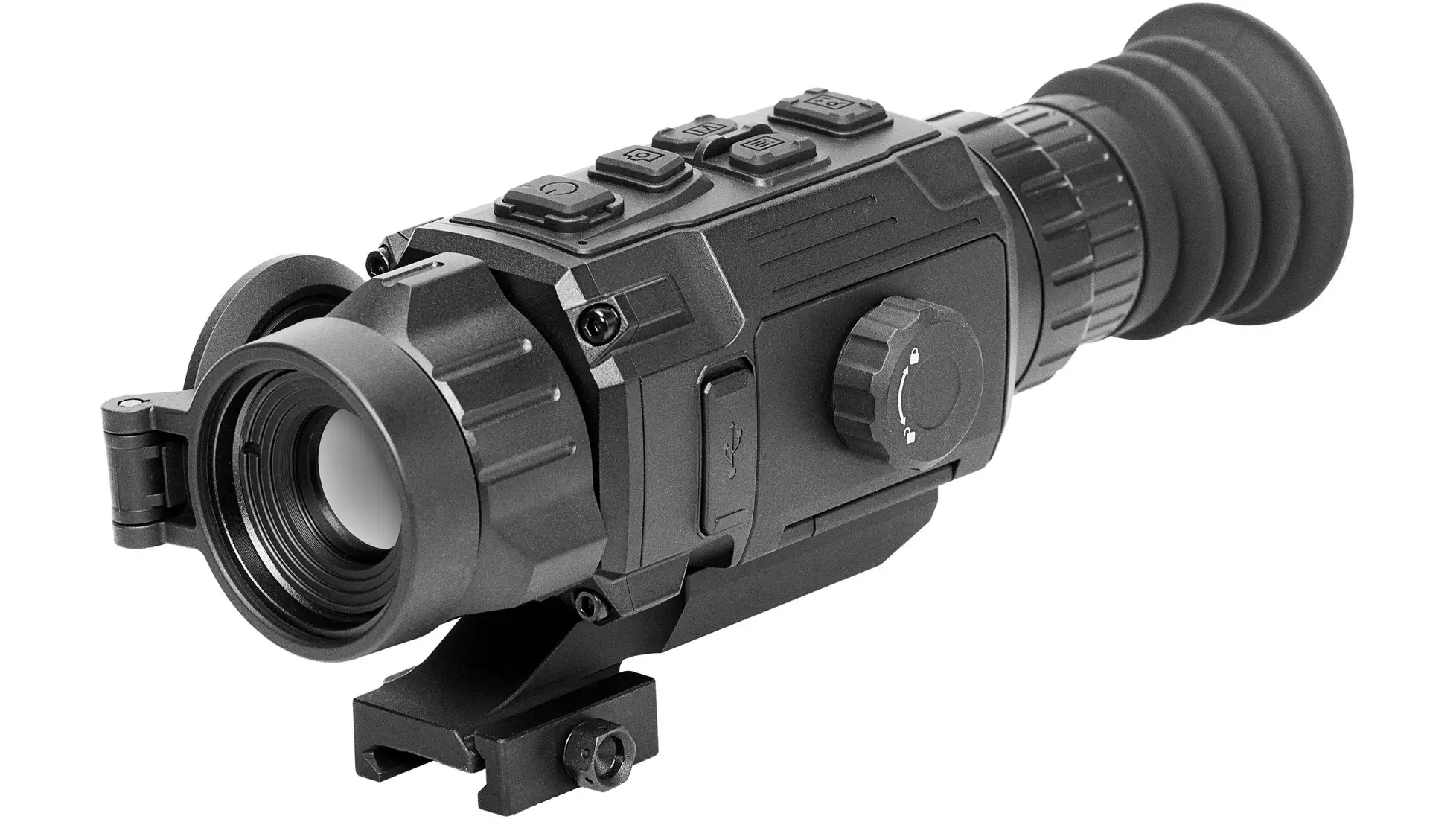
Best value: AGM RattlerV2 25-256 25mm
3.5-28x · 25mm germanium lens · 256x192 sensor · 35 mK NETD · 50 Hz · 10 reticles · QD mount · Wi-Fi app · 11.5 hr rechargeable
around $800exact price on OpticsPlanet
The budget thermal most buyers should start with. It pairs a 256x192 sensor and a 50 Hz refresh with a 25mm germanium lens at a 3.5x base, and AGM rates its detection to 1250 yards against 950 for the 19-256. Against the sharper 25-320 it keeps what matters on a long night: an 11.5-hour battery rating against 6.5 hours, and the ADM quick-detach mount in the box, which the 25-320 listing does not show. It also has the deepest owner record on this page, 4.8/5 from 33 reviews, and one owner calls it suited to hogs and coyotes within 200 to 300 yards.
Pros
- Under $1,000 with a 256x192 sensor and a 50 Hz refresh rate, double the 25 Hz of the original Rattler it replaces
- One owner calls it "a working man's thermal for the money", and another calls it "perfectly suited for hunting hogs/coyotes within 200-300 yards"
- Two rechargeable batteries (11.5 hours), a quick-detach mount that holds zero, and a case are all in the box
- The most-reviewed pick here at 4.8/5 across 33 owners, plus 10 reticles, zero profiles and a Wi-Fi app
Cons
- The 256x192 sensor gets grainy as you climb past the 3.5x base into digital zoom, an honest owner note
- The 3.5x base magnification is a little high for walking and scanning, where the wider 19-256 is easier
- Not built for long-range night work; owners keep shots inside about 300 yards
- A proprietary rechargeable battery, so you carry spares rather than buying cells in the field
Best for: a first thermal for night hog and coyote hunting inside about 300 yards. Take the 19-256 if you mostly scan for heat, or the 25-320 if image detail matters more than run time.
Key specifications
| Manufacturer | AGM Global Vision |
|---|---|
| Magnification | 3.5-28x (3.5x base, digital zoom) |
| Objective | 25 mm germanium |
| Sensor resolution | 256x192 pixels |
| NETD | 35 mK |
| Refresh rate | 50 Hz |
| Detection range | Up to 1250 yd (AGM rated) |
| Battery | Lithium-ion rechargeable, 11.5 hr, x2 included |
| Mount | Custom ADM quick-detach |
| Weight | 1.08 lb |
| Warranty | AGM manufacturer warranty |
“Twice as good as the original 25/256 for the same price. Battery life is great, image quality is significantly better than the original, and all of the features are an improvement. This thermal is perfectly suited for hunting hogs/coyotes within 200-300 yards.”
Verified owner (OK) via OpticsPlanet
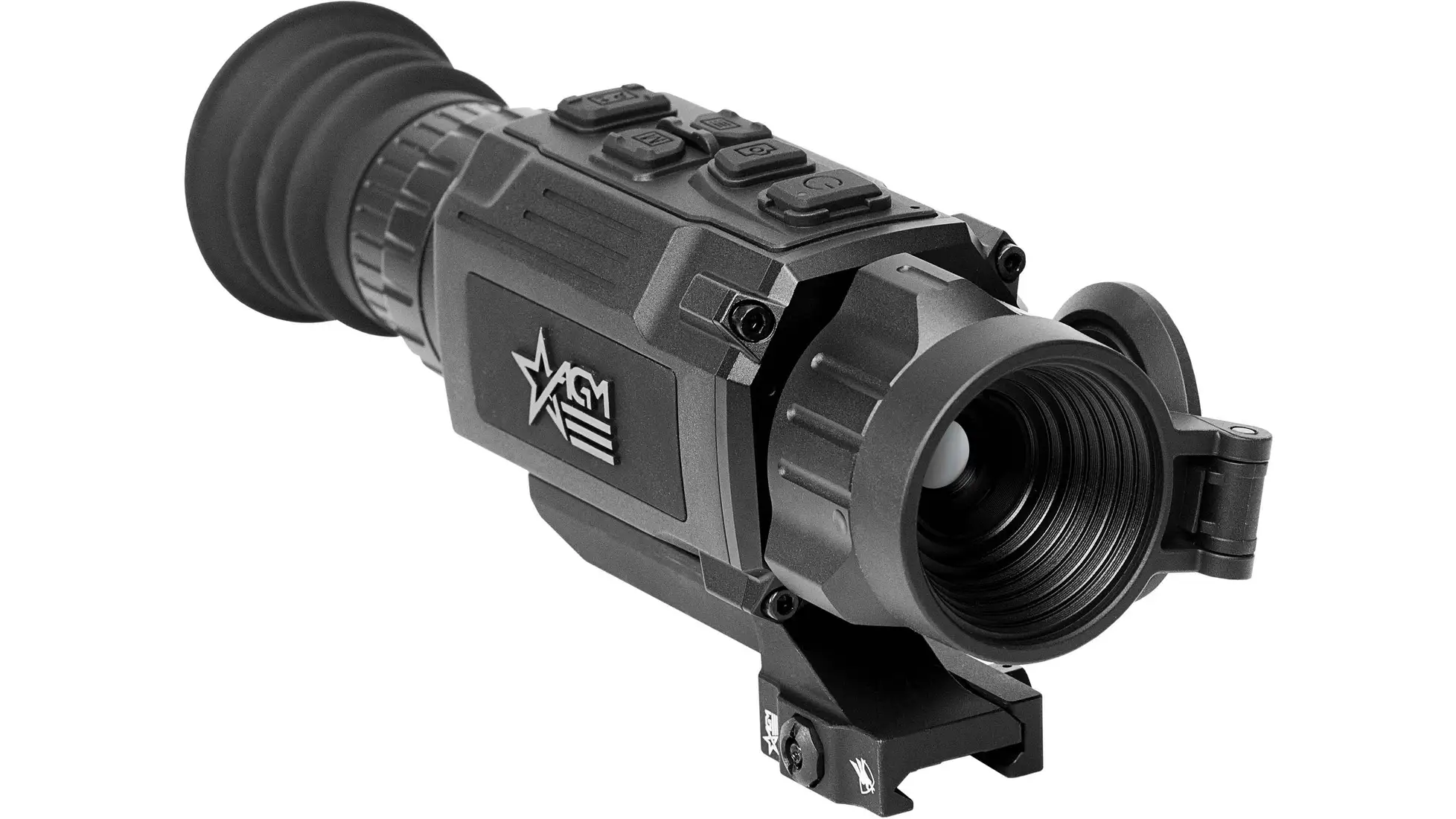
Cheapest and best scanner: AGM RattlerV2 19-256 19mm
2.5-20x · 19mm germanium lens · 256x192 sensor · 35 mK NETD · 50 Hz · wide 49 ft FOV · IP67 · QD mount · 11.5 hr rechargeable
around $700exact price on OpticsPlanet
The cheapest way into thermal on this page and the best scanner. It shares the 256x192 sensor, 35 mK rating and 50 Hz refresh of the 25-256 but uses a 19mm lens at a 2.5x base, which gives the widest view here: 49 feet at 100 yards, against 37 feet for the 25-256 and 40 feet for the 35-384. At 1.06 lb it is also the lightest pick, and it still ships with two batteries, the quick-detach mount and an IP67 rating. The cost is reach: AGM rates detection to 950 yards, and one owner finds details hard to make out past 100 yards.
Pros
- The lowest price here, the honest entry point into thermal
- The widest field of view of any pick here (49 feet at 100 yards) and the lowest 2.5x base magnification, so it is the best scanner and buddy scope
- Owners rate its image as good as or better than an ATN Thor 4 and praise it for never glitching
- Two rechargeable batteries, a quick-detach mount and an IP67 weather rating; at 1.06 lb the lightest pick
Cons
- The 19mm lens and 256x192 sensor limit usable range; one owner finds details hard to make out past 100 yards
- Best for close-range and scanning, not long-range night shooting
- Magnification above 2.5x is digital zoom, so it softens as you zoom in
Best for: a scanner, a buddy scope or close-range hog and varmint work inside about 150 yards. Step up to the 25-256 for more reach once you have found the animal.
Key specifications
| Manufacturer | AGM Global Vision |
|---|---|
| Magnification | 2.5-20x (2.5x base, digital zoom) |
| Objective | 19 mm germanium |
| Sensor resolution | 256x192 pixels |
| NETD | 35 mK |
| Refresh rate | 50 Hz |
| Field of view | 49 ft at 100 yd (widest here) |
| Battery | Lithium-ion rechargeable, 11.5 hr, x2 included |
| Sealing | IP67 waterproof |
| Weight | 1.06 lb |
| Warranty | AGM manufacturer warranty |
“This is a nice entry level thermal scope. It has high screen resolution, good refresh rate. It has as good or better image quality as a Thor 4. It has never glitched. Return to zero mount and all accessories are included in a nice carry case. It is no wonder these are some of the highest rated thermals for entry level units.”
Myles Smith, verified owner (AR) via OpticsPlanet
Best under $1,500
Stepping up from the 25-256 buys one thing on this family, and it is the thing that matters most at night: sensor. The 25-320 is the same 25mm body, the same 3.5-28x, the same 1.08 lb and the same 50 Hz as the 25-256, with a 320x256 sensor in place of 256x192 and a sub-20 mK sensitivity rating in place of 35 mK. Its price has moved around the $1,000 line, so check it even if your ceiling is lower.
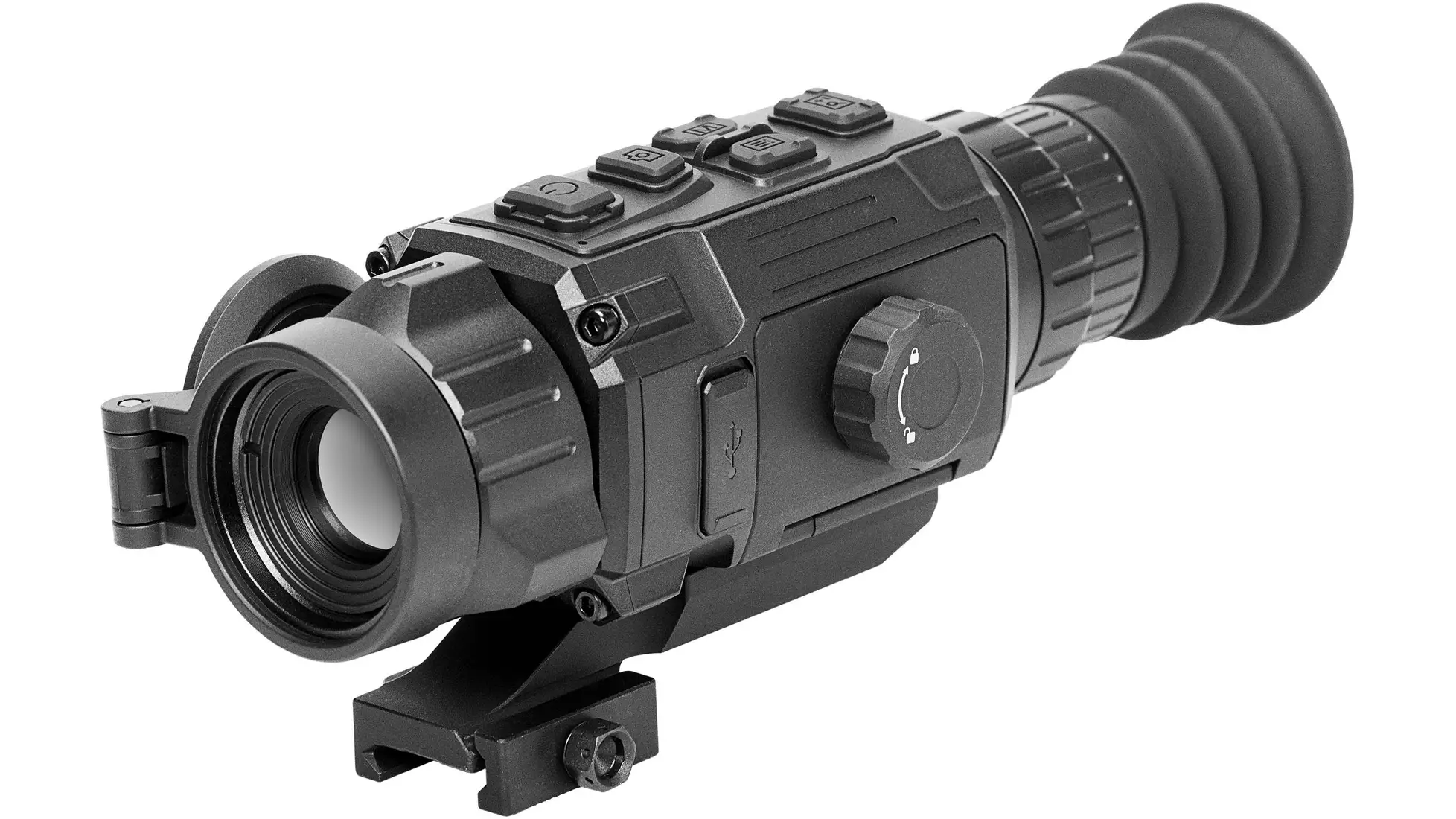
Best image under $1,500: AGM RattlerV2 25-320
3.5-28x · 25mm lens · 320x256 sensor (12-micron) · sub-20 mK NETD · 50 Hz · 1024x768 OLED display · 16 GB storage · 6.5 hr rechargeable
around $1,000exact price on OpticsPlanet
The same 25mm lens, 3.5-28x range, 1.08 lb weight and 50 Hz refresh as the 25-256, with the sensor changed: 320x256 pixels at a 12-micron pitch and an AGM-rated sub-20 mK sensitivity, against 256x192 and 35 mK on the 25-256. It adds a 1024x768 OLED display and 16 GB of onboard storage, and keeps Shot Activated Recording and Wi-Fi. Two things go the other way. AGM rates the battery at 6.5 hours against 11.5 (AGM says two batteries are included), and the listing shows the riflescope alone in the package contents, so confirm the mount before you order. It is also new enough to carry a single customer review, so its track record is the 25-256 chassis, not its own.
Pros
- A 320x256 sensor with a 12-micron pixel pitch and an AGM-rated sub-20 mK sensitivity, the sharpest image under $1,500 here
- The same 25mm lens, 3.5-28x range, 1.08 lb weight and 50 Hz refresh as the 25-256, so the upgrade is purely the sensor
- A 1024x768 OLED display, 16 GB of onboard storage, Shot Activated Recording and Wi-Fi
Cons
- Rated for 6.5 hours of battery life against the 11.5 hours AGM claims for the 25-256
- Almost no owner record yet: one customer review at our last check
- The listing shows the riflescope alone in the package contents, so confirm the mount before you order
Best for: buyers who want more image than the 25-256 without leaving the RattlerV2 body. If you want proven-in-the-field over newest, the 25-256 is the safer buy.
Key specifications
| Manufacturer | AGM Global Vision |
|---|---|
| Magnification | 3.5-28x |
| Objective | 25 mm |
| Sensor resolution | 320x256 pixels (12-micron) |
| NETD | sub-20 mK (AGM rated) |
| Refresh rate | 50 Hz |
| Display | 1024x768 OLED |
| Field of view | 37-28 ft at 100 yd |
| Battery | Lithium-ion rechargeable, 6.5 hr, 2 included (AGM) |
| Storage | 16 GB onboard |
| Sealing | IP67 |
| Weight | 1.08 lb |
Best under $2,000
The last budget step, and the two picks here answer different questions: the 35-384 for the most pixels on the animal, the Thor LTV for standard 30mm rings and a 60 Hz refresh. Above this price, the 640 and 1280 resolution scopes with built-in rangefinders are ranked in our best thermal scope guide.
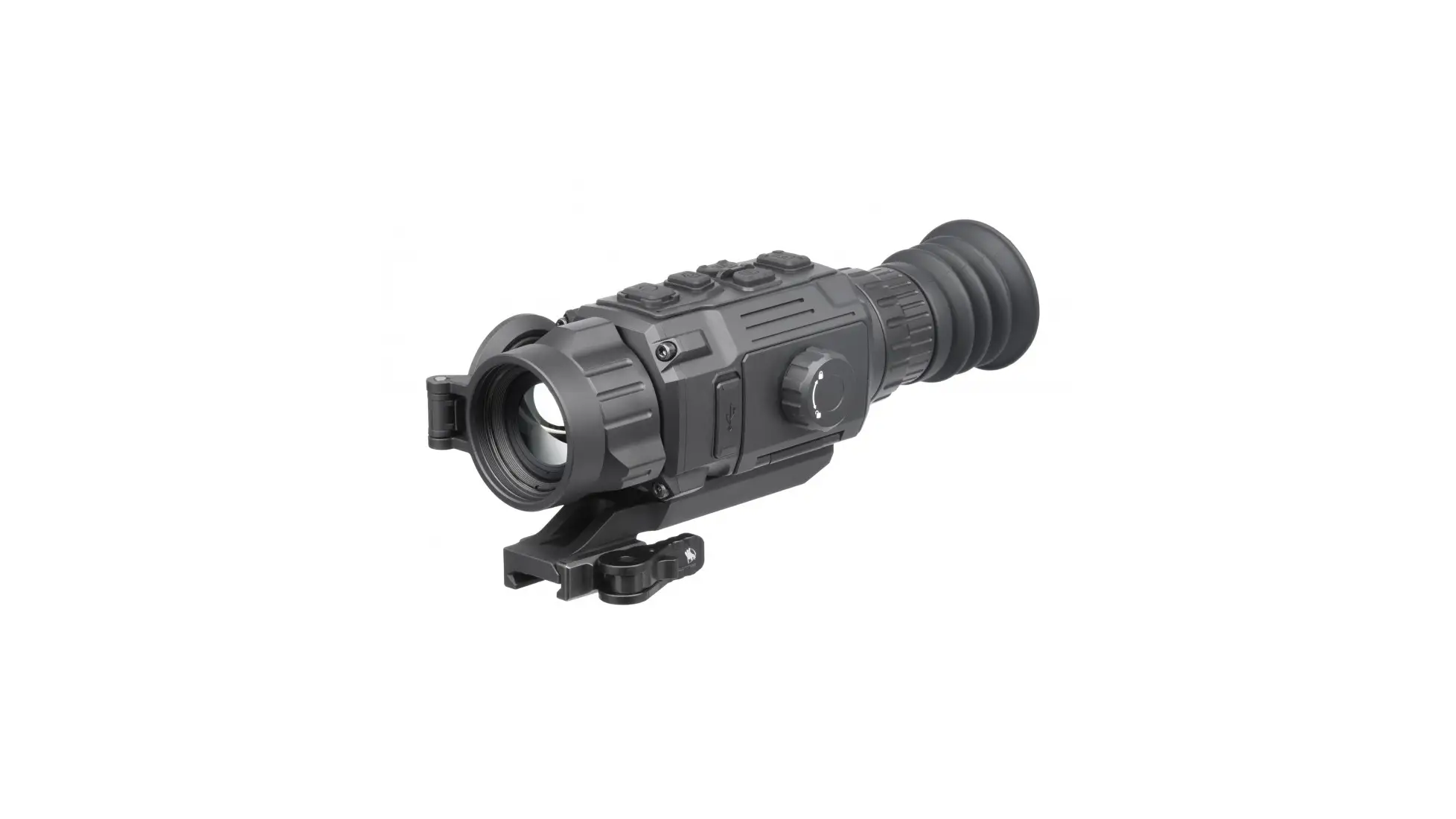
Best image under $2,000: AGM RattlerV2 35-384 3-24x35mm
3-24x · 35mm germanium lens · 384x288 sensor · sub-20 mK NETD · 50 Hz · 10 reticles · QD mount · Wi-Fi app · 11 hr rechargeable
around $1,600exact price on OpticsPlanet
The image pick. A 384x288 sensor with a 20 mK (sub-20) NETD rating behind a 35mm germanium lens puts more pixels on the animal than any other scope on this page, and AGM rates its detection to 1800 yards. It keeps the full RattlerV2 package: the ADM quick-detach mount, two batteries rated for 11 hours, ten reticles, shot-activated recording and a Wi-Fi app. Against the ATN Thor LTV in the same tier it resolves more; the Thor's case is mounting and refresh rate, not image.
Pros
- 384x288 resolution with a sub-20 mK NETD rating, for clearer target identification than the 256-resolution RattlerV2 models
- A 35mm germanium lens and 3x base magnification give real reach, with AGM-rated detection out to 1800 yards
- Ships complete: a custom ADM quick-detach mount that returns to zero, two rechargeable batteries (11 hours), a charger and a carry case
- 10 reticle options with multiple caliber zero profiles, shot-activated recording and a Wi-Fi app for a phone
Cons
- Priced well above the 256-resolution RattlerV2 models, the trade for the 384 sensor and higher magnification
- Magnification above the 3x base is digital zoom, so the image softens as you zoom in, as with all scopes in this class
- The proprietary lithium-ion battery has no AA or CR123 fallback, so you carry spares rather than buying cells in the field
- The 3x base magnification gives a narrower field of view than the 19-256, so it is a shooter first and a wide scanner second
Best for: hunters who keep failing to identify animals at distance with a 256x192 scope. If you mainly scan, the 19-256 has the wider view.
Key specifications
| Manufacturer | AGM Global Vision |
|---|---|
| Magnification | 3-24x (3x base, digital zoom) |
| Objective | 35 mm germanium |
| Sensor resolution | 384x288 pixels |
| NETD | 20 mK (sub-20) |
| Refresh rate | 50 Hz |
| Detection range | Up to 1800 yd (AGM rated) |
| Battery | Lithium-ion rechargeable, 11 hr, x2 included |
| Mount | Custom ADM quick-detach |
| Weight | 1.13 lb |
| Warranty | AGM manufacturer warranty |
“The AGM rattler v2 is a very nice scope for the money. I had been looking at several different options and decided on the rattler v2 because of the options it has, the convenience of the large buttons on top, and the price range. I like this scope so much I will definitely be purchasing another one for my next setup.”
T.J., verified owner (IA) via OpticsPlanet
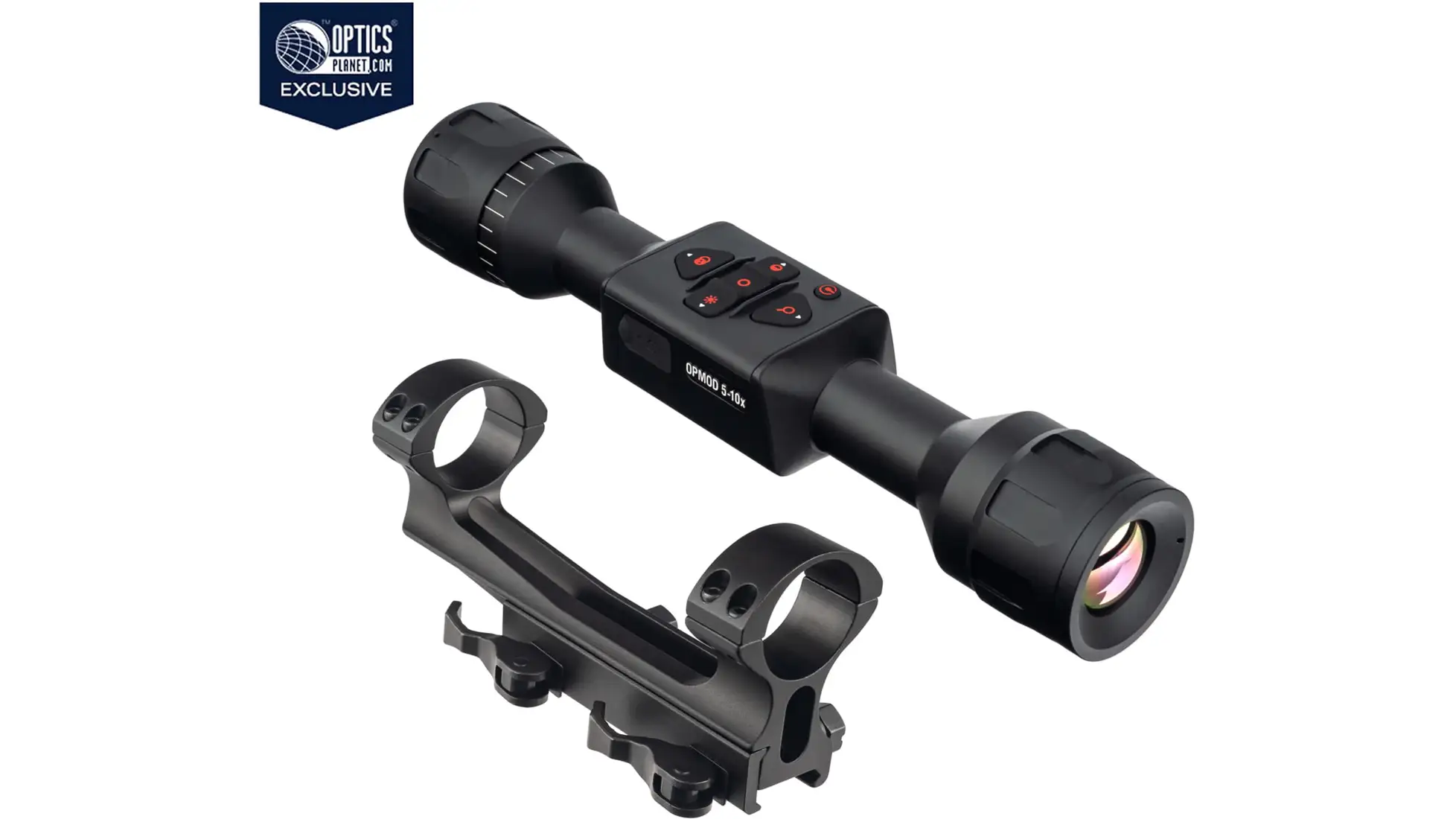
Most rifles fit it: ATN Thor LTV 5-15x Gen 5
5-15x · 35mm objective · 320x240 sensor · 60 Hz · 90mm eye relief · standard 30mm rings · onboard video · IP67 · 9 hr rechargeable
around $1,750exact price on OpticsPlanet
The pick if you want out of the AGM ecosystem. Standard 30mm rings instead of a proprietary mount and a 90mm eye relief mean it goes on almost any rifle, crossbow or air rifle. It also refreshes at 60 Hz, where the AGM picks run 50 Hz. It records video to a microSD card, carries a 3-year ATN warranty and has 31 owner reviews at 4.5/5. The trade is image: its 320x240 sensor resolves less than the 35-384's 384x288, and at 1.4 lb it is the heaviest pick here.
Pros
- A deep, long-term review base at 4.5/5 across 31 owners, including an owner who logged 65 pigs with it
- A faster 60 Hz refresh rate than the 50 Hz AGM picks, for smoother motion while scanning
- A very long 90mm eye relief and standard 30mm ring mounting, so it fits almost any rifle, crossbow or air rifle with no proprietary mount
- Records video to a microSD card, weighs in as the lightest of ATN's Thor line, and carries a 3-year ATN warranty
Cons
- The 320x240 sensor resolves less detail than the AGM RattlerV2 35-384's 384x288 at a similar price
- The heaviest pick here at 1.4 lb and 11.5 inches long
- Owners report needing high-rise rings or spacers for a comfortable cheek weld
- There is a learning curve; several owners needed time (or ATN's training) to get comfortable with the menu
Best for: hunters who want a thermal in standard 30mm rings on a rifle, crossbow or air rifle. If image detail decides it, the 35-384 resolves more.
Key specifications
| Manufacturer | ATN |
|---|---|
| Magnification | 5-15x |
| Objective | 35 mm |
| Sensor resolution | 320x240 pixels |
| Display | 1280x720 |
| Refresh rate | 60 Hz |
| Eye relief | 90 mm |
| Detection range | Up to 1510 m (ATN rated) |
| Battery | Lithium-ion rechargeable, 9 hr, x2 included |
| Mount | Standard 30 mm riflescope rings |
| Sealing | IP67 waterproof |
| Weight | 1.4 lb |
| Warranty | ATN 3-year |
“This scope has been excellent, it really makes the pigs pop out in total darkness way better than night vision. I have killed 65 pigs since I got it. Another thing I like is there is no white out like night vision so you have a chance to make several kills. This scope is so simple to use, not too much BS like my night vision had. The battery life is awesome, I have only charged it three times since I started using it.”
Hbankst, verified owner (MS) via OpticsPlanet
Why there is nothing under $500
It is one of the most common searches in this category, so it deserves a straight answer rather than a page of picks that quietly ignores it. We read the retailer's entire thermal rifle scope catalogue, 244 products at our last check: the cheapest thermal rifle scope of any kind costs more than $600, and there is nothing under $500 at all. That is where the category starts, not a gap we overlooked.
If your ceiling is genuinely under $500, a thermal monocular for scanning is the honest alternative to a rifle scope you would regret.
What to weigh in a budget thermal
- Sensor resolution. The picks here run from 256x192 (19-256, 25-256) through 320x240 (Thor LTV) and 320x256 (25-320) to 384x288 (35-384). More pixels identify an animal farther out and hold up better under digital zoom, which is where owners of the 256x192 models report the image getting grainy.
- Sensitivity (NETD). The 256x192 RattlerV2 models are rated at 35 mK; the 25-320 and 35-384 at sub-20 mK. Lower separates a warm animal from a warm background more cleanly.
- Base magnification and field of view. The 19-256 starts at 2.5x with a 49-foot view at 100 yards; the 25-256 at 3.5x with 37 feet; the 35-384 at 3x with 40 feet. Low base magnification is for finding heat, higher for identifying it.
- What is in the box. The 19-256, 25-256 and 35-384 include two batteries and the ADM quick-detach mount. The 25-320 listing shows the riflescope alone in the package contents; AGM says two batteries are included. The Thor LTV takes standard 30mm rings and includes two batteries rated for 9 hours.
- Refresh rate. The RattlerV2 models run 50 Hz, double the 25 Hz of the original Rattler; the Thor LTV runs 60 Hz.
For 640 and 1280 resolution and built-in rangefinders, see our best thermal scope guide, or the best thermal scope for coyote hunting.
FAQ
What is the best budget thermal scope?
For most buyers, the AGM RattlerV2 25-256: a 256x192 sensor at 50 Hz, an AGM-rated detection range of 1250 yards, two rechargeable batteries rated for 11.5 hours and a quick-detach mount in the box, and the deepest owner record here at 4.8 stars from 33 reviews. The RattlerV2 25-320 is the same scope body with a sharper 320x256 sensor and sub-20 mK sensitivity, and it is the model Outdoor Life picked as its top budget thermal, but it is rated for 6.5 hours of battery and has a single owner review so far. If you want the cheapest honest thermal, the RattlerV2 19-256 is the entry point and the best scanner.
What is the best thermal scope under $1,000?
The AGM RattlerV2 25-256, with the RattlerV2 19-256 at under $800 as the cheaper alternative. Both run a 256x192 sensor at 50 Hz and ship with two rechargeable batteries and a quick-detach mount. The difference is lens and base magnification: the 25-256 uses a 25mm lens at 3.5x for more reach once you have found the animal, while the 19-256 uses a 19mm lens at 2.5x for a 49-foot view at 100 yards, which makes it the better scanner. If your ceiling is a firm $1,000, check the sharper RattlerV2 25-320 as well, because its price has moved around that line. One 25-256 owner calls it suited to hogs and coyotes within 200 to 300 yards, not long-range night hunting.
What is the best thermal scope under $2,000?
Two, and they answer different questions. The AGM RattlerV2 35-384 is the image pick: a 384x288 sensor and a 35mm lens resolve more detail and reach than anything below it here, and AGM rates its detection to 1800 yards. The ATN Thor LTV 5-15x Gen 5 is the pick if you want out of the AGM ecosystem, with a 60 Hz refresh, a 90mm eye relief and standard 30mm rings so it mounts on almost any rifle, crossbow or air rifle. Be clear-eyed on the trade: its 320x240 sensor resolves less detail than the 35-384, so you are buying its mounting and feature set, not the sharpest image.
How cheap can a usable thermal scope be?
At the retailer we send you to, the cheapest thermal rifle scope of any kind still costs more than $600, and the cheapest we are willing to recommend is the AGM RattlerV2 19-256 at under $800. We checked: there is no thermal rifle scope under $500 in that catalogue at all, so if you are searching for one, you are searching for a product category that does not really exist at this retailer rather than for a bargain you have not found yet. What the 19-256 gives up against the pricier picks is reach: a 19mm lens, an AGM-rated detection range of 950 yards, and one owner finds details hard to make out past 100 yards.
What do you give up with a budget thermal scope?
Against the 384x288 RattlerV2 35-384, the 256x192 picks put fewer pixels on the animal, so they identify game at shorter range and get grainier as you use digital zoom. They are also rated at 35 mK rather than sub-20 mK, which is how cleanly a warm animal separates from a warm background. What you keep is real thermal capability: one 25-256 owner calls it suited to hogs and coyotes within 200 to 300 yards, the quick-detach mount holds zero, and two rechargeable batteries are in the box. For most night hunting inside 300 yards, that is enough.
Is a 256x192 thermal scope good enough for hunting?
Yes, for the ranges most hunters actually shoot. One 25-256 owner calls it suited to hogs and coyotes within 200 to 300 yards, one 19-256 owner finds details hard to make out past 100 yards, and both 256x192 picks here are rated 4.8 stars or higher by their owners. Step up to a 320x256 or 384x288 sensor only if you regularly need to identify targets at longer range or want a cleaner image under digital zoom.
More: best thermal scopes overall · best thermal scope for coyote hunting · best rifle scopes.