Best image-stabilized binoculars in 2026
Our verdict for 2026: the Sig Sauer ZULU6 HDX OIS 12x42 (around $1,100) is the best image-stabilized binocular for most people, balancing reach and a steady handheld view. For maximum handheld magnification, step up to the ZULU6 OIS 16x42 (around $1,200); for the best waterproofing, the Kite APC 16x42 (around $1,400) is IPX-7 submersible. Want small and light, or a pocket pair for events? See the ZULU6 OIS 10x30 (around $1,000) and the Nikon STABILIZED 12x25 (around $700).
Image stabilization is what finally makes 12x and 16x usable in the hand, no tripod. Prices verified September 30, 2026; confirm the current price and availability on the retailer page.
Above about 10x, your own hand shake blurs the detail that magnification is supposed to give you. Image-stabilized binoculars cancel that shake electronically, so a 12x or 16x view snaps into focus in your hands, no tripod, no rest. It is the single biggest upgrade to high-power glassing, and it is why owners keep saying they stopped using their ordinary binoculars. Below are five picks, from the do-everything Sig ZULU6 12x42 to a pocketable Nikon for concerts and travel.
How these picks were made: a research-based roundup comparing published specifications, stabilization design, waterproof ratings, warranty terms, owner reviews and live pricing on OpticsPlanet (checked in the retailer's own product pages, via a real browser). Scores are our editorial opinion, not a hands-on test of every model, and owner ratings are shown attributed to their source. Confirm current price and stock on the retailer page. See how we evaluate.
- Sig Sauer ZULU6 HDX OIS 12x42 - Best overall
- Sig Sauer ZULU6 HDX OIS 16x42 - Best for maximum reach
- Kite Optics APC Stabilized 16x42 - Best premium (and best in wet weather)
- Sig Sauer ZULU6 HDX OIS 10x30 - Best compact and lightweight
- Nikon STABILIZED 12x25 S - Best for concerts, sports and travel
- How to choose image-stabilized binoculars
- FAQ
Quick comparison
| Category | Pick | Spec | Price | |
|---|---|---|---|---|
| Best overall | Sig Sauer ZULU6 HDX OIS 12x42 | 12x42 · 21.5 oz | around $1,100 | Check price |
| Best for maximum reach | Sig Sauer ZULU6 HDX OIS 16x42 | 16x42 · 20 oz | around $1,200 | Check price |
| Best premium (and best in wet weather) | Kite Optics APC Stabilized 16x42 | 16x42 · 735 g | around $1,400 | Check price |
| Best compact and lightweight | Sig Sauer ZULU6 HDX OIS 10x30 | 10x30 · 18.6 oz | around $1,000 | Check price |
| Best for concerts, sports and travel | Nikon STABILIZED 12x25 S | 12x25 · 13.9 oz | around $700 | Check price |
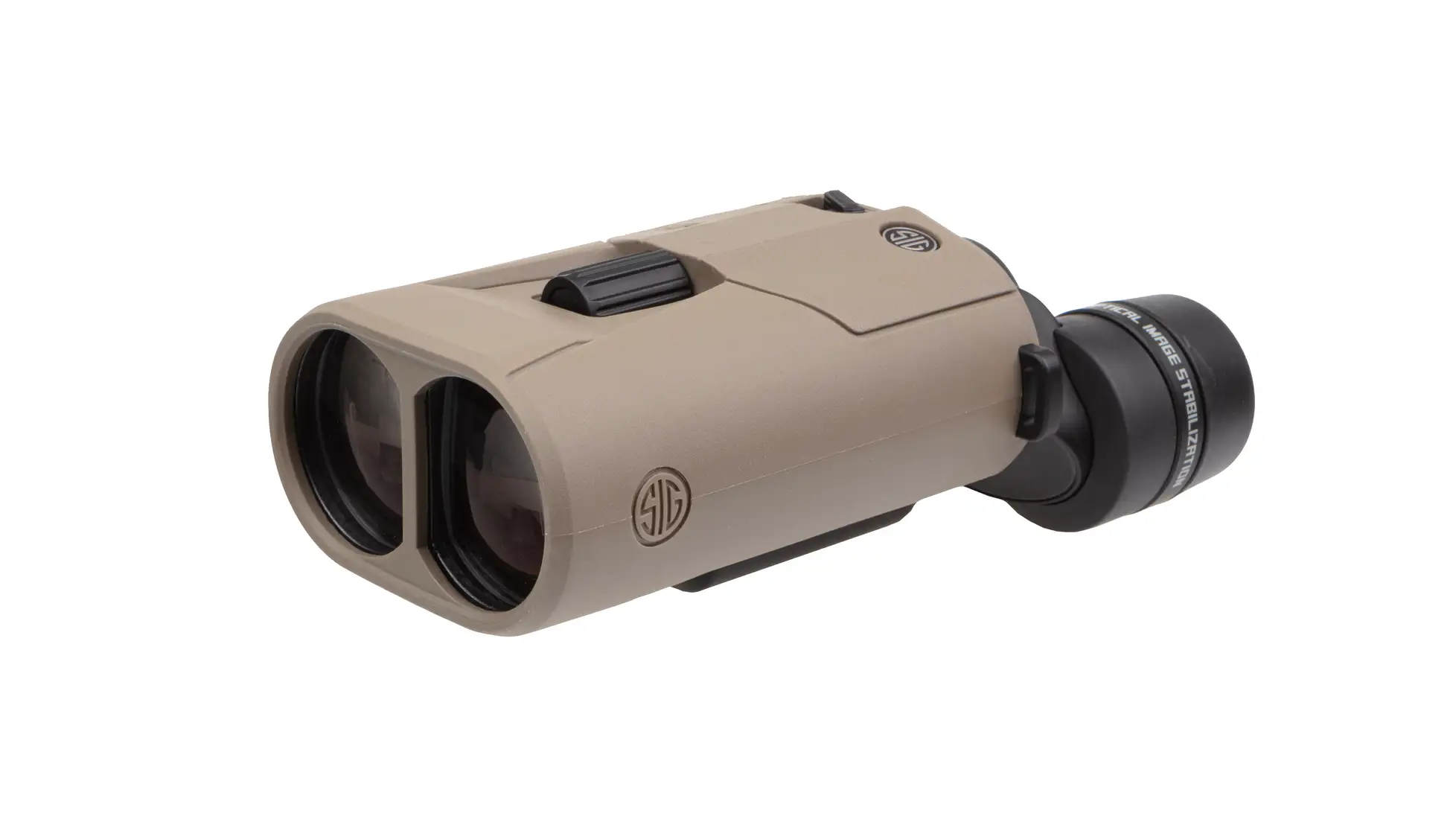
Best overall: Sig Sauer ZULU6 HDX OIS 12x42
Schmidt-Pechan · 12x42 · 2-axis gimbal OIS · HDX glass
around $1,100exact price on OpticsPlanet
If you buy one image-stabilized binocular, make it this one. At 12x the ZULU6 hits the sweet spot between reach and hand-holdability, and the 2-axis gimbal stabilization is genuinely transformative: owners describe glassing effectively while their heart is racing, breathing hard, standing with no rest, no tripod. The HDX glass is not alpha-tier (owners are candid it is not Swaro or Leica), but it holds up well against similarly priced non-stabilized glass from Leupold and Vortex, and the stabilization more than makes up the difference in what you can actually see. It is light at 21.5 oz, runs for months on a single AA, carries a generous 17 mm of eye relief, and is backed by the Sig Infinite Guarantee. Multiple owners sold pricier non-IS binoculars after trying it.
Pros
- 12x is the best all-round balance: enough reach, still hand-holdable with OIS on
- Stabilization lets you glass steadily out of breath, standing, one-handed, with no tripod
- Glass holds up against similarly priced non-stabilized Leupold and Vortex binoculars
- Light (21.5 oz), long single-AA battery life, generous 17 mm eye relief
- Sig Infinite Guarantee; owners routinely sell their non-IS binoculars after buying it
Cons
- Glass is good, not alpha: not Swarovski or Leica sharpness (expected at the price)
- Narrow field of view and a 3.5 mm exit pupil, so it is not a low-light champion
- Target mode adds stabilization but shows a little lag when panning quickly
- Included case and covers are basic (a common gripe across the ZULU6 line)
Best for: almost everyone who wants image stabilization: hunters, birders, boaters and general glassing where a steady 12x handheld view matters more than the last few percent of glass quality.
Key specifications
| Magnification | 12x |
|---|---|
| Objective lens | 42 mm |
| Prism | Schmidt-Pechan |
| Stabilization | 2-axis gimbal OIS, Scan + Target modes |
| Glass | HDX, Spectracoat |
| Eye relief | 17 mm |
| Exit pupil | 3.5 mm |
| Weight | 21.5 oz |
| Battery | Single AA |
| Sealing | IPX-4, fog resistant |
| Warranty | Sig Sauer Infinite Guarantee |
“...I expected the image stabilization to be excellent but the optics to be a bit lacking, given the features and price. Not so. The optics hold up well against similarly priced non-stabilized glass from Leupold, Vortex, etc... The OIS is incredibly useful, and allows you to glass effectively with your heart racing, breathing hard, standing... with no rest needed... Battery life is great as well...”
Jack, verified owner (WY) via OpticsPlanet
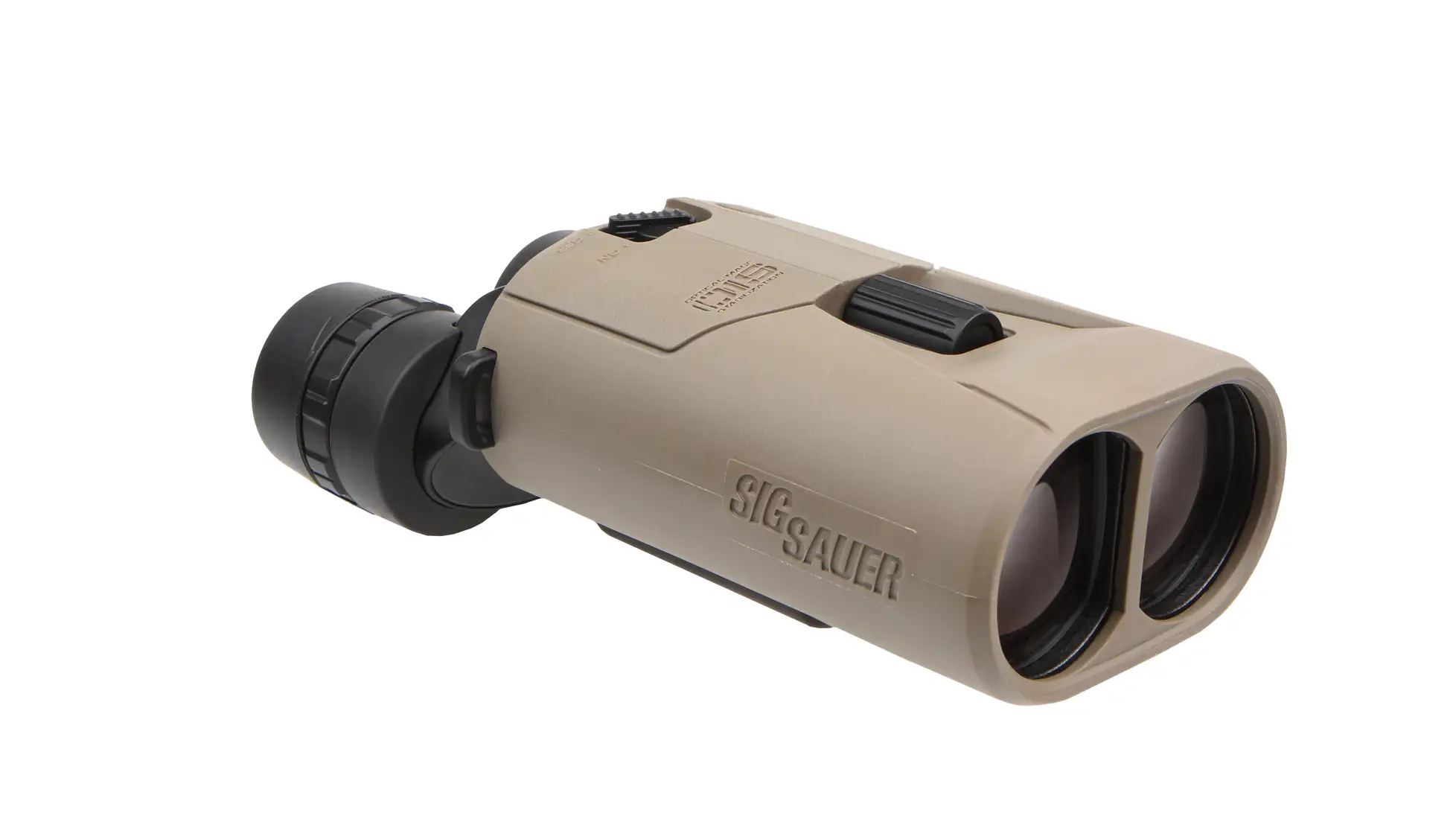
Best for maximum reach: Sig Sauer ZULU6 HDX OIS 16x42
Schmidt-Pechan · 16x42 · 2-axis gimbal OIS · HDX glass
around $1,200exact price on OpticsPlanet
This is the reason image stabilization exists: 16x is impossible to hold steady by hand, and the ZULU6 makes it usable. Owners glass one-handed, call rifle shots at 500 to 1,000 yards, even watch bullet trace, and competitive archers read scoring rings at distance from the shooting line. It replaces a spotting scope and tripod for a lot of people, saving around 8 lb in the pack. It is the same body and glass as the 12x42 with more magnification and a slightly shorter 14 mm eye relief, and the same honest caveats apply: good-not-alpha glass, and Sig skimps on the accessories. But for pure handheld reach, nothing else here touches it.
Pros
- 16x handheld is genuinely usable thanks to OIS: one-handed glassing, call shots to 1,000 yds
- Elite for competitive archery (reading scoring rings) and long-range spotting
- Replaces a spotter and tripod for many, saving ~8 lb of pack weight
- Compact and lighter than most Canon OIS binoculars; zero eye fatigue
Cons
- Poor included accessories: no lens covers, unattached easily-lost eye caps, basic case
- Ergonomic niggles: stiff eyepiece (IPD) adjustment, low-profile focus knob, small IS switch
- The stabilization can feel briefly disorienting or mildly motion-sick for a few users
- 14 mm eye relief and a narrow 3.8-degree field; glass is good, not alpha-tier
Best for: long-range glassers, Western hunters and competitive archers who want the most handheld magnification and will accept the accessory and ergonomic quirks for it.
Key specifications
| Magnification | 16x |
|---|---|
| Objective lens | 42 mm |
| Prism | Schmidt-Pechan |
| Stabilization | 2-axis gimbal OIS, Scan + Target modes |
| Glass | HDX, Spectracoat |
| Eye relief | 14 mm |
| Field of view | 3.8 degrees |
| Weight | 20 oz |
| Battery | Single AA |
| Sealing | IPX-4 |
| Warranty | Sig Sauer Infinite Guarantee |
“You will NEVER go back to ordinary binos after glassing with these... The image stabilization is amazing... I even found my self using them one handed as I was spotting for my buddy. He shot targets between 500 and 1k yards and not only was I able to call his shots perfectly but I could even see the freakin bullets' shockwave as it flew!!”
Nick, verified owner (CA) via OpticsPlanet
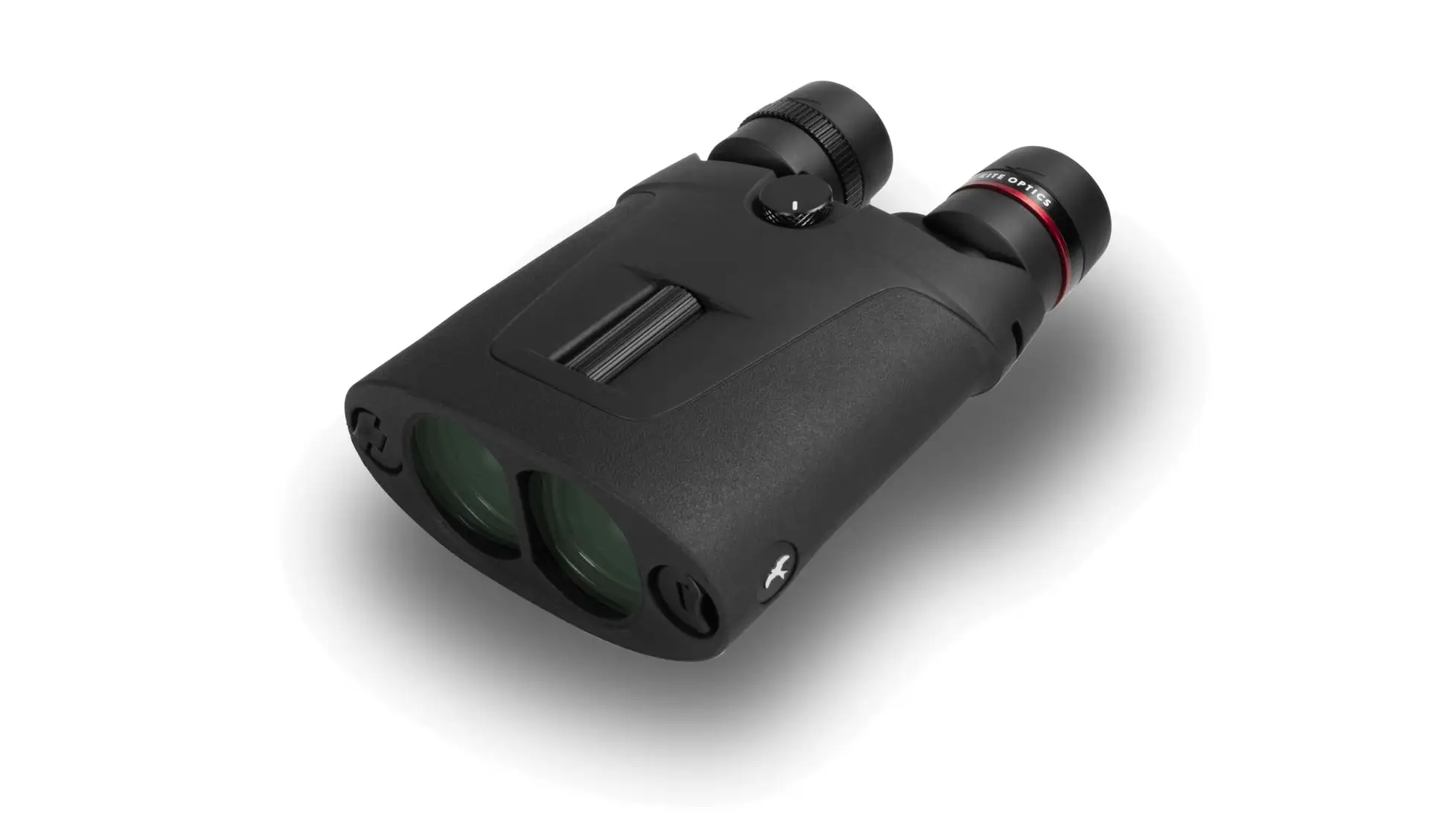
Best premium (and best in wet weather): Kite Optics APC Stabilized 16x42
Roof BAK4 · 16x42 · stabilized · IPX-7 submersible
around $1,400exact price on OpticsPlanet
From a Belgian birding-optics specialist, the APC 42 is the pick if you want 16x stabilization with the best weatherproofing here. It is the only binocular in this guide rated IPX-7 submersible (the Sig ZULU6 line is IPX-4), which makes it the one to trust in rain and on the water. Owners report rock-steady 16x views in strong gusty winds from a running side-by-side, spotting turkey at over 1,700 yards and reading feather texture at 40, and it doubles for boating and even moongazing. The catch is simple: it costs about $180 more than the Sig 16x42, it is a little larger and heavier, and its review record, while a perfect 5.0, is still small at six reviews.
Pros
- IPX-7 submersible waterproofing: the best in this guide, ideal for rain and boating
- Rock-steady 16x even in strong wind; owners spot turkey past 1,700 yds, feather texture at 40
- Belgian birding-brand pedigree; fully multi-coated BAK4 glass with HR coating
- Runs on 2 AA with a second chamber for 2 spares; auto-off saves battery
Cons
- Costs about $180 more than the Sig ZULU6 16x42 for similar reach
- Larger and heavier (735 g) than the Sig line; owners call it a little bulky
- Small review record: a perfect 5.0, but only six reviews so far
- Inherent to 16x: narrow field and a 2.62 mm exit pupil, so modest true low-light
Best for: birders and boaters who want the best waterproofing and a top-rated 16x stabilized view and are happy to pay a premium over the Sig for it.
Key specifications
| Magnification | 16x |
|---|---|
| Objective lens | 42 mm |
| Prism | Roof, BAK4 |
| Stabilization | Image stabilized |
| Glass | Fully multi-coated + HR coating |
| Eye relief | 14 mm |
| Exit pupil | 2.62 mm |
| Twilight factor | 25.9 |
| Weight | 735 g |
| Battery | 2 AA (+ 2-spare chamber) |
| Sealing | IPX-7 (submersible) |
“I have other good-quality name-brand binos, but these Kites are the bomb... I spotted 15 turkey on the edge of a clearing at over 1700 yards, couldn’t see them with my bare eyes. I can see the texture in a bird’s feathers at 40 yards. The image stabilizing works perfectly, no hiccups, smooth, even in a side-by-side on a hill with the engine running and strong gusty winds.”
Hunting in the U.P., verified owner via OpticsPlanet
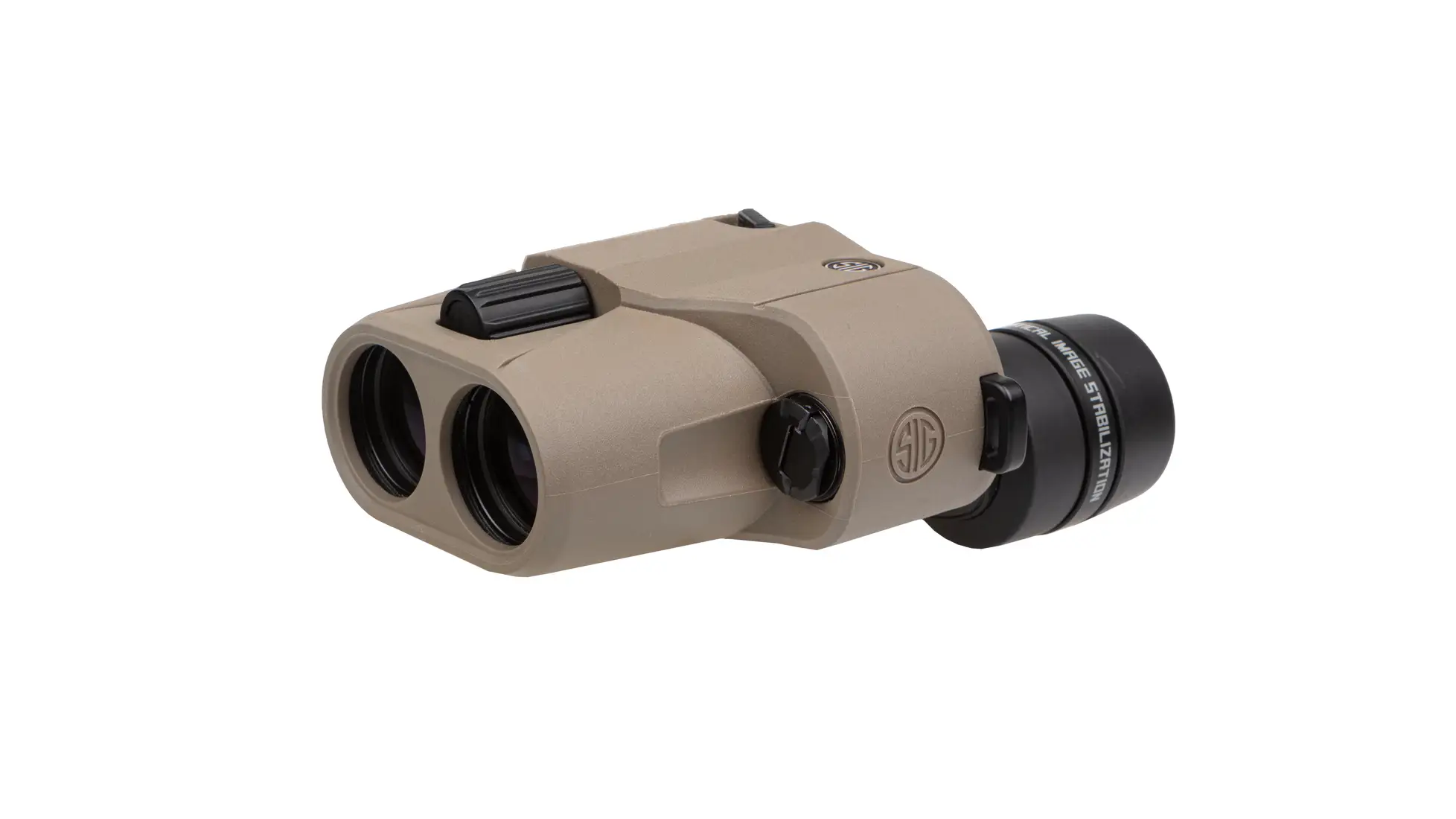
Best compact and lightweight: Sig Sauer ZULU6 HDX OIS 10x30
Schmidt-Pechan · 10x30 · 2-axis gimbal OIS · HDX glass
around $1,000exact price on OpticsPlanet
The 10x30 is the smallest, lightest and cheapest way into the ZULU6 OIS line, and the 10x power gives the widest, most relaxed view of the family. At 18.6 oz and 5.9 inches it is the one you actually carry, and owners who also own the 16x42 buy this one specifically for more field of view in a tree stand or blind, or for boating and travel. You give up reach and low-light ability (a 30 mm objective is the smallest here), and the review record is thin at five reviews, so it earns a slightly lower score, but as a compact stabilized glass it does exactly what it should.
Pros
- Smallest and lightest here (18.6 oz, 5.9 in): the one you will actually pack
- Widest, most relaxed view of the ZULU6 line thanks to lower 10x power
- Cheapest way into Sig image stabilization; same OIS "won’t go back" reaction
- Great for tree stands, blinds, boating and travel; Sig Infinite Guarantee
Cons
- Smallest 30 mm objective, so the weakest low-light performer of the picks
- Thin review record (five reviews) and the lowest rating of the three Sigs
- One owner reported short usable runtime per session ("great for 5 minutes at a time")
- Shares the line’s basic-accessories caveat
Best for: anyone who wants stabilized binoculars small and light enough to carry all day, for tree stands, blinds, boats and travel, and who values a wide view over maximum reach.
Key specifications
| Magnification | 10x |
|---|---|
| Objective lens | 30 mm |
| Prism | Schmidt-Pechan |
| Stabilization | 2-axis gimbal OIS, Scan + Target modes |
| Glass | HDX, Spectracoat |
| Eye relief | 15 mm |
| Weight | 18.6 oz |
| Length | 5.9 in |
| Battery | Single AA |
| Sealing | IPX-4 |
| Warranty | Sig Sauer Infinite Guarantee |
“If your on the fence about the clarity and overall quality of these binos they stand alone. With the image stabilizing tech these are the perfect deer blind/stand binos... Having the 16x42 variant of these binos I was looking for something little less power with more field of view for a tree stand/blind.”
PittsArchers, verified owner (PA) via OpticsPlanet
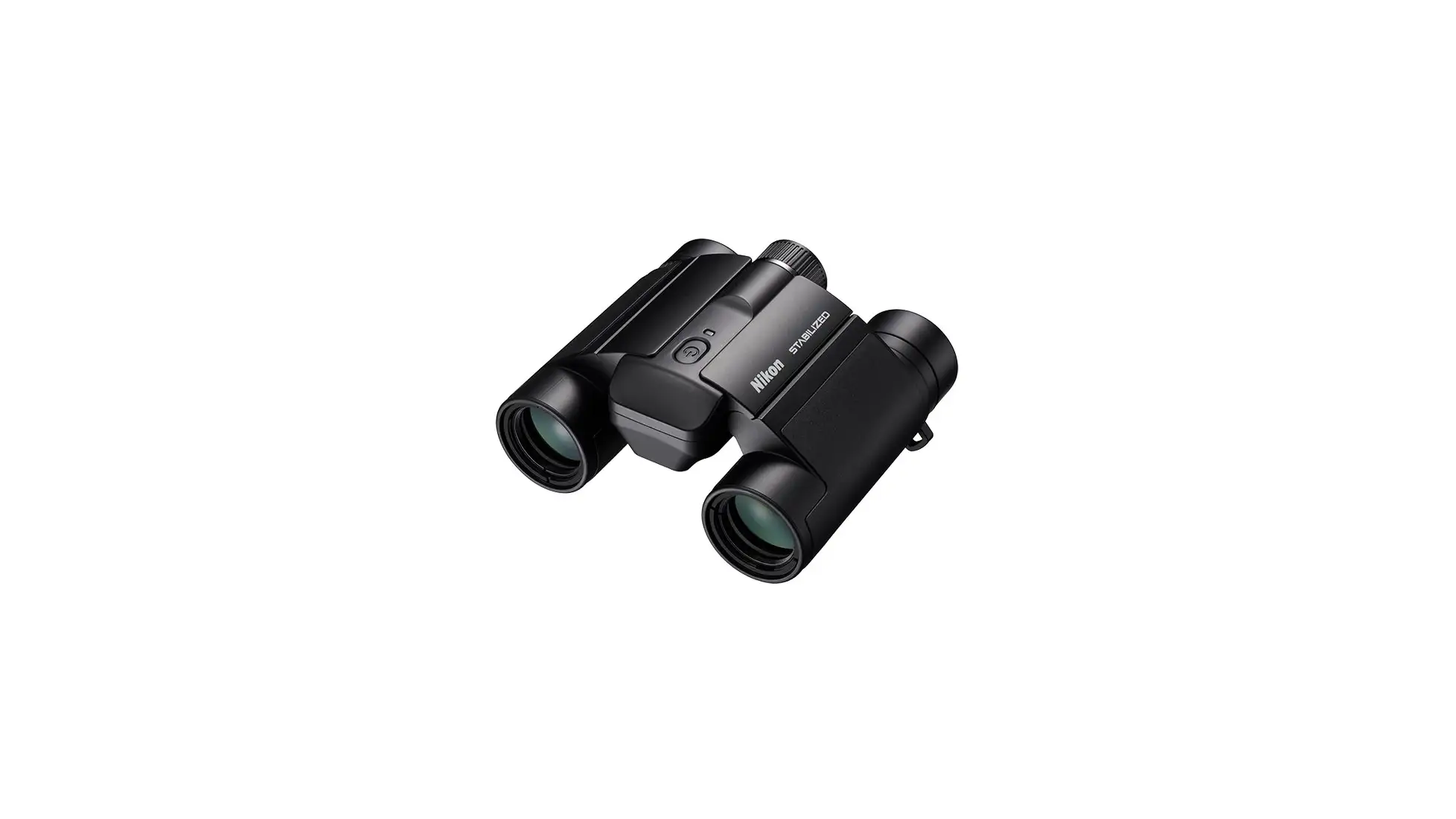
Best for concerts, sports and travel: Nikon STABILIZED 12x25 S
Roof prism · 12x25 · pocketable · 13.9 oz
around $700exact price on OpticsPlanet
If you want image stabilization in a jacket pocket for concerts, theater, sporting events and travel, the Nikon is the value entry: the cheapest stabilized binocular here and, at 13.9 oz and 3.9 inches, by far the smallest. Nikon builds it for lit venues and daytime, exactly where a small 25 mm objective is not a handicap, and it ships with two AA batteries and an auto-off timer. Be clear about what it is not: with a 25 mm objective and a 2.1 mm exit pupil, it is a poor low-light or wildlife glass, and its OpticsPlanet review record is a single review, so it earns the lowest score here despite doing its narrow job well.
Pros
- Cheapest and by far the most compact stabilized binocular here (13.9 oz, pocketable)
- Purpose-built for concerts, theater, sports and travel in lit venues and daylight
- Nikon stabilization is noticeable and low-fatigue; auto-off saves battery
- Includes two AA batteries, a case and a strap
Cons
- Tiny 25 mm objective and 2.1 mm exit pupil: weak in true low light and for wildlife
- Very thin record: a single OpticsPlanet review at the time of writing
- Narrow field of view and a short 12.3 mm eye relief (tight for eyeglass wearers)
- No listed waterproof rating; pricey for a 25 mm compact
Best for: concert, theater, sports and travel use where you want stabilization in a pocketable binocular and will not be glassing wildlife at dawn or dusk.
Key specifications
| Magnification | 12x |
|---|---|
| Objective lens | 25 mm |
| Prism | Roof |
| Stabilization | Nikon image stabilization; ~60-min auto-off |
| Glass | Multi-layer coated |
| Eye relief | 12.3 mm |
| Exit pupil | 2.1 mm |
| Field of view | 236 ft at 1000 yds |
| Weight | 13.9 oz |
| Length | 3.9 in |
| Battery | 2 AA (included) |
“We bought this Nikon primarily for theater/opera use + some outdoor activity. Stabilizer work good, difference is noticeable, especially during in low light condition i.e. concert hall. This Nikon is reasonably light and small... palm size.”
Stan, verified owner (TX) via OpticsPlanet
How to choose image-stabilized binoculars
A few things decide whether a stabilized binocular fits you:
- Magnification. Stabilization pays off most at 12x and up. 12x is the best all-round choice; 16x is for maximum reach and target work; a 10x compact is for a wide, easy view and packability.
- Objective and low light. A 42 mm objective (Sig ZULU6, Kite APC) is usable at dusk; a 25 to 30 mm compact (Nikon 12x25, Sig 10x30) is a daylight and lit-venue tool, not a low-light glass.
- Waterproofing. If you glass in rain or on the water, the Kite APC's IPX-7 submersible rating beats the Sig line's IPX-4 splash resistance.
- Weight and size. These run 14 to 26 oz. The Sig 10x30 and Nikon 12x25 are the packable ones; the 16x models are larger.
- Batteries. Most use one or two AA and an auto-off timer. Carry a spare; battery life is generally strong (owners go months on the Sig line).
- Glass expectations. At this price the glass is very good but not alpha (Swarovski, Leica). The stabilization, not the glass, is what you are paying for, and it is worth it at high power.
FAQ
Are image-stabilized binoculars worth it?
For high magnification, yes. Above about 10x, your natural hand shake blurs fine detail, and stabilization cancels it so you can actually resolve what the magnification promises, no tripod needed. Owners consistently say a stabilized 12x or 16x replaces a spotting scope and tripod for glassing, and that they stop using their non-stabilized binoculars afterward. The trade-offs are cost (stabilized pairs start under $750, and most of them run past $1,000), the need for batteries, and slightly heavier bodies. If you mainly use 8x or 10x and already hold steady, you may not need it; at 12x and up it is genuinely transformative.
What is the best image-stabilized binocular overall?
The Sig Sauer ZULU6 HDX OIS 12x42 is our best overall pick. Its 12x magnification balances reach with hand-holdability, the 2-axis gimbal stabilization is excellent, it is light at 21.5 oz with long single-AA battery life, and the glass holds up against similarly priced non-stabilized binoculars. If you want maximum reach, step up to the 16x42; if you want the best waterproofing, the Kite APC 16x42 is IPX-7 submersible.
Do image-stabilized binoculars work in low light?
They stabilize equally well in low light, but low-light brightness is set by the objective size and exit pupil, not the stabilization. The 42 mm Sig ZULU6 models (3.5 mm exit pupil at 12x) are usable at dusk, though they are not dedicated low-light glass; owners rate the 12x50-class brightness as comparable. The compact 25 mm Nikon and 30 mm Sig 10x30 are weaker after dark. For serious dawn and dusk glassing, favor a 42 mm-or-larger stabilized model, or a bright non-stabilized 8x42 or 10x50.
Sig ZULU6 vs Canon image-stabilized binoculars?
Canon pioneered image-stabilized binoculars and still makes excellent ones, but they are expensive and, until recently, were not waterproof. Owners in this class repeatedly frame the Sig ZULU6 HDX as the value alternative: comparable or better stabilization, weatherproofing the older Canons lacked, and a more compact, lighter body, for less money. One owner who tried the Canon 12x36 IS III and 10x42 L IS still chose the Sig. If budget is no object the top Canon and the premium Kite APC are worth a look, but the Sig ZULU6 line is where most buyers get the most stabilization per dollar.
New to binoculars? Learn what the numbers mean. For non-stabilized options, see our best binoculars for hunting, birding and astronomy guides, or carry your glass better with the best binocular harness picks.