Zeiss Victory SF review: the 10x42, and when the 8x42, 10x32 or 8x32 is the better pick
Our verdict: 4.5/5. The Zeiss Victory SF 10x42 is Zeiss's flagship roof prism binocular, and it is the model we review here; Zeiss itself calls the Victory SF “The top model from ZEISS.” Zeiss lists a very wide 360 ft field of view at 1,000 yards, 92 % light transmission, a 4.2 mm exit pupil, 18 mm of eye relief, 1.5 m close focus and 790 g (27.8 oz), made in Germany. Independent tests back the glass: Allbinos measured a peak transmission of 93.7 % on a 10x42, and OutdoorGearLab weighed theirs at 28.2 oz and found it “perfectly balanced”. It loses half a point for what to know first: there is no tripod socket, Allbinos notes a slight yellow-green hue, OutdoorGearLab found the eyecup click stops loosely defined, and the retailer's owner record is two reviewers, both from early 2020. For birding, read the 8x42 section; for a lighter kit, the 10x32 or 8x32. For Zeiss's other binocular lines, see our Zeiss Conquest HDX review and Zeiss SFL review.
The 10x42 (part 524224-0000-000) sells for around $3,000; the 8x42 around $3,000, the 10x32 around $2,500 and the 8x32 around $2,500. Check price and availability on OpticsPlanet; confirm the current price on the retailer page.
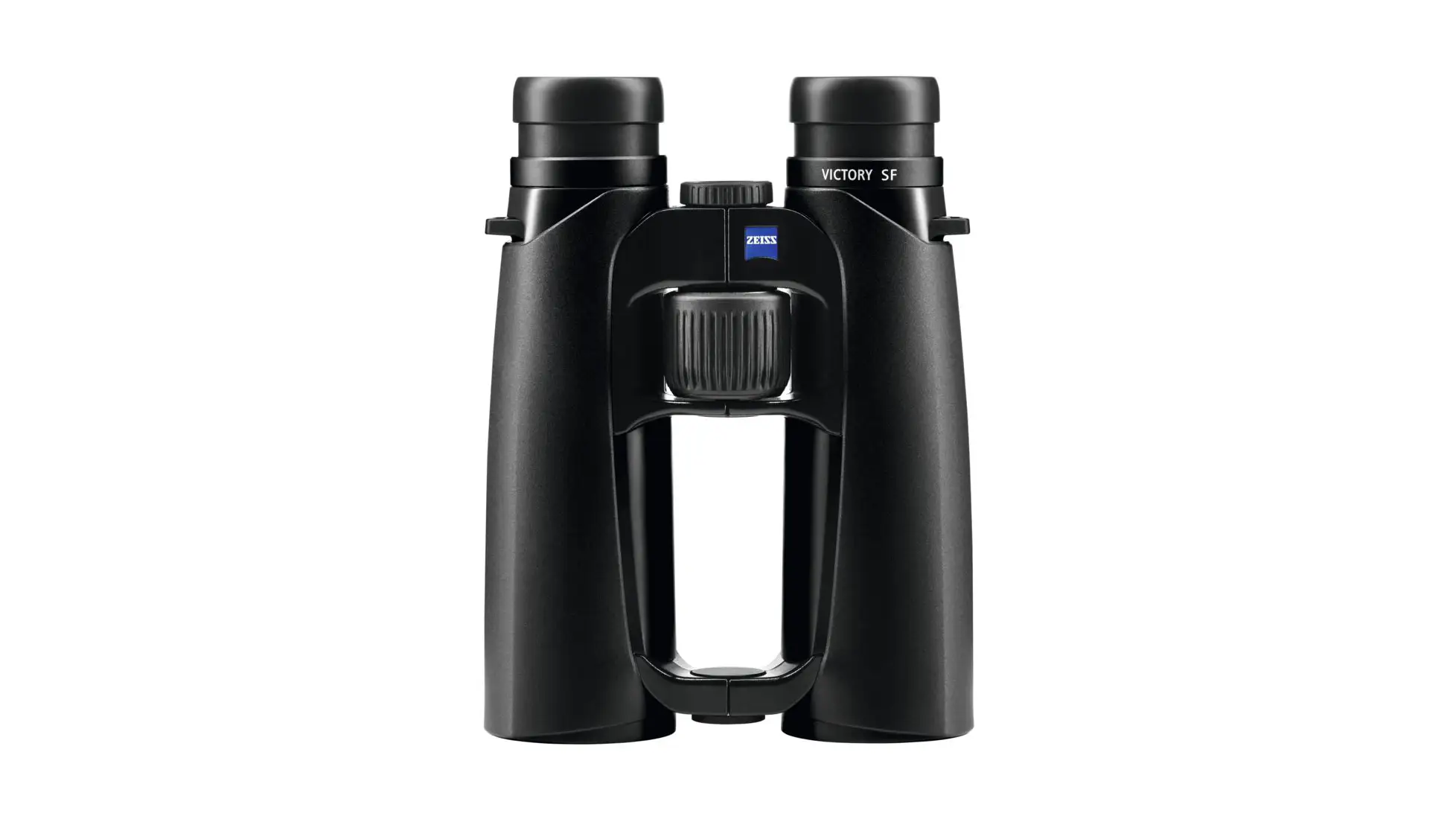
How we reviewed it: a research-based review built from the retailer's listings for the four Victory SF models, every review those listings show (5 on the 10x42 from two reviewers, 2 on the 8x42 from one reviewer, 1 on the 8x32, none on the 10x32), Zeiss's technical data, instruction manual, online shop pages and US warranty documents, and independent tests by Allbinos, OutdoorGearLab and Audubon that we read ourselves. Where the retailer's specification table disagrees with Zeiss, we print Zeiss's figure and say so; where Zeiss's own documents disagree, we print both. Third-party research leads we could not confirm on a primary source were left out. We have not field-tested these binoculars; the score is our editorial opinion and owner ratings are shown attributed to their source. See how we evaluate.
What the Victory SF is, and what it is not
Victory SF is a Zeiss binocular line in four sizes in Zeiss's technical data: 8x42, 10x42, 8x32 and 10x32. OpticsPlanet has a separate listing for each, and this page covers all four. According to Allbinos, Zeiss presented the 8x42 and 10x42 in June 2014 and announced the 8x32 and 10x32 in March 2020. Zeiss describes the line as “especially ideal for hunting from a stationary location in expansive hunting areas”, and it lists the same four models on its nature observation pages too.
The 42 mm models changed color once. A review hosted on Zeiss's own birding blog, by Richard Gregory, describes “the updated ZEISS Victory SF” in black, with redesigned armoring that replaced the original grey, a smoother focus action and a fix for eyecups that could unscrew, and says “The optics in the updated binoculars have not changed”. All four retailer listings on this page are black. If you read an older review or shop for a used pair, check which version it is.
Not to be confused with the Zeiss SFL (a separate, lighter line; see our Zeiss SFL review), the Conquest HDX (see our Conquest HDX review), the Victory HT or the Victory Pocket. Each has its own Zeiss technical data, and none of their figures appear on this page.
The optics: Zeiss's figures and two independent tests
Zeiss's online shop lists the lens type as Ultra-FL and the coatings as LotuTec and ZEISS T* on all four sizes, and its instruction manual names a Schmidt-Pechan prism. Zeiss claims 92 % light transmission for the 42 mm models and 90 % for the 32 mm models. On the 10x42, Zeiss gives a field of view of 120 m at 1,000 m (360 ft at 1,000 yards) and says the line's wide field “enhances the observable area of interest by up to 20 % compared to other binoculars”. That is Zeiss's claim, not a measurement of ours.
Allbinos (10x42, test dated 23 July 2016) measured transmission of 93.7 % (plus or minus 1 %) at its peak and wrote that it reaches “about 93% in the middle of the visible spectrum”. It measured the field of view at 6.80 degrees, in line with the specification, and rated the prisms as BaK-4 glass. Its colour note: “Noticeable loss of blue and purple light. Slight yellow-green hue.” Its one listed con on that unit was “distinct reflections visible beyond the eyepiece's diaphragm”. In its later 8x42 test (15 March 2021), Allbinos wrote that Zeiss “did a quick facelift” of the series and that the problems with unwanted reflections were removed.
OutdoorGearLab (10x42, Benjamin Hickok, December 23, 2023), which says it buys every product it tests, called it “one of the most impressive models we tested” and wrote that the slightest color fringing appears only at the outermost part of the view. Two findings cut the other way: in their fence-board field-of-view test it identified 54 boards, “about average for this group at the time of testing”, while other premium models reached 60 or more; and the eyecup adjustment “rolls through loosely defined positions” instead of stopping at clear intervals. They measured 19 mm of eye relief against Zeiss's 18 mm.
Handling: focus, balance, eyecups and the tripod question
Focus. Zeiss's Victory SF page says the focus wheel needs “only 1.4 turns from close focus to infinity” and can be turned precisely with gloves on; its Victory SF 32 page gives 1.6 turns for the 32 mm models. Allbinos measured the 10x42's wheel at a working range of 650 degrees, about 1.8 turns by our arithmetic and more than Zeiss's 1.4; its 8x32 figure, about 580 degrees, works out to about 1.6 turns, in line with Zeiss's figure for the 32 mm models.
Balance. Zeiss's Victory SF 32 page describes its ErgoBalance Concept as a way to shift the center of gravity closer to the eyepieces. Allbinos explains it on the 10x42: the eyepiece optics weigh more than the objective, so “the centre of gravity is situated near your eyes”. OutdoorGearLab weighed its 10x42 at 28.2 oz (799 g) against Zeiss's 790 g and found it perfectly balanced.
Eyecups and glasses. Zeiss's manual says each eyecup locks in four positions; with glasses, turn it fully down to the lowest click stop. Zeiss lists 18 mm of eye relief on the 42 mm models and 19 mm on the 32 mm models. As above, OutdoorGearLab found the click stops on its 10x42 loosely defined.
No tripod socket. Allbinos found no socket on the 10x42 and the 8x32. Zeiss's manual says the binoculars mount on any camera tripod with the ZEISS Binofix universal tripod adapter, an accessory that is not included.
What the 10x42 reviewers say: two voices from early 2020
The 10x42 listing shows 5 reviews, all five stars, and we read all of them. Four are the same text by the same reviewer, Toddvross from Illinois, posted as separate entries; we count them once. That leaves two reviewers, neither with the Verified Owner tag, and both dated January and February 2020. Neither review raises a negative.
“Everyone who looks thru these is amazed at the brightness,color, clarity and lack of distortion anywhere in the sight picture.”
Toddvross (IL), reviewer, via OpticsPlanet
The same reviewer lists clarity, warranty, weight, brightness, color and ergonomics as pros, writes “None” under cons and marks hunting as the main use. The second reviewer, mountin710 from Wisconsin, writes about light:
“I noticed a big difference in low light conditions with these Victory SF’s.”
mountin710 (WI), reviewer, via OpticsPlanet
Two people over six years ago is not a pattern, and the 5.0 average rests on them. On this model the weight of the evidence is Zeiss's data and the independent tests above, not owner sentiment.
Trade-offs, plainly
- No tripod socket: to put it on a tripod you need Zeiss's Binofix universal tripod adapter, sold separately.
- Color is not neutral in Allbinos's tests: a slight yellow-green hue on the 10x42 and 8x42, a distinct green hue on the 8x32.
- OutdoorGearLab found the 10x42's eyecup click stops loosely defined, and its field of view about average in their fence-board test despite Zeiss's wide-field claim.
- Allbinos's 8x32 test lists truncated exit pupils and spikes on bright objects such as lampposts among its cons.
- 790 g (27.8 oz) on the 42 mm models (Zeiss); OutdoorGearLab weighed the 10x42 at 28.2 oz.
- A thin review record: two reviewers on the 10x42, one on the 8x42, one on the 8x32 and none on the 10x32.
Which Victory SF: 10x42, 8x42, 10x32 or 8x32
The four models are separate retailer listings with different part numbers, all black. The figures below are Zeiss's technical data on zeiss.com for each model; rating and price come from each model's own listing. Exit pupil is checked by arithmetic (objective divided by magnification).
| Spec | 10x42 (524224-0000-000) | 8x42 (524223-0000-000) | 10x32 (523225-0000-000) | 8x32 (523224-0000-000) |
|---|---|---|---|---|
| Light transmission (Zeiss) | 92 % | 92 % | 90 % | 90 % |
| Exit pupil | 4.2 mm | 5.3 mm | 3.2 mm | 4.0 mm |
| Twilight factor | 20.5 | 18.3 | 17.9 | 16.0 |
| Field of view at 1,000 yd | 360 ft | 444 ft | 390 ft | 465 ft |
| Field of view at 1,000 m | 120 m | 148 m | 130 m | 155 m |
| Apparent field of view | 64° | 64° | 69° | 67° |
| Close focus | 1.5 m (4.9 ft) | 1.5 m (4.9 ft) | 1.9 m (6.4 ft) | 1.9 m (6.4 ft) |
| Eye relief | 18.0 mm | 18.0 mm | 19.0 mm | 19.0 mm |
| Weight | 790 g (27.8 oz) | 790 g (27.8 oz) | 590 g (20.8 oz) | 600 g (21.2 oz) |
| Length / width | 173 / 125 mm | 173 / 125 mm | 150 / 112 mm | 150 / 112 mm |
| Case (Zeiss shop box list) | Thermoformed bag | Thermoformed bag | Cordura bag | Cordura bag |
| OpticsPlanet rating | 5.0/5 from 5 reviews (two reviewers) | 5.0/5 from 2 reviews (one reviewer) | No reviews | 5.0/5 from 1 review |
| Price | around $3,000 | around $3,000 | around $2,500 | around $2,500 |
All four share, per Zeiss: a -4.0 to +4.0 dpt diopter range, nitrogen filling, LotuTec, water resistance of 400 mbar and an operating temperature of -25 to +63 °C (-13 to +145 °F) on zeiss.com (-30 to +63 °C, -22 to +145 °F in the manual). Width is measured at 65 mm interpupillary distance. Zeiss's instruction manual gives a few different figures from zeiss.com: 27.5 oz for the 42 mm models, 1.95 m close focus for the 32 mm models, 152 mm length for the 8x32, 174 by 127 mm for the 42 mm models and 54 to 76 mm interpupillary distance on all four (zeiss.com: 55 to 76 mm on the 42 mm models).
8x42
The 8x42 (part 524223-0000-000) shares the 10x42's body in Zeiss's data, 790 g (27.8 oz) and 173 mm long, and trades 2x of magnification for a 5.3 mm exit pupil (42 / 8 = 5.25) and a wider field of view, 148 m at 1,000 m (444 ft at 1,000 yards). The retailer shows the same photo for this listing as for the 10x42, so we do not repeat it here. The retailer's specification table lists 776 g and 420 ft; Zeiss lists 790 g and 444 ft on its website and in its manual, and its shop also gives 444 ft, so use Zeiss's numbers.
Audubon's test. In its “Top of the Line” category (published November 26, 2019), Audubon's editors scored the Victory SF 8x42 8.36, third of the four binoculars in that category; the winner scored 9.03, and the Leica Noctivid 8x42 came fourth at 8.33. Audubon called it “The lightest contender in this category” and praised its “fast handling and tremendous field of view”. Allbinos's 8x42 test (15 March 2021) measured transmission of 91.2 % (plus or minus 1 %) and a field of view of 8.35 degrees, which it calls “slightly narrower than stated”; it also notes the same slight yellow-green hue as on the 10x42.
Its owner record is 2 reviews from one reviewer, Matt from Hawaii, both from October 2025; one of the two carries the Verified Owner tag. Matt calls them the best binoculars on the market and compares them with the Zeiss Conquest HDX:
“The HDX also has a tripod mount screw-in capability, whereas the Victory SF does not.”
Matt (HI), reviewer, via OpticsPlanet
The same reviewer writes that the Victory SF is “slightly heavier than the Zeiss Conquest HDX and 3/4 inch longer”. One reviewer is one opinion. For the format question, see our 8x42 vs 10x42 guide and our best 8x42 binoculars guide.
10x32
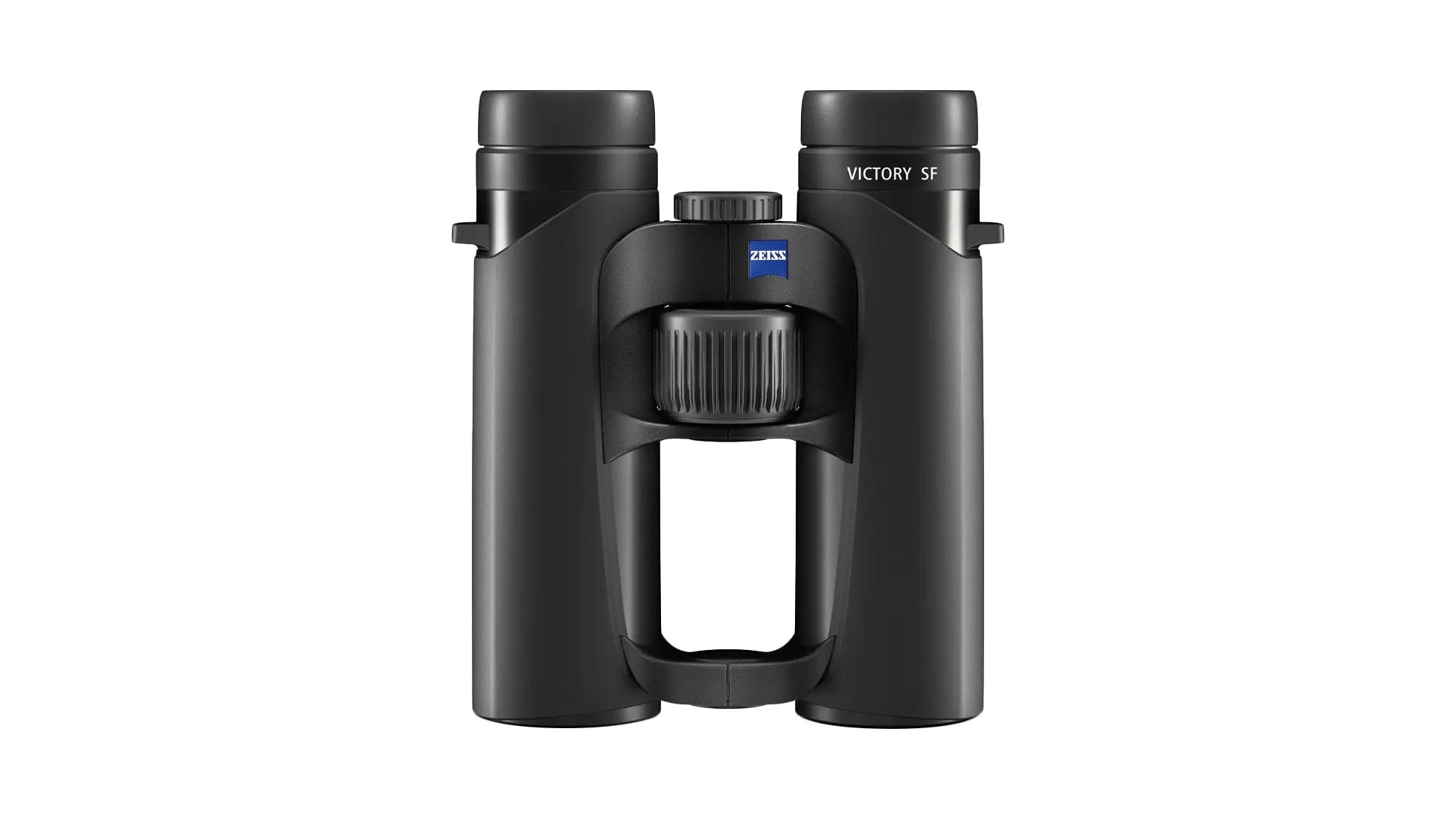
The 10x32 (part 523225-0000-000) is the lightest Victory SF, 590 g (20.8 oz) and 150 mm long in Zeiss's data, with a 390 ft field of view at 1,000 yards and the widest apparent field of the four at 69°. The cost is light: a 3.2 mm exit pupil (32 / 10 = 3.2) and a twilight factor of 17.9 against the 10x42's 20.5. Zeiss's shop lists a Cordura bag instead of the 42 mm models' thermoformed bag.
An award, as Zeiss reports it. A Zeiss press release dated September 2, 2020 (published on The Shooting Wire) says “Outdoor Life Magazine has selected the ZEISS Victory SF 10x32 binocular as the Editor’s Choice Award in the hunting binocular category.” (source: Zeiss press release; we could not open Outdoor Life's own page). The judges quoted in that release praise its “absurdly wide field of view” and “the very positive four-position eyecups and the locking diopter control”.
The 10x32 listing has no owner reviews, so there is nothing from owners to report.
8x32
The 8x32 (part 523224-0000-000) has the widest true field of view of the four, 155 m at 1,000 m (465 ft at 1,000 yards), with a 4.0 mm exit pupil (32 / 8 = 4.0) and 600 g (21.2 oz) in Zeiss's data. The retailer's photo for this listing is near-identical to the 10x32's above, so we do not repeat it.
Allbinos's test (12 January 2021) is the most mixed of the independent results we read. Allbinos measured transmission of 90.6 % (plus or minus 1 %) and a field of view of 8.75 degrees, close to the specification, called the field “one of the widest in this class of equipment” and wrote that the 8x32 earned “the first place in our ranking” (Allbinos's own 8x32 ranking, not an award). Its cons: “truncated exit pupils”, “spikes on bright objects (e.g. lampposts)” and a transmission curve that is not especially flat, with a “Distinct green hue”. In its later 8x42 test, Allbinos wrote that the 8x42 “fared much better” than the 8x32 against bright light. If you glass toward streetlights or a low sun, weigh that.
The retailer's table. The 8x32 listing's main specification table gives 4 mm of eye relief, BK-7 prisms and a 56 to 74 mm interpupillary distance. Zeiss lists 19.0 mm of eye relief and 54 to 76 mm, and Allbinos rated the 8x32's prisms as BaK-4. Use Zeiss's figures.
Its review record is a single five-star review from August 2021, without the Verified Owner tag; the reviewer writes about binoculars they have tested and does not say they own this pair:
“There's no question that the 8x32 SFs are the best binoculars I've ever tested at this size.”
Stacie Fisher (MS), reviewer, via OpticsPlanet
One review is one opinion.
Key specifications: 10x42 (part 524224-0000-000)
| Magnification / objective | 10x / 42 mm |
|---|---|
| Part number (this listing) | 524224-0000-000, black |
| Prism | Schmidt-Pechan (Zeiss instruction manual) |
| Lens type / coatings | Ultra-FL; LotuTec / ZEISS T* (Zeiss online shop) |
| Light transmission | 92 % (Zeiss) |
| Exit pupil | 4.2 mm (42 / 10 = 4.2) |
| Twilight factor | 20.5 |
| Field of view | 120 m at 1,000 m (360 ft at 1,000 yd) |
| Apparent field of view | 64° (zeiss.com); 65° (Zeiss instruction manual) |
| Close focus | 1.5 m (4.9 ft) (zeiss.com); 1.5 m (5 ft) (manual) |
| Eye relief ("exit pupil distance") | 18.0 mm |
| Diopter range | -4.0 to +4.0 dpt |
| Interpupillary distance | 55 to 76 mm (zeiss.com); 54 to 76 mm (manual) |
| Weight | 790 g (27.8 oz) (zeiss.com); 790 g (27.5 oz) (manual) |
| Length / width at 65 mm IPD | 173 mm (6.8 in) / 125 mm (4.9 in) (zeiss.com); 174 / 127 mm (manual) |
| Sealing | Nitrogen filled, LotuTec, water resistance 400 mbar |
| Operating temperature | -25 to +63 °C (-13 to +145 °F) (zeiss.com); -30 to +63 °C (-22 to +145 °F) (manual) |
| Focus | 1.4 turns from close focus to infinity (Zeiss Victory SF page) |
| Tripod | No socket; ZEISS Binofix universal tripod adapter (manual), sold separately |
| Country of origin (Zeiss shop) | Germany |
Figures are Zeiss's technical data on zeiss.com unless marked as the Zeiss instruction manual or the Zeiss online shop. The retailer's 10x42 table lists the weight as 27.5 oz and the close focus as 5 ft, which are the manual's figures, and the water resistance as “400 bars, 0.4 bars”; Zeiss says 400 mbar.
Warranty, box and where it is made
Zeiss's online shop gives Germany as the country of origin for all four sizes and lists the box as “Binocular, Eyepiece cover, Neoprene strap, Thermoformed bag, Microfiber cloth, Instructions” for the 42 mm models, with a Cordura bag instead for the 32 mm models. Zeiss's instruction manual lists a slightly different package: eyepiece cap, protective lens cap with its strap, carrying strap, carrying case, lens cleaning cloth and instructions.
The shop names the ZEISS Transferable Limited Lifetime Warranty and a Five-Year No-Fault Policy. Zeiss's US warranty document (revised December 16, 2020) covers the optical system for the life of the product; straps, lens caps and rubber armoring are covered for 1 year; accidental damage is excluded; and it “only covers products purchased within the USA or Canada from Authorized ZEISS Sports Optics Dealers.” Zeiss's No-Fault Policy document lists the Victory SF and covers accidental damage during normal use in the first five years, once per product, if the owner registers online within 60 days of purchase. Zeiss's shop and its No-Fault document word the transfer terms differently, so ask Zeiss before you rely on the No-Fault Policy for a gift or a second-hand pair, and confirm with Zeiss which dealers it counts as authorized.
On awards: the Outdoor Life Editor's Choice for the 10x32 above is the only one we found, and we print it as Zeiss reports it.
Should you buy it, and what else to consider
- Buy the 10x42 if you want one premium binocular for open-country hunting and general glassing, and you value a very wide view and balance over the lightest weight. Skip it if you need a tripod socket on the body.
- Buy the 8x42 if you watch birds or hunt woods and low light; it has the larger exit pupil and the wider view at the same weight.
- Buy the 10x32 if weight matters most; it is the lightest of the four and the one Zeiss reports won Outdoor Life's Editor's Choice.
- Buy the 8x32 if you want the widest true field in a small body and rarely look toward bright lights; read Allbinos's cons above first.
- What else to consider: our Zeiss Conquest HDX review covers a lighter Zeiss 10x42 at 715 g (25.2 oz) per Zeiss; our Zeiss SFL review covers Zeiss's SFL line from the 8x40 to the 12x50; and our best 8x42 binoculars guide ranks 8x42s with a premium pick. For birding-first picks, see best binoculars for birding; for hunting, best binoculars for hunting.
- Comparing alphas? Our Leica Noctivid review covers Leica's premium 10x42 and 8x42, and our Nikon Monarch HG review a lower-priced 10x42, with the 8x42, 8x30 and 10x30 in the same line.
FAQ
Is the Zeiss Victory SF worth it?
It is a top-tier binocular with a very wide view, and the independent tests we read support that: Allbinos measured a peak light transmission of 93.7 % on a 10x42, and OutdoorGearLab called it one of the most impressive models they tested. What you give up: there is no tripod socket, Allbinos notes a slight yellow-green hue on the 42 mm models, and the owner record on the retailer is tiny (two reviewers on the 10x42, both from early 2020). Whether that is worth the price is your call; the 32 mm models are the lighter option.
Zeiss Victory SF 8x42 or 10x42?
Zeiss lists both at 790 g and 173 mm long, so the choice is optical. The 8x42 has a 5.3 mm exit pupil and a 444 ft field of view at 1,000 yards; the 10x42 has a 4.2 mm exit pupil and 360 ft. Our reading of those numbers: the 8x42 for birding, woods and low light, the 10x42 when you need more reach in open country.
Is the Zeiss Victory SF the same as the Zeiss SFL?
No. Zeiss sells the Victory SF and the SFL as separate lines with separate technical data. The Victory SF comes in four sizes (8x42, 10x42, 8x32 and 10x32); the SFL is covered in our own Zeiss SFL review. Nor is the Victory SF the Conquest HDX, the Victory HT or the Victory Pocket.
Does the Zeiss Victory SF have a tripod socket?
No. Allbinos found no tripod socket on the 10x42 and the 8x32. Zeiss's instruction manual says the Victory SF can be mounted on any camera tripod using the ZEISS Binofix universal tripod adapter, which is an accessory and not in the box.
Is the Zeiss Victory SF waterproof?
Zeiss lists every Victory SF size as nitrogen filled with LotuTec coating and a water resistance of 400 mbar. The operating temperature is -25 to +63 °C (-13 to +145 °F) in Zeiss's technical data on its website and -30 to +63 °C (-22 to +145 °F) in Zeiss's instruction manual.
What warranty does the Zeiss Victory SF have, and where is it made?
Zeiss's online shop names the ZEISS Transferable Limited Lifetime Warranty and a Five-Year No-Fault Policy and gives Germany as the country of origin for all four sizes. Zeiss's US warranty PDF covers the optical system for life, straps, lens caps and rubber armoring for 1 year, excludes accidental damage, and applies to products bought in the USA or Canada from authorized ZEISS Sports Optics dealers. The No-Fault Policy covers accidental damage in normal use for five years, once per product, if you register online within 60 days. Confirm the terms with Zeiss before you buy.
More binoculars: best binoculars for birding · best 8x42 binoculars · Zeiss Conquest HDX review · Zeiss SFL review · 8x42 vs 10x42.