Vortex binoculars: which line to buy, from Triumph HD to Razor
Our verdict for 2026: buy the Diamondback HD 10x42 (around $220) unless you have a reason not to. It has HD glass on dielectric, phase-corrected prisms, a magnesium body at 21.3 oz and a 5 ft close focus. On a tight budget, the Triumph HD 10x42 (around $100) keeps both prism coatings and 17 mm of eye relief but focuses no closer than 15.3 ft. For 12x reach on the least money, the Crossfire HD 12x50 (around $180) trades coatings for magnification. If you wear glasses and glass for hours, the Viper HD 10x42 (around $410) adds 17 mm of eye relief, a 341 ft field and a locking diopter. At the top, the Razor HD 10x42 (around $1,000) is the only Vortex here with a lab measurement behind it, 86.8 percent transmission.
Every rung carries the same Vortex VIP warranty. Prices verified October 14, 2026; confirm the current price on the retailer page.
Vortex sells binoculars as a ladder of named lines, and the useful question is what each step up actually changes. The answer is not the same at every rung: one step buys weight and close focus, another buys eye relief and coatings, and one is a change of format rather than of glass. Below is the ladder in one table, one card per line, the size question, and what the warranty says in Vortex's own words.
How we reviewed these: a research-based roundup built from Vortex's published specifications as listed on the OpticsPlanet product pages, owner reviews read on those listings, and, for the Razor HD 10x42, an independent laboratory measurement. Every binocular here already has its own card or full review on this site. Scores are our editorial opinion, not a hands-on test of every model. See how we evaluate.
- The Vortex ladder in one table
- Vortex Triumph HD 10x42 - The entry rung
- Vortex Crossfire HD 12x50 - The budget 12x50 rung
- Vortex Diamondback HD 10x42 - The default pick
- Vortex Viper HD 10x42 - Best step-up
- Vortex Razor HD 10x42 - The premium rung
- Which size: 8x42, 10x42 or 12x50
- What the VIP warranty covers
- Which Vortex binocular should you buy?
- FAQ
The Vortex ladder in one table
Each line below is priced from the one model we card for it, and the last column links to our own coverage of it.
| Line | What it adds | Price | Our coverage |
|---|---|---|---|
| Triumph HD | The entry rung: HD glass with dielectric and phase-corrected prisms, 17 mm eye relief, harness in the box. 15.3 ft close focus | around $100 | Triumph HD 10x42 review |
| Crossfire HD | 12x reach through 50 mm. Phase correction and dielectric coatings not stated by Vortex. 29.5 oz | around $180 | Crossfire HD 12x50 review |
| Diamondback HD | Magnesium chassis; in the 10x42, 21.3 oz, a 5 ft close focus and 15 mm of eye relief | around $220 | 10x42, 8x42 and 12x50 reviews |
| Viper HD | XR Plus fully multi-coated lenses, locking diopter, 341 ft field and 17 mm eye relief in the 10x42. 24.9 oz | around $410 | 10x42 and 12x50 reviews |
| Razor HD and UHD | XR Plus coatings, 362 ft field in the HD 10x42, and 86.8 percent transmission measured by an independent lab | around $1,000 | Razor binoculars guide |
| Ranger HD 3000 | A 10x42 with a built-in laser Vortex rates to 3,000 yards on reflective targets and 1,500 yards on deer, with an angle-compensated HCD mode. 32.4 oz | around $720 | Ranger HD 3000 review |
Read the table once and two things stand out. First, the ladder is not a pure coating ladder: Vortex lists dielectric and phase-correction prism coatings for the Triumph HD at the bottom, and states neither for the Crossfire HD 12x50 above it, so the Crossfire is a step into 12x rather than into better glass. Second, eye relief does not rise with price. The cheapest binocular here has as much as the Viper HD, and the Diamondback HD 10x42 has the least of the 10x42 cards. If you wear glasses, read that column before the price column.
Quick comparison
| Category | Pick | Spec | Price |
|---|---|---|---|
| The entry rung | Vortex Triumph HD 10x42 | 10x42 · 17 mm eye relief | around $100 |
| The budget 12x50 rung | Vortex Crossfire HD 12x50 | 12x50 · 29.5 oz | around $180 |
| The default pick | Vortex Diamondback HD 10x42 | 10x42 · 21.3 oz | around $220 |
| Best step-up | Vortex Viper HD 10x42 | 10x42 · 341 ft field of view | around $410 |
| The premium rung | Vortex Razor HD 10x42 | 10x42 · 86.8% measured | around $1,000 |
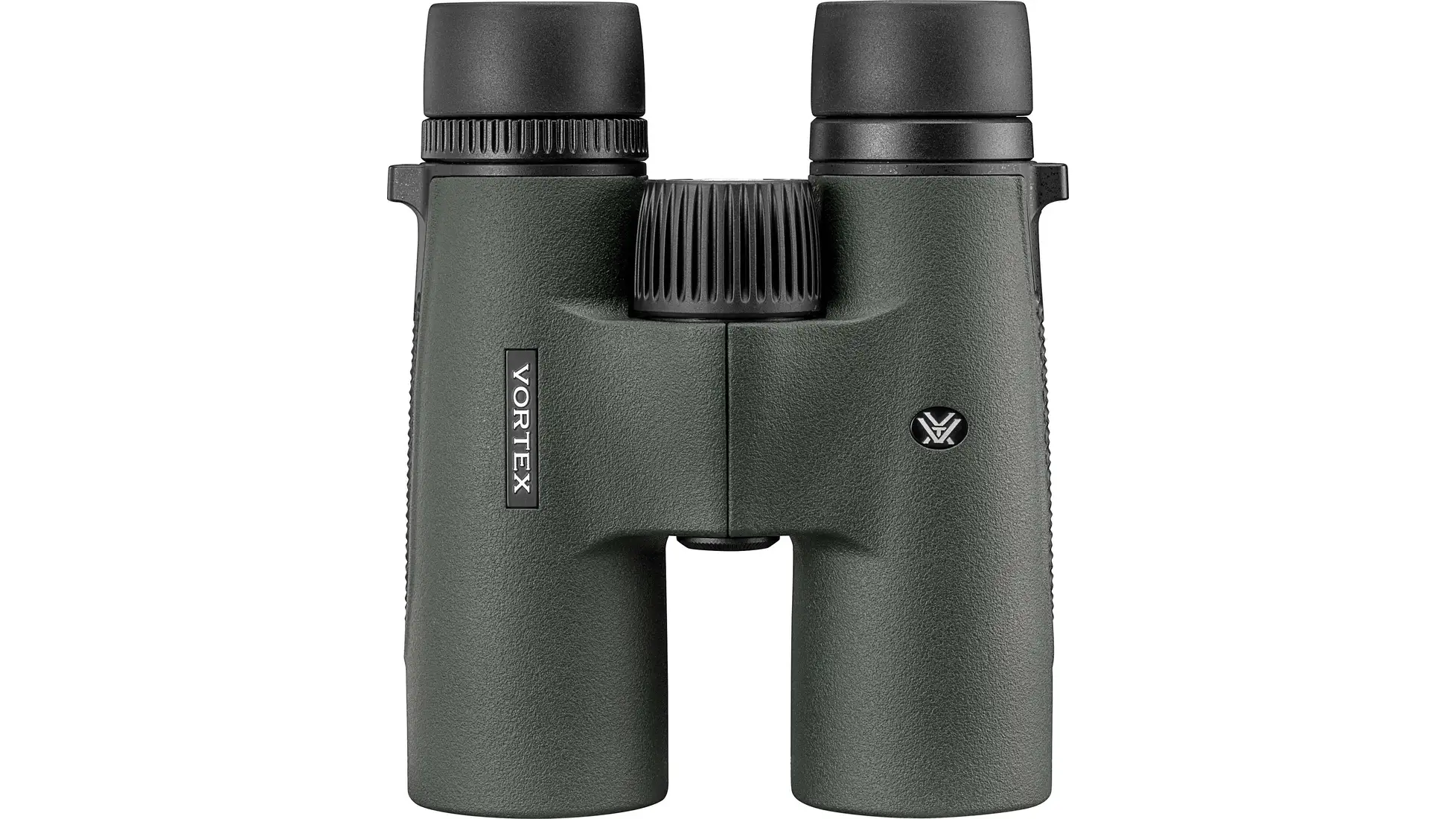
The entry rung: Vortex Triumph HD 10x42
Roof prism · 10x42 · HD glass · phase-corrected + dielectric · 22.9 oz
around $100exact price on OpticsPlanet
This is the cheapest Vortex binocular we card, and it gives away less than its price suggests. Vortex lists an HD optical system, dielectric prism coatings and phase correction for the Triumph HD, the coating pair Vortex says enhances resolution and contrast and gives bright, colour-accurate images in a roof prism. Its 17 mm of eye relief matches the Viper HD further up the line and beats the Diamondback HD 10x42, so it is a comfortable pair for eyeglass wearers, and the field of view is 334 ft at 1000 yds. A GlassPak harness, case, neck strap and covers come in the box. What it gives up is close focus and weight: Vortex lists a 15.3 ft close focus, so it is poor for anything near, and at 22.9 oz it is heavier than the magnesium Diamondback HD 10x42. One owner titled their review "The budget diamondback hd" and reports that their brother, who owns the Diamondback HD, said "I see no major difference."
Pros
- Vortex lists dielectric prism coatings and phase correction for it, two coatings Vortex does not state for the dearer Crossfire HD 12x50
- 17 mm of eye relief, the same figure as the Viper HD and more than the Diamondback HD 10x42
- GlassPak harness, case, neck strap and covers included, so there is nothing else to buy
- The Vortex VIP warranty, the same cover as every rung above it
Cons
- A 15.3 ft close focus is far, so it is poor for feeder birds, butterflies or anything close in
- At 22.9 oz it is heavier than the Diamondback HD 10x42, which also focuses down to 5 ft
- The objective lens covers working loose and falling off is the most repeated owner complaint
- HD here means Vortex's entry HD, not the ED glass of binoculars two or three times the price
Best for: the first serious pair, a truck or pack binocular, and eyeglass wearers on a tight budget. Step to the Diamondback HD if close focus or carry weight matter.
Key specifications
| Magnification | 10x |
|---|---|
| Objective lens | 42 mm |
| Prism | Roof, BAK-4, phase-corrected + dielectric |
| Glass | HD, fully multi-coated |
| Eye relief | 17 mm |
| Exit pupil | 4.2 mm |
| Field of view | 334 ft at 1000 yds |
| Close focus | 15.3 ft |
| Weight | 22.9 oz |
| In the box | GlassPak harness + case, neck strap, covers, lens cloth |
| Warranty | Vortex VIP: unlimited, unconditional, lifetime |
| MPN carded | TRI-1042 |
“these work like high price binos, very surprised and impressed. Comes with a case, chest strap and neck strap, plus a lifetime warranty no questions asked!”
Raymond Washburn, verified owner (CA) via OpticsPlanet
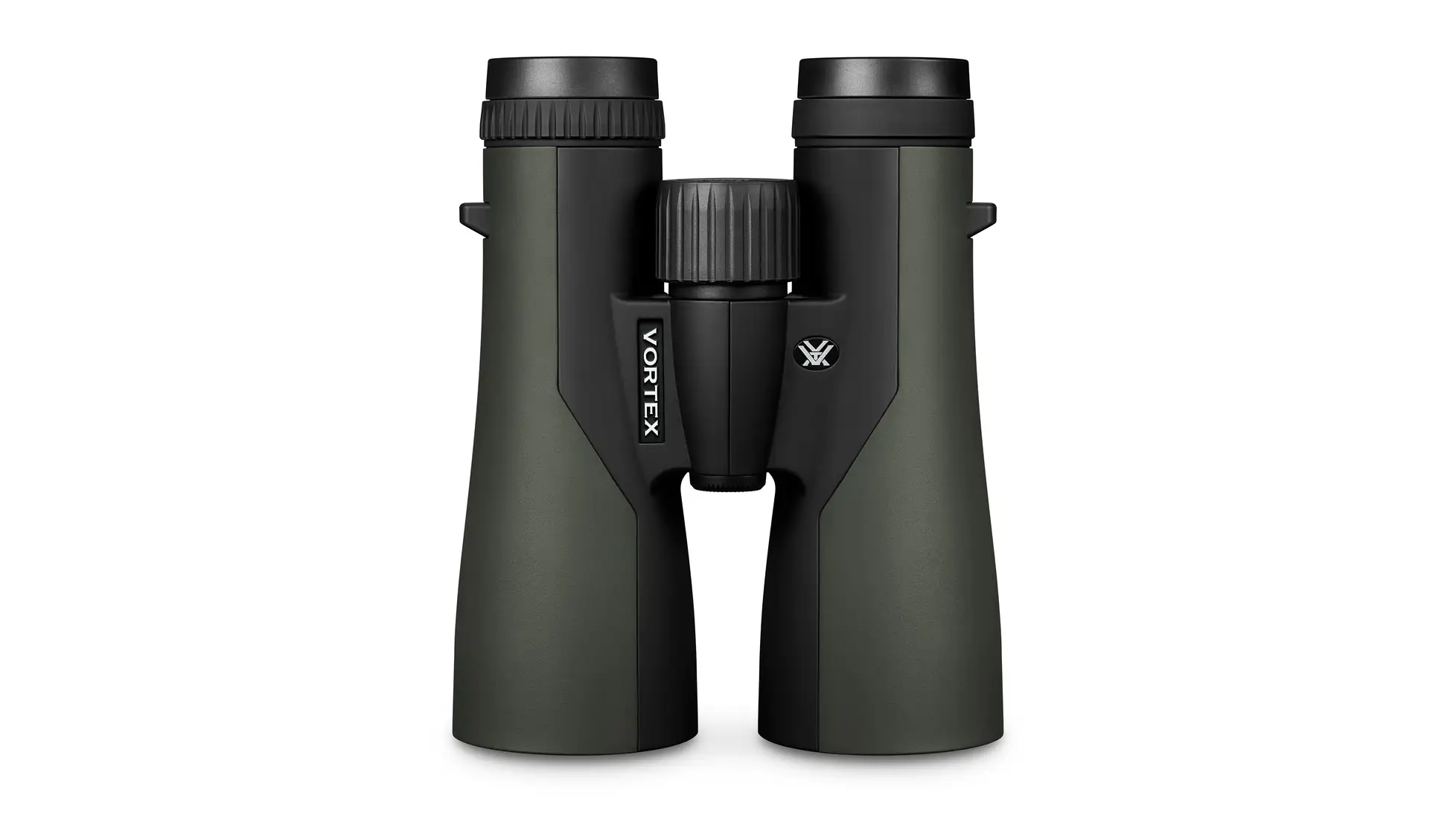
The budget 12x50 rung: Vortex Crossfire HD 12x50
Roof prism · 12x50 · HD optical system, fully multi-coated · 29.5 oz · GlassPak harness in the box · MPN CF-4314
around $180exact price on OpticsPlanet
We card the Crossfire HD in one size, the 12x50, and it is the cheapest way into 12x reach in the Vortex line on this site. From Vortex's own specification: an HD optical system with fully multi-coated lenses, 273 ft at 1000 yds, a 6 ft close focus, 15 mm of eye relief and 29.5 oz. Read it as a format step, not a coating step. Vortex names phase correction and dielectric prism coatings for the Triumph HD and the Diamondback HD, and states neither for this model; against the Diamondback HD 12x50 it also gives up extra-low dispersion glass and a magnesium chassis. The coatings and the extra-low dispersion glass are what control colour fringing and contrast at dawn and dusk; the magnesium chassis is a weight and strength difference. What you get for the money is 12x through a 50 mm objective, a GlassPak case and harness, and the VIP warranty.
Pros
- 12x reach through a 50 mm objective for the least money in the Vortex line we card
- 15 mm of eye relief, more than the Diamondback HD 12x50's 14 mm, which helps eyeglass wearers
- HD optical system with fully multi-coated lenses and a 6 ft close focus (Vortex)
- GlassPak case and harness in the box, and the Vortex VIP warranty
Cons
- Vortex does not state phase correction or dielectric prism coatings for it, and it gives up the Diamondback HD's extra-low dispersion glass and magnesium chassis
- At 29.5 oz it is the heaviest of the cards on this page, and weight is the one complaint more than two owners raise
- The most upvoted review of the product is a 2-star return citing a loose, laggy focus and cloudy edges
- The eyepiece covers are not tethered while the objective covers are
Best for: glassing from a steady position when 12x matters more than coatings. Step to the Diamondback HD 12x50 for better glass at dawn and dusk.
Key specifications
| Magnification | 12x |
|---|---|
| Objective lens | 50 mm |
| Glass | HD optical system, fully multi-coated lenses |
| Phase correction | Not stated by Vortex or by the retailer |
| Eye relief | 15.0 mm |
| Exit pupil | 4.2 mm (50 divided by 12) |
| Field of view | 273 ft at 1000 yds, 5.2 degrees |
| Close focus | 6.0 ft |
| Weight | 29.5 oz |
| Warranty | Vortex VIP: unlimited, unconditional, lifetime |
“Nice optic for this price. A little heavy, but not bad. Neck strap is decent, and the case harness is very nice. I wish the eye piece covers were tethered.”
Mike (TN) via OpticsPlanet
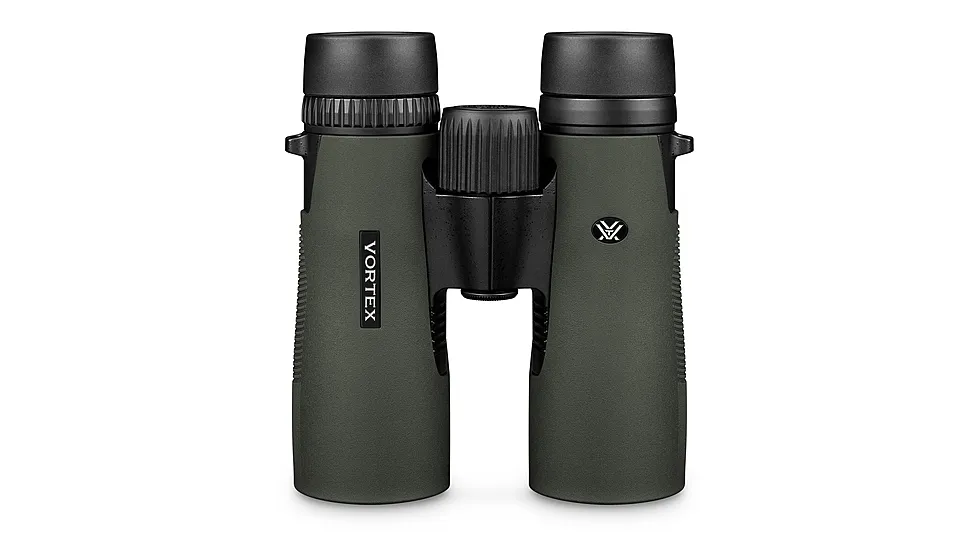
The default pick: Vortex Diamondback HD 10x42
Roof prism · 10x42 · HD glass · phase-corrected + dielectric · 21.3 oz
around $220exact price on OpticsPlanet
This is the Vortex binocular most readers should buy, and the reason is what it adds over the Triumph HD without asking for Viper money. It keeps the full coating stack, HD glass on dielectric, phase-corrected roof prisms, and moves it onto a magnesium chassis at 21.3 oz, the lightest 10x42 in the Vortex line we card. Close focus drops from the Triumph's 15.3 ft to 5 ft, which turns it into a wildlife and birding pair as well as a hunting one, and it is argon-purged and waterproof with ArmorTek on the exposed glass. The price of the step is eye relief. At 15 mm it is less than the Triumph's 17 mm, so check it first if you wear thick glasses. One owner who compared it against their Nikon ProStaff 3s and 7s wrote the line that sums it up, quoted below. On the listing, the buy box shows the camo DB-215-OBL alongside the green DB-215 we card; it is the same binocular in a different finish at a higher price, so confirm the MPN before you order.
Pros
- HD glass with dielectric and phase-corrected prisms on a magnesium chassis, at 21.3 oz the lightest 10x42 in the Vortex line we card
- A 5 ft close focus, against 15.3 ft on the Triumph HD, so it works for near wildlife as well as long glassing
- An owner comparing it side by side found it slightly brighter than their Nikon ProStaff 7s in a smaller body
- Argon-purged and waterproof, fogproof and shockproof, with ArmorTek on the exterior lenses
Cons
- 15 mm eye relief is the tightest of the 10x42s on this page, the one specification to check if you wear thick eyeglasses
- The rubber on the eyecups is stiff, which an owner raised specifically against softer Nikon eyecups
- One owner who otherwise likes it calls the included harness "pretty much useless" while rating the case and neck strap fine; others list the kit as a plus
- The buy box mixes the green and camo finishes, so the first price shown is not always the model we card
Best for: nearly everyone: hunting, hiking, travel and general glassing, with a close focus short enough for wildlife. Step to the Viper HD if you wear glasses and glass for hours.
Key specifications
| Magnification | 10x |
|---|---|
| Objective lens | 42 mm |
| Prism | Roof, BAK4, phase-corrected + dielectric |
| Glass | HD, fully multi-coated, ArmorTek exterior lens coating |
| Eye relief | 15 mm |
| Exit pupil | 4.2 mm |
| Field of view | 330 ft at 1000 yds (6.3 degrees) |
| Close focus | 5 ft |
| Weight | 21.3 oz |
| Chassis | Magnesium alloy |
| Sealing | Argon-purged; waterproof, fogproof, shockproof |
| In the box | GlassPak harness + case, neck strap, covers, cloth |
| Warranty | Vortex VIP: unlimited, unconditional, lifetime |
| MPN carded | DB-215 (green). The camo DB-215-OBL is the same binocular in a different finish |
“The Vortex Diamondbacks impressed me because they are much smaller than my 7s, slightly smaller than my 3s, but have a slightly brighter picture than my Prostaff 7s”
Jon, verified owner (AR) via OpticsPlanet
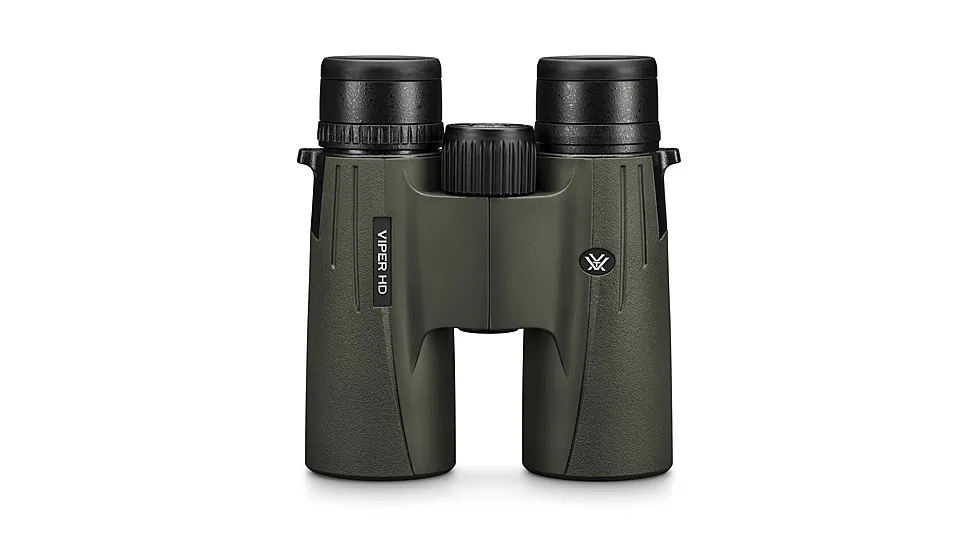
Best step-up: Vortex Viper HD 10x42
Roof prism · 10x42 · HD glass · XR Plus fully multi-coated · locking diopter · 24.9 oz
around $410exact price on OpticsPlanet
The Viper HD is the rung where Vortex spends on comfort and coatings rather than on weight. Against the Diamondback HD 10x42 it moves to XR Plus fully multi-coated HD lenses on dielectric, phase-corrected prisms, widens the field of view from 330 to 341 ft at 1000 yds, raises eye relief from 15 to 17 mm and adds a locking diopter, so a knock in the truck does not undo your diopter setting. That eye relief figure is the one that decides it for eyeglass wearers who glass for hours. The cost is carry weight and close focus: 24.9 oz against 21.3, and a 6 ft close focus (Vortex’s figure) against 5. Owners describe it in working terms. One who used it for three days on a varmint hunt singled out the fitted moving parts and the locking diopter ring, quoted below.
Pros
- XR Plus fully multi-coated HD lenses on dielectric, phase-corrected prisms, a coating tier above the Diamondback HD
- 17 mm of eye relief and a 341 ft field of view, both more than the Diamondback HD 10x42
- A locking diopter, so your diopter setting survives being carried, stowed and knocked around
- The same VIP warranty and included GlassPak harness as the cheaper rungs
Cons
- Roughly twice the price of the Diamondback HD 10x42 for a difference that is real but incremental
- At 24.9 oz it is 3.6 oz heavier than the Diamondback HD 10x42, which is felt on an all-day carry
- A 6 ft close focus (Vortex) is longer than the Diamondback HD's 5 ft, so it is the weaker of the two for near wildlife
- The Triumph HD at the bottom of the line already has the same 17 mm of eye relief, so eye relief alone does not justify the step
Best for: eyeglass wearers and long glassing sessions, and anyone who wants better coatings without a four-figure price. Stay on the Diamondback HD if weight and close focus matter more.
Key specifications
| Magnification | 10x |
|---|---|
| Objective lens | 42 mm |
| Prism | Roof, dielectric + phase-corrected |
| Glass | HD, XR Plus fully multi-coated |
| Eye relief | 17 mm |
| Exit pupil | 4.2 mm (42 divided by 10) |
| Field of view | 341 ft at 1000 yds (6.5 degrees) |
| Close focus | 6 ft |
| Weight | 24.9 oz |
| Diopter | Locking, plus or minus 4 |
| Warranty | Vortex VIP: unlimited, unconditional, lifetime |
“The moving parts are well fitted and the locking diopter ring is a nice touch. My hunting partners all remarked on the clarity of the glass.”
West Coast Sportsman, verified owner (CA) via OpticsPlanet
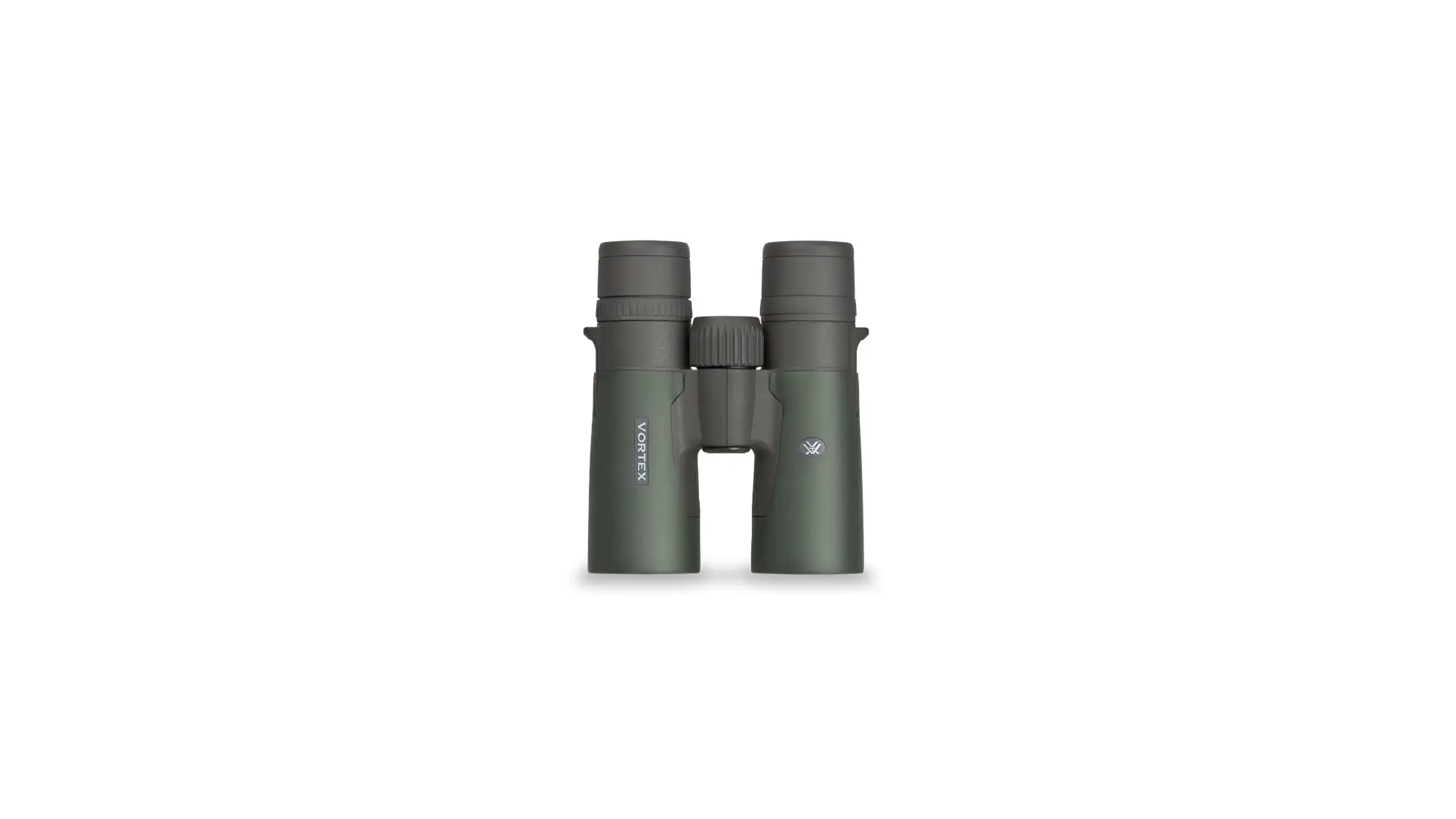
The premium rung: Vortex Razor HD 10x42
Roof prism · 10x42 · HD glass · XR Plus coatings · magnesium chassis · 24.8 oz
around $1,000exact price on OpticsPlanet
The Razor is the top of the line, and the Razor HD 10x42 is the first Vortex binocular on this page with an independent laboratory measurement behind it: AllBinos recorded 86.8 percent light transmission. It widens the field of view again, to 362 ft at 1000 yds, keeps a generous 16.5 mm of eye relief, and puts XR Plus coatings on HD glass in a 24.8 oz magnesium body. Owners have been comparing it with much dearer glass for years. One ran it beside a Leica Trinovid 8x42 for three days with four other people, in daylight and late twilight, and the group voted the two equal. The honest counterweight is low light. Owners split on it, and a likely reason is physical: a 4.2 mm exit pupil is narrower than a dark-adapted pupil, so at true dawn and dusk the Razor HD 8x42 gathers more. The Razor family also has a second line, the UHD, with a different prism; our Razor binoculars guide decodes the two.
Pros
- The only Vortex binocular on this page with an independent lab measurement: 86.8 percent light transmission (AllBinos)
- A 362 ft field of view, the widest of the 10x42s on this page, with 16.5 mm of eye relief
- The deepest owner record of the Razor line, running from 2013 to 2026, including a three-day group comparison with a Leica Trinovid that ended in a tie
- One owner reports the VIP warranty honoured on a pair they bought second-hand
Cons
- Owners split on low-light performance: a 4.2 mm exit pupil is the likely reason, and the Razor HD 8x42 is the better buy if dawn and dusk are your hours
- More than four times the price of the Diamondback HD 10x42; two owners list price as their con and a third calls it not worth the money
- At 24.8 oz it is 3.5 oz heavier than the Diamondback HD 10x42
Best for: buyers who glass long enough to notice coatings and want the most measured glass in the Vortex line we card. Choose the Viper HD if the budget is the limit.
Key specifications
| Magnification | 10x |
|---|---|
| Objective lens | 42 mm |
| Prism | Roof, BAK4, dielectric + phase-corrected |
| Glass | HD (extra-low dispersion), XR Plus fully multi-coated |
| Eye relief | 16.5 mm |
| Exit pupil | 4.2 mm (42 divided by 10) |
| Field of view | 362 ft at 1000 yds (6.9 degrees) |
| Measured transmission | 86.8 percent (AllBinos independent laboratory measurement, not a manufacturer figure) |
| Close focus | 6 ft |
| Weight | 24.8 oz |
| Chassis | Magnesium, rubber armour |
| MPN carded | RZB-2102 (green). This is the Razor HD line, not the Razor UHD |
| Warranty | Vortex VIP: unlimited, unconditional, lifetime |
“Opinions were split and wandered back and forth as to which was brightest and which had the best resolution. Final vote was that they were equal”
bladepeek (MI) via OpticsPlanet, comparing it with a Leica Trinovid 8x42
Looking at the Razor line in more depth? The Razor HD and the Razor UHD share a name but use different prisms, and our Vortex Razor binoculars guide decodes the two, including the Razor HD 8x42 for low light.
Which size: 8x42, 10x42 or 12x50
Pick the size before the line, because the size decides how the binocular behaves in the hours you use it. Exit pupil is the objective divided by the magnification, and it sets how much light reaches your eye at dawn and dusk.
- 8x42: a 5.25 mm exit pupil and the widest view. The Diamondback HD 8x42 shows 393 ft at 1000 yds against 330 ft for the 10x42, with 17 mm of eye relief and a 5 ft close focus. Best for birding, woods hunting and low light. See our Diamondback HD 8x42 review and best 8x42 binoculars.
- 10x42: a 4.2 mm exit pupil and more reach, still light enough to carry all day. The all-round choice. See best 10x42 binoculars, and 8x42 vs 10x42 if you are torn between the two.
- 12x50: more magnification, the same 4.2 mm exit pupil as a 10x42, and more weight: the Diamondback HD 12x50 weighs 28.9 oz against 21.3 for the 10x42, with a 271 ft field. Best from a steady position. See best 12x50 binoculars and our Diamondback HD 10x42 vs 12x50 comparison.
Torn between two rungs in the same size? Our Diamondback HD vs Viper HD comparison covers the step most buyers argue about.
What the VIP warranty covers
The warranty is the same on every line on this page, so it should not decide between them, but it does change the maths of buying any of them. In Vortex's own warranty text, as published on the retailer's product pages and on Vortex's warranty page, the company will repair or replace a damaged or defective product at no charge, and "it doesn't matter how it happened, whose fault it was, or where you purchased it." The same text lists it as fully transferable, with no warranty card and no receipt needed.
The limits are written down too, and they are worth knowing before you rely on it: the VIP warranty "does not cover loss, theft, deliberate damage or cosmetic damage that does not hinder the performance of the product." Owners report it working in practice. One Razor HD owner who bought their pair second-hand describes Vortex refurbishing it after a Dall sheep hunt left it dirty, sticky and with a bent eyepiece cover.
Which Vortex binocular should you buy?
- Most buyers: the Diamondback HD 10x42. Full prism coatings, the lightest 10x42 on this page and a 5 ft close focus.
- Tight budget or a first pair: the Triumph HD 10x42. Same prism coatings on paper, more eye relief, but heavier and with a distant close focus.
- You want 12x for the least money: the Crossfire HD 12x50, knowing it is a format step, not a glass step.
- You wear glasses and glass for hours: the Viper HD 10x42, for 17 mm of eye relief, a 341 ft field and a locking diopter.
- You want the best measured glass Vortex makes in this size: the Razor HD 10x42, or the Razor HD 8x42 if you glass mostly at dawn and dusk.
- You want to range as well as glass: the Ranger HD 3000, and compare it in our best rangefinding binoculars guide.
FAQ
Which Vortex binoculars are the best value?
The Diamondback HD 10x42 for most buyers. It carries HD glass on dielectric, phase-corrected roof prisms, the same coating stack Vortex lists for the dearer Viper HD prisms, on a magnesium chassis at 21.3 oz, with a 5 ft close focus. The Triumph HD 10x42 below it lists the same two prism coatings and costs less, but it weighs 22.9 oz and only focuses down to 15.3 ft. The Viper HD above it adds a locking diopter, 17 mm of eye relief and a 341 ft field of view for roughly twice the money.
What is the difference between Vortex Diamondback HD and Viper HD binoculars?
In the 10x42 size, the Viper HD moves to XR Plus fully multi-coated lenses, widens the field of view from 330 to 341 ft at 1000 yds, raises eye relief from 15 to 17 mm and adds a locking diopter. The Diamondback HD is lighter at 21.3 oz against 24.9 and focuses closer, 5 ft against 6. If you wear glasses or glass for hours, the Viper earns its price. If you carry all day or watch things nearby, the Diamondback is the better binocular for you.
Are Vortex Triumph HD binoculars good?
Yes, as an entry pair, and better than the price suggests on paper. Vortex lists an HD optical system, dielectric prism coatings and phase correction for the Triumph HD 10x42, and it has 17 mm of eye relief, as much as the Viper HD. Owners rate it 4.8 out of 5 across 56 reviews on OpticsPlanet. Its real limits are a 15.3 ft close focus and objective covers that owners say work loose.
What does the Vortex VIP warranty cover?
Vortex says it will repair or replace the binocular at no charge if it becomes damaged or defective, and that it does not matter how it happened, whose fault it was, or where you purchased it. The warranty is fully transferable and needs no warranty card or receipt. It does not cover loss, theft, deliberate damage, or cosmetic damage that does not hinder the performance of the product.
Should I buy Vortex 10x42 or 12x50 binoculars?
Buy the 10x42 if you carry the binocular all day or glass handheld, and the 12x50 if you glass from a steady position and want more reach. A 12x50 does not give you a bigger exit pupil than a 10x42: 50 divided by 12 and 42 divided by 10 both come to about 4.2 mm. What it adds is magnification, and it costs weight: the Diamondback HD 12x50 weighs 28.9 oz against 21.3 for the 10x42, with a narrower 271 ft field of view.
Which Vortex binoculars are best if I wear glasses?
Check eye relief rather than the line name, because in the Vortex range it does not rise with price. Among the 10x42 cards on this page, the Triumph HD and the Viper HD both have 17 mm, the Razor HD has 16.5 mm and the Diamondback HD has 15 mm. The Diamondback HD 8x42 has 17 mm as well. If you wear thick glasses, start from those figures.
Related: best binoculars for hunting · best budget binoculars · Vortex Razor binoculars decoded · Nikon binoculars decoded · Bushnell binoculars decoded.