Zeiss Conquest HDX review: the 10x42, and when the 8x42, 15x56 or LRP 15x56 is the better pick
Our verdict: 4.5/5. The Zeiss Conquest HDX 10x42 is a light, sealed, all-round roof prism binocular, and it is the model we review here. Zeiss lists it at 715 g (25.2 oz) and 150 mm long, with 90 % light transmission, a 4.2 mm exit pupil, a 345 ft field of view at 1,000 yards, a locking diopter and a focus wheel that needs 1.3 rotations for its full range. OpticsPlanet shoppers rate it 5.0 out of 5 from 3 reviews, and reviewers single out sharp, clear glass. It loses half a point for what to know first: the owner record is tiny, one reviewer sees some color fringing and softness toward the edge of the view, and the lens caps draw complaints on both 42 mm listings. If you hunt woods or low light, read the 8x42 section; for long-range glassing from a tripod, the 15x56, and for spotting at rifle matches, the LRP 15x56 with its mil reticle. For Zeiss's lightweight premium line, see our Zeiss SFL review.
The 10x42 listing (part 524215-0000-000) sells for around $800. Check price and availability on OpticsPlanet; confirm the current price on the retailer page.
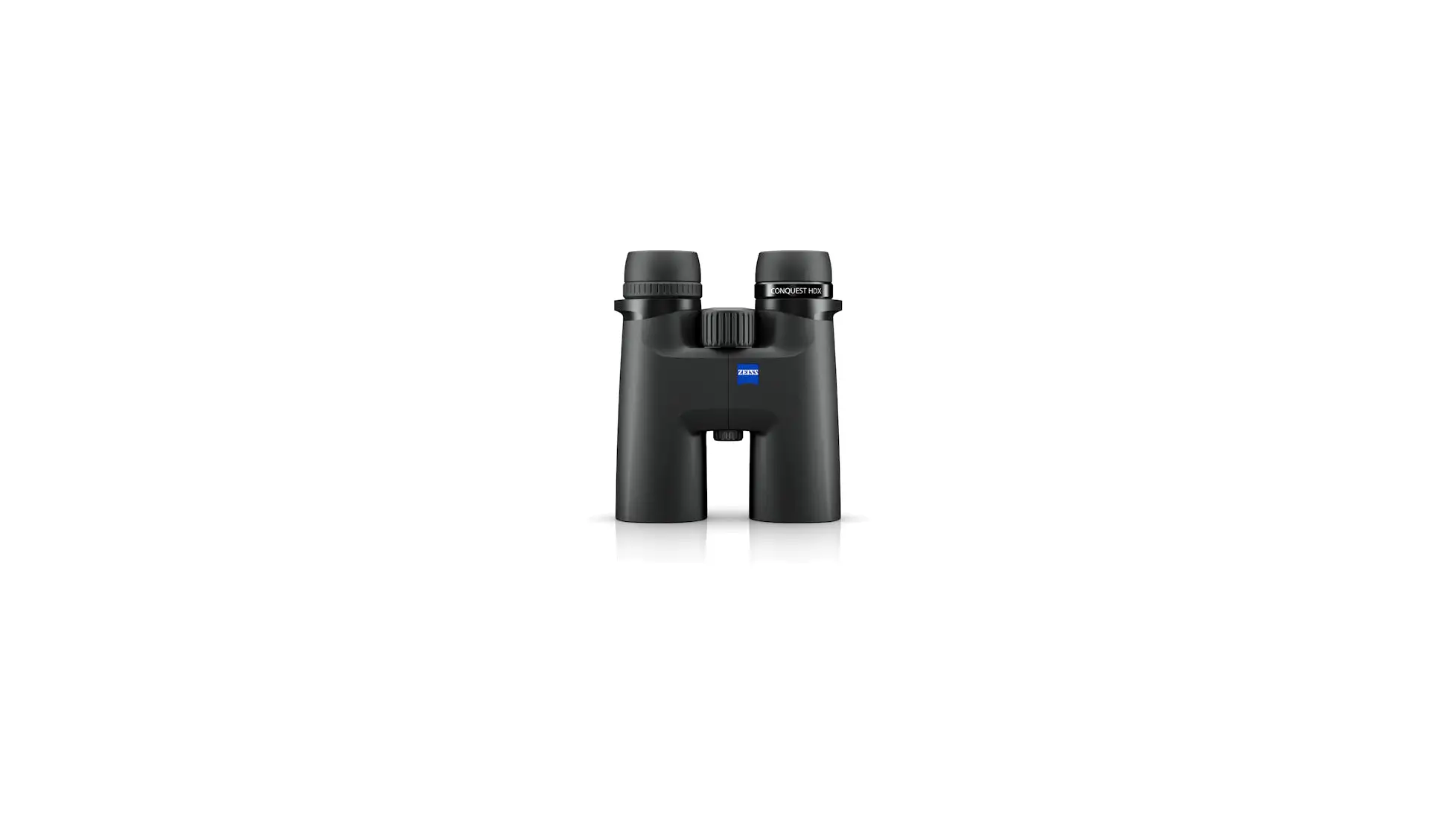
How we reviewed it: a research-based review built from the retailer's listings for four Conquest HDX models, every owner review those listings show (3 for the 10x42, 2 for the 8x42, 1 each for the 15x56 and the LRP 15x56), Zeiss's technical data for each size, Zeiss's page for the LRP 15x56, Zeiss's announcement of the 15x56 models and Zeiss's online shop pages for all four. Where the retailer's specification table disagrees with Zeiss, we print Zeiss's figure and say so. Third-party research leads we could not confirm on a Zeiss page were left out. We have not field-tested these binoculars; the score is our editorial opinion and owner ratings are shown attributed to their source. See how we evaluate.
What the Conquest HDX line is
Conquest HDX is a Zeiss binocular line in seven sizes in Zeiss's technical data: 8x32, 10x32, 8x42, 10x42, 8x56, 10x56 and 15x56, plus the LRP 15x56 with a reticle, which Zeiss covers on its own page. OpticsPlanet has a separate listing for each. This page covers four of them; the retailer also lists the 8x32, 10x32, 8x56 and 10x56, which we have not reviewed. Zeiss announced the 15x56 and the LRP 15x56 in a news release dated 14 January 2025.
Zeiss's online shop sums up the build in a few lines: “ED glass, aspheric lenses and FieldFlattener Technology for edge-to-edge sharpness”, a “Durable and lightweight magnesium housing with full rubber armoring”, “Adjustable and removeable eyecups, locking diopter, removable flip-down lens covers” and a “Fast, smooth, and precise focus wheel – with only 1.3 rotations.” Those are Zeiss's claims, not measurements of ours.
The prism changes with size. The retailer's listings name a Schmidt-Pechan prism on the 10x42 and 8x42 and an Abbe-Koenig prism on both 15x56 models. Our roof prism vs porro prism guide explains why Zeiss uses the compact Schmidt-Pechan in the smaller HDX models and the Abbe-Koenig in the 56 mm ones. Not to be confused with the older Conquest HD binoculars, the Zeiss SFL line (see our Zeiss SFL review) or the Conquest V4 riflescope.
What the three 10x42 reviewers say: sharp, clear glass
The 10x42 listing shows 3 reviews and we could read all of them. All three carry five stars in the retailer's rating field; two reviewers carry the Verified Owner tag. The tagged reviews are from January and April 2026. The most recent comes from Southeast Alaska:
“Been running these in Southeast Alaska and they’ve held up well in wet, rough conditions.”
Mountain Ghost (AK), verified owner, via OpticsPlanet
The same reviewer writes “Glass is sharp with good low light performance, and they’re comfortable for long glassing sessions.” The second tagged reviewer, from Minnesota, is clear that it is a first impression: “Have not had a chance to use them in the field yet but first impressions are really good.” and “Checking them out in backyard they are very crisp and clear.”
The third review is the most detailed of the three and the only balanced one. It sits in the retailer's Most Helpful box, which shows the reviewer, Robert from Indiana, with no date and no Verified Owner tag. On the glass: “On axis performance is excellent.” On the build: “Locking diopter works well.” and “Body armor, overall 'feel' and balance are top notch.” The retailer shows five stars; the review text itself ends “Overall 4.5/5 stars.”
The honest catches: edges, lens caps, a tiny record
Color fringing and soft edges (10x42, one reviewer). Robert, the same reviewer, notes two optical compromises:
“Some chromatic aberration at the periphery but you have to work to see it. Some loss of sharpness at the edges.”
Robert (IN), reviewer, via OpticsPlanet
That is one reviewer, one unit, and they qualify it themselves. Zeiss credits its FieldFlattener with “edge-to-edge sharpness”; this reviewer's eyes saw some loss at the edges. Robert also writes that the “Focuser is solid but there are better out there” and that the adjustable eyecups “are good, not great.”
The lens caps. This is the one point raised on both 42 mm listings: three of the five reviews on the 10x42 and 8x42 mention the caps. Robert writes “Objective cap covers could use some improvement - they're finicky to place and not really solid after connecting.” An 8x42 owner lists the dust caps as a con, and a second 8x42 owner finds the caps get in the way of the case (both quoted in the 8x42 section below). Three short comments are not a pattern, but they agree.
A tiny owner record. The four listings hold 7 reviews between them. The 10x42's 5.0 average is three reviews, one of them written before the reviewer had used it in the field.
The retailer's 10x42 spec table. It lists an exit pupil of 5.6 mm, a length of 210 mm and a weight of 44.1 oz. Zeiss's figures for the 10x42 are 4.2 mm, 150 mm and 715 g (25.2 oz), and 42 divided by 10 is 4.2. The three retailer figures are the ones Zeiss publishes for the 10x56. Use Zeiss's numbers.
Trade-offs, plainly
- A 4.2 mm exit pupil and 345 ft field of view on the 10x42 against 5.3 mm and 384 ft on the 8x42 (Zeiss): the 10x42 trades some low-light brightness and width of view for reach.
- One 10x42 reviewer sees some color fringing at the periphery and some loss of sharpness at the edges.
- Lens caps: one 10x42 reviewer and one 8x42 owner find them hard to seat; a second 8x42 owner says the case foam does not fit with the caps installed.
- Close focus of 2.0 m (6.6 ft) on the 42 mm models and 3.5 m (11.5 ft) on the 15x56 models (Zeiss), if you watch birds or insects up close.
- Zeiss publishes two eye relief figures for the 42 mm models (16.5 mm and 18 mm, see below); if you wear glasses, check with Zeiss.
- Only 7 owner reviews across the four listings, and a single review on each 15x56 model.
Which Conquest HDX: 10x42, 8x42, 15x56 or LRP 15x56
The four models are separate retailer listings with different part numbers, all black. The optical figures below are Zeiss's technical data for each model; rating and price come from each model's own listing. Exit pupil is checked by arithmetic (objective divided by magnification).
| Spec | 10x42 (524215-0000-000) | 8x42 (524214-0000-000) | 15x56 (525636-0000-000) | LRP 15x56 (525636-9901-000) |
|---|---|---|---|---|
| Prism (retailer listing) | Schmidt-Pechan | Schmidt-Pechan | Abbe-Koenig | Abbe-Koenig |
| Exit pupil | 4.2 mm | 5.3 mm | 3.7 mm | 3.7 mm |
| Twilight factor | 20.5 | 18.3 | 29.0 | 29.0 |
| Field of view at 1,000 yd | 345 ft | 384 ft | 240 ft | 240 ft |
| Field of view at 1,000 m | 115 m | 128 m | 80 m | 80 m |
| Close focus | 2.0 m (6.6 ft) | 2.0 m (6.6 ft) | 3.5 m (11.5 ft) | 3.5 m (11.5 ft) |
| Eye relief | 16.5 mm (zeiss.com) / 18 mm (Zeiss shop) | 16.5 mm (zeiss.com) / 18 mm (Zeiss shop) | 18.0 mm | 18.0 mm |
| Weight | 715 g (25.2 oz) | 715 g (25.2 oz) | 1,280 g (45.2 oz) zeiss.com / 44.6 oz Zeiss shop | 1,280 g (45.2 oz) zeiss.com / 44.6 oz Zeiss shop |
| Length / width | 150 / 119 mm | 150 / 119 mm | 210 / 145 mm | 210 / 145 mm |
| Reticle | None | None | None | Milliradian, etched |
| Tripod adapter in the box | Not in Zeiss's box list | Not in Zeiss's box list | Yes (Zeiss shop box list) | Yes, Arca-Swiss compatible (Zeiss) |
| OpticsPlanet rating | 5.0/5 from 3 reviews | 4.5/5 from 2 reviews | 5.0/5 from 1 review | 5.0/5 from 1 review |
| Price | around $800 | around $800 | around $1,550 | around $1,600 |
All four share, per Zeiss: 90 % light transmission, a -4.0 to +4.0 dpt diopter range, nitrogen filling, LotuTec, water resistance of 400 mbar and an operating temperature of -20 to +63 °C (-4 to +145 °F). Width is measured at 65 mm interpupillary distance. Zeiss calls eye relief "exit pupil distance" on zeiss.com and "eye relief" on its shop; for the 42 mm models the two Zeiss sites give different numbers, and we print both. Interpupillary distance is 54 to 74 mm on the 42 mm models; for the 15x56 models zeiss.com says 56 to 74 mm and the Zeiss shop 54 to 74 mm.
8x42
The 8x42 (part 524214-0000-000) shares the 10x42's body in Zeiss's data, 715 g (25.2 oz) and 150 mm long, and trades 2x of magnification for a 5.3 mm exit pupil (42 / 8 = 5.25) and a wider 384 ft field of view. Zeiss's shop lists the same box contents as the 10x42, with no tripod adapter. The retailer shows the same photo for this listing as for the 10x42, so we do not repeat it here.
Its owner record is 2 reviews, one four-star and one five-star, both Verified Owner, from November 2025, so close to a year old. The four-star owner bought it to replace an old Bushnell 7x50, mainly for Michigan hunting, and had logged about 10 hunts with it when they wrote. Among the pros they list “Super crisp and clear!” and “Unlike my Bushnell binocs, I had no problems with lens fogging”. Among the cons:
“The dust caps need improvement. They are somewhat difficult to seat properly and keep seated.”
Ken (MI), verified owner, via OpticsPlanet
The same owner notes it is “Not quite as bright in low light as a 7x50 but understandably, this is a function of the difference in optics than a fault of Zeiss”. On choosing between the two 42s, they write “I find the 8x42 to be a good fit for Michigan hunting (combination of open fields and wooded or brush settings).” and “Out west hunting, the 10x42 might be a better choice.” The five-star owner likes the binoculars and has one note about the case: “The zippered case that comes with the binocs have foam pads that the binoculars fit in for storage. They don’t fit on the binoculars once the caps are installed”.
For a broader look at the format, see our best 8x42 binoculars guide and 8x42 vs 10x42.
15x56
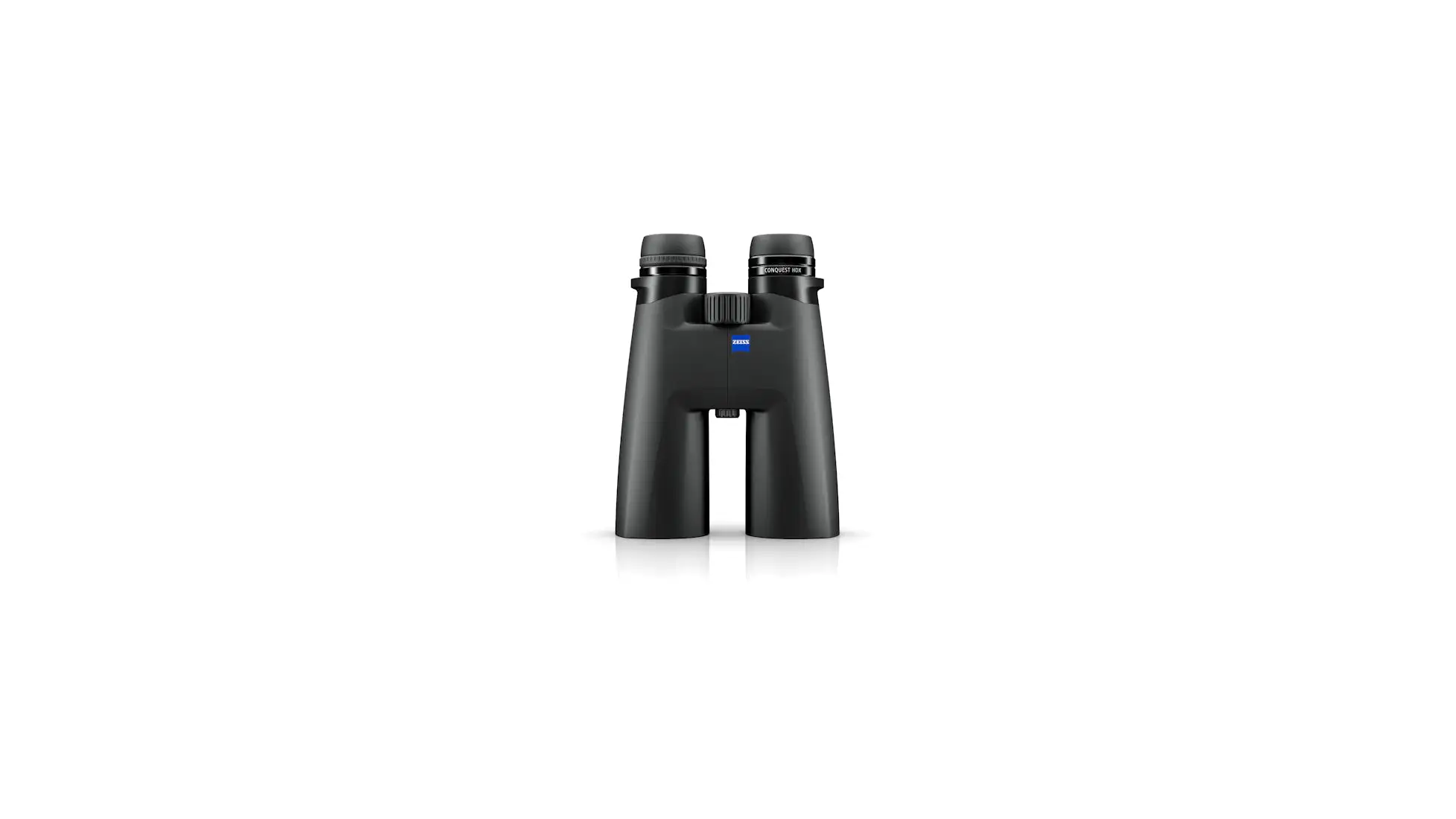
The 15x56 (part 525636-0000-000) is the long-range model: 15x with a 3.7 mm exit pupil (56 / 15 = 3.73), a 240 ft field of view and a 29.0 twilight factor, in a 210 mm body (both Zeiss weights are in the table above). Zeiss's shop lists a tripod adapter in the box. Our reasoning, not a source: at 15x every tremor of your hands is magnified fifteen times, so plan on using that adapter.
Its owner record is a single five-star review, without the Verified Owner tag, from December 2025:
“Crystal clear detail and focus. I love the tripod adapter option.”
Duane Hurst (PA), reviewer, via OpticsPlanet
One review is one opinion.
LRP 15x56 with milliradian reticle
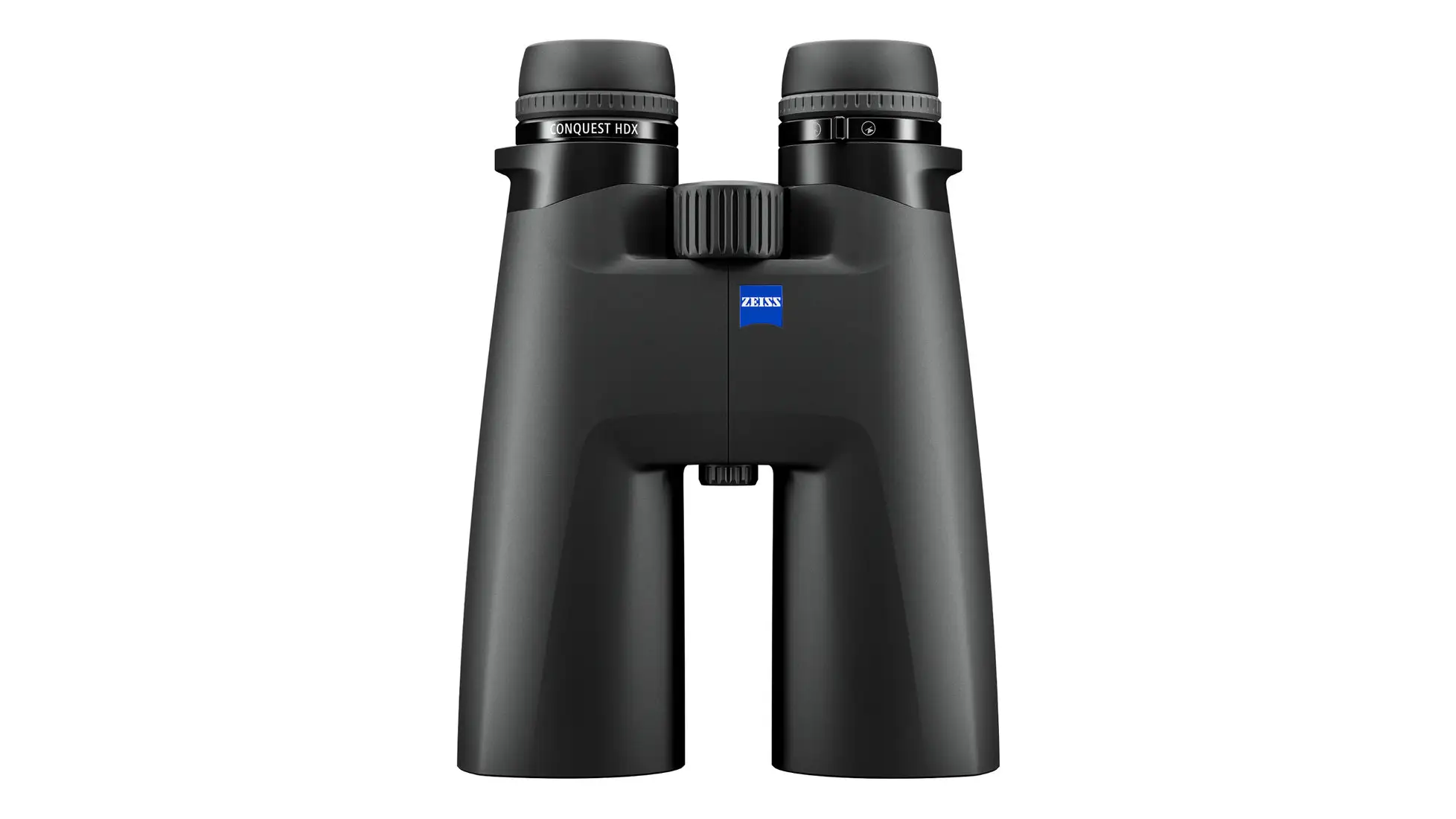
The LRP 15x56 (part 525636-9901-000) has the same optical figures as the standard 15x56 in Zeiss's technical data, and adds a reticle for spotting at rifle matches. Zeiss says it is “Tailored to enhance the performance of competitors in Precision Rifle Series (PRS) and National Rifle League (NRL) events.” What the LRP adds, in Zeiss's words:
- The reticle: “An advanced milliradian reticle etched onto the internal lens, helps shooters assess bullet impacts, lead moving targets, and make wind calls in competitions.” Zeiss describes a T-style and tree-style design with a floating center dot, offering 10.0 MRAD of windage and 5.0 MRAD of drop.
- Riflescope match: Zeiss calls it “a perfect complement to the ZEISS ZF-MRi reticle offered in our LRP S5 and S3 riflescopes (and similar MRAD reticles, too).” Our Zeiss LRP S3 review covers that riflescope.
- Leveling: “a lever at the top of the left ocular for easy and quick reticle leveling”.
- Two diopters: “two locking diopter adjustments – one for sharpening the reticle and the other for achieving a focused view across the entire field of view.”
- Tripod: a 1/4-20 tripod adapter port, and Zeiss says the binocular “includes an Arca-Swiss compatible adapter”. The retailer's package contents list the binocular, case, strap and tripod adaptor.
The retailer's LRP table says 42.5 oz, an 18 mm exit pupil and a field of view in yards at 1,000 feet. Zeiss gives the LRP the same weights as the standard 15x56, 56 divided by 15 is 3.7 mm, and Zeiss gives 240 ft at 1,000 yards, so we use Zeiss's figures.
Its owner record is a single five-star review from a verified owner, posted in September 2026:
“Glass quality is excellent and reticle is perfect for measuring targets and speed of movers.”
RobW (MO), verified owner, via OpticsPlanet
One review is one opinion. If you are new to mil math, our mil-dot ranging calculator shows how a mil reading turns into a distance.
Key specifications: 10x42 (part 524215-0000-000)
| Magnification / objective | 10x / 42 mm |
|---|---|
| Part number (this listing) | 524215-0000-000, black |
| Prism (retailer listing) | Schmidt-Pechan |
| Exit pupil | 4.2 mm (42 / 10 = 4.2) |
| Twilight factor | 20.5 |
| Field of view | 115 m at 1,000 m (345 ft at 1,000 yd), 66° angular |
| Close focus | 2.0 m (6.6 ft) |
| Eye relief | 16.5 mm (zeiss.com, "exit pupil distance"); 18 mm (Zeiss online shop) |
| Diopter range | -4.0 to +4.0 dpt; locking diopter (Zeiss shop) |
| Interpupillary distance | 54 to 74 mm |
| Light transmission | 90 % |
| Weight | 715 g (25.2 oz) |
| Length / width at 65 mm IPD | 150 mm (5.9 in) / 119 mm (4.7 in) |
| Sealing | Nitrogen filled, LotuTec, water resistance 400 mbar |
| Operating temperature | -20 to +63 °C (-4 to +145 °F) |
| Focus | 1.3 rotations of the focus wheel (Zeiss shop) |
| Housing | Magnesium with full rubber armoring (Zeiss shop) |
| In the box (retailer listing) | Binocular, neck strap, cleaning cloth, flip-down lens caps, carrying case with strap |
| Country of origin (Zeiss shop) | Japan |
Figures are Zeiss's technical data for the Conquest HDX 10x42 unless marked as the Zeiss online shop or the retailer listing. Zeiss's online shop lists the box as “Binocular, Carrying case with strap, Protection cap for eyepiece, Protection cap lens, Neck strap, Cleaning cloth, Quick guide and Safety instruction” and names the ZEISS Transferable Limited Lifetime Warranty and Transferable Five-Year No-Fault Policy. On awards: we found none we could confirm on a primary source, so we claim none.
Should you buy it, and what else to consider
- Buy the 10x42 if you want one light binocular for open-country hunting and general glassing. Skip it if edge-to-edge sharpness matters more to you than anything else; one reviewer sees some softness and fringing at the edges.
- Buy the 8x42 if you hunt woods, brush or low light; it has the larger exit pupil and the wider view at the same weight.
- Buy the 15x56 if you glass long distances from a tripod; Zeiss's box list includes the adapter.
- Buy the LRP 15x56 if you spot for PRS or NRL style matches and want a mil reticle in your binocular.
- Comparing the field? Our best binoculars for hunting guide ranks other 10x42s, the best binoculars for long distance guide covers high-magnification options, and the Vortex Razor binocular guide covers another premium line. For choosing a size, see how to choose binoculars and our guide to binocular numbers. For a Zeiss riflescope, see our Zeiss Conquest V4 review.
FAQ
Is the Zeiss Conquest HDX a good binocular?
The owner record is positive and very small. On OpticsPlanet the 10x42 is rated 5.0 out of 5 from 3 reviews, the 8x42 4.5 from 2, and the 15x56 and the LRP 15x56 5.0 from a single review each. Reviewers praise sharp, clear glass. The cautions come from the same few voices: one 10x42 reviewer sees some color fringing and softness at the edges of the view, and three reviewers across the 10x42 and 8x42 listings find the lens caps fiddly or say the caps get in the way of the case. Seven reviews across four listings is too few to call anything a pattern.
Zeiss Conquest HDX 8x42 or 10x42?
Zeiss lists both at 715 g (25.2 oz) and 150 mm long, so the choice is optical. The 8x42 has a 5.3 mm exit pupil and a 384 ft field of view at 1,000 yards; the 10x42 has a 4.2 mm exit pupil and 345 ft. Our reading of those numbers: the 8x42 for woods, low light and a wider view, the 10x42 for open country where you need more reach. One 8x42 owner who hunts Michigan writes that the 10x42 might be a better choice out west.
What is the difference between the Conquest HDX 15x56 and the LRP 15x56?
Both are 15x56 binoculars with an Abbe-Koenig prism on the retailer's listings and the same optical figures in Zeiss's technical data. The LRP adds a milliradian reticle etched onto an internal lens, a lever at the top of the left ocular to level the reticle, and two locking diopter adjustments (one for the reticle, one for the view) where Zeiss's shop lists one locking diopter on the standard model. Zeiss says the LRP is tailored to competitors in Precision Rifle Series (PRS) and National Rifle League (NRL) events, and that an Arca-Swiss compatible adapter is included.
How heavy is the Zeiss Conquest HDX?
Zeiss lists the 10x42 and the 8x42 at 715 g (25.2 oz). For the 15x56, Zeiss's technical data says 1,280 g (45.2 oz) while Zeiss's own online shop says 44.6 oz; the LRP 15x56 carries the same two figures on the same two Zeiss sites. The 42 mm models are 150 mm (5.9 in) long, the 15x56 models 210 mm (8.3 in).
Is the Zeiss Conquest HDX waterproof?
Zeiss lists every Conquest HDX size as nitrogen filled, with LotuTec coating, water resistance of 400 mbar and an operating temperature of -20 to +63 °C (-4 to +145 °F).
What warranty does the Zeiss Conquest HDX have, and where is it made?
Zeiss's own online shop pages for the 10x42, 8x42, 15x56 and LRP 15x56 each name the ZEISS Transferable Limited Lifetime Warranty and Transferable Five-Year No-Fault Policy, and each gives Japan as the country of origin. Confirm the terms with Zeiss before you buy.
More binoculars: best binoculars for hunting · best 8x42 binoculars · Zeiss SFL review · best binocular harness · roof prism vs porro prism.