Zeiss LRP S3 review: the 6-36x56 FFP long-range scope, its trade-offs, and when the 4-25x50 is the better pick
Our verdict: 4.5/5. The Zeiss LRP S3 6-36x56 is a first focal plane long-range scope on a 34 mm tube. Zeiss lists 32.0 MRAD (110 MOA) of elevation travel, parallax from 10 m, red/green illumination with five intensity levels, an external locking windage turret and a feature it calls Ballistic Stop, and its own shop gives the country of origin as Japan. OpticsPlanet shoppers rate it 4.9 out of 5 across 8 reviews, and reviewers single out the glass, the controls and the illuminated reticle. It loses half a point for what to know first: Zeiss lists it at 39.1 oz, reviewers on both LRP S3 listings call the eye box tight or small, and the owner record is small. If you shoot long range from a rest and want 36x, it fits. If you dial a lot of elevation, for example for rimfire matches, the 4-25x50 has more travel by Zeiss's numbers. If you hunt with a second focal plane scope and dial in MOA, see our Zeiss Conquest V4 review.
The ZF-MRi row we review here (part 522695-9916-090) sells for around $2,500. Check price and availability on OpticsPlanet; confirm the current price on the retailer page.
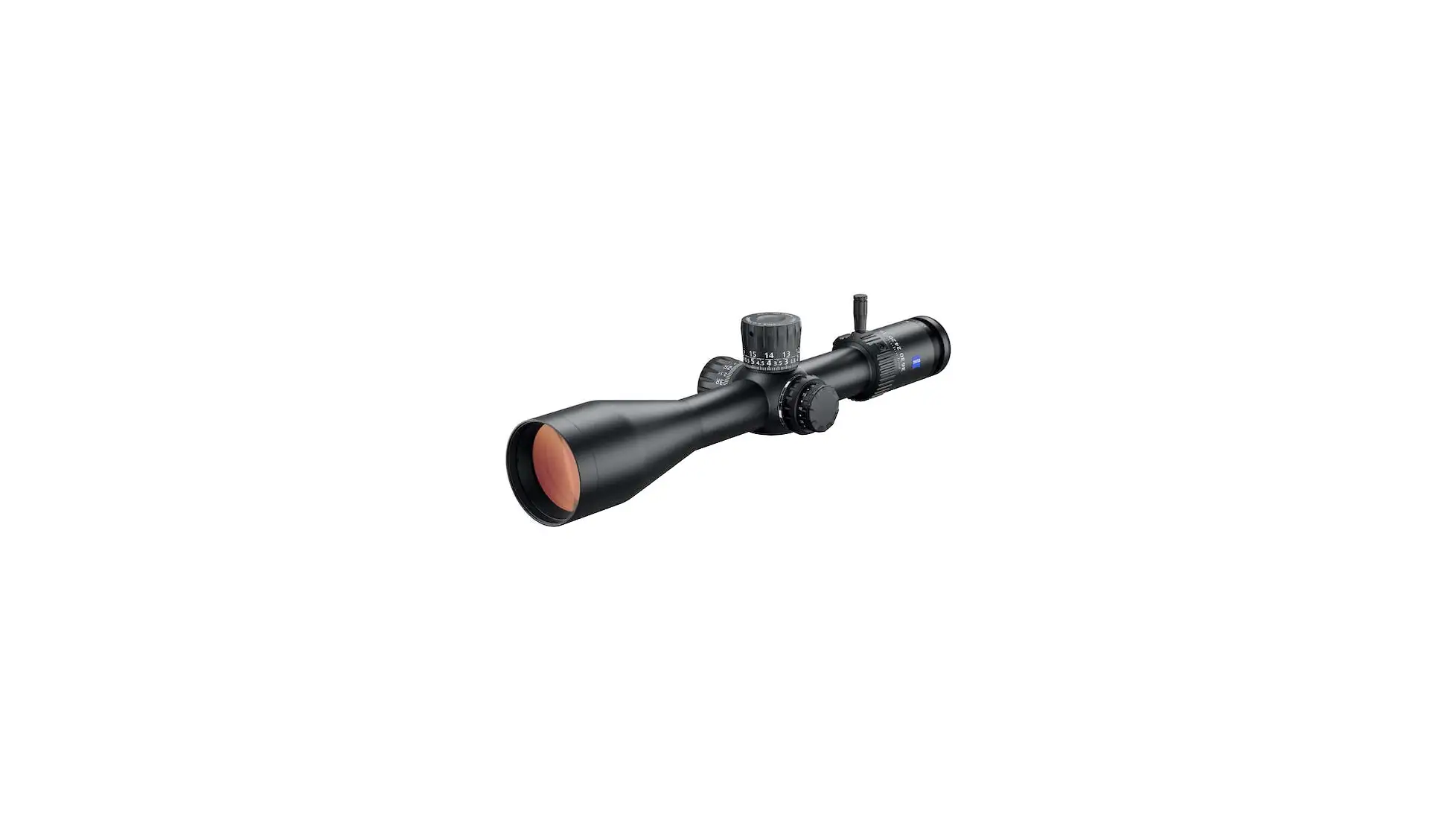
How we reviewed it: a research-based review built from the retailer's specification tables for the two LRP S3 listings, every owner review those listings show (8 for the 6-36x56, 4 for the 4-25x50), and Zeiss's own technical data, shop and warranty pages for the manufacturer figures. Where the retailer and Zeiss disagree, we print Zeiss's figure or leave the number out. Third-party research leads we could not confirm on Zeiss's site, including who builds the scope for Zeiss, how the Ballistic Stop is set, and any competition use, were left out. We have not bench-tested this scope; the score is our editorial opinion and owner ratings are shown attributed to their source. See how we evaluate.
What the LRP S3 line is
The LRP S3 is Zeiss's first focal plane long-range riflescope line. Zeiss's technical data page lists two models, the 4-25x50 (Zeiss calls it 425-50) and the 6-36x56 (636-56), and OpticsPlanet sells each as its own listing. Both share a 34 mm main tube, a 0.1 MRAD or 0.25 MOA click depending on the reticle row, and Zeiss's note that “One revolution equals 10 MRAD or 25 MOA”, with an elevation turret Zeiss describes as having dual row engraving. Zeiss credits the optics to “multi-element ED glass, ZEISS T* lens coating, and 90% light transmission”, and describes the reticle lighting as “Digitally controlled diffractive reticle illumination technology” in red or green with five intensity levels and an auto-off feature.
Each size comes with two reticles: ZF-MRi (MRAD) and ZF-MOAi (MOA). The rows we price on this page are the ZF-MRi rows. Zeiss's shop says the ZF-MRi was “designed with professional input from active competitors and instructors”, and Zeiss's technical data page says of it: “Its purpose is to dominate at PRS and NRL matches.” That is Zeiss's own claim. Because the reticle is in the first focal plane, its marks keep their values at every magnification; our FFP vs SFP guide explains why that matters for holds.
One number to watch on the retailer page. The product description on the 6-36x56 listing quotes 160 MOA or 46.5 MRAD of elevation travel. In Zeiss's technical data that figure belongs to the 4-25x50; Zeiss lists the 6-36x56 at 32.0 MRAD / 110 MOA. If you choose the bigger scope for its elevation, plan on 110 MOA.
Why reviewers rate it: glass, controls, an illuminated reticle
The 6-36x56 listing has 8 reviews and we could read all of them: seven are five stars and one is four stars. Seven of the eight carry the retailer's Verified Owner tag, and two of the eight are from the same reviewer, so they are seven voices, not eight. The reviews run from September 2024 to September 2026. Four reviewers praise the glass, the image or the resolution. One of them compares it with two other scopes they own:
“Clearer glass, easy to operate controls, and the best illuminated reticle.”
Bob (TN), verified owner, via OpticsPlanet
In the same review that reviewer writes, in their own words, “This beats my Leopold Mark V HD and my Vortex Strike Eagle by a mile.” Another reviewer lists “Great turret feel” and “Nice, usable reticle” among the pros, and a third places it “Hot on the heels of the Vortex Razor Gen III.” Those are reviewers' opinions, not measurements.
The illumination draws specific comments. The four-star reviewer writes that “The illumined recital is more than indicated in the pictures” and adds:
“Points on the drop compensation recital are illuminated as well as the center cross hairs.”
Jake Rae (CO), verified owner, via OpticsPlanet
Zeiss describes it differently: its shop pages for both rows say “Only the center section of the reticle illuminates for a most precise point of aim.” We cannot settle the difference from one review; check it on the scope before you rely on illuminated holdover points.
The longest review, which compares it with other scopes the reviewer owns, says the “Reticle is perfect for aging eyes, bold, easy to focus on and non-obstructing.” The most helpful review, from a reviewer who mounted two of them, calls it “excellent for LRS or hunting.”
The honest catches: weight, a tight eye box, a small record
Weight. Zeiss lists the 6-36x56 at 1,107 g (39.1 oz) without inner rail, and 384 mm (15.1 in) long, before rings. The four-star reviewer of the 6-36x56 names both the eye box and the weight:
“Eye box is a little tight and slightly on the heavier side, but build quality is excellent.”
Jake Rae (CO), verified owner, via OpticsPlanet
On the 4-25x50 listing, weight is the most common complaint: three of its four reviewers raise it (see below). For a rifle you carry far, plan for it.
Eye box. One 6-36x56 reviewer calls it tight; another, in an earlier review, pushes back on eye box complaints in general in their own words, “just mount your scope properly and adjust LOP”, and two of the four 4-25x50 reviewers name the eye box or eye relief as a con. One of them adds that they see the same with every high magnification scope.
One reviewer's earlier unit. The longest 6-36x56 review says they bought this scope once before from a different seller and “unfortunately had to return because of parallax adjustment issues”, and still rates it five stars. That is one reviewer's report about one unit, not a pattern.
A small owner record. The two listings hold 12 reviews between them. The 6-36x56's 4.9 average comes from 8 reviews by seven reviewers; that is a good sign, not proof.
What is in the box. Zeiss's shop lists “Riflescope, Protective lens cap, battery, Optical cleaning cloth, User Guide, Safety information, Twin Torx wrench” for both rows. A sunshade is not on that list.
Trade-offs, plainly
- 39.1 oz and 15.1 in on the 6-36x56 (Zeiss): a scope for a rest or a barricade, not a long walk.
- 110 MOA (32.0 MRAD) of elevation on the 6-36x56, against 160 MOA on the 4-25x50 (Zeiss). Run your drop chart against it if you dial far.
- Reviewers on both listings describe the eye box as tight or small.
- Only 8 owner reviews on the 6-36x56 listing and 4 on the 4-25x50.
- The retailer's 6-36x56 description quotes the 4-25x50's elevation figure; go by Zeiss's per-model numbers.
- Zeiss's general sports-optics warranty page (it does not name the LRP S3) puts electronic components on a five-year term, not the lifetime term of the optical system.
Which LRP S3: 6-36x56 or 4-25x50
The two sizes are separate retailer listings with different part numbers. Each column below is described from its own listing and Zeiss's technical data for that model; where they disagree, Zeiss's figure is printed. Both prices are for the ZF-MRi row of each listing.
| Spec | 6-36x56 (522695-9916-090) | 4-25x50 (522675-9916-090) |
|---|---|---|
| Reticle (row priced) | ZF-MRi, 0.1 MRAD | ZF-MRi, 0.1 MRAD |
| Elevation travel at 100 m | 32.0 MRAD / 110 MOA | 46.5 MRAD / 160 MOA |
| Windage travel at 100 m | 14.6 MRAD / 50 MOA | 17.5 MRAD / 60 MOA |
| Parallax | 10 m to infinity | 15 m to infinity |
| Field of view at 100 yds | 20.4 to 3.3 ft | 28.5 to 4.8 ft |
| Eye relief | 3.0 to 3.5 in | 3.0 to 3.5 in |
| Objective tube | 65 mm | 60 mm |
| Length | 384 mm (15.1 in) | 340 mm (13.4 in) |
| Weight (without inner rail) | 1,107 g (39.1 oz) | 1,040 g (36.7 oz) |
| OpticsPlanet rating | 4.9/5 from 8 reviews | 4.5/5 from 4 reviews |
| Price | around $2,500 | around $2,300 |
Both share, per Zeiss: first focal plane, 34 mm main tube, ZF-MRi or ZF-MOAi reticle, red/green illumination with five intensity levels on a CR2032, 90 % light transmission, waterproof to 400 mbar, -25 to +55 °C (-13 to +131 °F) operating temperature, shock tested to 1,500 g-force, and Japan as the country of origin on Zeiss's shop pages. The retailer lists both at 2.4 lb; for the 4-25x50 we print Zeiss's 36.7 oz.
4-25x50 with the ZF-MRi reticle
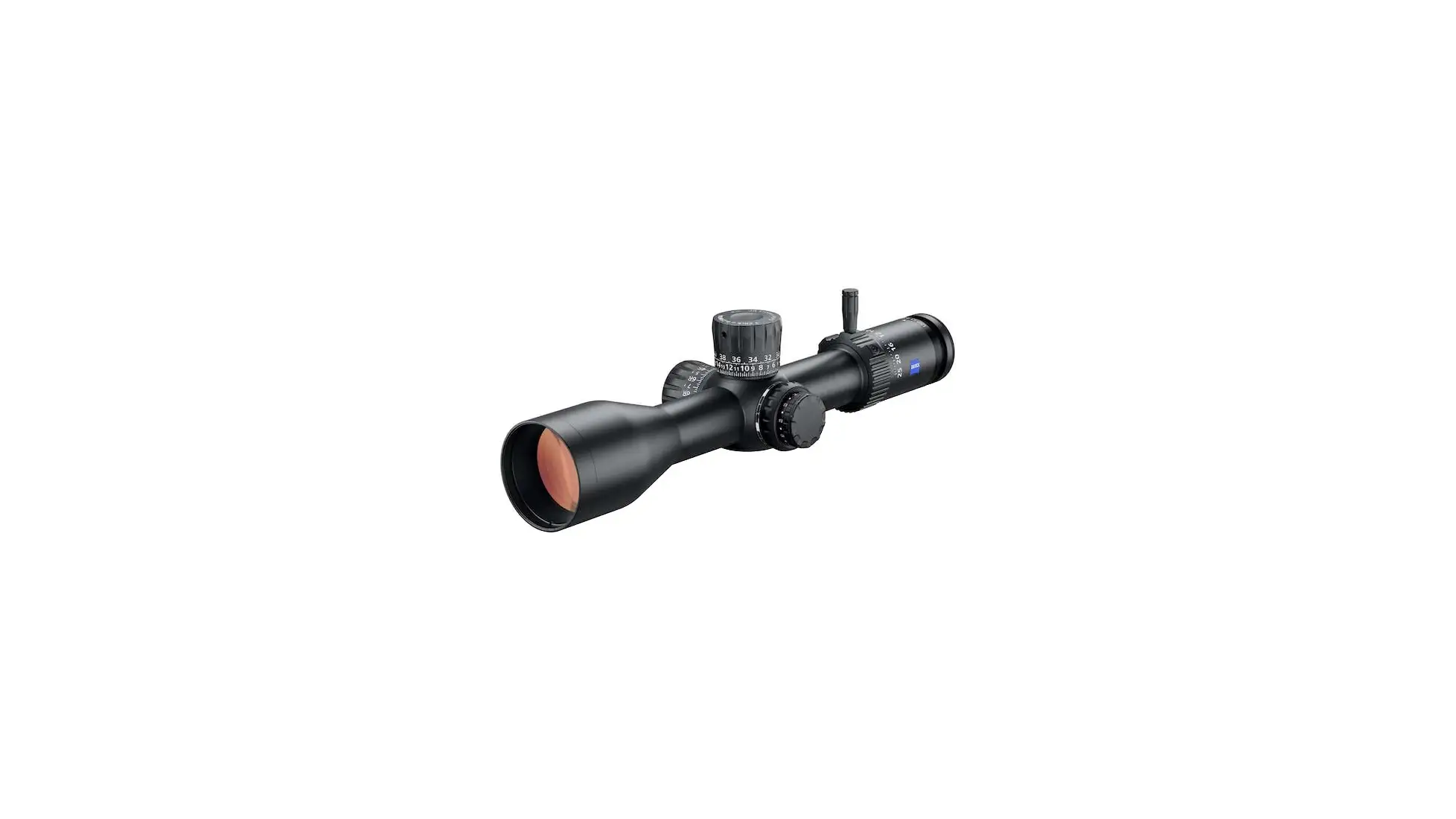
The 4-25x50 (part 522675-9916-090, ZF-MRi, 0.1 MRAD) is the shorter and lighter of the two at 340 mm and 36.7 oz, with a 28.5 ft field of view at 4x, and Zeiss lists the most elevation travel in the line: 46.5 MRAD / 160 MOA. On its technical data page Zeiss links the LRP S3 line's elevation travel (not this model by name) to rimfire: “In the world of long-range rimfire competition, the little 22 LR cartridge is frequently pushed beyond its intended limits.” The same listing sells a ZF-MOAi row (part 522665-9917-090, 0.25 MOA) at the same price as the ZF-MRi row; the price here is for the ZF-MRi row.
Its owner record is 4 reviews: two five-star and two four-star, posted between May 2023 and July 2025, so all of them are more than a year old. One reviewer uses it in rimfire competition:
“I use it for rimfire competitions (NRL/NRLX PRS) and it seems to be tailor made for this.”
Matt F (OK), verified owner, via OpticsPlanet
That reviewer adds “I love the locking windage”, while their only complaint is that “the eye box is small.” The most helpful review, from a reviewer who describes themselves as an eye doctor, says “The clarity of this scope is incredible.” and lists as its con: “Heavy! Big!” Three of the four reviewers name the weight. One four-star reviewer also comments on the first focal plane reticle at low power and on a zero stop:
“As it is first focal plane it is hard to use mil marks until 5 plus power. Scope is very heavy. Zero stop would be nice.”
Zeke (LA), verified owner, via OpticsPlanet
Zeiss lists Ballistic Stop on both LRP S3 models and says it “provides an absolute and repeatable zero”. Ask the retailer or read Zeiss's user guide for how the Ballistic Stop is set.
Key specifications: 6-36x56, ZF-MRi (part 522695-9916-090)
| Magnification | 6-36x |
|---|---|
| Objective | 56 mm |
| Main tube | 34 mm |
| Focal plane | First focal plane (FFP) |
| Reticle (this row) | ZF-MRi (part 522695-9916-090) |
| Click value | 0.1 MRAD on this row (the ZF-MOAi row is 0.25 MOA) |
| Per turn | One revolution equals 10 MRAD or 25 MOA |
| Elevation travel at 100 m | 32.0 MRAD / 110 MOA |
| Windage travel at 100 m | 14.6 MRAD / 50 MOA |
| Parallax | 10 m to infinity |
| Field of view at 100 yds | 20.4 to 3.3 ft |
| Eye relief | 3.0 to 3.5 in |
| Illumination | Red/green, five intensity levels, auto-off, CR2032 battery included |
| Light transmission | 90 % |
| Length | 384 mm (15.1 in) |
| Weight | 1,107 g (39.1 oz), without inner rail |
| Waterproof | 400 mbar |
| Operating temperature | -25 to +55 °C (-13 to +131 °F) |
| Shock tested | 1,500 g-force |
| Country of origin | Japan (Zeiss shop page) |
| Warranty | ZEISS Transferable Limited Lifetime Warranty (Zeiss shop page) |
Figures are Zeiss's technical data page for the 6-36x56 unless marked as Zeiss's shop page. We do not print the exit pupil: Zeiss's published low-power figure does not match the objective divided by the magnification, and Zeiss does not explain why. On awards: we found no award to claim for the LRP S3, so we claim none.
Should you buy it, and what else to consider
- Buy the 6-36x56 if you shoot long range from a bipod, bench or barricade, want 36x and parallax down to 10 m, and 110 MOA of elevation covers your drop.
- Buy the 4-25x50 if you need the most elevation (160 MOA per Zeiss), for example to dial a 22 LR far out, or want the shorter, lighter, wider-view scope.
- Pick the ZF-MOAi row on either listing if you work in MOA; the prices on this page are for the ZF-MRi rows.
- Comparing the field? Our best long range rifle scope guide, the Vortex Razor HD Gen III review, the Nightforce ATACR review and the Steiner T6Xi review cover other 34 mm first focal plane long-range scopes. For a second focal plane Zeiss hunting scope, see our Zeiss Conquest V4 review; for rimfire, our best rimfire scope guide. For dialing see how to adjust a rifle scope, MOA vs MRAD and parallax in a rifle scope; for mounting a 34 mm tube, our scope rings guide.
FAQ
Is the Zeiss LRP S3 a good scope?
The owner record says yes, and it is small. OpticsPlanet shoppers rate the 6-36x56 4.9 out of 5 across 8 reviews (seven five-star, one four-star) and the 4-25x50 4.5 out of 5 across 4 reviews. Reviewers praise the glass, the controls and the illuminated reticle. The cautions they repeat are weight and a tight eye box at high magnification. Twelve reviews across two listings is not enough to call anything a pattern, so read them as individual reports.
How much elevation travel does the Zeiss LRP S3 have?
It depends on the model. Zeiss lists 32.0 MRAD / 110 MOA of elevation and 14.6 MRAD / 50 MOA of windage for the 6-36x56, and 46.5 MRAD / 160 MOA of elevation and 17.5 MRAD / 60 MOA of windage for the 4-25x50. The retailer's 6-36x56 description quotes the 160 MOA figure; by Zeiss's technical data that number belongs to the 4-25x50.
Where is the Zeiss LRP S3 made?
Zeiss's own shop lists the country of origin as Japan on the product pages for both LRP S3 rows reviewed here (522695-9916-090 and 522675-9916-090).
Does the Zeiss LRP S3 have a zero stop?
Zeiss lists a feature it calls Ballistic Stop and says it provides an absolute and repeatable zero. One reviewer of the 4-25x50 wrote that a zero stop would be nice. Read Zeiss's user guide or ask the retailer how the Ballistic Stop is set before you buy.
What warranty does the Zeiss LRP S3 have?
Zeiss's shop pages for both rows name the ZEISS Transferable Limited Lifetime Warranty. Zeiss's general warranty information page, which covers its sports optics and does not name the LRP S3, says the warranty covers the optical system for the life of the product and electronic components for five years from the date of purchase. Confirm the terms for your scope with Zeiss.
Which Zeiss LRP S3 should I buy, the 6-36x56 or the 4-25x50?
The 6-36x56 if you want more magnification and parallax down to 10 m, and 110 MOA of elevation covers your drop. The 4-25x50 if you need the most elevation travel (160 MOA per Zeiss), a wider field of view at the low end, and a scope that is shorter and a little lighter. Both are first focal plane on a 34 mm tube with the same reticle choices.
More rifle scopes: best rifle scopes · best long range rifle scopes · best scope for 6.5 Creedmoor · best rimfire scope · Zeiss Conquest V4 review. From the same maker: our Zeiss SFL binocular review and our Zeiss Conquest HDX review, whose LRP 15x56 binocular Zeiss pairs with the ZF-MRi reticle.