Best compact binoculars in 2026
Our verdict for 2026: the best compact binocular is the Zeiss Terra ED Pocket 8x25 (around $400): ED glass at a published 88% light transmission in a 10.9 oz body, with a 357 ft field and 16 mm of eye relief. Only the Zeiss Victory Pocket 8x25 (around $920) beats it on weight and field of view, for more than twice the money. If the Terra is more than a pocket pair is worth to you, the Leupold BX-1 Rogue 8x25 (around $100) does the same job for a quarter of the money and is the value pick. Travelling, or wearing glasses? The Vortex Diamondback HD 8x28 (around $160) gives the longest eye relief and the brightest view here. Want more reach in the same tiny body as the Rogue? The Rogue 10x25 (also around $110). Want HD glass and 10x reach in something you will still carry? The Vortex Diamondback HD 10x32 (around $220).
The one thing to understand before you choose: every 8x25 here, from the cheapest Leupold to the dearest Zeiss, has the same 3.1 mm exit pupil. Price buys sharper, more colour-accurate glass, a wider field and a lighter body. It does not buy brightness at dusk. Only a bigger objective does that, and only if the magnification does not rise with it: the 32 mm pick here is a 10x, which lands it at 3.2 mm, within a tenth of a millimetre of the 8x25s, while the 8x28 keeps 8x and reaches 3.5 mm, the brightest view on the page. That is why serious low-light glassing belongs on a full-size 42 mm instead: see our best binoculars for hunting. If price rather than size is driving the decision, our best budget binoculars guide compares these against full-size pairs at the same money.
Our six picks carry 147 reviews on OpticsPlanet. Prices verified October 14, 2026; confirm the current price on the retailer page.
A compact binocular earns its place by being the one you actually carry. Below are six pocketable picks across reach, brightness and budget, with honest pros and cons and how to choose.
How these picks were made: a research-based roundup comparing published specifications, warranty terms, owner reviews and pricing across reputable retailers. Scores are our editorial opinion, not a hands-on test of every model, and owner ratings are shown attributed to their source. Confirm current price on the retailer page. See how we evaluate.
- Zeiss Terra ED Pocket 8x25 - Best overall compact
- Leupold BX-1 Rogue 8x25 - Best value compact
- Vortex Diamondback HD 8x28 - Best for travel and eyeglasses
- Zeiss Victory Pocket 8x25 - Best premium pocket
- Leupold BX-1 Rogue 10x25 - Best pocket reach
- Vortex Diamondback HD 10x32 - Best step-up (HD glass)
- How much should you spend?
- How light are they, and what light costs you
- Do they work if you wear glasses?
- Which one for travel, hiking and birding?
- How to choose compact binoculars
- FAQ
Quick comparison
| Category | Pick | Spec | Price |
|---|---|---|---|
| Best overall compact | Zeiss Terra ED Pocket 8x25 | 8x25 · 10.9 oz | around $400 |
| Best value compact | Leupold BX-1 Rogue 8x25 | 8x25 · 12.7 oz | around $100 |
| Best for travel and eyeglasses | Vortex Diamondback HD 8x28 | 8x28 · 13.7 oz | around $160 |
| Best premium pocket | Zeiss Victory Pocket 8x25 | 8x25 · 10.2 oz | around $920 |
| Best pocket reach | Leupold BX-1 Rogue 10x25 | 10x25 · 12.6 oz | around $110 |
| Best step-up (HD glass) | Vortex Diamondback HD 10x32 | 10x32 · 16 oz | around $220 |
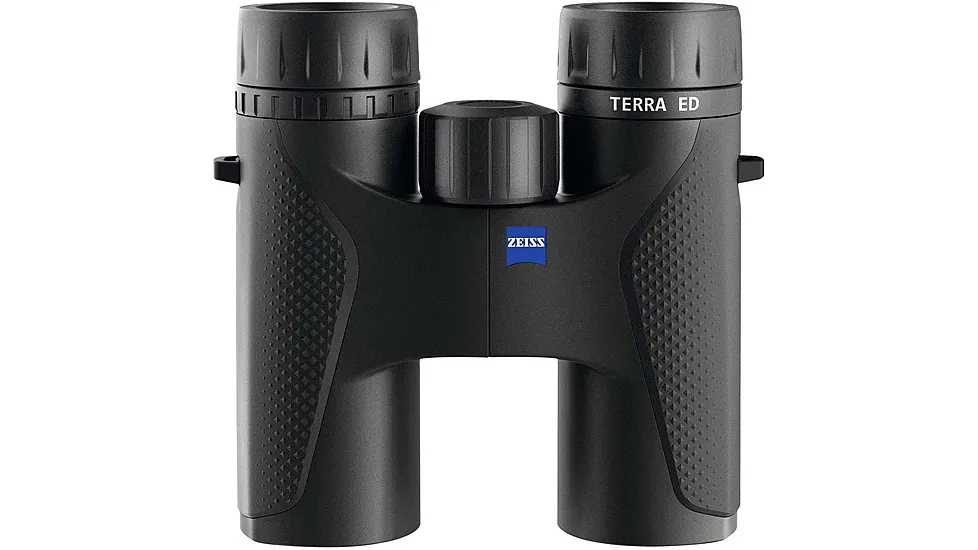
Best overall compact: Zeiss Terra ED Pocket 8x25
Schmidt-Pechan roof · 8x25 · ED glass · 88% transmission
around $400exact price on OpticsPlanet
This is the pocket binocular that stops feeling like a compromise. Zeiss puts extra-low dispersion glass in the objectives and publishes 88 percent light transmission, which is well above the 80 to 84 percent a typical mid-tier roof prism manages, and you see it as colour that stays honest and edges that stay clean against a bright sky. Only the Zeiss Victory Pocket, at more than twice the price, is lighter or wider: the Terra weighs 10.9 oz, shows a 357 ft field of view and gives 16 mm of eye relief, and it focuses down to 6.2 ft where the 25 mm Leupolds need 14.1 ft. The evidence that convinced us is an owner test rather than a spec: one owner put a standard eye chart at 50 yards and read the same 10/40 line through this 8x25 as through a Nikon Monarch 7 8x42, and found it slightly easier through the Zeiss. The 42 mm only pulled ahead on field of view.
Pros
- ED objective glass with a manufacturer-published 88% light transmission: the sharpest, most colour-accurate view here
- Close to the Victory Pocket on weight and field of view for well under half the money: 10.9 oz with a 357 ft field, so it disappears into a jacket pocket
- 16 mm eye relief, and owners who wear thick prescription glasses report the full field with the eyecups retracted
- 6.2 ft close focus, less than half the Leupolds' 14.1 ft, which is what makes it usable for feeder birds and insects
- Waterproof to 100 mbar and nitrogen-filled, under a Zeiss transferable limited lifetime warranty that survives resale
Cons
- The dioptre ring carries no scale or witness marks, so a bumped setting has to be found again from scratch (owners and independent reviewers agree this one is a design flaw, not a bad unit)
- A single asymmetric hinge rather than a twin-hinge folding bridge: quick to open one-handed, but it folds wider and setting your eye spacing is fussier
- Some owners read the depth of field as shallow. The likely cause is the very fast focus wheel (close focus to infinity in about 1.25 turns), which makes the focal plane easy to overshoot
- A 3.1 mm exit pupil is a 25 mm binocular's hard limit: it is no brighter at dusk than the far cheaper compacts here
- Four times the price of the Leupold, and the case fits poorly once the strap is threaded
Best for: the buyer who carries a binocular every day and refuses to accept a dim, soft image for the privilege: hiking, travel, daytime safari and serious pocket birding. Skip it for dusk hunting, marine use or astronomy, where a 25 mm objective simply cannot gather enough light, and skip it if a pocket pair is a secondary optic you use twice a year.
Key specifications
| Magnification | 8x |
|---|---|
| Objective lens | 25 mm |
| Prism | Schmidt-Pechan roof |
| Glass | ED (extra-low dispersion) objectives, hydrophobic ZEISS MC coating |
| Light transmission | 88% (manufacturer figure) |
| Eye relief | 16 mm |
| Exit pupil | 3.1 mm |
| Field of view | 357 ft at 1000 yds (52 deg apparent) |
| Close focus | 6.2 ft |
| Weight | 10.9 oz |
| Length | 4.4 in |
| Body | Fiberglass-reinforced casing |
| Sealing | Waterproof to 100 mbar, nitrogen-filled |
| Operating range | +5 to +140 F |
| Warranty | Zeiss transferable limited lifetime warranty |
“I found these small glassing gems to perform optically and ergonomically within 95% of the venerable and well built CL's (at 1/3 the price)... Hinge tensions are perfect, and the focuser is fast, going from close focus (mine's about 5ft) to infinity in just 1.25 turns.”
Theo, verified owner (LA) via OpticsPlanet, comparing it to the Swarovski CL Pocket 8x25 he had owned
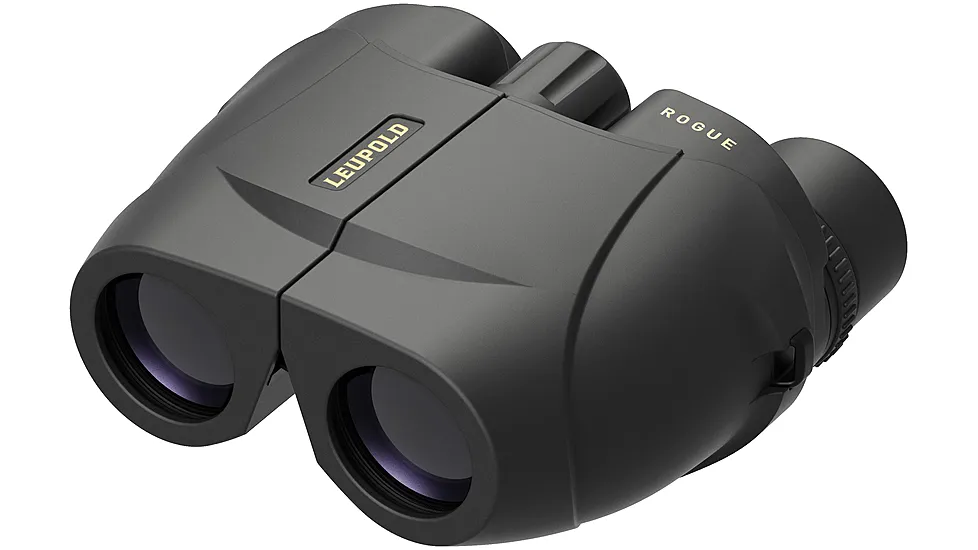
Best value compact: Leupold BX-1 Rogue 8x25
Inverted Porro · 8x25 · BAK4 · waterproof
around $100exact price on OpticsPlanet
This is the compact to beat at its price. Most pocket binoculars in this price range use cheap roof prisms that lose light because they skip the costly phase-correction coatings; the BX-1 Rogue instead uses an inverted Porro prism, which reflects light internally with almost no loss, so it stays surprisingly bright and high-contrast for its size. It is genuinely tiny (4.3 inches, 12.7 oz), fully waterproof and fogproof, and covered by Leupold's Gold Ring lifetime guarantee. It has the most owner reviews of any pick here by a wide margin, and Outdoor Life named it their Best Turkey-Vest Binocular for exactly this pocket-and-forget role. The Zeiss beats it on field of view, weight and close focus, but costs four times as much, which is the whole decision on this page. It ships with a case, strap, covers and cloth.
Pros
- Inverted Porro glass stays bright, sharp and high-contrast for the price (no phase-coating tax like cheap roof compacts)
- Genuinely pocketable: 4.3 in and 12.7 oz, so it actually comes with you
- Fully waterproof and fogproof, backed by Leupold's Gold Ring lifetime guarantee
- A wide 337 ft field of view and the same 3.1 mm exit pupil as the Zeiss, with 67 reviews behind it (the deepest owner record here)
- Narrow interpupillary adjustment suits smaller faces and younger users
Cons
- Small 3.1 mm exit pupil limits dawn and dusk use (a 25 mm compact trade-off, not a fault)
- 15 mm eye relief with small eyecups means fussy eye placement, and it is marginal for thick eyeglasses
- Long 14.1 ft close focus is poor for near subjects like feeder birds or butterflies
- No tripod socket, and the inverted-Porro body is chunkier than a sleek roof compact
Best for: ultralight and turkey or bow hunting, hiking, travel, stadiums and packing light, and as a youth or narrow-face pair. Skip it for serious low-light glassing, close-range birding, stargazing or marine use.
Key specifications
| Magnification | 8x |
|---|---|
| Objective lens | 25 mm |
| Prism | Inverted Porro, BAK4 |
| Glass | Fully multi-coated |
| Eye relief | 15 mm |
| Exit pupil | 3.1 mm |
| Field of view | 337 ft at 1000 yds (6.4 deg) |
| Close focus | 14.1 ft |
| Weight | 12.7 oz |
| Length | 4.3 in |
| Sealing | Waterproof, fogproof (nitrogen) |
| In the box | Case, shoulder strap, lens covers, cloth |
| Warranty | Leupold Gold Ring lifetime guarantee |
“This is exactly what I wanted, a small set of binoculars with excellent clarity, and these provide those characteristics very well. I was impressed with how sharp the images are.”
Rkich (VA) via OpticsPlanet
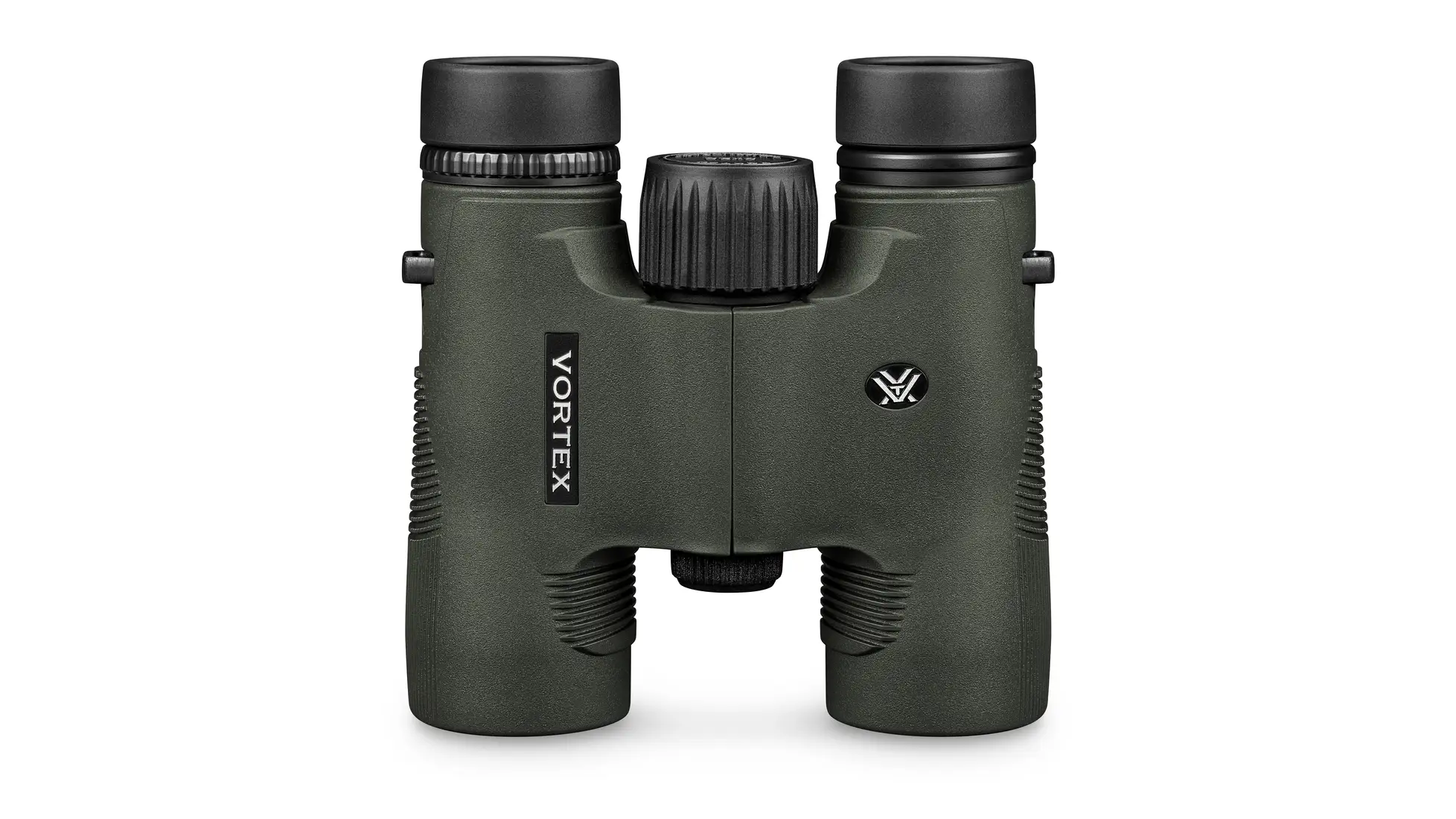
Best for travel and eyeglasses: Vortex Diamondback HD 8x28
Roof prism · 8x28 · HD glass · open hinge
around $160exact price on OpticsPlanet
🏆 Best Budget pocket binocular in its 2024 pocket binocular review (source: Cornell Lab of Ornithology, All About Birds)
This is the compact to carry if you wear glasses or travel with one pair for everything. It gives the longest eye relief on this page (18 mm) and the brightest view: 28 mm of objective behind 8x works out to a 3.5 mm exit pupil, which by our arithmetic is about 25 percent more image brightness than the 8x25s here and about 20 percent more than its 10x32 sibling. Cornell Lab's All About Birds named it their pick for Best Budget pocket binocular in a 2024 test, and credited its large focus wheel, roomy eyecups and single-hinged bridge with giving a great birding experience, while noting that those choices cost some bulk and weight. That is the honest trade: at 13.7 oz it is heavier than every 25 mm pick here. Owners buy it for exactly the job this page is about: one verified owner titled their review "Best Portable Bino for Travel", and another calls it the pair for the car or travel.
Pros
- The longest eye relief here at 18 mm, and an owner who wears glasses calls it great for exactly that
- The brightest pick on the page: a 3.5 mm exit pupil against 3.1 mm for the 8x25s and 3.2 mm for the 10x32
- Cornell Lab's Best Budget pocket binocular (2024), with a large focus wheel and roomy eyecups that suit birding
- A 6 ft close focus, HD glass with dielectric prism coatings, and the Vortex VIP lifetime warranty
Cons
- At 13.7 oz and 4.6 in it is heavier and taller than the 25 mm picks, the bulk Cornell's testers also noted
- Several owners see softening and faint colour fringing toward the edges, and one saw glare scanning toward a low sun
- Still a compact at dusk: OpticsPlanet's own expert points low-light buyers to an 8x42 instead
- The focus wheel needs a long turn from close to far, and one owner lost a lens cover that popped off
Best for: travel, the car, daypacks and anyone who glasses with eyeglasses on, plus casual birding thanks to the 6 ft close focus. Skip it if the smallest, lightest pocket pair is the whole point: the 25 mm Zeiss and Leupold picks weigh less.
Key specifications
| Magnification | 8x |
|---|---|
| Objective lens | 28 mm |
| Prism | Roof, dielectric coatings |
| Glass | HD optical system, fully multi-coated, ArmorTek |
| Eye relief | 18 mm |
| Exit pupil | 3.5 mm |
| Field of view | 332 ft at 1000 yds (6.2 deg) |
| Close focus | 6 ft |
| Weight | 13.7 oz |
| Height | 4.6 in |
| Interpupillary distance | 55 to 72 mm |
| Sealing | Argon-purged, waterproof, fogproof, shockproof |
| Warranty | Vortex VIP lifetime |
“With 18mm of eye relief, these binoculars are great for people who wear glasses. The 28mm objective lens captures more than enough light for daytime use. Optical clarity is on par with my Leupold BX-3 Mojave 10x42s at half the cost.”
Chris, verified owner (TX) via OpticsPlanet
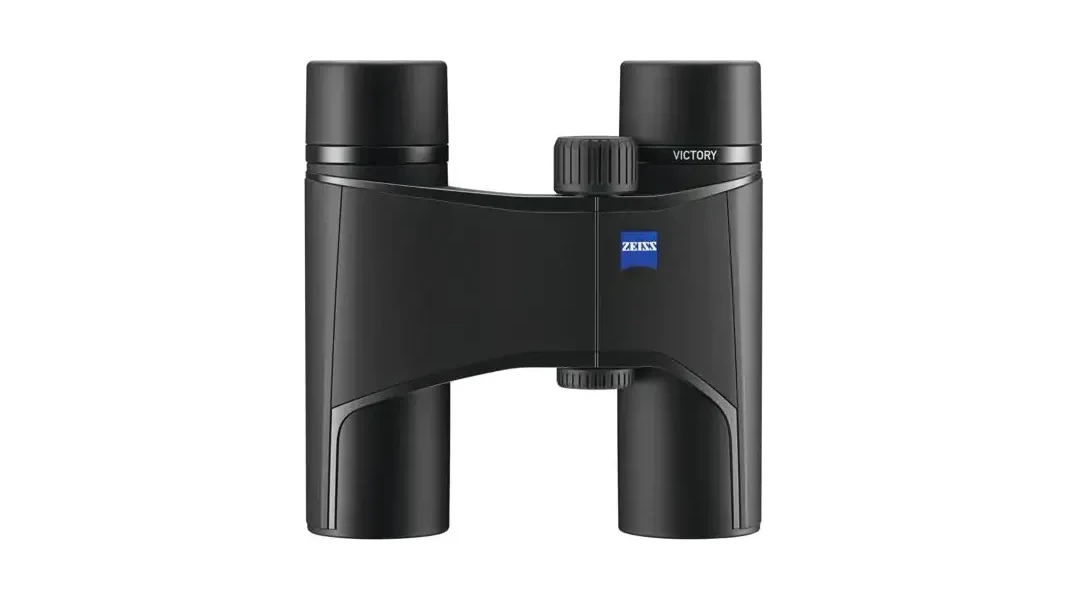
Best premium pocket: Zeiss Victory Pocket 8x25
Schmidt-Pechan roof · 8x25 · 91% transmission
around $920exact price on OpticsPlanet
🏆 Top Pick, tied first with the Swarovski CL Pocket 8x25, in its 2024 pocket binocular review (source: Cornell Lab of Ornithology, All About Birds)
This is where money stops buying a compromise. The Victory Pocket is the lightest ranked pick here at 10.2 oz and shows the widest field of view at 390 ft, and Zeiss publishes 91 percent light transmission for it, the highest figure on this page. Cornell Lab's All About Birds tied it first among its 2024 Top Picks with the Swarovski CL Pocket 8x25, which this retailer does not carry, and singled out the clever asymmetrical design. Two honest caveats. Cornell discloses sponsorship agreements with Zeiss and Swarovski, the two brands that tied for its top spot. And it is still an 8x25: the same 3.1 mm exit pupil as the Terra ED Pocket and the Rogue 8x25, so the extra money buys sharpness, field and weight, not a brighter view at dusk. It costs more than twice the Terra, and for most buyers the Terra is the better spend.
Pros
- The lightest ranked pick here at 10.2 oz, with the widest field of view at 390 ft
- Zeiss publishes 91 percent light transmission, the highest figure on this page
- Tied first among Cornell Lab's 2024 Top Picks, which praised its clever asymmetrical design
- 16.5 mm eye relief, 6.2 ft close focus, waterproof to 100 mbar and nitrogen-filled
Cons
- More than twice the price of the Terra ED Pocket, which gets you most of the way for far less
- The same 3.1 mm exit pupil as every 8x25 here: better glass, but no brighter at dusk
- No owner reviews on OpticsPlanet yet, so the case rests on editorial tests, and Cornell discloses sponsorship ties with Zeiss and Swarovski
Best for: the buyer who wants the lightest, widest pocket binocular this retailer carries and will pay for the last few percent of glass: serious pocket birding and travel where every ounce counts. Most buyers should stop at the Terra ED Pocket.
Key specifications
| Magnification | 8x |
|---|---|
| Objective lens | 25 mm |
| Prism | Schmidt-Pechan roof |
| Light transmission | 91% (manufacturer figure) |
| Eye relief | 16.5 mm |
| Exit pupil | 3.1 mm |
| Field of view | 390 ft at 1000 yds (60 deg apparent) |
| Close focus | 6.2 ft |
| Weight | 10.2 oz |
| Length | 4.4 in |
| Sealing | Waterproof to 100 mbar, nitrogen-filled, LotuTec coating |
| Operating range | -13 to +145 F |
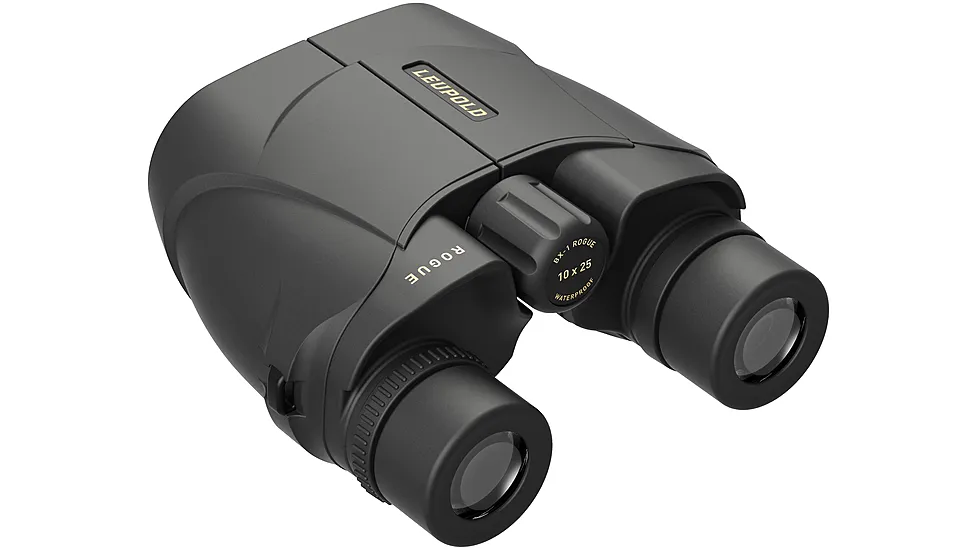
Best pocket reach: Leupold BX-1 Rogue 10x25
Inverted Porro · 10x25 · BAK4 · waterproof
around $110exact price on OpticsPlanet
Same pocket size, same waterproof Gold Ring build as the 8x25, but with 10x magnification for more detail on distant subjects. If you already know you want the extra reach and mostly glass in decent light, this is the pick. Owners praise the clarity, easy focus and packability, and it slips into a jacket pocket or shooting bag just like the 8x25. The trade-off is light: 10x through a 25 mm lens gives a smaller 2.5 mm exit pupil, so it is the dimmest pick here at dawn and dusk, and the extra magnification shows a little more hand shake.
Pros
- 10x reach in the same tiny 4.3 in, 12.6 oz waterproof body as the 8x25
- Bright, clear Porro glass with easy, precise focus that owners consistently praise at the price
- Fully waterproof and fogproof; Leupold Gold Ring lifetime warranty; includes case, strap and covers
- 4.8/5 from 40 reviews: strong social proof for a compact
Cons
- Smaller 2.5 mm exit pupil (10x through 25 mm) makes it the weakest pick here in low light; owners flag dawn, dusk and timber use
- Narrower field of view (5.6 degrees) than the 8x25, and the extra magnification shows more hand shake
- Same 15 mm eye relief, small eyecups and long 14.1 ft close focus as the 8x25
- Can fog briefly in very cold weather when brought to a warm face (owner-reported)
Best for: travel, hiking, cruises and general glassing when you want more reach in a pocket size and view mostly in good light. Choose the 8x25 for a wider, steadier, brighter view, or the 10x32, whose 3.2 mm exit pupil really is a large step up from this one’s 2.5 mm.
Key specifications
| Magnification | 10x |
|---|---|
| Objective lens | 25 mm |
| Prism | Inverted Porro, BAK4 |
| Glass | Fully multi-coated |
| Eye relief | 15 mm |
| Exit pupil | 2.5 mm |
| Field of view | 5.6 degrees |
| Close focus | 14.1 ft |
| Weight | 12.6 oz |
| Length | 4.3 in |
| Sealing | Waterproof, fogproof (nitrogen) |
| In the box | Case, shoulder strap, lens covers, cloth |
| Warranty | Leupold Gold Ring lifetime guarantee |
“Perfect for a hike, cruise, or other activities that you'd like to have a better view, but weight may be an issue. Light, decent glass, good field of view, and above average low light performance for the type of binoculars they are.”
Mark (MN) via OpticsPlanet
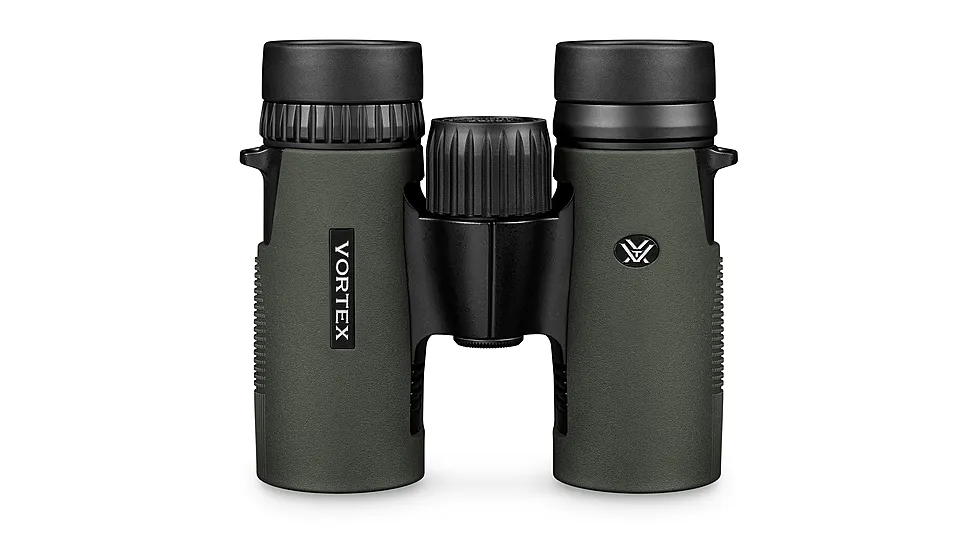
Best step-up (HD glass): Vortex Diamondback HD 10x32
Roof prism · 10x32 · HD glass · argon
around $220exact price on OpticsPlanet
When you want a bigger objective and better glass in a body you will still carry, the Diamondback HD 10x32 is the step-up. It brings HD (extra-low dispersion) glass with dielectric, phase-corrected roof prisms, and its 32 mm objective gathers about 64 percent more light than a 25 mm one, because area grows with the square of the diameter. What it does NOT do is give you a brighter view than the 8x25s here, and that is worth being straight about: the extra light is spent on the extra magnification, so its exit pupil lands at 3.2 mm against the Zeiss and Rogue 8x25 at 3.1 mm. By our arithmetic that is roughly a 5 percent difference in image brightness, which no eye separates. Where it IS genuinely brighter is against the Rogue 10x25 (2.5 mm), which is a difference of about 64 percent. The brightest compact on this page is actually its smaller, cheaper sibling, the 8x28 (3.5 mm). It is a little bigger and pricier than the 25 mm Leupolds (16 oz, 4.4 in) but its 6-foot close focus runs rings around their 14.1 ft, and it is fully waterproof, fogproof and shockproof with the Vortex VIP lifetime warranty. One owner who replaced a $600 pair kept it purely for the weight; another compares it favorably to far pricier German and Japanese glass.
Pros
- HD glass with dielectric, phase-corrected roof prisms and true colour, plus 10x reach that none of the 8x picks offer
- Still compact at 16 oz and 4.4 in, but with a 6 ft close focus (far better than the Leupolds' 14.1 ft) for near subjects
- Fully waterproof, fogproof and shockproof (argon), ArmorTek scratch coating, tripod-adaptable
- Vortex VIP lifetime warranty and a generous kit (case, straps, tethered covers, rainguard)
Cons
- Bigger and pricier than the 25 mm Leupold compacts: more a mid-size than a true pocket binocular
- 14 mm eye relief is tight for people who wear thick eyeglasses
- A 32 mm objective still gathers less light than a full-size 42 mm for serious dawn and dusk glassing
- Modest review count (17) versus the 8x25's 67
Best for: travelers and hunters who want HD glass and 10x reach in a body they will still carry, plus close focus for casual birding. Step down to the 25 mm Leupolds for true pocketability and price. Do not step up to it expecting a brighter view than the 8x25s: for that you need a full-size 42 mm, not 32 mm at 10x.
Key specifications
| Magnification | 10x |
|---|---|
| Objective lens | 32 mm |
| Prism | Roof, phase-corrected + dielectric |
| Glass | HD (extra-low dispersion), fully multi-coated |
| Eye relief | 14 mm |
| Exit pupil | 3.2 mm |
| Field of view | 340 ft at 1000 yds (6.5 deg) |
| Close focus | 6 ft |
| Weight | 16 oz |
| Length | 4.4 in |
| Sealing | Argon-purged; waterproof, fogproof, shockproof |
| In the box | Deluxe case + straps, tethered covers, rainguard, cloth |
| Warranty | Vortex VIP lifetime |
“This 10x32 Diamondback HD is just the right size to take almost everywhere... With a 3.2 exit pupil it's not bad in low light. I have some high quality German and Japanese bins worth a whole lot more money that have marginally better views but for a general purpose bin and a great value this bin is tuff to beat.”
Optics Guy (CT) via OpticsPlanet
How much should you spend on compact binoculars?
Three price steps matter, and the jumps between them buy different things.
- Below the Rogue, around $80. This is the souvenir tier. The Nikon Aculon T02 8x21 is the honest example: a real Nikon, multilayer-coated, only 6.9 oz, and a 21 mm objective that works out to a 2.6 mm exit pupil, dimmer than everything else on this page. It is a fine glovebox or concert pair and it is not a binocular you glass with, and Nikon's 10.3 mm of eye relief is short for anyone in glasses. It is a benchmark here rather than a ranked pick, because OpticsPlanet carries no owner reviews for it at all. Check availability
- The Rogue step, around $100. The real floor for a binocular you will keep. The Leupold BX-1 Rogue buys a proper 25 mm objective, waterproofing and a lifetime guarantee, and its inverted-Porro layout dodges the phase-coating cost that makes cheap roof compacts look washed out. For most buyers this step is the biggest single upgrade on the page.
- The step up, around $160 and above. Past the Rogue step you are mostly buying glass quality and ergonomics, not brightness. The one exception is the Vortex 8x28, which spends its extra 3 mm of objective at 8x and so reaches a 3.5 mm exit pupil, plus 18 mm of eye relief. The Vortex 10x32 spends it on aperture and correction (32 mm, HD glass, phase-corrected prisms) rather than on a brighter image, since 10x through 32 mm gives the same exit pupil as 8x through 25 mm; the two Zeiss models spend it on transmission, field of view and weight, and the Victory Pocket takes that furthest. All are real improvements you can see. None will turn a pocket binocular into a low-light instrument.
How light are they, and what light costs you
Weight is the entire reason a compact exists, so here is every optic on this page ranked by it, with the number that decides how bright it looks sitting next to it. Read the two columns together: on a lightweight binocular they are the same trade-off written twice.
| Pick | Weight | Exit pupil |
|---|---|---|
| Nikon Aculon T02 8x21 (benchmark, not a ranked pick) | 6.9 oz | 2.6 mm |
| Zeiss Victory Pocket 8x25 | 10.2 oz | 3.1 mm |
| Zeiss Terra ED Pocket 8x25 | 10.9 oz | 3.1 mm |
| Leupold BX-1 Rogue 10x25 | 12.6 oz | 2.5 mm |
| Leupold BX-1 Rogue 8x25 | 12.7 oz | 3.1 mm |
| Vortex Diamondback HD 8x28 | 13.7 oz | 3.5 mm |
| Vortex Diamondback HD 10x32 | 16 oz | 3.2 mm |
Two things fall out of that table that the box copy will not tell you. The first is that the spread is narrower than it feels: from the lightest ranked pick to the heaviest is under 6 oz, and every ranked pick falls between 4.3 and 4.6 in long. What separates them in a jacket pocket is heft, not size.
The second is that weight does not track brightness in a straight line. The Rogue 10x25 is heavier than both Zeiss models and dimmer than them, because putting 10x behind the same 25 mm objective drops the exit pupil to 2.5 mm. At the other end, the brightest view here belongs to the Vortex 8x28 at 3.5 mm, and it costs 3.5 oz over the Victory Pocket to get it. If you want the lightest binocular here that is still worth glassing with, it is the Victory Pocket at 10.2 oz, with the Terra ED at 10.9 oz for well under half the money; both tie the Rogue 8x25 for the brightest 25 mm view while weighing less. Below that, the 6.9 oz Nikon is genuinely pocket lint, and its 2.6 mm exit pupil is the price of getting there.
Do compact binoculars work if you wear glasses?
Yes, but this is where compacts fail people most often, and the number to check is eye relief. Wearing glasses holds your eye roughly 12 to 15 mm further back, so anything under about 15 mm of eye relief starts cropping the image into a dark tunnel. Compacts are the worst offenders because a small eyepiece makes long eye relief expensive to engineer.
Among the picks here the Vortex Diamondback HD 8x28 leads at 18 mm, and a verified owner who wears glasses calls it great for exactly that. The Zeiss Victory Pocket gives 16.5 mm and the Zeiss Terra ED Pocket 16 mm, and the Terra's owners specifically report seeing the full field with prescription glasses on and the eyecups twisted down. The Leupolds give 15 mm, which is workable but fussy: one owner calls the small eyecups awkward to position. The Vortex Diamondback HD 10x32 gives 14 mm and is the one to avoid if you wear thick lenses, despite being the better binocular in most other respects.
Whatever you buy, retract the eyecups fully before you judge it, and check for a dark ring at the edge of the view rather than in the middle.
Which compact for travel, hiking and birding?
- Travel and hiking. Weight and bulk decide this, not optics, because the pair you leave in the hotel is worth nothing. The two Zeiss models (10.2 and 10.9 oz) and the Rogue 8x25 (12.7 oz) genuinely pocket. For one pair that does everything on a trip, the Vortex Diamondback HD 8x28 is our travel pick: 13.7 oz, the brightest view and the longest eye relief here, and the pair its owners describe buying for travel. The 16 oz Vortex 10x32 is more of a small-daypack binocular.
- Birding. Close focus is the spec nobody checks and everybody misses. Both Zeiss models focus to 6.2 ft and both Vortexes to 6 ft, so all four work on a feeder or a warbler in the next bush. Cornell Lab's 2024 pocket binocular test put the Victory Pocket at the top and named the 8x28 its best budget pocket pair. The 25 mm Leupolds need 14.1 ft, at which range a small bird is a smudge. For dedicated birding at dawn see our best binoculars for birding picks instead, where full-size glass changes the answer.
- Safari and open-country wildlife. 8x beats 10x from a moving vehicle: the lower magnification hides hand shake that a 10x amplifies. Our safari picks cover this in full.
- Hunting. A compact is a spot-and-stalk and pack-weight tool, not a dusk tool. If the last twenty minutes of legal light matter to you, a 25 mm objective is the wrong instrument at any price.
- Stargazing and marine. Skip compacts entirely for both. Astronomy needs aperture and a large exit pupil; marine use needs a wide, bright, steady view. See our astronomy picks.
How to choose compact binoculars
A few decisions matter more than any single number on the box:
- Size vs light, and the sum that decides it. Divide the objective by the magnification and you get the exit pupil, which is what sets how bright the view looks. Every 8x25 here gives 3.1 mm, the 10x25 gives 2.5 mm, the 10x32 gives 3.2 mm and the 8x28 gives 3.5 mm. So better glass does not buy brightness, and neither does a bigger objective on its own: the 32 mm is paired with 10x, which spends the extra aperture on magnification instead, while the 28 mm stays at 8x and is the one real brightening step. The only real dimming step on this page is going from 8x to 10x in a 25 mm body. Match the size to how much you will actually carry, and go to a full-size 42 mm if dusk is the job.
- Magnification. 8x is wider, steadier and brighter; 10x reaches further but shakes more and dims the view in a compact. For a do-everything pocket pair, 8x is the safer choice.
- Prism type. A quality inverted Porro (like the Leupold) is bright and cheap; a good roof prism (like the Vortex HD) is sleeker and sharper but costs more for the same brightness. See roof prism vs porro prism.
- Eye relief if you wear glasses. This is the one spec where the picks genuinely separate: the Vortex 8x28 gives 18 mm, the Zeiss Victory 16.5 mm, the Zeiss Terra 16 mm, the Leupolds 15 mm and the Vortex 10x32 14 mm. Under about 15 mm gets marginal with thick prescription lenses, so retract the eyecups fully and check you still see the whole field, not a dark ring.
- Sealing and warranty. Every ranked pick is waterproof. The Terra ED, both Leupolds and both Vortexes carry a lifetime guarantee (Zeiss transferable limited lifetime on the Terra, Leupold Gold Ring, Vortex VIP), which is real value on an optic that lives in a pocket. For the Victory Pocket, check Zeiss's current warranty terms before you buy: we could not confirm them from Zeiss's own pages.
Want more low-light reach than a compact can give? A full-size 42 mm is the answer: see our best binoculars for hunting picks (10x42 and 12x50).
FAQ
What are the best compact binoculars?
The Zeiss Terra ED Pocket 8x25 is the best compact binocular overall: ED glass at a published 88% light transmission, a 357 ft field of view, 16 mm of eye relief and a 10.9 oz body. The Zeiss Victory Pocket 8x25 is the premium pick, lighter at 10.2 oz and wider at 390 ft, for more than twice the money. The Leupold BX-1 Rogue 8x25 is the value pick and does the same job as the Terra for roughly a quarter of the money. The Vortex Diamondback HD 8x28 is the pick for travel and eyeglasses, with the longest eye relief here (18 mm) and the brightest view (a 3.5 mm exit pupil). The Rogue 10x25 adds reach in the same tiny body as the 8x25, and the Vortex Diamondback HD 10x32 is the step-up for HD glass and 10x reach. One correction to the usual advice: the 10x32 is not brighter than the 8x25s, because its bigger objective is paired with more magnification, which lands it at a 3.2 mm exit pupil against their 3.1 mm. Current prices for every pick are on the cards above.
How much should you spend on compact binoculars?
Below the Rogue you are buying a 21 mm souvenir pair that is noticeably dim. The floor for a binocular you will actually keep is the Leupold BX-1 Rogue tier, which buys a proper 25 mm objective, waterproofing and a lifetime guarantee. Spending above that buys glass quality, eye relief and weight rather than brightness, because every 25 mm compact shares the same 3.1 mm exit pupil no matter what it costs. Stepping up in aperture only helps if the magnification does not rise with it: the 32 mm Vortex here is a 10x, so it lands at a 3.2 mm exit pupil, essentially the same as the 8x25s, while the Vortex 8x28 keeps 8x and reaches 3.5 mm, the brightest view on this page. If you want a genuinely brighter view after sunset, the step that buys it is a full-size 42 mm, not a 32 mm at 10x.
What are the lightest compact binoculars?
Of the picks here the Zeiss Victory Pocket 8x25 is the lightest at 10.2 oz, followed by the Zeiss Terra ED Pocket 8x25 at 10.9 oz, the Leupold BX-1 Rogue 10x25 at 12.6 oz, the Rogue 8x25 at 12.7 oz, the Vortex Diamondback HD 8x28 at 13.7 oz and the Vortex Diamondback HD 10x32 at 16 oz. The Nikon Aculon T02 8x21 is lighter still at 6.9 oz, but it is a 21 mm souvenir pair rather than a ranked pick. Two things are worth knowing before you shop on weight alone. The ranked picks all fall between 4.3 and 4.6 in long, so heft rather than size is what you notice in a pocket. And lighter is not automatically dimmer in order: the Rogue 10x25 is heavier than both Zeiss models and dimmer than them, because 10x behind a 25 mm objective gives a 2.5 mm exit pupil where the 8x25s give 3.1 mm. The lightest pick worth glassing with is the Victory Pocket, and the lightest for the money is the Terra ED.
Do compact binoculars work if you wear glasses?
Yes, if you check eye relief first. Glasses hold your eye about 12 to 15 mm further back, so under roughly 15 mm of eye relief the view crops into a dark tunnel. The Vortex Diamondback HD 8x28 gives the most here at 18 mm, and an owner who wears glasses calls it great for exactly that. The Zeiss Victory Pocket gives 16.5 mm, and the Zeiss Terra ED Pocket gives 16 mm, with owners reporting the full field with prescription glasses on and the eyecups twisted down. The Leupold BX-1 Rogue models give 15 mm, which works but needs careful eye placement. The Vortex Diamondback HD 10x32 gives 14 mm and is the weakest choice for thick lenses. Always retract the eyecups fully before judging any pair.
What are the best compact binoculars for travel?
For most travellers the Vortex Diamondback HD 8x28 is the best compact binocular for travel: it gives the brightest view on this page (a 3.5 mm exit pupil), the longest eye relief (18 mm) for anyone who wears glasses, a 6 ft close focus and the Vortex VIP lifetime warranty, and owners buy it for exactly this, one titling their review "Best Portable Bino for Travel". It weighs 13.7 oz, though. If every ounce in a carry-on counts, the Zeiss Terra ED Pocket 8x25 weighs 10.9 oz and the Zeiss Victory Pocket 8x25 10.2 oz, and the Leupold BX-1 Rogue 8x25 is the pick to take where you would not risk an expensive pair. For safari, where you glass from a moving vehicle, stay at 8x.
What magnification is best for compact binoculars?
8x is the better choice for almost everyone. It gives a wider field of view, a steadier image and a larger 3.1 mm exit pupil, so it is brighter and easier to hold. 10x through a 25 mm lens drops the exit pupil to 2.5 mm, which is dimmer in low light and shows more hand shake, and the extra magnification only pays off in good light on distant, static subjects. Pick 8x25 for all-round use and 10x25 only if reach is specifically what you want.
Are small binoculars worth it, or should you buy full-size?
Compact binoculars are worth it when portability is the priority, because the best binocular is the one you actually carry. The trade-off is light: a 25 mm or 32 mm objective gathers less than a full-size 42 mm, so compacts are dimmer at dawn and dusk. For daytime hiking, travel, hunting packs and sports they are excellent; if you glass seriously in low light, choose a full-size 42 mm instead.
Are compact 25 mm binoculars good for stargazing?
No. Astronomy needs a large exit pupil and lots of light-gathering, and a 25 mm compact has only a 2.5 to 3.1 mm exit pupil, far too small for faint night-sky objects. For stargazing you want a large-aperture binocular such as a 15x70 or 20x80 on a tripod. Compacts are built for daytime portability, not the night sky.
New to binoculars? Learn what the numbers mean, roof prism vs porro prism and 8x42 vs 10x42, read our Vortex Diamondback HD 10x42 review, or see our best binoculars for hunting, birding and astronomy roundups.