Vortex Razor HD LHT review: a first focal plane 4.5-22x50 at 21.7 oz, and what the light weight costs
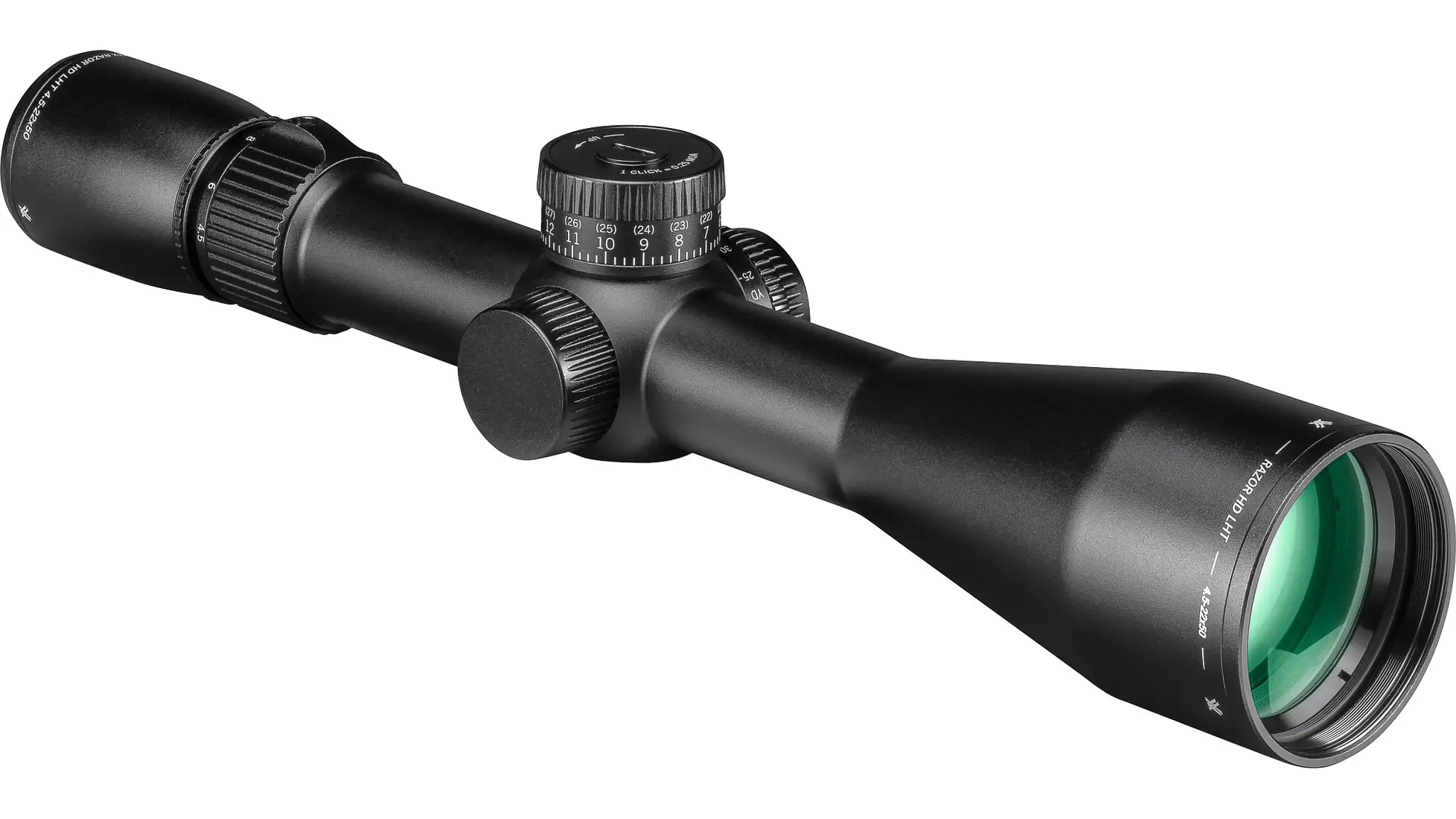
Our verdict: 4.5/5. The Vortex Razor HD LHT 4.5-22x50 FFP is a long-range hunting scope built around weight. Vortex lists it at 21.7 oz on a 30mm tube, with a first focal plane XLR-2 reticle, an exposed elevation turret, a capped windage turret, push-button illumination and the RevStop zero system. Reviewers praise two things above all: how light it is and how clear the glass is. It loses half a point for trade-offs you should know first. With RevStop installed, Vortex lists 27 MOA of total elevation adjustment, against a 75 MOA maximum. Several reviewers call the illumination dim or its push button awkward, two find the fine reticle hard to see against dark backgrounds, and two think the glass is not worth the price. If you hunt mountains or open country and carry the rifle all day, it fits. If you shoot timed matches or dial far past your zero, look at a heavier tactical scope or the Vortex Razor HD Gen III, a long-range and competition scope. Our best deer hunting scope guide points open-country hunters here.
OpticsPlanet shoppers rate this 4.5-22x50 FFP listing 4.8/5 across 45 reviews. The XLR-2 MOA row we review here (RZR-42201) sells for around $1,500. Check price and availability on OpticsPlanet; confirm the current price on the retailer page.
How we reviewed it: a research-based review built from the retailer's specification tables for three Razor HD LHT listings, every owner review those listings show (45 for the 4.5-22x50, 10 for the 3-15x42, 8 for the 3-15x50), and Vortex's own product and warranty pages for the manufacturer figures. Where the retailer table and Vortex disagree, we print Vortex's figure or leave the number out. Third-party research leads we could not confirm on Vortex's site, including where the scope is made, tracking tests and a forum drop test, were left out. We have not bench-tested this scope; the score is our editorial opinion and owner ratings are shown attributed to their source. See how we evaluate.
What the Razor HD LHT is
The Razor HD LHT is a lightweight Razor that Vortex lists for western hunting. OpticsPlanet sells three sizes as separate listings, all on a 30mm tube: the 4.5-22x50 in the first focal plane, and a 3-15x42 and a 3-15x50 in the second focal plane. Vortex describes the 4.5-22x50 as lightweight yet rugged, with “push-button illumination and a rock-solid zero system”. On its 3-15x50 page, Vortex lists these glass and build features: an HD optical system, an APO system with index-matched lenses, XR Plus anti-reflective lens coatings, ArmorTek exterior lens coatings, a locking elevation turret with an integrated locking mechanism, and the RevStop zero system, which Vortex calls a patented streamlined design.
For scale: the retailer lists the Razor HD Gen III 6-36x56, Vortex's long-range Razor, at 45.1 oz (see our Razor HD Gen III review). The LHT 4.5-22x50 is listed at less than half that. It is built for a rifle you carry up a mountain, not for a heavy bench or chassis rifle.
The row we review is the 4.5-22x50 with the XLR-2 MOA reticle and 1/4 MOA clicks (RZR-42201). The same listing sells an XLR-2 MRAD row (RZR-42202) at the same price; its travel figures are not in our records, so the turret numbers on this page are for the MOA row. Because the reticle is in the first focal plane, it grows and shrinks with the image, so its hash marks keep their values at every magnification. Our FFP vs SFP guide explains why that matters for holdovers and wind calls.
Why reviewers rate it: weight and glass
We could read all 45 reviews on the retailer's page for this listing, and the star rating of 44 of them: 37 are five stars, six are four stars and one is two stars (the featured negative review does not show its stars). Weight and glass clarity are the two themes reviewers repeat most. Weight comes up in 20 of the 45 reviews, written by 19 reviewers. One was surprised at the weight savings compared with their previous setup, and one mountain hunter in Montana chose it on price, weight and performance, noting it was a half pound or more lighter than the other scopes they considered.
“Wow! The clarity is amazing, and the weight (or lack there of) is incredible, I thought the box was empty!”
Jason Fairclough (UT), verified owner, via OpticsPlanet
Praise for the glass and its clarity comes up even more often than weight. One reviewer who lists an “NF ATACR”, a Steiner, a Bushnell and a Vortex Razor among the scopes they own calls the LHT's glass exceptional, and another says they cannot tell it apart from the Razor Gen II and Gen III. The zero system gets the third kind of praise: two reviewers call the zero stop easy to install or implement, another likes the RevStop system for quick zeroing, and one who bought the scope twice describes the return to zero this way:
“Dialing up for longer shots and the return to zero functionality has always worked flawlessly.”
NickCO (CO), verified owner, via OpticsPlanet
The warranty comes up too. One reviewer had the eyepiece bent by a local gun store while it was being mounted, sent the scope to Vortex on August 3 and had it back on August 11. Vortex's VIP warranty page says it will repair or replace a damaged or defective product at no charge, however it happened; it does not cover loss, theft, deliberate damage, or cosmetic damage that does not hinder performance.
“There were no shipping costs for returning the scope to Vortex, and I wasn't charged for the replacement scope.”
IndyDave (IN), verified owner, via OpticsPlanet
The honest catches: RevStop range, illumination, a fine reticle and the glass debate
Dialing range with RevStop installed. Vortex lists a maximum elevation adjustment of 75 MOA for the 4.5-22x50 MOA model, and a total elevation adjustment of 27 MOA with the RevStop zero system installed. One turn of the elevation turret is 15 MOA, and windage tops out at 45 MOA. For most hunting distances that is plenty; if you dial for very long shots, run your drop chart against the 27 MOA figure first. Our how to adjust a rifle scope guide covers dialing basics, and the MOA and MRAD calculator converts drops.
Illumination. This is the most mixed theme. One reviewer calls the light dim and the most helpful review says it is not daylight bright, and three criticize the push button itself (spongy, not tactile, or “chincy” in one reviewer's word). Others like it: one calls the illumination very bright, and another notes that it lights both axes rather than only a centre dot.
“The illumination is not daylight bright.”
Blue Max, four-star most helpful review, via OpticsPlanet
A fine reticle. Two reviewers find the reticle hard to see against a dark background, one of them at low magnification. The longer review warns that the reticle suits stationary targets better than fast transitions.
“the reticle is very thin/fine to the point of being a little difficult to find, especially with a dark background.”
Rascal (GA), four-star review, via OpticsPlanet
The glass debate. Most reviewers praise the glass, but two do not: the featured negative review says the image clarity is not on par with the price, and a two-star reviewer found it no better than their cheaper Vortex and Sig scopes.
“Image clarity is not on par with the price range of this scope.”
Most helpful negative review, via OpticsPlanet
A 2.3 mm exit pupil at 22x, and eye relief to plan for. At full zoom the exit pupil works out to 2.3 mm (50 mm divided by 22x), so your eye has to sit squarely behind the ocular. The most helpful reviewer says the eye box tightens quickly between 18x and 22x, and had to move their mount forward a couple of slots compared with other scopes to get the eye relief right at high zoom. The same reviewer still rates the eye box at maximum zoom better than other scopes they own with much lower magnification. Check ring position at maximum magnification when you mount it; see our scope rings guide.
Small things. One reviewer would like a less glossy finish and found the diopter finicky to set, one finds the windage clicks hard to count, and one says it could use a factory throw ring.
Trade-offs, plainly
- With RevStop installed, Vortex lists 27 MOA of total elevation adjustment on the 4.5-22x50 MOA model, against a 75 MOA maximum.
- Windage tops out at 45 MOA on the 4.5-22x50 (Vortex).
- Illumination splits reviewers: one calls it dim, the most helpful review says it is not daylight bright, and three dislike the push button.
- The fine reticle can be hard to find against a dark background, per two reviewers.
- Two reviewers think the glass does not justify the price, while most praise it.
- A 2.3 mm exit pupil at 22x and eye relief that may need careful ring placement at high zoom.
- One reviewer would have liked a factory throw ring and bought an aftermarket one.
Which configuration: 4.5-22x50 FFP, 3-15x42 or 3-15x50
The three sizes are separate retailer listings with different part numbers. Each column below is described from its own listing and from Vortex's spec table for that size; where they disagree, Vortex's figure is printed. Vortex lists the same field of view for the 3-15x42 and the 3-15x50.
| Spec | 4.5-22x50 FFP (RZR-42201) | 3-15x42 SFP (RZR-31501) | 3-15x50 SFP (RZR-31503) |
|---|---|---|---|
| Focal plane | First | Second | Second |
| Reticle (row priced) | XLR-2 MOA | HSR-5i MOA | G4i BDC MRAD |
| Click value | 1/4 MOA | 1/4 MOA | 0.1 MRAD |
| Travel per rotation | 15 MOA | 15 MOA | 6 MRAD |
| Max elevation / windage | 75 / 45 MOA | 80 / 80 MOA | 23 / 23 MRAD |
| Total elevation with RevStop | 27 MOA | 27 MOA | 11 MRAD |
| Field of view at 100 yds (Vortex) | 23.5 to 4.7 ft | 35.3 to 7.0 ft | 35.3 to 7.0 ft |
| Eye relief (Vortex) | 4.0 in | 3.8 in | 3.8 in |
| Parallax (Vortex) | 25 yds to infinity | 20 yds to infinity | 20 m to infinity |
| Length (Vortex) | 13.3 in | 13.4 in | 13.6 in |
| Weight | 21.7 oz | 19.1 oz | 20.5 oz |
| OpticsPlanet rating | 4.8/5 from 45 reviews | 4.6/5 from 10 reviews | 4.8/5 from 8 reviews |
| Price | around $1,500 | around $1,100 | around $1,350 |
Turret figures are Vortex's for the row priced in each column. Because the 3-15x sizes are second focal plane, their reticle marks hold their stated values at one magnification only; check Vortex's reticle documentation for that setting before you hold over.
3-15x42 SFP with the HSR-5i MOA reticle
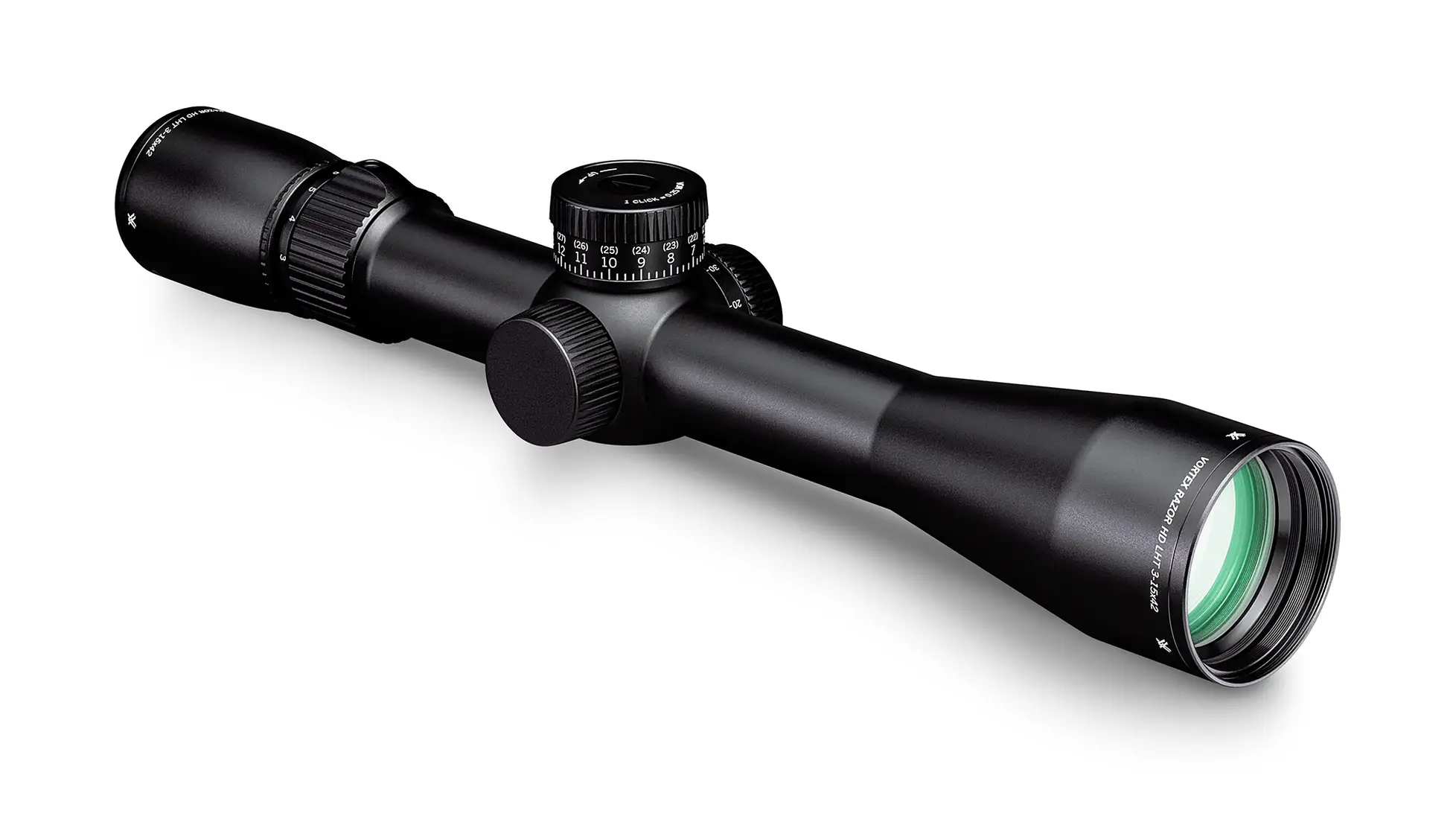
The 3-15x42 (RZR-31501, HSR-5i MOA) is the lightest of the three at a listed 19.1 oz and starts at 3x with a 35.3 ft field of view at 100 yards per Vortex, which suits timber and mixed hunting. The same listing also sells an HSR-5i MRAD row (RZR-31502), which costs more. Its owner record is 10 reviews: seven five stars, two four stars and one three stars. Weight and glass are the praise reviewers repeat. The criticisms are single voices: one finds the eye box very tight at 15x, one dislikes the zero stop and the stiff power ring, one is not the biggest fan of the push-button illumination, one wants crisper elevation clicks, and the three-star review is about appearance rather than glass. That three-star review is titled about a 2-10 model, so it may not be about this size. A Reddit thread in the search results compares this size with the Viper HD 3-15x44; our Viper HD 3-15x44 review covers that scope.
“The eyebox is very tight at 15x, at 12x the eyebox is large enough for off hand shooting.”
j-dizzle (UT), verified owner, via OpticsPlanet
3-15x50 SFP with the G4i BDC MRAD reticle
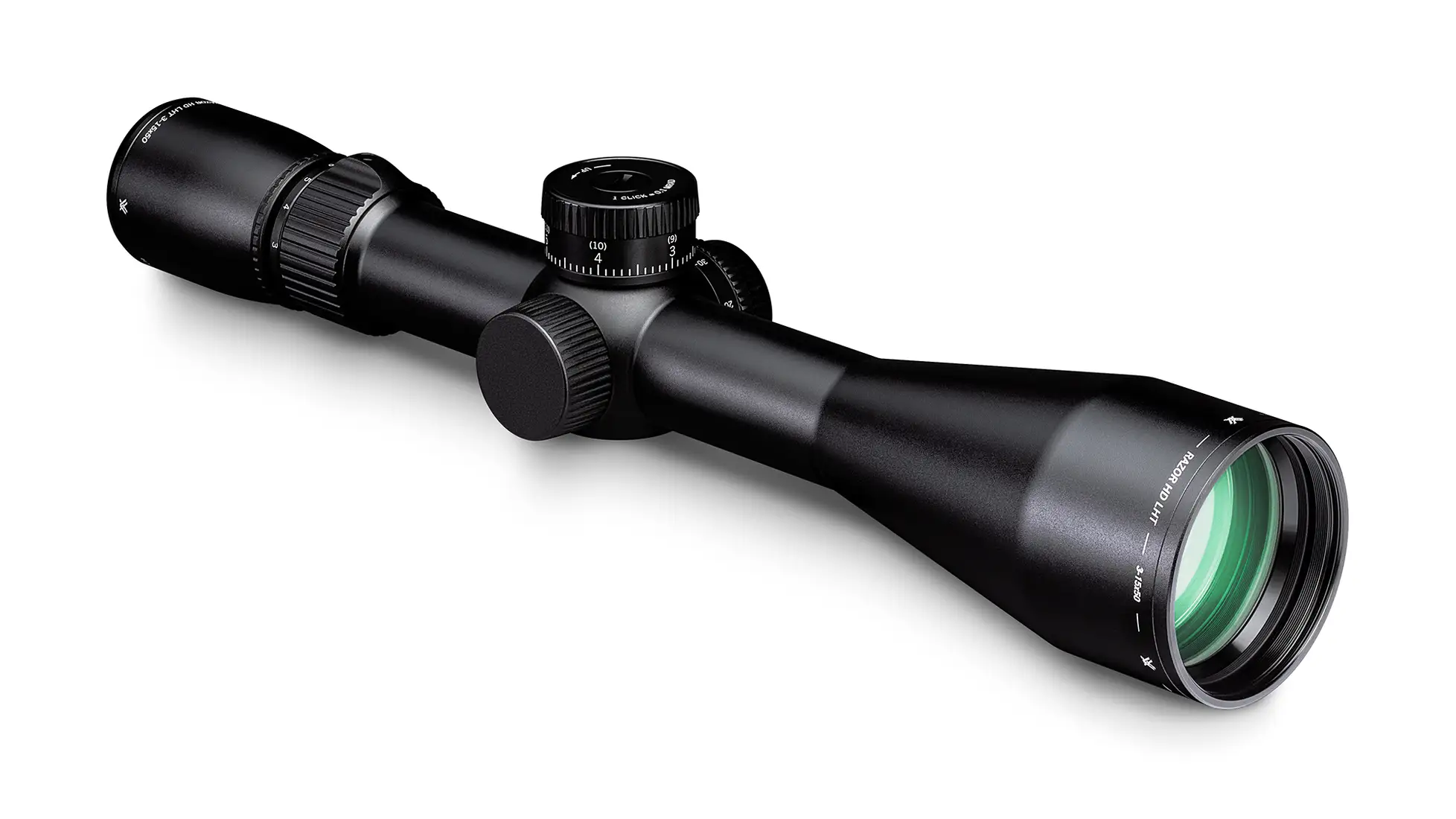
The 3-15x50 (RZR-31503) is sold here only with the G4i BDC MRAD reticle, which Vortex says provides reference marks to compensate for bullet drop and bullet drift. It clicks in 0.1 MRAD, and Vortex lists 11 MRAD of total elevation with RevStop installed. Choose it if you would rather hold over on a drop reticle than dial, and want the larger objective. Its owner record is eight reviews, six five stars and two four stars, mostly praising clear glass. One reviewer finds the windage clicks less crisp than the elevation clicks, two list price as a con, and one who owns an older non-illuminating LH model thinks the older scope is a little clearer.
“Locking elevation turrets are awesome no more losing my zero when transporting my rifle.”
Most helpful positive review, via OpticsPlanet
Key specifications: 4.5-22x50 FFP, XLR-2 MOA
| Magnification | 4.5-22x |
|---|---|
| Objective | 50 mm |
| Tube | 30 mm, aircraft grade aluminum (retailer) |
| Focal plane | First focal plane (FFP) |
| Reticle (this row) | XLR-2 MOA, red illumination |
| Illumination | Push button (Vortex); 10 brightness settings, one CR2032 battery (retailer) |
| Turrets | Exposed elevation, capped windage (Vortex) |
| Click value | 1/4 MOA (Vortex) |
| Travel per rotation | 15 MOA (Vortex) |
| Max elevation / windage | 75 MOA / 45 MOA (Vortex) |
| Total elevation with RevStop installed | 27 MOA (Vortex) |
| Parallax | 25 yds to infinity |
| Exit pupil | 11.1 to 2.3 mm (50 mm divided by 4.5x and 22x; the retailer lists 11.11 to 2.27 mm) |
| Field of view | 23.5 to 4.7 ft at 100 yds |
| Eye relief | 4.0 in |
| Diopter | -2 to +2 dpt (retailer) |
| Length | 13.3 in |
| Weight | 21.7 oz |
| Coatings | XR Plus fully multi-coated (retailer) |
| Warranty | Vortex VIP: unlimited, unconditional, lifetime (Vortex) |
Figures are Vortex's spec table for the XLR-2 MOA model unless marked as the retailer's; where both publish a figure for this size they agree. We do not print the retailer's angular field of view for this size. On awards: we found no award to claim for the Razor HD LHT, so we claim none.
Should you buy it, and what else to consider
- Buy the 4.5-22x50 FFP if you hunt mountains or open country, want reticle holds that work at any magnification, and will dial within the RevStop range.
- Buy the 3-15x42 if you want the lightest LHT, a wider low end and an MOA or MRAD reticle in the second focal plane.
- Buy the 3-15x50 if you prefer holding over on a BDC reticle in mils and want the bigger objective.
- Want more dialing range and do not mind the weight? Our Razor HD Gen III review covers Vortex's competition Razor, and our Nightforce NX8 page covers a Nightforce alternative.
- Comparing the field? Start at our best long range rifle scope guide, or pick by cartridge with the best scope for 6.5 Creedmoor and best scope for 300 Win Mag. Parallax is explained in parallax in a rifle scope, and units in MOA vs MRAD.
FAQ
Is the Vortex Razor HD LHT worth the money?
For a hunter who carries the rifle far and wants a first focal plane reticle and a dialing turret without a heavy scope, the owner record says yes: OpticsPlanet shoppers rate the 4.5-22x50 FFP 4.8 out of 5 across 45 reviews, and weight and clarity are what they praise most. Two reviewers disagree on the glass: the featured negative review says the image clarity is not on par with the price, and a two-star reviewer found it no better than cheaper scopes they own. If you shoot timed matches or need long dialing range above zero with the zero stop installed, look at a heavier tactical scope instead.
Is the Vortex Razor HD LHT reliable?
None of the 45 reviews we could read on the 4.5-22x50 listing reports the scope losing zero, and one reviewer who has bought it twice says the return to zero has always worked. One reviewer had the eyepiece bent by a gun store during mounting, sent the scope to Vortex on August 3 and had it back on August 11, and says they were not charged for the replacement scope. Vortex covers the line with its VIP warranty, which it describes as unlimited, unconditional and lifetime; Vortex excludes loss, theft, deliberate damage and cosmetic damage that does not affect performance.
How much does the Razor HD LHT 4.5-22x50 weigh?
Vortex lists 21.7 oz and a length of 13.3 inches for the 4.5-22x50 FFP, and the retailer specification table gives the same figures. The 3-15x42 is listed at 19.1 oz and the 3-15x50 at 20.5 oz.
What does the 27 MOA figure with RevStop mean?
Vortex lists two elevation figures for the 4.5-22x50 MOA model: a maximum elevation adjustment of 75 MOA, and a total elevation adjustment of 27 MOA with the RevStop zero system installed. The 3-15x42 MOA model lists 80 MOA and 27 MOA, and the 3-15x50 MRAD model lists 23 MRAD and 11 MRAD. If you plan to dial far past your zero, check your drop chart against the RevStop figure before you buy.
Is the Razor HD LHT first or second focal plane?
It depends on the size. The 4.5-22x50 is first focal plane, so its reticle grows and shrinks with the image and holds its values at every magnification. The 3-15x42 and 3-15x50 are second focal plane, so their marks hold their stated values at one magnification only.
Is the Razor HD LHT as good as a Nightforce?
We have not compared them side by side. Two reviewers on the 4.5-22x50 listing made the comparison themselves: one who lists an NF ATACR among the scopes they own rates the LHT glass as exceptional but says the LHT feels less robust than that scope, and another looked through a Nightforce 2.5x20 in a store and chose the Vortex for its field of view, its eye relief and its lower price. Our Nightforce NX8 page covers the Nightforce side.
More rifle scopes: best rifle scopes · best long range rifle scopes · best scope for deer hunting · Zeiss Conquest V4 review · Leupold Mark 4HD review.