Pulsar Telos LRF XT50: a 1280x1024 thermal monocular with a built-in laser rangefinder
Sponsored by Pulsar. Pulsar paid for this coverage. The brand could correct factual errors before publication; the verdict and the downsides are ours. How sponsored content works.
Our verdict: the Pulsar Telos LRF XT50 suits the hunter or observer who wants the highest-resolution sensor in Pulsar's Telos line and a wide view in a handheld thermal, plus a built-in rangefinder. Pulsar pairs a 1280x1024 sensor with a 50 mm F1.0 lens for a 17.5° field of view, adds a rangefinder rated to 1,312 yards, and rates the battery for 8 hours at 22°C. Inside Pulsar's own line, the 640x480 Telos LRF XP50 has the lower NETD on both of Pulsar's measures and an 8.5-hour battery rating, against the XT50's higher resolution, wider field and longer rangefinder. Pulsar describes the XT50 as a handheld observation device, not intended for firearm mounting: it is for observing and ranging, on its own or next to a separate riflescope. To see how its published figures line up against the other 1280x1024 handhelds with a rangefinder, read how it compares. Compact handhelds with smaller sensors are a different class, covered in our thermal monocular guide.
No owner reviews on OpticsPlanet yet. The listing has one offer, the Black Telos LRF XT50 (PL77524), at around $4,500. Check price and availability on OpticsPlanet.
How we put this together: this is a sponsored, research-based spotlight. We have not used the XT50 ourselves. It is built from Pulsar's specification page, user manual, FAQ, upgrade-program site and US warranty page; one retailer's published field review; one forum user's field notes; the OpticsPlanet listing; and the rivals' own spec pages. There is no score on this page, because Pulsar paid for it. Claims we could not confirm on a primary source are left out. See how we evaluate.
What the Telos LRF XT50 is
The XT50 is a handheld thermal imaging monocular with a laser rangefinder built in. Pulsar's FAQ is direct that it is an observation device and not intended to be mounted on firearms, so it is used in the hand or on a tripod, on its own or next to a separate riflescope. Pulsar describes it as designed for observation, search and rescue, security, outdoor activities and wildlife observation, and its manual lists hunting among the uses.
It is one of nine models Pulsar lists in the Telos line, which differ in sensor, lens and whether they carry a rangefinder. The XT50 has the highest-resolution sensor of the nine. Its closest sibling for a buyer is the Telos LRF XP50, which comes up again below, because on two numbers it beats the XT50.
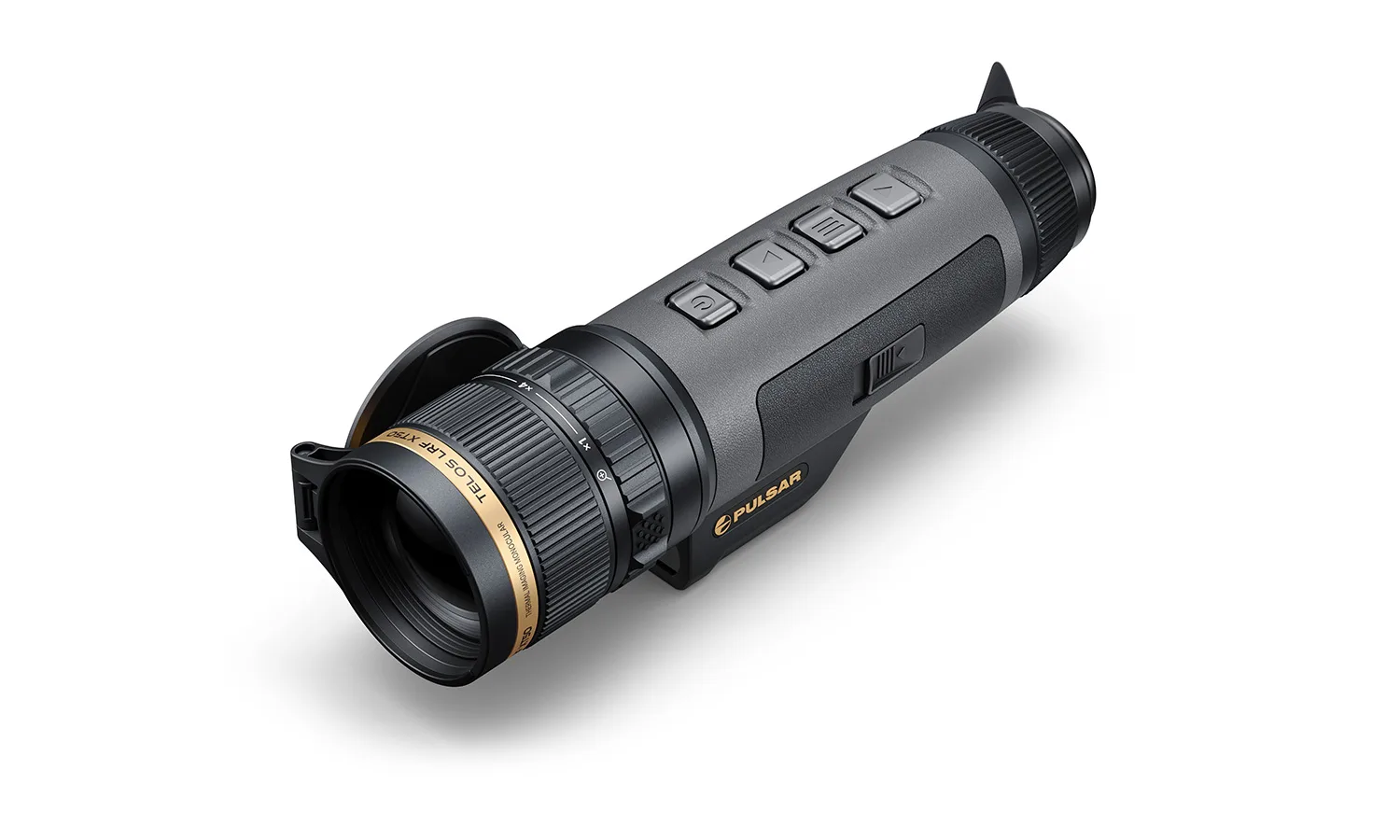
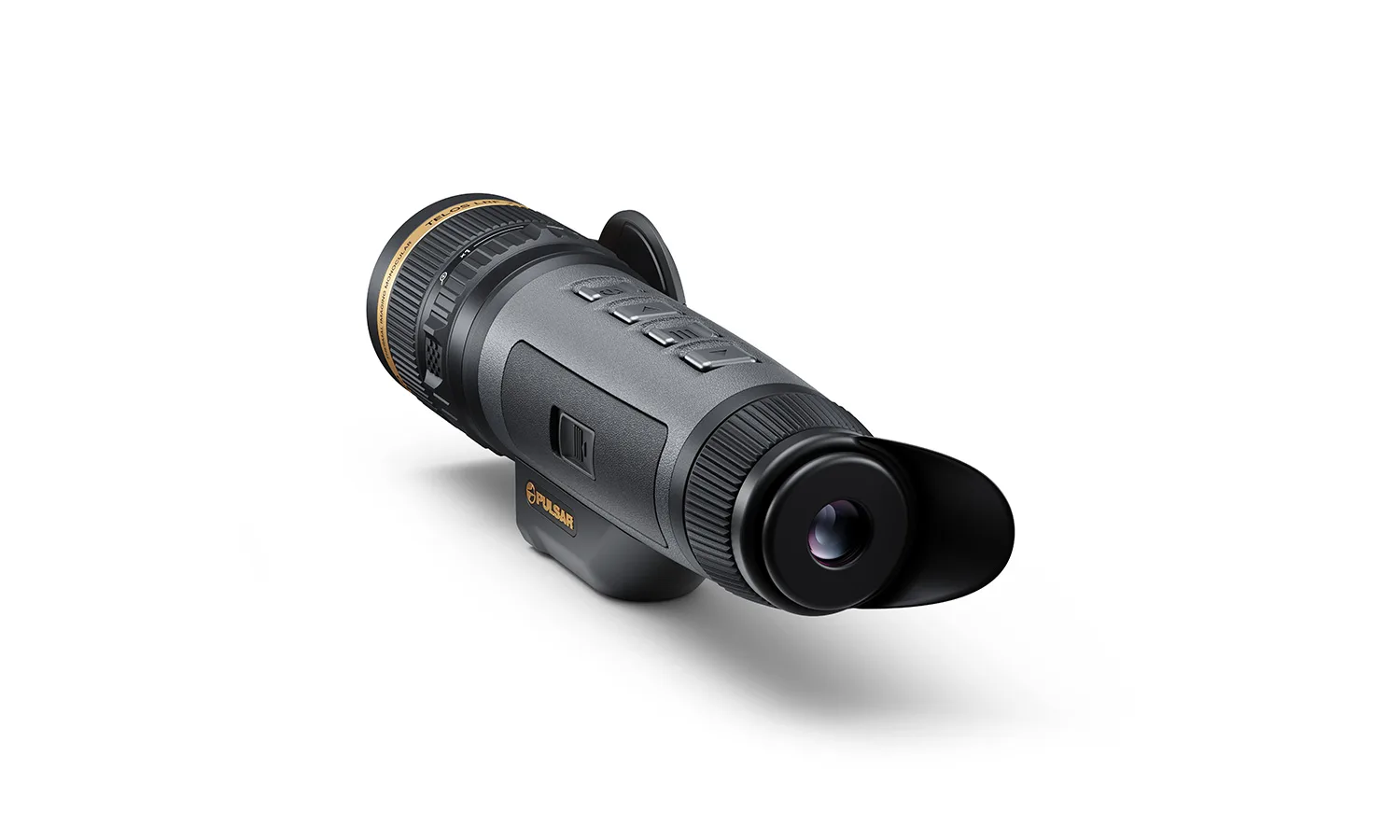
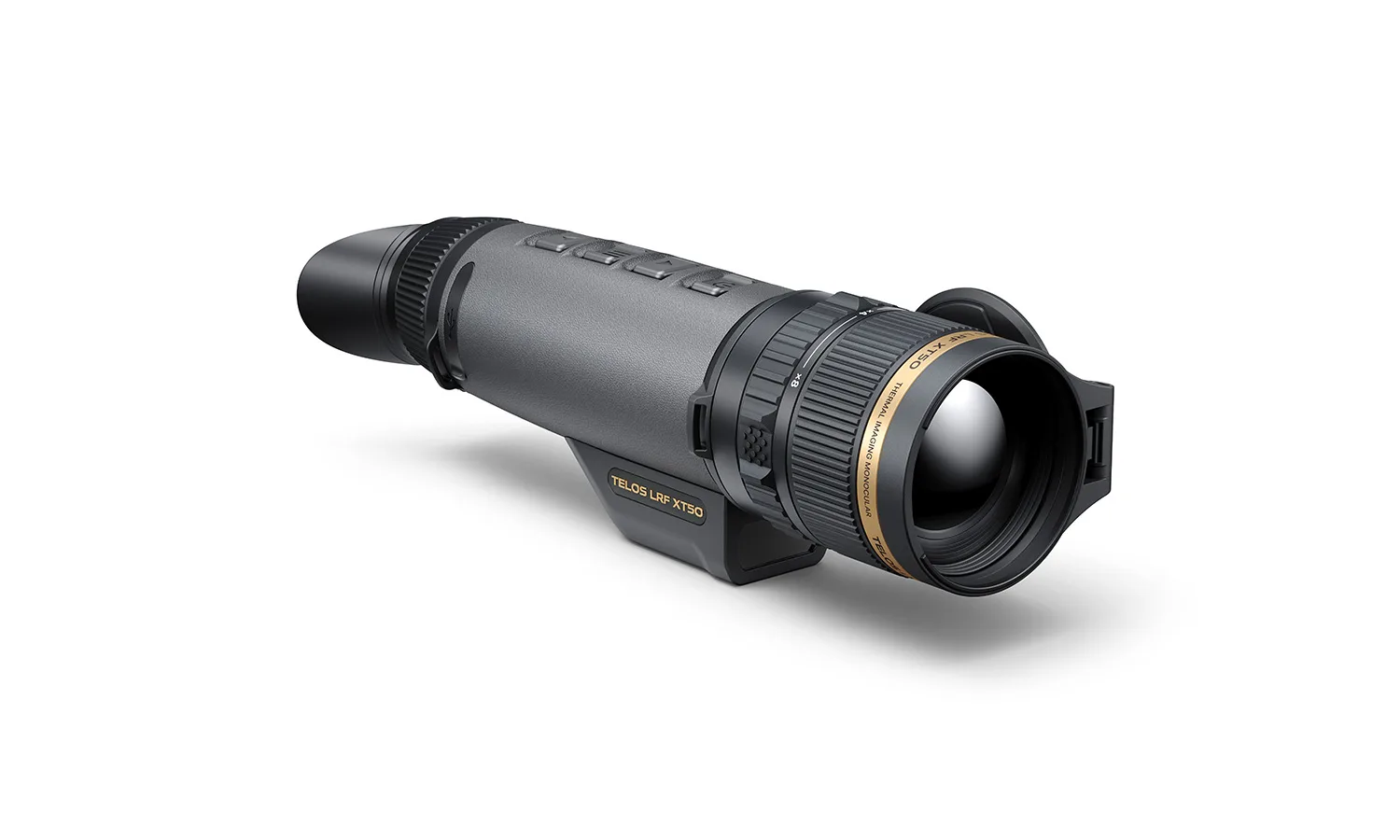
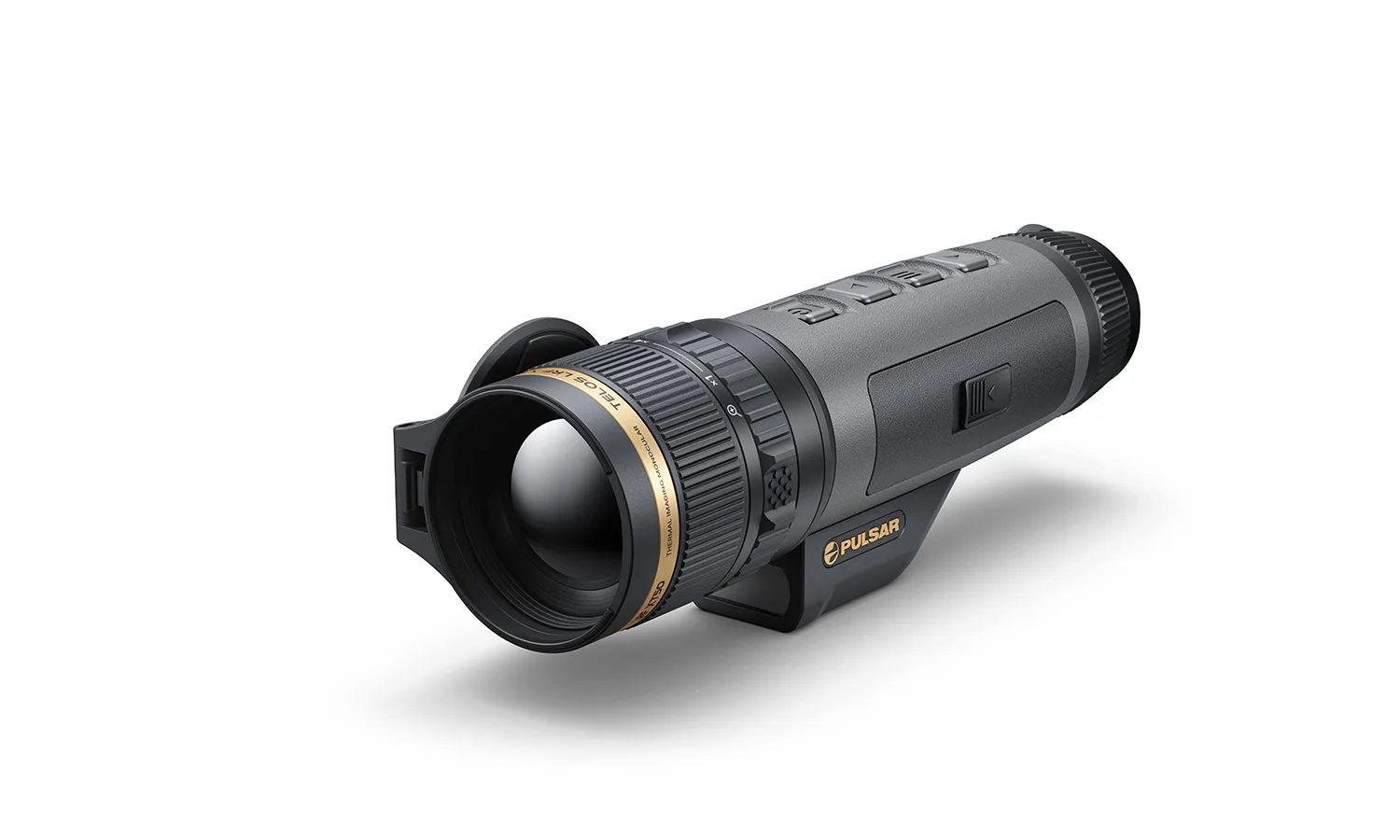
Renders supplied by Pulsar and used with its permission.
The image: why 1280x1024 matters here
Pulsar lists an uncooled 1280x1024 sensor with a 12 µm pixel pitch at 50 Hz, behind a 50 mm F1.0 lens, and calls it a European-made sensor. The base magnification is 2x and the field of view is 17.5° by 14°, which Pulsar gives as 30.7 by 24.7 meters at 100 meters. Digital zoom runs to 16x, and a Zoom Boost setting extends it to 24x. The eyepiece is a 1920x1080 AMOLED. Pulsar's FAQ names the 1280x1024 sensor as the XT50's main advantage and ties it to the wider 17.5° by 14° field and to more comfortable observation at low and medium magnification.
Our reading of those numbers: the large sensor is what lets Pulsar pair a wide field with usable digital zoom. A low 2x base finds heat quickly across a field or a treeline, and there are enough pixels to zoom in on what you found before the image breaks up. The field reports below say the same thing, in their own words.
Sensitivity needs a careful reading. NETD (noise equivalent temperature difference) is the smallest temperature difference a thermal imager can pick up, so lower is better. Pulsar publishes two NETD figures for the XT50, and they measure different things: a sensor NETD under 40 mK, the sensor's own rating before image processing, and a system NETD under 20 mK, the whole device with its processing algorithms. ATN and Nocpix each publish a single NETD figure on the pages we read and do not label it sensor or system NETD (ATN's text gives its figure as the rating of its 1280x1024 sensor), so the comparison below does not rank one maker's NETD against another's.
Why it matters, in Pulsar's own explanation (its journal article on NETD and sNETD): sensitivity counts most when thermal contrast is low, in rain, fog or humid air, when the objects in view sit at similar temperatures, and a lower NETD helps tell them apart. In dry, clear weather, Pulsar writes, small NETD differences are hard to see and spatial resolution matters more, and optics, housing and screen quality also shape the image. Pulsar adds that makers measure NETD in different ways, system NETD especially. That is the maker's framing; we have not measured either figure.
Rangefinder and ballistics
The rangefinder is a 905 nm, Class 1 laser that Pulsar rates to 1,200 meters (1,312 yards) with an accuracy of plus or minus 1 meter, and its manual notes that the range depends on the target and the conditions. Pulsar's manual lists a ballistic calculator among the features, and its spec page names Stream Vision 2 and Stream Vision Ballistics as the supported apps. Optics Trade's reviewer singles out the rangefinder with Stream Vision Ballistics as a very useful combination for hunters.
What the field reports say
There are no owner reviews on OpticsPlanet yet, and we found no review from a buyer who paid for the unit. Two field reports exist that are not Pulsar's own content, and each comes with context worth knowing.
Optics Trade (a retailer that sells the XT50), review by Tilen, September 17, 2026. The reviewer used it outdoors and while hunting; the article does not say where the unit came from. They report the image appearing about six seconds after switching on, and they call the wide field one of the strongest practical advantages, especially at shorter distances and in wooded areas.
“For us, this was one of the strongest practical advantages of the XT50.”
Tilen, Optics Trade (retailer field review), on the wide field of view
On zoom, they write that the image is not as sharp at 24x as at lower magnification, but that the remaining detail is still impressive.
“Even at 24x, the image remained usable.”
Tilen, Optics Trade (retailer field review)
The one compromise they name is size: “At 242 mm long and 730 g, the XT50 is not particularly small or light.”
A user named Dari on The Stalking Directory forum, August 28, 2026. They say they spent time testing the XT50; they do not say whether they bought or borrowed it. Everything below is that one user's report: not a pattern, and not something we could check ourselves.
What they liked:
- Image quality and field of view. They praise both; in their words, “Spotting is fast and pleasant.”
- Battery life. “The battery comfortably lasted me through two outings of about 4 hours each.”
What concerned them:
- Controls by feel. The zoom ring sits right next to the focus ring at the front, and they kept twisting the zoom when they meant to focus.
- Rangefinder and hand position. In their words, the way you hold the rings means “your left hand completely blocks the LRF beam.”
- Stabilization in the menu. There is no direct button for image stabilization; you turn it on in the menus.
- Calibration while warming up. They report the image calibrating every 2 to 3 minutes for the first half hour, and again a couple of seconds after raising it to the eye after a few minutes of inactivity, which freezes the screen briefly. Their fix was to switch automatic calibration off and calibrate by hand; Pulsar's manual offers manual, semi-automatic and automatic modes.
How it compares with its rivals
The XT50 is not the only 1280x1024 handheld with a rangefinder. Each figure below is from that maker's own page, read on October 15, 2026.
| Model | Sensor | Published NETD | NETD basis (as the maker states it) | Rangefinder | Notes (per each maker) |
|---|---|---|---|---|---|
| Pulsar Telos LRF XT50 | 1280x1024, 12 µm, 50 Hz | Sensor <40 mK, system <20 mK | Both: sensor and system | 1,200 m | Reference |
| ATN BlazeHunter XD LRF 1280x1024 | 1280x1024, 2-16x | ≤15 mK | Not labelled as sensor or system NETD; ATN's text gives a sub-15 mK NETD rating for its 1280x1024 sensor | Up to 1,000 m, ±1 m | Two batteries in the box for up to 10+ hours (ATN) |
| Nocpix VISTA S50R | 1280x1024, 60 Hz | ≤15 mK | Not specified | 1,200 yd, ±1 yd | 60 Hz, F0.9 lens, 2560x2560 AMOLED |
| Pulsar Telos LRF XP50 | 640x480, 17 µm, 50 Hz | Sensor <18 mK, system <15 mK | Both: sensor and system | 1,000 m | Lower NETD than the XT50 on both bases, 8.5 h battery rating (Pulsar) |
Like for like, inside Pulsar's own line: against the XP50, the XT50 has a 1280x1024 sensor against 640x480, a wider 17.5° field (the XP50's is 12.4°), more detection range (2,300 m against 1,800 m) and a longer rangefinder (1,200 m against 1,000 m). The XP50 has the lower NETD on both of Pulsar's measures (sensor under 18 against under 40 mK, system under 15 against under 20 mK) and a longer battery rating, 8.5 hours against 8, all per Pulsar.
Across makers: the XT50 ranges farther on paper than the ATN (1,200 m against 1,000 m), while ATN puts two batteries in the box and rates them for up to 10+ hours, and Nocpix lists a 60 Hz sensor, an F0.9 lens and a 2560x2560 AMOLED display. ATN and Nocpix each publish NETD as ≤15 mK without labelling it sensor or system NETD (ATN's text gives its figure as the rating of its 1280x1024 sensor), so there is no like-for-like basis to set it against either of Pulsar's numbers, and we do not name a NETD winner across makers.
Telos is also the line Pulsar markets as upgradeable: through a dealer, owners of other Telos models (the XQ35, XG50, XP50 and XL50, with or without a rangefinder) can move up to the XT50's 1280x1024 sensor and rangefinder. Pulsar's upgrade site does not list an upgrade for the XT50 itself. For US buyers, see intended use and buyer considerations.
Our reading: the XT50 fits the buyer who mostly scans open ground and wants a 1280x1024 image with a wide field and a built-in rangefinder in one handheld. For a buyer whose usual conditions are low-contrast (fog, rain, humid air), sensitivity weighs more, and the one like-for-like NETD comparison on this page, inside Pulsar's line, favors the XP50.
Figures are each maker's own published specifications. Prices move, so check each maker's or retailer's current price yourself.
Battery, power and the cold
Pulsar rates the LPS 7i pack (6400 mAh) for 8 hours at 22°C. Its manual says the real figure depends on how much you use Wi-Fi, Bluetooth, the recorder and the rangefinder, and that running the battery below 0°C (32°F) lowers its capacity, which Pulsar calls normal and not a defect. The pack is removable and the device takes 5 V or 9 V USB-C Power Delivery for external power. The manual's box list has one battery pack and a spare battery compartment cover, not a second battery, so a long winter sit would need a spare pack or a power bank. Pulsar rates the XT50 to operate from -25 to +40°C (-13 to +104°F).
Warranty and service in the US
Pulsar USA's warranty page says every Pulsar device ships with a factory 3-year warranty and that registering it adds 2 more years. The extension applies to US purchases made on or after January 1, 2024, of devices manufactured after January 1, 2023, and the warranty is transferable with proof of purchase or a serial number. Rechargeable battery packs get 1 year. Pulsar USA says units sold in the US are serviced and repaired by its team in Mansfield, Texas, not overseas.
OpticsPlanet's listing carries this notice: “This item may be regulated for export by the U.S. Department of State or the U.S. Department of Commerce.”
Intended use and buyer considerations
Pulsar describes the XT50 as a handheld observation device that is not intended to be mounted on firearms. That is the category it belongs to: a thermal monocular for observing and ranging, held in the hand or set on a tripod, on its own or next to a separate riflescope. Pulsar positions it for open plains, mixed terrain and extended missions, and its FAQ says the body design and one-hand operation are intended for prolonged use in the field. Aiming with a thermal image is a different category, the thermal riflescope.
- The upgrade program and the US. Pulsar's upgrade program site says the program is available in all European Union countries, Norway and Switzerland, and its country list (which also names the United Kingdom) does not include the United States, as read on October 15, 2026. A US buyer gets the XT50 as delivered.
- Size and weight. 242 x 72 x 77 mm and 0.73 kg with the battery, per Pulsar.
- Battery in the box. The manual's box list has one LPS 7i pack (see battery, power and the cold).
- One user's field notes. The points on controls, rangefinder and hand position, stabilization in the menu and calibration while warming up come from one forum user, alongside their praise for the image, field of view and battery (see what the field reports say).
Key specifications
| Model | Pulsar Telos LRF XT50 thermal imaging monocular (handheld; not for firearm mounting, per Pulsar) |
|---|---|
| Version carded | The single OpticsPlanet offer, Black, MPN PL77524 (Pulsar SKU 77524) |
| Sensor | Uncooled microbolometer, 1280x1024, 12 µm pixel pitch, 50 Hz |
| Sensitivity | Sensor NETD under 40 mK; system NETD under 20 mK |
| Objective lens | 50 mm, F1.0 |
| Magnification | 2-16x (1-8x digital zoom on a 2x base); Zoom Boost extends it to 24x |
| Field of view (H x V) | 17.5° x 14°; 30.7 x 24.7 m at 100 m |
| Eye relief / diopter | 13 mm / -5 to +4 |
| Display | AMOLED HD, 1920x1080 |
| Detection range | 2,300 m (2,515 yd), deer-sized object, ideal conditions |
| Laser rangefinder | 905 nm, Class 1; up to 1,200 m (1,312 yd), accuracy ±1 m |
| Recording | 1440x1080 photo and video, .mp4 / .jpg, 128 GB built-in memory |
| Wireless / apps | Wi-Fi 2.4 / 5 GHz, Bluetooth BLE 5.0; Stream Vision 2 and Stream Vision Ballistics |
| Power | LPS 7i Li-ion battery pack, 6400 mAh; 8 h at 22°C; 5 V / 9 V USB Type-C Power Delivery |
| Protection | IPX7 |
| Operating temperature | -25 to +40°C (-13 to +104°F) |
| Weight (with battery) | 0.73 kg (25.75 oz) |
| Dimensions | 242 x 72 x 77 mm (OpticsPlanet: 9.53 x 2.83 x 3.03 in) |
| Tripod | Adaptor for 1/4" (Pulsar spec page) |
| In the box (manual) | Monocular, LPS 7i battery pack with protective cover, spare battery compartment cover, power adapter, USB Type-C cable with USB Type-A adapter, case, hand strap, quick start guide, lens cloth, warranty card |
| Warranty (US) | 3 years factory, 5 years with registration (Pulsar USA); battery packs 1 year |
Specifications are Pulsar's, from the Telos page on pulsarvision.com (XT50 specification block) and the XT50 user manual; the warranty row is Pulsar USA's, and the "Version carded" and inch dimensions are the OpticsPlanet listing's. No editorial award is claimed.
Which option fits which need
- The Telos LRF XT50 is built for glassing big fields or mixed ground at night with the highest-resolution sensor in Pulsar's Telos line and a built-in rangefinder, carried in the hand rather than mounted.
- Pulsar's Telos LRF XP50 is the line's 640x480 option, with a lower NETD on both of Pulsar's measures (sensor and system) and an 8.5-hour battery rating, against the XT50's higher resolution, wider field and longer rangefinder.
- Compact handhelds with smaller sensors are a different class: our thermal monocular guide covers compact ATN models with sensors up to 640x512, and our RIX Titan T6 review covers a 640x480 handheld with a rangefinder and ballistic calculator.
- Thermal binoculars use both eyes for long scanning sessions: see our best thermal binoculars guide.
- A thermal scope is the category for aiming with a thermal image: see the best thermal scope guide.
FAQ
Can you mount the Pulsar Telos LRF XT50 on a rifle?
No. Pulsar's own FAQ says the Telos LRF XT50 is a handheld observation device and is not intended to be mounted on firearms. It is a spotter for finding and ranging; aiming with a thermal image is the job of a different category, the thermal riflescope.
How long does the Telos LRF XT50 battery last?
Pulsar rates the LPS 7i battery pack (6400 mAh) for 8 hours at 22°C (72°F). Its manual adds that actual operating time depends on how much you use Wi-Fi, Bluetooth, the video recorder and the rangefinder, and that using the battery below 0°C (32°F) reduces its capacity. The battery is removable and the device also runs on USB-C external power. One forum user who spent time with the XT50 wrote that the battery lasted through two outings of about 4 hours each.
Can the Telos LRF XT50 be upgraded in the United States?
No. Pulsar's upgrade site does not list an upgrade for the XT50 itself (it is a model other Telos units can move up to), and the program's country list (European Union countries, Norway, Switzerland and the United Kingdom) does not include the United States.
How far can the Telos LRF XT50 see and range?
Pulsar says the XT50 can detect a deer-sized object at up to approximately 2,300 meters (2,515 yards) under ideal conditions, and its rangefinder measures to 1,200 meters (1,312 yards) with an accuracy of plus or minus 1 meter. Detection means a heat source shows up on the screen; telling what the animal is takes a shorter distance, and Pulsar does not publish a recognition figure on the pages we read.
What warranty does the Telos LRF XT50 have in the US?
Pulsar USA's warranty page says every Pulsar device ships with a factory 3-year warranty, and registering the product adds 2 more years. That optional extension is limited to purchases made in the United States, on or after January 1, 2024, of devices manufactured after January 1, 2023. Rechargeable battery packs are covered for 1 year. Pulsar USA says its units are serviced and repaired in Mansfield, Texas.
More thermal: best thermal monocular · RIX Titan T6 review · Armasight Sidekick review · thermal vs night vision.