Steiner Predator 4 review: the 2.5-10x42, the rest of the line, and the compact 4S
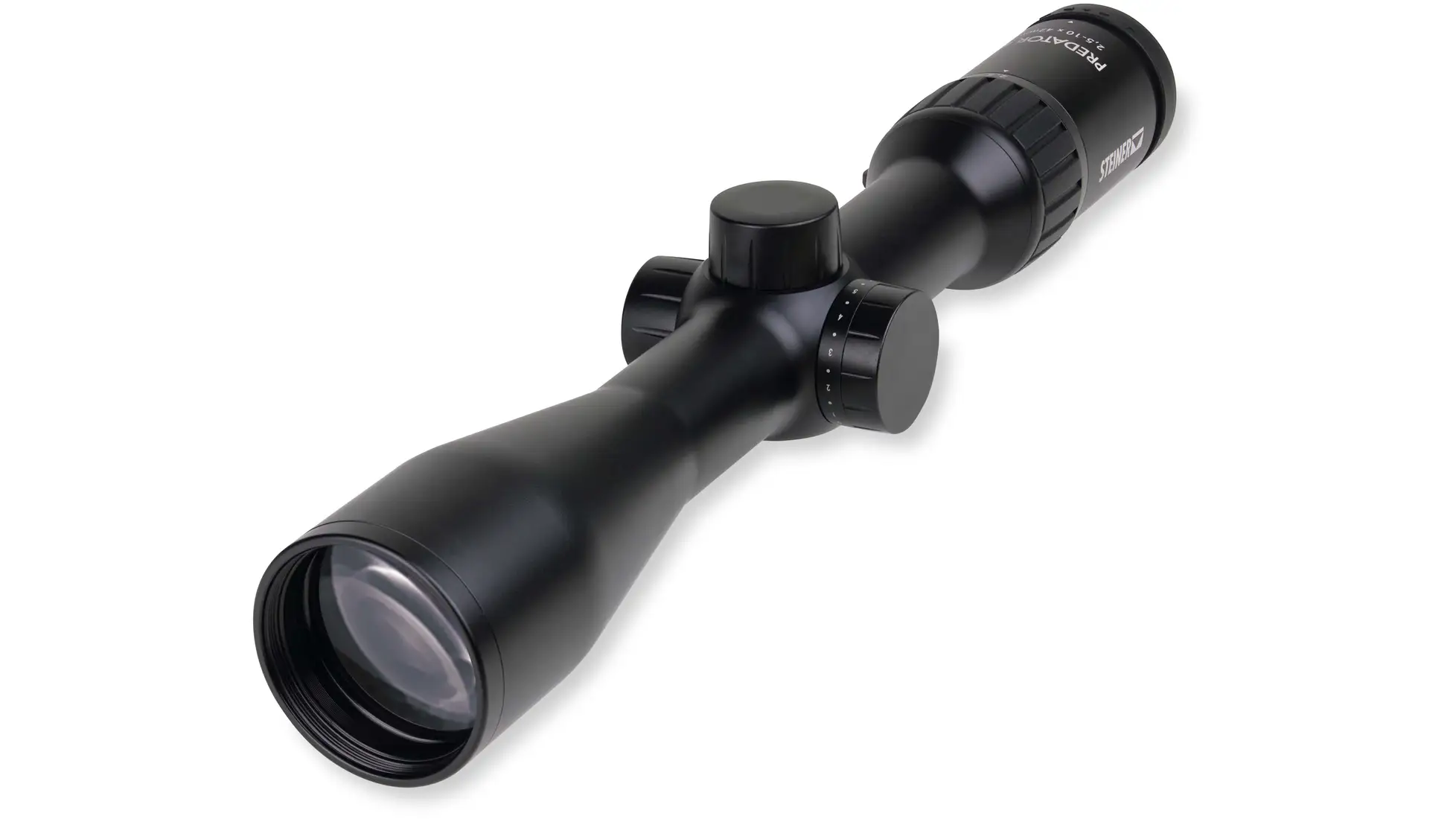
Our verdict: 4.0/5. The Steiner Predator 4 is a second focal plane hunting scope line built around Steiner's illuminated E3 holdover reticle, and the 2.5-10x42 we review here is the all-round size: a 30mm tube, 50 MOA of elevation in 0.25 MOA clicks, 11 illumination levels and parallax fixed at 100 m in Steiner's manual, so there is no side focus knob to set. Five of the six OpticsPlanet reviews on it name the glass or clarity as a positive. It loses a point for what to know first: the E3 holds are drawn for 200 to 400 yards from a 100 yard zero, the longer-range sizes give up elevation (Steiner's US pages list 30 MOA on the 4-16x50, where its manual gives about 25, and 25 MOA on the 6-24x50), and the owner record is small. The 4S is the compact 4-16x44 whose side focus Steiner says is tailored for thermal clip-ons. For our deer-rifle picks see the best scope for deer hunting; for a same-class second focal plane scope with far more elevation, our Leupold VX-5HD Gen 2 review.
The 2.5-10x42 (item 8770) sells for around $1,050, the 4-16x50 (8772) for around $1,150, the 3-12x56 (8778) for around $1,100, the 6-24x50 (8773) for around $1,200 and the Predator 4s 4-16x44 (8777) for around $950. OpticsPlanet shows 4.5/5 from 6 reviews on the 2.5-10x42. Check price and availability on OpticsPlanet; confirm the current price on the retailer page.
How we reviewed it: a research-based review built from the retailer's five Predator 4 listings (12 owner reviews in total: 6 on the 2.5-10x42, 5 on the 4-16x50, 1 on the 6-24x50, none on the 3-12x56 or the 4S), checked against Steiner's five US product pages, its E3 and 4Ai reticle pages, its warranty page and the Predator 4 user manual Steiner links from its product pages. Independent tests are cited only where we read the article: Sporting Shooter and Australian Shooter on the 4-16x50, Rifle Magazine on the 4S. Where Steiner's own documents disagree we print both, labelled; where the retailer and Steiner disagree, we print Steiner. Research leads we could not confirm on a primary source were left out. We have not tested this scope ourselves; the score is our editorial opinion and owner ratings are shown attributed to their source. See how we evaluate.
The Predator 4 line in one paragraph
Steiner's hunting riflescope catalogue lists five scopes under its Predator 4 heading: the 2.5-10x42, 3-12x56, 4-16x50, 6-24x50 and the Predator 4s 4-16x44. Four of them carry the E3, a second focal plane holdover reticle with an illuminated center; the 3-12x56 carries the 4Ai, which Steiner describes as built on the classic German #4 design with a daylight-visible illuminated center dot and bold outer posts. Steiner-Optik's address in the manual is Bayreuth, Germany, and the manual calls it a Beretta Holding company; in the US the warranty is given by Burris. The Predator 8 is a separate Steiner line, and nothing on this page is borrowed from it.
The 2.5-10x42 (8770): the all-round size
On Steiner's US page the 2.5-10x42 has a 30mm tube, a 2nd focal plane E3 reticle, 0.25 MOA clicks and 50 MOA of windage and elevation. Field of view runs from 48 ft at 2.5x to 12 ft at 10x at 100 yards and eye relief is 3.5 in. Steiner lists 13.3 in and 22.7 oz on the US page; its user manual gives 604 g for the same model, which is 21.3 oz by our arithmetic, so the two Steiner documents disagree by more than an ounce.
Parallax is the detail that sets this size apart. Steiner's manual says the riflescopes are set to be parallax free to 100 m and lists the 2.5-10x42 as "100 m fix", and its US spec table has no side focus row for this model. In practice that is one fewer knob to set on a woods or stand rifle; at 10x on close or far targets you cannot focus the parallax out. Steiner's US page lists "50 m at low end" for the same scope and does not explain it.
The 2.5-10x42 is the best-reviewed listing in the line: 4.5/5 from 6 OpticsPlanet reviews, 3 of them tagged Verified Owner. Five of the six name the glass or clarity as a positive. The negatives are about size and the eye box: one Verified Owner returned it for being too big for their deer hunting, and two reviewers (one of them a Verified Owner) mention a small eye box or short eye relief.
“I returned for credit as it is too big, way more than needed for everyday deer hunting.”
Red (MS), Verified Owner, three-star review, via OpticsPlanet
“Be aware, the eye relief is a little short (but I have a longer than average LOP, so perhaps that was part of it).”
AJ (CO), Verified Owner, five-star review, via OpticsPlanet
“Elevation and windage markings are very user-friendly and easy to pick out.”
KD (TX), five-star review, via OpticsPlanet
A four-star reviewer who compares it with several scopes they own sums up the eye box point and the turret question in their own words: the eyebox is the only issue they name, and they call the Predator 4 “not really a dialing scope”.
The 4-16x50 (8772): side focus, less elevation
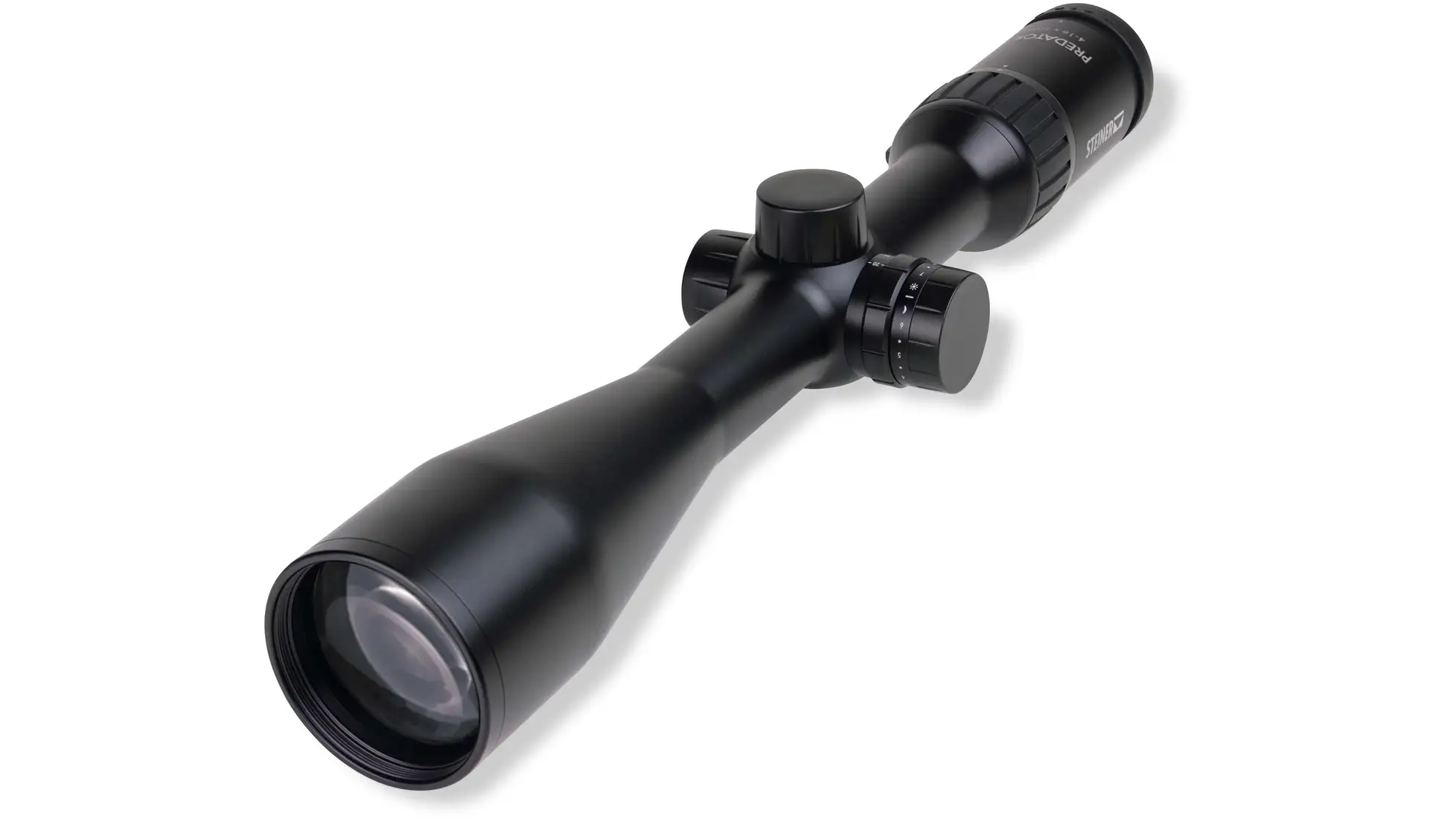
The 4-16x50 adds a side focus knob, which Steiner's US page lists from 20 yds to infinity, and keeps the E3 reticle, 0.25 MOA clicks and 3.5 in of eye relief. Steiner lists 14.7 in and 23.7 oz, and a field of view of 30 to 7.5 ft. The retailer's listing title says 4.4-16x50; Steiner lists the magnification as 4-16x.
The trade is elevation. Steiner's US page lists 30 MOA of windage and elevation; its manual gives 72 cm at 100 m for this model, which is about 25 MOA by our arithmetic, and Chris Redlich of Australian Shooter, who reviewed a 4-16x50 at the invitation of the Australian distributor Beretta, also writes +/- 25 MOA and calls it “by no means a long-range target-style scope”. In the same review the shooter in Redlich's test used the E3 holds on 16x to score “V bulls” at 500 and 600 yards while aiming off with a .223, and Redlich found the plain E3 less practical on small game in the dark until the illuminated center was switched on.
Sporting Shooter's Nick Harvey ran a box test on a 4-16x50 and wrote that “Shooting the square proved the internal mechanisms provide consistent, repeatable adjustments”. Harvey also describes the turrets as capped, and says both dials can be reset to zero by loosening the top cap and lifting the turret.
On OpticsPlanet the 4-16x50 shows 4.8/5 from 5 reviews, 3 tagged Verified Owner; 4 of the 5 praise the glass or clarity and none is negative.
“Unless you are regularly shooting varmints out past 400 yards this scope is incredible.”
Tyson Blair (TX), Verified Owner, five-star review, via OpticsPlanet
The 3-12x56 (8778): the low-light size with a different reticle
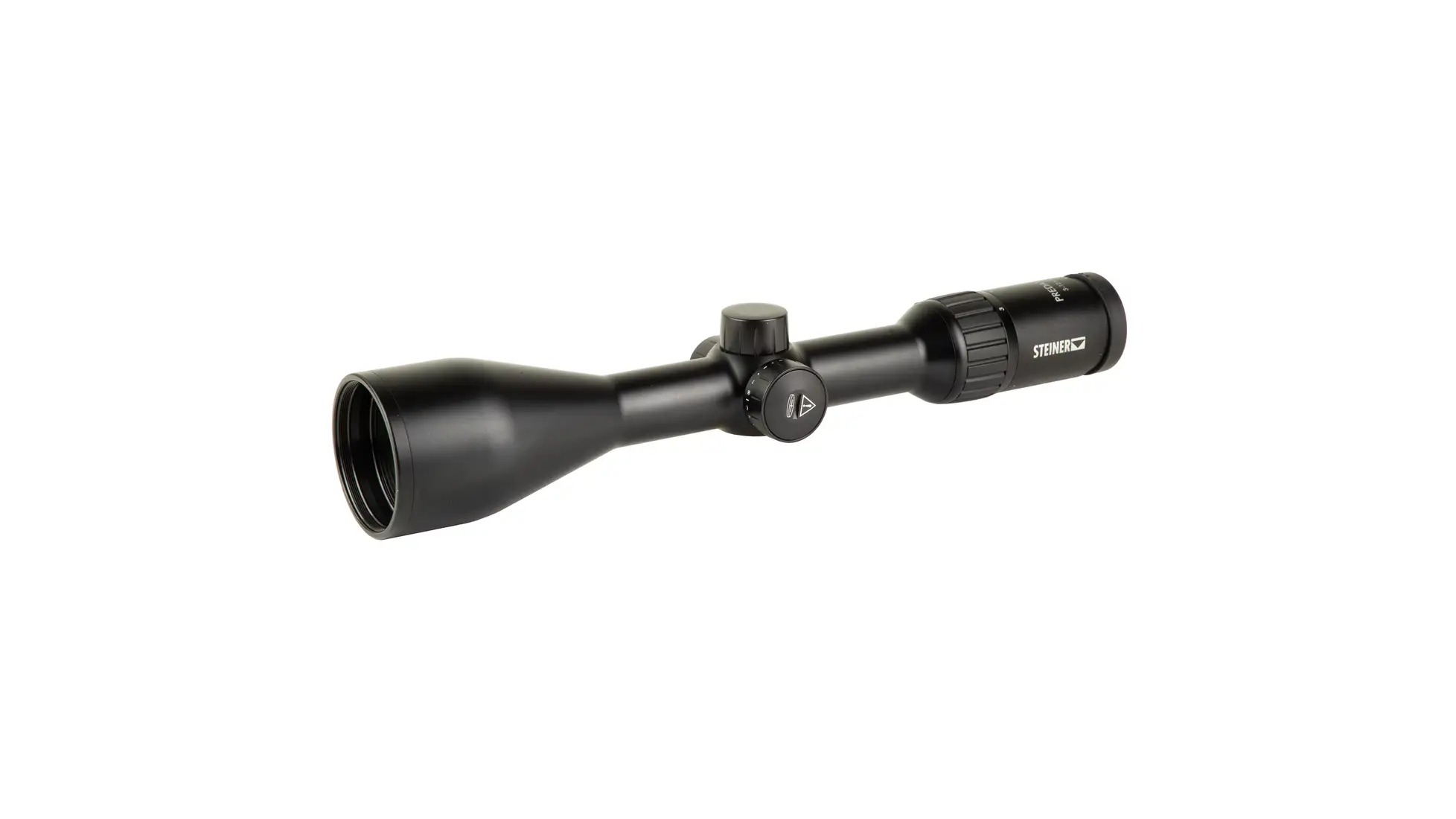
The 3-12x56 is the one Predator 4 without the E3. Steiner lists it with the 4Ai Illuminated reticle and names the Predator 4 3-12x56 among its 4Ai products; the retailer's specification table says E3, which does not match Steiner. It is also the only Predator 4 page where Steiner prints a light transmission figure, 90%, and the only one Steiner describes with "superior twilight performance". Parallax is fixed at 100 yds, clicks are 0.25 MOA, and windage and elevation are 50 MOA each on Steiner's page (the retailer's 72/72 cm figure does not match Steiner's, so we print Steiner's). Steiner lists 13.9 in and 22.5 oz and a field of view of at least 39 ft down to 9.9 ft at 100 yards.
Steiner's 3-12x56 page has no focal plane, tube diameter, eye relief, illumination level count or warranty row; the retailer's listing gives a 30mm tube, second focal plane and 3.54 in of eye relief. The listing has no owner reviews, so this size rests on Steiner's specification alone.
The 6-24x50 (8773): most magnification, least elevation
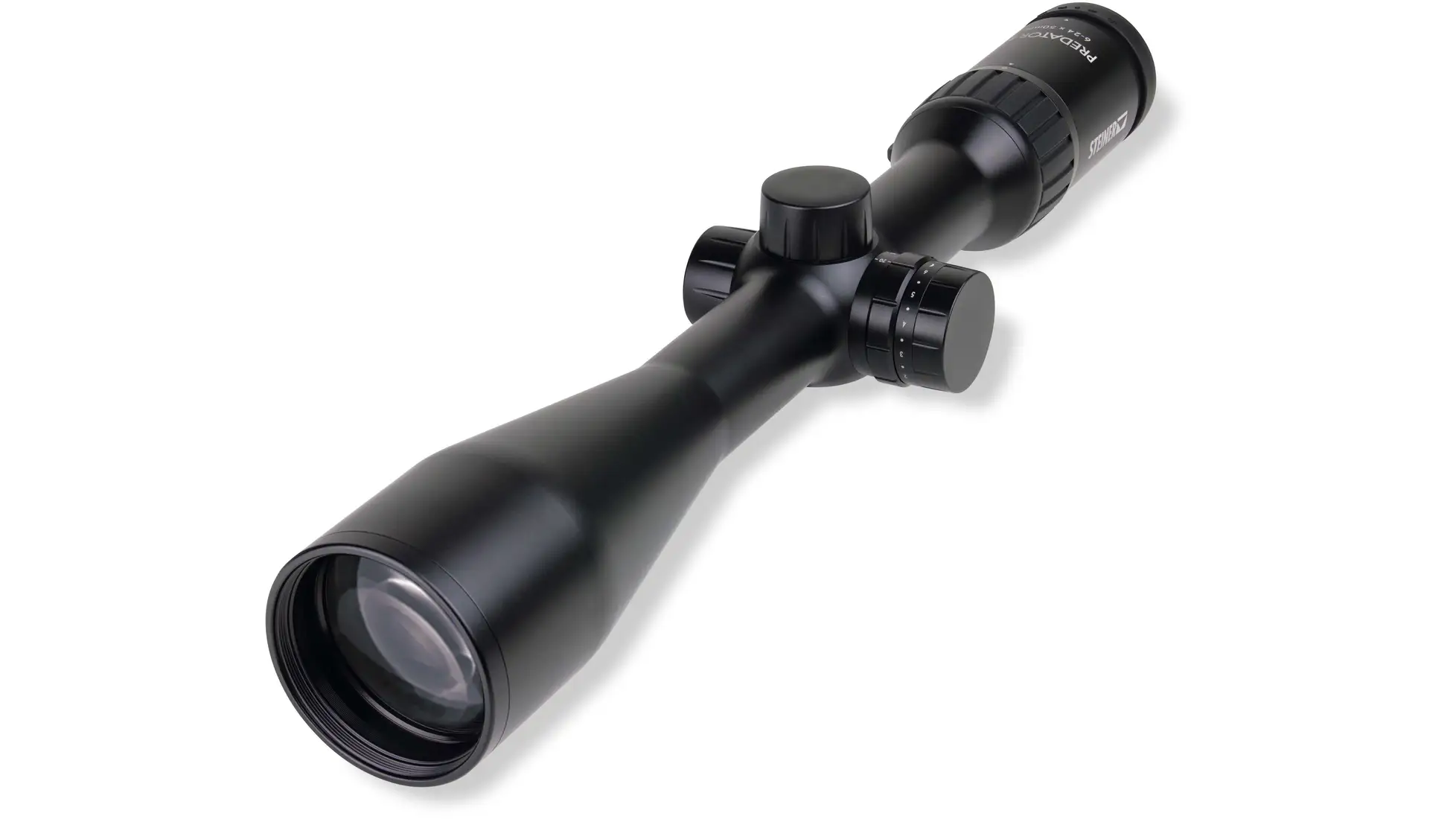
The 6-24x50 has the most magnification in the line and, on Steiner's figures, the least adjustment: 25 MOA of windage and elevation on the US page, 72 cm at 100 m in the manual. Side focus is standard, but Steiner's documents disagree on how close it goes: the US page says 55 yds to infinity, the manual's table says 20y to infinity. Steiner lists 14.7 in, 23.5 oz, 3.5 in of eye relief and a field of view of 20.1 to 5.1 ft. Divide the 50 mm objective by 24 and the exit pupil is about 2.1 mm at full power (our arithmetic), which matches Steiner's 2 mm.
With 25 MOA of total travel this is a scope for holding with the E3 rather than dialing far. One review on the listing, five stars, not tagged Verified Owner.
“The parallax, magnification, and eye piece are very smooth and easy to adjust.”
Tim (NC), five-star review, via OpticsPlanet
The Predator 4s 4-16x44 (8777): the compact one
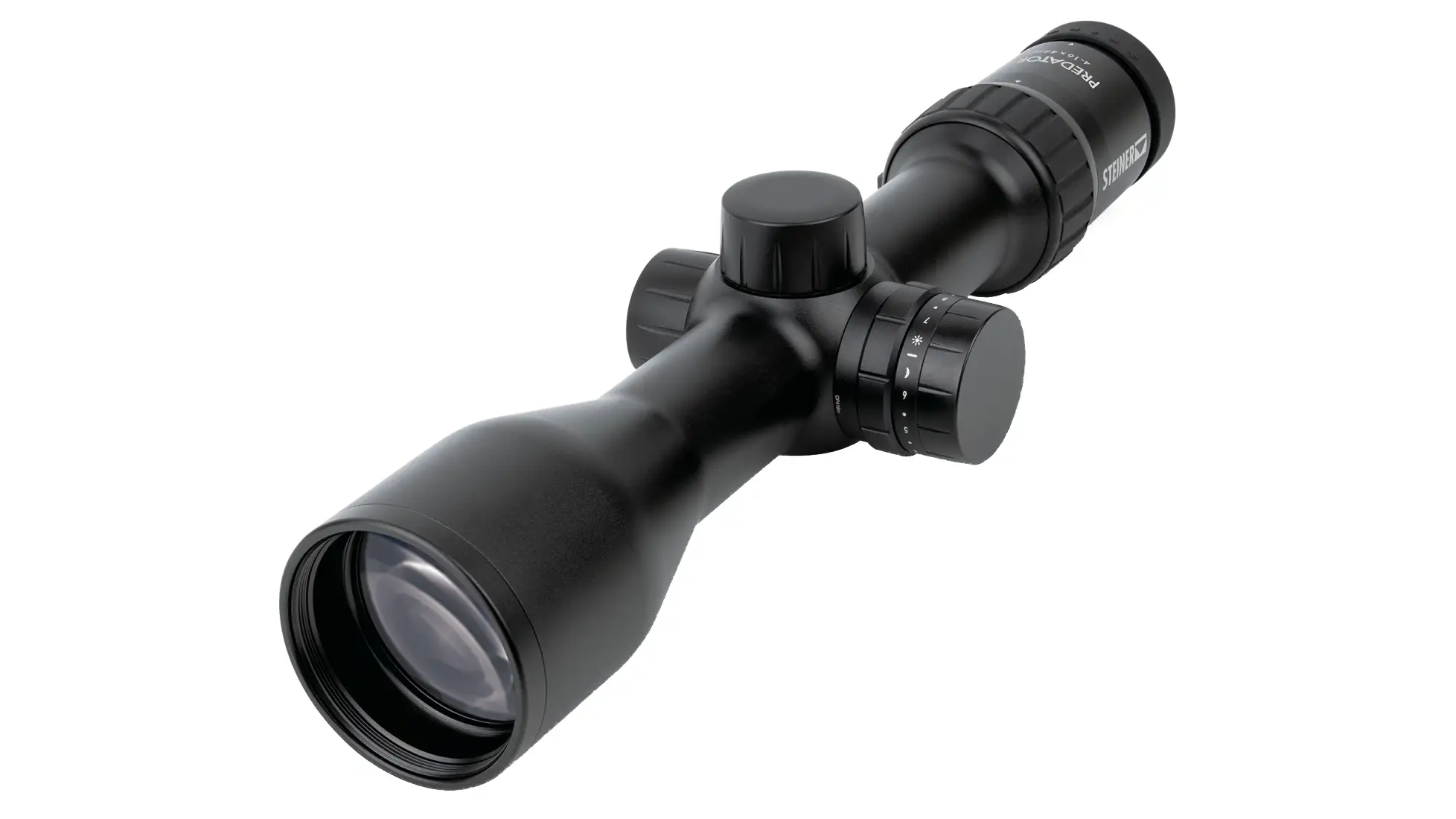
Steiner calls the Predator 4s “the world's shortest and lightest 4-16X hunting riflescope”, 25% shorter than its closest competitors, and gives 10.9 inches and just over 18 ounces on a 30mm tube. That is Steiner's claim; we found no independent measurement of it, and Patrick Meitin of Rifle Magazine words it as “likely the most compact and lightest” in its magnification range. Steiner lists an E3 second focal plane reticle with 11 illumination settings on a rotary dial, 1/4 MOA clicks, 85 mm of eye relief and side focus from 50 meters to infinity, which it says is tailored for thermal imaging attachments. The retailer's buy-together title calls the reticle "Short E3"; Steiner's page says E3. The Steiner pages we read do not say what the S in 4s stands for.
The short body is also its catch. Meitin found that on the short-action rifles with two-piece bases in that test the scope would not accommodate the base spacing, and wrote that a bolt rifle may need extra-high rings with a Picatinny rail or a cantilever mount, and calls it an ideal AR optic. Steiner does not list an adjustment range on its 4s page; Meitin gives 30 MOA of elevation. It is the lowest-priced of the five rows on this page. The listing has no owner reviews.
The E3 reticle, explained
Steiner's E3 page says to zero the crosshairs at 100 yards; the descending hash marks on the lower post then give holdover points for 200, 300 and 400 yards. The product pages add 5 and 10 MPH crosswind reference marks. Steiner says the E3 is optimized for standard, magnum and varmint calibers and that actual point of impact may vary by caliber, load and environment. Its manual gives the E3 subtensions “at max. magnification” (10x, 16x and 24x on the three models it covers). On a second focal plane reticle the marks cover more target as you zoom down, so the published values hold at the top of the zoom; our FFP vs SFP guide explains why. Steiner's manual says the illuminated red dot has six night levels and five bright day levels, with the OFF position and the intermediate positions using no power, on a CR2032 battery.
The honest catches
Elevation drops as magnification rises. Steiner lists 50 MOA on the 2.5-10x42 and 3-12x56, 30 MOA on the 4-16x50 (72 cm, about 25 MOA, in its manual) and 25 MOA on the 6-24x50. The sizes that look like long-range scopes have the least travel to dial. If you plan to dial your drop, see the alternatives below.
Steiner's own documents disagree. The US pages and the manual differ on the 4-16x50 elevation, the 2.5-10x42 weight and the 6-24x50 parallax range. We print both where they differ; if one figure decides your purchase, ask Steiner before you buy.
Mounting clearance. Steiner's manual specifies 30 mm rings tightened to no more than 2 Nm. Redlich (who reviewed the 4-16x50 at the invitation of the Australian distributor Beretta) notes a 48mm ocular bell that needs care when mounting low on rifles with a 90-degree bolt throw, and Meitin found the 4s would not accommodate the base spacing on the short-action rifles with two-piece bases in that test.
Warranty terms to read. Steiner's Heritage Warranty page says “For the Life of the Product” and that the warranty transfers to future owners automatically, but it covers electronic components for 3 years from purchase or delivery by the original purchaser, and it is valid in the U.S. and Canada on items made since 2014 and bought from Burris or a Burris authorized seller in the United States.
A small owner record. Twelve reviews across five listings, two listings with none. That is too little to judge long-term durability from owner reviews.
Trade-offs, plainly
- Second focal plane on every size Steiner states; the E3 subtensions are given at maximum magnification.
- Elevation travel is 25 to 50 MOA depending on size, least on the 6-24x50.
- The 2.5-10x42 and 3-12x56 have fixed parallax; side focus only on the 4-16x50, 6-24x50 and 4s.
- Two 2.5-10x42 reviewers mention a small eye box or short eye relief; one Verified Owner returned it as too big.
- Electronic components are covered for 3 years, not for the life of the product.
- The 4s is short enough to complicate mounting on some bolt rifles.
Key specifications: all five Predator 4 scopes
| Spec | 2.5-10x42 | 4-16x50 | 3-12x56 | 6-24x50 | 4s 4-16x44 |
|---|---|---|---|---|---|
| Item number | 8770 | 8772 | 8778 | 8773 | 8777 |
| Reticle | E3, illuminated | E3, illuminated | 4Ai Illuminated | E3, illuminated | E3, illuminated |
| Focal plane | Second | Second | Not on Steiner's page | Second | Second |
| Tube | 30 mm | 30 mm | Not on Steiner's page | 30 mm | 30 mm |
| Click value | 0.25 MOA | 0.25 MOA | 0.25 MOA | 0.25 MOA | 1/4 MOA |
| Windage / elevation range | 50 / 50 MOA (manual: 145 cm at 100 m) | 30 / 30 MOA (manual: 72 cm at 100 m, about 25 MOA by our arithmetic) | 50 / 50 MOA | 25 / 25 MOA (manual: 72 cm at 100 m) | Not on Steiner's page (Rifle Magazine: 30 MOA elevation) |
| Parallax | No side focus; manual: 100 m fix (US page: "50 m at low end") | Side focus, 20 yds to infinity | 100 yds fixed | Side focus; US page: 55 yds to infinity (manual table: 20y) | Side focus, 50 meters to infinity |
| Illumination | 11 levels (5 day / 6 night), CR2032 | 11 levels (5 day / 6 night), CR2032 | CR2032 (level count not on Steiner's page) | 11 levels (5 day / 6 night), CR2032 | Rotary dial, 11 settings |
| Field of view | 48 to 12 ft at 100 yd | 30 to 7.5 ft | 39 to 9.9 ft at 100 yd | 20.1 to 5.1 ft | 11 to 2.75 (Steiner prints "mm"; the listing gives m at 100 m) |
| Eye relief | 3.5 in | 3.5 in | Not on Steiner's page (listing: 3.54 in) | 3.5 in | 85 mm |
| Exit pupil (Steiner) | 0.34 to 0.16 in (manual: 8.7 to 4.2 mm) | Manual: 9.2 to 3.0 mm | 0.37 to 0.17 in | 8.2 to 2 mm | 10.8 to 2.92 mm |
| Exit pupil (our arithmetic) | 16.8 to 4.2 mm | 12.5 to 3.1 mm | 18.7 to 4.7 mm | 8.3 to 2.1 mm | 11 to 2.75 mm |
| Light transmission | No figure | No figure | 90% | No figure | No figure |
| Length | 13.3 in | 14.7 in | 13.9 in | 14.7 in | 10.9 in |
| Weight | 22.7 oz (manual: 604 g, 21.3 oz by our arithmetic) | 23.7 oz | 22.5 oz | 23.5 oz | Just over 18 oz |
| Operating temperature | -13 to +145 F | -13 to +145 F | -13 to +145 F | -13 to +145 F | -25 to +63 C (text: -13 to +145 F) |
| Diopter | +2 to -3 | +2 to -3 | +2 to -3 | +2 to -3 | -3 to +2 dpt |
Figures are from Steiner's US product pages unless marked "manual" (Steiner's Predator 4 user manual, which covers the 2.5-10x42, 4-16x50 and 6-24x50 only). The 4s length and weight are from the text of Steiner's 4s page. Exit pupil in the arithmetic row is the objective divided by the magnification; Steiner's own low-power figures are smaller. Steiner lists the 3-12x56 field of view as "39 ft - 9.9ft" with a greater-than-or-equal sign. The retailer's tables are not used where they differ from Steiner.
Should you buy one?
- Buy the 2.5-10x42 for an all-round hunting rifle where shots stay inside the E3's 400 yard holds and you want no parallax knob to think about.
- Buy the 4-16x50 for open country where side focus and more magnification matter, accepting about 25 to 30 MOA of travel.
- Buy the 3-12x56 for dusk and dawn hunting if you prefer a plain 4Ai post reticle with an illuminated dot over holdover marks.
- Buy the 6-24x50 for varmint shooting from a rest where you hold with the reticle rather than dial.
- Buy the 4s for an AR or a light rifle, or to run a thermal clip-on, and check your ring spacing first.
- What else to consider: the Leupold VX-5HD Gen 2 if you want to dial, with 85 MOA of elevation on the 19.9 oz 3-15x44; the Leupold VX-6HD Gen 2 for 85 to 120 MOA of total adjustment depending on size; the Zeiss Conquest V4 6-24x50 for 80 MOA of elevation and a zero stop in the same magnification range; or Steiner's own T6Xi if you want a first focal plane long-range scope. For clip-on units to pair with the 4s, see our best clip-on thermal guide.
FAQ
Is the Steiner Predator 4 first or second focal plane?
Second focal plane. Steiner lists the 2.5-10x42, 4-16x50, 6-24x50 and the Predator 4s 4-16x44 with a 2nd focal plane E3 reticle. Steiner's page for the 3-12x56 has no focal plane row; the OpticsPlanet listing gives second focal plane.
What is the Steiner Predator 4S?
The compact 4-16x44 member of the line: Steiner lists it under its Predator 4 Riflescopes heading. Steiner calls it the world's shortest and lightest 4-16X hunting riflescope and gives 10.9 inches and just over 18 ounces, with side focus from 50 meters to infinity that it says is tailored for thermal imaging attachments. The Steiner pages we read do not say what the S stands for.
Does the Predator 4 2.5-10x42 have parallax adjustment?
No side focus. Steiner's user manual says the riflescopes are set to be parallax free to 100 m and lists the 2.5-10x42 as 100 m fix. Steiner's US product page lists 50 m at low end for the same scope without explaining it. The 4-16x50, 6-24x50 and the 4S have side focus.
How far does the E3 reticle reach?
Steiner says to zero the crosshairs at 100 yards; the hash marks on the lower post then give holdover points for 200, 300 and 400 yards, with crosswind marks for 5 and 10 mph. Steiner adds that actual point of impact may vary by caliber, load and environment, and its manual gives the reticle subtensions at maximum magnification.
What warranty does the Steiner Predator 4 have?
The Steiner Heritage Warranty, given in the US by Burris. Steiner describes it as For the Life of the Product, transferred automatically to future owners, with no loss of rights if you do not register. Electronic components are covered for 3 years from purchase or delivery by the original purchaser. It is valid in the U.S. and Canada on items made since 2014 and bought from Burris or a Burris authorized seller in the United States.
Which Predator 4 size should I buy?
The 2.5-10x42 for all-round woods and field hunting with no parallax knob to set, the 4-16x50 for open country with side focus, the 3-12x56 for dusk and dawn if you prefer a plain 4Ai post reticle, the 6-24x50 for varmint shooting from a rest, and the 4S if you want 4-16x in the shortest, lightest package or plan to run a thermal clip-on.
More rifle scopes: best rifle scopes · best scope for deer hunting · best long range rifle scopes · best scope rings · MOA vs MRAD · parallax in a rifle scope.