Vortex Defender-CCW vs Defender-ST: which one fits your gun?
Our verdict: this one is decided by your slide, not by features. The Defender-CCW (around $220) is a 0.95 oz micro on the Shield RMSc footprint, for slim carry pistols like the P365, Glock 43X and 48 MOS or Hellcat. The Defender-ST (around $270) is a bigger 1.48 oz sight on the DeltaPoint Pro footprint that ships with a Glock MOS plate and a Picatinny mount, for full-size pistols, a shotgun or an AR at 45 degrees. Most buyers will find only one of them physically fits. Where both fit, buy the CCW to carry and the ST to do everything else.
Between them these two carry 333 owner reviews on OpticsPlanet, both averaging 4.7/5. Prices verified September 30, 2026; confirm the current price on the retailer page. The Defender-CCW is a full pick in our best pistol red dot guide.
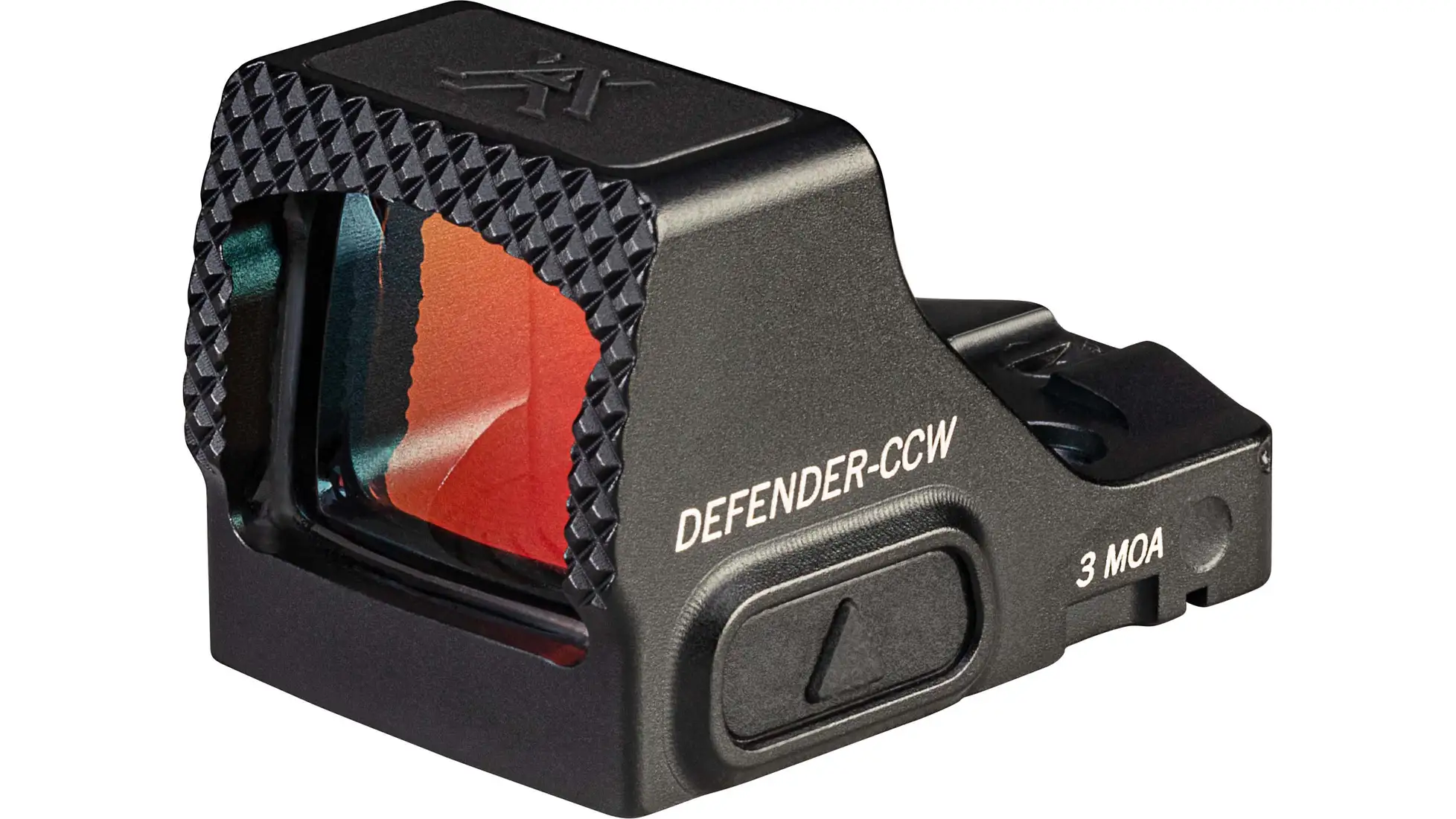
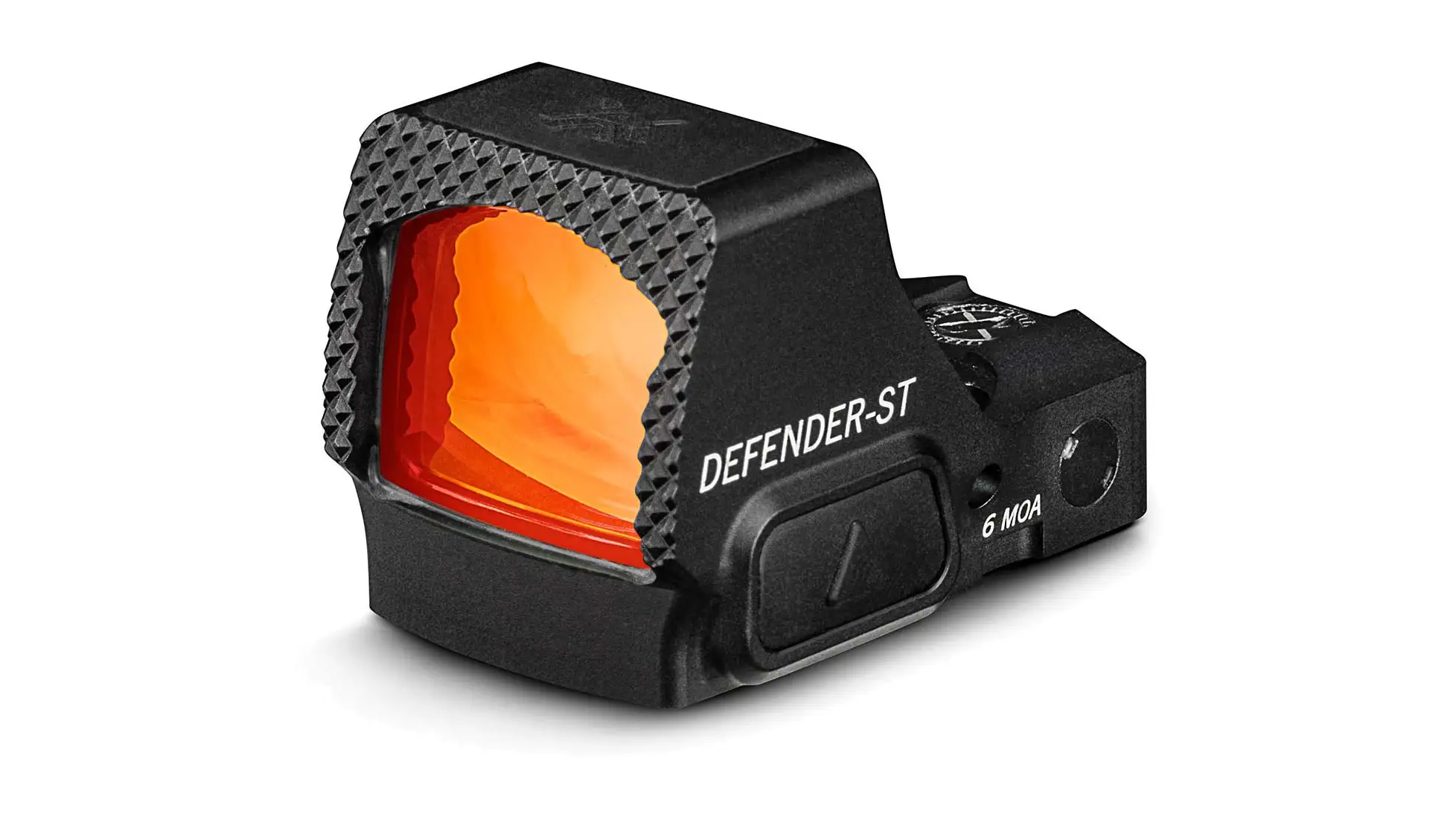
How this comparison was made: a research-based, spec-by-spec comparison built from the retailer's specifications for both sights and their full owner records, 333 reviews between them. We have not bench-tested the two side by side. Every row in the table is listed for both sights; specs recorded for only one are left out rather than guessed. Scores and verdicts are our editorial opinion. See how we evaluate.
Side-by-side specifications
| Vortex Defender-CCW | Vortex Defender-ST | |
|---|---|---|
| Street price | around $220 Check Defender-CCW price | around $270 Check Defender-ST price |
| Owner rating | 4.7/5, 226 reviews on OpticsPlanet | 4.7/5, 107 reviews on OpticsPlanet |
| Built for | Slim carry slides | Full-size pistols, shotgun, AR at 45 degrees |
| Footprint | Shield RMSc | DeltaPoint Pro (DPP) |
| In the box | Picatinny mount + 1° shim plate | Picatinny mount + Glock MOS plate |
| Magnification | 1x | 1x (true) |
| Objective | 25 mm | 23 mm |
| Reticle | 3 or 6 MOA red dot | 3 or 6 MOA red dot |
| Emitter | Open | Open reflex |
| Adjustment click | 1 MOA | 1 MOA |
| Battery | CR1632, top load, 9,500 hr (Vortex) | CR2032, top load, 25,000 hr (Vortex) |
| Wake / power | Motion activation, 10-min auto-shutoff, button lockout | Motion activation, 10-min auto-shutoff, button lockout |
| Weight | 0.95 oz | 1.48 oz |
| Warranty | Vortex VIP: unlimited, unconditional, lifetime | Vortex VIP: unlimited, unconditional, lifetime |
Start with the slide, not the spec sheet
Comparisons inside one brand usually turn into a feature argument. This one does not, because the two sights use different footprints and that decides most purchases before any feature is weighed. The Defender-CCW is cut for Shield RMSc, the pattern slim carry slides use, so it drops onto a Sig P365, a Glock 43X or 48 MOS, a Springfield Hellcat or a Ruger Max-9 with no plate. The Defender-ST uses the DeltaPoint Pro pattern and is dimensionally larger, so it will not fit those slim slides at all. Owners report it going straight onto full-size guns like the Sig P320 X5 Legion and the Springfield Echelon.
So the first question is not which sight is better. It is what your slide is milled for. If the answer is RMSc, the CCW is your Vortex. If it is DeltaPoint Pro, or you are mounting to a shotgun or an AR, the ST is.
Where the ST earns the extra money
- It arrives ready for a Glock MOS. A Glock MOS plate is in the box alongside the Picatinny mount both sights include, so on a full-size MOS slide there is no plate to buy.
- It goes on more than a pistol. The same sight works on a shotgun or at a 45-degree offset on an AR, which the carry micro is not built for.
- The bigger battery. A CR2032 rather than a CR1632, which Vortex rates at 25,000 hours against the CCW's 9,500, in a top-loading door.
- Build. A ShockShield polymer insert, Fast-Rack slide texturing on the housing and ArmorTek coatings. One owner calls it "an absolute tank with crystal clear glass" and says it keeps a perfect zero through abuse.
Where the CCW is the better buy
- It fits the gun you carry. For a slim optics-ready pistol this is the only one of the two that mounts, which settles it.
- Weight. 0.95 oz against 1.48 oz. On a carry gun that is a real difference, and the CCW keeps a large aspherical window despite it.
- Sight picture for the size. Owners repeatedly single out the CCW's window as the biggest they found in a carry micro, which is what makes the dot fast to catch on the draw.
- Price. It costs less than a standard Defender-ST, and unless you need the Glock MOS plate, you are not giving anything up on a carry pistol.
"The buttons are super tactile and large... The issue with the big chunky button is that even with the enclosed rubber cover on the sight if you lay your pistol down on a bench or anywhere else that is a hard surface, the buttons WILL get pushed... the threads on the door are very fine and easily cross-thread."
NorCalHunter (CA), verified Defender-ST owner on a Sig P320 X5 Legion, via OpticsPlanet
The trade-offs, honestly
Both sights are open-emitter, so neither is sealed against mud, snow or holster lint reaching the LED. That is the shared limitation, and if a sealed emitter is what you actually want, Vortex's separate Enclosed Solar Micro versions of the CCW and the ST are different products, not variants of either sight here.
The ST's own owners flag two specific annoyances worth knowing before you buy: those big tactile buttons can be pressed and change brightness when the pistol is set down on a hard surface, and the fine-threaded battery door cross-threads easily, which turns a top-load battery swap into a careful job. Some owners also report faster battery drain than they expected, and the dot sits low when co-witnessing standard iron sights. The CCW's counterpart trade is runtime: about 9,500 quoted hours from its smaller CR1632 is well short of what a shake-awake rival like the Holosun HS407K-X2 quotes, which is the comparison we run in full on our Defender-CCW vs HS407K-X2 page.
Which one, in one line
- Slim carry pistol (P365, 43X, 48 MOS, Hellcat, Max-9): the Defender-CCW. The ST does not fit.
- Full-size optics-ready pistol on the DPP pattern: the Defender-ST, and the plate is already in the box.
- One sight for a pistol, a shotgun and an AR: the Defender-ST, which is what the "do-it-all" framing actually means.
- Cheapest way into the bigger sight: the OPMOD Tan 6 MOA Defender-ST at under $250, a special edition that undercuts the standard models and the CCW alike, if tan and a 6 MOA dot suit you.
FAQ
What is the difference between the Vortex Defender-CCW and the Defender-ST?
Size and footprint first, everything else second. The Defender-CCW is a 0.95 oz carry micro on the Shield RMSc footprint, made for slim optics-ready slides like the Sig P365, Glock 43X and 48 MOS, Springfield Hellcat and Ruger Max-9. The Defender-ST is a larger 1.48 oz sight on the DeltaPoint Pro footprint that ships with a Glock MOS plate and a Picatinny mount, so it goes on full-size pistols, a shotgun or an AR at 45 degrees. They are not two versions of one optic competing on features; they fit different guns. Check what your slide is cut for and the choice is usually made for you.
Can the Defender-ST fit a slim carry pistol?
Generally no. The ST is dimensionally larger than an RMSc micro, so slim slides cut for RMSc, like an M&P Shield or a Glock 43X, will not take it. That is exactly the gap the Defender-CCW fills. If you want one Vortex dot for a slim carry gun, it is the CCW; if your carry gun is a full-size optics-ready pistol on the DeltaPoint Pro pattern, the ST is on the table.
Which is better value?
It depends which ST you buy. The standard 3 and 6 MOA Defender-ST models cost about $50 more than the Defender-CCW, so the bigger sight is meaningfully dearer. Both come with a Picatinny mount in the box, and the ST adds a Glock MOS plate, which saves buying one on a full-size Glock MOS and means nothing on a slide cut for the CCW. The OPMOD Tan 6 MOA special edition sits under $250, below the CCW. If the tan finish and a 6 MOA dot suit you, that OPMOD model is the cheapest way into the larger sight.
Is either one an enclosed-emitter sight?
Neither. Both the Defender-CCW and the base Defender-ST 1x23mm are open-emitter reflex sights, which some listings blur. Vortex does sell enclosed versions of both, the Defender-CCW Enclosed Solar Micro and the Defender-ST Enclosed Solar Micro, as separate products that Vortex lists above the open sights. If a sealed emitter is your priority for weather, mud or holster lint, neither sight on this page is the answer.
Do both carry the Vortex VIP warranty?
Yes, and it is the same warranty on both: the unlimited, unconditional Vortex VIP lifetime warranty. Vortex says it does not matter where you purchased it or how the optic was damaged. On a comparison where the two sights split on footprint and size, the warranty is one thing you do not have to weigh.
Which has the better battery setup?
The ST, on paper. It runs a CR2032, the larger and more common cell, which Vortex rates at 25,000 hours against about 9,500 hours for the CCW's smaller CR1632. Both load from the top, so you swap the cell without dismounting the sight or losing zero, and both have a button lockout that stops the brightness being nudged. The honest caveat comes from ST owners themselves: its battery door threads are fine and cross-thread easily, so it is a top-load done carefully rather than casually.
Read our full Vortex Defender-ST review, or see the Defender-CCW ranked in our best pistol red dot guide. Cross-shopping brands instead of models? See Defender-CCW vs Holosun HS407K-X2 and Holosun 407C vs 507C. Want the duty-grade tier above both? Our Trijicon RMR vs SRO comparison covers it.