The best budget red dot
Quick answer, by what you can spend. Under $100, the Bushnell Trophy TRS 1x25 at around $120 is the honest floor for an AR or a rimfire, a plain 3 MOA tube dot rated 4.4/5 by 257 owners on OpticsPlanet. Its price has crossed the $100 line in both directions in recent weeks, so read the figure before you buy. One tier up, at around $150, the Sig Sauer Romeo5 Gen 2 is the value sweet spot for a carbine and the pick most often named for this question; if you may add a magnifier later, the Holosun ARO at around $140 is the alternative. Under $200, the Gideon Omega buys an SRO-sized window for competition and range. For concealed carry specifically, spend up to a proven optic like the Holosun HS407C rather than buying the cheapest thing that fits. Full specs are on our best red dot sight guide.
Most people asking this are putting a dot on an AR, and there the budget question has a clear ladder: a plain tube dot under $100, a genuinely good one under $150, and a large-window pistol optic if you are shooting competition instead. What "budget" still costs you is proven electronics and crush durability, so match the optic to the risk, a cheap dot for play and practice and a proven one for a gun you would stake your life on. Below: the ladder by price ceiling first, then each tier's pick in full, then the large-window competition dots.
Budget red dots by price ceiling
These are what the question usually means. We have not bench-tested any of them, so they carry their owner records and their manufacturers' published specs rather than our own range results; prices were read on the retailer's product pages the day this page was updated.
- Under $100, for an AR or rimfire: Bushnell Trophy TRS 1x25. A 3 MOA tube dot with no shake-awake and no frills, rated 4.4/5 by 257 owners, the largest owner record on this page after the StrikeFire II. This is the level where you accept a manual on/off switch and a shorter battery life in exchange for a working dot. Full card below.
- The value sweet spot: Sig Sauer Romeo5 Gen 2. The optic most commonly named as the best overall budget red dot, and the one Google's own summary puts first. A 2 MOA dot with Sig's MOTAC motion activation, rated 4.6/5 by 36 owners, listed in three configurations, all at around $150. If you want one answer for a carbine and do not want to think about it, this is it.
- Same tier, if a magnifier may come later: Holosun ARO. A 1x22mm rifle dot whose housing Holosun sized to line up with its own magnifiers, shipping on an integrated lower one-third co-witness pedestal, with a 2 MOA dot, 12 brightness settings and a CR2032 rated 50,000 hours in an IP67 body. Owners rate it 4.9/5 across 45 reviews on OpticsPlanet. The red ARO-RD2 is around $140, and gold and green versions sit within a few dollars of it, which matters if a red dot smears for your eyes. Read our Holosun ARO review.
- The cheapest way into that tier: Sig Sauer Romeo MSR Gen II. The Romeo5's simpler sibling, with a rotary on/off dial instead of motion activation, rated 4.8/5 by 30 owners, from around $130 in Flat Dark Earth, or around $130 for the black version with a green dot. Full card below.
- Same tier, if you want the Vortex warranty: Vortex Crossfire II red dot. A 1x22mm enclosed 2 MOA dot that ships with both a lower 1/3 co-witness riser and a low mount, rated 4.6/5 by 115 owners, at around $130. Assume no motion wake. Full card below.
- One step up, a full-size 30mm tube for an AR: Vortex StrikeFire II. An enclosed 30mm tube with a 4 MOA dot that ships with a lower 1/3 co-witness cantilever mount, rated 4.7/5 by 615 owners, at around $170. No motion wake. Full card below.
- Under $200, for competition and range: Gideon Optics Omega. Covered in full below, with a deep-sleep caveat that rules it out for defensive use.
Budget red dots compared
The deciding differences at this price are how the dot turns on and what it mounts to. Battery figures are each maker's own rating; owner ratings are OpticsPlanet's, attributed, not ours.
| Pick | Price | Dot | Turns on | Battery (maker's rating) | Mount | Owners |
|---|---|---|---|---|---|---|
| Bushnell Trophy TRS 1x25 | around $120 | 3 MOA | By hand; no auto-off, no motion wake | CR2032, up to 5,000 h | Integral Picatinny | 4.4/5 (257) |
| Sig Romeo MSR Gen II | around $130 | 2 MOA | Rotary dial; no motion wake | CR2032, 35,000 h (spec table) | See-through riser | 4.8/5 (30) |
| Vortex Crossfire II red dot | around $130 | 2 MOA | Rotary dial; assume no motion wake | CR2032, 50,000 h | Lower 1/3 riser and low mount | 4.6/5 (115) |
| Holosun ARO | around $140 | 2 MOA | Shake-awake not on the spec sheet | CR2032, 50,000 h | Integrated lower 1/3 pedestal | 4.9/5 (45) |
| Sig Romeo5 Gen 2 | around $150 | 2 MOA | MOTAC motion wake | CR2032, 40,000 h | Absolute co-witness riser and low mount | 4.6/5 (36) |
| Vortex StrikeFire II 1x30 | around $170 | 4 MOA | Button; 12-hour auto-off, no motion wake | CR2, 50,000 h | Lower 1/3 cantilever | 4.7/5 (615) |
| Gideon Optics Omega | around $190 | Circle-dot or dot | Motion wake, but deep sleep after 12 h still | CR1632 | RMR footprint, low Picatinny mount included | 4.6/5 (121) |
| Swampfox Justice II | around $200 | 6 MOA | Shake N Wake | CR1632, up to 50,000 h | RMR footprint | 4.3/5 (41) |
Best budget red dot under $100
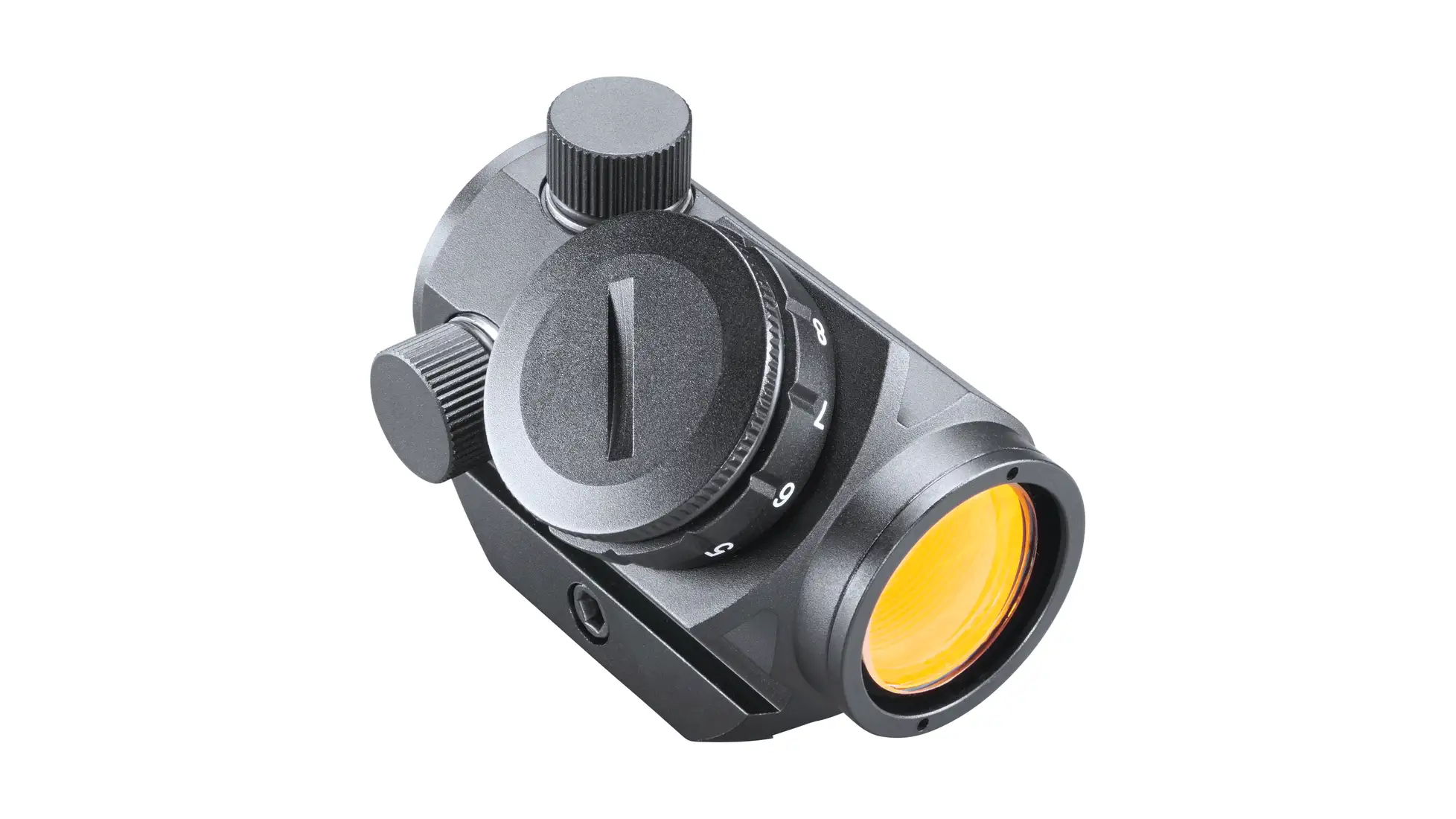
The under-$100 answer: Bushnell Trophy TRS 1x25
around $120 4.4/5, 257 ratings on OpticsPlanet
Read the price before anything else. This is the optic that clears the under-$100 bar, but its listed price has crossed that line in both directions in the weeks we have tracked it, so the card above carries the figure from our latest check and the listing is the place to confirm what it costs today. What it is is a plain tube dot with a plain job: put a 3 MOA dot on a carbine, a rimfire or a slug gun and hold zero. Bushnell's own specs put it at a 20 mm objective in a 25 mm tube, 1 MOA clicks with 40 MOA per turn, 11 brightness settings, a CR2032 good for up to 5,000 hours, a closed reflex housing rated IPX5, and 3.7 oz on an integral Picatinny mount. There is no plate footprint to match, because there is no plate: it clamps to a rail, which is why this is a rifle and rimfire answer rather than a pistol one. Bushnell also lists unlimited eye relief, which is what makes it usable on a handgun or a shotgun, and an Amber-Bright lens coating the company says helps separate the brown of a deer from other browns, its claim rather than a measurement, and the reason the glass reads visibly warm rather than neutral. Know exactly what the price costs you: Bushnell's spec sheet lists auto shutoff as No, and there is no motion wake either, so this optic is on when you leave it on and dead when you forget. At 5,000 hours the battery is roughly a tenth of what the 50,000-hour class delivers. That combination is why we would put it on a range, plinking or hunting gun and not on a defensive one.
The owner record is large and also old, and both matter. The 4.4 out of 5 comes from 257 owners, second on this page only to the StrikeFire II, but it accumulated over more than a decade: the two reviews other buyers found most helpful were written in 2013 and 2014, so treat it as evidence about a long-running product rather than about this month's production run. We scanned 254 of those reviews. Only 8 percent say they would not recommend it, which is low for the price class, and 162 of them judge the optic explicitly on what it costs. The negative reports are not scattered: the recurring one is the dot cutting out under recoil, sometimes needing a smack to come back, alongside a handful of units that arrived faulty or off-center. An industry write-up attributes that dropout not to dead electronics but to the contact spring in the top-loading battery tray losing tension under recoil, fixable by bending it back with a flat screwdriver; we have not verified that mechanism with Bushnell, but it fits what owners describe. Bushnell's published warranty covers dot sights in its lifetime tier, read on the company's own warranty page on 2026-08-17, which is unusual protection at this price.
Best budget red dot under $150
The Romeo5 Gen 2 and the Holosun ARO in the ladder above both sit near the top of this tier and each has its own review. The two we card in full here are the cheaper Sig, for a buyer who wants a dial, and the Vortex, for a buyer who wants its warranty and two mounts in the box.
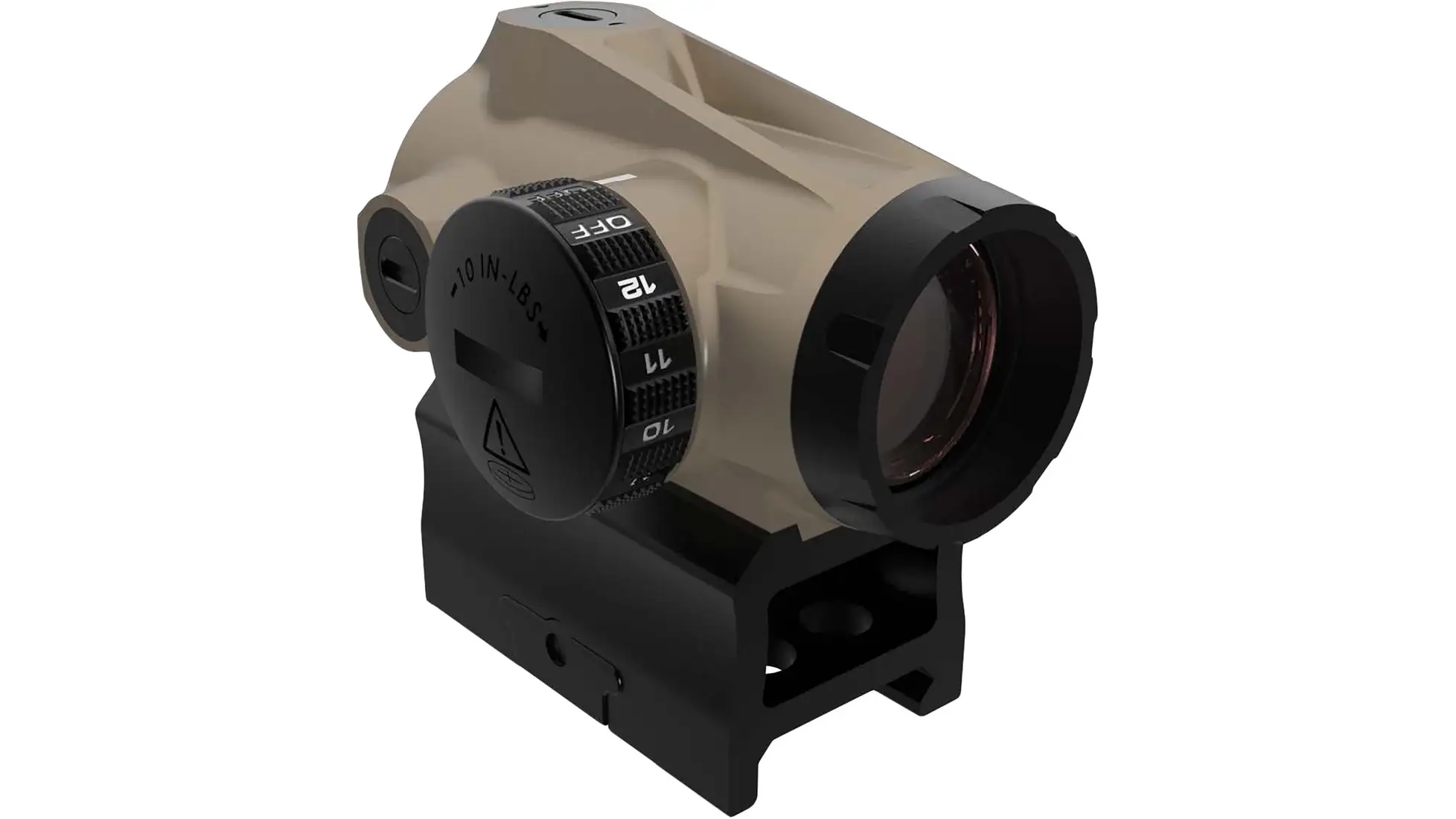
The dial-switch pick under $150: Sig Sauer Romeo MSR Gen II
around $130 4.8/5, 30 ratings on OpticsPlanet
Buy it if you want to know the dot is on without looking. The Romeo MSR Gen II is a sealed 1x20mm dot for a carbine, rimfire or shotgun that turns on, off and brighter with a rotary dial rather than buttons, and that one design choice is what its owners talk about. Eight of them single it out, and the most detailed reason they give is that a dial tells you by feel whether the optic is on, while push-button optics, as one owner who bought two of these puts it, do not always come on with the first press, which is not what you want in an emergency. One owner notes there is an off position at each end of the dial, so you cannot roll past it into the night-vision settings. The figure above is for the Flat Dark Earth version, the one the listing puts first; the black version with a green dot, which seven owners in the record say they chose, is on the same listing at its own price (quoted in the ladder above), and one owner who found a red dot "terrible in full sun" calls the green an improvement.
What Sig specifies. A 2 MOA dot, 12 brightness settings (10 daylight and 2 for night vision), a CR2032, IPX7 waterproofing, 100 MOA of total elevation travel, 5.7 oz, and a see-through riser mount. Eye relief is unlimited, as on any reflex dot. On battery life Sig disagrees with itself: its own spec table says 35,000 hours while the feature list on the same page says 40,000, so plan on the lower number. The warranty is Sig's Infinite Guarantee, which Sig describes as needing no receipt or warranty card and as fully transferable.
The trade-off against the Romeo5 is the whole decision. Sig does not list motion activation for this optic, and four owners confirm it has none: it stays on until you turn it off. If you want the optic to wake when you pick the gun up, buy the Romeo5 Gen 2; if you would rather switch it deliberately, this is the cheaper Sig. Owners who compare the two tend to favour the dial: one prefers it to the Romeo5 they also own, and another calls it a more robust Romeo5 with night-vision settings. The complaints are few and specific: one owner found the supplied mount too low and moved the optic to a mount of their own, another wished it came with the Romeo5's mount, one points out the windage and elevation adjusters have no covers, and one says the finish scratches easily. None of the 28 reviews we could read says they would not recommend it.
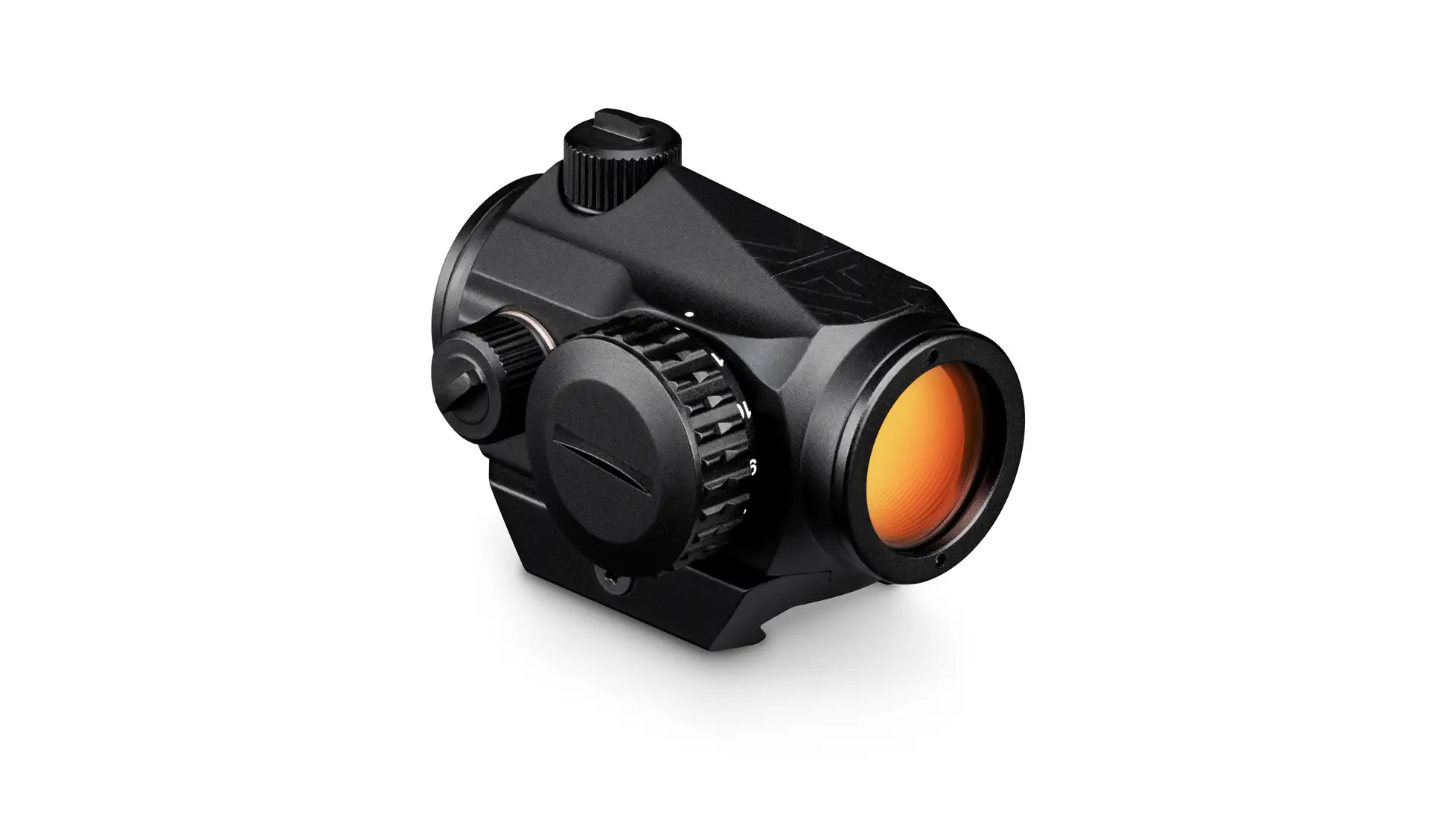
The Vortex pick under $150: Vortex Crossfire II red dot
around $130 4.6/5, 115 ratings on OpticsPlanet
Buy it if you want Vortex's warranty on a sub-$150 dot. The Crossfire II red dot is a compact 1x22mm enclosed tube with a 2 MOA dot and a rotary brightness dial, and it ships with two mounts, a lower 1/3 co-witness riser for an AR and a low mount for a rimfire or shotgun, so one purchase covers either kind of gun. Vortex rates its CR2032 at 50,000 hours, the glass is fully multi-coated, the tube is nitrogen purged, and it carries the same VIP warranty as the StrikeFire II below. Owners rate it 4.6 out of 5 across 115 reviews; of the 113 we could read, 4 say they would not recommend it. Owners who weighed it against a Romeo5 split: one chose it because they were uneasy about the Sig's warranty and see motion activation as one more thing to break, another for the dial and the two mounts in the box, while a third recommends the Romeo5 instead for its motion activation.
Assume it has no motion wake. This is the one thing to get right. Vortex's own product page now lists motion activation with a 10-minute auto-shutoff, under a Vortex SKU that is written differently from the retailer's and marked new. The retailer's feature list does not include it, and seven owners on OpticsPlanet say theirs has none, the most recent in July 2026. We cannot tell you which version the listing ships, so buy it as a sight you turn on by hand; if motion wake matters to you, the Romeo5 Gen 2 has it for a little more. Owners also say the dial is stiff to turn, and several found the lowest brightness settings invisible in daylight, so expect to run it near the top of the dial outdoors.
Best budget full-size red dot for an AR: Vortex StrikeFire II
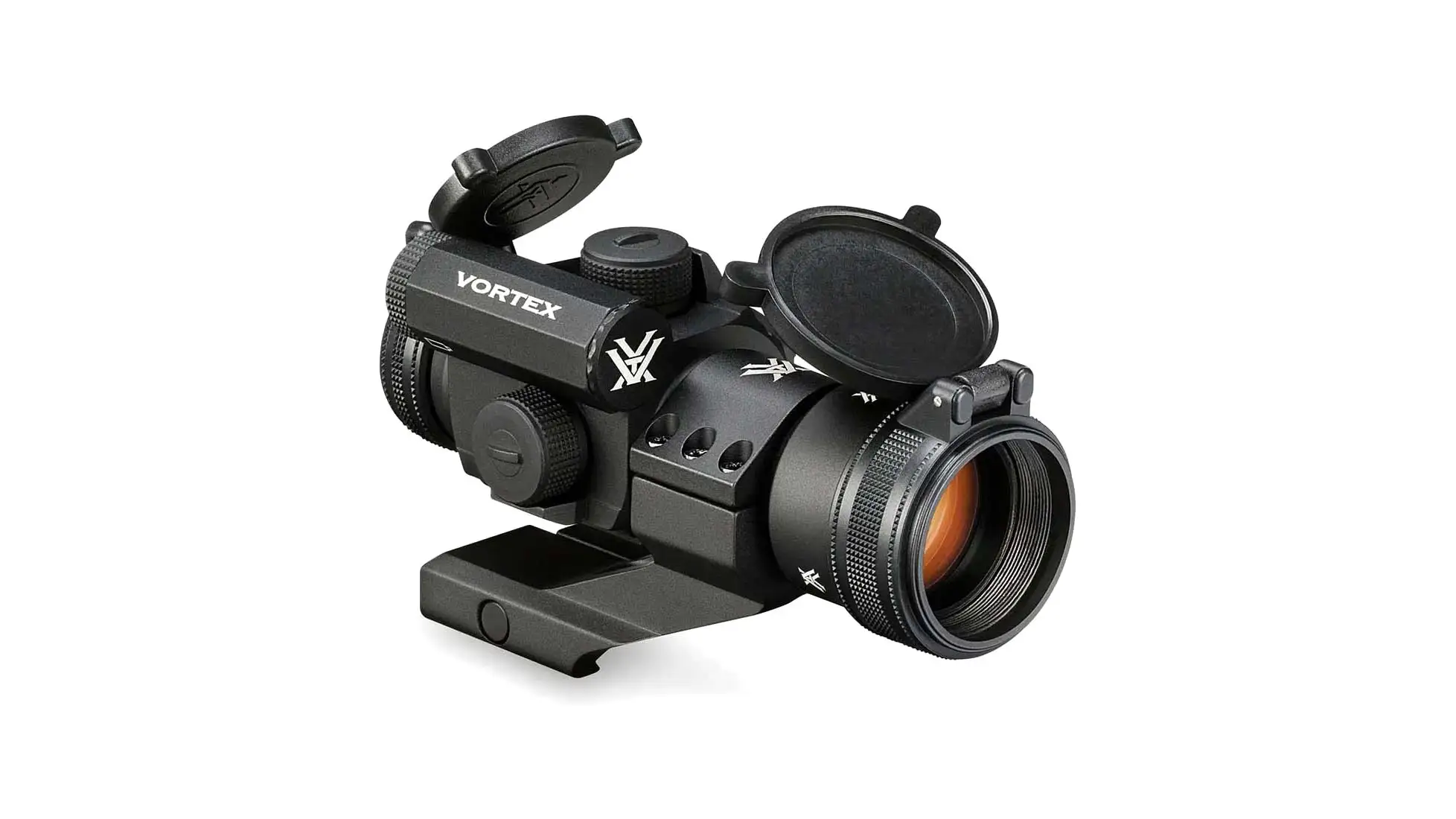
The full-size AR tube: Vortex StrikeFire II 1x30
around $170 4.7/5, 615 ratings on OpticsPlanet
Buy it if you want a full-size tube on a carbine. The StrikeFire II costs more than the picks above, and what the extra buys is a bigger 30mm tube in a cantilever ring mount set at a lower 1/3 co-witness for an AR-15, with flip caps, the battery and the wrench in the box. The optic is enclosed and nitrogen purged, an aluminum tube with a 4 MOA dot, ten brightness settings whose lowest two are night-vision compatible, and 0.5 MOA clicks. Vortex rates its CR2 at 50,000 hours, with a 12-hour auto-shutoff behind it. Its owner record is the largest on this page, 615 ratings averaging 4.7 on OpticsPlanet. The red-only and red/green versions sell at the same price, so take the red/green.
What the extra money does not buy. There is no motion wake: you press a button to turn it on, and it switches itself off after 12 hours, which matters on a home-defense rifle and not on a range gun. A 4 MOA dot covers about four inches at 100 yards, so this is a 100-yard carbine optic rather than a precision one, and the tube is 7.2 oz before the mount, 12.8 oz with it. Owners who like the mount still wish it clamped with two screws instead of one. The warranty is Vortex's VIP, which Vortex calls unlimited, unconditional and lifetime and says covers damage however it happened and wherever you bought the optic; loss, theft, deliberate damage and cosmetic damage are excluded. Read our full Vortex StrikeFire II review for the owner record.
Best budget competition and range pistol dots
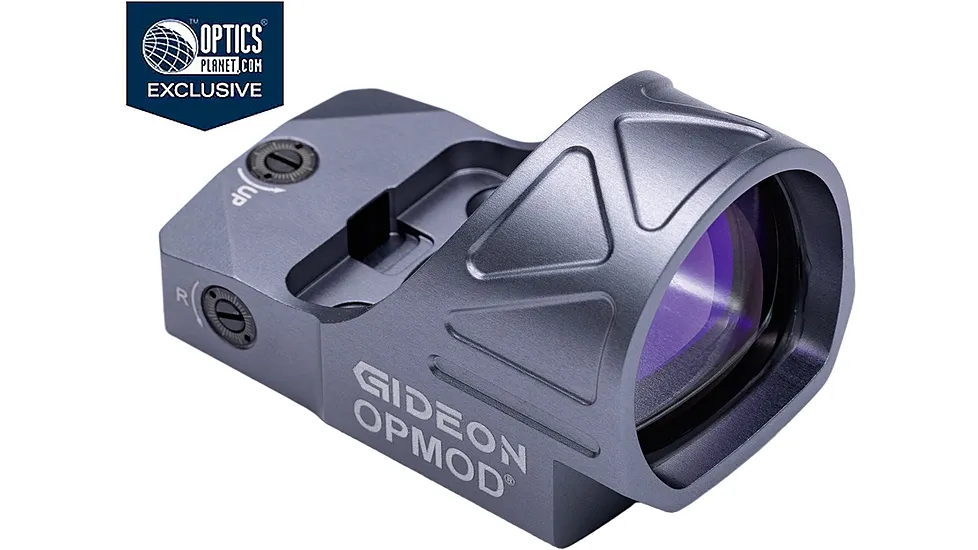
Best big-window budget dot for competition and range: Gideon Optics Omega
around $190 4.6/5, 121 ratings on OpticsPlanet
For competition and range use, the Omega is the big-window budget pick we would take first, because the flaw it is known for does not bite in that role. It is the closest thing to a Trijicon SRO's giant window at a third of the price, an enormous 22.3 by 27 mm lens with clear, low-tint glass that shooters with astigmatism love, plus a top-loading CR1632, tactile 1 MOA clicks, a lifetime warranty that covers accidental breakage, and a low-profile Picatinny mount in the box so it doubles as a rimfire, PCC or 45-degree offset optic. It rides the RMR footprint and mounts directly to Shadow Systems, ZEV and PSA Dagger slides. The one catch is decisive: after 12 hours of stillness the Omega enters a deep sleep and no longer wakes from motion, you must press a button to bring the dot back. That is a non-issue in competition or at the range, where you turn it on each session, but it disqualifies the Omega for concealed carry or a bedside gun. Buy it as a big-window range and competition value, not a defensive optic. Circle-dot or plain dot, red or green. Shop the configurations before you click buy: the black standard models priced above sit alongside grey OPMOD kit versions of the same optic for noticeably less, which is the cheapest new Omega on the listing and a genuine saving. The kit prices move against each other week to week, so compare the colours rather than assuming the green or the red is the cheaper one.
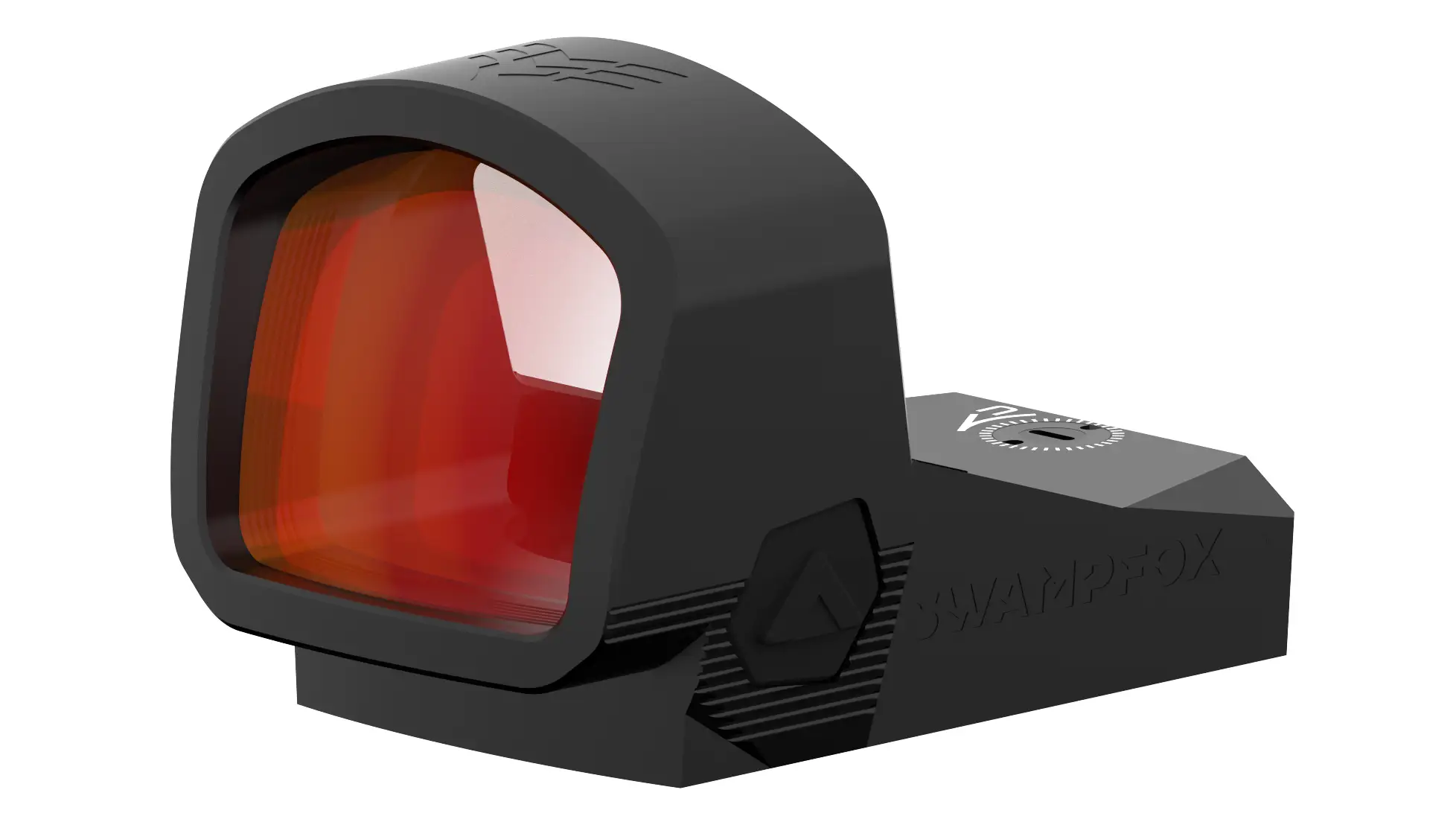
Big-window alternative with a caveat: Swampfox Justice II
around $200 4.3/5, 41 ratings on OpticsPlanet
The Justice II offers a similar recipe, a big 30 mm window on the RMR footprint, a top-loading battery, Shake N Wake with no deep-sleep trap, multiple screw sets and anti-fog coatings, and it has its fans among competitors. We rank it below the Gideon, though, because of its owner record. A repeated complaint is glass distortion, several owners describe visible double-vision or a dropped target through the window, which is the last thing you want on a precision competition dot, and others report an emitter reflection or ghost image that one repeat Swampfox owner calls "a Swampfox thing." There are also durability reports that give us pause at this price, a cracked lens at 31 rounds, a dead-on-arrival unit, and an internal failure that stuck the dot in a corner, and more than one owner returned it for a Holosun or a Gideon. It is a real big-window value if you get a good one, but it is a bigger quality-control gamble than the Gideon, so inspect the glass carefully on arrival. Read our full Swampfox Justice II review for the detail.
Best budget red dot for carry and for an AR
The big-window picks above are competition and range optics. For the jobs where reliability matters more than window size, we point you to proven picks we have reviewed in full rather than the cheapest option:
- Budget concealed carry: skip the big-window competition dots and their sleep quirks and buy proven electronics. The Holosun HS407C-X2 gives duty-grade reliability, a solar failsafe and flawless shake-awake for budget-carry money; see also our best pistol red dot and best enclosed red dot guides.
- Budget AR / rifle: a tube red dot is the value play on a carbine: the Sig and Vortex picks in the $150 tier above, or the Vortex StrikeFire II if you want a full-size 30mm tube. More options in our best red dot for an AR-15 guide.
- Budget enclosed (all-weather): if you want a sealed emitter on a budget, our Osight SE is the cheapest genuinely enclosed carry dot we cover.
One optic we gathered and did not recommend: the Lucid HD7 Gen III. Its owner record shows a repeated fuzzy-dot and reticle-alignment problem, with multiple owners returning it for a Holosun, so it did not make the list.
What matters on a budget red dot
- Shake-awake reliability. The biggest budget-optic trap is an always-on feature that is not always on. The Gideon's 12-hour deep sleep is the clearest example, fine for range use, disqualifying for defense. If you carry always-on, verify the wake behavior or buy proven electronics.
- Footprint. Most of these budget dots use the Trijicon RMR footprint. That direct-mounts to many full-size optics-ready slides, but a micro-9 (P365, Glock 43X) is cut for RMSc and needs an adapter plate. Confirm your slide cut before buying.
- Window size vs durability. A big competition window (Omega, Justice II) is fast to get behind but has thin walls; a smaller-window carry dot (407C) trades view for crush strength.
- Astigmatism. A clean round dot matters more than brightness numbers; green usually reads cleaner than red for astigmatic eyes. See best red dot for astigmatism.
- Warranty. Budget brands lean on warranty: the Gideon covers accidental breakage for life, which offsets some of the unproven-durability risk.
FAQ
What is the best budget red dot?
It depends on the gun and on your ceiling. For an AR, which is what most people are asking about, the Sig Sauer Romeo5 Gen 2, under $150, is the value answer (or the Holosun ARO, also under $150, if you may add a magnifier later), one tier above the Bushnell Trophy TRS 1x25 that holds the under-$100 floor for a rifle or rimfire. For a budget competition or range pistol we would take the Gideon Omega, under $200, first: a huge SRO-style window, astigmatism-friendly glass and a lifetime warranty, with a 12-hour deep-sleep quirk that only matters for defense, not competition. The Swampfox Justice II is a similar big-window option but ranks below it, because its owner record shows repeated glass distortion and some durability failures. For budget concealed carry, skip both and buy proven electronics: the Holosun HS407C. For a budget AR, the Vortex StrikeFire II. There is no single "best" budget dot, only the best for your use.
What is the best red dot sight under $100?
The Bushnell Trophy TRS 1x25. At that ceiling you are buying a plain tube dot for a rifle or a rimfire, and this is the sensible one. Check its price before you buy: it has crossed the $100 line in both directions in the weeks we have tracked it. Nothing else we cover sells new under $100 and is worth buying, so if it sits above $100 on the day you look, the next step is the Sig Sauer Romeo5 Gen 2 under $150. What the TRS gets you: a 3 MOA dot rated 4.4 out of 5 by 257 owners, the second-largest owner record named here after the StrikeFire II. One thing to get right before you compare it to anything: the 25 in the name is the tube diameter, not the lens. Bushnell specifies a 20 mm objective, 1 MOA clicks and 11 brightness settings, and retailer listings that say 35 mm are wrong. Be clear about what this price class costs you. Bushnell lists auto shutoff as No and there is no motion wake-up either, so you turn it on and off by hand and you will eventually leave it on; the CR2032 is rated up to 5,000 hours, roughly a tenth of the 50,000-hour class; and the Amber-Bright coating makes the glass read visibly warm. In its favour, Bushnell covers dot sights under its lifetime warranty tier. It is a working red dot for a range, plinking or hunting gun, not a defensive optic, and no pistol-cut micro sells new at this price worth buying.
Should I buy the Sig Romeo5 or the Romeo MSR?
Decide by how you want the optic to turn on. The Romeo5 Gen 2 has Sig's MOTAC motion activation, so it wakes when the gun moves and sleeps when it sits. The Romeo MSR Gen II does not list motion activation, and owners confirm it has none: it uses a rotary dial for on, off and brightness, with 10 daylight and 2 night-vision settings. Owners who chose the MSR say the dial is the point, because you can tell by feel that the dot is on and a push button does not always respond to the first press. The cost is that the MSR stays on until you switch it off, and Sig's own page rates its CR2032 at 35,000 hours in the spec table and 40,000 in the feature list. Both were under $150 at our last check, and the MSR also comes in a black green-dot version that seven of its owners on OpticsPlanet say they chose.
Which red dot is better, Holosun or Vortex?
For most budget and mid-tier buyers Holosun gives more features per dollar, and Vortex gives a better warranty and easier service. Holosun is where solar failsafes, multi-reticle systems and side-loading battery trays show up first at a given price, which is why our budget carry pick is a Holosun. Vortex counters on the warranty, and the gap is wider than it looks. Vortex calls its VIP warranty unlimited, unconditional and lifetime, and states it does not matter how the damage happened, whose fault it was, or where you bought it; the exclusions are loss, theft, deliberate damage and cosmetic damage that does not hinder performance. Holosun's lifetime cover is conditional: registration is required to validate it, the LED is covered for ten years rather than for life, professional use voids it, and Holosun says it will not honour it at all on units from non-authorised Amazon resellers. So: Holosun if you are buying features and will register the optic and buy from an authorised seller, Vortex if you want the simplest possible promise when something breaks. Both statements are the manufacturers' own published terms, read 2026-08-15. On this page the Vortex options are the Crossfire II red dot in the under-$150 tier and the StrikeFire II one step up.
What is the catch with the Gideon Omega shake-awake?
This is the single most important thing to know about the Omega. Its motion wake-up works normally for the first 12 hours, but after 12 hours of stillness the optic enters a deep sleep and will no longer wake from movement: you have to press a side button (or, in some cases, pull the battery) to bring the dot back. Gideon has given mixed messaging about whether a firmware revision fixed it and you cannot verify which version you will receive, so we judge it by its worst documented behavior. It is fine for competition and range use, where you power-cycle the optic each session, but it disqualifies the Omega for concealed carry or a bedside home-defense gun, where the dot must be on the instant you draw.
Which budget red dot is best for astigmatism?
Both of our competition picks earn praise from shooters with astigmatism, because both keep a clean, round dot where cheaper optics smear into a starburst. Choose a green dot over red if you can: the eye is more sensitive to green, so the emitter runs at lower power and blooms less, which is exactly what helps astigmatic eyes. The Swampfox Justice II and Gideon Omega both offer a green option. For a dedicated deep-dive, see our best red dot for astigmatism guide.
Are cheap red dots worth it, or should you save for a Holosun or Trijicon?
A good budget dot under $250 is genuinely worth it for competition, range and rimfire use, where you are not betting your life on it and you handle the gun constantly. What you give up versus a Holosun or Trijicon is proven long-term durability and, on some budget optics, reliable always-on electronics. So spend more, or buy a proven mid-tier optic like the Holosun HS407C, specifically for a carry or home-defense gun. Match the optic to the risk: budget for play, proven for defense.
Prices verified September 30, 2026, re-verified on the product pages the day this page was written. Prices move, so confirm the current figure on the retailer page before you buy.
More: best red dot sights overall · best pistol red dot · best red dot for astigmatism · best enclosed red dot · Holosun HS407C-X2 review · Trijicon SRO review.