The best holographic sights
Quick answer: the EOTech 518.A65 (around $640) is the holographic sight to buy for most people. It runs on two ordinary AA batteries rather than a camera cell, and it gives you the classic 68 MOA ring with a 1 MOA centre dot, unlimited eye relief and a submersible housing, rated 4.6 out of 5 by 24 owners. The Vortex Razor AMG UH-1 Gen II has a deeper record, 4.6 from 90 owners, an IPX-8 rating and a quick-detach mount in the box, but it runs a single CR123A cell instead of AA. Two honest warnings before you spend: holographic battery life is measured in hundreds of hours, not years, and if you are shopping because of astigmatism this is the wrong category.
What holographic actually buys you
A holographic sight builds its reticle from a hologram recorded in the window and lit by a laser, rather than projecting an LED off a coated lens the way a reflex red dot does. Two practical consequences follow. The reticle keeps working when part of the window is obscured or damaged, and the big ring around a small dot is quick for the eye to find with both eyes open, which is why the format has a following in close-quarters use. You pay for it in power draw, weight and price. If you want the difference explained properly, we have a red dot vs holographic sight guide and a brand-level EOTech vs Aimpoint comparison.
The one to buy for most people: EOTech 518.A65
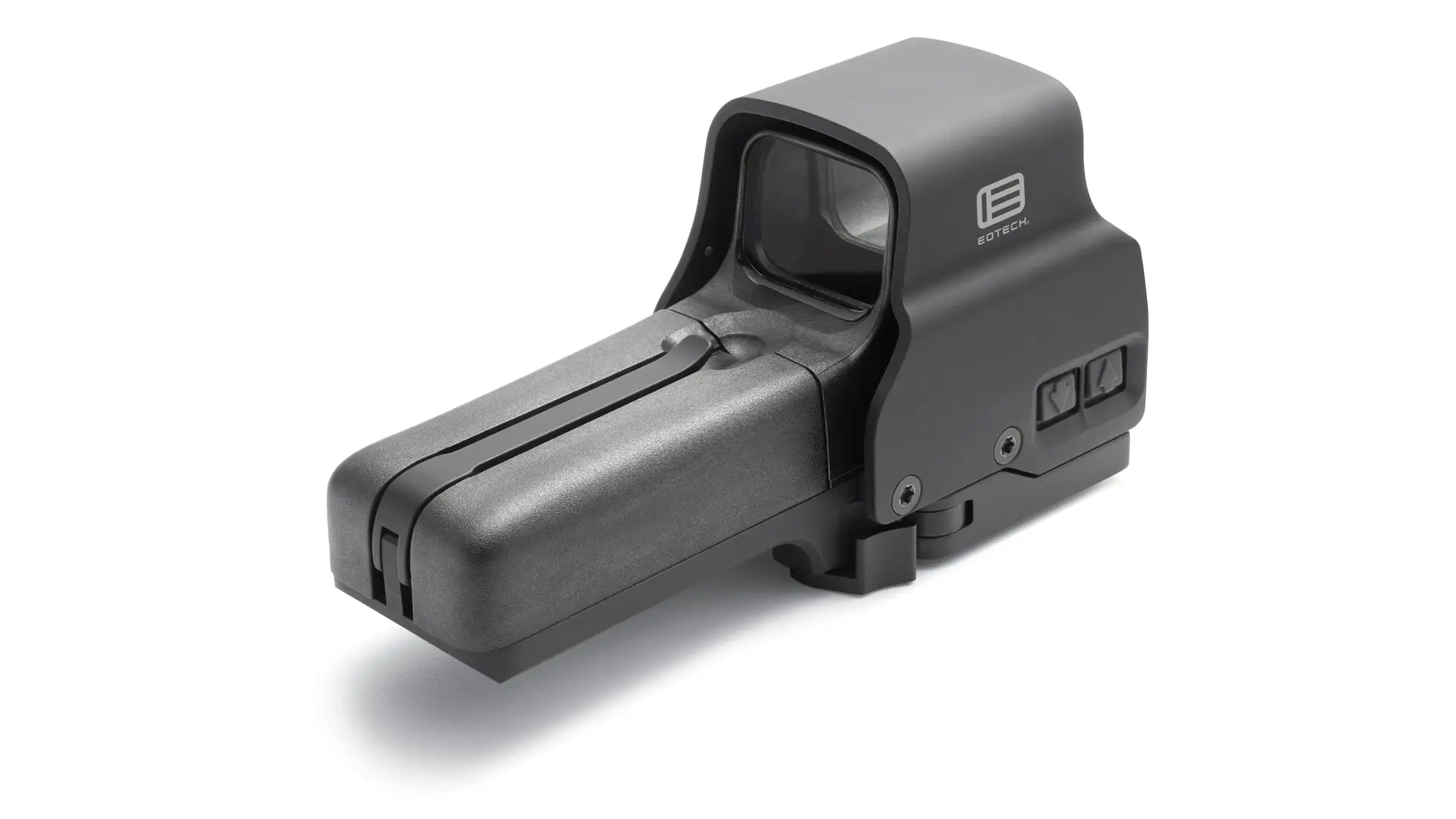
around $640 4.6/5, 24 reviews on OpticsPlanet
This is the practical choice in the category. The 518 gives you EOTech's 68 MOA ring with a single 1 MOA dot, an enclosed emitter, unlimited eye relief, 0.5 MOA adjustments and a housing that is submersible to three metres, on a Weaver mount at 13.8 ounces. The detail that matters most day to day is the power source: two AA batteries, rated 2,200 hours on alkaline or 2,500 on lithium. Owners single that out, alongside quick both-eyes-open target acquisition out to 100 yards, a wide viewing area and no parallax error. The retailer marks it Made in USA.
Three things to know before ordering. It is not night vision compatible, which the model name states outright; EOTech's XPS3 and EXPS3 lines are where night vision compatibility lives. The sight times out automatically after four or eight hours with no permanent-on option, which the most helpful positive reviewer notes and does not mind. And the same reviewer's headline figure for brightness settings does not appear on the retailer's specification sheet, so we do not print a settings count. Two kit variants are also listed if you want them: one bundled with a Streamlight TLR-1 HL and a second, dearer bundle. Both are separate SKUs rather than the sight we rank here, so we do not quote their prices; the retailer page carries the current figure for each. Prices verified September 30, 2026.
One piece of history is worth knowing, because it cuts both ways. EOTech describes its EXPS3 and XPS2 as the Close Combat Optic of choice for USSOCOM; the 518 here is not one of those models. But in November 2015 EOTech, its then-parent L-3 and its president settled a federal False Claims Act lawsuit for $25.6 million, and EOTech and L-3 admitted that EOTech knew its holographic sights suffered thermal drift (the point of aim moving away from the point of impact in heat and cold), cold weather distortion and moisture incursion, and that it was slow to disclose this to the Defense Department (source: U.S. Attorney's Office, Southern District of New York). We would not treat that as a live defect on a current 518, but if you shoot in genuine cold, confirm the sight's zero across temperature yourself before you rely on it. On the reassuring side, on sights made since 2017 EOTech's warranty runs 10 years and passes to later owners: free repair or replacement for the first five years, then repair for a bench fee through year ten. A used sight made before 2017 falls under EOTech's older two-year warranty, so check the manufacture date before you buy one secondhand.
The deeper owner record: Vortex Razor AMG UH-1 Gen II
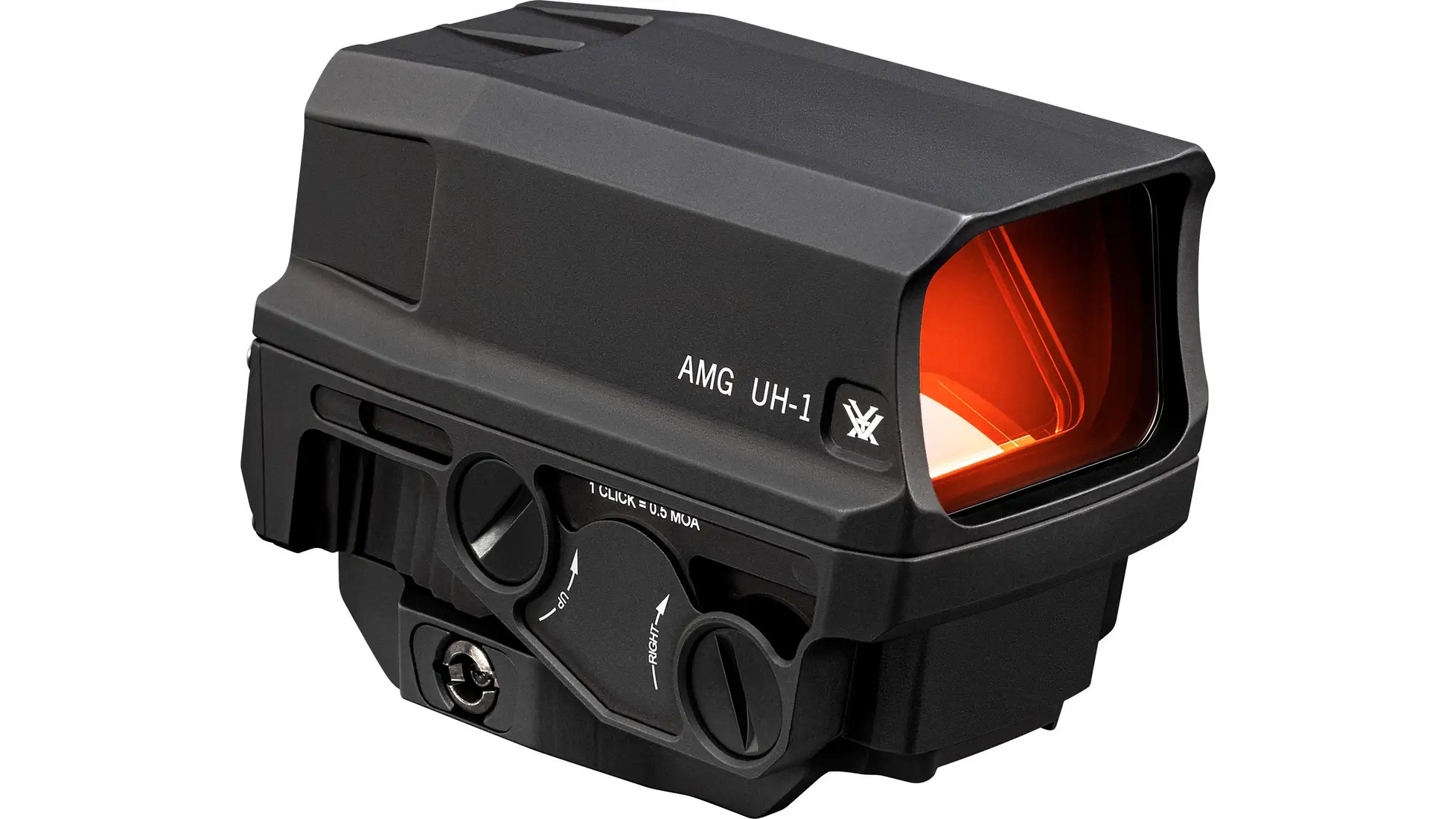
around $600 4.7/5, 92 reviews on OpticsPlanet
On the owner record this is the stronger sight, with nearly four times as many reviews as the EOTech and the same 4.6 average. It is a 1x holographic sight with a 1 MOA EBR-CQB reticle across fifteen brightness settings, an enclosed emitter, unlimited eye relief, parallax-free viewing, 0.5 MOA adjustments, an aluminium alloy chassis rated IPX-8 and a quick-detach mount in the box, running one CR123A. The review the retailer ranks as most helpful positive calls it built like a tank and says the owner prefers it to his old EOTech, with battery life the only downside, which he accepts as normal for a holographic sight.
On the honest side, the most helpful negative review is a quality control complaint about white scuff marks around the housing on a brand-new unit, and a separate verified owner reports a reticle fault while making a point of saying it was not the retailer's doing. Against 92 reviews at 4.7 that is a minority experience, but it is real.
Side by side
| EOTech 518.A65 | Vortex Razor AMG UH-1 Gen II | |
|---|---|---|
| Reticle | 68 MOA ring, 1 MOA dot | 1 MOA EBR-CQB |
| Battery | 2 x AA, 2,200 to 2,500 hours | 1 x CR123A |
| Adjustment | 0.5 MOA | 0.5 MOA |
| Water rating | Submersible to 3 m | IPX-8 |
| Mount | Weaver | Quick detach, included |
| Weight | 13.8 oz | Not printed (see note) |
| Night vision | Not compatible | Not stated on the spec sheet |
| Owner rating | 4.6/5 from 24 | 4.7/5 from 92 |
Specifications from the retailer product pages. We print no weight for the UH-1 Gen II because the specification table we read did not list one, and we would rather leave a cell honest than fill it.
⛔ If you are here because of astigmatism, read this first
There is a widespread claim that holographic sights solve astigmatism. The owner record does not support it. One 518 owner writes that the holographic reticle is too fuzzy for him and that he cannot recommend the sight to anyone with astigmatism, and says he will look at a scope or a Holosun instead. Another, who rates the sight highly and does recommend it, warns that if you wear glasses or have even slight astigmatism you need to be wearing them to use it properly. A hologram is still light being formed for your eye to focus, so an irregular cornea can still smear it.
The dependable answer for astigmatism is a reticle etched into glass, which does not depend on your cornea at all. That is a prism sight, and it is a different purchase: see our best prism scope picks, which start at around $170, or read the progression from dimming and green dots to etched reticles in our astigmatism guide. We would rather send you to a cheaper category that works than sell you a holographic sight at this price that blurs.
How to choose
- Battery life is the category's tax. Hundreds to a couple of thousand hours, not years. AA cells on the EOTech make that far easier to live with than a proprietary cell.
- Check night vision compatibility explicitly. The 518.A65 does not have it. EOTech's XPS3 and EXPS3 lines are the NV path; the XPS2 is the compact non night vision alternative.
- Weigh the ring. The 68 MOA ring is fast up close and coarse at distance; a 1 MOA dot inside it is what you use for precision.
- Weigh the owner record. The Vortex is the deeper-reviewed sight, 90 ratings against 24, and it ships with a quick-detach mount.
- Want a magnifier behind it? That is the classic holographic setup: see our best red dot magnifier picks.
- Want years of battery and less weight? Buy a reflex red dot instead: best red dot sights.
FAQ
What is a holographic sight and how is it different from a red dot?
A holographic sight builds its reticle from a laser-lit hologram recorded in the optical window, while a standard red dot projects an LED off a coated lens. Practically, the holographic reticle sits in the target plane and stays usable even if part of the window is blocked or cracked, and the large ring-and-dot pattern is fast to pick up. The cost is power: holographic sights run for hundreds or low thousands of hours where a reflex red dot runs for years, and they are heavier and more expensive.
Are holographic sights good for astigmatism?
Not reliably, and this is worth knowing before you spend. Owners of the EOTech 518 in the review record we read report the opposite of the common claim: one says the holographic reticle looks too fuzzy and that he cannot recommend it if you have astigmatism, and another, who otherwise rates the sight highly, warns that you need to wear your glasses with it. If astigmatism is your reason for shopping, the reliable fix is an etched reticle rather than any projected or holographic one, which is what a prism scope gives you.
How long does a holographic sight battery last?
Far less than a red dot, and you should plan around it. The EOTech 518.A65 is rated at 2,200 hours on alkaline AA cells or 2,500 hours on lithium, roughly three months of continuous running, and it times out automatically after four or eight hours. The Vortex UH-1 Gen II runs a single CR123A. Compare that with a modern reflex red dot rated in years and the trade is clear. The upside on the EOTech is that AA batteries are cheap and available anywhere, which several owners call out as a practical advantage.
Is the EOTech 518 night vision compatible?
No, and the model name says so: this is the non-night-vision version, and its lowest settings are not designed to work behind a night vision device. If you need night vision compatibility, EOTech puts it in other models in the same family, such as the XPS3 and EXPS3 lines, at a higher price. Buying the 518 and discovering it will not run with a PVS-14 behind it is an avoidable mistake, so check that requirement before you order.
Should you buy a holographic sight at all?
Buy one if you want the fastest close-quarters reticle available and can live with battery life measured in hundreds of hours: the large ring draws your eye to the centre dot quickly with both eyes open, and it works with the window partly obscured. Skip it if you want years of battery life, the lowest weight or the lowest price, where a reflex red dot wins outright, or if you have astigmatism, where an etched prism reticle is the more dependable answer.
More: red dot vs holographic sight · EOTech vs Aimpoint · best red dot magnifiers · best prism scopes · best red dot sights.