Trijicon SRO review: the big-window pistol dot
Our verdict: 4.5/5. The Trijicon SRO is the competition and target red dot that solves one problem better than anything else on its footprint: finding and holding the dot. Its large round window and deep housing give a tube-like frame that makes the dot nearly impossible to lose on a fast draw, the glass is clear, the battery loads from the top so you swap it without losing zero, and it rides the same RMR footprint the whole aftermarket supports. The honest catch is that it is a big, premium optic: taller and bulkier than an RMR, open-emitter, and priced around $580 for the model we anchor on, with a real minority of owners reporting electronic or glass defects against an otherwise strong record.
Is the SRO discontinued? No. Trijicon's own SRO page listed ten models, four of them green-dot versions new for 2026, when we read it on 16 November 2026. Owners rate it 4.7/5 across 232 reviews on OpticsPlanet. The eight models on the main OpticsPlanet SRO listing (not all ten configurations) ran from around $570 to around $670 at our last read, and which dot size or finish is cheapest has changed from one read to the next, so pick the model you want and check its own price. Prices verified November 15, 2026; confirm the current price on the retailer page.
How we reviewed it: a research-based review built from the retailer specification sheet, the owner-review record, and the manufacturer's own documentation. We have not bench-tested this unit ourselves; the score is our editorial opinion and owner ratings are shown attributed to their source. See how we evaluate.
What it is
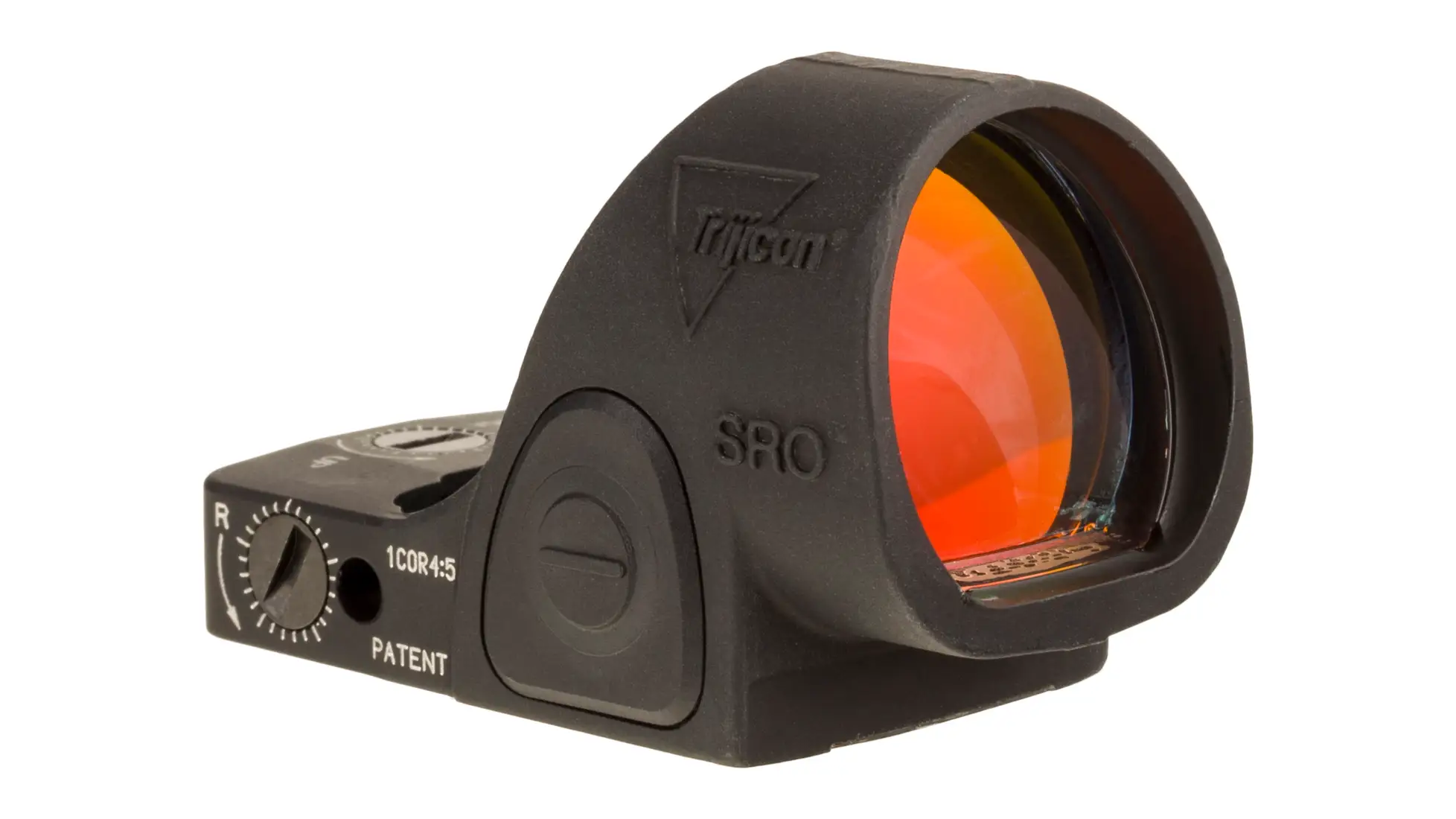
The Trijicon SRO (Specialized Reflex Optic) is a 1x pistol reflex sight built around one idea: a large round window. Where a Trijicon RMR frames the dot in a small rectangle, the SRO sets it in a big circle of glass in a deep housing, so the dot sits inside a tube-like frame that is fast to acquire and hard to lose. It shares the RMR footprint, runs a 7075-T6 aluminum housing, offers a 1, 2.5 or 5 MOA dot with eight brightness settings (including a super-bright mode and two night-vision levels), and feeds from a top-loading CR2032 you can change without pulling the optic. Trijicon aimed it squarely at competition and target shooters who want speed and a forgiving sight picture over the smallest possible footprint.
The big round window is the whole point
Every design choice on the SRO serves the window. The large circular lens and the depth of the housing combine into what shooters describe as a tube-like orientation cue: the dot is framed, centered and easy to catch even on an imperfect draw or through recoil, where a smaller rectangular optic often shows only aluminum until you fix your grip. For aging eyes that struggle to shift focus between the front sight and the target, that big, obvious dot is a genuine advantage. OpticsPlanet's gear expert frames the SRO exactly this way: they run an RMR on their carry gun and write that the design that makes it so rugged also makes its window small, while at a match or competition "seeing everything is more important than ultimate ruggedness". We put the two side by side, spec for spec, in Trijicon RMR vs SRO: same footprint, same price band, opposite jobs.
“A larger window and deep housing gives a ‘tube’-like orientation feedback making it nearly impossible to ‘lose the dot’... not a ‘duty’ optic like the RMR... It is the best.”
Matt S., OpticsPlanet gear expert (IL), via OpticsPlanet
The RMR footprint and the top-loading battery
Because the SRO uses the same footprint as the Trijicon RMR, it mounts on any RMR-cut slide and on the huge range of RMR adapter plates already on the market, and it does not require a sealing plate. Trijicon also moved the battery to the top of the housing: you swap the CR2032 without unbolting the optic or losing your zero, a small thing that owners single out again and again as a favorite feature (the RMR, by contrast, loads its battery from the bottom and usually has to come off the gun). Tool-less windage and elevation complete the picture, so zeroing and maintenance are both quick.
“Big glass, clear dot, top load battery, and it’s made in the USA! The 5 MOA dot is perfect... Very easy to track.”
BASE772 (MO), via OpticsPlanet
Which dot size to choose
The SRO comes in a 1, 2.5 or 5 MOA dot, and the choice is about your use, not accuracy. A 5 MOA dot is the fastest to find under speed and the common competition pick; the 1 MOA is the precision option for slow-fire bullseye work; 2.5 MOA is the do-everything middle. Remember that a larger dot is not less accurate, the optic is identical and the dot simply covers more of the target, roughly 5 inches at 100 yards for the 5 MOA but only about 1.3 inches at 25 yards, which is why competitors run it happily. If you want the math for your own distances, our dot size at distance calculator and MOA dot size guide lay it out.
Which SRO model to buy, and what each one costs
Trijicon lists ten configurations of the SRO. They differ in dot size, dot color and finish, and Trijicon rates battery life separately for red and green (see the specifications). Green is the new part: Trijicon added green-dot SROs for 2026 in 1 and 2.5 MOA, so a 5 MOA SRO is red. OpticsPlanet lists the first eight rows below on its main SRO listing and the two 1 MOA green models on a separate listing. Prices below were read from the retailer on November 15, 2026 and matched by manufacturer part number rather than by price, the rule we apply to every multi-model listing: Trijicon pages at this retailer have carried dealer-demo units priced above a new sight, and a price alone cannot tell you which is which.
| Model (MPN) | Dot | Finish | Price |
|---|---|---|---|
| SRO2-C-2500020 | 2.5 MOA red | Coyote brown | around $580 |
| SRO2-C-2500002 | 2.5 MOA red | Matte black | around $570 |
| SRO1-C-2500021 | 1 MOA red | Coyote brown | around $630 |
| SRO1-C-2500001 | 1 MOA red | Matte black | around $580 |
| SRO3-C-2500022 | 5 MOA red | Coyote brown | around $620 |
| SRO3-C-2500003 | 5 MOA red | Matte black | around $620 |
| SRO2-C-2500027 | 2.5 MOA green | Matte black | around $610 |
| SRO2-C-2500035 | 2.5 MOA green | Coyote brown | around $670 |
| SRO1-C-2500026 | 1 MOA green | Matte black | around $620 |
| SRO1-C-2500034 | 1 MOA green | Coyote brown | around $690 |
One thing in that table is worth acting on, and it is not a ranking. The cheapest red model on this listing has changed from one of our reads to the next, and the gap between the two finishes has flipped along with it. Price does not follow dot size or finish here in any stable way, so choose the dot size for your shooting and the finish for your build, then check that model's own price: the table is a reading, not an order.
On mounting: because the SRO shares the Trijicon RMR footprint, it bolts straight onto a slide milled for an RMR. If instead you are fitting it to a Glock MOS, a Springfield OSP, a Walther PDP or an H&K VP9 Optics Ready, Trijicon specifies its mounting kit AC32085, so add that small part to the budget. Trijicon's manual recommends torquing the supplied mounting screws to 15 in-lbs and says the SRO is specifically designed for pistol use.
The honest trade-offs: size, emitter and defect reports
The same big housing that makes the SRO so easy to shoot also makes it bulky. It is noticeably taller and larger than an RMR, which is why it is a competition and target optic rather than a slim carry or duty sight, and it can print under light clothing. It is also an open emitter, so heavy lube, dust or mud in the emitter well can degrade the dot until cleaned, where a sealed optic would shrug it off. And while the 4.7/5 owner average is strong, we read the negative reviews too: a real minority describe electronic or glass problems, a dot that quit, a lost zero, cracked glass, or a faint red line in the window on a couple of units. That is a minority against a large, positive sample rather than a systemic fault, but on a sight at this price it is worth going in with eyes open.
Trijicon builds the SRO from "forged 7075 aluminum and tempered glass" and says it has been "tested to survive typical pistol mounted drops". It also writes that "The SRO is designed to survive the rigors of slide ride pistols and is engineered for hard use." Those are the maker's claims. Trijicon's warranty terms: lifetime for the original owner on the optical system and metal structure; electronics five years from original manufacture. Its manual also warns: "Removing the bottom plate will void the Trijicon warranty."
“The red dot on the SRO just stopped working one day while sitting in the safe... Pros: bigger window. Cons: fragile.”
Sunburn (CO), verified owner, via OpticsPlanet (a minority report; most owners rate it 4-5 stars)
Trade-offs, plainly
- Big and tall: the deep round housing prints and rides higher than an RMR, so it is a competition/target optic, not a slim carry or duty sight.
- Open emitter: heavy lube, dust or mud in the emitter well can degrade the dot until cleaned; not a mud-and-rain choice.
- Premium price, from $570, well above budget and mid-tier pistol dots.
- A real minority of owners report electronic or glass defects (dot failure, lost zero, cracked glass) against an otherwise strong 4.7/5 record.
- Glass: cracked glass is among the minority owner reports on OpticsPlanet, and Trijicon pitches the SRO at target and competition shooting. We see it as a range and competition optic, not a hard-duty one.
- Generally too tall to co-witness stock iron sights; Trijicon says it is compatible with suppressor-height iron sights. Best mounted on a properly milled or plated slide, and Trijicon's manual does not recommend mounting it on pistols if the front of the optic overhangs the chamber/breach face.
Key specifications
| Magnification | 1x (true) |
|---|---|
| Reticle | 1, 2.5 or 5 MOA red dot, or 1 or 2.5 MOA green dot (this review anchors the 1 MOA red) |
| Emitter | Open reflex |
| Window size | 0.98 x 0.89 in (large round window) |
| Finishes | Matte black or coyote brown anodized |
| Footprint / mounting | Trijicon RMR footprint; Glock MOS, Springfield OSP, Walther PDP and H&K VP9 Optics Ready need Trijicon kit AC32085 |
| Illumination | Adjustable LED, 8 brightness settings (1 super-bright, 2 night-vision); red on most models, green on the 1 and 2.5 MOA models Trijicon added for 2026 |
| Adjustments | 1 MOA per click; 150 MOA total travel per Trijicon's product pages (its spec sheet prints 120 MOA); tool-less |
| Eye relief / parallax | Unlimited, parallax free |
| Battery | One CR2032, top-loading (change without dismounting). Trijicon rates red models at over 3 years of continuous use and green models at 2 years per its product pages (its spec sheet prints 1.4 years for the 1 MOA green), at setting 4 of 8 and 70°F |
| Housing | 7075-T6 forged aluminum, anodized, with a tempered glass lens (Trijicon); Made in USA per the retailer's listing |
| Controls | Button lock-out (auto-brightness) and lock-in (fixed brightness) modes |
| Weight | 1.6 oz with battery, per Trijicon's spec sheet |
| Dimensions | 2.2 x 1.3 x 1.4 in (L x W x H), per Trijicon |
| Sealing | Waterproof to 10 ft (3 m) for one hour, per Trijicon |
| Warranty | Trijicon: lifetime for the original owner on the optical system and metal structure; electronics five years from original manufacture |
On awards: the SRO was a finalist for Best New Optic in NASGW's 2019 Caliber Awards (source: NASGW). OpticsPlanet's "Best Rated Product" label, by contrast, is a store rating, not a trophy. Beyond that finalist place, its other credential is the depth of its owner record, 4.7/5 across 232 reviews, which we show attributed rather than fold into a rating of our own.
Should you buy it, and what else to consider
- Buy it if you want the fastest, most forgiving sight picture for competition or target shooting and value a big window and a top-loading battery over a slim footprint.
- Want the same big-window idea for less? The Holosun HS507COMP is a large-window competition open reflex at around $370, well under the cheapest SRO.
- Need mud-and-rain reliability? Step to an enclosed emitter like the Aimpoint ACRO P-2 or the value-priced Steiner MPS.
- Carrying, not competing? A slimmer micro like the Holosun HS507K conceals better; see our best pistol red dot guide.
- Astigmatism? Dot shape and size matter; we cover the choices in best red dot for astigmatism.
FAQ
What does SRO stand for, and how is it different from a Trijicon RMR?
SRO stands for Specialized Reflex Optic. It shares the exact same RMR mounting footprint as the Trijicon RMR, so it drops onto the same slides and plates, but the window is completely different: the SRO uses a large round window where the RMR uses a small rectangular one. That big round glass, set in a deep housing, gives a tube-like frame that makes the dot far easier to find on a fast draw and nearly impossible to lose, which is exactly why competition shooters reach for it. The trade is size: the SRO is taller and bulkier than an RMR, so the RMR remains the choice for a slim, snag-free duty or carry setup.
Is the Trijicon SRO an open or enclosed emitter?
It is an open emitter. The LED projector sits in an exposed well beneath the big round lens, the same design as a Holosun 507C or the RMR. That keeps the window large and the sight relatively low, but it means debris, heavy lube or caked mud in the emitter well can smear or blank the dot until you clean it, unlike a sealed enclosed optic (an Aimpoint ACRO P-2 or Steiner MPS). For competition and range use that is a non-issue; for a mud-and-rain duty gun an enclosed sight is the safer pick.
What dot sizes does the Trijicon SRO come in?
Three sizes: 1 MOA, 2.5 MOA and 5 MOA. The 1 MOA is the precision choice for bullseye and slow-fire target work; the 5 MOA is fastest to catch under speed and the usual competition pick; 2.5 MOA splits the difference as an all-round size. A bigger dot is not less accurate, the optic is unchanged, the dot just blankets more of the target, so choose by whether you value a fine aiming point or the fastest possible pickup. Note that the size is no longer the only reticle decision: Trijicon added green-dot SROs for 2026, and green is offered in 1 MOA and 2.5 MOA only, so a 5 MOA SRO is red.
Is there a green dot version of the Trijicon SRO?
Yes, and it is recent. Trijicon lists green-dot SROs badged new for 2026 in 1 MOA and 2.5 MOA, in both matte black and coyote brown, alongside the long-standing red models. There is no 5 MOA green. Green sits at a small premium over the equivalent red model and some shooters pick it up faster against green foliage or brown targets, where a red dot can blend in; against a white paper target the difference is largely preference.
Is the Trijicon SRO discontinued?
No. Trijicon's own SRO page listed ten models, four of them green-dot versions new for 2026, when we read it on 16 November 2026. That is a line still being added to, not one being wound down. The ten split into four 1 MOA, four 2.5 MOA and two 5 MOA models, each in matte black or coyote brown anodized.
Does the Trijicon SRO come in FDE?
Not under that name. The SRO ships in two finishes, matte black and coyote brown anodized, and the coyote brown is the tan option people usually mean when they search for an FDE SRO. It is a Trijicon-specific color rather than a match for any particular rifle maker’s flat dark earth, so if you are color-matching a build, compare it against your handguard in person rather than assuming it will blend.
Will the Trijicon SRO mount directly on a Glock MOS?
Not on the bare MOS plates. Trijicon calls for its SRO mounting kit, part AC32085, when you are fitting an SRO to a Glock MOS, a Springfield OSP, a Walther PDP or an H&K VP9 Optics Ready, so budget for that small extra part with the optic. On a slide milled directly for the RMR footprint, the SRO bolts straight on, because the SRO and the RMR share that footprint exactly.
How do you turn off a Trijicon SRO?
Press and hold both the plus and minus buttons for at least three seconds, per Trijicon's manual. To turn it back on, press and release one of the buttons and it powers into the default automatic mode. If you leave it on a manually set brightness, a 16.5 hour reset timer returns it to Automatic Mode; that timer is not active in Lock-Out or Lock-In mode.
Is the Trijicon SRO good for concealed carry?
It can carry, and its button lock-out mode secures an auto-brightness setting for exactly that, but it is not the ideal concealment optic. The tall, deep round housing that makes the dot so easy to find also prints more under light clothing and rides higher in the holster than a low-profile RMR or a subcompact carry micro. The SRO is at its best as a competition and target optic; for daily concealed carry a slimmer sight like the Holosun HS507K or an enclosed carry micro suits better.
How reliable is the Trijicon SRO?
Owners rate it 4.7 out of 5 across 232 reviews on OpticsPlanet, and the praise centers on its window, clarity and top-loading battery. A minority report electronic or glass defects, such as a dot that stopped working, a lost zero or cracked glass. Trijicon says it has been "tested to survive typical pistol mounted drops". Its warranty: lifetime for the original owner on the optical system and metal structure; electronics five years from original manufacture.
More: best red dot sights · best pistol red dots · Leupold DeltaPoint Pro review · Holosun HS507COMP review · best red dot for a Glock.