Steiner MPS review: the enclosed ACRO pistol dot
Our verdict: 4.5/5. The Steiner MPS is the value play in enclosed-emitter pistol optics. It seals its LED inside an all-metal, armored housing so mud, rain, snow and holster lint can never blank out the dot, mounts on the same rugged Aimpoint ACRO footprint the professionals trust, and does it for roughly $200 less than an Aimpoint ACRO P-2. A larger window than the ACRO makes the 3.3 MOA dot easy to find on a fast draw, and the chassis is tough enough that police agencies have approved it for duty. The honest catch is electronics: a 13,000-hour CR1632 and no shake-awake, so it needs a proactive battery habit that premium rivals do not.
Owners rate it 4.6/5 across 41 reviews on OpticsPlanet. It weighs 2.05 oz (58 g). The black model is around $350. Prices verified September 30, 2026; confirm the current price on the retailer page.
How we reviewed it: a research-based review built from the retailer specification sheet, the owner-review record, and a deep-research pass across industry publications and independent hands-on tests. We have not bench-tested this unit ourselves; the score is our editorial opinion and owner ratings are shown attributed to their source. See how we evaluate.
What it is
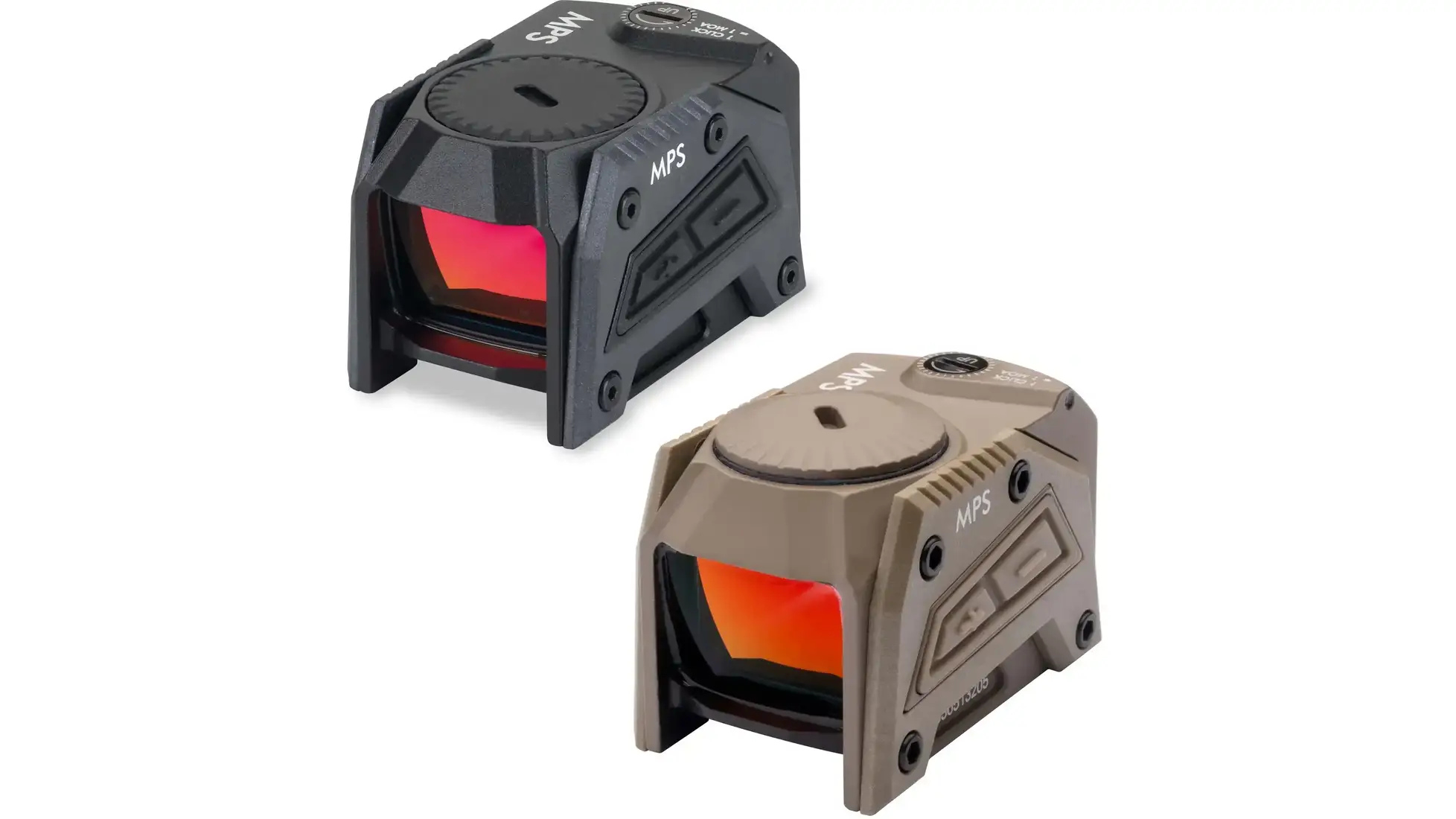
The Steiner MPS (Micro Pistol Sight) is a 1x reflex red dot built for handguns, with a single 3.3 MOA dot and an all-metal, fully enclosed housing. Its whole reason for being is durability: reinforced armored sidewalls, a recessed front lens under a metal hood, a nitrogen-purged sealed emitter, and the Aimpoint ACRO mounting footprint. It weighs 2.05 oz, runs eight brightness levels including two for night vision, and uses a top-loading CR1632 battery you can change without pulling the optic off the slide. Steiner aimed it squarely at duty and hard-use shooters who want an ACRO-class sight without an ACRO-class price.
The enclosed emitter is the whole point
An open-emitter sight leaves its LED projector exposed in a recessed pocket. Let water, mud, snow or pocket lint settle in that pocket and the beam scatters into an unusable starburst or vanishes entirely, and you cannot reach in to clear it. The MPS seals the emitter inside its metal housing, so the only surfaces the environment touches are the flat outer lenses. Cake it in mud and you wipe the glass with a thumb or a shirt and the dot is instantly back. Steiner also mounts the emitter at the roof of the housing rather than the base, which lets the sight window sit lower on the slide and makes co-witnessing with iron sights easier than on many enclosed optics. For anyone who has watched a red dot die in cold rain, this is the feature that matters.
“I have ran RMR, SRO, Delta point pros, and Holosuns... The 509t I had 3 of them all ended up with water intrusion into the optic and cloudiness due to moisture haze or frozen... At the costs of those optics I need something more robust, after all this is something you are intrusting your life or loved ones lives to.”
WileyJ77 (OH), via OpticsPlanet
The ACRO footprint, and the mounting catch
Instead of inventing a proprietary mount or using RMR-pattern vertical screws, Steiner built the MPS around the Aimpoint ACRO footprint. The ACRO clamps with a horizontal cross-bolt, conceptually a tiny Picatinny interface, which spreads the violent shear of a reciprocating slide across a broad surface rather than loading two small screws that can shear or back out. The practical payoff is that the MPS drops onto any ACRO-milled slide, or any optics-ready pistol with an ACRO adapter plate from makers like C&H Precision, Forward Controls or Apex. The catch is simply the flip side of that: if your pistol is cut for an RMR or a Holosun K pattern instead, you will need the right ACRO plate, so confirm your slide cut before you buy.
Duty-approved, and what that actually means
The MPS has no editorial "optic of the year" trophy, and we checked; Steiner has won those with other products, but not with this one. What it has instead is arguably a higher bar for a defensive optic: formal law-enforcement duty approvals. Per NRA outlets, the Kansas Highway Patrol has approved the MPS for duty carry, and it is approved by the Lubbock and Cross Roads police departments and the Arlington SWAT unit, with field testing by the Dallas Police Department. Those approvals are real-world verification of the 1,000 G shock rating and sealed housing, agencies do not sign off on gear that loses zero out of a patrol car. We treat that as institutional validation rather than a marketing award, and cite the sources here in text only.
The real trade-off: battery and no shake-awake
Every rugged strength of the MPS is counterweighted by its power architecture, and this is the honest reason to think twice. The CR1632 is rated up to 13,000 hours, well short of the 50,000-hour life that the Aimpoint ACRO P-2 and current Holosun enclosed sights deliver; owners running high daylight brightness report swapping the cell every few months rather than every few years. Worse for a defensive gun, the original MPS has no shake-awake, only a 13-hour auto-off timer, so to keep the dot always ready you must manually defeat that timer, which keeps it powered and drains the small cell faster still. The mitigation Steiner built in is the top-loading tray: you change the battery without unbolting the optic, so at least a swap never costs you your zero. If you are a set-it-and-forget-it shooter, this is the spec that should steer you to an ACRO P-2 or the newer Steiner MPS 2.0 instead.
“The MPS is overbuilt which is good for protection... Glass clarity and dot brightness are wonderful... It is a bit strange that they didn't include a shake awake feature since the optic has a timed shut off feature but its not a deal breaker... I would definitely recommend it as a solid alternative to anyone interested in or waiting for an ACRO.”
Matt S., OpticsPlanet gear expert (IL), via OpticsPlanet
How much does the Steiner MPS weigh, and how do the three MPS models compare?
The MPS weighs 2.05 oz, or 58 grams. Steiner and the retailer agree on that figure, and Steiner publishes the metric one, which is the number most European sources quote. It is the optic on its own: the MPS mounts straight to an ACRO footprint and no plate is included, so if your slide needs an adapter plate you should add its weight to that.
Steiner sells the MPS in three forms and the names are easy to mix up, so here is the comparison, with weights, because weight is usually the reason people ask.
| Model | Weight | Battery and runtime | Footprint and dot | Retailer today |
|---|---|---|---|---|
| MPS (reviewed here) | 2.05 oz / 58 g | CR1632, up to 13,000 h, 13-hour auto-off, no shake-awake | ACRO, 3.3 MOA | around $350 black |
| MPS 2.0 | 2.32 oz | CR2032, up to 90,000 h at level 4 (27,000 h at maximum) | ACRO, 3.3 MOA | around $550 |
| MPS-C | 1.13 oz / 32 g | CR1632, shake-awake, or always-on, or 13-hour auto-off | RMSc, 1.6 MOA | around $500 |
Read that table as an answer to this review's main criticism. The thing we mark the original MPS down for is its electronics: 13,000 rated hours and no motion wake, against a 50,000-hour class standard. The MPS 2.0 fixes precisely that, moving to the larger CR2032 and a rated 90,000 hours at moderate brightness. The cost of the fix is 0.27 of an ounce, roughly a hundred and fifty dollars, and an owner record that does not exist yet: the 2.0 carries no reviews at the retailer, where the original has 39. If you want the battery life and will take the newer design on trust, the 2.0 is the better optic on paper. If you want the version owners have already put rounds behind, this one is.
⚠️ One caution if you are comparing spec sheets yourself. The retailer's page for the MPS 2.0 lists its weight as 2.05 oz, which is the original MPS's figure; Steiner's own table gives 2.32 oz for that same item number. We publish Steiner's. In the same vein, the two disagree on the length of the original: Steiner says 1.89 in and the retailer says 2.17 in, and we have not been able to establish which convention each is using, so both are in the specification table below rather than one of them being quietly picked.
The carry answer: MPS-C
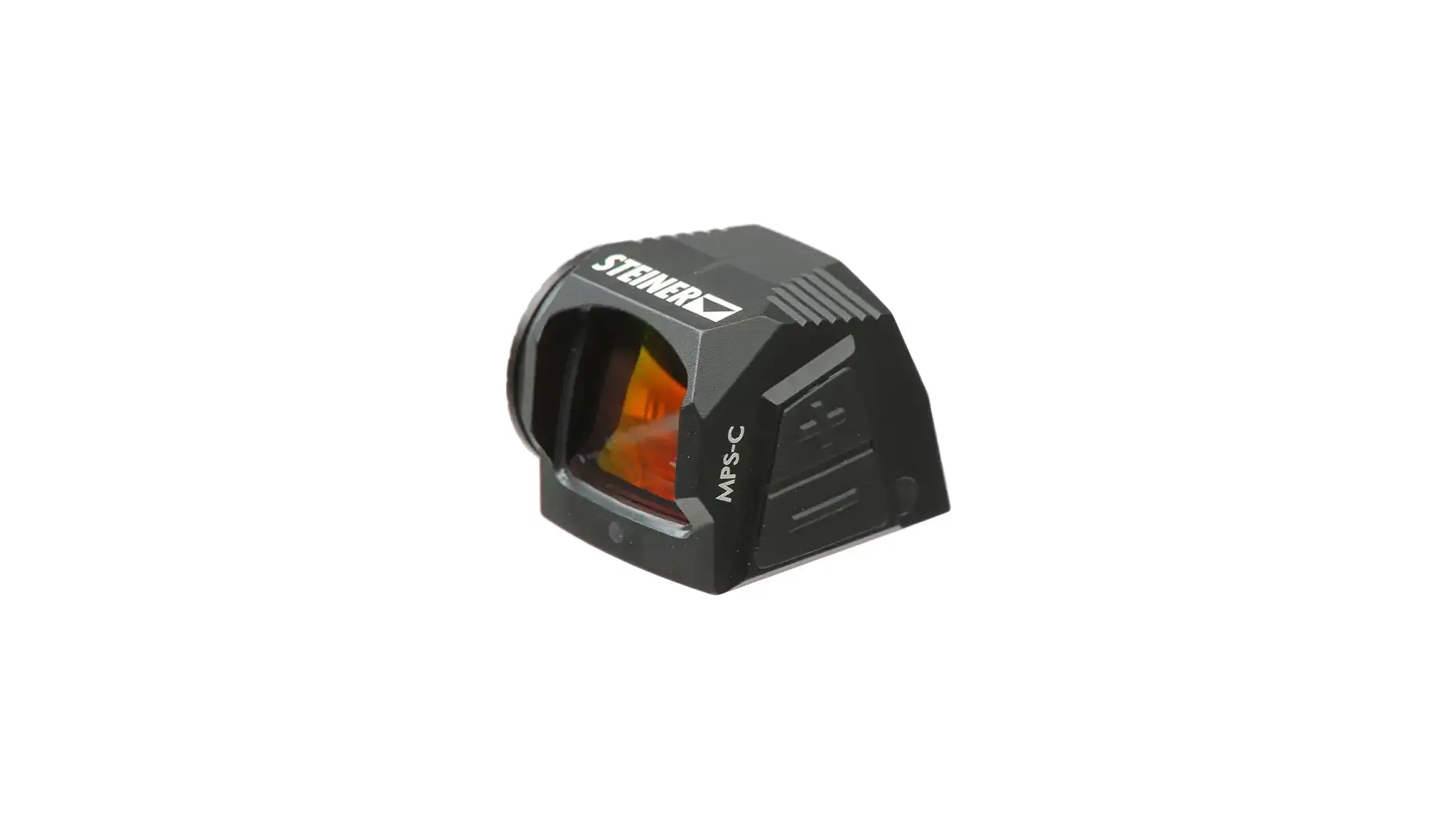
If you came to this review because you want a sealed Steiner on a carry pistol, the MPS-C rather than the MPS is probably your answer, and the reason is footprint and mass. The MPS is an ACRO optic weighing 2.05 oz; the MPS-C is an RMSc optic weighing 1.13 oz, or 32 g, which is close to half, and RMSc is the cut on the slimline guns people actually carry. Steiner's own specification for item number 8700000039 gives a 21 by 19 mm objective, 1 MOA clicks with 50 MOA of adjustment in each axis, a 1.46 by 1.27 by 1.08 in body in hard-anodized Class III aluminum with reinforced sidewalls, and the same fully sealed emitter that is the whole point of this family. It also answers the criticism this review makes of the original: the MPS-C has motion-sensing shake-awake, with always-on and a 13-hour auto-shutoff as selectable alternatives, where the MPS has the auto-shutoff and no motion wake at all. It runs around $500.
Two honest limits. Steiner does not publish a rated battery life for the MPS-C, and it uses the same small CR1632 cell as the MPS, so the electronics complaint is only half answered: you get the motion wake, but not a published runtime you can compare against a 50,000-hour Holosun. And the owner record is effectively empty, 4.5 out of 5 from two ratings, so there is nothing there to tell you how it survives a year of carry. If a proven record matters more to you than the Steiner name, that is an argument for a Holosun EPS Carry instead.
⛔ One number to get right if you are cross-shopping spec sheets: the dot is 1.6 MOA. The retailer's specification table for this optic says 2 MOA while its own feature list on the same page says 1.6 MOA, and Steiner publishes 1.6 MOA. This is the mirror image of the warning we give elsewhere about trusting a spec table over marketing copy: here it is the table that is wrong, which is why the rule is really "go to the manufacturer", not "trust the table".
What owners flag, plainly
Across 41 reviews the MPS is very well liked (4.6/5), and owners keep returning to the same praise: the armored build, the flat easy-to-clean glass, and a crisp round dot that shooters with astigmatism single out. The most useful criticisms are the honest limits of the design rather than a pattern of failure. Beyond the battery and shake-awake points above, owners note the brightness buttons are solid individually but awkward to press simultaneously to lock a setting. The most helpful negative review is a genuine quality defect, debris that got inside a unit and damaged the glass, handled as a warranty claim; we flag it as an isolated defect resolved through Steiner's Heritage Warranty, not an inherent flaw.
“It came sighted in out to 20 yards spot on. I made no adjustments. Glass was clear while shooting in cloudy rainy weather and had no issues with the red dot, also it's amazingly light but yet feels like military grade.”
Reggie Broen, verified owner (FL), on a Beretta shotgun, via OpticsPlanet
Trade-offs, plainly
- 13,000-hour battery life, short of the 50,000-hour class standard; heavy daylight users change the CR1632 every few months.
- No shake-awake; a 13-hour auto-off timer only, which you must manually defeat for always-on carry, taxing the battery further.
- Single 3.3 MOA dot only: no selectable circle-dot and no green option on this original model.
- Blocky "mailbox" enclosed form with a roof-high center of mass; it can print under light clothing and feels top-heavy for deep concealment.
- ACRO footprint means an RMR- or K-cut slide needs the correct ACRO adapter plate before it will mount.
Key specifications
| Magnification | 1x (true) |
|---|---|
| Reticle | 3.3 MOA red dot (single dot only) |
| Emitter | Fully enclosed (see note; the OP table row is mislabeled) |
| Footprint | Aimpoint ACRO |
| Window size | 0.63 x 0.83 in |
| Illumination | Red |
| Brightness | 8 settings (6 daylight, 2 night-vision compatible) |
| Adjustments | 1 MOA clicks, 90 MOA total travel |
| Parallax | Parallax-free 10-150 m |
| Battery | One CR1632, up to 13,000 hours, top-loading tray |
| Power saving | 13-hour auto-off timer (no shake-awake) |
| Housing | All-metal, hard-anodized; reinforced armored sidewalls |
| Weight | 2.05 oz (58 g), per both Steiner and the retailer |
| Length | 1.89 in per Steiner; the retailer lists 2.17 in |
| Sealing / durability | Waterproof, fogproof, -40 to 140 F |
| Warranty | Steiner Heritage Warranty (lifetime; US electronics limited to 3 years per Steiner literature) |
On awards: the MPS itself has no standalone editorial award, and we checked. Other Steiner optics have won them (the P4Xi riflescope took a 2018 NRA Golden Bullseye), but none was given to the MPS, so we claim none. Its credential instead is institutional: law-enforcement duty approvals, which for a defensive optic is a stricter test than a magazine award.
Should you buy it, and what else to consider
- Buy it if you want an enclosed-emitter, ACRO-footprint duty pistol optic that shrugs off mud, rain and cold, and you would rather manage a battery schedule than pay Aimpoint or Trijicon money.
- Step up to an Aimpoint ACRO P-2 if you want the same footprint with a true 50,000-hour battery and deeper submersion, and the extra cost is acceptable.
- Want carry, not duty? A slimmer open-emitter micro like the Holosun HS507K conceals better; see our best pistol red dot guide.
- Astigmatism? Owners praise the MPS's crisp round dot; we cover emitter and dot choices in best red dot for astigmatism.
- Mounting a Glock or other optics-ready pistol? The plate matters as much as the sight. See best red dot for a Glock and our best red dot sight guide.
FAQ
Is the Steiner MPS an enclosed or open emitter?
It is fully enclosed. The LED emitter is sealed inside an all-metal, nitrogen-purged housing, so unlike an open-emitter sight (a Trijicon RMR or a Holosun 507C), debris cannot collect in an exposed emitter well and blank out your dot. If mud, rain or holster lint lands on the flat outer glass, you wipe it off with a thumb and the dot is back, a clearing move that is impossible on an open emitter. One note for spec-sheet readers: the OpticsPlanet specification table lists "Emitter Type: Open," but the product title, description and feature list all state it is fully enclosed, as does every industry review, so the table row is an error.
What footprint does the Steiner MPS use and what pistols fit it?
The MPS uses the Aimpoint ACRO footprint, a horizontal cross-bolt clamp rather than the vertical screws of an RMR-pattern cut. It drops directly onto any slide milled for an Aimpoint ACRO, and onto any optics-ready pistol using an ACRO adapter plate (C&H Precision, Forward Controls, Apex and others make them). The cross-bolt design spreads slide-recoil shear across a wide surface instead of loading two small screws, which is a large part of why the ACRO interface is trusted for duty use. Confirm your slide is ACRO-cut or that an ACRO plate exists for your pistol before you order.
What is the Steiner MPS battery life, and does it have shake-awake?
It runs a single CR1632 rated up to 13,000 hours, and no, it has no shake-awake (motion wake). Instead it uses a user-selectable auto-off timer that shuts the sight down after 13 hours of inactivity. Two honest consequences: 13,000 hours is well short of the 50,000-hour standard set by the Aimpoint ACRO P-2 and modern Holosun enclosed models, so owners running high daylight brightness report changing the cell every few months; and for always-ready carry you must manually disable the auto-off, which keeps the dot lit and draws the battery down faster. The upside is the battery tray sits on top, so you swap the cell without removing the optic or losing your zero.
Steiner MPS vs Aimpoint ACRO P-2: what is the difference?
They share the same ACRO footprint and the same enclosed-emitter concept, and the MPS typically sells for roughly $200 less. The MPS also has a noticeably larger, slightly flared window than the ACRO P-2's small square one, which makes the dot easier to find on an imperfect draw. The ACRO P-2 answers back on electronics and sealing: a larger CR2032 giving a true 50,000-hour battery life, and a deeper submersion rating. In short, the MPS trades battery endurance for a bigger window and a much lower price while keeping the same rugged mounting standard.
Is the Steiner MPS good for concealed carry?
It works, but it is not the ideal concealment optic. Enclosed emitters are inherently blockier (owners and reviewers nickname the MPS a "mailbox"), and because the emitter sits at the roof of the housing the mass rides a little high, which can print under light clothing and feel top-heavy inside the waistband. Where the MPS shines is overt duty and range use: the armored sidewalls, recessed hooded front lens and 1,000 G shock rating let you rack the slide off a belt or barricade one-handed. For deep concealment, a slimmer sight like the Steiner MPS-C or an enclosed Holosun EPS Carry suits better.
More: best red dot sights · best pistol red dots · best red dot for a Glock · best red dot for astigmatism · Holosun HS507K review.