Trijicon RMR vs SRO: which should you buy?
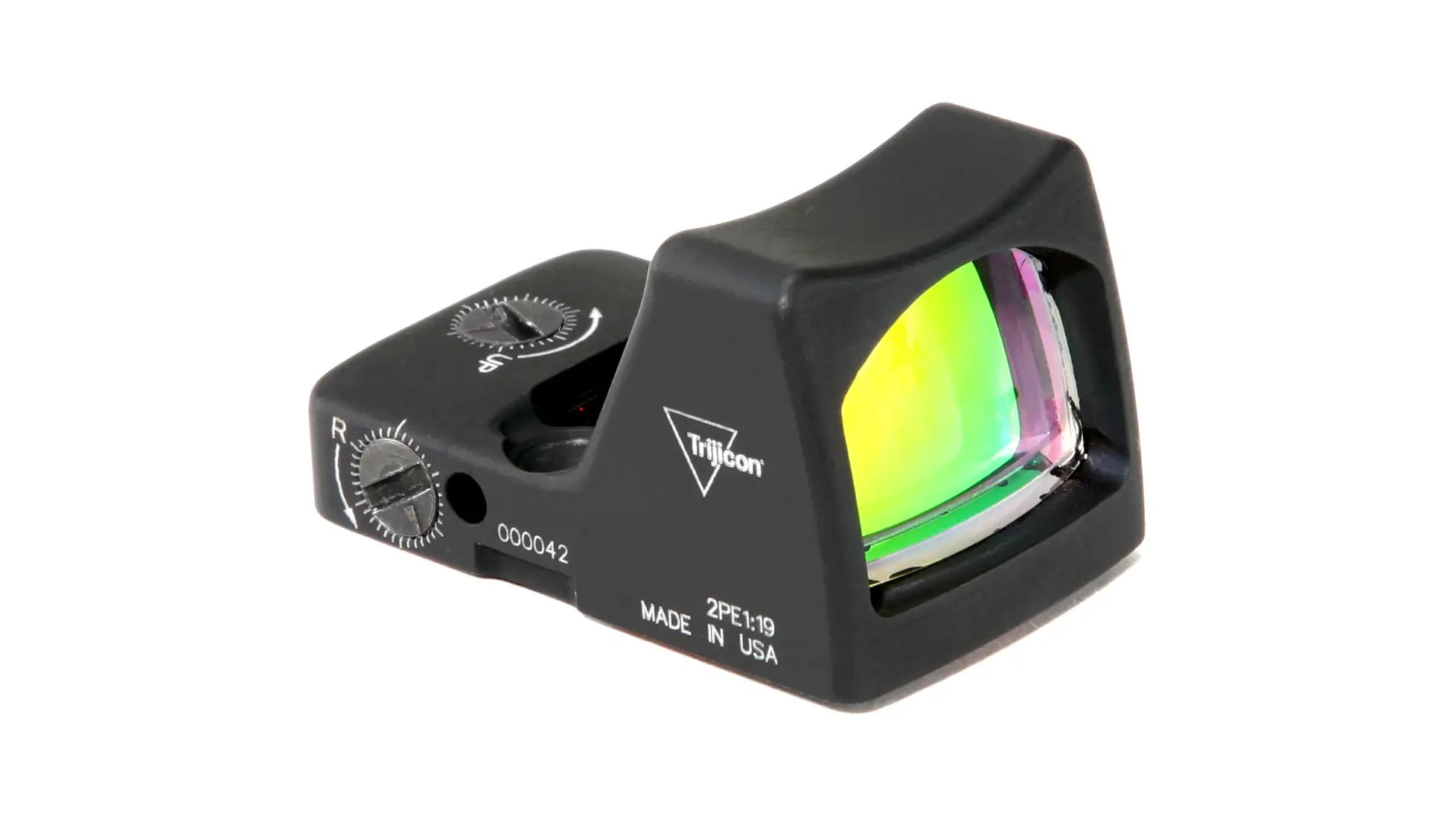
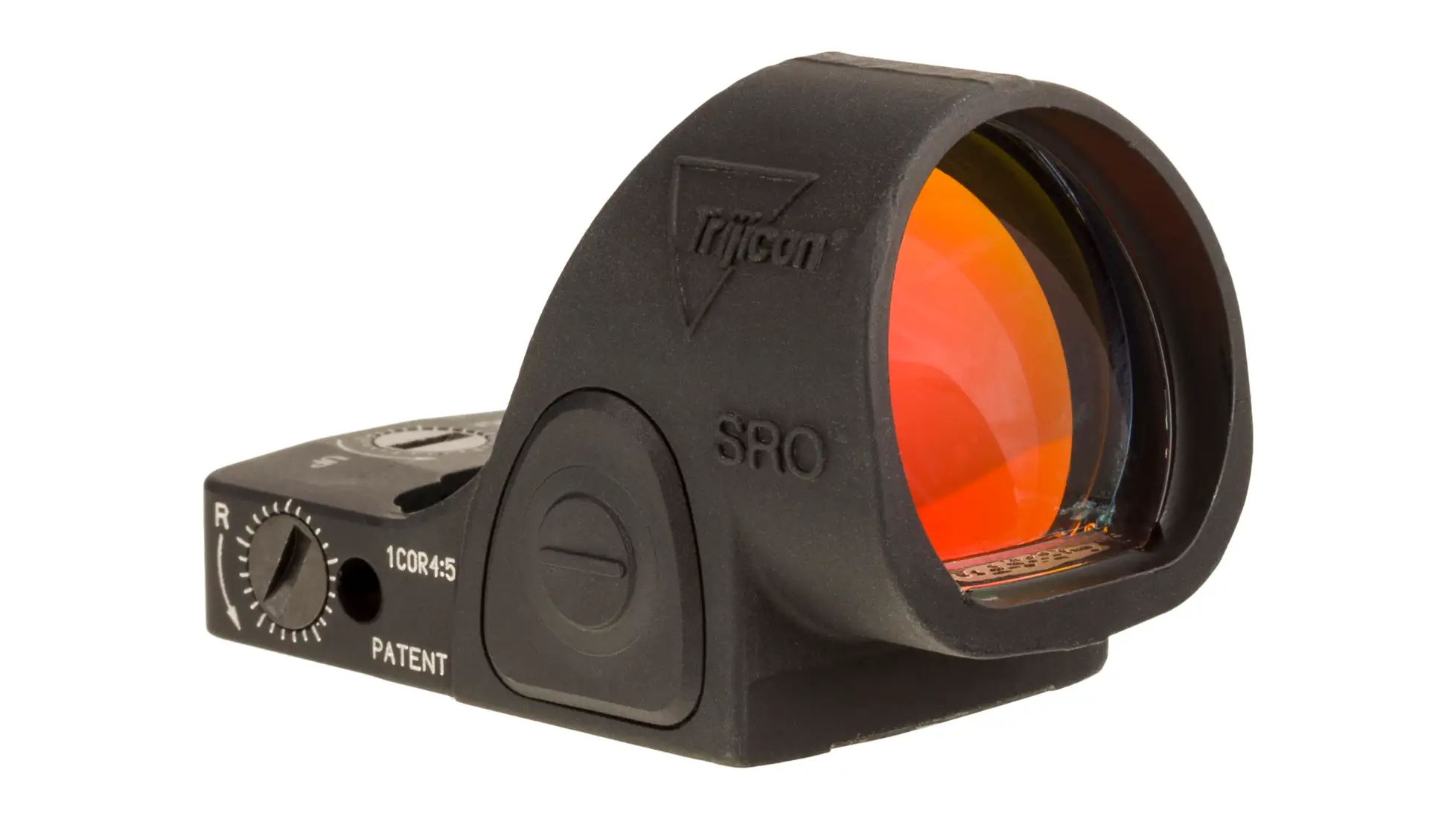
Our verdict: buy the RMR Type 2 (around $520) for a duty, carry or defensive pistol, and the SRO (around $580) for competition and target shooting. They share a footprint, an emitter type and a 1 MOA click, and the SRO now asks a modest premium over the RMR, so this is not a better-or-worse decision. It is a small tough window versus a large fast one. The RMR's forged housing diverts impact away from the lens and its owners' loudest complaint is that the window is small. The SRO answers exactly that complaint with a big round window you can barely lose the dot in, and pays for it with a thinner durability record and no forward iron sights.
Between them these two carry 446 owner reviews on OpticsPlanet, both averaging 4.7/5. Prices verified September 30, 2026; confirm the current price on the retailer page. The RMR is the premium duty pick in our best pistol red dot guide.
How this comparison was made: a research-based, spec-by-spec comparison built from the retailer's specifications for both sights and their full owner records, 446 reviews between them. We have not bench-tested the two side by side. Every row in the table is listed for both sights; specs recorded for only one are left out rather than guessed, which is why window size and weight are discussed in the text instead. Scores and verdicts are our editorial opinion. See how we evaluate.
Side-by-side specifications
| Trijicon RMR Type 2 RM01 | Trijicon SRO | |
|---|---|---|
| Street price | around $520 Check RMR price | around $580 Check SRO price |
| Owner rating | 4.7/5, 220 reviews on OpticsPlanet | 4.7/5, 228 reviews on OpticsPlanet |
| Role | Duty and carry | Competition and target |
| Reticle | 3.25 MOA dot (RM01) | 1, 2.5 or 5 MOA dot (chosen at purchase) |
| Magnification | 1x | 1x |
| Footprint | RMR | RMR |
| Emitter | Open | Open |
| Illumination | Automatic LED, ambient-adjusting | 8 settings incl. 2 night-vision, with lock-out and lock-in |
| Adjustment click | 1 MOA | 1 MOA |
| Battery | CR2032, bottom load | CR2032, top load |
| Housing | Forged 7075-T6 aluminum | 7075-T6 aluminum, anodized |
| Water resistance | Waterproof to 66 ft | Waterproof to 10 ft |
| Made in | USA | USA |
Same mount, close money, opposite jobs
Most comparisons at this level come down to price. This one does not. Both sights are 1x open-emitter Trijicons on the RMR footprint, both adjust in 1 MOA clicks, and both are made in the USA. Drop either one on the same milled slide and it fits. They were within a few dollars of each other when we first compared them, and the SRO has since moved above the RMR, which is a real difference but a small one against what either costs. What separates them is what Trijicon built each to survive.
The RMR Type 2 is a duty optic. Its forged 7075-T6 housing is shaped to push an impact away from the lens, it is waterproof to 66 feet, and it was selected under the U.S. Special Operations Command Handgun Reflex Sight programme in 2018 (source: U.S. Special Operations Command). Owners run it through hundreds of rounds and drops onto concrete and report a perfect zero afterwards. The SRO is a match optic. It takes the one thing RMR owners complain about, the small window, and rebuilds the front of the sight around fixing it.
"SRO for competition, RMR for duty/carry."
Deuce (WI), via OpticsPlanet, echoing the retailer's own gear expert
The window is the whole argument
Read the RMR's own owner record and the same line keeps appearing under Cons: small window. One owner who rates it highly for carry writes that its glass "is smaller than some and may not be the best target shooting option", but that it is the best defensive option he has used because it will keep working. That is the trade the RMR asks you to accept.
The SRO does not accept it. Its large round window sits in a deep housing that gives a tube-like sense of where you are behind the sight, and owners describe the result the same way over and over: it is nearly impossible to lose the dot. Several older shooters single it out for aging eyes. You also pick the dot size when you buy, so a 1 MOA for precision work or a 5 MOA for fast follow-up shots, where the RM01 RMR gives you one 3.25 MOA dot chosen as a middle ground.
The practical cost of that deep housing is that you generally cannot run forward iron sights through the SRO. On a competition gun nobody misses them. On a carry gun, that is a real decision.
Where the SRO is genuinely better
- Finding and tracking the dot. The large window plus deep housing is the fastest sight picture of the two, and it is the reason the SRO exists.
- The battery. The SRO loads its CR2032 from the top, so you change it without unmounting the optic and without re-zeroing. The RMR loads from the bottom, which means taking it off the slide.
- Brightness control. Eight settings including two night-vision modes, plus lock-in to freeze your chosen brightness for a match and lock-out to secure auto-brightness for carry. The RM01 RMR runs an automatic LED that sets brightness for you, with no manual override.
- Dot size choice. 1, 2.5 or 5 MOA at purchase instead of a single 3.25 MOA.
Where the RMR is genuinely better
- Proven hard use. A forged housing built to divert impact, waterproof to 66 feet, with a SOCOM selection behind it and an owner record full of drops onto concrete that held zero.
- Backup irons. Its lower profile is what lets you keep forward iron sights in the picture.
- Failure record. The critical reviews on the RMR are mostly about a bad unit out of the box, which the warranty covers. The SRO's cluster harder on optics that stopped working later, which is the failure mode that matters on a defensive gun.
- Nothing to set. The automatic LED is a downside for a competitor who wants a fixed brightness and an upside for someone who wants to draw and shoot without touching a button.
The SRO trade-off you should know before you buy
The SRO averages 4.7 out of 5 across 228 OpticsPlanet reviews, so most owners are happy. But its critical reviews are not about preference, they are about hardware. A dot that stopped after ten rounds and would not return until the battery was pulled. A sight that died sitting in a safe, where a new battery did not fix it. A lost zero after six or seven shots. A window cracked within a week. And the one we find most telling, because it comes from an owner of four SROs and an RMR who still recommends the line: two brand-new units both showing a red line in the upper third of the window.
That is a minority of a strong average and it is not a reason to avoid the SRO on a match gun, where a failure costs you a stage. It is a reason to think hard before it goes on the gun you carry. Keep it separate from a different complaint in the same reviews, that some units arrived with fingerprints, wear marks or missing parts: that is a received-condition problem between the retailer and the box, not a fault in the optic's design.
Which one, in one line
- Duty, carry or a defensive pistol: the RMR Type 2. Buy the record, not the window.
- USPSA, IDPA, steel or range and target work: the SRO. Buy the window, and pick your dot size.
- One gun that does both: the RMR, with the honest note that you are giving up sight-picture speed for durability you may never test.
- Neither, if the budget is the problem: both are premium optics. Our best pistol red dot guide has picks at a fraction of this, including the Holosun HS507C-X2 on the same RMR footprint.
FAQ
What is the difference between the Trijicon RMR and the SRO?
The job, not the mount. Both are 1x open-emitter Trijicon reflex sights on the RMR footprint, so they fit the same slides and mounts, and until recently they cost about the same; the SRO now costs more than the RMR. The RMR Type 2 is the duty and carry optic: a compact, forged housing whose patented shape diverts impact away from the lens, with a small window that owners themselves list as its main drawback. The SRO is the competition and target optic: a large round window in a deep housing that makes the dot far easier to find and follow, plus a top-loading battery you swap without unmounting the sight. Trijicon's own gear expert puts it plainly, that the SRO is not a duty optic like the RMR.
Is the SRO more expensive than the RMR?
Yes, and that changed recently. Our anchor SKUs are the 3.25 MOA black RMR and the 1 MOA black SRO, and as of the price check on September 30, 2026 the SRO costs more than the RMR, and the size of that gap has moved in both directions over the weeks we have tracked it. Both current figures are in the price row of the comparison table above. Watch the specific model rather than the line: which SRO dot size and finish is cheapest has changed from one read to the next. The premium is small enough that it should not decide this for you; how you use the pistol still should.
Can you co-witness iron sights with the SRO?
Generally no, and this is one of the clearest practical splits between the two. The SRO sits taller with a deeper housing, so you cannot usually run forward irons through it, which is exactly why the OpticsPlanet gear expert calls it a match optic rather than a duty one. If backup irons that you can see through the optic matter to you, that points to the RMR.
Which has the better dot for fast shooting?
The SRO, by design. Its large round window and deep tube-like housing give you more orientation feedback, and owners repeatedly say it is nearly impossible to lose the dot, with several older shooters calling out how much easier it is on aging eyes. You also choose the dot size at purchase, 1, 2.5 or 5 MOA. The RMR gives you a single 3.25 MOA dot in this RM01 model, sized as an all-rounder, in a smaller window that takes more discipline to find under speed.
Is the SRO reliable enough for carry?
That is the honest weak point. Against a 4.7 out of 5 average across 228 OpticsPlanet reviews, the critical reviews cluster on hardware failure rather than preference: a dot that stopped after ten rounds, a unit that died sitting in a safe, a lost zero after several shots, a cracked window, and an owner of four SROs who received two units with a red line in the upper window. It is a minority against a strong average, but it is a pattern in the direction that matters least for a competition optic and most for a carry gun. The RMR is the sight with the duty record.
Do the RMR and SRO use the same mounts and plates?
Yes. Both use the Trijicon RMR footprint, the most widely supported cut on the market, so the same milled slides, adapter plates and rifle mounts work for either sight. Neither includes a plate matched to your specific pistol, so budget for one if your slide is not already cut. The SRO does not require a sealing plate.
Read our full Trijicon SRO review, or see the RMR Type 2 ranked in our best pistol red dot guide. Carrying a slim-slide pistol where neither of these will fit? The Trijicon RMRcc is the narrow-body version of the RMR. Comparing on a budget instead? See Holosun 407C vs 507C and Defender-CCW vs HS407K-X2.