Primary Arms SLx 5x36 Gen III review
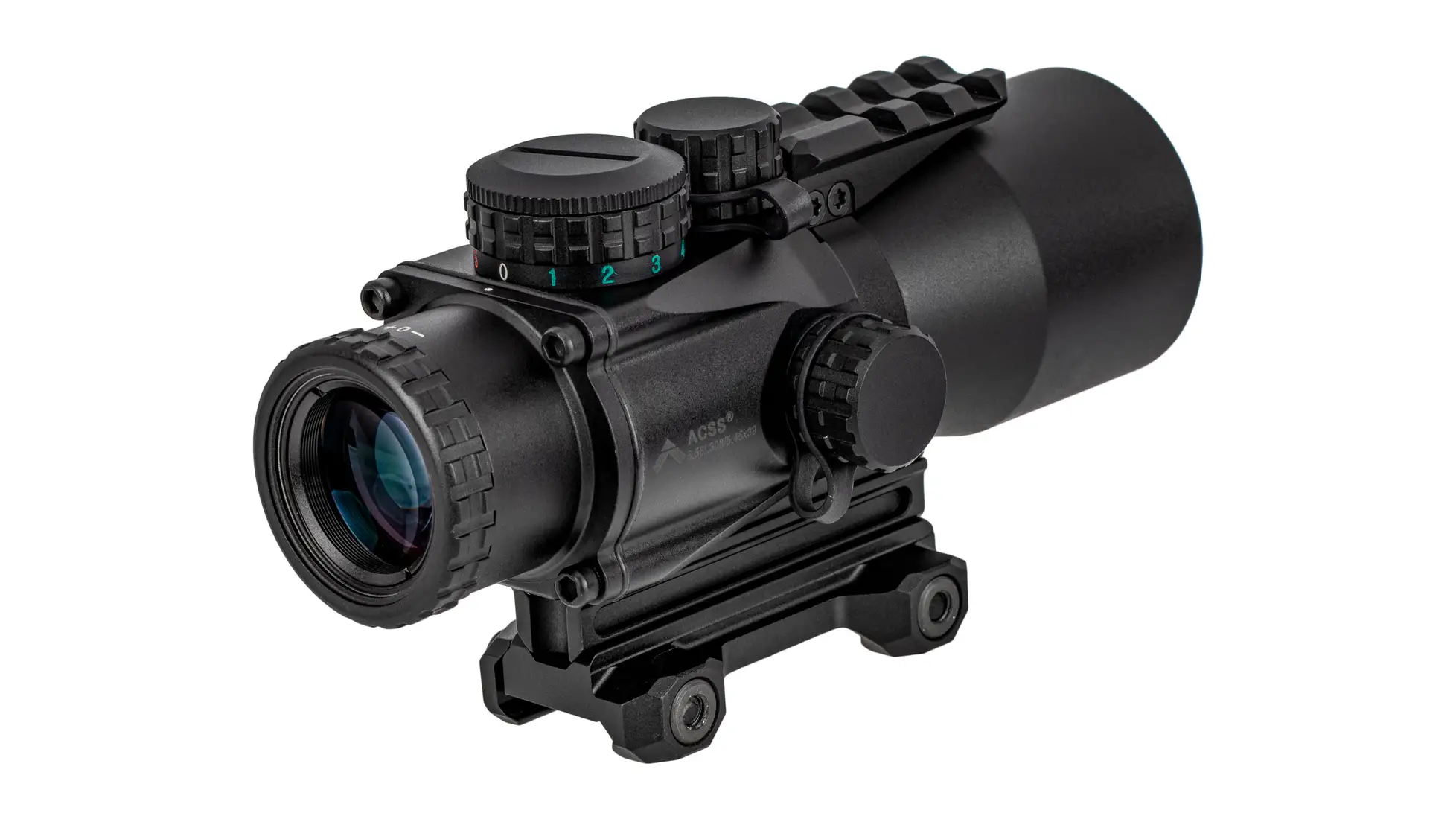
Our verdict: 4.3/5. This is the sight people mean when they search for an affordable ACOG-format optic, and it earns the comparison on shape and function rather than internals: fixed 5x36, an etched ACSS ballistic reticle in red or green, 1/3 MOA clicks, an integrated Picatinny mount and a heavy-duty build that even its critics concede. At around $340 it undercuts the Vortex Spitfire 5x while offering the same magnification. The costs are real and physical: 18.4 ounces makes it the heaviest prism we cover, the 18.8 foot field of view is the narrowest, and one owner received a reticle canted out of the box.
Owners rate it 4.5/5 across 101 reviews on OpticsPlanet. around $340 at the retailer, MPN 710028. Every specification on this page was re-checked against Primary Arms' own sheet for this update. Prices verified September 30, 2026; confirm the current price on the retailer page.
How we reviewed it: a research-based review from the retailer specification sheet and the owner-review record, read lowest rating first. We read the 10 lowest-rated of 99 written reviews plus the two the retailer highlights. We have not bench-tested this optic and we have not tested a Trijicon ACOG; the score is our editorial opinion and owner ratings are attributed. See how we evaluate.
What "5x36" means, before the review
5x36 describes a format rather than a brand: a fixed 5x magnification optic with a 36 mm objective lens. Nothing zooms, and the size is set by that objective. It belongs to the fixed-power prism family the Trijicon ACOG made famous, although the ACOG itself is not a 5x36: none of the ACOG models OpticsPlanet lists uses those numbers, and the best known is the 4x32. A 5x36 is almost always a compact, dense, mount-included sight built to sit low on a carbine and reach a few hundred yards, and more than one maker builds to those numbers. The trade the format forces is the same every time: fixed magnification and a small objective buy you toughness and a short package, and cost you field of view and a tight eye box. On this sight those costs are 18.8 feet of view at 100 yards and 2.50 to 3.00 inches of eye relief, both from Primary Arms' own specification sheet, and an exit pupil of about 7.2 mm, which is simply 36 divided by 5 (the maker's table lists 7.0 mm, and a feature bullet on the same page says 10.3 mm, which a 36 mm objective at 5x cannot produce). The exit pupil is the width of the light column reaching your eye, and a 1x prism's is far wider, which is part of why owners describe the head position here as unforgiving.
If you searched the bare format term and have not settled on a magnification yet, the honest first question is not which 5x36 but whether 5x fixed is the right optic at all. Our best prism scope guide covers 1x, 3x and 5x side by side, and the ACOG clone guide explains where this format came from.
What it is
A fixed 5x36 prism scope with an etched ACSS reticle, offered in 5.56/.308 and 5.56/5.45/.308 versions, with red and green illumination across five settings. Adjustments are 1/3 MOA, the mount is a ruggedized Picatinny unit, and the housing is aluminium, waterproof, shockproof and fogproof, running a single CR2032. Because the reticle is etched, the sight still aims with a dead battery. It is 5.81 inches long and 18.4 ounces, which is the honest headline: this is a solid, dense optic rather than a lightweight one.
Mounting: what actually comes in the box
This comes up constantly around this sight, so here is what the manufacturer supplies rather than what forums remember. The Gen III ships with its own ruggedized Picatinny mount, which Primary Arms describes as using integrated recoil lugs and large-diameter crossbolts for clamping power, plus an included riser. In Primary Arms' words the riser "is the perfect height for AR-15s and AR-10s, but can be easily removed for carry handle or AK use". So for the two most common cases, a flat-top AR or a carry-handle or AK build, you do not buy anything extra: you either keep the riser or take it off.
What we are not going to tell you is how it fits third-party mounts. Older owner reports about clearance in aftermarket mounts circulate widely, we have not tested any, and the housing shape has changed across generations, so we would only be repeating something we cannot check. If you plan to discard the supplied mount for a specific aftermarket one, confirm clearance with that mount's maker before you buy.
The ACOG comparison, in owners' words
We did not invent the framing. The review the retailer ranks as most helpful positive opens by addressing anyone who wants a Trijicon ACOG but cannot justify the four-figure price, and presents this as the substitute, explaining that he mounted it on a 16 inch M4 because he was not happy with the accuracy of an unmagnified red dot at 50 to 100 yards. Note that the price he quotes is years old; the verified price today is around $340. We print no ACOG price of our own because we have not verified one.
Where the comparison stops is illumination. A Trijicon ACOG lights its reticle with fiber optic and tritium and needs no battery at all. This sight uses an LED on a CR2032, so when the battery is out the etched reticle remains but it is black rather than glowing. Our ACOG clone guide works through that difference in full.
“For those of you who want a Trijicon ACOG but can't afford the $1200+ price tag the Primary Arms 5X Prism Scope is a fantastic substitute…”
Most helpful positive review, via OpticsPlanet. The price he quotes for this sight is years out of date.
The honest catch: weight, view and one canted reticle
Start with the physical facts, because they are what most buyers underestimate. At 18.4 ounces this is more than double the weight of the SLx 3x MicroPrism and roughly 70 percent heavier than the Vortex Spitfire 5x, which delivers the same magnification. Field of view is 18.8 feet at 100 yards, the narrowest here, which is the price of 5x in a compact prism. One owner's entire verdict is that it is heavy, with poor eye relief and not enough magnification for what he wanted, and he used it once before taking it off the rifle.
Then the defects. A verified owner reports that on mounting he found the reticle leaning slightly counter-clockwise, and points out that this makes the BDC useless, since holdover marks only work if they sit plumb under the aiming point. That is the same failure reported by several Burris AR-332 owners, so treat a level check on arrival as standard practice in this category. Another owner flags side-to-side play in the diopter adjustment ring.
Two pieces of context so you read the record correctly. The most helpful negative review is not about a fault: the writer calls it a quality-built scope with crystal clear glass and a heavy-duty mounting system, but returned it for a 1-6x24 because the reticle was too small for him to read the range estimator and the distance numbers. And one Kentucky owner deliberately rated the sight a single star while calling it excellent, purely so readers would notice his warning about the diopter ring, which distorts the star distribution downward. A separate owner argues you are paying for the brand and names a cheaper alternative; we did not verify that claim, so we report it as his opinion and make no recommendation about it.
Trade-offs, plainly
- 18.4 ounces, the heaviest prism we cover, and 5.81 inches long.
- Narrowest field of view here at 18.8 feet at 100 yards, with a 7.2 mm exit pupil (36 / 5) and 2.50 to 3.00 inches of eye relief, which together are why the eye box is unforgiving.
- A verified owner received a reticle canted counter-clockwise, which disables the ballistic holdovers.
- Reported side-to-side play in the diopter adjustment ring.
- The reticle's range estimator marks are small enough that one owner returned the sight for an LPVO.
- Illumination is LED and battery dependent, unlike the fiber optic and tritium system it is compared with.
Key specifications
| Magnification | Fixed 5x |
|---|---|
| Objective | 36 mm |
| Reticle | Etched ACSS 5.56/.308 or ACSS 5.56/5.45/.308 |
| Illumination | Red and green, 5 settings |
| Eye relief | 2.50 to 3.00 in |
| Exit pupil | 7.2 mm (36 mm / 5x; Primary Arms lists 7.0 mm) |
| Field of view | 18.8 ft at 100 yds |
| Adjustment | 1/3 MOA clicks |
| Battery | One CR2032 |
| Build | Aluminum; waterproof, shockproof, fogproof |
| Size and weight | 5.81 in long, 18.4 oz |
| Mount | Ruggedized Picatinny mount with integrated recoil lugs; AR-height riser included and removable |
No editorial award is claimed for this sight, and the retailer's "Best Rated Product" tag is a store rating rather than a trophy. We make no claim that this optic equals a Trijicon ACOG; we have not tested one, and the illumination systems differ fundamentally.
Should you buy it, and what else to consider
- Buy it if you want the ACOG format, fixed 5x with an etched ballistic reticle and an integrated mount, and weight is not your constraint.
- Want 5x for eight ounces less? The Vortex Spitfire HD Gen II 5x is 10.8 ounces, though its supplied mount needs replacing on an AR.
- Want the lightest prism instead? The SLx 3x MicroPrism is 7.95 ounces with finer clicks.
- Want to spend half as much? The Burris AR-332 is around $170 at 3x.
- Want a readable reticle at distance? An LPVO is what the returning owner above switched to.
- Wondering whether the pricier GLx tier is the upgrade? Our GLx vs SLx decoder reads both spec sheets side by side, including the four numbers where the cheaper SLx wins.
FAQ
Is the SLx 5x36 a good ACOG alternative?
It is the sight ACOG shoppers most often land on, and its own owners say so: the review the retailer ranks as most helpful positive opens by recommending it to anyone who wants a Trijicon ACOG but cannot justify the price, and explains he bought it because an unmagnified red dot was not accurate enough for him at 50 to 100 yards. It matches the ACOG format, fixed 5x, etched ballistic reticle, integrated mount. What it does not match is the illumination: an ACOG runs on fiber optic and tritium with no battery, while this uses an LED and a CR2032.
What does 5x36 mean on a prism scope?
It is a format, not a model name: fixed 5x magnification with a 36 mm objective lens. Nothing zooms, and the objective size sets how much light the sight gathers and how big it is. It belongs to the fixed-power prism family the Trijicon ACOG made famous, though no ACOG model OpticsPlanet lists is itself a 5x36, and a 5x36 is typically compact, heavy for its size, supplied with its own mount and aimed at a few hundred yards. More than one manufacturer builds to those numbers, which is why the bare term returns several different sights. The costs are consistent across the format and worth knowing before you shop: on this one, Primary Arms publishes an 18.8 foot field of view at 100 yards, 2.50 to 3.00 inches of eye relief and a 7.0 mm exit pupil (36 divided by 5 gives 7.2 mm); that field of view is far narrower than you get from a 1x or 3x prism.
Do I need to buy a mount or riser for the SLx 5x36?
No, for the usual builds. Primary Arms supplies the Gen III with its ruggedized Picatinny mount, built around integrated recoil lugs and large-diameter crossbolts, and with a riser included. Primary Arms states that the riser is the right height for AR-15 and AR-10 flat-tops and can be removed for carry handle or AK use, so both cases are covered by what is in the box. If you intend to replace the supplied mount with a specific aftermarket one, check clearance with that mount maker first: we have not tested third-party mounts on this sight and will not repeat claims we cannot verify.
How heavy is it compared with other prism scopes?
It is the heaviest we cover at 18.4 ounces, more than double the 7.95 ounce Primary Arms SLx 3x MicroPrism and well above the 10.8 ounce Vortex Spitfire 5x, which offers the same magnification. At 5.81 inches it is also the longest. Some owners read that mass as ACOG-like toughness, and even critical reviewers praise the heavy-duty mounting system, but one owner sums the sight up as heavy with poor eye relief and not enough magnification. If ounces matter on your rifle, this is the wrong 5x.
What are the known faults?
One verified owner reports his reticle arrived leaning slightly counter-clockwise, which he points out makes the ballistic drop reticle useless, the same defect class reported on the Burris AR-332. Another flags side-to-side play in the diopter adjustment ring. The most helpful negative review is not about a fault at all but about size: the reviewer could not read the range estimator marks or the distance numbers at 5x, returned it and bought a 1-6x24 instead. Check the reticle against a level when it arrives.
Why is one owner rating it one star while praising it?
Because he wanted the warning to be seen. A Kentucky owner writes that the scope is excellent but deliberately gave it one star so other readers would notice a possible weak spot, the diopter adjustment ring wiggling side to side, and he still recommends the sight. It is worth knowing when you read the star distribution, since that review is counted as a one-star among 101 ratings while its content is largely positive. We report it with its context rather than as a negative.
More: best prism scopes · ACOG clones explained · Burris AR-332 review · best LPVO · best scope for an AR-15.