Primary Arms SLx 3x MicroPrism review
Our verdict: 4.6/5. The best prism sight we cover, and it wins on the numbers that decide how a prism feels to use. It weighs 7.95 ounces, red dot territory, in a body under three inches long. It has the longest eye relief here at 2.7 to 3 inches, and Primary Arms lists a 7.4 mm exit pupil, more than either Vortex Spitfire can deliver from its objective. Adjustments are fine 0.25 MOA clicks, four times finer than either Vortex Spitfire. The etched ACSS Raptor reticle keeps working with a dead battery, and it is waterproof, shockproof and fogproof. The reason it is not higher: two owners report running out of adjustment before reaching zero, which is a real risk to plan for. The Best value pick in the same guide is the Burris AR-332.
Owners rate it 4.7/5 across 131 reviews on OpticsPlanet, the highest average in our prism coverage. It sells for around $350, MPN 710037. Price verified September 30, 2026; confirm on the retailer page.
How we reviewed it: a research-based review from the retailer specification sheet and the owner-review record, read lowest rating first. We read the 10 lowest-rated of 129 written reviews plus the two the retailer highlights. We have not bench-tested this optic; the score is our editorial opinion and owner ratings are attributed. See how we evaluate.
What it is
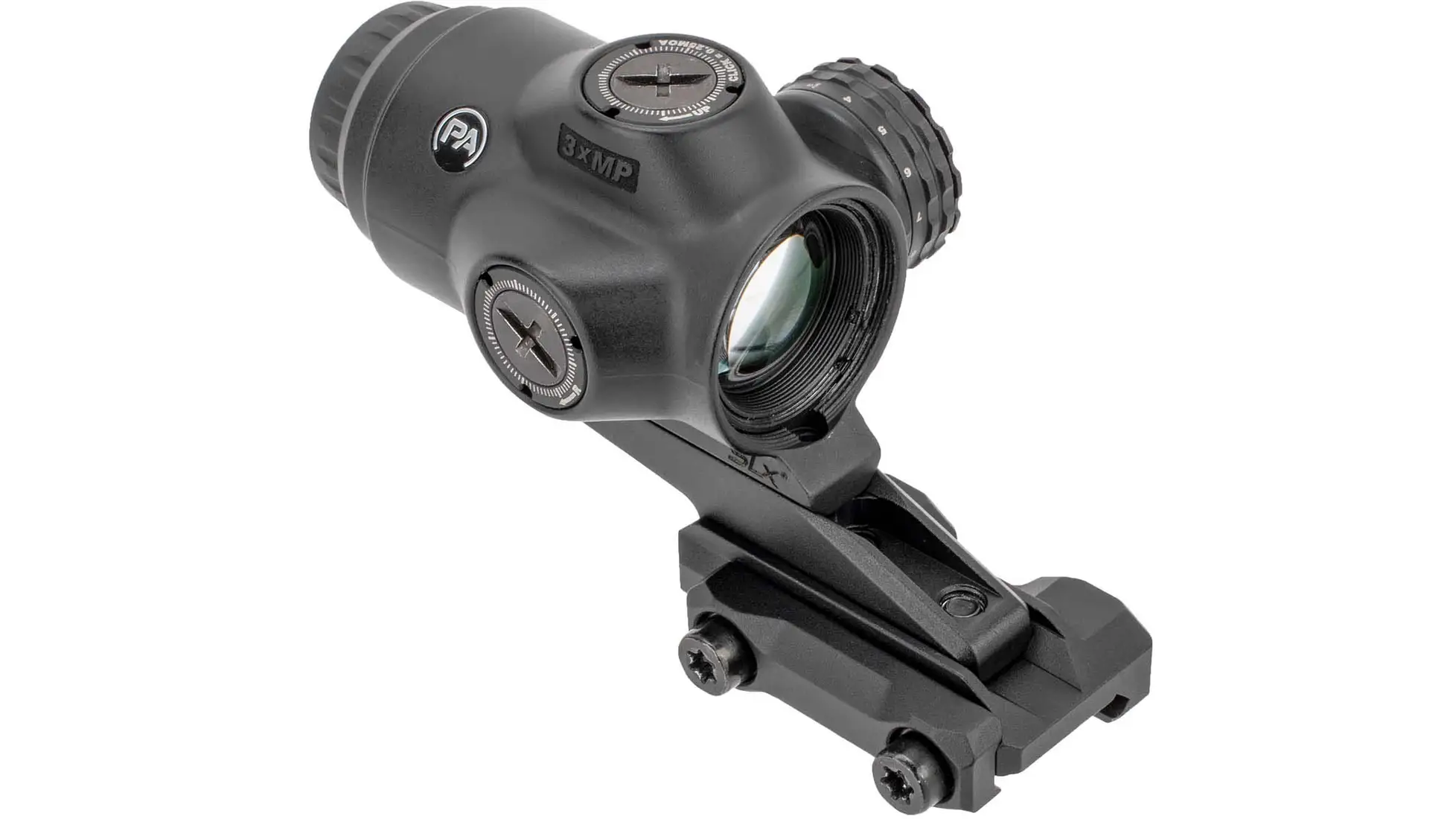
A fixed 3x prism sight built around an etched ACSS Raptor reticle carrying holdovers for 5.56 and .308. The emitter is enclosed, illumination is LED off a single CR2032, and the housing is aluminium, waterproof, shockproof and fogproof. What separates it from the rest of the category is the packaging of the numbers: 7.95 ounces and 2.95 inches long, with 2.7 to 3 inches of eye relief, a 7.4 mm exit pupil and a 38 foot field of view at 100 yards. That is the widest view and the longest eye relief in the group, in the lightest body.
Why it leads the category
The owner argument for it is weight without compromise. The review the retailer ranks as most helpful positive puts it directly: at around eight ounces the optic is no heavier than an average red dot, yet it adds the range and accuracy potential of a magnified optic, with glass the reviewer calls crystal clear and a build he expects to take abuse. Our own reading of the spec sheet supports the practical part of that: the 0.25 MOA clicks make a real difference when you are trying to settle a zero, and the exit pupil and eye relief figures are the ones that determine whether you spend your range day hunting for the sight picture.
The honest catch: adjustment range and eye box
The failure to plan for is zeroing. Two separate owners describe running out of adjustment. The most helpful negative review describes a unit whose zero sat at the extreme right of the windage range: tested on two different AR-15s, one barely reached zero with the knob against its stop and the other remained one to two MOA off. Because he tested on two rifles, that points at the optic rather than the host. A second owner could not laser bore sight his at all, with the elevation adjustment maxing out well short, and reports that swapping to the other mounting bracket supplied in the box did not solve it. Both describe good build quality and clear glass otherwise, which is the pattern of a unit-level defect rather than a design flaw. Bore sight early, keep the box.
The second caution is the eye box. On paper this is the most forgiving prism here, but one owner who says he has owned several Primary Arms optics with mixed results calls the eye box unforgiving to the point of nearly unusable. Prisms are tighter than scopes as a class, and no spec sheet cancels an individual's experience. Finally, on the reticle: an owner who wanted usable ballistic drops at range says plainly that if that is your goal you should stay with an LPVO, which is fair for any 3x optic.
“Good build quality, clear glass, ok eye relief, looks great. However, I must have received a bad copy. Zero is at the right-most of the adjustable range.”
Most helpful negative review, via OpticsPlanet
Trade-offs, plainly
- Two owners report running out of windage or elevation adjustment before reaching zero, one after testing on two different rifles.
- One owner finds the eye box unforgiving despite the class-leading eye relief and exit pupil figures.
- At 3x the ACSS holdovers are not a substitute for an LPVO reticle at distance, per one owner.
- It costs twice the Burris AR-332, which has more than double the review record.
- No video on the product page, so there is no manufacturer footage to check before buying.
Key specifications
| Magnification | Fixed 3x |
|---|---|
| Objective | Not published by Primary Arms |
| Exit pupil | 7.4 mm (Primary Arms spec sheet) |
| Reticle | Etched ACSS Raptor 5.56/.308, LED illuminated |
| Emitter | Enclosed |
| Eye relief | 2.7 to 3 in |
| Field of view | 38 ft at 100 yds |
| Adjustment | 0.25 MOA clicks |
| Battery | One CR2032 |
| Build | Aluminum; waterproof, shockproof, fogproof |
| Size and weight | 2.95 in long, 7.95 oz |
| Mount | Picatinny; AR-15 platform |
Two sourcing notes. Our photo shows a green illuminated variant while the model priced above is the red illuminated one; the retailer lists several combinations of colour, reticle and illumination, every one of them at the same price as the model priced above, and we make no part-number claim about the unit pictured. And an owner review credits the sight with a specific number of brightness settings that does not appear on the retailer specification sheet, so we print no brightness count rather than repeat an unverified figure. No editorial award is claimed; "Best Rated Product" is a store label.
Should you buy it, and what else to consider
- Buy it if you want magnification without red dot weight, value fine adjustments, and will bore sight it early to confirm the zero centres.
- Want to spend half as much? The Burris AR-332 is around $170 with 294 owner reviews and dual-colour illumination.
- Want more reach? The Vortex Spitfire 5x is the light 5x, the SLx 5x36 Gen III the ACOG-style one.
- Prefer Vortex glass and the VIP warranty? See the Spitfire HD Gen II 3x, but read its eye relief section first.
- Comparing the field? Our best prism scope guide ranks all five.
- Tempted by the step up to GLx? Our GLx vs SLx decoder compares the two tiers spec by spec, and four of those numbers favour the cheaper SLx.
FAQ
How heavy is the SLx 3x MicroPrism really?
It is 7.95 ounces, which is the point of the product. That is lighter than many enclosed red dots and roughly half the weight of the 14.2 ounce Burris AR-332, while still giving fixed 3x magnification and an etched ACSS Raptor reticle. The owner review the retailer ranks as most helpful positive makes the same argument: at around 8 ounces it is no heavier than an average red dot yet adds the range and accuracy of a magnified optic. It is also short at 2.95 inches, so it takes little rail.
What is the zeroing problem some owners report?
Two separate owners report running out of adjustment before reaching zero. The review the retailer flags as most helpful negative describes a unit whose zero sat at the far right of the windage range: tested on two different AR-15s, one barely reached zero with the knob at its stop and the other was still one to two MOA away. A second owner could not laser bore sight his because the elevation adjustment maxed out well short, and swapping the supplied mounting bracket did not fix it. Bore sight yours early and keep the packaging until you have confirmed it centres.
Is the eye box on the MicroPrism forgiving?
On paper it has the most eye relief of the prisms we cover, 2.7 to 3 inches, and Primary Arms lists a 7.4 mm exit pupil, larger than either Vortex Spitfire can deliver from its objective. The Burris AR-332 works out larger on exit pupil, since its 32 mm objective at 3x gives about 10.7 mm. In practice one owner strongly disagrees, calling the eye box unforgiving to the point of nearly unusable. Prism sights are tighter than rifle scopes as a class, so the honest summary is that this one gives you the most margin of the group, not that it is generous.
Can you use the ACSS Raptor holdovers at 3x?
For close to mid range work, yes; for reading fine drop marks at distance, one owner says no. His review is blunt that if you want magnification and a BDC you can genuinely use, you should stay with an LPVO. The ACSS Raptor reticle carries holdovers for 5.56 and .308 and is etched into the glass so it stays usable with a dead battery. Whether the subtensions are readable enough at 3x depends on your eyes and your distances, so treat this as a close-quarters carbine optic first.
More: best prism scopes · Burris AR-332 review · ACOG clones explained · best red dot for astigmatism · best red dot for an AR-15.