ACOG clones, honestly assessed
Quick answer: an ACOG clone is a fixed-magnification prism sight built in the ACOG's shape and role, not a copy of its internals. The real difference is illumination: most Trijicon ACOG models run on fiber optic and tritium with no battery at all, while every affordable alternative uses an LED and a CR2032. Both keep an etched reticle when the light is off. If you want the closest thing today, the Primary Arms SLx 5x36 Gen III (around $340, owners 4.5/5 from 101) is the sight ACOG shoppers actually land on. For half that, the Burris AR-332 (around $170, owners 4.6/5 from 294) does the 3x version of the job. Check the reticle for cant the day it arrives; on both models that is the one repeated defect.
What people are actually asking for
The search is rarely about copying Trijicon. It is about a specific package: fixed magnification so there is no zoom ring to be caught on the wrong setting, an etched ballistic reticle that works with a dead battery, an integrated mount instead of rings, and a short, tough body that lives on a carbine. That package used to mean paying four figures. It no longer does, and the honest version of this page is about what the price difference actually buys.
The one difference that matters: illumination
Most genuine ACOG models light the reticle with a fiber optic tube that gathers ambient daylight and a tritium vial that glows without any input at all (Trijicon's LED ACOG models use an AA battery instead). On those fiber and tritium models there is no battery, no runtime and no switch to leave on. The sights below use an LED powered by a CR2032. In daylight, with a reticle etched into the glass, both give you a usable aiming point. In the dark, or when the battery dies, the clone's reticle is still there but it is black rather than glowing. Whether that gap is worth several hundred dollars is a judgement about your use, not a spec, and we say plainly that we have not tested a Trijicon ACOG ourselves.
We print no ACOG price here. The four-figure figure that circulates comes from owner reviews rather than a source we verified, so treat it as context, not a quote.
The closest one: Primary Arms SLx 5x36 Gen III
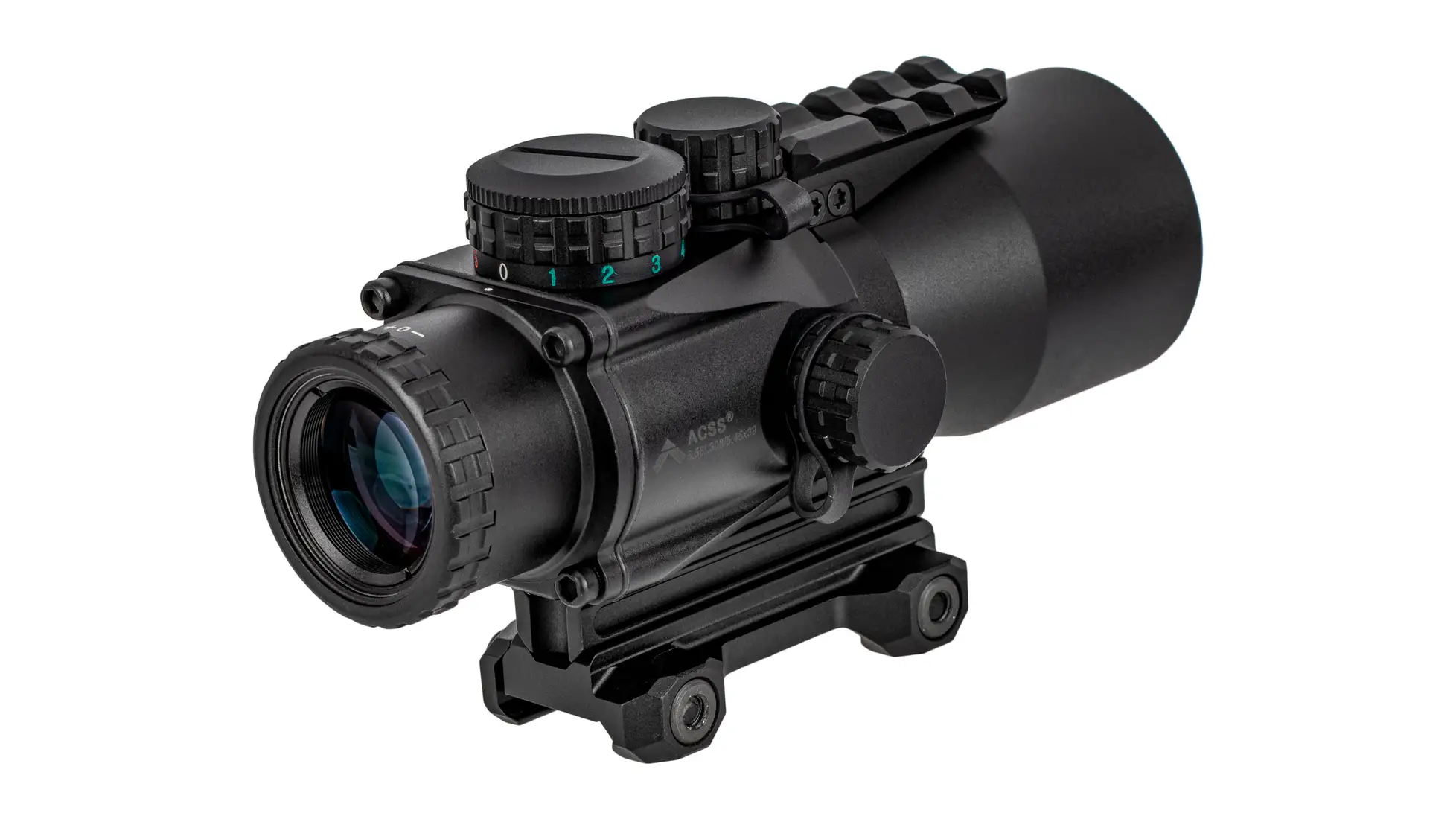
around $340 4.5/5, 101 reviews on OpticsPlanet
Fixed 5x36 with an etched ACSS reticle in 5.56/.308 or 5.56/5.45/.308, red and green illumination across five settings, 0.333 MOA clicks, an integrated Picatinny mount, waterproof, shockproof and fogproof. The owner record makes the positioning for us: the review the retailer ranks as most helpful positive opens by recommending it to anyone who wants a Trijicon ACOG but cannot justify the price, and explains he bought it because an unmagnified red dot was not accurate enough for him at 50 to 100 yards. That reviewer quotes a much older price; today it is around $340.
The costs are real. It weighs 18.4 ounces, more than twice the lightest prism we cover, and one owner's whole verdict is heavy, poor eye relief, not enough magnification. Field of view is narrow at 18.8 feet at 100 yards. A verified owner reports his reticle arrived canted slightly counter-clockwise, which he notes renders the BDC useless. One reviewer who likes the sight deliberately rated it one star to flag that the diopter ring has side-to-side play, so read the star distribution with that in mind. What comes in the box, the full specification sheet and the rest of the owner record are in our Primary Arms SLx 5x36 review.
The half-price 3x version: Burris AR-332
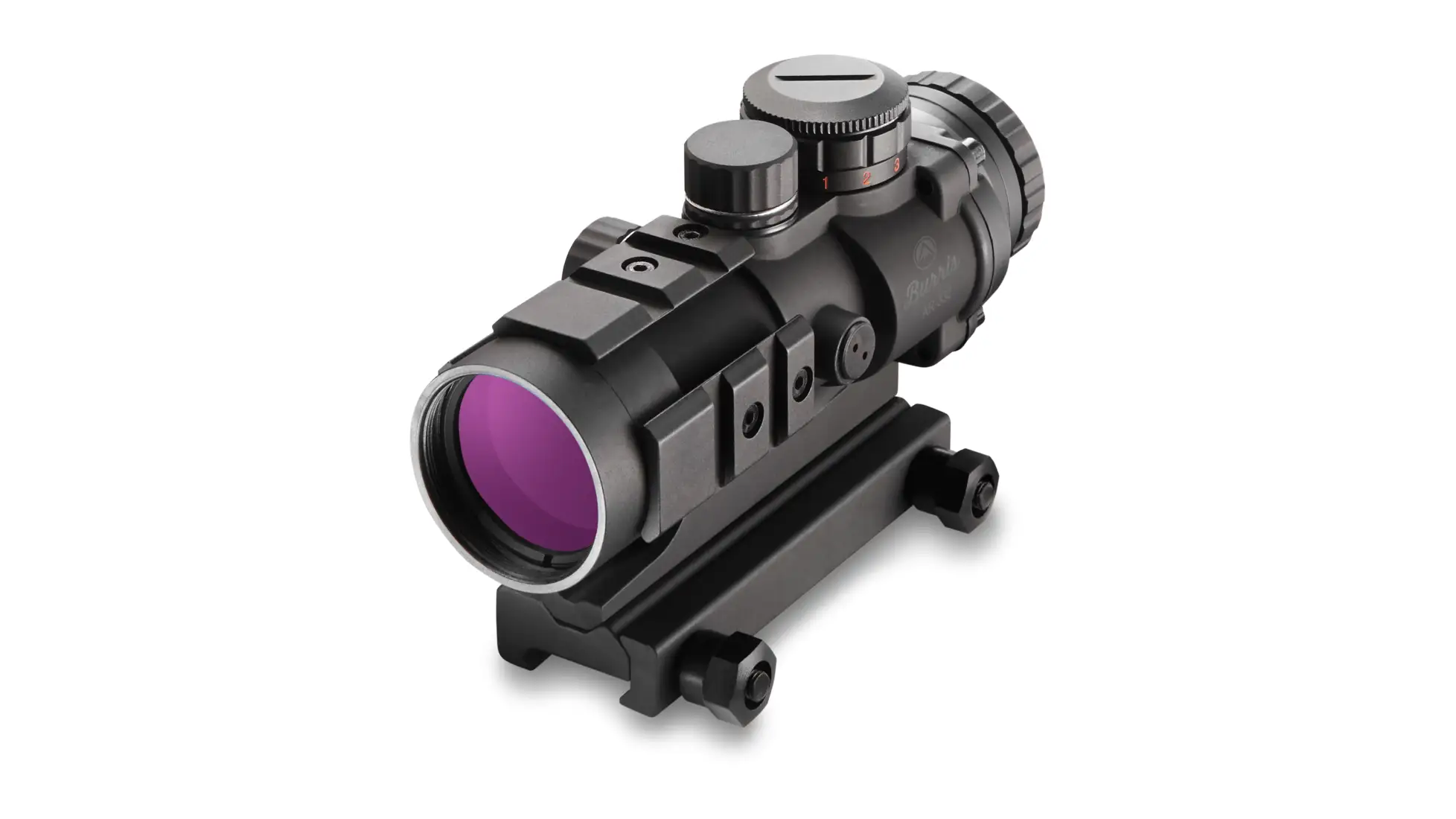
around $170 4.6/5, 294 reviews on OpticsPlanet
If 3x is enough, this is the cheapest credible route into the format and it carries the deepest owner record in our prism coverage by a wide margin. Fixed 3x32, etched Ballistic CQ reticle, red and green illumination across ten settings, 0.5 MOA clicks, integrated Picatinny mount, sunshade and flip-up covers in the box, and a retailer exclusive listed under MPN 300208. Its widest field of view, 32 feet at 100 yards, also makes it the friendlier of the two up close.
Same warning, more loudly: the low-rated reviews cluster on reticles that arrive canted, plus one frozen illumination knob and some zero-holding failures. And the expensive mistake to avoid is the rebate: one verified owner could not return a defective sight because the UPC had already been mailed off for the rebate. Check first, claim second. It is also 14.2 ounces and 5.29 inches long, so it is not the light option.
If the ACOG shape is not actually what you need
- Want the lightest prism instead of the most ACOG-like? The Primary Arms SLx 3x MicroPrism is 7.95 ounces with finer 0.25 MOA clicks. It leads our best prism scope guide.
- Want variable magnification? A 1-6x or 1-8x LPVO gives you close-range speed and real reach in one optic, and reads better at distance than a small prism reticle.
- Shopping because a red dot blurs for you? That is astigmatism, and an etched reticle is the standard fix: see best red dot for astigmatism.
- Just want speed up close? A plain 1x dot is lighter, cheaper and faster: best red dot for an AR-15.
FAQ
What is an ACOG clone?
ACOG clone is shooter shorthand for an affordable fixed-magnification prism sight built in the same shape and role as the Trijicon ACOG: a compact 3x or 5x optic with an etched ballistic reticle and an integrated mount, meant to sit on an AR-15 and work without a variable zoom ring. The term describes the format, not a copy of the internals. The clones use an LED and a CR2032 battery for illumination, where most genuine ACOG models use fiber optic and tritium and need no battery at all.
What does a real ACOG do that a clone does not?
The illumination is the honest dividing line. Most Trijicon ACOG models light the reticle with a fiber optic tube that harvests ambient daylight and a tritium vial that glows in the dark, so they are always on and have no battery to fail or forget; Trijicon's LED ACOG models run on an AA battery instead. Every prism sight on this page uses an LED powered by a CR2032, so its illumination has a runtime and an off switch. Both keep an etched reticle you can aim with when the illumination is gone. Beyond that, you are comparing individual optics rather than categories, and we have not tested a Trijicon ACOG ourselves.
Which ACOG alternative should you buy?
For the closest experience, the Primary Arms SLx 5x36 Gen III, under $400: fixed 5x36 with an etched ACSS ballistic reticle in red or green, an integrated Picatinny mount and 0.333 MOA clicks, rated 4.5 out of 5 by 101 owners. For half the money, the Burris AR-332, under $200, gives you fixed 3x32, an etched Ballistic CQ reticle, red and green illumination and 294 owner reviews, the deepest record in our prism coverage. Prices verified September 30, 2026; confirm on the retailer page.
Are ACOG clones any good, honestly?
On average yes, with a specific failure to watch for. Both sights we recommend hold high owner ratings, 4.5 and 4.6 out of 5, but reading their lowest-rated reviews first surfaces the same defect on both: a reticle that arrives visibly canted, which makes a ballistic holdover reticle useless. It is a minority of units, not the norm, but it is common enough to plan for. Mount the sight the day it arrives, check the reticle against a level, and do not mail off any rebate barcode until you have confirmed the unit is straight.
More: best prism scopes · best LPVO · best red dot for astigmatism · LPVO vs red dot · best scope for an AR-15.