Primary Arms GLx decoded: GLx vs SLx, and which prism to buy
By the OpticVerdict Editorial Team. Research-based roundup · Updated 2026-09-26
Our verdict for 2026: buy the
GLx 1x MicroPrism (around $330) if you want the finest
zero and the longest eye relief, or the
GLX 2x24mm (around $390) if you want enough magnification to
identify a target past 100 yards. But the question most people are really asking is GLx or SLx,
and the honest answer is that it is a trade, not an upgrade: GLx buys you 1/2 MOA
clicks, a bigger objective and more eye relief, and it costs you half the battery life, well under
half the adjustment travel, a little field of view and 3.6 ounces.
The surprise in the pricing: the GLx 1x at around $330 is
cheaper than four of the six SLx prisms at the same retailer, the SLx 3x
MicroPrism at around $350 among them. The premium tier is not the expensive choice here. The one
SLx that undercuts it meaningfully is the SLx 1x MicroPrism, now sold there in its H1/T1-footprint
version at around $300, which is the direct
tier comparison. Prices, part numbers and both line-ups
re-verified against the retailer and Primary Arms on August 14, 2026 (September 30, 2026 for the
carded picks); confirm the current price on the retailer page.
Primary Arms sorts its optics into tiers, CLx at the bottom, then SLx, then GLx, then PLx, and the
natural assumption is that moving up a tier makes everything better. On the 1x prisms that assumption
is wrong in a way you can check yourself in about two minutes, because Primary Arms publishes a full
specification table for both optics and four of those numbers go the other way.
How these picks were made: a research-based roundup built from Primary Arms' own
published specification tables for the GLx 1x and the SLx 1x read side by side, the National Tactical
Officers Association's public Member Tested listing, an independent hands-on review read at source,
and 58 owner reviews across the two carded optics. Live pricing and part numbers were
read from each variant's own listing on OpticsPlanet. Scores are our editorial opinion, not a
hands-on test. Where a claim could not be verified at its source we say so rather than repeat it.
See how we evaluate.
This is the comparison the search term is asking for, and it is not usually published because it
requires opening two manufacturer spec tables at once. Every number below is from Primary Arms' own
product pages for the GLx 1x MicroPrism and the SLx 1x MicroPrism, read on July 26, 2026.
Specification
GLx 1x MicroPrism
SLx 1x MicroPrism
Which wins
Click value
1/2 MOA
1 MOA
GLx
Objective diameter
20.5 mm
Not published
GLx (stated as larger)
Exit pupil
18.8 mm
15.6 mm
GLx
Eye relief
4.40 in rated
2 to 6 in, 3.6 in optimum
GLx
Field of view at 100 yds
74.8 ft
76.50 ft
SLx
Battery life
14,925 hrs at setting 5
29,000 hrs at medium
SLx, by roughly double
Total windage and elevation
50 MOA
120 MOA
SLx, by 2.4 times
Weight
9.1 oz
5.5 oz, 7.6 oz with riser
SLx
Length
2.6 in
2.48 in
SLx, marginally
Illumination control
Push buttons, recessed dial
Rotary knob
Preference
Illumination settings
13, with 3 night vision
13, with 3 night vision
Identical
Lens coating
Fully multi-coated
Fully multi-coated
Identical as listed
Sealing
IP67, nitrogen purged
IP67, nitrogen purged
Identical
Mounting heights included
8
8
Identical
Four specifications go to the cheaper optic, four go to the dearer one, and five are identical. That
is the whole answer to "SLx or GLx" on the 1x prisms, and it explains something that otherwise looks
like a contradiction in the reviews. The owner who has both, whose review is the most helpful one on
the GLx listing at eleven votes of eleven, says the things they value are the half-MOA adjustment
increments and the push-button controls, and that they cannot tell the glass apart. They are not
underselling the optic. They are describing exactly what the spec sheets describe.
One claim we deliberately did not make. It is widely repeated that the GLx's larger
objective widens the field of view. Primary Arms' own numbers say the opposite: 74.8 feet at 100
yards for the GLx against 76.50 for the SLx. A larger objective buys light and a bigger exit pupil,
which is why the GLx view is more forgiving of head position, but it did not buy field of view here.
Where each Primary Arms prism sits, priced
Every row below, price position and owner review count, was re-read from each product's own page at
the retailer on September 26, 2026, all ten of them: the retailer's Primary Arms prism category lists
exactly these ten. Note where the GLx 1x falls: below four of the six SLx prisms.
Why some cells give a position rather than a figure. Five of these optics are picks
we card, so their prices are read from the retailer on a fixed cadence and shown here. The other five are
context: we do not card them, nothing re-reads their prices for us, and a figure nobody checks is a
figure that goes quietly wrong. Where they sit in the order is the part that answers the question,
so that is what we publish for them.
Optic
Tier
Magnification
Price
Owner ratings
CLx 1x Prismatic
CLx
1x
Below the GLx 1x
2
CLx 3x Prismatic
CLx
3x
Below the GLx 1x
6
SLx 1x MicroPrism (H1/T1 footprint)
SLx
1x
around $300
0 (new; the original's 145 are on a listing that has closed)
SLx 3x32 Compact
SLx
3x
Below the GLx 1x
66
GLx 1x MicroPrism
GLx
1x
around $330
28
SLx 5x36 Gen III
SLx
5x
around $340
102
SLx 3X Micro Prism
SLx
3x
Above the GLx 1x
8
SLx 3x MicroPrism
SLx
3x
around $350
135
GLX 2x24mm
GLx
2x
around $390
40
SLx 5x Micro Prismatic
SLx
5x
Above the GLX 2x24mm
20
Two things fall out of that table. The first is that tier only loosely tracks price: the two CLx
prisms are the cheapest in the table, as the entry tier should be, but the cheapest GLx undercuts four
of the six SLx prisms. The
second is that the two lines now overlap at exactly one magnification, 1x, where the SLx 1x
MicroPrism at around $300 sits against the GLx 1x MicroPrism at around $330. Everywhere else they
divide by working distance rather than by quality grade, with GLx also covering 2x while SLx covers 3x
and 5x. So for most shoppers this is a magnification decision; for the 1x shopper, and only for them,
it is a genuine tier decision, and that is the one the spec table above settles. If 3x or 5x is what
you want, our best prism scope guide covers the SLx
options in detail, including the SLx
3x MicroPrism and the SLx 5x36 Gen
III.
Where PLx fits, and why it is not in that table
People often frame this as a three-way, SLx vs GLx vs PLx, because PLx is the name at the top of
Primary Arms' tier list. For a prism buyer it is not really a three-way. When we read the retailer's
Primary Arms prism category on July 26, 2026, the eight optics above are what it contained:
no PLx prism appeared in it at all. So the decision in front of you is SLx against
GLx, and, as the table shows, that decision is about magnification and price rather than tier.
We said in July that we had not read the PLx line-up and would not describe one we had not seen. We
have now read it, on Primary Arms' own PLx series listing on August 14, 2026, and the answer is
cleaner than expected: PLx contains no prism at all. What is in it is low-power
variable rifle scopes, the PLxC 1-8x24 and 1.5-12x36 families, and enclosed pistol red dots such as
the HTX-1. So "SLx vs GLx vs PLx" is not a prism question in any sense: if you are shopping a prism,
PLx is not a tier above your options, it is a different kind of optic. What the numbers above add is
that spending up a tier is not a shortcut to a better prism either, because the cheapest GLx already
undercuts four SLx models while the most-reviewed prism in the table is an SLx.
Best GLx overall: Primary Arms GLx 1x MicroPrism Prismatic Red Dot Sight
🏆 Evaluated in the National Tactical Officers Association Member Tested and Recommended program, October 2024 (source: National Tactical Officers Association)
This is the GLx to buy, and the most useful thing we can tell you about it is that it is not simply a better SLx. Primary Arms publishes both spec sheets, and read side by side they describe a trade rather than an upgrade. You gain the things that make aiming precise: 1/2 MOA clicks instead of 1 MOA, a 20.5mm objective instead of the SLx tube, an 18.8mm exit pupil against 15.6mm, and 4.40 inches of rated eye relief. You give up things that make an optic convenient: half the battery life at 14,925 hours against 29,000, well under half the adjustment travel at 50 MOA against 120, 1.7 feet of field of view, and 3.6 ounces. Coatings, waterproof rating, illumination settings and mounting options are identical on paper. The owner record lines up with exactly that reading. The most helpful review on the listing, marked helpful by eleven of eleven readers, is from a shooter who already owned the SLx 1x and bought this one when a sale put them at the same price. Their conclusion, in their words, is that the adjustment increment and the push-button controls are what they like, and that with their untrained eye they cannot tell the glass apart. What tips it for us is the price: this GLx sits below the SLx 3x MicroPrism on the same retailer, so the premium tier here is not the expensive choice.
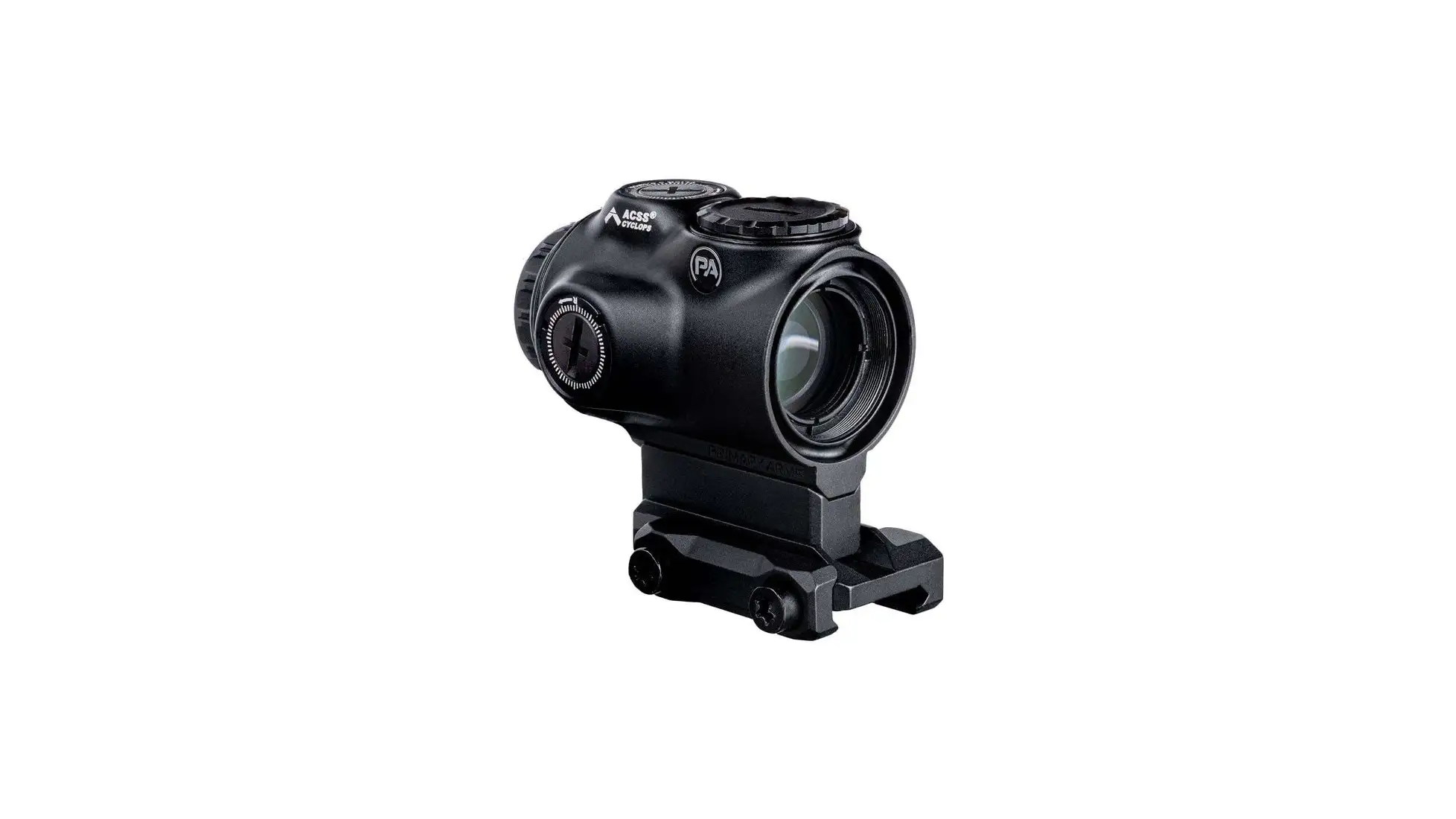
Primary Arms GLx 1x MicroPrism overview via OpticsPlanet: the 20.5mm-objective 1x prism with an etched ACSS Cyclops reticle, push-button illumination and 1/2 MOA adjustments.
Pros
1/2 MOA clicks against the SLx line's 1 MOA, in a dial recessed into the housing so it is harder to knock off zero. Confirmed three ways: Primary Arms' spec table, an independent hands-on review, and an owner who has both optics
Eye relief is the standout. Primary Arms rates it at 4.40 inches and the independent reviewer reports it works from about one inch out to a foot or more, which is why it mounts anywhere on the receiver like a red dot rather than in a prism's usual tight box
The strongest astigmatism record we have seen on a single listing: six of twenty owners raise it unprompted, one describing star patterns and bokeh through ordinary red dots even with corrective lenses, then a crisp picture through this
The reticle is etched into the glass, so it stays usable as a black aiming point with a dead battery. Four owners bring this up independently, and it is the one thing no LED red dot at any price can do
Eight mounting heights come in the box on a Trijicon mini-ACOG footprint, which the independent reviewer singles out as something you do not get from other prism sights
Evaluated in the National Tactical Officers Association Member Tested and Recommended program in October 2024, a law-enforcement testing programme rather than a magazine list
Cons
The reticle is fine to the point of being hard to read fast. This is the one criticism that recurs everywhere: the most helpful negative review on this listing calls it super tiny, two owners of the 2x24 say the same, and the independent reviewer lists "sometimes hard to make out BDC because chevron is small" as their own con
It is the heavy one. At 9.1 ounces it carries 3.6 ounces more than the 5.5 ounce SLx 1x, which the independent reviewer also lists as a con. On a build where weight is the point, that is a real difference
You lose half the battery life and well over half the adjustment travel compared with the cheaper SLx 1x: 14,925 hours against 29,000, and 50 MOA of total windage and elevation against 120 MOA. On a 1x optic the travel rarely matters; the battery life might
Daylight brightness is good but not red-dot bright. The independent reviewer puts it plainly: it is not as bright as Primary Arms' own NOVA reticle or a typical red dot, though still bright enough to use
Owners report no lens covers in the box, and Primary Arms' product page does not list covers among the included accessories. The anti-reflection device is explicitly sold separately
Best for: the shooter who wants one 1x optic that stays usable with a dead battery and stays crisp for an astigmatic eye, and who will actually use the finer 1/2 MOA zero. Skip it for the SLx 1x if weight and battery life matter more than adjustment precision, or step up to the 2x24 below if your real complaint is that 1x leaves you guessing past 100 yards.
1x CR2032 (included), 14,925 hours at setting 5, top loading
Footprint
Trijicon mini-ACOG, 8 mounting heights included
Sealing
IP67, nitrogen purged
Length and weight
2.6 in, 9.1 oz
Warranty
Primary Arms lifetime warranty
Model carded
710071, red reticle. A green-illuminated 710072 is listed at the same price; the used and factory demo units that were listed in July have gone
“This optic is phenomenal. I already have the SLX 1x model... The thing I like most about the GLX over the SLX is the 1/2 MOA increments in adjustment as opposed to the 1 MOA adjustments for the SLX... If you prefer push button illumination as opposed to a rotary knob, then you might prefer the GLX. As for glass clarity, my untrained eye can't tell the difference between the GLX and the SLX. I think both optics are excellent choices.”
M109 Steel Rain, verified owner via OpticsPlanet, the listing's most helpful review at 11 of 11
Best GLx for reach: Primary Arms GLX 2x24mm Prismatic Red Dot Sight
4.4/5 our editorial score
4.7/5 from 40 ratings on OpticsPlanet, 38 of them written
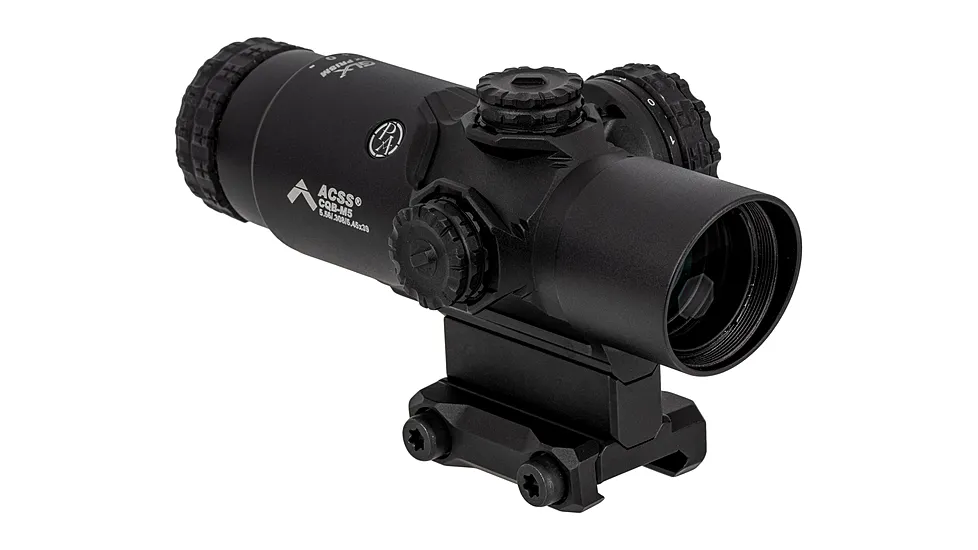
The 2x24 is the older and better documented of the two GLx prisms, with 38 written reviews stretching back to December 2020, and the reason to choose it over the 1x is simple: 2x is enough magnification to identify what you are shooting at without being enough to slow you down up close. What the owner record establishes across five and a half years is an unusually forgiving eye box for a prism, which the specification explains rather than contradicts: 3.5 inches of eye relief and a 12mm exit pupil. One owner who describes themselves as a Leupold and Trijicon devotee writes that the combination makes it as fast as their 1.5x optic and simple for beginners. Another compares it directly against a Trijicon ACOG TA33 he already owned and kept this instead because the ACOG sat too high on their rifle. The most quoted framing on the whole listing comes from an owner who calls it the answer for people who cannot decide between an LPVO and a dot, and that is genuinely what this optic is: it competes with a 1-6x more than it competes with another prism. Note the internal difference before you assume the line is uniform: this model uses 1/4 MOA clicks, not the 1/2 MOA of the 1x.
Pros
The most forgiving eye box in this comparison, and the specs say why: 3.5 inches of eye relief with a 12mm exit pupil. At least eight owners raise eye relief unprompted, one noting you can mount it far forward and still keep the picture
The deepest owner record on the line by a wide margin: 38 written reviews from December 2020 to May 2026 at 4.7 out of 5, and not one of the complaints is about optical quality
A wide 42 foot field of view at 100 yards and 20,000 hours of illumination at the medium setting, both from Primary Arms' own feature sheet
Enclosed emitter, and the mount is genuinely included: three risers and a ruggedized mount ship in the box, compatible with standard mini-ACOG style mounts
The ACSS CQB-M5 reticle carries ranging and moving-target holds out to 500 yards, which is the practical argument for 2x over a plain dot
Cons
The same fine-reticle trade-off as the 1x, reported independently here: one owner calls the reticle relatively small and a bit hard to see, another calls it a bit tiny. Usable, but not what you want if your priority is the fastest possible sight picture
The battery compartment protrudes noticeably from the left side, which an owner calls their only gripe and describes as sticking out about a mile
It is the biggest and heaviest optic here at 5.3 inches and 11 ounces, and an owner who otherwise likes it says they wish it were not quite as long
Owners report no dust or lens covers in the box, the same omission as the 1x
Reviews written before 2022 may describe an earlier version. One owner reports the illumination dial gained marked night-vision settings and better daylight brightness at some point, contradicting what older reviews said, so weigh the dates when you read them
Best for: the shooter who wants an ACOG-style sight picture on a carbine, a carry-handle build or a 300 Blackout pistol without ACOG money or ACOG mounting height, and who would otherwise be shopping 1-6x LPVOs. Choose the 1x instead if you want the lightest option and the finest zero, or if you shoot mostly inside 100 yards.
Key specifications
Manufacturer
Primary Arms
Magnification
2x
Objective diameter
24 mm
Exit pupil
12 mm
Eye relief
3.5 in
Field of view
42 ft at 100 yds
Reticle
ACSS CQB-M5 5.56, glass etched
Click value
1/4 MOA, capped turrets
Illumination
LED red, 11 brightness settings
Emitter type
Enclosed
Battery
1x CR2032, up to 20,000 hours at medium
Mount
Picatinny, 3 risers and ruggedized mount included, mini-ACOG compatible
Sealing
Waterproof, fogproof, shockproof
Length and weight
5.3 in, 11 oz
Model carded
710010 (of 6 listed variants; 5 used and factory demo units excluded)
“This optic exceeds / defies expectations: First, the combination of large exit pupil and longish eye relief produce a generous eye box that makes this as fast as my 1.5x optic and simple to use for beginners.”
A verified owner writing under "Trijicon fanboy" (LA) via OpticsPlanet
The reticle criticism, and why it happens
One criticism turns up on both optics and from an independent reviewer as well, so it is worth
taking seriously rather than filing under taste. The ACSS reticle is fine. The most helpful negative
review on the 1x listing calls it super tiny. Two owners of the 2x24 independently describe it as
small and a bit hard to see. And the reviewer who scored the 1x 8.5 out of 10 lists it as one of their
two cons, in the form "sometimes hard to make out BDC because chevron is small".
Our reading of why is that it is the price of what the reticle is for, not a manufacturing
shortcoming. A bullet-drop ladder has to subtend to actual distances to be any use, and at 1x a
target at 300 or 400 yards is already small in the view. Thicken the lines enough to read them at a
glance and the lines start covering the thing you are aiming at. The reticle's answer is to do two
jobs at once: the bold outer horseshoe is the fast, close-range aiming device, working much like the
ring of a holographic sight, and the fine chevron tip is what you use when you want precision. It is
also worth saying plainly that if speed is the only thing you care about, a plain circle-dot red dot
will serve you better, and several of these same owners say the prism is close behind a dot on speed
rather than equal to it.
The related point, if you have astigmatism, is that this trade-off is usually still worth taking.
Six of the twenty written reviews on the 1x raise astigmatism unprompted. One owner describes getting
star patterns and bokeh through conventional red dots even while wearing corrective lenses, then a
clean picture through this. If that is your situation, our
prism scopes for astigmatism guide
covers why etched reticles behave differently from projected dots.
The SLx 1x and the GLx riflescope: what changed since July
Two things people search for were missing from the retailer we send readers to when we first wrote
this page. On re-checking, one of them has arrived and the other has an answer we can now give.
The SLx 1x MicroPrism is sold there, but as a different listing than in August. In
August we reported it had arrived, with 145 owner ratings at 4.6 out of 5. By September 26, 2026 the retailer
had closed that listing and was selling the SLx 1x in its newer H1/T1 footprint
version instead: the Aimpoint Micro mounting pattern, five reticle options, orderable, and no owner
reviews yet. Primary Arms lists the H1/T1 version with the same 29,000 hour battery, 1 MOA clicks and
120 MOA of travel as the original, so the spec comparison on this page still describes it; what does
not carry over is the 145-rating record, which belongs to the version you can no longer order there.
We are flagging the change rather than editing it away, because it is the second time this one
paragraph has gone stale while each fact in it was true on the day we wrote it.
That also makes the 1x tier decision concrete for the first time. You can now see both optics priced
in one place, the SLx at around $300 against the GLx at around $330, which is what the spec trade
at the top of this page actually costs. Whether it is worth it is the same answer as before, half-MOA
clicks and eye relief against battery life, travel and weight, except that you can now put a number
on it.
A GLx riflescope such as the 2.5-10x44 people search for: we said in July that we
had not checked what Primary Arms itself lists, so we would not claim it did or did not exist. We
have now checked, on August 14, 2026. Primary Arms' own GLx rifle scope listing holds two models,
the 3-18x44 FFP and the 4.5-27x56 FFP. The 2.5-10x44 is not among
them. What survives of it in that catalogue is a sun shade sold for the 2.5-10x44, which is usually
what a model looks like after it leaves a line-up rather than before it joins one, though we will
call that our reading rather than an announcement from Primary Arms. Either way, the practical
answer for you is unchanged: the retailer we send readers to still has pages for several GLx
riflescopes, a 2.5-10x44 among them, but on September 26, 2026 every one was discontinued, closed or
had nothing to order, so this page cannot point you at one.
Frequently asked questions
What is the difference between Primary Arms GLx and SLx?
GLx is the tier above SLx, but on the 1x prisms it is a trade rather than a straight upgrade, and Primary Arms' own two spec sheets show it. The GLx 1x gives you 1/2 MOA clicks against the SLx 1 MOA, a 20.5mm objective, an 18.8mm exit pupil against 15.6mm, 4.40 inches of rated eye relief, and push-button illumination instead of a rotary knob. The SLx 1x gives you roughly double the battery life at 29,000 hours against 14,925, more than double the adjustment travel at 120 MOA against 50, a slightly wider field of view at 76.50 feet against 74.8 at 100 yards, and it weighs 5.5 ounces against 9.1. Coatings are listed identically as fully multi-coated on both, both are IP67, both have 13 illumination settings with three night-vision levels, and both ship with eight mounting heights. So the honest summary is that GLx buys aiming precision and eye relief, and costs you battery life, travel and weight. You can also price that trade in one basket: the retailer now sells the SLx 1x MicroPrism in its newer H1/T1-footprint version, which was priced below the GLx 1x MicroPrism when we checked on September 26, 2026.
Is the GLx glass actually better than the SLx glass?
Primary Arms says so, and there is a measurable difference behind the claim, but be careful how much weight you put on it. What is verifiable is the hardware: the GLx has a larger objective lens and a larger exit pupil, 20.5mm and 18.8mm against the SLx's 15.6mm exit pupil, and Primary Arms states on its own product page that the GLx sits slightly higher on a shared mount because of the larger objective. What is not verifiable is the leap from that to "better glass". Primary Arms lists both optics as fully multi-coated. The independent reviewer who tested the GLx wrote that they were not sure whether the clarity improvement came from the larger objective lens or from better glass. And the most helpful owner review on the listing is from a shooter who owns both and says that with their untrained eye they cannot tell them apart. Our reading: expect a brighter, more forgiving view because of the bigger aperture, and treat "better glass" as the manufacturer's claim rather than a measured result.
Can I buy the Primary Arms SLx 1x MicroPrism at the same retailer as the GLx?
Yes, but not the listing you may have read about. The original SLx 1x MicroPrism page there, with 145 owner ratings at 4.6 out of 5, has been closed by the retailer. What it sells instead is the SLx 1x MicroPrism in its newer H1/T1 footprint version, the Aimpoint Micro mounting pattern, in five reticle options. Primary Arms lists it with the same 29,000 hour battery, 1 MOA clicks and 120 MOA of travel as the original, and the retailer lists it at 5.5 ounces. It is new, so it has no owner reviews yet, which means the 145-rating record belongs to the older version, not to the one you can order. The 1x tier decision can still be priced in one place, with the trade-offs in the spec table on this page.
Should I get the GLx 1x or the GLX 2x24?
Decide it on distance and weight, not on tier, because these are two quite different optics. The 1x MicroPrism is 2.6 inches and 9.1 ounces, has 1/2 MOA clicks and a 74.8 foot field of view, and behaves like a red dot you can shoot with a dead battery. The 2x24 is 5.3 inches and 11 ounces, has 1/4 MOA clicks and a 42 foot field of view, and gives you enough magnification to identify a target at distance. Owners describe the 2x24 as the answer when you cannot decide between a low-power variable and a dot. So: inside 100 yards, on a light build, or if you want maximum speed, take the 1x. If your actual complaint is that an unmagnified sight leaves you guessing past 100 yards, or you want an ACOG-style picture without ACOG mounting height, take the 2x24 and accept the extra two ounces.
Is the ACSS Cyclops reticle too small?
It is genuinely thin, and that criticism is the most consistent one on the whole line: the most helpful negative review on the 1x calls the reticle super tiny, two separate owners of the 2x24 describe it as small and a bit hard to see, and the independent reviewer who scored the optic 8.5 out of 10 lists "sometimes hard to make out BDC because chevron is small" as one of their two cons. That is worth knowing before you buy. It is also, in our reading, a deliberate design consequence rather than a fault. A bullet-drop ladder has to subtend to real distances, and at 1x magnification a target at 300 or 400 yards is already tiny in the view, so thickening the lines enough to read them quickly would mean the lines covering the target you are trying to hit. The reticle answers this by doing two jobs: the bold outer horseshoe is what you use for fast, close shooting, and the fine chevron tip is what you use when you want precision. If you only ever want speed, a circle-dot red dot will suit you better.
Does Primary Arms make a GLx riflescope, like the 2.5-10x44?
Primary Arms does make GLx riflescopes, but not that one, as of our check on August 14, 2026. Its own GLx rifle scope listing holds two models: the 3-18x44 FFP with the ACSS Apollo reticle and the 4.5-27x56 FFP with the ACSS Athena BPR MIL reticle. The 2.5-10x44 that people search for is not in it. A sun shade made for the 2.5-10x44 is still sold in the accessories, which in our reading is the trace a model leaves after it exits a line-up, though we are calling that our reading rather than a statement from Primary Arms. The part that matters for buying: the retailer we send readers to still has pages for several GLx riflescopes, a 2.5-10x44 among them, but when we checked on September 26, 2026 every one was discontinued, closed or had nothing to order, so we cannot point you to one at all. The GLx optics it does carry are the two prisms on this page plus GLx reflex sights and a magnifier.
Has the Primary Arms GLx 1x MicroPrism won any awards?
It has one piece of institutional recognition that we could verify at the source, and we want to be precise about what it is. The National Tactical Officers Association lists the GLx 1x MicroPrism in its Member Tested and Recommended programme under Scopes and Sights, with a review date of October 2024. That is a testing programme run by a law-enforcement association, which is a different thing from a magazine naming a product to a best-of list. What we cannot tell you is the score, because the NTOA keeps the scores and the written reviews behind a member login, so anyone quoting you a grade is not reading it from the public listing. Separately, an independent gun-gear review site scored the optic 8.5 out of 10 in December 2024, which is an editorial rating rather than an award.
OpticVerdict Editorial Team · optics reviewers at OpticVerdict
Every award, spec and superlative in this guide is checked against a primary source before it is
published, and every rating we cite is shown attributed to where it comes from. Read
how we evaluate or learn more about this site.
Source-verified claimsAttributed ratings onlyMethod disclosed on every page