SIG Sauer ZULU6 HDX review: the 12x42, and which of the four sizes to buy
Our verdict: 4.5/5. The SIG Sauer ZULU6 HDX is SIG's line of image-stabilized binoculars in four sizes: 10x30, 12x42, 16x42 and 20x42. This ZULU6 HDX review centers on the 12x42 (SIG part SOZ6WP12), our best overall pick in the image-stabilized binocular roundup. SIG describes its stabilization as “Gyroscopically stabilized” and gives it two modes, Scan and Target; it says Target mode increases stability up to 50%. SIG lists the 12x42 at 21.5 oz with 17 mm of eye relief, one AA rated at 30 hours and an IPX7 waterproof and fog-proof rating, under its Infinite Guarantee. In the reviews, the steady handheld view is what owners praise most often. The trade-off is the view itself: SIG lists 3.8 degrees of field of view on the 12x42, and owners call the glass good rather than alpha-class. Pick the 10x30 for the lightest pair and the widest view, the 16x42 or 20x42 for reach.
Skip it if:
- you glass wide country at first and last light: SIG's fields of view run 3.3 to 5.2 degrees, and the exit pupils work out at 2.1 to 3.5 mm;
- you wear eyeglasses and want the 16x42: SIG lists 14 mm of eye relief on it;
- you want binoculars that need no battery: the stabilization runs on one, and SIG does not publish how the binocular behaves without it.
OpticsPlanet shoppers rate the 12x42 4.8/5 from 17 reviews (the retailer's figure, read 15 October 2026; our 4.5 is a separate editorial score). It sells for around $1,100; confirm the current price and availability on the retailer page.
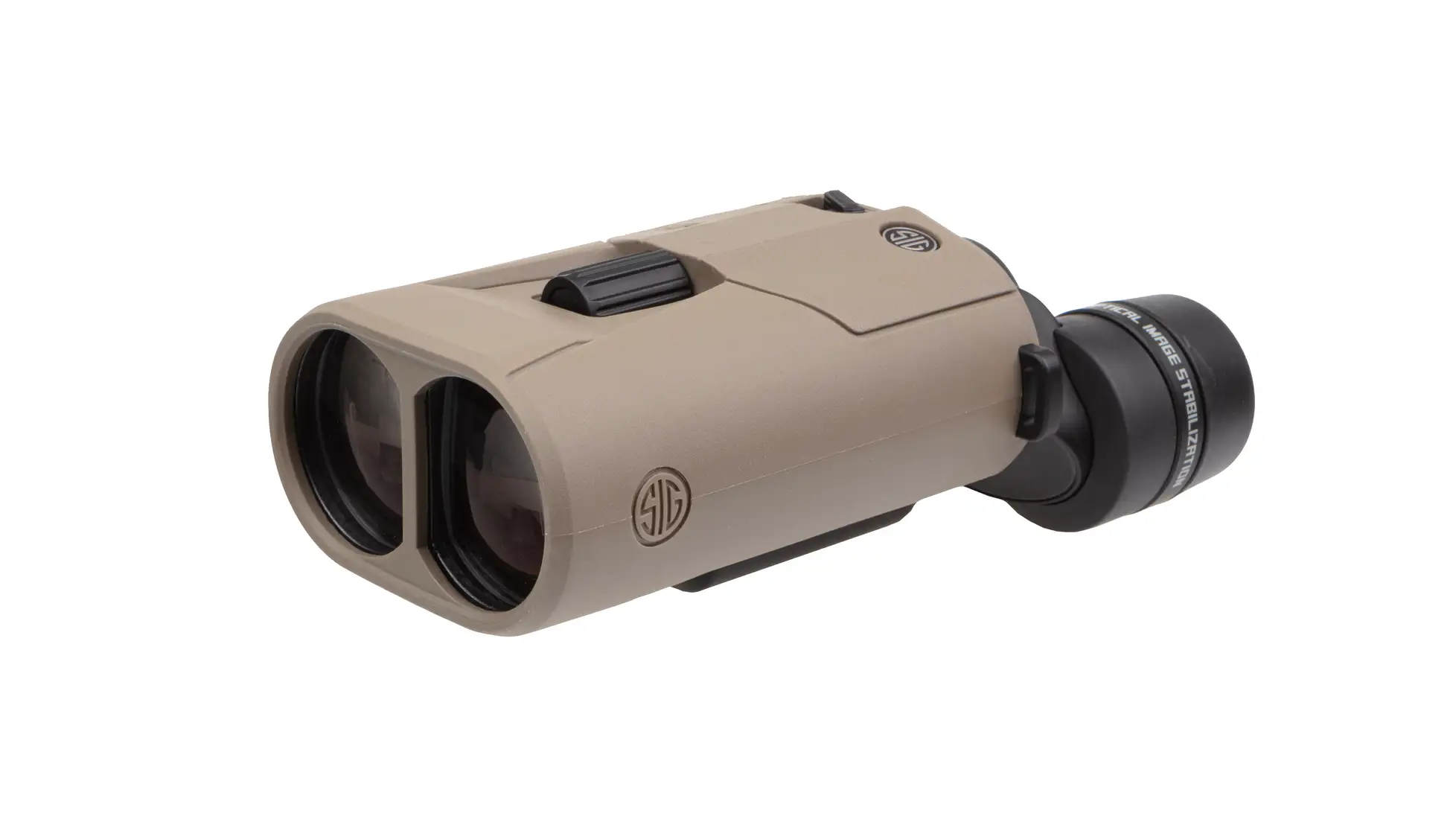
What the ZULU6 HDX is
SIG's product title for the size we review is “ZULU6 HDX BINOCULAR 12X42MM”; OpticsPlanet lists the same binocular as the SIG SAUER ZULU6 HDX OIS 12x42mm Schmidt-Pechan Prism Binocular. SIG's page sums it up in one line: “Experience image stabilization in the ZULU6 HDX and change the way you hunt.” It is “Available in 10x, 12x, 16x, and 20x magnification”, per SIG, and all four sizes share SIG's Schmidt-Pechan prism, thermoplastic body, rubber armor and Flat Dark Earth color.
SIG defines HDX on the product page as “Advanced optical systems comprising both High Definition (ED) and High Transmittance (HT) glass for ultra-high resolution, optical performance and light transmission.” Its November 2025 blog post describes the same glass differently, as “a high-definition (HD) and extra-low dispersion (ED) lens system”. The lenses carry SIG's SpectraCoat anti-reflection, LensArmor abrasion-resistant and LenShield oleophobic coatings.
The HDX is the second ZULU6. SIG announced the original ZULU6 in November 2020 in two sizes, 10x30 and 16x42, with an IPX4 rating. SIG publishes no launch date for the HDX; the earliest copy of SIG's ZULU6 HDX page in the Internet Archive is from 11 May 2023, labeled “New!”, so we give no launch date. SIG's newer ZULU6 HDX PRO is a separate line; the comparison is further down.
Reviewed here: Sig Sauer ZULU6 HDX OIS 12x42
Schmidt-Pechan · 12x42 · gyroscopic OIS, Scan + Target modes · HDX glass · IPX7 (SIG) · SIG Infinite Guarantee
around $1,100exact price on OpticsPlanet
SIG's 12x42 is the middle of the ZULU6 HDX line: 12x on a 42 mm objective, 21.5 oz, 17 mm of eye relief (the most of the four sizes), one AA rated at 30 hours and an IPX7 waterproof and fog-proof rating, per SIG. Its stabilization runs in two modes, Scan and Target. All 17 of its OpticsPlanet reviews date from July 2023 on, and 13 of them praise the stabilization; the cautions are glass that owners call good rather than top-tier and a field of view one reviewer calls small.
Pros
- Gyroscopic stabilization with Scan and Target modes (SIG); 13 of the 17 reviews praise it
- Most eye relief of the ZULU6 HDX sizes: 17 mm (SIG)
- 21.5 oz on one AA rated at 30 hours, with a 10-minute auto shut-off (SIG)
- IPX7 waterproof and fog-proof, backed by the SIG Infinite Guarantee
Cons
- Narrow view: SIG lists 3.8 degrees, and one reviewer calls the field of view small
- Glass is good, not alpha: an owner says it is not in the league of top-end Swarovski or Leica
- Stabilization needs a battery, and SIG does not publish how the binocular behaves without one
- One reviewer finds Target mode lags when scanning around
Best for: hunters and birders who want one stabilized binocular for general glassing, on foot or from a vehicle, and value eye relief and a steady 12x over the widest view.
Key specifications
| Magnification | 12x (SIG) |
|---|---|
| Objective lens | 42 mm (SIG) |
| Prism | Schmidt-Pechan (SIG) |
| Stabilization | Gyroscopic OIS, Scan + Target modes (SIG) |
| Glass | HDX, SpectraCoat (SIG) |
| Eye relief | 17 mm (SIG) |
| Exit pupil | 3.5 mm (42 / 12, our arithmetic) |
| Weight | 21.5 oz (SIG) |
| Battery | One AA, 30 hrs (SIG) |
| Sealing | IPX7 waterproof and fog-proof (SIG) |
| Warranty | SIG Infinite Guarantee |
“There are 2 settings: scan mode with mild stabilization and target mode with heavy stabilization. The target mode is like glassing with a tripod with quality ball head.”
Rage (OR), a Verified Owner, via OpticsPlanet, November 2025
Which size: 10x30, 12x42, 16x42 or 20x42
The four sizes are separate retailer listings with separate SIG part numbers. The figures below are SIG's, from each size's own page; exit pupil is our arithmetic (objective divided by magnification), because SIG does not list it. Ratings and prices come from each size's own listing, read 15 October 2026.
| SIG figure | 10x30 (SOZ6WP10) | 12x42 (SOZ6WP12) | 16x42 (SOZ6WP16) | 20x42 (SOZ6WP20) |
|---|---|---|---|---|
| Field of view | 5.2 degrees | 3.8 degrees | 3.8 degrees | 3.3 degrees |
| Eye relief | 15 mm | 17 mm | 14 mm | 15 mm |
| Exit pupil (our arithmetic) | 3.0 mm | 3.5 mm | 2.6 mm | 2.1 mm |
| Near focus | 3.5 m (11.48 ft) | 4 m (13.1 ft) | 4.0 m (13.1 ft) | 4.0 m (13.1 ft) |
| Weight | 19.2 oz | 21.5 oz | 21.9 oz | 21.9 oz |
| Battery, run time | One CR2, 20 hrs | One AA, 30 hrs | One AA, 30 hrs | One AA, 30 hrs |
| Length / height / width | 5.9 / 1.96 / 4.72 in | 7.08 / 2.75 / 4.72 in | 7.08 / 2.75 / 4.72 in | 7.08 / 2.75 / 4.72 in |
| On SIG's tripod adapter list | No | Yes | Yes | Yes |
| OpticsPlanet rating | 4.5/5 from 6 reviews (includes the earlier model) | 4.8/5 from 17 reviews | 4.7/5 from 19 reviews (includes the earlier model) | 4.6/5 from 16 reviews |
| Price | around $1,000 | around $1,100 | around $1,200 | See the retailer's 20x42 listing |
All four share, per SIG: Schmidt-Pechan prism, thermoplastic body with rubber armor, twist-up eyecups, a +/- 3 diopter range, 56 mm to 70 mm interpupillary distance, a foam carrying case and neck strap, and an IPX7 waterproof and fog-proof rating. SIG publishes field of view in degrees only for the HDX, and lists the same 3.8 degrees on its 12x42 and 16x42 pages; we print SIG's figures as published and add no conversion to feet.
12x42: the one we review
SIG gives the 12x42 the most eye relief of the four, 17 mm, at 21.5 oz. Its 17 reviews all date from July 2023 on, so all of them are about the HDX. It is the size we card above and the one this review scores.
10x30: lightest, widest, shortest near focus
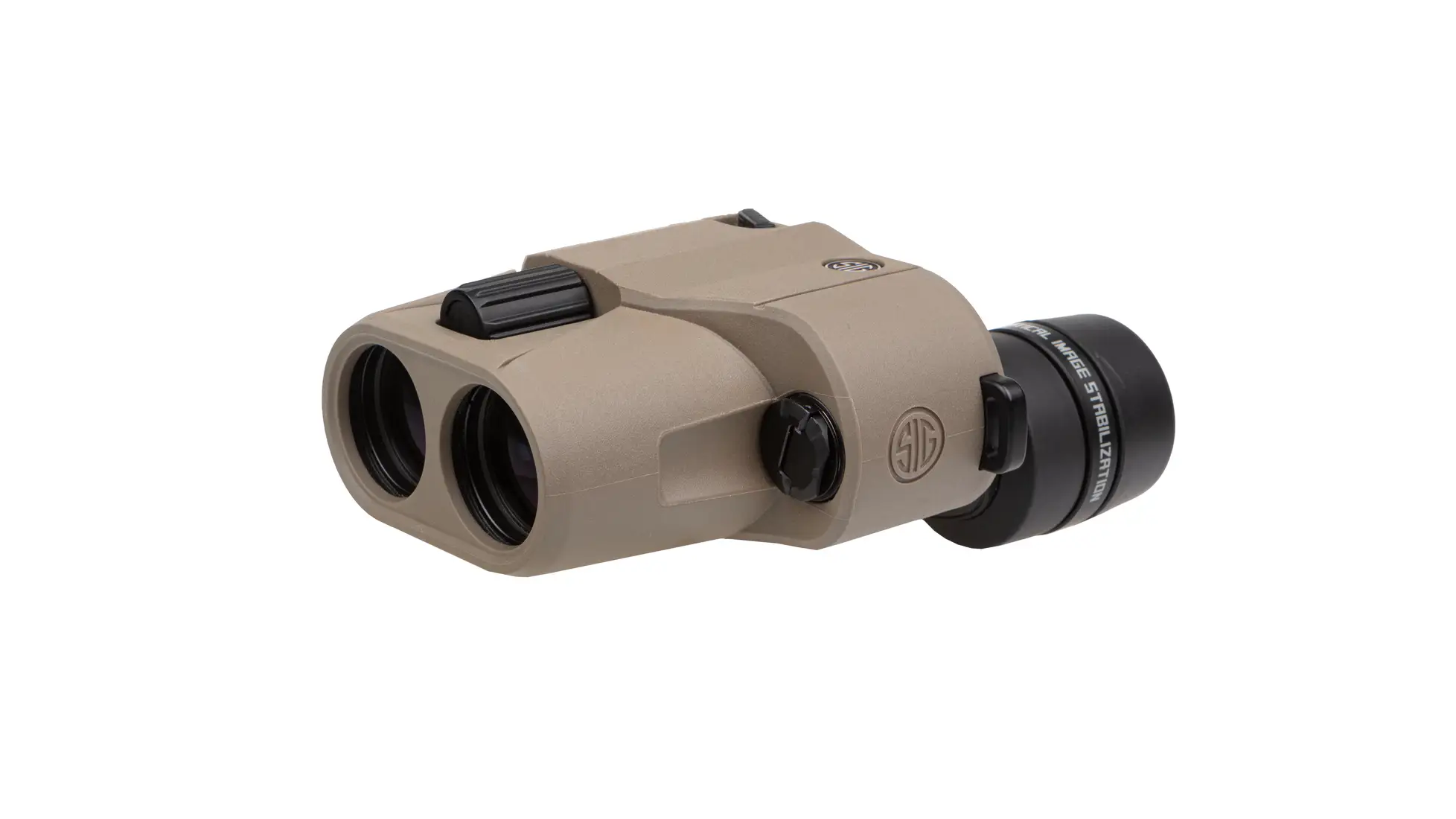
By SIG's figures the 10x30 is the lightest (19.2 oz) and shortest (5.9 in) of the four, has the widest field of view (5.2 degrees) and the shortest near focus in the line (3.5 m, 11.48 ft). It runs on one CR2 rated at 20 hours rather than an AA, and SIG's quick-reference guide puts its battery port on the left side rather than the bottom. Its 30 mm objective gives a 3.0 mm exit pupil (our arithmetic). SIG's tripod adapter page does not list the 10x30, although SIG's own 10x30 page still suggests that adapter.
Its HDX record is thin. Of the 6 reviews on its listing, we count 2 as written about the HDX; the other 4 date from before it or describe the earlier model. One of the two, a Verified Owner who also has the 16x42, writes that they were “looking for something little less power with more field of view for a tree stand/blind”.
“these are the perfect deer blind/stand binos”
PittsArchers (PA), a Verified Owner, via OpticsPlanet, March 2025, who lists “very small” as the con
16x42: more reach, least eye relief
The 16x42 shares the 12x42's body dimensions in SIG's figures and weighs 21.9 oz. It has the least eye relief of the four, 14 mm, and a 2.6 mm exit pupil (42 / 16 = 2.625, our arithmetic). Of the 19 reviews on its listing, we count 9 as HDX-era; the rest are about the original ZULU6 16x42 (see what owners report). Two HDX-era reviewers describe range and archery use:
“I primarily use them on the range to spot shots without the hassle of needing a tripod or spotting scope.”
Larry Hood (CA), a Verified Owner on the 16x42 listing, via OpticsPlanet, January 2024
“At a 3-d tournament they are perfect to see exactly where you need to aim for that 12 ring.”
Tay Beezy (AZ), a Verified Owner, via OpticsPlanet, December 2024
20x42: the most reach
The 20x42 is the most magnification in the HDX line: 3.3 degrees of view, 15 mm of eye relief and 21.9 oz, per SIG, with a 2.1 mm exit pupil (our arithmetic). OpticsPlanet lists it too, rated 4.6/5 from 16 reviews, all of them from July 2023 on. We do not card it here. Five of those 16 reviewers describe it as a stand-in for a spotting scope:
“I'm now using the 20x 42 in place of my spotting scope for the most part”
mtndon (WA), a Verified Owner, via OpticsPlanet, December 2023
For non-stabilized ways to reach far, see our best binoculars for long distance.
Key specifications: ZULU6 HDX 12x42
| SKU / model | SOZ6WP12, ZULU6 HDX |
|---|---|
| Magnification | 12x |
| Objective lens diameter | 42 mm |
| Field of view | 3.8 degrees (SIG publishes no figure in feet for the HDX) |
| Eye relief | 17 mm |
| Exit pupil | 3.5 mm (42 / 12, our arithmetic; SIG does not list it) |
| Near focus | 4 m (13.1 ft) |
| Weight | 21.5 oz (SIG does not say whether that includes the battery) |
| Length / height / width | 7.08 in / 2.75 in / 4.72 in |
| Battery and run time | One AA, 30 hrs |
| Auto shut-off | 10 minutes after power-on (quick-reference guide) |
| Stabilization | OIS, gyroscopically stabilized; Scan mode and Target mode |
| Prism / frame / housing | Schmidt-Pechan / thermoplastic body / rubber armor |
| Coatings | SpectraCoat, LensArmor, LenShield, HDX glass |
| Waterproofing | IPX7 waterproof and fog-proof (feature list) |
| Eyecups / diopter / interpupillary distance | Twist up / +/- 3 / 56 mm to 70 mm |
| Tripod mount | Capable: yes. Included: no |
| Case and strap | Foam carrying case, neck strap |
| Color | Flat Dark Earth (FDE) |
| Warranty | SIG SAUER Infinite Guarantee |
SIG figures from its ZULU6 HDX 12x42 page and its ZULU6 HDX quick-reference guide (P/N 7404220 R00, the PDF SIG links as the owner's manual), read 15 October 2026. The retailer's specification tables for the HDX sizes show a close focus of 8.2 m, a 56 to 75 mm interpupillary distance and IPX-4, and on the 10x30 and 16x42 listings weights of 18.6 oz and 20 oz. Those match SIG's published figures for the original ZULU6, not SIG's HDX pages, so we print SIG's HDX figures above.
How the stabilization works
SIG calls it OIS, Optical Image Stabilization: “Proprietary SIG Optical Image Stabilizer System that is Gyroscopically stabilized to cancel out unwanted shaking and vibrations that can blur an image, especially at higher magnification levels.” It has two modes. In SIG's words, “Scan Mode is designed specifically for scanning and gridding terrain. Target Mode is designed specifically for locking in on wild game & targets”, and SIG says Target mode “increases stability up to 50%”. SIG does not say what the 50% is measured against, and it publishes no image compensation angle for the HDX (it does for the HDX PRO).
The quick-reference guide sets out the controls. Toggling the power switch forward turns the stabilization on, with a green light, in Scan mode. For Target mode: “Toggle the power switch to the OFF position and then back to the ON position within 2 seconds. The power indicator light will now turn to an amber color signifying you are in Target mode.” The binocular shuts off by itself 10 minutes after it is turned on, and it comes back in Scan mode whenever it is switched off or times out.
The reviews read like a stabilization review. By our count, 33 of the 44 HDX-era reviews praise the stabilization in so many words.
“allows you to glass effectively with your heart racing, breathing hard, standing”
Jack (WY), a Verified Owner, via OpticsPlanet, March 2024, on the 12x42
“this 20x is steady as a rock once turned on”
Brock (MN), a Verified Owner, via OpticsPlanet, April 2025, on the 20x42
Two 12x42 owners say Scan mode is enough most of the time. One of them writes “I find I don’t often have to kick in the extra 50% stability of the target mode because the scan mode is that good”. Target mode has a cost for some: a 12x42 reviewer says it “definitely shows some lag if you’re scanning around”, and a 20x42 owner says it “will cause you to lose a little contrast”. A 16x42 reviewer finds the switch small and would like a different control:
“Would be nice if there was a 3 position switch instead or something along those lines.”
Eli (ID), reviewer, via OpticsPlanet, December 2023, on the 16x42
One owner bought the 12x42 for a reason SIG does not mention: “Purchased these for my wife to counter a hand tremor”. Others use the line from vehicles and boats; a 12x42 owner calls it “Great binos for glassing from a vehicle”. One 20x42 owner notes the limit of a small, light binocular: “they will still move up and down with every breath”.
Glass and low light
SIG makes no light transmission claim in figures for the HDX. What sets the ceiling on brightness at dusk is the exit pupil, and by our arithmetic the HDX sizes run from 3.5 mm on the 12x42 down to 2.1 mm on the 20x42, against 4.2 mm on a 10x42. That is arithmetic, not a test. Owners split on the glass. On the positive side:
“my other Binos are SLC’s, the Sig’s are easily as clear”
Rage (OR), a Verified Owner, via OpticsPlanet, November 2025, on the 12x42
Five HDX-era reviews hold the glass or the view back. A 12x42 owner writes that “The glass obviously isn't in the same league as top-end Swaro or Leica stuff”, and a 12x42 reviewer that “the glass quality isn’t the greatest and you get such a small FOV”. On the 20x42, one owner writes “Sure there’s better glass out there”, and another that “the objective lenses are too small to gather sufficient light to view small birds with detail at the distance they're capable of”. The three-star 12x42 review, from an owner who sent the pair back, reports a reflection in bright light and that “The aberration at the edges seems large”.
On last light specifically, a 16x42 reviewer upgrading from a Vortex Diamondback HD 12x50 writes: “I'd say these are on the same level as the diamondbacks during last light.”
Battery, power and auto shut-off
SIG lists one AA rated at 30 hours on the 12x42, 16x42 and 20x42, and one CR2 rated at 20 hours on the 10x30. SIG's quick-reference guide puts the battery port on the bottom of the 12x42 and 16x42 and on the left side of the 10x30 (it does not name the 20x42), and says the binoculars “will automatically shut off 10 minutes after being turned ON” to help conserve battery life. SIG's 42 mm parent page says the battery is included, and a 12x42 owner writes that they were “still on the single AA that came with them 4-ish months ago, under pretty regular use”.
SIG does not say whether the AA should be alkaline or lithium, and does not publish how the binocular behaves with no battery or a flat one. One 20x42 owner runs rechargeables, noting “while they don't claim compatibility, I've been using them with 1.2V rechargeable batteries”; that is the owner's practice, not SIG's advice. None of the 44 HDX-era reviews complains about battery life.
Build, accessories and the tripod adapter
SIG lists a thermoplastic body with rubber armor, twist-up eyecups, a +/- 3 diopter range and a 56 mm to 70 mm interpupillary distance. Its quick-reference guide puts the focus wheel on the front, above the objective lenses, and turns it clockwise to focus closer. In the box, SIG's pages name a foam carrying case and a neck strap and say no tripod mount is included; SIG publishes no fuller box list for the HDX.
The accessories draw a repeated complaint. Four HDX-era reviews criticize the case or the covers, and a fifth owner replaced the eyepiece caps with a one-piece cap.
“Lens covers are a joke.”
Jim (Queensland, Australia), reviewer, via OpticsPlanet, November 2023, on the 20x42
“I've already lost 1 of 2 eye pieces.”
Eli (ID), reviewer, via OpticsPlanet, December 2023, on the 16x42
A 16x42 owner lists “cheap carrying case” as the con, and a 20x42 owner writes that “the lens caps provided barely hold on and there is none for the unique shape of the bottom lenses”.
Tripod adapter. SIG sells a ZULU6 HDX Binocular Adapter and describes it as “Compatible with ZULU6 HDX 12x42mm, 16x42mm, 20x42mm, and ZULU6 16x42 prescriptions”, with an ARCA-Swiss footprint and a 1/4 inch-20 thread for universal mounting, glass filled nylon and a weight of 1.4 oz. The adapter is for the 42 mm sizes, per SIG's adapter page; the 10x30 is not on its list.
Warranty: SIG's Infinite Guarantee
SIG's product page puts it in four lines: “NO RECEIPTS”, “NO WARRANTY CARDS”, “FULLY-TRANSFERABLE”, “FOREVER”, and adds “SIG SAUER Electro-Optics are guaranteed forever. It's an unlimited lifetime guarantee.” SIG's warranty page promises that the product was “originally manufactured free of defects in material, workmanship, electrical, optical, and mechanical function” and that SIG will repair it at no charge, or replace it. SIG lists “No Time Limit Applies”.
The limits are SIG's too. The Infinite Guarantee page excludes intentional damage, misuse, cosmetic damage that does not affect performance, loss, theft and unauthorized repair or modification, and asks customers to obtain a Return Merchandise Authorization (RMA) from SIG Customer Service first. On scope it says: “This warranty applies to commercial customers only and does not apply to government, non-commercial, or non-US customers.”
Two 20x42 owners describe their service experience. One sent a pair that would not turn on reliably back to SIG and writes “Unconditional warranty so nothing to worry about.” The other, in the only one-star HDX-era review, used the binocular upside down with the switch at the bottom; after an accident and a repair the stabilization stopped working in that position, and the owner writes that a SIG customer service rep, after asking the repair technicians, told them the binocular is meant to be held with the switch at the top, and would not issue another RMA. That owner closes with “So much for the warranty.” SIG's quick-reference guide that we read says nothing about holding orientation. These are two owner accounts, not a measure of SIG's service.
What owners report (44 HDX-era reviews)
We read all 58 reviews on the four HDX listings, collected 15 October 2026. The retailer's star averages for the 16x42 (4.7/5 from 19) and the 10x30 (4.5/5 from 6) include reviews of the earlier model: one 16x42 reviewer titled a review “Reviews Prior to May 2023 are Gen 1 Zulu6”. By date and content we count 10 of the 19 reviews on the 16x42 listing and 4 of the 6 on the 10x30 listing as about, or from before, the original ZULU6, and leave them out of everything below. That leaves 44: all 17 on the 12x42, all 16 on the 20x42, 9 on the 16x42 and 2 on the 10x30, dated July 2023 to October 2026. They are 38 five-star, 4 four-star, 1 three-star and 1 one-star, and 36 of them are tagged Verified Owner. We counted the themes ourselves.
- Stabilization: 33 of the 44 praise it in so many words (13 of 17 on the 12x42, 12 of 16 on the 20x42, 7 of 9 on the 16x42, 1 of 2 on the 10x30).
- Light and compact: 15 praise the light weight or the small size.
- Spotting-scope stand-in: 5 of the 16 on the 20x42.
- Modes: 2 say Scan mode is enough most of the time; 2 report a Target-mode trade (lag when scanning, a little contrast).
- Glass: 5 hold the glass or the view back; one 12x42 owner rates it as clear as their Swarovski SLCs.
- Accessories: 4 criticize the case or covers; a fifth replaced the eyepiece caps.
- Battery: no complaint; 2 12x42 owners are positive about the single AA.
- Failures and returns: 3. The three-star 12x42 owner returned a pair that “appeared that they had been previously used”, with a reflection in bright light; one 20x42 owner sent a pair back to SIG for intermittent power; the one-star 20x42 review is the gyro account above.
“Surprisingly lightweight for all the tech they packed in there.”
Hubertus (OH), a Verified Owner, via OpticsPlanet, June 2024, on the 12x42
“It allowed me to discern details at a distance that I couldn't with regular binoculars.”
Joe (FL), a Verified Owner, via OpticsPlanet, June 2024, on the 16x42, about Target mode
ZULU6 HDX vs HDX PRO vs the original ZULU6 vs HDX MARINE
Four ZULU6 binoculars come in a 16x42, and the retailer's HDX listings even carry some of the original's figures. SIG's own figures for each 16x42, side by side, so you can tell them apart. SIG's PRO 42 mm pages carry a “NEW!” label; we give no prices for the PRO or the MARINE.
| SIG figure, 16x42 | ZULU6 HDX (SOZ6WP16) | ZULU6 HDX PRO (SOZ6WP1642) | Original ZULU6, 2020 (SOZ61601) | ZULU6 HDX MARINE (SOZ6WP16M) |
|---|---|---|---|---|
| Stabilization modes | Scan and Target | OmniScan and OmniLock (“4th Generation Optical Image Stabilization”) | No mode section in SIG's quick-reference guide for it | Scan and Target |
| Field of view | 3.8 degrees | 4.2 degrees, 220 ft at 1,000 yards | 3.8 degrees | 3.8 degrees |
| Eye relief | 14 mm | 15.5 mm | 14 mm | 14 mm |
| Weight, as SIG states it | 21.9 oz | 30 oz [868 g] W/Battery | 20 oz | 21.9 oz |
| Battery, run time | One AA, 30 hrs | (2) AA Alkaline Battery, up to 40 hours | AA (no run time in SIG's 2020 list) | One rechargeable Li-ion AA or one AA alkaline, up to 30 hours |
| Near focus | 4.0 m | 5.0 m | Not in SIG's 2020 list | 4.0 m |
| Image compensation angle | Not published | 3 degrees | Not published | Not published |
| Waterproof rating | IPX7 | IPX7 | IPX4 | IPX-7 |
| Color, case, strap | Flat Dark Earth; foam carrying case; neck strap | Flat Dark Earth; carry case; neck strap | Not in SIG's 2020 list | Orange; orange waterproof Pelican case; hi-vis floating neck strap |
| Sizes in that line | 10x30, 12x42, 16x42, 20x42 | 12x42, 14x42, 16x42, 20x42; and 14x50, 16x50, 18x50 | 10x30, 16x42 | 10x30, 16x42 (the two MARINE pages we read) |
SIG's November 2025 blog post separates the two current lines in one sentence: “The HDX PRO optical system further improves light transmission and reduces glare when compared to the standard HDX optical system.” It adds that the PRO “automatically blends both modes together using OmniScan”, where the HDX has the two modes you switch between yourself. That is SIG's comparison; we have not reviewed the PRO and give it no score.
From the original ZULU6 to the HDX, SIG's figures for the 10x30 and 16x42 keep the same field of view, eye relief and battery type, and change the weight (18.6 to 19.2 oz on the 10x30, 20 to 21.9 oz on the 16x42), the waterproof rating (IPX4 to IPX7), the glass (HDX) and the modes (Target mode is new). The part numbers tell them apart: SOZ61001 and SOZ61601 for the original, SOZ6WP10 and SOZ6WP16 for the HDX.
Trade-offs, plainly
- SIG's fields of view are narrow at 12x to 20x: 3.8, 3.8 and 3.3 degrees.
- The glass is good, not alpha-class: 5 HDX-era reviews hold the glass or the view back.
- The case and covers are basic: 4 HDX-era reviews criticize them.
- Target mode adds stability, per SIG, but one reviewer sees lag when scanning and one owner a little lost contrast.
- The stabilization needs a battery, and SIG does not publish how the binocular behaves without one.
- Eyeglass wearers: SIG lists 14 mm of eye relief on the 16x42.
- The 10x30's HDX record is two reviews, and SIG's tripod adapter page does not list it.
- The retailer's specification tables show figures from the original ZULU6 (8.2 m close focus, IPX-4, 56 to 75 mm); go by SIG's HDX pages.
How we reviewed it
A research-based review built from SIG's four ZULU6 HDX product pages, its ZULU6 HDX 42 mm parent page, the ZULU6 HDX quick-reference guide (P/N 7404220 R00), its warranty and Infinite Guarantee pages, its ZULU6 HDX Binocular Adapter page, its HDX PRO and HDX MARINE pages, its November 2020 ZULU6 announcement and its November 2025 ZULU6 blog post, read 15 October 2026; SIG's ZULU6 HDX page as archived in the Internet Archive on 11 May 2023; the four OpticsPlanet listings, read 15 October 2026; and all 58 reviews those listings show, collected 15 October 2026, of which we treat 44 as HDX-era and counted their themes ourselves. Where the retailer's specification table disagrees with SIG, we print SIG's figure and say so. We have not tested the ZULU6 HDX hands-on. The 4.5/5 is our editorial score; the retailer ratings are shown attributed. See how we evaluate.
Should you buy the SIG ZULU6 HDX?
- Buy the 12x42 if you want one stabilized binocular for general glassing, on foot or from a vehicle: it has the most eye relief of the four (17 mm, per SIG) at 21.5 oz.
- Buy the 16x42 or the 20x42 if reach matters more than field of view, for spotting shots on the range or glassing far country without a tripod; on the 16x42, check that 14 mm of eye relief works with your glasses.
- Buy the 10x30 if light weight and the widest view in the line come first, for a tree stand or a blind, and you will not need SIG's tripod adapter.
- Skip it if you glass wide country in low light, or want binoculars that need no battery.
- Look at SIG's ZULU6 HDX PRO if you want SIG's OmniScan and OmniLock modes and the wider field of view SIG lists for it; on the 16x42, SIG lists the PRO at 30 oz with the battery and the HDX at 21.9 oz, without saying whether the HDX figure includes its battery.
For the other stabilized binoculars we rate, see the best image-stabilized binoculars.
FAQ
What is the difference between the ZULU6 HDX and the ZULU6 HDX PRO?
By SIG's own pages, the ZULU6 HDX has two user-selectable stabilization modes, Scan and Target, HDX glass and one battery: one AA rated at 30 hours on the 42 mm sizes, one CR2 rated at 20 hours on the 10x30. SIG's pages for the 42 mm ZULU6 HDX PRO list what SIG calls 4th Generation Optical Image Stabilization with OmniScan and OmniLock modes, HDX PRO glass, two AA batteries rated at up to 40 hours and a 3 degree image compensation angle. On the 16x42, SIG lists the HDX at 21.9 oz with a 3.8 degree field of view and the PRO at 30 oz with the battery and 4.2 degrees (220 ft at 1,000 yards). SIG's own comparison says the HDX PRO optical system further improves light transmission and reduces glare when compared to the standard HDX optical system.
Which ZULU6 HDX size should I buy?
For most glassing, the 12x42: SIG gives it the most eye relief of the four (17 mm) at 21.5 oz. For more reach, the 16x42 or 20x42, which SIG lists at 21.9 oz each with 3.8 and 3.3 degrees of view; the 16x42 has the least eye relief (14 mm). For the lightest, shortest pair with the widest view, the 10x30: 19.2 oz, 5.9 in long and 5.2 degrees, on one CR2 rated at 20 hours, though SIG's tripod adapter page does not list it.
Is the ZULU6 HDX waterproof?
Yes. SIG rates the ZULU6 HDX IPX7 waterproof and fog-proof. The original ZULU6 that SIG announced in November 2020 carried an IPX4 rating, and the retailer's specification tables for the HDX sizes still show IPX-4, so go by SIG's HDX pages.
What battery does the ZULU6 HDX use, and how long does it last?
SIG lists one AA for the 12x42, 16x42 and 20x42, rated at 30 hours, and one CR2 for the 10x30, rated at 20 hours. SIG's quick-reference guide says the binoculars shut off automatically 10 minutes after being turned on, to help conserve battery life, and that toggling the power switch resets the timer. SIG's 42 mm parent page says the battery is included. SIG does not say whether the AA should be alkaline or lithium, and does not publish how the binocular behaves with no battery or a flat one.
Does the ZULU6 HDX fit a tripod?
SIG lists every size as tripod mount capable, with no tripod mount included. SIG's ZULU6 HDX Binocular Adapter page lists the ZULU6 HDX 12x42, 16x42 and 20x42, and the original ZULU6 16x42, as compatible; the 10x30 is not on that list. SIG describes the adapter as glass filled nylon, 1.4 oz, with an ARCA-Swiss footprint and a 1/4 inch-20 thread.
Is the ZULU6 HDX good for eyeglass wearers?
SIG lists 17 mm of eye relief on the 12x42, 15 mm on the 10x30 and the 20x42, and 14 mm on the 16x42. Its quick-reference guide says the eyecups twist up and down to accommodate the eye relief distance required when wearing eyeglasses. One 20x42 owner writes that the eye relief has to be set to the max to get a good image. If you glass in glasses, the 12x42 has the most eye relief of the four.
What does Target mode do on the ZULU6 HDX?
SIG says Target mode increases stability up to 50% and is designed for locking in on game and targets, while Scan mode is designed for scanning and gridding terrain. To enter Target mode, start in Scan mode and toggle the power switch off and back on within 2 seconds; the indicator light turns amber. The binocular returns to Scan mode when it is turned off or after the 10-minute auto shut-off. SIG does not say what the 50% is measured against. One reviewer finds Target mode lags when scanning around, and one owner says it costs a little contrast.
More: best image-stabilized binoculars · best binoculars for long distance · best binoculars for hunting · how we evaluate.