Pulsar Thermion 3 vs Thermion 2: the LRF 60 thermal riflescopes compared
Sponsored by Pulsar. Pulsar paid for this coverage. The brand could correct factual errors before publication; the verdict and the downsides are ours. How sponsored content works.
Quick answer: Pulsar's Thermion 3 comes in two versions, and in this guide we pair each with a Thermion 2 LRF 60 model. The Thermion 3 LRF XT60 (1280x1024 sensor, 2-24x) lines up with the Thermion 2 LRF XL60 (1024x768, 2.5-20x): the same 12 µm pixels behind a 60 mm lens, with a field about 25% wider (14.6° against 11.7°). The Thermion 3 LRF XR60 (640x480, 12 µm, 4-40x) lines up with the Thermion 2 LRF XP60 (640x480, 17 µm, 3-24x): the same pixel count, a narrower field and more magnification. Pulsar's own journal names a different Thermion 2, the LRF XG60, as the XR60's closest match on paper; the XG60 is not covered here. Across both pairs, per Pulsar's manuals, the Thermion 3 ranges to 1,200 m instead of 800 m, records at 1440x1080 instead of 1280x960 to 128 GB instead of 64 GB, but it is also 0.1 kg heavier (1.3 against 1.2 kg). Each Thermion 2 model lists a lower sensor NETD than the Thermion 3 it pairs with, and the same system NETD. Each Thermion 3 version is covered on its own in our sponsored spotlight.
How we put this together: this is a sponsored, research-based range guide. We have not used any of the four scopes ourselves. The figures are from Pulsar's user manuals for each model; Pulsar's view is from its journal comparison, product pages and launch film; offers are from the OpticsPlanet listings. Where we say what a figure means in use, it is marked as our reading. There is no score on this page, because Pulsar paid for it. See how we evaluate.
Which option fits which need: the four scopes
All four are 60 mm thermal riflescopes on a 30 mm tube with a built-in laser rangefinder. What each one fits, below, is our reading of Pulsar's figures, not a field result.

Pulsar Thermion 3 LRF XT60 (2-24x60)
The widest field of the four, 14.6° (25.7 m at 100 m), and the lowest base magnification, 2x, from the highest-resolution sensor here, 1280x1024. Pulsar rates the rangefinder to 1,200 m and the batteries to 8.5 hours. Our reading: it fits the hunter who scans wide or mixed ground and wants to find heat quickly, then zoom in on it. Its sensor NETD (under 40 mK) is the highest of the four; its system NETD (under 20 mK) matches the XL60's.
OpticsPlanet, MPN PL76590: around $6,500
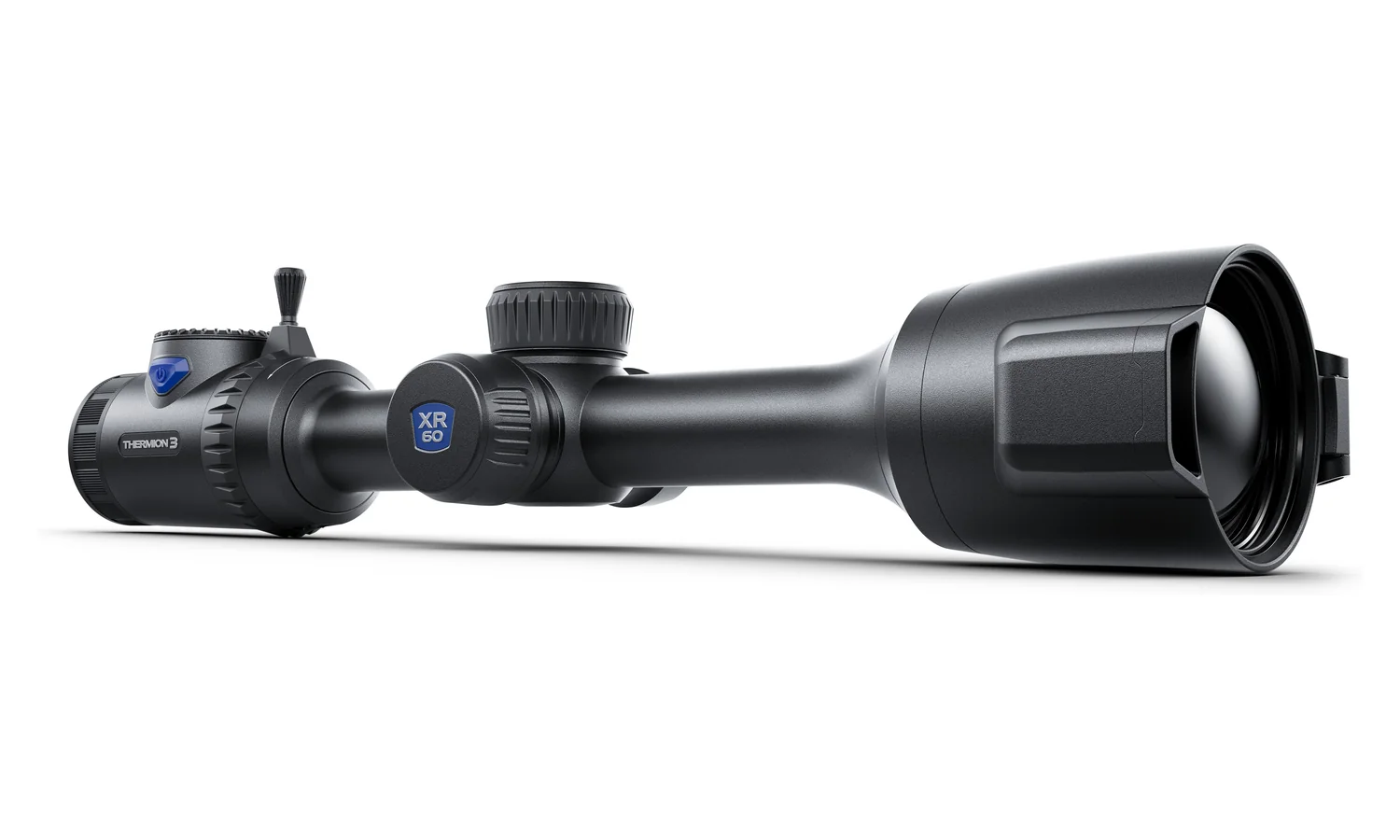
Pulsar Thermion 3 LRF XR60 (4-40x60)
The most magnification of the four, 4-40x, and the longest battery rating, 14 hours, with a 640x480, 12 µm sensor and the narrowest field, 7.3° (12.8 m at 100 m). Same 1,200 m rangefinder as the XT60. Pulsar's own journal adds a caveat at the top of the range: “although the image quality won’t be top-notch at this level”. Our reading: it fits the hunter who watches one spot at longer distance and sits out long nights.
OpticsPlanet, MPN PL76589: around $4,500
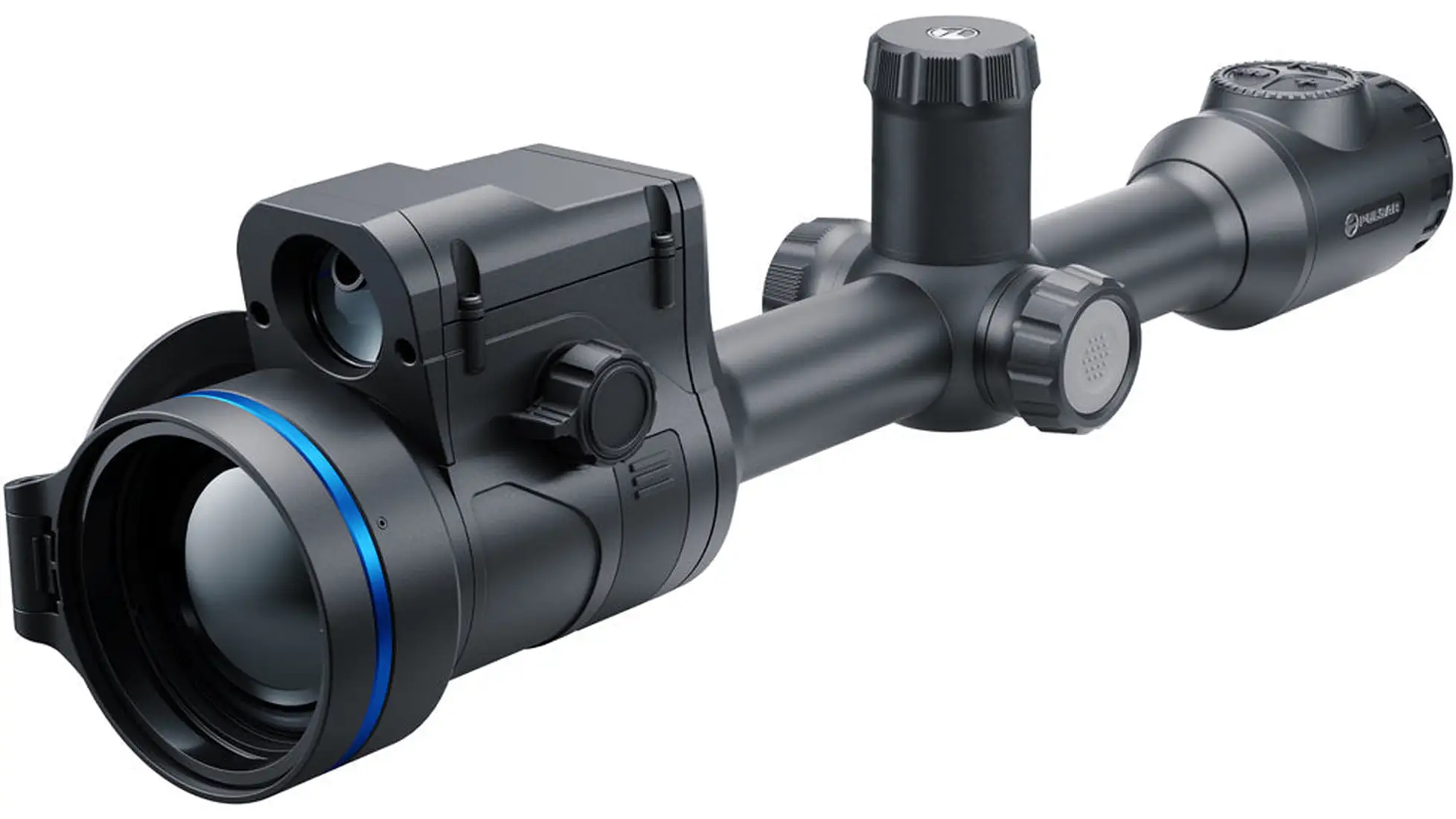
Pulsar Thermion 2 LRF XL60 (2.5-20x60)
The Thermion 2's 1024x768 model: 2.5-20x, an 11.7° field (20.5 m at 100 m), an 800 m rangefinder and an 8-hour battery rating. Its sensor NETD (under 35 mK) is lower than the XT60's; its system NETD is the same, under 20 mK. It is 0.1 kg lighter than either Thermion 3, and its manual's box list has two removable APS3 packs. Pulsar's Thermion 2 LRF page calls it “the optimum choice for pest and predator control”.
OpticsPlanet, MPN PL76575: around $5,000
Pulsar Thermion 2 LRF XP60 (3-24x60)
A 640x480 sensor with larger 17 µm pixels: a 10.4° field (18.1 m at 100 m), 3-24x, an 800 m rangefinder and an 11-hour battery rating. Its sensor NETD, under 25 mK, is the lowest of the four, and its system NETD, under 18 mK, ties the XR60's. Pulsar's Thermion 2 LRF page calls it “the best-performing riflescope in humid conditions”. Our reading, resting on that Pulsar claim and the lowest sensor NETD: it fits the hunter whose nights are often damp or foggy and who wants a wider field than the XR60's.
OpticsPlanet, MPN PL76576K: around $5,500
The four scopes side by side
Every figure below is from Pulsar's user manual for that model. Shared by all four, per the same manuals: 30 mm tube, Wi-Fi 2.4 / 5 GHz and Bluetooth BLE 4.2, 5 V / 9 V USB Type-C power, and an operating range of -25 to +50°C (-13 to +122°F).
| Spec | Thermion 3 LRF XT60 | Thermion 3 LRF XR60 | Thermion 2 LRF XL60 | Thermion 2 LRF XP60 |
|---|---|---|---|---|
| Sensor | 1280x1024, 12 µm, 50 Hz | 640x480, 12 µm, 50 Hz | 1024x768, 12 µm, 50 Hz | 640x480, 17 µm, 50 Hz |
| Sensor NETD | <40 mK | <30 mK | <35 mK | <25 mK |
| System NETD | <20 mK | <18 mK | <20 mK | <18 mK |
| Lens | 60 mm, F1.0 | 60 mm, F1.0 | 60 mm, F1.1 | 60 mm, F1.1 |
| Magnification | 2-24x | 4-40x | 2.5-20x | 3-24x |
| Field of view (horizontal) | 14.6° / 25.7 m at 100 m | 7.3° / 12.8 m at 100 m | 11.7° / 20.5 m at 100 m | 10.4° / 18.1 m at 100 m |
| Eye relief | 65 mm | 65 mm | 65 mm | 65 mm |
| Display | AMOLED, 2560x2560 | AMOLED, 2560x2560 | Micro-OLED, 2560x2560 | Micro-OLED, 2560x2560 |
| Detection range ("deer" type object) | 2,950 m (3,226 yd) | 2,950 m (3,226 yd) | 2,800 m (3,062 yd) | 2,000 m (2,178 yd) |
| Laser rangefinder (905 nm, accuracy 1 m) | 1,200 m (1,312 yd) | 1,200 m (1,312 yd) | 800 m (875 yd) | 800 m (875 yd) |
| Click value at 100 m (lowest to highest magnification) | 20 mm at 2x to 1.7 mm at 24x | 10 mm at 4x to 1 mm at 40x | 16 mm at 2.5x to 2 mm at 20x | 14 mm at 3x to 1.75 mm at 24x |
| Click range (H/V) at 100 m | 4,000 mm | 2,000 mm | 3,200 mm | 2,840 mm |
| Recording | 1440x1080, .mp4 / .jpg | 1440x1080, .mp4 / .jpg | 1280x960, .mp4 / .jpg | 1280x960, .mp4 / .jpg |
| Built-in memory | 128 GB | 128 GB | 64 GB | 64 GB |
| Batteries | Built-in APS5 4900 mAh + removable APS5 4900 mAh | Built-in APS5 4900 mAh + removable APS5 4900 mAh | Built-in APS5 4900 mAh + removable APS3 3200 mAh | Built-in APS5 4900 mAh + removable APS3 3200 mAh |
| Runtime at 22°C (both batteries) | 8.5 h | 14 h | 8 h | 11 h |
| Protection (IEC 60529) | IP67 | IP67 | IPX7 | IPX7 |
| Max. recoil | 6,000 J (rifled) | 6,000 J (rifled) | 6,000 J (rifled); smoothbore caliber 12 | 6,000 J (rifled); smoothbore caliber 12 |
| Length | 391 mm without eyecup (15.4 in) | 391 mm without eyecup (15.4 in) | 442 mm with eyecup (17.4 in) | 442 mm with eyecup (17.4 in) |
| Weight (with removable battery) | 1.3 kg (45.9 oz) | 1.3 kg (45.9 oz) | 1.2 kg (42.3 oz) | 1.2 kg (42.3 oz) |
NETD (noise equivalent temperature difference) is the smallest temperature difference a thermal imager can pick up, so lower is better. Pulsar publishes two figures: the sensor NETD, the sensor's own rating, and the system NETD, the whole device with its image processing. Compare sensor with sensor and system with system.
Thermion 3 LRF XT60 vs Thermion 2 LRF XL60
What changed in the numbers, per Pulsar's manuals:
- Sensor and field: 1280x1024 against 1024x768, both 12 µm; field 14.6° against 11.7°; magnification 2-24x against 2.5-20x.
- Sensitivity: sensor NETD under 40 mK against under 35 mK (the XL60's is lower); system NETD under 20 mK on both.
- Lens: F1.0 against F1.1, both 60 mm.
- Detection and ranging: 2,950 m against 2,800 m detection; rangefinder 1,200 m against 800 m.
- Recording: 1440x1080 to 128 GB against 1280x960 to 64 GB.
- Power: 8.5 hours against 8; removable pack APS5 (4900 mAh) against APS3 (3200 mAh).
- Body: 1.3 kg against 1.2 kg (the XT60 is heavier); IP67 against IPX7. Length: 391 mm without the eyecup against 442 mm with it, two different measures.
Our reading, with the arithmetic: both scopes put 12 µm pixels behind a 60 mm lens, so at the same magnification a target covers the same number of pixels on either one. The XT60's extra pixels go to the sides: 1280 columns against 1024 is 1.25 times as many, and 11.7° times 1.25 gives the XT60's 14.6°. So the gain is a wider view at comparable angular sampling, plus a lower 2x start and a longer 24x top end. Angular pixel sampling alone, however, does not determine overall perceived image quality or establish whether one scope will produce a sharper image of the same animal in every situation. The rangefinder is the largest single change, 1,200 m against 800 m. On sensitivity the XL60 lists the lower sensor figure and the two tie on system NETD, so the XT60 is not the more sensitive scope on Pulsar's numbers.
Thermion 3 LRF XR60 vs Thermion 2 LRF XP60
What changed in the numbers, per Pulsar's manuals:
- Sensor and field: 640x480 on both, 12 µm against 17 µm pixels; field 7.3° against 10.4°; magnification 4-40x against 3-24x.
- Sensitivity: sensor NETD under 30 mK against under 25 mK (the XP60's is lower); system NETD under 18 mK on both.
- Lens: F1.0 against F1.1, both 60 mm.
- Detection and ranging: 2,950 m against 2,000 m detection; rangefinder 1,200 m against 800 m.
- Recording: 1440x1080 to 128 GB against 1280x960 to 64 GB.
- Power: 14 hours against 11; removable pack APS5 (4900 mAh) against APS3 (3200 mAh).
- Body: 1.3 kg against 1.2 kg (the XR60 is heavier); IP67 against IPX7. Length: 391 mm without the eyecup against 442 mm with it, two different measures.
Our reading, with the arithmetic: the pixel count is the same, but the XR60's pixels are smaller (12 against 17 µm) behind the same 60 mm lens. Each pixel covers a narrower slice of the scene, so the XR60 puts about 1.4 times as many pixels across the same target (17 divided by 12) and pays for it with a narrower field, 7.3° against 10.4°. That fits its longer magnification range and Pulsar's higher detection figure. The XP60 keeps the wider view and the lower sensor NETD; the XR60 adds 3 hours of rated runtime and the 1,200 m rangefinder.
Pulsar's journal comparison pairs the XR60 most closely with a different Thermion 2 model, the LRF XG60, which it says “seems very close” on paper: the same 640x480, 12 µm sensor, a 4x base magnification and the same 7.3° field. That model is not covered on this page; we pair the XR60 with the XP60 because both are 640x480 models.
What Pulsar says about the two generations
Pulsar's journal article “Pulsar Thermion 3 vs Thermion 2 Comparison: Should You Upgrade?” (co-author Vilius Ūksas, expert contributor Riccardo Tamburini) sets out the maker's view. In its words: “Thermion 3 is the new flagship, but Thermion 2 remains highly capable”, and “Thermion 2 still makes sense if it already covers your normal hunting distances and situations.”
- Rangefinder. Beyond the 1,200 m rating, Pulsar writes that “The new LRF locks on a target quicker, naturally returning a faster reading.” It also says the rangefinder now sits on the side of the lens, inside its housing, and supports single-shot and scanning modes.
- Controls. Pulsar describes buttons moved closer to the shooter on the eyepiece, a circular encoder for navigation, a top-turret focus wheel reachable with either hand, and zoom by a ring on the eyepiece.
- Display. Both Thermion 3 models use a 2560x2560 AMOLED; the Thermion 2 LRF 60 models use a 2560x2560 Micro-OLED, which Pulsar sums up as “so the change is in panel type and interface rather than pixel count.”
- Recording. Pulsar says recoil-activated video recording on the Thermion 3 has three sensitivity levels; for the Thermion 2 LRF it writes that “recoil rec is available via firmware updates”.
- Battery. Both generations use one internal and one external battery. On why runtime differs from model to model, Pulsar writes: “The difference is mostly due to sensor resolution”.
- What stays. Per the journal: 30 mm rings, 6,000 J recoil resistance, ballistic and app support, and 65 mm eye relief on the 60 mm models.
The journal also quotes Riccardo Tamburini, Pulsar's expert contributor, on the new rangefinder: “The LRF is precise and fast, and it also works in light fog and humidity at night.” These are Pulsar's statements; we have not measured any of them.
More from the maker: the Thermion 3 page on pulsarvision.com.
In the box: mount, remote and batteries
Pulsar's manuals list no mount or rings for any of the four models; each manual says to mount the scope with 30 mm rings or a single-piece mount, purchased separately. The two Thermion 2 listings on OpticsPlanet have “w-mount” in their web address, so check the included items on the listing before ordering.
- Thermion 3 LRF XT60 and XR60 (manual box list): thermal imaging riflescope, removable rubber day eyecup, removable rubber night eyecup, zoom ring lever, APS5 rechargeable battery pack, APS5 battery charger, power adapter, remote control, USB Type-C cable with Type-A adapter, carrying case, lens cleaning cloth, Quick Start Guide, SV Ballistics Quick Start Guide, warranty card.
- Thermion 2 LRF XL60 and XP60 (manual box list): thermal imaging riflescope, removable rubber eyecup, APS3 battery pack (2 pcs.), wireless remote control, APS battery charger, power adapter, USB Type-C cable with USB Type-A adapter, carrying case, lens-cleaning cloth, quick user manual, warranty card.
Our reading: with the built-in APS5 counted, a Thermion 2 box holds three packs (one built in, two removable APS3) and a Thermion 3 box holds two (one built in, one removable APS5). The Thermion 3's removable pack is the larger one, 4900 against 3200 mAh. Pulsar's runtime ratings are for the built-in pack plus one removable pack.
Warranty in the US
Pulsar USA's warranty page says every Pulsar device ships with a factory 3-year warranty, and that registering the product adds 2 more years. The plan applies to products purchased on or after January 1, 2024, and the optional 2-year extension only to devices manufactured after January 1, 2023. Rechargeable battery packs are covered for 1 year. Pulsar's US product pages for the XL60 and XP60 state the same terms: a 3-year warranty, 5 years with registration.
FAQ
What is the main difference between the Pulsar Thermion 3 and Thermion 2 LRF 60 models?
Per Pulsar's user manuals, the Thermion 3 LRF models range to 1,200 m against 800 m, record at 1440x1080 against 1280x960 to 128 GB of memory against 64 GB, and carry an IP67 rating against IPX7. They are also heavier: 1.3 kg against 1.2 kg. The manuals measure the Thermion 3 at 391 mm without the eyecup and the Thermion 2 at 442 mm with it, so the two lengths are not a like-for-like comparison. Pulsar's journal adds redesigned controls, with a zoom ring on the eyepiece, a top-turret focus wheel and a circular encoder.
Which Thermion 2 model is the Thermion 3 LRF XT60 closest to?
On our reading of Pulsar's figures, the Thermion 2 LRF XL60. Both put 12 µm pixels behind a 60 mm lens, so at the same magnification a target covers the same number of pixels. The XT60's 1280x1024 sensor against the XL60's 1024x768 widens the field from 11.7° to 14.6° and lowers the base magnification from 2.5x to 2x.
How long do the Thermion 3 and Thermion 2 LRF 60 batteries last?
Pulsar's manuals rate the XR60 at 14 hours, the XP60 at 11, the XT60 at 8.5 and the XL60 at 8, at 22°C with both batteries. All four have a built-in APS5 pack plus a removable one: an APS5 (4900 mAh) on the Thermion 3, an APS3 (3200 mAh) on the Thermion 2. The manuals say actual runtime depends on use of Wi-Fi, the recorder, Bluetooth and the rangefinder.
Do the Thermion 3 and Thermion 2 LRF scopes come with a mount?
Pulsar's manuals list no mount or rings in the box for any of the four models, and say to mount the scope with 30 mm rings or a single-piece mount, purchased separately. The two Thermion 2 listings on OpticsPlanet have "w-mount" in their web address, so check the included items on the listing before ordering.
More thermal: best thermal scope · Pulsar Telos LRF XT50 spotlight · thermal vs night vision.