Pulsar Thermion 3 LRF XT60 and XR60: two versions of one thermal riflescope
Sponsored by Pulsar. Pulsar paid for this coverage. The brand could correct factual errors before publication; the verdict and the downsides are ours. How sponsored content works.
Our verdict: the Pulsar Thermion 3 LRF is a thermal riflescope with a laser rangefinder built in, mounted in standard 30 mm rings like a day scope, and it comes in two versions that share the 60 mm F1.0 lens, the body, the 1,200 m rangefinder and the display. The XT60 has a 1280x1024 sensor, 2-24x magnification and a 14.6° field of view: it fits the hunter who wants to see the most ground at once, which Pulsar's own review ties to forest and mixed terrain. The XR60 has a 640x480 sensor, 4-40x and a 7.3° field, and Pulsar rates it for 14 hours against the XT60's 8.5, with the lower NETD on both of Pulsar's measures: it fits long nights and open ground, where Pulsar's review places the higher magnification. Both use 12 µm pixels behind the same lens, so by our arithmetic a target covers the same number of sensor pixels in both at the same magnification; the XT60's extra pixels buy a field twice as wide and a 2x base, and keep twice as many pixels across as the XR60 when both are zoomed by the same digital factor. The numbers are in the two versions. For other thermal riflescopes, see our best thermal scope guide.
OpticsPlanet lists the XT60 (PL76590) at around $6,500 and the XR60 (PL76589) at around $4,500.

How we put this together: this is a sponsored, research-based spotlight. We have not used either version ourselves. It is built from Pulsar's two user manuals (XT60 and XR60), its Thermion 3 product page, its own in-depth review published on its journal, its launch and unboxing videos, Pulsar USA's warranty page and the two OpticsPlanet listings. Where Pulsar's documents give different figures, we print the user manual's. There is no score on this page, because Pulsar paid for it. Claims we could not confirm on a primary source are left out. See how we evaluate.
What the Thermion 3 LRF is
The Thermion 3 LRF is a thermal imaging riflescope: Pulsar's manual says it needs no external light source and is designed for use at night and during the day. It has a 30 mm tube that takes standard scope rings, a laser rangefinder and an integrated ballistic calculator. Pulsar's manual describes it as designed for hunting, target shooting and recreational shooting, observation and orientation. On Pulsar's product page the rangefinder sits inside the housing, not in the thermal lens.
It is the third generation of Pulsar's Thermion riflescope. In the spec tables of Pulsar's two manuals, the XT60 and XR60 differ in sensor, magnification, field of view, NETD, battery time, click value and click range; apart from the model name and SKU, every other row is the same. For the step from the previous generation, read how it compares with Thermion 2.
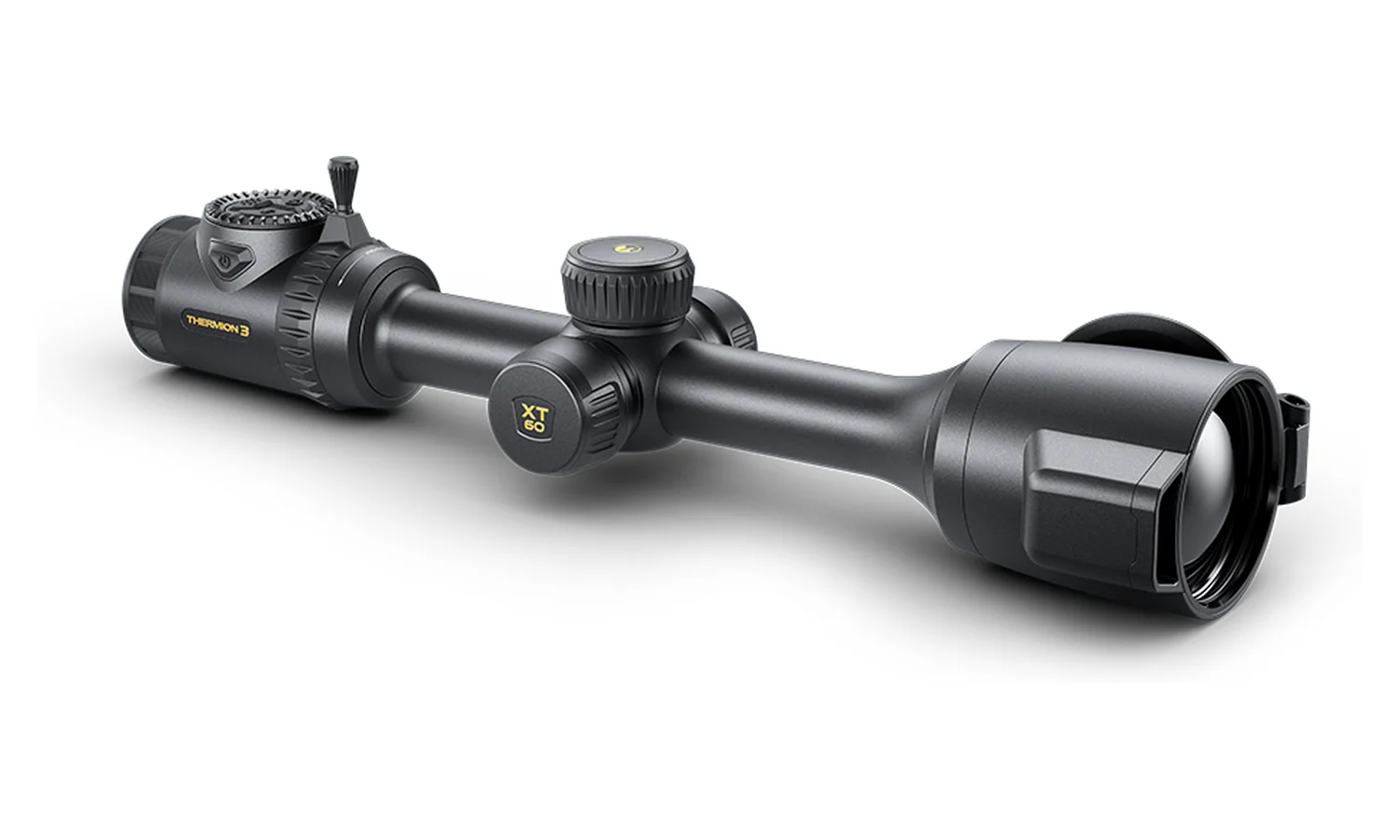
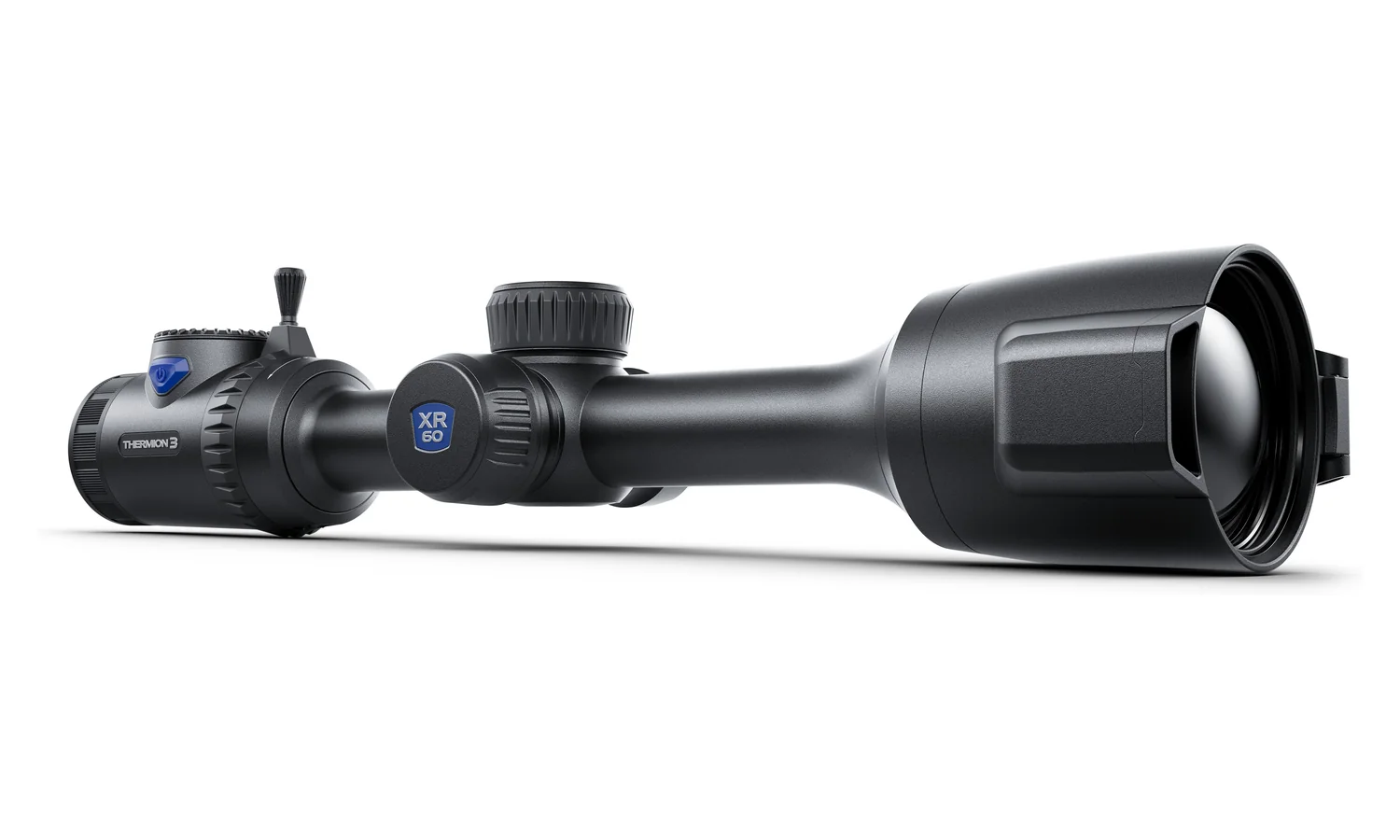
Renders supplied by Pulsar and used with its permission.
The two versions: XT60 and XR60
Except the OpticsPlanet MPN row, everything below comes from Pulsar's two user manuals. The rows are only those where the versions differ; the lens, rangefinder, display, body, weight and protection are the same.
| Thermion 3 LRF XT60 | Thermion 3 LRF XR60 | |
|---|---|---|
| Sensor | 1280x1024, 12 µm | 640x480, 12 µm |
| Magnification | 2-24x | 4-40x |
| Field of view (horizontal) | 14.6° (25.7 m at 100 m) | 7.3° (12.8 m at 100 m) |
| NETD, sensor / system | Under 40 / under 20 mK | Under 30 / under 18 mK |
| Operating time at 22°C | 8.5 h | 14 h |
| Click value at base magnification | 20 mm at 100 m (2x) | 10 mm at 100 m (4x) |
| Click range (H/V) at 100 m | 4,000 mm | 2,000 mm |
| OpticsPlanet MPN | PL76590 | PL76589 |
| XT60 2-24x: see it on OpticsPlanet | XR60 4-40x: see it on OpticsPlanet |
Our reading of Pulsar's figures (arithmetic, not a measurement and not Pulsar's statement): both sensors use 12 µm pixels behind the same 60 mm lens, so one sensor pixel covers the same angle in both, 12 µm divided by 60 mm, which is 0.2 milliradians, about 2 cm at 100 m. 1,280 pixels across then give about 25.6 m at 100 m and 640 pixels give 12.8 m, in line with Pulsar's 25.7 m and 12.8 m. The XT60's sensor is twice as wide, so its field is twice as wide (14.6° against 7.3°) at half the base magnification (2x against 4x). Zoomed to 4x, the XT60 shows the same 7.3° field as the XR60 at its base, from the same 640 sensor pixels across. So at the same magnification a target covers the same number of sensor pixels in both versions, up to the XT60's 24x; the XR60 carries on to 40x. Pulsar puts it this way: the XT60's 1280x1024 sensor gives greater image detail and a wider field of view, and retains more image detail when digitally zoomed, while the XR60, with 4-40x and a 640x480 sensor, is positioned for long-range precision. The two readings fit together: zoomed by the same digital factor, the XT60 keeps twice as many pixels across as the XR60; set to the same total magnification, the two put the same number of pixels on the target. Pulsar also gives both the same detection distance (2,950 m) and rangefinder reach (1,200 m). Angular pixel sampling alone does not decide overall image quality, though: thermal sensitivity, image processing and viewing conditions also play a role, so this arithmetic does not by itself rank the two versions on the picture you see.
Image and sensor
Pulsar lists uncooled sensors at 50 Hz in both versions, behind a 60 mm F1.0 lens, with a 2560x2560 AMOLED display and 65 mm of eye relief. The manual lists 9 color palettes, three calibration modes (automatic, semi-automatic and manual) and three sensitivity amplification levels; Pulsar's product page says the highest, Ultra-High, is meant for fog, rain, humidity and low temperatures.
Sensitivity needs a careful reading. NETD (noise equivalent temperature difference) is, in Pulsar's review's words for system NETD, the smallest temperature difference the sensor can pick up, so a lower number means higher thermal sensitivity. Pulsar's manuals publish two NETD figures for each version, a sensor NETD and a system NETD, and the XR60 is lower on both: a sensor NETD under 30 mK against the XT60's under 40, and a system NETD under 18 mK against under 20. Pulsar's own review says fog and humidity affect the image of any thermal, describes the XR60 as “naturally a bit lower in image quality” than the XT60, and says its “slightly higher thermal sensitivity helps in those poor conditions.” That is the maker's framing; we have not measured either version.
“The display is so fine that you stop thinking about pixels and start reading the animal.”
Erik Bjaelkvall, expert contributor quoted in Pulsar's own Thermion 3 LRF review (maker content, not an independent review)
Rangefinder and ballistics
Both versions carry a 905 nm laser rangefinder that Pulsar's manuals rate to 1,200 meters (1,312 yards) with a measurement accuracy of 1 meter; the manual notes that the range depends on the target and the conditions. Pulsar's product page lists single, scan and true horizontal distance (THD) modes. The integrated ballistic calculator takes ballistic profiles sent from the Stream Vision Ballistics app and, after a range reading, shows a Suggested Point of Aim (SPOA) on the reticle, per Pulsar's product page. Pulsar lists 10 reticles, which it says are scalable, and 10 zeroing profiles.
Pulsar's own review adds a practical point: the SPOA is only as good as the data entered, and it recommends measuring bullet speed with a chronograph, because the numbers on the ammunition box are often incorrect.
Click values change with magnification. At 100 m, one click on the XT60 moves the point of aim 20 mm at 2x, down to 1.7 mm at 24x; on the XR60, 10 mm at 4x, down to 1 mm at 40x. The total click range is 4,000 mm at 100 m on the XT60 and 2,000 mm on the XR60, per Pulsar's manuals.
Battery system
Each version runs on two APS5 lithium-ion packs of 4900 mAh: one built in and one removable. The manual says the scope draws on the removable pack first and switches to the built-in pack when the removable one runs low, and that the removable pack can be changed with the scope switched on. A 5 V or 9 V power bank on the USB-C port powers the scope and gradually recharges both packs.
Pulsar's manuals rate the two packs together at 8.5 hours for the XT60 and 14 hours for the XR60, at 22°C. The manual says the actual time depends on how much you use Wi-Fi, the video recorder, Bluetooth and the rangefinder, and that battery capacity decreases below 0°C (32°F). Pulsar's own review adds that for long, cold nights with the XT60 it is worth carrying a spare.
Pulsar's product page says both packs are user-replaceable. For the built-in pack, the manual lists the replacement steps but recommends having it replaced by a qualified professional or an authorized service center, and notes that running without it reduces operating time.
Build, size, weight and recoil
Pulsar's manuals give both versions the same body: 391 x 96 x 76 mm (15.4 x 3.8 x 3 in) without the eyecup, and 1.3 kg (45.9 oz) with the removable battery. They rate it for a maximum recoil power of 6,000 J on rifled weapons, IP67 protection and an operating range of -25 to +50°C (-13 to +122°F). On Pulsar's product page, focus is a top turret wheel, magnification is a zoom ring with a lever, and a proximity sensor turns the display off when you lift your eye. The scope records 1440x1080 photo and video to 128 GB of built-in memory, with recoil-activated recording, and connects by Wi-Fi to the Stream Vision 2 app.
What is in the box
Pulsar's manual lists the same package for both versions: the thermal imaging riflescope, a removable rubber day eyecup, a removable rubber night eyecup, a zoom ring lever, an APS5 rechargeable battery pack, an APS5 battery charger, a power adapter, a remote control, a USB Type-C cable with a Type-A adapter, a carrying case, a lens cleaning cloth, a quick start guide, an SV Ballistics quick start guide and a warranty card. Pulsar confirmed to us that this list, remote control included, is correct for US boxes. There are no scope rings or mount: the manual says to mount the riflescope with 30 mm scope rings or a single-piece scope mount, purchased separately.
Pulsar's own unboxing video unboxes the XT60 only: an on-screen “THERMION 3 XR60” title appears, and a second, white Pulsar box stays closed on the table throughout. What comes out of the box in the frames we checked: the scope in a black zippered soft case, a rubber eyecup, one battery, a two-slot Pulsar charger, a wall adapter, a braided USB cable and a blue manual marked “THERMION 3 LRF”, plus printed cards. No scope rings or mount appear. A few smaller items could not be identified from the frames, and we did not review the audio.
What Pulsar itself lists as considerations
Pulsar's own in-depth review of the Thermion 3 LRF, published on its journal, sets a column of considerations beside its benefits. It is maker content, not an independent review. Five of its six considerations follow, in Pulsar's words; the sixth is about price, which this page does not judge:
- “Ballistic features require initial setup and accurate input data”
- “Feature set may exceed the needs of occasional users”
- “Larger and heavier than compact thermal scopes, because of the 60 mm optical platform”
- “New control layout needs a short adjustment period for users of earlier Thermion generations”
- “XT60 battery life (up to 8.5 h) is shorter than the XR60’s (up to 14 h)”
To these we add two of our own, from the manuals: the scope needs rings or a mount bought separately, and it weighs 1.3 kg (45.9 oz) with the removable battery, before rings.
Warranty in the US
Pulsar USA's warranty page says every Pulsar device ships with a factory 3-year warranty and that registering the product adds 2 more years, free. The plan applies to products purchased on or after January 1, 2024, and the optional 2-year extension only to devices manufactured after January 1, 2023. Rechargeable battery packs are covered for 1 year. The warranty does not cover damage from misuse, unauthorized modifications, accidents or natural disasters, or cosmetic damage such as scratches or dents.
Key specifications
| LRF XT60 | LRF XR60 | |
|---|---|---|
| Pulsar SKU / OpticsPlanet MPN | 76590 / PL76590 | 76589 / PL76589 |
| Sensor | Uncooled microbolometer, 1280x1024, 12 µm, 50 Hz | Uncooled microbolometer, 640x480, 12 µm, 50 Hz |
| Sensor NETD | Under 40 mK | Under 30 mK |
| System NETD | Under 20 mK | Under 18 mK |
| Objective lens | 60 mm, F1.0 | 60 mm, F1.0 |
| Magnification | 2-24x | 4-40x |
| Field of view (horizontal) | 14.6°; 25.7 m at 100 m | 7.3°; 12.8 m at 100 m |
| Eye relief | 65 mm (2.6 in) | 65 mm (2.6 in) |
| Diopter adjustment | -4.5 to +3.5 | -4.5 to +3.5 |
| Detection distance (deer-type object) | 2,950 m (3,226 yd) | 2,950 m (3,226 yd) |
| Click value at 100 m | 20 mm at 2x, 10 mm at 4x, 5 mm at 8x, 2.5 mm at 16x, 1.7 mm at 24x | 10 mm at 4x, 5 mm at 8x, 2.5 mm at 16x, 1.2 mm at 32x, 1 mm at 40x |
| Click range (H/V) at 100 m | 4,000 / 4,000 mm | 2,000 / 2,000 mm |
| Display | AMOLED, 2560x2560 | AMOLED, 2560x2560 |
| Tube diameter for rings | 30 mm | 30 mm |
| Batteries | APS5 Li-ion 4900 mAh removable + APS5 4900 mAh built-in | APS5 Li-ion 4900 mAh removable + APS5 4900 mAh built-in |
| Operating time at 22°C (both packs) | 8.5 h | 14 h |
| External power | 5 V / 9 V USB Type-C Power Delivery | 5 V / 9 V USB Type-C Power Delivery |
| Max. recoil power (rifled weapon) | 6,000 J | 6,000 J |
| Protection | IP67 (IEC 60529) | IP67 (IEC 60529) |
| Operating temperature | -25 to +50°C (-13 to +122°F) | -25 to +50°C (-13 to +122°F) |
| Dimensions (without eyecup) | 391 x 96 x 76 mm (15.4 x 3.8 x 3 in) | 391 x 96 x 76 mm (15.4 x 3.8 x 3 in) |
| Weight (with removable battery) | 1.3 kg (45.9 oz) | 1.3 kg (45.9 oz) |
| Recording | 1440x1080 photo and video, .mp4 / .jpg, 128 GB built-in memory | 1440x1080 photo and video, .mp4 / .jpg, 128 GB built-in memory |
| Wireless | Wi-Fi 2.4 / 5 GHz (IEEE 802.11 b/g/n/ac), Bluetooth BLE 4.2 | Wi-Fi 2.4 / 5 GHz (IEEE 802.11 b/g/n/ac), Bluetooth BLE 4.2 |
| Laser rangefinder | 905 nm, up to 1,200 m (1,312 yd), accuracy 1 m | 905 nm, up to 1,200 m (1,312 yd), accuracy 1 m |
| Warranty (US) | 3 years factory, 5 with registration (Pulsar USA); battery packs 1 year | 3 years factory, 5 with registration (Pulsar USA); battery packs 1 year |
Specifications are Pulsar's, from the Thermion 3 LRF XT60 and XR60 user manuals; see also the Thermion 3 page on pulsarvision.com. The warranty row is Pulsar USA's, and the MPNs are the OpticsPlanet listings'. No editorial award is claimed.
Which version should you choose?
Pulsar's own review puts it this way: “Which model fits comes down to how you prefer to observe.” In the manuals, the two share the lens, the pixel size, the rangefinder, the body and the weight; they differ in sensor, field of view, magnification, NETD and battery time.
- The Thermion 3 LRF XT60 fits the hunter who wants the widest view: a 14.6° field and a 2x base for scanning and following movement, in Pulsar's review tied to forest and mixed terrain, with an 8.5-hour rating at 22°C.
- The Thermion 3 LRF XR60 fits long sits and open ground: a 4x base, zoom to 40x, the lower NETD on both of Pulsar's measures and a 14-hour rating at 22°C, with a field half as wide.
- By Pulsar's own use-case split (its review): for pest control, the XT60 for identifying targets and the XR60's runtime for the longer sessions; for forestry and land management, the XT60's wide field for scanning large areas.
- A handheld thermal for observing and ranging is a different category: see our Pulsar Telos LRF XT50 spotlight. For other thermal riflescopes, see the best thermal scope guide.
FAQ
What is the difference between the Pulsar Thermion 3 LRF XT60 and XR60?
Pulsar gives both a 60 mm F1.0 lens, 12 µm pixels, a 1,200 m rangefinder and the same body. The XT60 has a 1280x1024 sensor, 2-24x magnification and a 14.6° field of view; the XR60 has a 640x480 sensor, 4-40x and a 7.3° field. Pulsar rates the XR60 for 14 hours against the XT60's 8.5, and gives it the lower NETD on both of its measures, sensor and system.
How long does the Thermion 3 LRF battery last?
Pulsar's manuals rate the XT60 at 8.5 hours and the XR60 at 14 hours at 22°C, counting both of its APS5 packs (4900 mAh each): one built in and one removable. The manual adds that the actual time depends on how much you use Wi-Fi, the video recorder, Bluetooth and the rangefinder, and that battery capacity decreases below 0°C (32°F).
Does the Thermion 3 LRF come with scope rings or a mount?
No. Pulsar's manual says to mount the riflescope with 30 mm scope rings or a single-piece scope mount, purchased separately, and its package list has no rings or mount. Pulsar's own unboxing video of the XT60 shows none in the frames we checked. The manual's box list does include a carrying case, an APS5 battery charger, a power adapter and two eyecups, one for day and one for night.
How far can the Thermion 3 LRF detect and range?
Pulsar's manuals give both versions a detection distance of 2,950 meters (3,226 yards) for a deer-type object, and a 905 nm laser rangefinder that measures to 1,200 meters (1,312 yards) with 1 meter accuracy, depending on the target and the conditions. Detection means a heat source shows up on the screen; telling what the animal is takes a shorter distance.
What warranty does the Thermion 3 LRF have in the US?
Pulsar USA's warranty page says every Pulsar device ships with a factory 3-year warranty, and registering the product adds 2 more years. The plan applies to products bought on or after January 1, 2024, the optional extension to devices made after January 1, 2023, and rechargeable battery packs are covered for 1 year. Misuse, accidents and cosmetic damage are not covered.
More thermal: best thermal scope · thermal vs night vision.